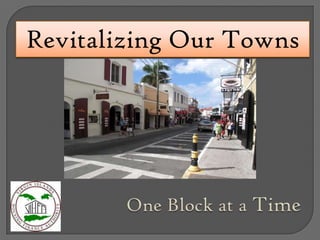
Revitalizing Our Towns
   A healthy and vibrant downtown
    are significant contributors to the
    economic health and quality of life
    in a community. Specifically, it
    creates jobs, fosters small
    business development, protects
    property values, and increases the
    community’s options for goods and
    services. A healthy downtown is a
    symbol of community pride and
    history.
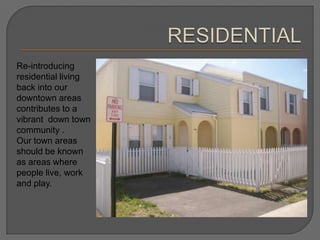
Re-introducing
residential living
back into our
downtown areas
contributes to a
vibrant down town
community .
Our town areas
should be known
as areas where
people live, work
and play.
 The  VIHFA has a Urban Renewal
  mandate, which is contemporarily referred
  to as community revitalization.
 Although community revitalization is a
  mandate, there is very limited funding
  available to carry it out.
   The U. S. Department of Housing & Urban
    Development (HUD) through the Community
    Development Block Grant provides annual grants
    to the Virgin Islands.

   The Community Development Block Grant (CDBG)
    is administered by the Virgin Islands Housing
    Finance Authority.

   CDBG makes available federal funds to non-profit
    and government agencies to address the housing,
    community and economic development needs and
    priorities of this Territory.
  20% is used for
  administrative
  purposes
 15% is used for
  public service
  projects
 The remaining
  funds are used
  for construction
  projects
To be funded, activities funded must meet one
  of the three national objectives:
• benefit to low- and moderate-income persons,
• aid in the prevention or elimination of slums
  and blight, or
• meet other community development needs
  having a particular urgency because existing
  conditions pose a serious and immediate
  threat to the health or welfare of the
  community.
•   Construction of public
    facilities and improvements,
    such as water systems,
    streets, and community
    centers;
•   Rehabilitation of houses and
    landmark structures;
    assistance to private, for
    profit entities to carry out
    economic development
    activities (including
    assistance to micro
    enterprises); and the
    provision of public services
    such as counseling, after-
    school, job training
    programs.
•   The CDBG Program solicits proposals
    annually to be considered for funding within
    the funding program years.
•   The Territory’s CDBG program receives
    approximately $1.8 million annually from HUD.
•   Applications are accepted from early January
    through mid-February of each year.
•   An Application must be completed.
•   The application describes what your project is
    all about and how much funds are needed .
 Non-Profit  Status
 Tax ID Number
 DUNS #
 Certificate of Good Standing
•   Public Hearing held in each district
•   Staff reviews application to make
    sure that the project meets one of
    the 3 National Objectives and
    funding recommendations are
    made to the Governor in the form of
    a Bill.
•   An Act is created based upon the
    information in the proposed Bill
    recommended by the Governor.
     By August 15th of each year, the
•   CDBG must submit the information
    on the projects to be funded to HUD
    in the Consolidated Plan.
•Public Service projects are expected to expend all
their funds within 12 months.

•Construction projects are expected to expend all
their funds with 18-24 months.
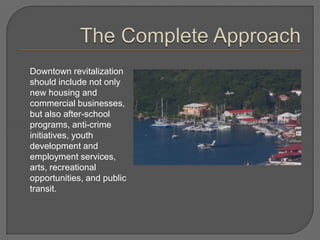
Downtown revitalization
should include not only
new housing and
commercial businesses,
but also after-school
programs, anti-crime
initiatives, youth
development and
employment services,
arts, recreational
opportunities, and public
transit.
AFFORDABLE HOUSING PROJECT TYPES

Projects initiated by Developers who seek endorsement of their
construction projects for the Affordable Housing Program as a
means to receive Affordable Housing Tax benefits.

Projects using construction end loan financing from the VIHFA,
and marketing assistance.

Projects using VIHFA's technical assistance in particular areas,
such as pre-qualifying and servicing loans for housing applicants
and providing access to the applicant master list.

Developers responding to VIHFA's solicitation for development
proposals.
DEVELOPER’S QUALIFICATIONS

In order to participate in any program of the Authority which has
as its objectives the construction of an affordable housing
development, a Developer must:

Be duly organized, validly existing, qualified and licensed to do
business under the laws of the Virgin Islands and shall be in good
standing in the Virgin Islands and shall have the power and
authority, corporate or otherwise, to own properties and carry on
business as is now being conducted.

Demonstrate specific, measurable housing construction
experience, expertise, and adequate staff capacity to undertake
the proposed development.
DEVELOPER’S QUALIFICATIONS

Be capable of proceeding promptly to construct and complete the
housing development or project.

Demonstrate to the satisfaction of the Authority, the availability of
sufficient financial resources to obtain adequate construction
financing to complete the construction of the proposed
development or project.
DEVELOPER'S SUBMITTAL OF PROJECT DOCUMENTS

Site plan; showing buildings, walkways, onsite parking, utility
connections, and drainage flow - away from foundations, to street
or proper drainage way.

Typical dwelling unit plans, properly detailed and prepared for
submittal to DPNR for permits. Including, a representative cross
section of site, showing location of building and site terrain -
elevations, depicted at a maximum of 5ft elevations, 2 ft is
preferred.

Projected construction schedule, displaying milestone stages of
construction as well as details of trade work durations.
DESIGN AND CONSTRUCTION STANDARDS

The project must conform to all applicable codes of the Virgin
Islands and the Federal Government .These will include, but not
be limited, to general construction, environmental concerns,
historic preservation, land use and zoning.

Each single family home must a certain minimum square footage
of space and amenities for proper functioning of a home while the
overall design is to be reviewed to minimize detrimental social or
physical impact on the surrounding community. The quality of
materials provided will be reviewed to insure that no excessive
maintenance costs will be borne by the home - buyer and life
cycle cost is lowered.
REQUIREMENTS FOR CLOSING COMPLETE UNITS

Certified As-Built Drawings

As-built plot surveys

Water test for cisterns

Water Supply and Disposal inspection Report

Certificate of Occupancy

Termite inspections certificate
BUILDING DESIGN GUIDELINES

Building design should provide for an attractive living facility
and environment suited to the social economic and
recreational needs of resident families and individuals. It
should provide for ease of circulation and housekeeping,
visual and auditory privacy, appropriate light and ventilation,
fire and accident protection, economy in maintenance and
use of space, accessory services, energy efficiency, and
sanitation facilities.
Allowable Housing Types:

 Single Family Detached

 Duplex Townhomes

 Row Houses

 Condominiums
ACCEPTABLE BUILDING SYSTEMS

•Reinforced concrete block throughout
•Reinforced concrete block with frame interior.
•Reinforced concrete with concrete block or frame interior
•Reinforced concrete utilizing insulated concrete forms,
(ICF’s) with concrete block or frame interior
•Steel frame with masonry exterior
•Steel frame with lath and plaster exterior or other
acceptable composite material

Other building systems must be submitted to the VIHFA for
review and approval
SPECIFIC REQUIREMENTS OF THE DEVELOPER

   During construction there will be meetings or conferences as
needed for proper controls and administration of the project,
which may include weekly meetings.

Before final inspections units shall be mopped clean, glass
washed, windows' moving parts cleaned from dirt/dust, and
lubricated as needed to be in good working order, water and
electricity turned on, and area landscaped. This shall be repeated
if necessary, upon final punch listed work is accepted.

Contractor shall keep one set of reproducible drawings marked
daily with as-built conditions. At closing, VIHFA shall be provided
with Mylar reproducible including as- built conditions.
SPECIFIC REQUIREMENTS OF THE VIHFA

The Authority's role in construction Administration will be one of
providing input into project development in the initial stages to
influence cost, design, quality and timely development of the
project. These are essential ingredients that determine the
success of failure of a development project.

The Authority has a vital role in ensuring that the projects are
finished on a timely basis.

Each project must start with the greatest understanding of all
aspects of the project. VIHFA can perform a valuable service in
aiding the Developer with project scheduling, weekly and monthly
reporting, establishing systems for accurate Documentation.
These are all elements that if handled professionally can save
time and money for the developer.

Revitalization cdbg block grant aug2012

  • 1.
  • 2.
     A healthy and vibrant downtown are significant contributors to the economic health and quality of life in a community. Specifically, it creates jobs, fosters small business development, protects property values, and increases the community’s options for goods and services. A healthy downtown is a symbol of community pride and history.
  • 3.
    Re-introducing residential living back intoour downtown areas contributes to a vibrant down town community . Our town areas should be known as areas where people live, work and play.
  • 4.
     The VIHFA has a Urban Renewal mandate, which is contemporarily referred to as community revitalization.  Although community revitalization is a mandate, there is very limited funding available to carry it out.
  • 5.
     The U. S. Department of Housing & Urban Development (HUD) through the Community Development Block Grant provides annual grants to the Virgin Islands.  The Community Development Block Grant (CDBG) is administered by the Virgin Islands Housing Finance Authority.  CDBG makes available federal funds to non-profit and government agencies to address the housing, community and economic development needs and priorities of this Territory.
  • 6.
     20%is used for administrative purposes  15% is used for public service projects  The remaining funds are used for construction projects
  • 7.
    To be funded,activities funded must meet one of the three national objectives: • benefit to low- and moderate-income persons, • aid in the prevention or elimination of slums and blight, or • meet other community development needs having a particular urgency because existing conditions pose a serious and immediate threat to the health or welfare of the community.
  • 8.
    • Construction of public facilities and improvements, such as water systems, streets, and community centers; • Rehabilitation of houses and landmark structures; assistance to private, for profit entities to carry out economic development activities (including assistance to micro enterprises); and the provision of public services such as counseling, after- school, job training programs.
  • 9.
    • The CDBG Program solicits proposals annually to be considered for funding within the funding program years. • The Territory’s CDBG program receives approximately $1.8 million annually from HUD. • Applications are accepted from early January through mid-February of each year. • An Application must be completed. • The application describes what your project is all about and how much funds are needed .
  • 10.
     Non-Profit Status  Tax ID Number  DUNS #  Certificate of Good Standing
  • 11.
    • Public Hearing held in each district • Staff reviews application to make sure that the project meets one of the 3 National Objectives and funding recommendations are made to the Governor in the form of a Bill. • An Act is created based upon the information in the proposed Bill recommended by the Governor. By August 15th of each year, the • CDBG must submit the information on the projects to be funded to HUD in the Consolidated Plan.
  • 12.
    •Public Service projectsare expected to expend all their funds within 12 months. •Construction projects are expected to expend all their funds with 18-24 months.
  • 13.
    Downtown revitalization should includenot only new housing and commercial businesses, but also after-school programs, anti-crime initiatives, youth development and employment services, arts, recreational opportunities, and public transit.
  • 14.
    AFFORDABLE HOUSING PROJECTTYPES Projects initiated by Developers who seek endorsement of their construction projects for the Affordable Housing Program as a means to receive Affordable Housing Tax benefits. Projects using construction end loan financing from the VIHFA, and marketing assistance. Projects using VIHFA's technical assistance in particular areas, such as pre-qualifying and servicing loans for housing applicants and providing access to the applicant master list. Developers responding to VIHFA's solicitation for development proposals.
  • 15.
    DEVELOPER’S QUALIFICATIONS In orderto participate in any program of the Authority which has as its objectives the construction of an affordable housing development, a Developer must: Be duly organized, validly existing, qualified and licensed to do business under the laws of the Virgin Islands and shall be in good standing in the Virgin Islands and shall have the power and authority, corporate or otherwise, to own properties and carry on business as is now being conducted. Demonstrate specific, measurable housing construction experience, expertise, and adequate staff capacity to undertake the proposed development.
  • 16.
    DEVELOPER’S QUALIFICATIONS Be capableof proceeding promptly to construct and complete the housing development or project. Demonstrate to the satisfaction of the Authority, the availability of sufficient financial resources to obtain adequate construction financing to complete the construction of the proposed development or project.
  • 17.
    DEVELOPER'S SUBMITTAL OFPROJECT DOCUMENTS Site plan; showing buildings, walkways, onsite parking, utility connections, and drainage flow - away from foundations, to street or proper drainage way. Typical dwelling unit plans, properly detailed and prepared for submittal to DPNR for permits. Including, a representative cross section of site, showing location of building and site terrain - elevations, depicted at a maximum of 5ft elevations, 2 ft is preferred. Projected construction schedule, displaying milestone stages of construction as well as details of trade work durations.
  • 18.
    DESIGN AND CONSTRUCTIONSTANDARDS The project must conform to all applicable codes of the Virgin Islands and the Federal Government .These will include, but not be limited, to general construction, environmental concerns, historic preservation, land use and zoning. Each single family home must a certain minimum square footage of space and amenities for proper functioning of a home while the overall design is to be reviewed to minimize detrimental social or physical impact on the surrounding community. The quality of materials provided will be reviewed to insure that no excessive maintenance costs will be borne by the home - buyer and life cycle cost is lowered.
  • 19.
    REQUIREMENTS FOR CLOSINGCOMPLETE UNITS Certified As-Built Drawings As-built plot surveys Water test for cisterns Water Supply and Disposal inspection Report Certificate of Occupancy Termite inspections certificate
  • 20.
    BUILDING DESIGN GUIDELINES Buildingdesign should provide for an attractive living facility and environment suited to the social economic and recreational needs of resident families and individuals. It should provide for ease of circulation and housekeeping, visual and auditory privacy, appropriate light and ventilation, fire and accident protection, economy in maintenance and use of space, accessory services, energy efficiency, and sanitation facilities.
  • 21.
    Allowable Housing Types: Single Family Detached Duplex Townhomes Row Houses Condominiums
  • 22.
    ACCEPTABLE BUILDING SYSTEMS •Reinforcedconcrete block throughout •Reinforced concrete block with frame interior. •Reinforced concrete with concrete block or frame interior •Reinforced concrete utilizing insulated concrete forms, (ICF’s) with concrete block or frame interior •Steel frame with masonry exterior •Steel frame with lath and plaster exterior or other acceptable composite material Other building systems must be submitted to the VIHFA for review and approval
  • 23.
    SPECIFIC REQUIREMENTS OFTHE DEVELOPER During construction there will be meetings or conferences as needed for proper controls and administration of the project, which may include weekly meetings. Before final inspections units shall be mopped clean, glass washed, windows' moving parts cleaned from dirt/dust, and lubricated as needed to be in good working order, water and electricity turned on, and area landscaped. This shall be repeated if necessary, upon final punch listed work is accepted. Contractor shall keep one set of reproducible drawings marked daily with as-built conditions. At closing, VIHFA shall be provided with Mylar reproducible including as- built conditions.
  • 24.
    SPECIFIC REQUIREMENTS OFTHE VIHFA The Authority's role in construction Administration will be one of providing input into project development in the initial stages to influence cost, design, quality and timely development of the project. These are essential ingredients that determine the success of failure of a development project. The Authority has a vital role in ensuring that the projects are finished on a timely basis. Each project must start with the greatest understanding of all aspects of the project. VIHFA can perform a valuable service in aiding the Developer with project scheduling, weekly and monthly reporting, establishing systems for accurate Documentation. These are all elements that if handled professionally can save time and money for the developer.