Writing Development Centre
University Library
facebook.com/NUlibraries
@ncl_wdc
Dr Helen Webster, Dr Caroline Crow
On behalf of the Writing Development Centre
Robinson Library
Revision Strategies
For enquiries about workshops, please email wdc@ncl.ac.uk
Writing Development Centre
University Library
facebook.com/NUlibraries
@ncl_wdc
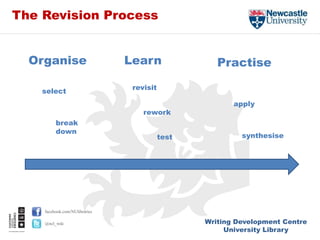
The Revision Process
select
break
down
Learn
revisit
test
Practise
apply
synthesise
Organise
rework
Writing Development Centre
University Library
facebook.com/NUlibraries
@ncl_wdc
What is the purpose of exams?
What do exams test that other forms
of assessment don’t?
Pair discussion: List three
things which can best be
tested by exams rather than
other forms of assessment
like coursework.
Writing Development Centre
University Library
facebook.com/NUlibraries
@ncl_wdc
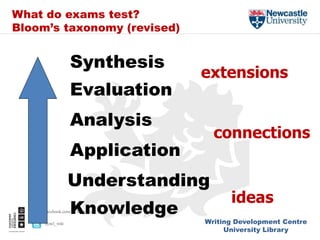
Knowledge
Understanding
Application
Analysis
Evaluation
Synthesis
ideas
connections
extensions
What do exams test?
Bloom’s taxonomy (revised)
Writing Development Centre
University Library
facebook.com/NUlibraries
@ncl_wdc
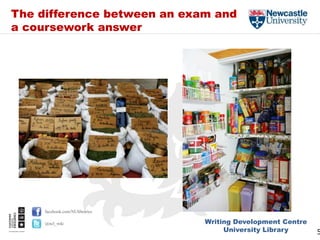
The difference between an exam and
a coursework answer
55
Writing Development Centre
University Library
facebook.com/NUlibraries
@ncl_wdc
Think about one of the modules
you’re revising for (and the exam
paper you brought).
If you were only allowed to take ten
core pieces of knowledge into the
exam, what would they be?
What should be in your store
cupboard?
Writing Development Centre
University Library
facebook.com/NUlibraries
@ncl_wdc
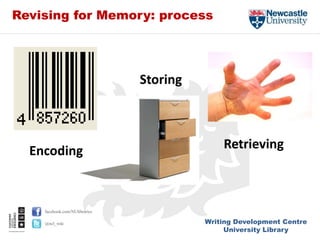
Revising for Memory: process
Storing
Encoding Retrieving
Writing Development Centre
University Library
facebook.com/NUlibraries
@ncl_wdc
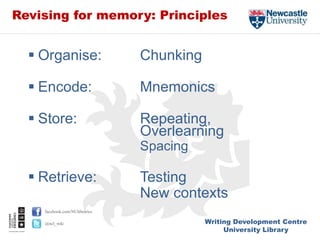
Revising for memory: Principles
 Organise: Chunking
 Encode: Mnemonics
 Store: Repeating,
Overlearning
Spacing
 Retrieve: Testing
New contexts
Writing Development Centre
University Library
facebook.com/NUlibraries
@ncl_wdc
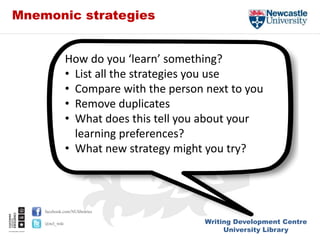
Mnemonic strategies
How do you ‘learn’ something?
• List all the strategies you use
• Compare with the person next to you
• Remove duplicates
• What does this tell you about your
learning preferences?
• What new strategy might you try?
Writing Development Centre
University Library
facebook.com/NUlibraries
@ncl_wdc
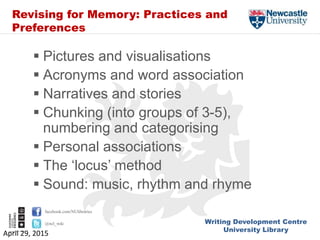
Revising for Memory: Practices and
Preferences
 Pictures and visualisations
 Acronyms and word association
 Narratives and stories
 Chunking (into groups of 3-5),
numbering and categorising
 Personal associations
 The ‘locus’ method
 Sound: music, rhythm and rhyme
April 29, 2015
Writing Development Centre
University Library
facebook.com/NUlibraries
@ncl_wdc
Different Materials
April 29, 2015
Writing Development Centre
University Library
facebook.com/NUlibraries
@ncl_wdc
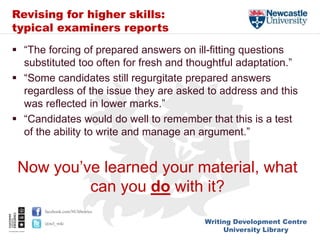
Revising for higher skills:
typical examiners reports
 “The forcing of prepared answers on ill-fitting questions
substituted too often for fresh and thoughtful adaptation.”
 “Some candidates still regurgitate prepared answers
regardless of the issue they are asked to address and this
was reflected in lower marks.”
 “Candidates would do well to remember that this is a test
of the ability to write and manage an argument.”
Now you’ve learned your material, what
can you do with it?
Writing Development Centre
University Library
facebook.com/NUlibraries
@ncl_wdc
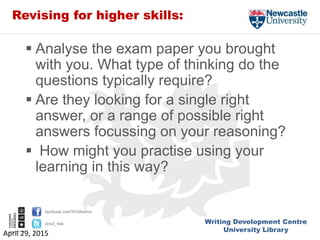
Revising for higher skills:
 Analyse the exam paper you brought
with you. What type of thinking do the
questions typically require?
 Are they looking for a single right
answer, or a range of possible right
answers focussing on your reasoning?
 How might you practise using your
learning in this way?
April 29, 2015
Writing Development Centre
University Library
facebook.com/NUlibraries
@ncl_wdc
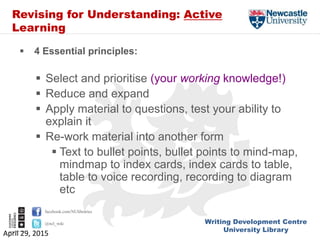
Revising for Understanding: Active
Learning
 4 Essential principles:
 Select and prioritise (your working knowledge!)
 Reduce and expand
 Apply material to questions, test your ability to
explain it
 Re-work material into another form
 Text to bullet points, bullet points to mind-map,
mindmap to index cards, index cards to table,
table to voice recording, recording to diagram
etc
April 29, 2015
Writing Development Centre
University Library
facebook.com/NUlibraries
@ncl_wdc
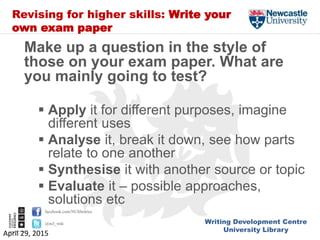
Revising for higher skills: Write your
own exam paper
Make up a question in the style of
those on your exam paper. What are
you mainly going to test?
 Apply it for different purposes, imagine
different uses
 Analyse it, break it down, see how parts
relate to one another
 Synthesise it with another source or topic
 Evaluate it – possible approaches,
solutions etc
April 29, 2015
Writing Development Centre
University Library
facebook.com/NUlibraries
@ncl_wdc
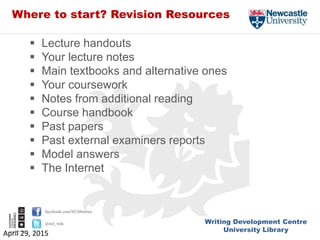
Where to start? Revision Resources
 Lecture handouts
 Your lecture notes
 Main textbooks and alternative ones
 Your coursework
 Notes from additional reading
 Course handbook
 Past papers
 Past external examiners reports
 Model answers
 The Internet
April 29, 2015
Writing Development Centre
University Library
facebook.com/NUlibraries
@ncl_wdc
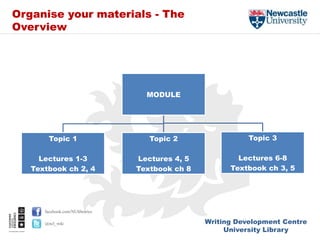
Organise your materials - The
Overview
MODULE
Topic 1
Lectures 1-3
Textbook ch 2, 4
Topic 2
Lectures 4, 5
Textbook ch 8
Topic 3
Lectures 6-8
Textbook ch 3, 5
Writing Development Centre
University Library
facebook.com/NUlibraries
@ncl_wdc
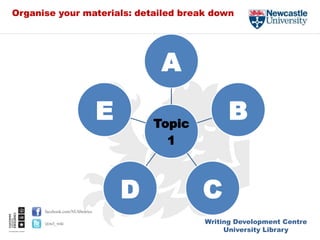
Organise your materials: detailed break down
Topic
1
A
B
CD
E
Writing Development Centre
University Library
facebook.com/NUlibraries
@ncl_wdc
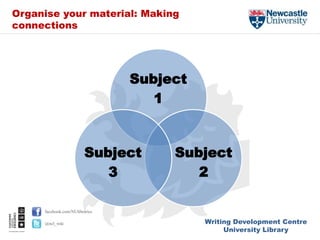
Organise your material: Making
connections
Subject
1
Subject
2
Subject
3
Writing Development Centre
University Library
facebook.com/NUlibraries
@ncl_wdc
Realistic Time management
 Keep working sessions short – take frequent
breaks
 Do not aim to work excessive hours per day, or
much out of your usual routine
 Change topic frequently and revisit topics
regularly
 Get an early night before an exam!
April 29, 2015
Writing Development Centre
University Library
facebook.com/NUlibraries
@ncl_wdc
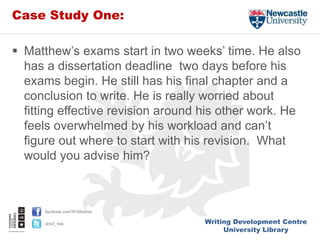
Case Study One:
 Matthew’s exams start in two weeks’ time. He also
has a dissertation deadline two days before his
exams begin. He still has his final chapter and a
conclusion to write. He is really worried about
fitting effective revision around his other work. He
feels overwhelmed by his workload and can’t
figure out where to start with his revision. What
would you advise him?
Writing Development Centre
University Library
facebook.com/NUlibraries
@ncl_wdc
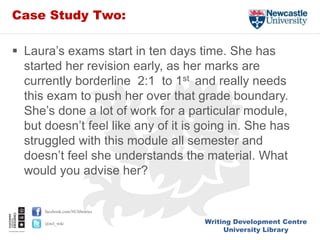
Case Study Two:
 Laura’s exams start in ten days time. She has
started her revision early, as her marks are
currently borderline 2:1 to 1st and really needs
this exam to push her over that grade boundary.
She’s done a lot of work for a particular module,
but doesn’t feel like any of it is going in. She has
struggled with this module all semester and
doesn’t feel she understands the material. What
would you advise her?
Writing Development Centre
University Library
facebook.com/NUlibraries
@ncl_wdc
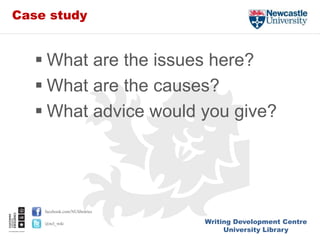
Case study
 What are the issues here?
 What are the causes?
 What advice would you give?
Writing Development Centre
University Library
facebook.com/NUlibraries
@ncl_wdc
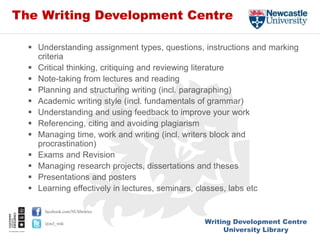
The Writing Development Centre
 Understanding assignment types, questions, instructions and marking
criteria
 Critical thinking, critiquing and reviewing literature
 Note-taking from lectures and reading
 Planning and structuring writing (incl. paragraphing)
 Academic writing style (incl. fundamentals of grammar)
 Understanding and using feedback to improve your work
 Referencing, citing and avoiding plagiarism
 Managing time, work and writing (incl. writers block and
procrastination)
 Exams and Revision
 Managing research projects, dissertations and theses
 Presentations and posters
 Learning effectively in lectures, seminars, classes, labs etc
Writing Development Centre
University Library
facebook.com/NUlibraries
@ncl_wdc
The Writing Development Centre
Level 2, Robinson Library
Our team offers:
- One-to-one tutorials on study
skills and all stages and types of
academic writing
- A programme of workshops on aspects
of study and academic writing
- Online resources
You can book appointments and workshops with us
online: http://www.ncl.ac.uk/students/wdc/

Revision strategies

  • 1.
    Writing Development Centre UniversityLibrary facebook.com/NUlibraries @ncl_wdc Dr Helen Webster, Dr Caroline Crow On behalf of the Writing Development Centre Robinson Library Revision Strategies For enquiries about workshops, please email wdc@ncl.ac.uk
  • 2.
    Writing Development Centre UniversityLibrary facebook.com/NUlibraries @ncl_wdc The Revision Process select break down Learn revisit test Practise apply synthesise Organise rework
  • 3.
    Writing Development Centre UniversityLibrary facebook.com/NUlibraries @ncl_wdc What is the purpose of exams? What do exams test that other forms of assessment don’t? Pair discussion: List three things which can best be tested by exams rather than other forms of assessment like coursework.
  • 4.
    Writing Development Centre UniversityLibrary facebook.com/NUlibraries @ncl_wdc Knowledge Understanding Application Analysis Evaluation Synthesis ideas connections extensions What do exams test? Bloom’s taxonomy (revised)
  • 5.
    Writing Development Centre UniversityLibrary facebook.com/NUlibraries @ncl_wdc The difference between an exam and a coursework answer 55
  • 6.
    Writing Development Centre UniversityLibrary facebook.com/NUlibraries @ncl_wdc Think about one of the modules you’re revising for (and the exam paper you brought). If you were only allowed to take ten core pieces of knowledge into the exam, what would they be? What should be in your store cupboard?
  • 7.
    Writing Development Centre UniversityLibrary facebook.com/NUlibraries @ncl_wdc Revising for Memory: process Storing Encoding Retrieving
  • 8.
    Writing Development Centre UniversityLibrary facebook.com/NUlibraries @ncl_wdc Revising for memory: Principles  Organise: Chunking  Encode: Mnemonics  Store: Repeating, Overlearning Spacing  Retrieve: Testing New contexts
  • 9.
    Writing Development Centre UniversityLibrary facebook.com/NUlibraries @ncl_wdc Mnemonic strategies How do you ‘learn’ something? • List all the strategies you use • Compare with the person next to you • Remove duplicates • What does this tell you about your learning preferences? • What new strategy might you try?
  • 10.
    Writing Development Centre UniversityLibrary facebook.com/NUlibraries @ncl_wdc Revising for Memory: Practices and Preferences  Pictures and visualisations  Acronyms and word association  Narratives and stories  Chunking (into groups of 3-5), numbering and categorising  Personal associations  The ‘locus’ method  Sound: music, rhythm and rhyme April 29, 2015
  • 11.
    Writing Development Centre UniversityLibrary facebook.com/NUlibraries @ncl_wdc Different Materials April 29, 2015
  • 12.
    Writing Development Centre UniversityLibrary facebook.com/NUlibraries @ncl_wdc Revising for higher skills: typical examiners reports  “The forcing of prepared answers on ill-fitting questions substituted too often for fresh and thoughtful adaptation.”  “Some candidates still regurgitate prepared answers regardless of the issue they are asked to address and this was reflected in lower marks.”  “Candidates would do well to remember that this is a test of the ability to write and manage an argument.” Now you’ve learned your material, what can you do with it?
  • 13.
    Writing Development Centre UniversityLibrary facebook.com/NUlibraries @ncl_wdc Revising for higher skills:  Analyse the exam paper you brought with you. What type of thinking do the questions typically require?  Are they looking for a single right answer, or a range of possible right answers focussing on your reasoning?  How might you practise using your learning in this way? April 29, 2015
  • 14.
    Writing Development Centre UniversityLibrary facebook.com/NUlibraries @ncl_wdc Revising for Understanding: Active Learning  4 Essential principles:  Select and prioritise (your working knowledge!)  Reduce and expand  Apply material to questions, test your ability to explain it  Re-work material into another form  Text to bullet points, bullet points to mind-map, mindmap to index cards, index cards to table, table to voice recording, recording to diagram etc April 29, 2015
  • 15.
    Writing Development Centre UniversityLibrary facebook.com/NUlibraries @ncl_wdc Revising for higher skills: Write your own exam paper Make up a question in the style of those on your exam paper. What are you mainly going to test?  Apply it for different purposes, imagine different uses  Analyse it, break it down, see how parts relate to one another  Synthesise it with another source or topic  Evaluate it – possible approaches, solutions etc April 29, 2015
  • 16.
    Writing Development Centre UniversityLibrary facebook.com/NUlibraries @ncl_wdc Where to start? Revision Resources  Lecture handouts  Your lecture notes  Main textbooks and alternative ones  Your coursework  Notes from additional reading  Course handbook  Past papers  Past external examiners reports  Model answers  The Internet April 29, 2015
  • 17.
    Writing Development Centre UniversityLibrary facebook.com/NUlibraries @ncl_wdc Organise your materials - The Overview MODULE Topic 1 Lectures 1-3 Textbook ch 2, 4 Topic 2 Lectures 4, 5 Textbook ch 8 Topic 3 Lectures 6-8 Textbook ch 3, 5
  • 18.
    Writing Development Centre UniversityLibrary facebook.com/NUlibraries @ncl_wdc Organise your materials: detailed break down Topic 1 A B CD E
  • 19.
    Writing Development Centre UniversityLibrary facebook.com/NUlibraries @ncl_wdc Organise your material: Making connections Subject 1 Subject 2 Subject 3
  • 20.
    Writing Development Centre UniversityLibrary facebook.com/NUlibraries @ncl_wdc Realistic Time management  Keep working sessions short – take frequent breaks  Do not aim to work excessive hours per day, or much out of your usual routine  Change topic frequently and revisit topics regularly  Get an early night before an exam! April 29, 2015
  • 21.
    Writing Development Centre UniversityLibrary facebook.com/NUlibraries @ncl_wdc Case Study One:  Matthew’s exams start in two weeks’ time. He also has a dissertation deadline two days before his exams begin. He still has his final chapter and a conclusion to write. He is really worried about fitting effective revision around his other work. He feels overwhelmed by his workload and can’t figure out where to start with his revision. What would you advise him?
  • 22.
    Writing Development Centre UniversityLibrary facebook.com/NUlibraries @ncl_wdc Case Study Two:  Laura’s exams start in ten days time. She has started her revision early, as her marks are currently borderline 2:1 to 1st and really needs this exam to push her over that grade boundary. She’s done a lot of work for a particular module, but doesn’t feel like any of it is going in. She has struggled with this module all semester and doesn’t feel she understands the material. What would you advise her?
  • 23.
    Writing Development Centre UniversityLibrary facebook.com/NUlibraries @ncl_wdc Case study  What are the issues here?  What are the causes?  What advice would you give?
  • 24.
    Writing Development Centre UniversityLibrary facebook.com/NUlibraries @ncl_wdc The Writing Development Centre  Understanding assignment types, questions, instructions and marking criteria  Critical thinking, critiquing and reviewing literature  Note-taking from lectures and reading  Planning and structuring writing (incl. paragraphing)  Academic writing style (incl. fundamentals of grammar)  Understanding and using feedback to improve your work  Referencing, citing and avoiding plagiarism  Managing time, work and writing (incl. writers block and procrastination)  Exams and Revision  Managing research projects, dissertations and theses  Presentations and posters  Learning effectively in lectures, seminars, classes, labs etc
  • 25.
    Writing Development Centre UniversityLibrary facebook.com/NUlibraries @ncl_wdc The Writing Development Centre Level 2, Robinson Library Our team offers: - One-to-one tutorials on study skills and all stages and types of academic writing - A programme of workshops on aspects of study and academic writing - Online resources You can book appointments and workshops with us online: http://www.ncl.ac.uk/students/wdc/

Editor's Notes

  • #4 Buzz activity: pairs and feed back Note also hidden curriculum issues and pragmatic issues around academic misconduct prevention.
  • #5 4
  • #7 Criteria – things which will be central, and which you could put to answer various different questions or which might be relevant across several topics, even across modules
  • #11 10
  • #12 Different formats suit different people, but don’t overuse any of them and mix up strategies
  • #15 14
  • #17 16
  • #18 17
  • #19 18
  • #20 19
  • #21 20