MULTIPLE CHOICE QUESTIONS ON SCHOOL
IMPROVEMENT PLAN (SIP)
*Phase 1 - Assess
*Phase 2 - Plan
*Phase 3 - Act
June, 2022
DR. GRANT B. GUBATAN
2017 Principal’s Test Topnotcher
10th Placer, Licensure Examination for Teachers
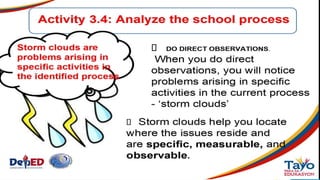
Cum Laude
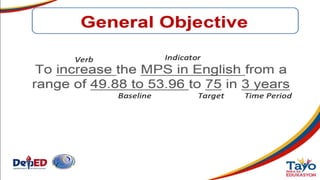
1. What is the INDICATOR in the objective: “To increase the
MPS in Science from a range of 48.89 to 53.69 to 75 in 3
years?”
A. 75
B. 3 years
C. 48.89 to 53.69
D. MPS in Science
ANSWER:
1. D. MPS in Science
2. Which of the following must be considered in organizing
project teams?
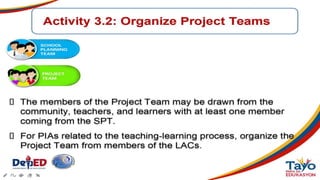
1. For Priority Improvement Areas related to the teaching-
learning process, organize the Project Team from members
of the Learning Action Cells.
2. The members of the Project Team may be drawn from
the community, teachers, and learners with at least one
member coming from the School Governing Council.
A. Statement 1 alone is sufficient to answer the question but
Statement 2 alone is not sufficient to answer the question.
B. Statement 2 alone is sufficient to answer the question but
Statement 1 alone is not sufficient to answer the question.
C. Both Statements 1 and 2 are sufficient to answer the
question.
D. Statements 1 and 2 are not sufficient to answer the
question and additional data is needed.
E. Each statement alone is sufficient to answer the question
ANSWER:
2. A. Statement 1 alone is sufficient but statement 2 alone is
not sufficient to answer the question.
3. The Project Team talks to the learners and stakeholders
who are relevant to the assigned PIA. What step under
Analyzing the PIAs is the team doing?
A. Do root cause analysis
B. Analyze the school process
C. Present the root cause to the SPT
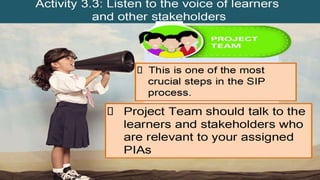
D. Listen to the voice of the learners and other stakeholders
ANSWER:
3. D. Listen to the voice of the learners and other
stakeholders
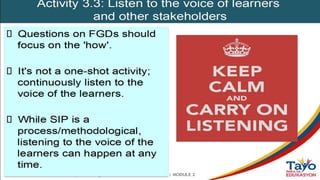
4. Which is/are true in listening to the voice of learners and
other stakeholders?
i. Home visits might be necessary.
ii. It's not a one-shot activity; continuously listen to the voice
of the learners.
iii. Questions on Focus Group Discussions (FGDs) should
focus on the 'what'.
iv. While SIP is a process/methodological, listening to the
voice of the learners can happen at any time.
v. This step is a good opportunity to ask the learners or
stakeholders on how they were helped by your school
vi. ‘Listening’ can be done through one-on-one or
dyads/triads interviews, surveys, or FGD with learners,
parents, and other stakeholders.
A. i, iii and vi only
B. ii, iv, v and vi only
C. i, ii, iv, v and vi only
D. i, ii, iii, iv, v and vi
ANSWER:
4. C. i, ii, iv, v and vi only
5. Why is listening to the voice of the learners and other
stakeholders should not be skipped in the 2nd and 3rd
years of SIP cycle?
1. Because the context, needs, and views of learners and
stakeholders might have changed
2. Because it can be done through one-on-one or
dyads/triads interviews, surveys, or FGD with learners,
parents and other stakeholders
A. Statement 1 alone is sufficient but statement 2 alone is
not sufficient to answer the question.
B. Statement 2 alone is sufficient but statement 1 alone is
not sufficient to answer the question.
C. Both statements 1 and 2 are sufficient to answer the
question.
D. Each statement alone is sufficient to answer the
question.
ANSWER:
5. A. Statement 1 alone is sufficient but statement 2 alone is

not sufficient to answer the question.
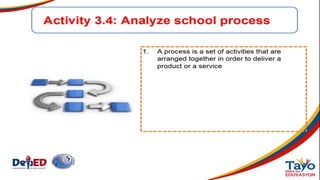
6. It is a set of activities that are arranged together in order
to deliver a product or a service.
A. Process
B. Storm Clouds
C. Root Cause Analyses
D. Priority Improvement Areas
ANSWER:
6. A. Process
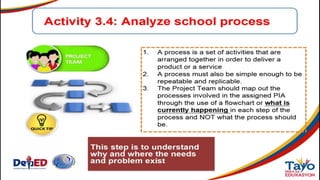
7. Which is/are true in analyzing school process?
i. A process must also be simple enough to be repeatable
and replicable.
ii. This step is to understand why and where the needs and
problem exist.
iii. The Project Team should map out the processes involved
in the assigned PIA through the use of a flowchart or what is
currently happening in each step of the process and NOT
what the process should be.
A. i and ii only
B. i and iii only
C. ii and iii only
D. i, ii and iii
ANSWER:
7. D. i, ii and iii
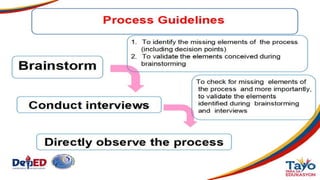
8. How can the school process be analyzed?
i. Conducting interviews
ii. Doing brainstorm sessions
iii.Directly observing the process
A. i and ii only
B. i and iii only
C. ii and iii only
D. i, ii and iii
ANSWER:
8. D. i, ii and iii
9. These are problems arising in specific activities in the
identified process.
A. Root Causes
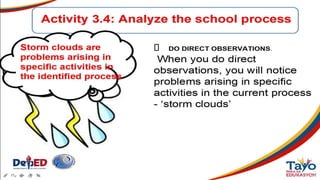
B. Storm Clouds
C. Root Cause Analyses
D. Priority Improvement Areas
ANSWER:
9. B. Storm Clouds
10. Why are storm clouds important?
1. They help locate where the issues reside.
2. They will be noticed by doing direct observations.
A. Statement 1 alone is sufficient but statement 2 alone is
not sufficient to answer the question.
B. Statement 2 alone is sufficient but statement 1 alone is
not sufficient to answer the question.
C. Both statements 1 and 2 are sufficient to answer the
question.
D. Each statement alone is sufficient to answer the
ANSWER:
10. A. Statement 1 alone is sufficient but statement 2 alone
is not sufficient to answer the question.
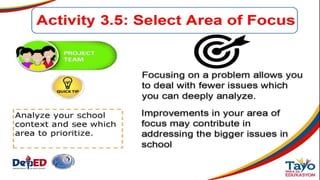
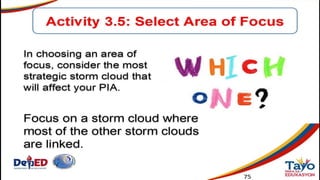
11. What must be considered in selecting area of focus in
analyzing the PIAs?
i. Focus on a storm cloud where most of the other storm
clouds are linked.
ii. Focusing on a problem allows you to deal with fewer
issues which you can deeply analyze.
iii. Improvements in your area of focus may contribute in
addressing the bigger issues in school.
iv. In choosing an area of focus, consider the most strategic
storm cloud that will affect your PIA.
A. i and iv only
B. ii and iii only
C. i, ii and iii only
D. i, ii, iii and iv
ANSWER:
11. D. i, ii, iii and iv
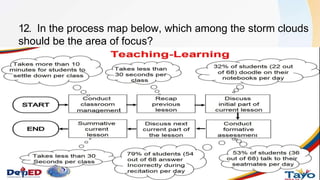
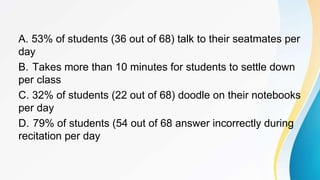
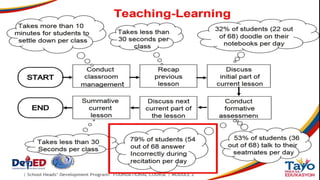
12. In the process map below, which among the storm clouds
should be the area of focus?
A. 53% of students (36 out of 68) talk to their seatmates per
day
B. Takes more than 10 minutes for students to settle down
per class
C. 32% of students (22 out of 68) doodle on their notebooks
per day
D. 79% of students (54 out of 68 answer incorrectly during
recitation per day
ANSWER:
12. D. 79% of students (54 out of 68 answer incorrectly
during recitation per day
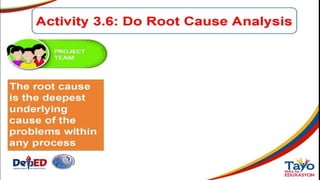
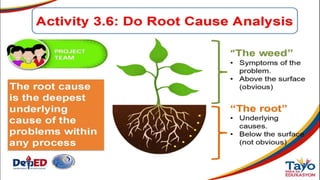
13. It is the deepest underlying cause of the problems within
any process.
A. Root Cause
B. Direct Cause
C. Indirect Cause
D. Root Cause Analysis
ANSWER:
13. A. Root Cause
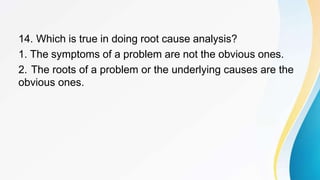
14. Which is true in doing root cause analysis?
1. The symptoms of a problem are not the obvious ones.
2. The roots of a problem or the underlying causes are the
obvious ones.
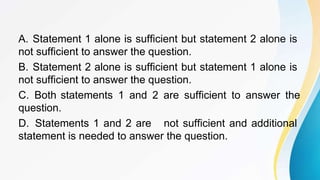
A. Statement 1 alone is sufficient but statement 2 alone is
not sufficient to answer the question.
B. Statement 2 alone is sufficient but statement 1 alone is
not sufficient to answer the question.
C. Both statements 1 and 2 are sufficient to answer the
question.
D. Statements 1 and 2 are not sufficient and additional
statement is needed to answer the question.
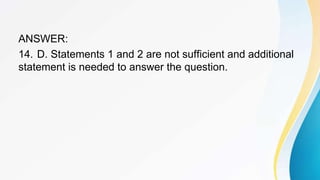
ANSWER:
14. D. Statements 1 and 2 are not sufficient and additional
statement is needed to answer the question.
15. Which is INCORRECT on the root cause?
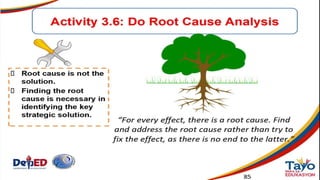
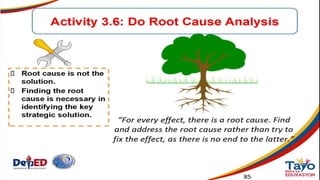
1. Root cause is the solution to the problem.
2. Finding the root cause is necessary in identifying the key
strategic solution.
A. Statement 1 alone is sufficient but statement 2 alone is
not sufficient to answer the question.
B. Statement 2 alone is sufficient but statement 1 alone is
not sufficient to answer the question.
C. Both statements 1 and 2 are sufficient to answer the
question.
D. Statements 1 and 2 are not sufficient and additional
statement is needed to answer the question.
ANSWER:
15. A. Statement 1 alone is sufficient but statement 2 alone
is not sufficient to answer the question.
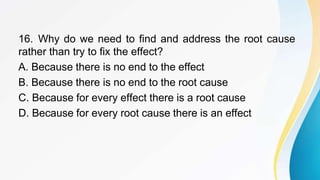
16. Why do we need to find and address the root cause
rather than try to fix the effect?
A. Because there is no end to the effect
B. Because there is no end to the root cause
C. Because for every effect there is a root cause
D. Because for every root cause there is an effect
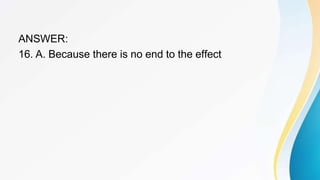
ANSWER:
16. A. Because there is no end to the effect
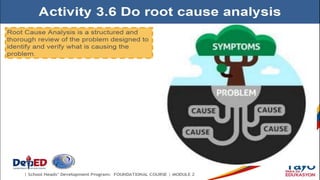
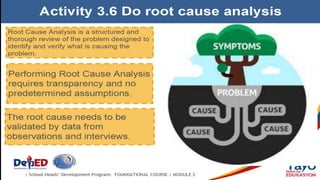
17. It is a structured and thorough review of the problem
designed to identify and verify what is causing the problem.
A. Root Cause
B. Direct Cause
C. Indirect Cause
D. Root Cause Analysis
ANSWER:
17. D. Root Cause Analysis
18. What is/are the thing/s to be considered in doing root
cause analysis?
1. The root cause needs to be validated by data from
observations and interviews.
2. Performing Root Cause Analysis requires transparency
and no predetermined assumptions.
A. Statement 1 alone is sufficient but statement 2 alone is
not sufficient to answer the question.
B. Statement 2 alone is sufficient but statement 1 alone is
not sufficient to answer the question.
C. Both statements 1 and 2 are sufficient to answer the
question.
D. Each statement alone is sufficient to answer the
question.
ANSWER:
18. D. Each statement alone is sufficient to answer the
question.
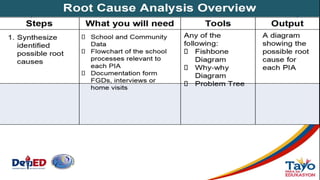
19. In analyzing the root cause, the first step is to
synthesize identified possible root causes. What is/are the
thing/s needed to do this step?
i. School and Community Data
ii. Documentation from FGDs, interviews or home visits
iii. Flowchart of the school processes relevant to each PIA
A. i only
B. i and ii only
C. ii and iii only
D. i, ii and iii
ANSWER:
19. D. i, ii and iii
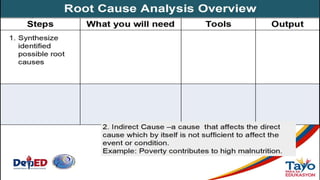
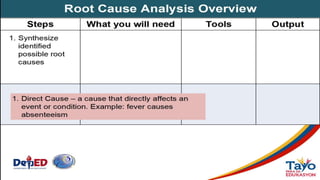
20. It is a cause that affects the direct cause which by itself
is not sufficient to affect the event or condition.
A. Root Cause
B. Direct Cause
C. Indirect Cause
D. Root Cause Analysis
ANSWER:
20. C. Indirect Cause
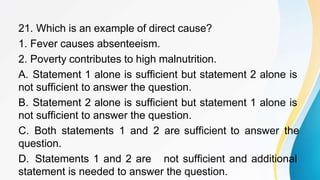
21. Which is an example of direct cause?
1. Fever causes absenteeism.
2. Poverty contributes to high malnutrition.
A. Statement 1 alone is sufficient but statement 2 alone is
not sufficient to answer the question.
B. Statement 2 alone is sufficient but statement 1 alone is
not sufficient to answer the question.
C. Both statements 1 and 2 are sufficient to answer the
question.
D. Statements 1 and 2 are not sufficient and additional
statement is needed to answer the question.
ANSWER:
21. A. Statement 1 alone is sufficient but statement 2 alone
is not sufficient to answer the question.
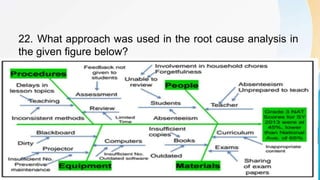
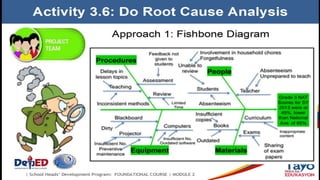
22. What approach was used in the root cause analysis in
the given figure below?
A. Problem Tree
B. Fishbone Diagram
C. Why-Why Diagram
D. Fault Tree Analysis
ANSWER:
22. B. Fishbone Diagram
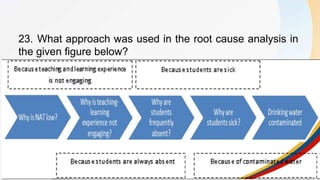
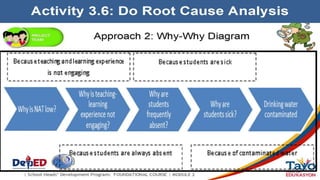
23. What approach was used in the root cause analysis in
the given figure below?
A. Problem Tree
B. Fishbone Diagram
C. Why-Why Diagram
D. Fault Tree Analysis
ANSWER:
23. C. Why-Why Diagram
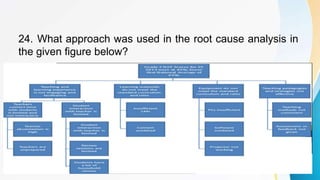
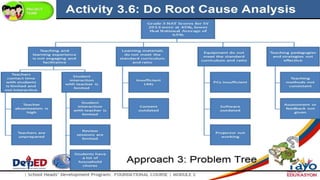
24. What approach was used in the root cause analysis in
the given figure below?
A. Problem Tree
B. Fishbone Diagram
C. Why-Why Diagram
D. Fault Tree Analysis
ANSWER:
24. A. Problem Tree
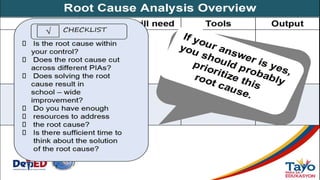
25. In root cause analysis, what must be considered in
prioritizing the root cause?
i. It is within the school’s control.
ii. It cuts across different PIAs.
iii. Solving it results in school-wide improvement.
iv. It can be addressed by having enough resources.
v. There is sufficient time to think about its solution.
A. iii and iv only
B. i, ii and iv only
C. i, ii, iv and v only
D. i, ii, iii, iv and v
ANSWER:
25. D. i, ii, iii, iv and v
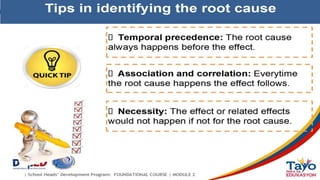
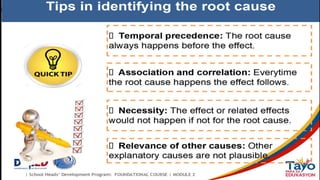
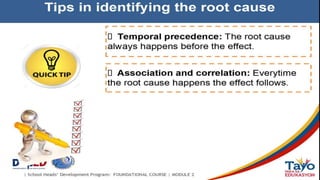
26. There are tips in identifying the root cause. One of these
is TEMPORAL PRECEDENCE which means
.
A. Other explanatory causes are not plausible.
B. The root cause always happens before the effect.
C. Every time the root cause happens the effect follows.
D. The effect or related effects would not happen if not for
the root cause.
ANSWER:
26. B. The root cause always happens before the effect.
27. What will happen if ASSOCIATION AND
CORRELATION was used in identifying the root cause?
A. Other explanatory causes are not plausible.
B. The root cause always happens before the effect.
C. Every time the root cause happens the effect follows.
D. The effect or related effects would not happen if not for
the root cause.
ANSWER:
27. C. Every time the root cause happens the effect follows.
28. In identifying the root cause, remember that the effect or
related effects would not happen if not for the root cause.
This is what we called
A. Necessity
B. Temporal precedence
C. Relevance of other causes
D. Association and Correlation
ANSWER:
28. A. Necessity
29. The Project Team considered that other explanatory
causes are not plausible in identifying the root cause. What
did the team consider?
A. Necessity
B. Temporal precedence
C. Relevance of other causes
D. Association and Correlation
ANSWER:
29. C. Relevance of other causes
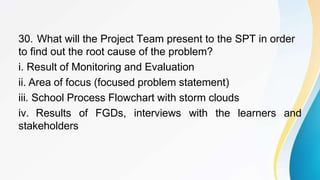
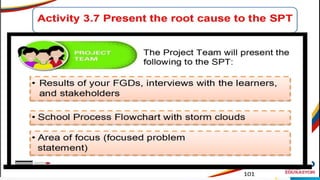
30. What will the Project Team present to the SPT in order
to find out the root cause of the problem?
i. Result of Monitoring and Evaluation
ii. Area of focus (focused problem statement)
iii. School Process Flowchart with storm clouds
iv. Results of FGDs, interviews with the learners and
stakeholders
A. i, ii and iii only
B. i, iii and iv only
C. ii, iii and iv only
D. i, ii, iii and iv
ANSWER:
30. C. ii, iii and iv only
`
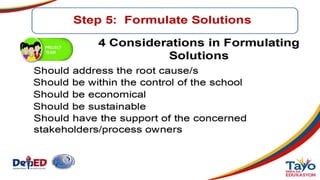
31. To formulate the solution is the 5th step under Phase II
(Plan). What are the considerations in doing this step?
i. Should be economical
ii. Should be sustainable
iii. Should address the root cause/s
iv. Should be within the control of the school
v. Should have the support of the concerned
stakeholders/process owners
A. i, ii, iii and iv only
B. i, ii, iii and v only
C. ii, iii , iv and v only
D. i, ii, iii, iv and v
ANSWER:
31. D. i, ii, iii, iv and v
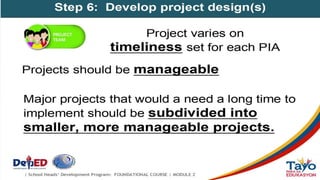
32. Developing project design is the 6th step under Phase II
(Plan) What must be considered in developing projects?
i. Projects should be manageable
ii. Project varies on timeliness set for each PIA
iii. Projects should be economical and sustainable
iv. Major projects that would need a long time to implement
should be subdivided into smaller, more manageable
projects.
A. i, ii and iii only
B. i, ii and iv only
C. i, iii and iv only
D. i, ii, iii and iv
ANSWER:
32. B. i, ii and iv only
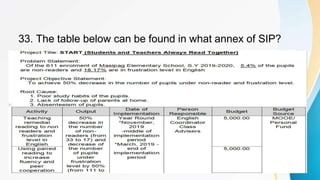
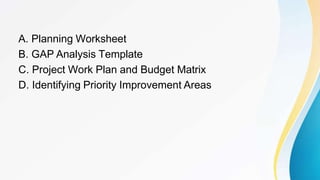
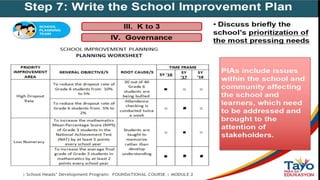
33. The table below can be found in what annex of SIP?
A. Planning Worksheet
B. GAP Analysis Template
C. Project Work Plan and Budget Matrix
D. Identifying Priority Improvement Areas
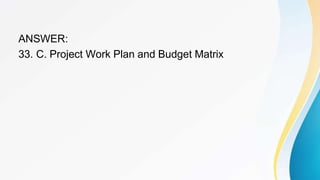
ANSWER:
33. C. Project Work Plan and Budget Matrix
34. The school developed Project START (Students and
Teachers Always Read Together) to address the problem on
low reading comprehension of the students. When will the
SPT monitor the project?
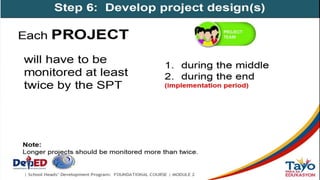
1. Four times, before the end of every grading period
2. Twice, during the middle and during the end of
implementation period
A. Statement 1 alone is sufficient but statement 2 alone is
not sufficient to answer the question.
B. Statement 2 alone is sufficient but statement 1 alone is
not sufficient to answer the question.
C. Both statements 1 and 2 are sufficient to answer the
question.
D. Each statement alone is sufficient to answer the
question.
ANSWER:
34. D. Each statement alone is sufficient to answer the
question.
35. The Principal is aware of the teaching and non-teaching
personnel’s contributions in planning and implementing the
SIP and AIP. How can their effort be rewarded?
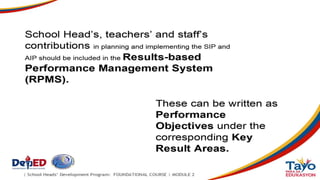
1. Include their contributions in the Results-Based
Performance Management System under a corresponding
objective in the Key Result Areas (KRAs).
2. Give an Outstanding Employee Award to them for their
contributions but not in the IPCRF because all of the KRA’s
objectives are already constant and could not be modified.
A. Statement 1 alone is sufficient but statement 2 alone is
not sufficient to answer the question.
B. Statement 2 alone is sufficient but statement 1 alone is
not sufficient to answer the question.
C. Both statements 1 and 2 are sufficient to answer the
question.
D. Each statement alone is sufficient to answer the
question.
ANSWER:
35. A. Statement 1 alone is sufficient but statement 2 alone
is not sufficient to answer the question.
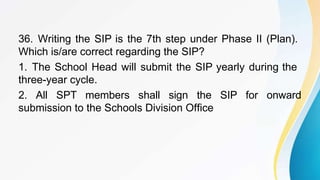
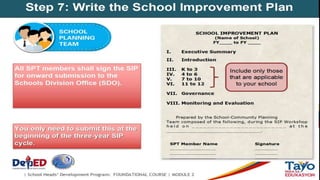
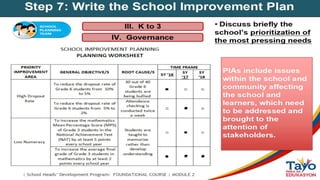
36. Writing the SIP is the 7th step under Phase II (Plan).
Which is/are correct regarding the SIP?
1. The School Head will submit the SIP yearly during the
three-year cycle.
2. All SPT members shall sign the SIP for onward
submission to the Schools Division Office
A. Statement 1 alone is sufficient but statement 2 alone is
not sufficient to answer the question.
B. Statement 2 alone is sufficient but statement 1 alone is
not sufficient to answer the question.
C. Both statements 1 and 2 are sufficient to answer the
question.
D. Statements 1 and 2 are not sufficient and additional
statement is needed to answer the question.
ANSWER:
36. B. Statement 2 alone is sufficient but statement 1 alone
is not sufficient to answer the question.
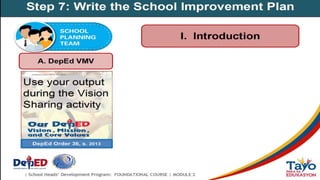
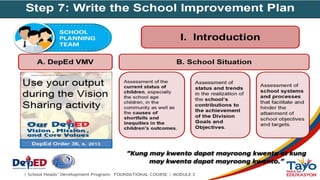
37. In writing the SIP Introduction, what should be included
under the DepEd Vision, Mission and Core Values (VMV)?
1. Assessment of the current status of children
2. The output during the Vision Sharing activity
A. Statement 1 alone is sufficient but statement 2 alone is
not sufficient to answer the question.
B. Statement 2 alone is sufficient but statement 1 alone is
not sufficient to answer the question.
C. Both statements 1 and 2 are sufficient to answer the
question.
D. Statements 1 and 2 are not sufficient and additional
statement is needed to answer the question.
ANSWER:
37. B. Statement 2 alone is sufficient but statement 1 alone
is not sufficient to answer the question.
38. In writing SIP Introduction, what should be included
under the School Situation?
1. Assessment of school systems and processes that
facilitate and hinder the attainment of school objectives and
targets
2. Assessment of status and trends in the realization of the
school’s contributions to the achievement of the Division
Goals and Objectives
A. Statement 1 alone is sufficient but statement 2 alone is
not sufficient to answer the question.
B. Statement 2 alone is sufficient but statement 1 alone is
not sufficient to answer the question.
C. Both statements 1 and 2 are sufficient to answer the
question.
D. Statements 1 and 2 are not sufficient and additional
statement is needed to answer the question.
ANSWER:
38. D. Statements 1 and 2 are not sufficient and additional
statement is needed to answer the question.
39. What is/are the possible root cause/s of high drop-out
rate?
1. Attendance checking is conducted once a week.
2. Forty out of fifty Grade 7 students are being bullied.
A. Statement 1 alone is sufficient but statement 2 alone is
not sufficient to answer the question.
B. Statement 2 alone is sufficient but statement 1 alone is
not sufficient to answer the question.
C. Both statements 1 and 2 are sufficient to answer the
question.
D. Each statement alone is sufficient to answer the
question.
ANSWER:
39. D. Each statement alone is sufficient to answer the
question.
40. What is/are the PIA/s if the general objective is “to
increase the average final grade of Grade 8 students in
Mathematics by at least 2 points every school year?
1. Low literacy
2. Low numeracy
A. Statement 1 alone is sufficient but statement 2 alone is
not sufficient to answer the question.
B. Statement 2 alone is sufficient but statement 1 alone is
not sufficient to answer the question.
C. Both statements 1 and 2 are sufficient to answer the
question.
D. Each statement alone is sufficient to answer the question
ANSWER:
40. B. Statement 2 alone is sufficient but statement 1 alone
is not sufficient to answer the question.
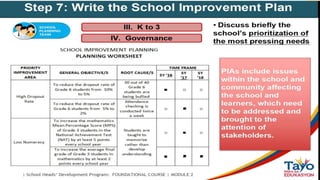
41. What is/are the possible general objective/s if the root
cause of the problem is “students are taught to memorize
rather than develop understanding?”
i. To reduce the drop-out rate of Grade 9 students from 9%
to 1% by the end of 3 years
ii. To increase the average final grade of Grade 8 students
in English by at least 1 point every school year
iii. To increase the Mathematics MPS of Grade 10 students
in the NAT by at least 3 points every school year.
A. ii only
B. iii only
C. i and ii only
D. ii and iii only
ANSWER:
41. D. ii and iii only
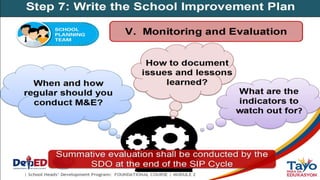
42. When is the summative evaluation conducted by the
SDO?
1. At the end of the SIP cycle
2. At the middle of the SIP cycle
A. Statement 1 alone is sufficient but statement 2 alone is
not sufficient to answer the question.
B. Statement 2 alone is sufficient but statement 1 alone is
not sufficient to answer the question.
C. Both statements 1 and 2 are sufficient to answer the
question.
D. Statements 1 and 2 are not sufficient and additional
statement is needed to answer the question.
ANSWER:
42. A. Statement 1 alone is sufficient but statement 2 alone
is not sufficient to answer the question.
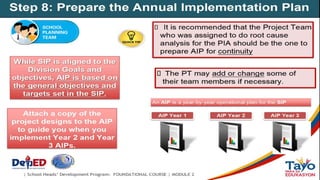
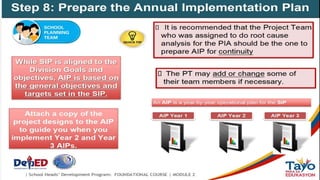
43. Preparing the AIP is the 8th step in Phase II (Plan).
What must be considered under this step?
i. The Project Team (PT) may add or change some of their
team members if necessary.
ii. It is recommended that the PT who was assigned to do
root cause analysis for the PIA should be the one to prepare
AIP for continuity
A. Statement 1 alone is sufficient but statement 2 alone is
not sufficient to answer the question.
B. Statement 2 alone is sufficient but statement 1 alone is
not sufficient to answer the question.
C. Both statements 1 and 2 are sufficient to answer the
question.
D. Each statement alone is sufficient to answer the
question.
ANSWER:
43. D. Each statement alone is sufficient to answer the
question.
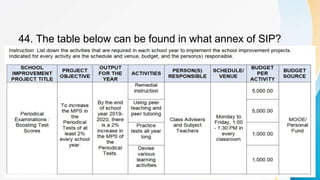
44. The table below can be found in what annex of SIP?
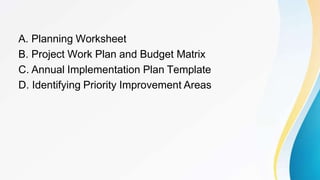
A. Planning Worksheet
B. Project Work Plan and Budget Matrix
C. Annual Implementation Plan Template
D. Identifying Priority Improvement Areas
ANSWER:
44. C. Annual Implementation Plan Template
45. Which is/are correct on the AIP?
i. It is a year-by-year operational plan for the SIP
ii. It is based on the general objectives and targets set in the
SIP
iii. It must be attached with a copy of project designs as
guide for the 2nd to 4th year of implementation
A. ii only
B. iii only
C. i and ii only
D. ii and iii only
ANSWER:
45. C. i and ii only
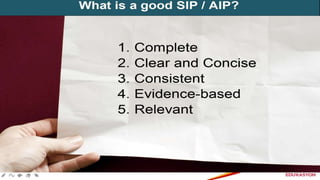
46. Which are the characteristics of a good SIP/AIP?
i. Specific
ii. Realistic
iii. Relevant
iv. Complete
v. Consistent
vi. Attainable
vii. Measurable
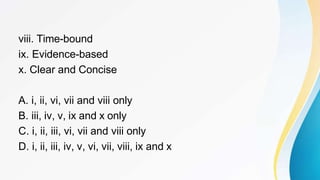
viii. Time-bound
ix. Evidence-based
x. Clear and Concise
A. i, ii, vi, vii and viii only
B. iii, iv, v, ix and x only
C. i, ii, iii, vi, vii and viii only
D. i, ii, iii, iv, v, vi, vii, viii, ix and x
ANSWER:
46. B. iii, iv, v, ix and x only
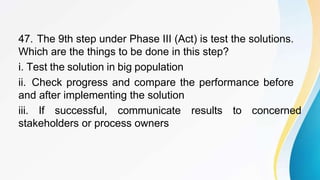
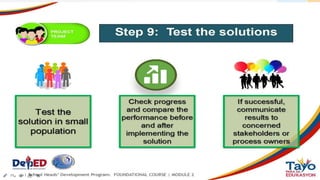
47. The 9th step under Phase III (Act) is test the solutions.
Which are the things to be done in this step?
i. Test the solution in big population
ii. Check progress and compare the performance before
and after implementing the solution
iii. If successful, communicate results to concerned
stakeholders or process owners
A. i and ii only
B. i and iii only
C. ii and iii only
D. i, ii and iii
ANSWER:
47. C. ii and iii only
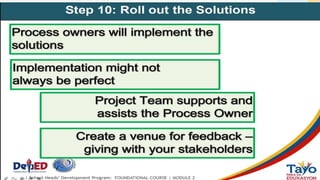
48. The 10th step under Phase III (Act) is roll out the
solutions. Which statements are correct in this step?
i. Implementation is always perfect
ii. Process owners will implement the solutions
iii. Project Team supports and assists the Process Owner
iv. Create a venue for feedback – giving with your
stakeholders
A. i and ii only
B. iii and iv only
C. ii, iii and iv only
D. i, ii, iii and iv
ANSWER:
48. C. ii, iii and iv only
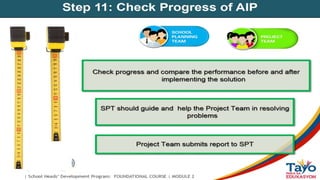
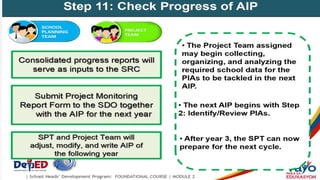
49. The 11th step under Phase III (Act) is check progress of
AIP. Which are the things to be done in this step?
i. Check progress and compare the performance before and
after implementing the solution
ii. SPT should guide and help the Project Team in resolving
problems
iii. Project Team submits report to SPT
A. i and ii only
B. i and iii only
C. ii and iii only
D. i, ii and iii
ANSWER:
49. D. i, ii and iii
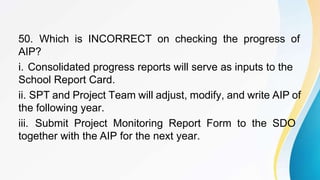
50. Which is INCORRECT on checking the progress of
AIP?
i. Consolidated progress reports will serve as inputs to the
School Report Card.
ii. SPT and Project Team will adjust, modify, and write AIP of
the following year.
iii. Submit Project Monitoring Report Form to the SDO
together with the AIP for the next year.
A. None
B. i
C. ii
D. iii
ANSWER:
50. A. None
Thank
You!!!

Review-Materials reviewer sample reviewer

  • 1.
    MULTIPLE CHOICE QUESTIONSON SCHOOL IMPROVEMENT PLAN (SIP) *Phase 1 - Assess *Phase 2 - Plan *Phase 3 - Act June, 2022 DR. GRANT B. GUBATAN 2017 Principal’s Test Topnotcher 10th Placer, Licensure Examination for Teachers Cum Laude
  • 2.
    1. What isthe INDICATOR in the objective: “To increase the MPS in Science from a range of 48.89 to 53.69 to 75 in 3 years?” A. 75 B. 3 years C. 48.89 to 53.69 D. MPS in Science
  • 3.
  • 5.
    2. Which ofthe following must be considered in organizing project teams? 1. For Priority Improvement Areas related to the teaching- learning process, organize the Project Team from members of the Learning Action Cells. 2. The members of the Project Team may be drawn from the community, teachers, and learners with at least one member coming from the School Governing Council.
  • 6.
    A. Statement 1alone is sufficient to answer the question but Statement 2 alone is not sufficient to answer the question. B. Statement 2 alone is sufficient to answer the question but Statement 1 alone is not sufficient to answer the question. C. Both Statements 1 and 2 are sufficient to answer the question. D. Statements 1 and 2 are not sufficient to answer the question and additional data is needed. E. Each statement alone is sufficient to answer the question
  • 7.
    ANSWER: 2. A. Statement1 alone is sufficient but statement 2 alone is not sufficient to answer the question.
  • 9.
    3. The ProjectTeam talks to the learners and stakeholders who are relevant to the assigned PIA. What step under Analyzing the PIAs is the team doing? A. Do root cause analysis B. Analyze the school process C. Present the root cause to the SPT D. Listen to the voice of the learners and other stakeholders
  • 10.
    ANSWER: 3. D. Listento the voice of the learners and other stakeholders
  • 12.
    4. Which is/aretrue in listening to the voice of learners and other stakeholders? i. Home visits might be necessary. ii. It's not a one-shot activity; continuously listen to the voice of the learners. iii. Questions on Focus Group Discussions (FGDs) should focus on the 'what'. iv. While SIP is a process/methodological, listening to the voice of the learners can happen at any time.
  • 13.
    v. This stepis a good opportunity to ask the learners or stakeholders on how they were helped by your school vi. ‘Listening’ can be done through one-on-one or dyads/triads interviews, surveys, or FGD with learners, parents, and other stakeholders. A. i, iii and vi only B. ii, iv, v and vi only C. i, ii, iv, v and vi only D. i, ii, iii, iv, v and vi
  • 14.
    ANSWER: 4. C. i,ii, iv, v and vi only
  • 17.
    5. Why islistening to the voice of the learners and other stakeholders should not be skipped in the 2nd and 3rd years of SIP cycle? 1. Because the context, needs, and views of learners and stakeholders might have changed 2. Because it can be done through one-on-one or dyads/triads interviews, surveys, or FGD with learners, parents and other stakeholders
  • 18.
    A. Statement 1alone is sufficient but statement 2 alone is not sufficient to answer the question. B. Statement 2 alone is sufficient but statement 1 alone is not sufficient to answer the question. C. Both statements 1 and 2 are sufficient to answer the question. D. Each statement alone is sufficient to answer the question.
  • 19.
    ANSWER: 5. A. Statement1 alone is sufficient but statement 2 alone is not sufficient to answer the question.
  • 21.
    6. It isa set of activities that are arranged together in order to deliver a product or a service. A. Process B. Storm Clouds C. Root Cause Analyses D. Priority Improvement Areas
  • 22.
  • 24.
    7. Which is/aretrue in analyzing school process? i. A process must also be simple enough to be repeatable and replicable. ii. This step is to understand why and where the needs and problem exist. iii. The Project Team should map out the processes involved in the assigned PIA through the use of a flowchart or what is currently happening in each step of the process and NOT what the process should be.
  • 25.
    A. i andii only B. i and iii only C. ii and iii only D. i, ii and iii
  • 26.
    ANSWER: 7. D. i,ii and iii
  • 28.
    8. How canthe school process be analyzed? i. Conducting interviews ii. Doing brainstorm sessions iii.Directly observing the process A. i and ii only B. i and iii only C. ii and iii only D. i, ii and iii
  • 29.
    ANSWER: 8. D. i,ii and iii
  • 31.
    9. These areproblems arising in specific activities in the identified process. A. Root Causes B. Storm Clouds C. Root Cause Analyses D. Priority Improvement Areas
  • 32.
  • 34.
    10. Why arestorm clouds important? 1. They help locate where the issues reside. 2. They will be noticed by doing direct observations. A. Statement 1 alone is sufficient but statement 2 alone is not sufficient to answer the question. B. Statement 2 alone is sufficient but statement 1 alone is not sufficient to answer the question. C. Both statements 1 and 2 are sufficient to answer the question. D. Each statement alone is sufficient to answer the
  • 35.
    ANSWER: 10. A. Statement1 alone is sufficient but statement 2 alone is not sufficient to answer the question.
  • 37.
    11. What mustbe considered in selecting area of focus in analyzing the PIAs? i. Focus on a storm cloud where most of the other storm clouds are linked. ii. Focusing on a problem allows you to deal with fewer issues which you can deeply analyze. iii. Improvements in your area of focus may contribute in addressing the bigger issues in school.
  • 38.
    iv. In choosingan area of focus, consider the most strategic storm cloud that will affect your PIA. A. i and iv only B. ii and iii only C. i, ii and iii only D. i, ii, iii and iv
  • 39.
    ANSWER: 11. D. i,ii, iii and iv
  • 42.
    12. In theprocess map below, which among the storm clouds should be the area of focus?
  • 43.
    A. 53% ofstudents (36 out of 68) talk to their seatmates per day B. Takes more than 10 minutes for students to settle down per class C. 32% of students (22 out of 68) doodle on their notebooks per day D. 79% of students (54 out of 68 answer incorrectly during recitation per day
  • 44.
    ANSWER: 12. D. 79%of students (54 out of 68 answer incorrectly during recitation per day
  • 46.
    13. It isthe deepest underlying cause of the problems within any process. A. Root Cause B. Direct Cause C. Indirect Cause D. Root Cause Analysis
  • 47.
  • 49.
    14. Which istrue in doing root cause analysis? 1. The symptoms of a problem are not the obvious ones. 2. The roots of a problem or the underlying causes are the obvious ones.
  • 50.
    A. Statement 1alone is sufficient but statement 2 alone is not sufficient to answer the question. B. Statement 2 alone is sufficient but statement 1 alone is not sufficient to answer the question. C. Both statements 1 and 2 are sufficient to answer the question. D. Statements 1 and 2 are not sufficient and additional statement is needed to answer the question.
  • 51.
    ANSWER: 14. D. Statements1 and 2 are not sufficient and additional statement is needed to answer the question.
  • 53.
    15. Which isINCORRECT on the root cause? 1. Root cause is the solution to the problem. 2. Finding the root cause is necessary in identifying the key strategic solution.
  • 54.
    A. Statement 1alone is sufficient but statement 2 alone is not sufficient to answer the question. B. Statement 2 alone is sufficient but statement 1 alone is not sufficient to answer the question. C. Both statements 1 and 2 are sufficient to answer the question. D. Statements 1 and 2 are not sufficient and additional statement is needed to answer the question.
  • 55.
    ANSWER: 15. A. Statement1 alone is sufficient but statement 2 alone is not sufficient to answer the question.
  • 57.
    16. Why dowe need to find and address the root cause rather than try to fix the effect? A. Because there is no end to the effect B. Because there is no end to the root cause C. Because for every effect there is a root cause D. Because for every root cause there is an effect
  • 58.
    ANSWER: 16. A. Becausethere is no end to the effect
  • 60.
    17. It isa structured and thorough review of the problem designed to identify and verify what is causing the problem. A. Root Cause B. Direct Cause C. Indirect Cause D. Root Cause Analysis
  • 61.
    ANSWER: 17. D. RootCause Analysis
  • 63.
    18. What is/arethe thing/s to be considered in doing root cause analysis? 1. The root cause needs to be validated by data from observations and interviews. 2. Performing Root Cause Analysis requires transparency and no predetermined assumptions.
  • 64.
    A. Statement 1alone is sufficient but statement 2 alone is not sufficient to answer the question. B. Statement 2 alone is sufficient but statement 1 alone is not sufficient to answer the question. C. Both statements 1 and 2 are sufficient to answer the question. D. Each statement alone is sufficient to answer the question.
  • 65.
    ANSWER: 18. D. Eachstatement alone is sufficient to answer the question.
  • 67.
    19. In analyzingthe root cause, the first step is to synthesize identified possible root causes. What is/are the thing/s needed to do this step? i. School and Community Data ii. Documentation from FGDs, interviews or home visits iii. Flowchart of the school processes relevant to each PIA A. i only B. i and ii only C. ii and iii only D. i, ii and iii
  • 68.
  • 70.
    20. It isa cause that affects the direct cause which by itself is not sufficient to affect the event or condition. A. Root Cause B. Direct Cause C. Indirect Cause D. Root Cause Analysis
  • 71.
  • 73.
    21. Which isan example of direct cause? 1. Fever causes absenteeism. 2. Poverty contributes to high malnutrition. A. Statement 1 alone is sufficient but statement 2 alone is not sufficient to answer the question. B. Statement 2 alone is sufficient but statement 1 alone is not sufficient to answer the question. C. Both statements 1 and 2 are sufficient to answer the question. D. Statements 1 and 2 are not sufficient and additional statement is needed to answer the question.
  • 74.
    ANSWER: 21. A. Statement1 alone is sufficient but statement 2 alone is not sufficient to answer the question.
  • 76.
    22. What approachwas used in the root cause analysis in the given figure below?
  • 77.
    A. Problem Tree B.Fishbone Diagram C. Why-Why Diagram D. Fault Tree Analysis
  • 78.
  • 80.
    23. What approachwas used in the root cause analysis in the given figure below?
  • 81.
    A. Problem Tree B.Fishbone Diagram C. Why-Why Diagram D. Fault Tree Analysis
  • 82.
  • 84.
    24. What approachwas used in the root cause analysis in the given figure below?
  • 85.
    A. Problem Tree B.Fishbone Diagram C. Why-Why Diagram D. Fault Tree Analysis
  • 86.
  • 88.
    25. In rootcause analysis, what must be considered in prioritizing the root cause? i. It is within the school’s control. ii. It cuts across different PIAs. iii. Solving it results in school-wide improvement. iv. It can be addressed by having enough resources. v. There is sufficient time to think about its solution. A. iii and iv only B. i, ii and iv only C. i, ii, iv and v only D. i, ii, iii, iv and v
  • 89.
    ANSWER: 25. D. i,ii, iii, iv and v
  • 91.
    26. There aretips in identifying the root cause. One of these is TEMPORAL PRECEDENCE which means . A. Other explanatory causes are not plausible. B. The root cause always happens before the effect. C. Every time the root cause happens the effect follows. D. The effect or related effects would not happen if not for the root cause.
  • 92.
    ANSWER: 26. B. Theroot cause always happens before the effect.
  • 94.
    27. What willhappen if ASSOCIATION AND CORRELATION was used in identifying the root cause? A. Other explanatory causes are not plausible. B. The root cause always happens before the effect. C. Every time the root cause happens the effect follows. D. The effect or related effects would not happen if not for the root cause.
  • 95.
    ANSWER: 27. C. Everytime the root cause happens the effect follows.
  • 97.
    28. In identifyingthe root cause, remember that the effect or related effects would not happen if not for the root cause. This is what we called A. Necessity B. Temporal precedence C. Relevance of other causes D. Association and Correlation
  • 98.
  • 100.
    29. The ProjectTeam considered that other explanatory causes are not plausible in identifying the root cause. What did the team consider? A. Necessity B. Temporal precedence C. Relevance of other causes D. Association and Correlation
  • 101.
    ANSWER: 29. C. Relevanceof other causes
  • 103.
    30. What willthe Project Team present to the SPT in order to find out the root cause of the problem? i. Result of Monitoring and Evaluation ii. Area of focus (focused problem statement) iii. School Process Flowchart with storm clouds iv. Results of FGDs, interviews with the learners and stakeholders
  • 104.
    A. i, iiand iii only B. i, iii and iv only C. ii, iii and iv only D. i, ii, iii and iv
  • 105.
    ANSWER: 30. C. ii,iii and iv only
  • 106.
  • 107.
    31. To formulatethe solution is the 5th step under Phase II (Plan). What are the considerations in doing this step? i. Should be economical ii. Should be sustainable iii. Should address the root cause/s iv. Should be within the control of the school v. Should have the support of the concerned stakeholders/process owners
  • 108.
    A. i, ii,iii and iv only B. i, ii, iii and v only C. ii, iii , iv and v only D. i, ii, iii, iv and v
  • 109.
    ANSWER: 31. D. i,ii, iii, iv and v
  • 111.
    32. Developing projectdesign is the 6th step under Phase II (Plan) What must be considered in developing projects? i. Projects should be manageable ii. Project varies on timeliness set for each PIA iii. Projects should be economical and sustainable iv. Major projects that would need a long time to implement should be subdivided into smaller, more manageable projects.
  • 112.
    A. i, iiand iii only B. i, ii and iv only C. i, iii and iv only D. i, ii, iii and iv
  • 113.
    ANSWER: 32. B. i,ii and iv only
  • 115.
    33. The tablebelow can be found in what annex of SIP?
  • 116.
    A. Planning Worksheet B.GAP Analysis Template C. Project Work Plan and Budget Matrix D. Identifying Priority Improvement Areas
  • 117.
    ANSWER: 33. C. ProjectWork Plan and Budget Matrix
  • 119.
    34. The schooldeveloped Project START (Students and Teachers Always Read Together) to address the problem on low reading comprehension of the students. When will the SPT monitor the project? 1. Four times, before the end of every grading period 2. Twice, during the middle and during the end of implementation period
  • 120.
    A. Statement 1alone is sufficient but statement 2 alone is not sufficient to answer the question. B. Statement 2 alone is sufficient but statement 1 alone is not sufficient to answer the question. C. Both statements 1 and 2 are sufficient to answer the question. D. Each statement alone is sufficient to answer the question.
  • 121.
    ANSWER: 34. D. Eachstatement alone is sufficient to answer the question.
  • 123.
    35. The Principalis aware of the teaching and non-teaching personnel’s contributions in planning and implementing the SIP and AIP. How can their effort be rewarded? 1. Include their contributions in the Results-Based Performance Management System under a corresponding objective in the Key Result Areas (KRAs). 2. Give an Outstanding Employee Award to them for their contributions but not in the IPCRF because all of the KRA’s objectives are already constant and could not be modified.
  • 124.
    A. Statement 1alone is sufficient but statement 2 alone is not sufficient to answer the question. B. Statement 2 alone is sufficient but statement 1 alone is not sufficient to answer the question. C. Both statements 1 and 2 are sufficient to answer the question. D. Each statement alone is sufficient to answer the question.
  • 125.
    ANSWER: 35. A. Statement1 alone is sufficient but statement 2 alone is not sufficient to answer the question.
  • 127.
    36. Writing theSIP is the 7th step under Phase II (Plan). Which is/are correct regarding the SIP? 1. The School Head will submit the SIP yearly during the three-year cycle. 2. All SPT members shall sign the SIP for onward submission to the Schools Division Office
  • 128.
    A. Statement 1alone is sufficient but statement 2 alone is not sufficient to answer the question. B. Statement 2 alone is sufficient but statement 1 alone is not sufficient to answer the question. C. Both statements 1 and 2 are sufficient to answer the question. D. Statements 1 and 2 are not sufficient and additional statement is needed to answer the question.
  • 129.
    ANSWER: 36. B. Statement2 alone is sufficient but statement 1 alone is not sufficient to answer the question.
  • 131.
    37. In writingthe SIP Introduction, what should be included under the DepEd Vision, Mission and Core Values (VMV)? 1. Assessment of the current status of children 2. The output during the Vision Sharing activity
  • 132.
    A. Statement 1alone is sufficient but statement 2 alone is not sufficient to answer the question. B. Statement 2 alone is sufficient but statement 1 alone is not sufficient to answer the question. C. Both statements 1 and 2 are sufficient to answer the question. D. Statements 1 and 2 are not sufficient and additional statement is needed to answer the question.
  • 133.
    ANSWER: 37. B. Statement2 alone is sufficient but statement 1 alone is not sufficient to answer the question.
  • 135.
    38. In writingSIP Introduction, what should be included under the School Situation? 1. Assessment of school systems and processes that facilitate and hinder the attainment of school objectives and targets 2. Assessment of status and trends in the realization of the school’s contributions to the achievement of the Division Goals and Objectives
  • 136.
    A. Statement 1alone is sufficient but statement 2 alone is not sufficient to answer the question. B. Statement 2 alone is sufficient but statement 1 alone is not sufficient to answer the question. C. Both statements 1 and 2 are sufficient to answer the question. D. Statements 1 and 2 are not sufficient and additional statement is needed to answer the question.
  • 137.
    ANSWER: 38. D. Statements1 and 2 are not sufficient and additional statement is needed to answer the question.
  • 139.
    39. What is/arethe possible root cause/s of high drop-out rate? 1. Attendance checking is conducted once a week. 2. Forty out of fifty Grade 7 students are being bullied.
  • 140.
    A. Statement 1alone is sufficient but statement 2 alone is not sufficient to answer the question. B. Statement 2 alone is sufficient but statement 1 alone is not sufficient to answer the question. C. Both statements 1 and 2 are sufficient to answer the question. D. Each statement alone is sufficient to answer the question.
  • 141.
    ANSWER: 39. D. Eachstatement alone is sufficient to answer the question.
  • 143.
    40. What is/arethe PIA/s if the general objective is “to increase the average final grade of Grade 8 students in Mathematics by at least 2 points every school year? 1. Low literacy 2. Low numeracy
  • 144.
    A. Statement 1alone is sufficient but statement 2 alone is not sufficient to answer the question. B. Statement 2 alone is sufficient but statement 1 alone is not sufficient to answer the question. C. Both statements 1 and 2 are sufficient to answer the question. D. Each statement alone is sufficient to answer the question
  • 145.
    ANSWER: 40. B. Statement2 alone is sufficient but statement 1 alone is not sufficient to answer the question.
  • 147.
    41. What is/arethe possible general objective/s if the root cause of the problem is “students are taught to memorize rather than develop understanding?” i. To reduce the drop-out rate of Grade 9 students from 9% to 1% by the end of 3 years ii. To increase the average final grade of Grade 8 students in English by at least 1 point every school year iii. To increase the Mathematics MPS of Grade 10 students in the NAT by at least 3 points every school year.
  • 148.
    A. ii only B.iii only C. i and ii only D. ii and iii only
  • 149.
    ANSWER: 41. D. iiand iii only
  • 151.
    42. When isthe summative evaluation conducted by the SDO? 1. At the end of the SIP cycle 2. At the middle of the SIP cycle
  • 152.
    A. Statement 1alone is sufficient but statement 2 alone is not sufficient to answer the question. B. Statement 2 alone is sufficient but statement 1 alone is not sufficient to answer the question. C. Both statements 1 and 2 are sufficient to answer the question. D. Statements 1 and 2 are not sufficient and additional statement is needed to answer the question.
  • 153.
    ANSWER: 42. A. Statement1 alone is sufficient but statement 2 alone is not sufficient to answer the question.
  • 155.
    43. Preparing theAIP is the 8th step in Phase II (Plan). What must be considered under this step? i. The Project Team (PT) may add or change some of their team members if necessary. ii. It is recommended that the PT who was assigned to do root cause analysis for the PIA should be the one to prepare AIP for continuity
  • 156.
    A. Statement 1alone is sufficient but statement 2 alone is not sufficient to answer the question. B. Statement 2 alone is sufficient but statement 1 alone is not sufficient to answer the question. C. Both statements 1 and 2 are sufficient to answer the question. D. Each statement alone is sufficient to answer the question.
  • 157.
    ANSWER: 43. D. Eachstatement alone is sufficient to answer the question.
  • 159.
    44. The tablebelow can be found in what annex of SIP?
  • 160.
    A. Planning Worksheet B.Project Work Plan and Budget Matrix C. Annual Implementation Plan Template D. Identifying Priority Improvement Areas
  • 161.
    ANSWER: 44. C. AnnualImplementation Plan Template
  • 163.
    45. Which is/arecorrect on the AIP? i. It is a year-by-year operational plan for the SIP ii. It is based on the general objectives and targets set in the SIP iii. It must be attached with a copy of project designs as guide for the 2nd to 4th year of implementation
  • 164.
    A. ii only B.iii only C. i and ii only D. ii and iii only
  • 165.
    ANSWER: 45. C. iand ii only
  • 167.
    46. Which arethe characteristics of a good SIP/AIP? i. Specific ii. Realistic iii. Relevant iv. Complete v. Consistent vi. Attainable vii. Measurable
  • 168.
    viii. Time-bound ix. Evidence-based x.Clear and Concise A. i, ii, vi, vii and viii only B. iii, iv, v, ix and x only C. i, ii, iii, vi, vii and viii only D. i, ii, iii, iv, v, vi, vii, viii, ix and x
  • 169.
    ANSWER: 46. B. iii,iv, v, ix and x only
  • 171.
    47. The 9thstep under Phase III (Act) is test the solutions. Which are the things to be done in this step? i. Test the solution in big population ii. Check progress and compare the performance before and after implementing the solution iii. If successful, communicate results to concerned stakeholders or process owners
  • 172.
    A. i andii only B. i and iii only C. ii and iii only D. i, ii and iii
  • 173.
    ANSWER: 47. C. iiand iii only
  • 175.
    48. The 10thstep under Phase III (Act) is roll out the solutions. Which statements are correct in this step? i. Implementation is always perfect ii. Process owners will implement the solutions iii. Project Team supports and assists the Process Owner iv. Create a venue for feedback – giving with your stakeholders
  • 176.
    A. i andii only B. iii and iv only C. ii, iii and iv only D. i, ii, iii and iv
  • 177.
    ANSWER: 48. C. ii,iii and iv only
  • 179.
    49. The 11thstep under Phase III (Act) is check progress of AIP. Which are the things to be done in this step? i. Check progress and compare the performance before and after implementing the solution ii. SPT should guide and help the Project Team in resolving problems iii. Project Team submits report to SPT
  • 180.
    A. i andii only B. i and iii only C. ii and iii only D. i, ii and iii
  • 181.
  • 183.
    50. Which isINCORRECT on checking the progress of AIP? i. Consolidated progress reports will serve as inputs to the School Report Card. ii. SPT and Project Team will adjust, modify, and write AIP of the following year. iii. Submit Project Monitoring Report Form to the SDO together with the AIP for the next year.
  • 184.
    A. None B. i C.ii D. iii
  • 185.
  • 187.