3/17/11
2
IF you dothe same thing over and over, and expect
to get different results, . . .
It might be time to try another approach.
Let’s get to the Root Cause.
3.
Definitions
Root Cause –Deepest underlying cause(s)
Root Cause Analysis (RCA) – a tool used both reactively,
to investigate an adverse event that already has occurred, and
proactively, to analyze and improve processes and systems
before they break down
Data Analysis – the process of gathering, reviewing, and
evaluating data.
Symptoms – the noticeable gap between expectations and
reality; the “red flag” that draws attention to the issue.
3
4.
Why Use RootCause Analysis (RCA)?
Root Cause Analysis:
Helps identify the problem or challenge
Helps resolve the Problem
Eliminates Patching
Conserves Resources
Facilitates Discussion (leading to solutions)
Provides Rationale for Strategy Selection
3/17/11
4
5.
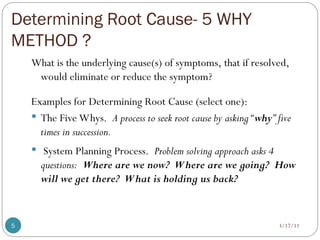
Determining Root Cause-5 WHY
METHOD ?
What is the underlying cause(s) of symptoms, that if resolved,
would eliminate or reduce the symptom?
Examples for Determining Root Cause (select one):
The Five Whys. A process to seek root cause by asking “why” five
times in succession.
System Planning Process. Problem solving approach asks 4
questions: Where are we now? Where are we going? How
will we get there? What is holding us back?
3/17/11
5
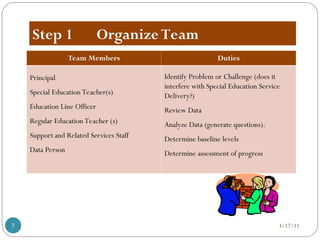
Step 1 OrganizeTeam
3/17/11
7
Team Members Duties
Principal
Special Education Teacher(s)
Education Line Officer
Regular Education Teacher (s)
Support and Related Services Staff
Data Person
Identify Problem or Challenge (does it
interfere with Special Education Service
Delivery?)
Review Data
Analyze Data (generate questions).
Determine baseline levels
Determine assessment of progress
8.
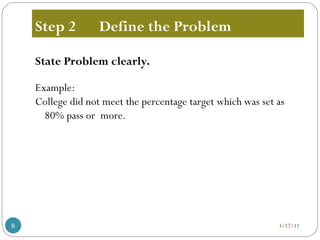
Step 2 Definethe Problem
State Problem clearly.
Example:
College did not meet the percentage target which was set as
80% pass or more.
3/17/11
8
9.
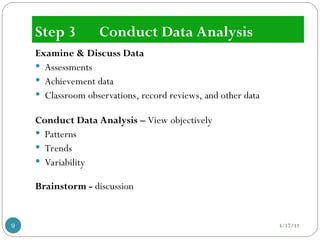
Step 3 ConductData Analysis
Examine & Discuss Data
Assessments
Achievement data
Classroom observations, record reviews, and other data
Conduct Data Analysis – View objectively
Patterns
Trends
Variability
Brainstorm - discussion
3/17/11
9
10.
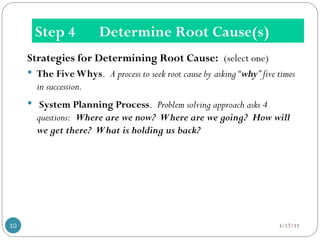
Step 4 DetermineRoot Cause(s)
Strategies for Determining Root Cause: (select one)
The Five Whys. A process to seek root cause by asking “why” five times
in succession.
System Planning Process. Problem solving approach asks 4
questions: Where are we now? Where are we going? How will
we get there? What is holding us back?
3/17/11
10
11.
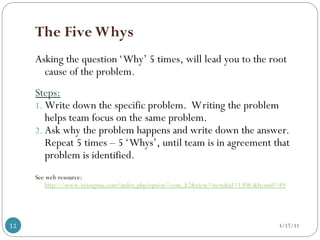
The Five Whys
3/17/11
11
Askingthe question ‘Why’ 5 times, will lead you to the root
cause of the problem.
Steps:
1. Write down the specific problem. Writing the problem
helps team focus on the same problem.
2. Ask why the problem happens and write down the answer.
Repeat 5 times – 5 ‘Whys’, until team is in agreement that
problem is identified.
See web resource:
http://www.isixsigma.com/index.php?option=com_k2&view=item&id=1308:&Itemid=49
12.
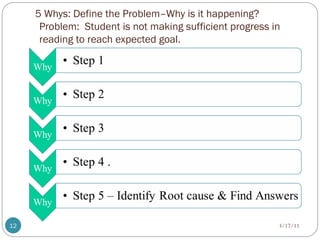
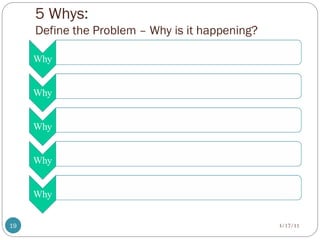
5 Whys: Definethe Problem–Why is it happening?
Problem: Student is not making sufficient progress in
reading to reach expected goal.
3/17/11
12
13.
System Planning Process
3/17/11
13
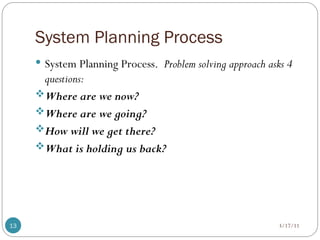
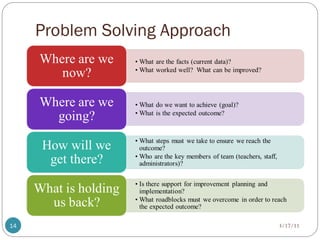
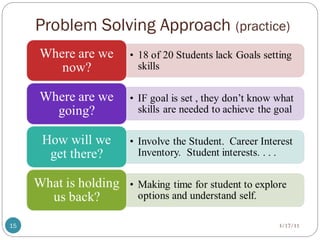
System Planning Process. Problem solving approach asks 4
questions:
Where are we now?
Where are we going?
How will we get there?
What is holding us back?
Step 4 DetermineRoot Cause(s)
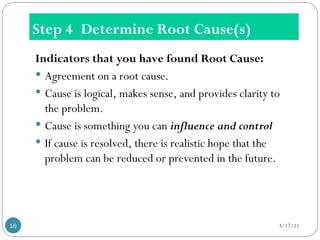
Indicators that you have found Root Cause:
Agreement on a root cause.
Cause is logical, makes sense, and provides clarity to
the problem.
Cause is something you can influence and control
If cause is resolved, there is realistic hope that the
problem can be reduced or prevented in the future.
3/17/11
16
17.
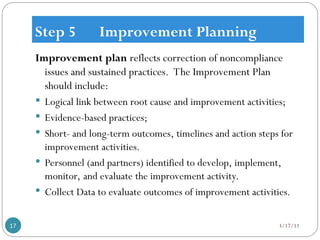
Step 5 ImprovementPlanning
Improvement plan reflects correction of noncompliance
issues and sustained practices. The Improvement Plan
should include:
Logical link between root cause and improvement activities;
Evidence-based practices;
Short- and long-term outcomes, timelines and action steps for
improvement activities.
Personnel (and partners) identified to develop, implement,
monitor, and evaluate the improvement activity.
Collect Data to evaluate outcomes of improvement activities.
3/17/11
17
18.
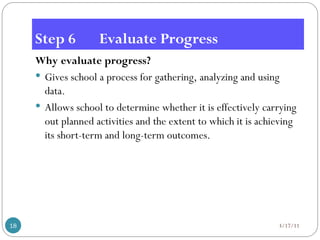
Step 6 EvaluateProgress
Why evaluate progress?
Gives school a process for gathering, analyzing and using
data.
Allows school to determine whether it is effectively carrying
out planned activities and the extent to which it is achieving
its short-term and long-term outcomes.
3/17/11
18
#2 The BIE will continue to conduct Compliance Monitoring, and will also review the extent of improved student performance outcomes.
Rather than using the same strategies and practices and getting the same results, it is time that we dig deeper to review and analyze the effectiveness of our efforts. I believe that most of you have the knowledge and skills to achieve the expected outcomes, but perhaps application may not be optimal.
One approach that has been used in industry and is recommended by OSEP is – determining the root cause.
By getting to the root cause of a problem or challenge, we can better determine if our best efforts are actually going to help us achieve the expected outcome.
#3 Before we proceed further, let’s review some definitions.
#5 The process of determining root cause was used most notably in the business sector – Toyota, in particular used the system in their production system. The process is being used in other sectors as well.
We are providing two strategies for determining root cause. You may also use other approaches (see reference at end of presentation).
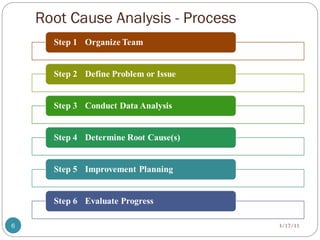
#6 These 6 steps are fundamental to the process of Root Cause Analysis. If you look up other resources, you may find some models with a few additional steps.
#7 The team is comprised of a variety of people focused on a range of tasks
#9 In the current situation, most of the issues or concerns have surfaced from the review of IEP files. Some items lack consistency in services to students with disabilities.
For example:
absence of a behavior intervention plan (BIP) esp. when a student may exhibit behaviors that interfere with learning or present safety concerns.
limited information in the PLAAFP (present levels of academic achievement and functional performance).
absence of relevant postsecondary goals. Goal may reflect one that should be conducted while still in high school rather than one that reflects a goals after leaving high school.
If one is using root cause analysis for concerns re: achievement gaps, you will be reviewing assessment data and progress information.
#10 The two approaches are ones that can be readily used and implemented. Select one that best fits your team. If you would like to venture on use of other approaches, you may refer to the reference on Root Cause listed at the end of this presentation.
#11 If the final step describes a condition that is not within the control or influence of the school, go back to the prior step.
#13 This process requires more engagement from the team and more discussion.