Beth Picknally Camden
University of Pennsylvania Libraries
bethpc@upenn.edu
June 2014
 Business definition
 Library approach
 My approach
◦ Cost
◦ Value
 Fast-track replacements
 Serials check-in
 Returns
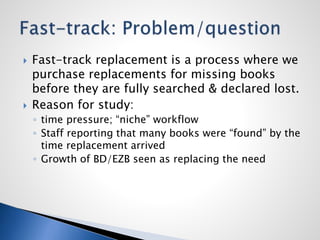
 Fast-track replacement is a process where we
purchase replacements for missing books
before they are fully searched & declared lost.
 Reason for study:
◦ time pressure; “niche” workflow
◦ Staff reporting that many books were “found” by the
time replacement arrived
◦ Growth of BD/EZB seen as replacing the need
 Costs
 Sample of 75 replacements over 3 FYs
 Circulation data
 Discussions with bibliographers
Total spent
Number
purchased
Average
cost
FY08 $19,394.33 427 $45.42
FY09 $23,953.85 478 $50.11
FY10 $27,074.64 507 $53.40
Total 08-10 $70,422.82 1,412 $49.87
Sample
size
Still
lost? %
Aver circ
orig copy
Aver circ
repl copy
Aver circ
BD/EZB
FY08 25 14 56.0% 5.12 2.64 0.68
FY09 25 12 48.0% 3.64 0.96 2.4
FY10 25 13 52.0% 3.04 1.44 0.16
Overall 75 40 53.3% 3.93 1.68 1.08
 Couldn’t get report with all the factors that I
wanted to consider
 So used sample for a deep dive
◦ Voyager searching
◦ BD/EZB reports
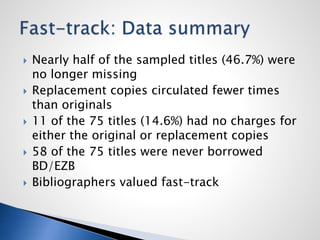
 Nearly half of the sampled titles (46.7%) were
no longer missing
 Replacement copies circulated fewer times
than originals
 11 of the 75 titles (14.6%) had no charges for
either the original or replacement copies
 58 of the 75 titles were never borrowed
BD/EZB
 Bibliographers valued fast-track
 Continue Fast-track
 Change in timing (now biweekly)
 Considering another review
 Is periodical check-in worth the cost (staff
time, etc.)?
 Cost
 Staff interviews
 Patron point-of-use survey
 Tracking patron questions
Total salaries $ 77,216.00
current periodicals (est.) 5500
Annual cost per title $ 14.04
FY11 collection spending
Monograph: $ 3,686,338.19 24.82%
Serial: $ 1,507,453.46 10.15%
Electronic: $ 9,031,362.90 60.80%
General funds: $ 629,180.47 4.24%
 2 minute paper survey
 The survey results indicated:
◦ Users found issues they needed on the shelves
(71%)
◦ Users consulted catalog first (64%)
◦ If not found: they equally either ask for help,
request an ILL, or use the online version
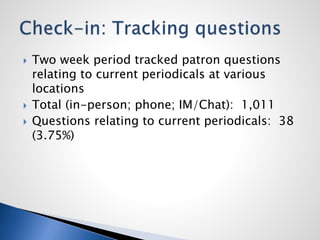
 Two week period tracked patron questions
relating to current periodicals at various
locations
 Total (in-person; phone; IM/Chat): 1,011
 Questions relating to current periodicals: 38
(3.75%)
 Value of check-in
◦ Collection integrity
◦ Fiscal responsibility
◦ Competence and service quality
◦ Vendor reliability and accountability
 Also gathered info about current WF
problems
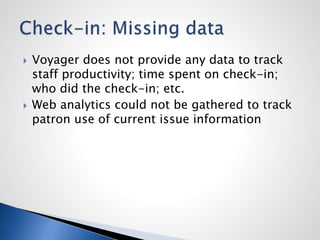
 Voyager does not provide any data to track
staff productivity; time spent on check-in;
who did the check-in; etc.
 Web analytics could not be gathered to track
patron use of current issue information
 Report recommended continuing check-in
◦ Deciding factor: fiscal responsibility
 Appendix documented a variety of workflow
and timeliness problems. Many have been
addressed.
This study looked at activity of returning books
to vendors, for both approval plans and firm
orders, and included a review of related
activities including bibliographer review of
approval books.
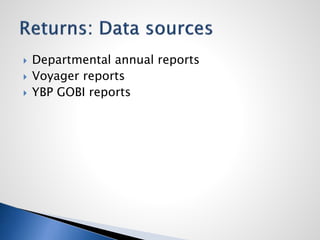
 Departmental annual reports
 Voyager reports
 YBP GOBI reports
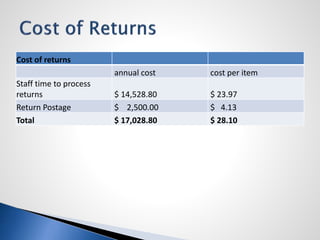
Cost of returns
annual cost cost per item
Staff time to process
returns $ 14,528.80 $ 23.97
Return Postage $ 2,500.00 $ 4.13
Total $ 17,028.80 $ 28.10
 30+ approval plans
 3 years of data:
◦ Number received (up slightly over 3 years)
◦ Number returned (declining over 3 years)
◦ Calculated % returned for each vendor
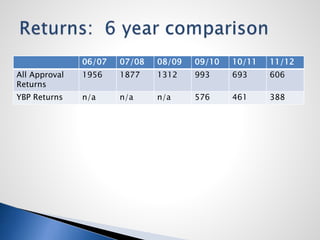
 Overall return rate declining 4%2%
06/07 07/08 08/09 09/10 10/11 11/12
All Approval
Returns
1956 1877 1312 993 693 606
YBP Returns n/a n/a n/a 576 461 388
Approval Return Reasons
damaged/defective 40 2%
duplicate 564 29%
no to series 13 1%
poor quality 21 1%
reprint 12 1%
scope 656 34%
textbook 3 0%
too expensive 56 3%
vendor error 1 0%
wrong format 2 0%
no reason 563 29%
LC Class Shipped Returned % Ret'd
A 12 0 0%
B 1828 21 1%
C 84 0 0%
D 1299 6 0%
E 637 1 0%
F 374 1 0%
G 449 28 6%
H 2937 36 1%
J 970 5 1%
K 460 54 12%
L 551 5 1%
LC Class Shipped Returned % Ret'd
M 335 0 0%
N 664 11 2%
P 3839 12 0%
Q 460 76 17%
R 184 14 8%
S 55 2 4%
T 357 55 15%
U 183 27 15%
V 35 5 14%
Z 47 1 2%
Total 15760 360 2%
 Eliminated plan with high rate of return
 Shared data with Coll Dev for updating
profiles
 Not returning books costing $25 or less
 Used data (reduction in returns) to justify
changing staff duties to union
 Time consuming
 Not all data available
 Unexpected findings about related WF
 Assumptions may/may not be proven
 Other factors beyond data can influence
decisions
 Determining the VALUE of a service is more
difficult than determining the COST
Driving With Data: A Roadmap for
Evidence-Based Decision Making in
Academic Libraries – Marcum & Schonfeld

Return-on-Investment Studies: Using Production Data in Technical Services

  • 1.
    Beth Picknally Camden Universityof Pennsylvania Libraries bethpc@upenn.edu June 2014
  • 2.
     Business definition Library approach  My approach ◦ Cost ◦ Value
  • 3.
     Fast-track replacements Serials check-in  Returns
  • 4.
     Fast-track replacementis a process where we purchase replacements for missing books before they are fully searched & declared lost.  Reason for study: ◦ time pressure; “niche” workflow ◦ Staff reporting that many books were “found” by the time replacement arrived ◦ Growth of BD/EZB seen as replacing the need
  • 5.
     Costs  Sampleof 75 replacements over 3 FYs  Circulation data  Discussions with bibliographers
  • 6.
    Total spent Number purchased Average cost FY08 $19,394.33427 $45.42 FY09 $23,953.85 478 $50.11 FY10 $27,074.64 507 $53.40 Total 08-10 $70,422.82 1,412 $49.87
  • 7.
    Sample size Still lost? % Aver circ origcopy Aver circ repl copy Aver circ BD/EZB FY08 25 14 56.0% 5.12 2.64 0.68 FY09 25 12 48.0% 3.64 0.96 2.4 FY10 25 13 52.0% 3.04 1.44 0.16 Overall 75 40 53.3% 3.93 1.68 1.08
  • 8.
     Couldn’t getreport with all the factors that I wanted to consider  So used sample for a deep dive ◦ Voyager searching ◦ BD/EZB reports
  • 9.
     Nearly halfof the sampled titles (46.7%) were no longer missing  Replacement copies circulated fewer times than originals  11 of the 75 titles (14.6%) had no charges for either the original or replacement copies  58 of the 75 titles were never borrowed BD/EZB  Bibliographers valued fast-track
  • 10.
     Continue Fast-track Change in timing (now biweekly)  Considering another review
  • 11.
     Is periodicalcheck-in worth the cost (staff time, etc.)?
  • 12.
     Cost  Staffinterviews  Patron point-of-use survey  Tracking patron questions
  • 13.
    Total salaries $77,216.00 current periodicals (est.) 5500 Annual cost per title $ 14.04 FY11 collection spending Monograph: $ 3,686,338.19 24.82% Serial: $ 1,507,453.46 10.15% Electronic: $ 9,031,362.90 60.80% General funds: $ 629,180.47 4.24%
  • 14.
     2 minutepaper survey  The survey results indicated: ◦ Users found issues they needed on the shelves (71%) ◦ Users consulted catalog first (64%) ◦ If not found: they equally either ask for help, request an ILL, or use the online version
  • 15.
     Two weekperiod tracked patron questions relating to current periodicals at various locations  Total (in-person; phone; IM/Chat): 1,011  Questions relating to current periodicals: 38 (3.75%)
  • 16.
     Value ofcheck-in ◦ Collection integrity ◦ Fiscal responsibility ◦ Competence and service quality ◦ Vendor reliability and accountability  Also gathered info about current WF problems
  • 17.
     Voyager doesnot provide any data to track staff productivity; time spent on check-in; who did the check-in; etc.  Web analytics could not be gathered to track patron use of current issue information
  • 18.
     Report recommendedcontinuing check-in ◦ Deciding factor: fiscal responsibility  Appendix documented a variety of workflow and timeliness problems. Many have been addressed.
  • 19.
    This study lookedat activity of returning books to vendors, for both approval plans and firm orders, and included a review of related activities including bibliographer review of approval books.
  • 20.
     Departmental annualreports  Voyager reports  YBP GOBI reports
  • 21.
    Cost of returns annualcost cost per item Staff time to process returns $ 14,528.80 $ 23.97 Return Postage $ 2,500.00 $ 4.13 Total $ 17,028.80 $ 28.10
  • 22.
     30+ approvalplans  3 years of data: ◦ Number received (up slightly over 3 years) ◦ Number returned (declining over 3 years) ◦ Calculated % returned for each vendor  Overall return rate declining 4%2%
  • 23.
    06/07 07/08 08/0909/10 10/11 11/12 All Approval Returns 1956 1877 1312 993 693 606 YBP Returns n/a n/a n/a 576 461 388
  • 24.
    Approval Return Reasons damaged/defective40 2% duplicate 564 29% no to series 13 1% poor quality 21 1% reprint 12 1% scope 656 34% textbook 3 0% too expensive 56 3% vendor error 1 0% wrong format 2 0% no reason 563 29%
  • 25.
    LC Class ShippedReturned % Ret'd A 12 0 0% B 1828 21 1% C 84 0 0% D 1299 6 0% E 637 1 0% F 374 1 0% G 449 28 6% H 2937 36 1% J 970 5 1% K 460 54 12% L 551 5 1% LC Class Shipped Returned % Ret'd M 335 0 0% N 664 11 2% P 3839 12 0% Q 460 76 17% R 184 14 8% S 55 2 4% T 357 55 15% U 183 27 15% V 35 5 14% Z 47 1 2% Total 15760 360 2%
  • 26.
     Eliminated planwith high rate of return  Shared data with Coll Dev for updating profiles  Not returning books costing $25 or less  Used data (reduction in returns) to justify changing staff duties to union
  • 27.
     Time consuming Not all data available  Unexpected findings about related WF  Assumptions may/may not be proven  Other factors beyond data can influence decisions  Determining the VALUE of a service is more difficult than determining the COST
  • 28.
    Driving With Data:A Roadmap for Evidence-Based Decision Making in Academic Libraries – Marcum & Schonfeld

Editor's Notes

  • #3 Business definition (real money): “Some people think ROI is only calculated in financial terms, but it more broadly refers to any positive or negative business outcomes that are the result of making a particular investment. The "return" might be measured by progress toward goals, positive impact on intangible assets, increased competence, improved morale, employee or partner satisfaction, and other non-financial benefits. Costs can be calculated in both financial terms and in non-financial terms such as risk or impact on intangible assets and resources.” http://www.valuenetworksandcollaboration.com/advanced/tipsforcostbenefit.html Library ROI: -Public libraries: economic impact in a given community of library budget “In the study of Florida public libraries, a total of 17 public libraries were analyzed to assess the benefits to adult users who were 18 years of age or older; this study also considered the economic impact on these users....The analysis showed that approximately $6.40 of the total value per $1 of the budget was created. “ http://www.ala.org/research/librariesmatter/taxonomy/term/129 -Academic libraries: focusing on student/researcher impact Value of Academic Libraries Toolkit http://www.ala.org/acrl/issues/value/valueofacademiclibrariestoolkit#Academic%20Library%20ROI My approach -Investment=Cost (Salaries; Collection $; Shipping; supplies; other) -Return=Value -Internal: impact on other WF; impact on other depts -External: User impact—direct/indirect Value is the hardest to measure
  • #5 2011
  • #7 Key: the collection cost was small as % of budget
  • #9 Time consuming – especially for BD/EZB
  • #10 So, BD.EZB assumption was not true Bibliographers valued fast-track (low cost; no decision needed; not subject funds)
  • #11 Single person study Took a lot of time Decision to use group for next study
  • #12 Late 2011 “Pet” project of the library director
  • #14 Note: Voyager can give us a count of subscriptions, but not a count of just periodical subscriptions which are currently received. Serials budget includes all print serials (not just periodicals) and print+online NOT MUCH DATA
  • #15 distributed near the current periodicals area in 20 locations; 2 week period; 39 returned; chiefly from 3 locations ADD QUESTIONS -results were small and somewhat skewed by a larger number of returns from one small library -one key point: 64% claimed to check catalog first—USER VALUE of check-in information in the catalog
  • #16 Very small % but PS staff give a strong emphasis on using check-in records to answer questions: “answer with authority”
  • #17 Collection integrity—we won’t know what we own; we won’t be able to claim Fiscal responsibility—audit trail; we prepay; if no check in no records of univ assets Service –speaking with authority about whether we have an issue
  • #18 Classic vs New Franklin
  • #19 Group process for this study did not work well -less open to change than we would like Director not happy with result -we will revisit at some point
  • #20 Approach – small group of 2 2012/13
  • #21 Tons of data available—Lots of funs to dig into it!
  • #22 FY12 costs
  • #23 One vendor with a 16% return rate – plan was cancelled even before we finished the study Huge table with each vendor over 3 years
  • #24 From dept annual reports
  • #25 Voyager report (3 FYs)—note does not include all returns (we don’t add records for all approvals at the point of receipt); so not included in this table No reason: YBP has discontinued slips with reason for return; so more recent returns do not have a reason Dupl: w/ diff. plan; w/ e-resource; w/ firm order; w/ gift; w/ standing order Scope: language; narrow geog.; out of scope; peripheral interest; too specialized; sufficient coverage; too narrow; too popular; wrong level Both Dupl & Scope point to the need for better awareness of app profiles
  • #26 From YBP report – FY12 Although the overall return rate is low at 2%, several of the LC classes show a high rate of return, including several in the double-digits (K, Q, T, U, and V). To clarify the picture further, we looked at returns rates by subclass. 22 subclasses had a return rate of 25% or higher; several subclasses had a 100% return rate (chiefly in K). An additional 18 subclasses had return rates of 10-14%. These subclasses should be reviewed by bibliographers to consider moving to the YBP slip plan. This would further reduce the number of returns. In general, small numbers in a subject area lend to a higher return rate. Also note that the classes with 0-1% are clear candidates for shelf ready (currently only Literature is shelf ready)
  • #27 -considering moving to $50 cost as the cut off for returns -path for position elimination not clear