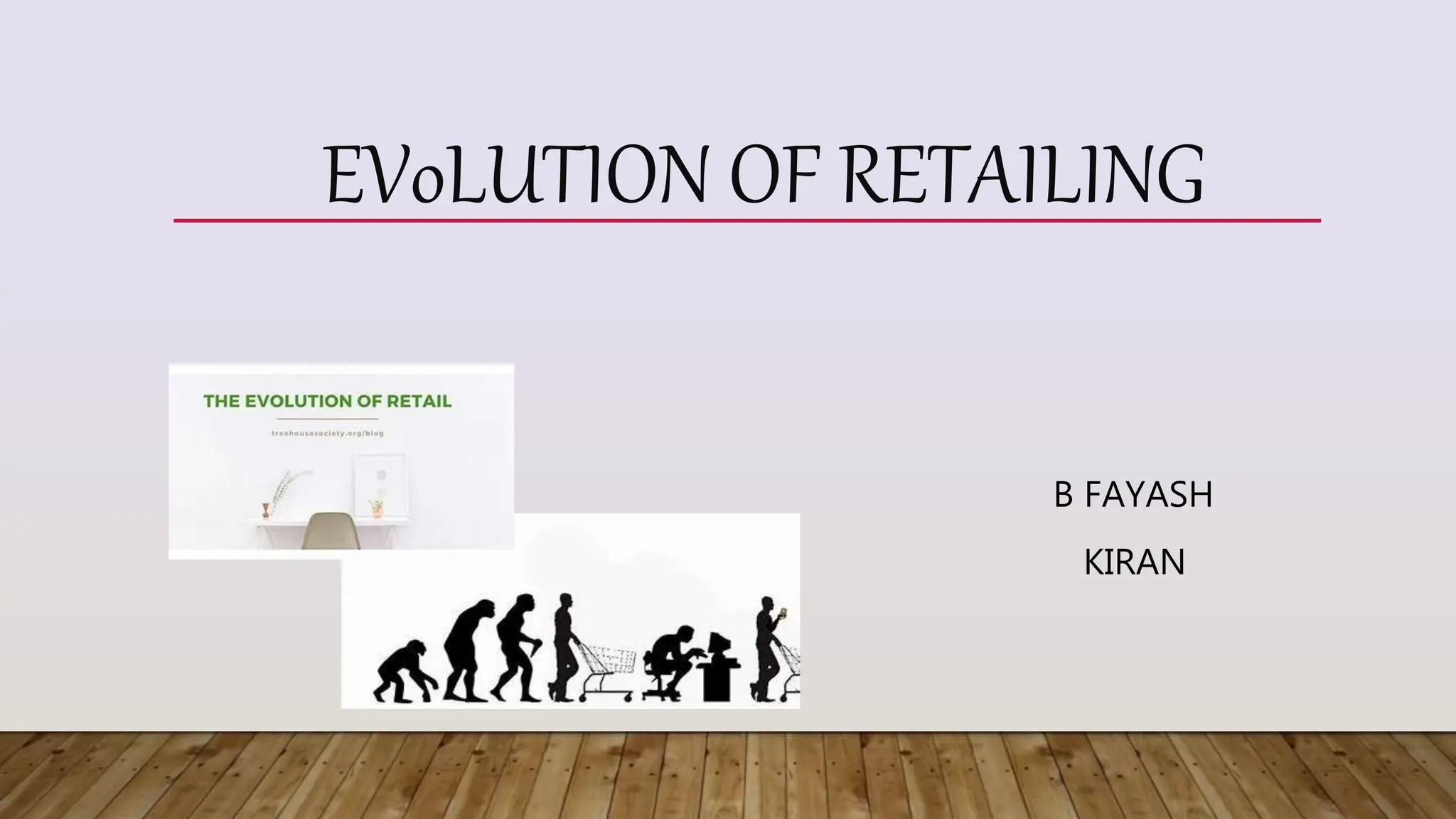
EVoLUTION OF RETAILING
B FAYASH
KIRAN
INTRODUCTION
DEFINITION OF RETAILING:
• The process of selling goods and services to consumers for personal use.
• Retailing is an essential part of the global economy, constantly evolving
to meet consumer demands and technological advancements.
TRADITIONAL RETAILING
• The practice of selling products or services through physical stores.
• Brick-and-mortar stores dominated the retail landscape for centuries.
• Limited product selection, local customer base, and face-to-face
transactions.
RISE OF DEPARTMENT STORES
• The 19th century marked a significant shift in retailing with the emergence
of department stores.
• These stores went beyond traditional small shops by offering a wide
variety of products.
• This expansion of offerings catered to a broader customer base and
encouraged increased spending within a single store.
SUPERMARKETS AND SELF-SERVICE
• Supermarkets emerged in the early to mid-20th century, representing a
significant evolution in retailing.
• Supermarkets introduced the concept of convenience by offering a wide
variety of products in a single location.
• Packaged goods became prevalent, allowing customers to quickly and
easily select pre-packaged items rather than requesting individual
quantities.
RISE OF SHOPPING MALLS
• The mid-20th century witnessed a transformative phase in retailing with
the emergence of shopping malls.
• Shopping malls aimed to provide a complete and centralized shopping
experience.
• This approach encouraged consumers to spend extended periods in the
mall, fostering a sense of community and turning shopping into a
recreational activity rather than a simple transaction.
OMNICHANNEL RETAILING
• Omnichannel retailing is a modern approach that seamlessly integrates
multiple channels, providing customers with a unified and consistent
shopping experience across online and offline platforms.
• Unlike traditional multichannel strategies, omnichannel emphasizes a
cohesive and interconnected customer journey.
• Customers can seamlessly transition between these channels, such as
researching products online and making purchases in-store, or vice versa.
SOCIAL COMMERCE
• Social commerce is the integration of e-commerce with social media platforms,
allowing users to discover, shop, and purchase products directly through these
social channels.
• It leverages the social nature of online platforms to facilitate and enhance the
shopping experience.
• Social commerce has evolved as social media platforms gained prominence.
• It builds on the idea that consumers trust recommendations from their social
networks and seek a more interactive and personalized shopping experience.
SUSTAINABLE AND ETHICAL RETAILING
• The evolution of retailing has witnessed a significant shift in consumer values, with an
increasing demand for sustainable and ethically sourced products.
• Consumers are becoming more conscious of the environmental and social impacts of their
purchases, prompting retailers to adopt eco-friendly practices and ethical sourcing.
• In response to consumer demand and global awareness, retailers are integrating
sustainable practices into their operations.
FUTURE TRENDS
Integration of Artificial Intelligence (AI)
• AI will play a pivotal role in personalizing customer experiences through advanced
analytics.
Augmented Reality (AR) and Virtual Reality (VR)
• AR and VR technologies will revolutionize the in-store and online shopping experience.
Voice Commerce
• The rise of voice-activated devices will lead to increased voice commerce.
CONCLUSION
• Retailing is a dynamic industry that continuously adapts to technological advancements
and changing consumer behaviors.
• The evolution of retailing is marked by a journey from traditional brick-and-mortar stores
to the current era of omnichannel experiences.
• The retail industry's ability to innovate and embrace emerging technologies will determine
its success in the future.
THANK YOU ^^

Retailing management: Evolution of RETAILING

  • 1.
  • 2.
    INTRODUCTION DEFINITION OF RETAILING: •The process of selling goods and services to consumers for personal use. • Retailing is an essential part of the global economy, constantly evolving to meet consumer demands and technological advancements.
  • 3.
    TRADITIONAL RETAILING • Thepractice of selling products or services through physical stores. • Brick-and-mortar stores dominated the retail landscape for centuries. • Limited product selection, local customer base, and face-to-face transactions.
  • 4.
    RISE OF DEPARTMENTSTORES • The 19th century marked a significant shift in retailing with the emergence of department stores. • These stores went beyond traditional small shops by offering a wide variety of products. • This expansion of offerings catered to a broader customer base and encouraged increased spending within a single store.
  • 5.
    SUPERMARKETS AND SELF-SERVICE •Supermarkets emerged in the early to mid-20th century, representing a significant evolution in retailing. • Supermarkets introduced the concept of convenience by offering a wide variety of products in a single location. • Packaged goods became prevalent, allowing customers to quickly and easily select pre-packaged items rather than requesting individual quantities.
  • 6.
    RISE OF SHOPPINGMALLS • The mid-20th century witnessed a transformative phase in retailing with the emergence of shopping malls. • Shopping malls aimed to provide a complete and centralized shopping experience. • This approach encouraged consumers to spend extended periods in the mall, fostering a sense of community and turning shopping into a recreational activity rather than a simple transaction.
  • 7.
    OMNICHANNEL RETAILING • Omnichannelretailing is a modern approach that seamlessly integrates multiple channels, providing customers with a unified and consistent shopping experience across online and offline platforms. • Unlike traditional multichannel strategies, omnichannel emphasizes a cohesive and interconnected customer journey. • Customers can seamlessly transition between these channels, such as researching products online and making purchases in-store, or vice versa.
  • 8.
    SOCIAL COMMERCE • Socialcommerce is the integration of e-commerce with social media platforms, allowing users to discover, shop, and purchase products directly through these social channels. • It leverages the social nature of online platforms to facilitate and enhance the shopping experience. • Social commerce has evolved as social media platforms gained prominence. • It builds on the idea that consumers trust recommendations from their social networks and seek a more interactive and personalized shopping experience.
  • 9.
    SUSTAINABLE AND ETHICALRETAILING • The evolution of retailing has witnessed a significant shift in consumer values, with an increasing demand for sustainable and ethically sourced products. • Consumers are becoming more conscious of the environmental and social impacts of their purchases, prompting retailers to adopt eco-friendly practices and ethical sourcing. • In response to consumer demand and global awareness, retailers are integrating sustainable practices into their operations.
  • 10.
    FUTURE TRENDS Integration ofArtificial Intelligence (AI) • AI will play a pivotal role in personalizing customer experiences through advanced analytics. Augmented Reality (AR) and Virtual Reality (VR) • AR and VR technologies will revolutionize the in-store and online shopping experience. Voice Commerce • The rise of voice-activated devices will lead to increased voice commerce.
  • 11.
    CONCLUSION • Retailing isa dynamic industry that continuously adapts to technological advancements and changing consumer behaviors. • The evolution of retailing is marked by a journey from traditional brick-and-mortar stores to the current era of omnichannel experiences. • The retail industry's ability to innovate and embrace emerging technologies will determine its success in the future.
  • 12.