RESTful Meetup vol.3
2014.04.12
Venue provided by SonicGarden Inc.
『RESTful Web APIs』読書会
と内容の紹介
Introduction of the reading group and a brief summary of
“RESTful Web APIs”
『RESTful Web APIs』読書会
The reading group of “RESTful Web APIs”
• 毎月第2・第4木曜日の19:30∼22:00にここで開催してい
ます。
• モニターに本を映して、主に @tkawa が簡単な日本語訳
を読んでいきつつ、みんなで気になったことや疑問点な
どを話し合って理解を深めます。
Meetup on the 2nd and the 4th Thursdays every month in this place
Displaying the text and its rough Japanese translation, 

we discuss what interests us, what we don't know, etc.
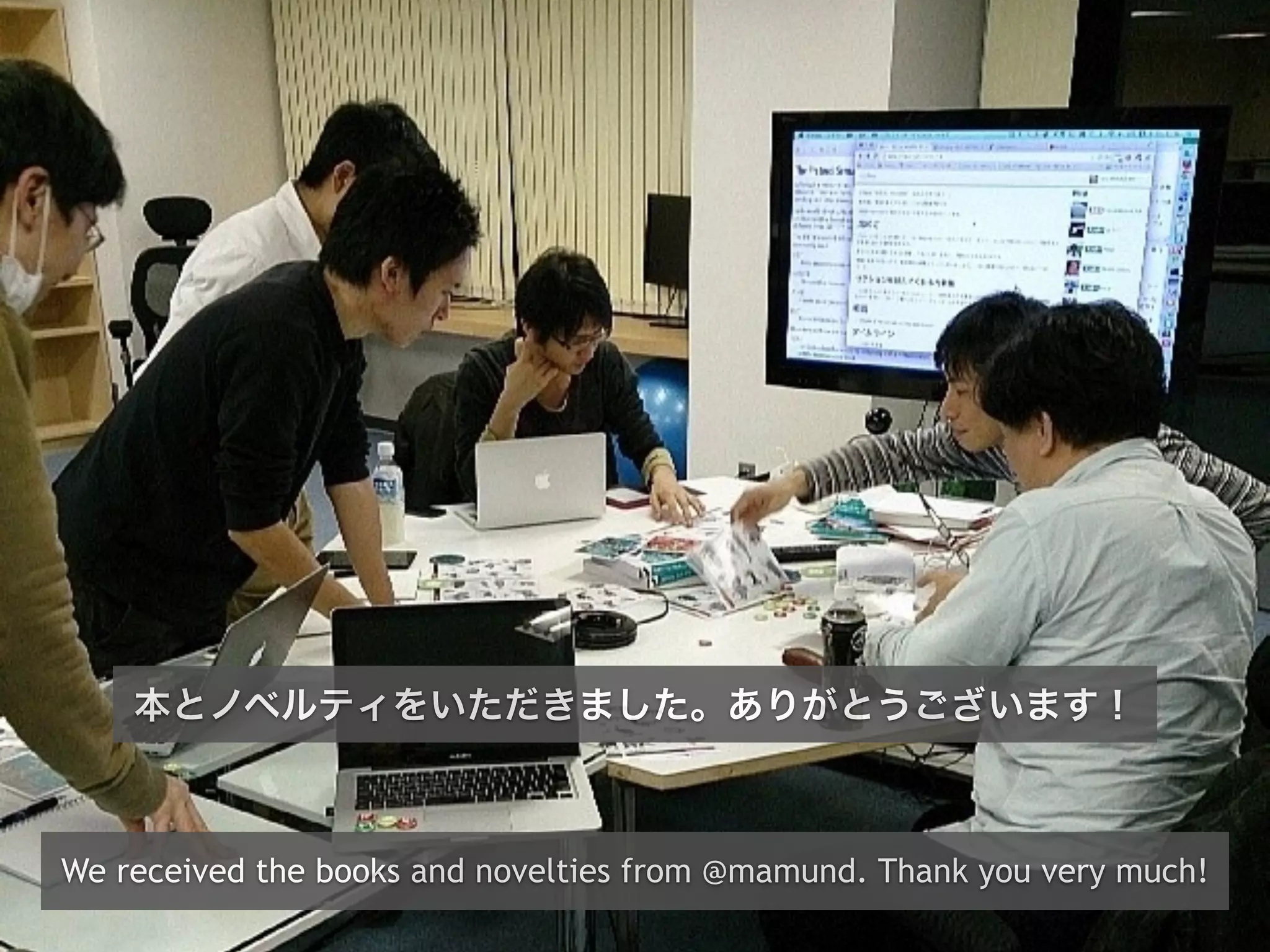
本とノベルティをいただきました。ありがとうございます!
We received the books and novelties from @mamund. Thank you very much!
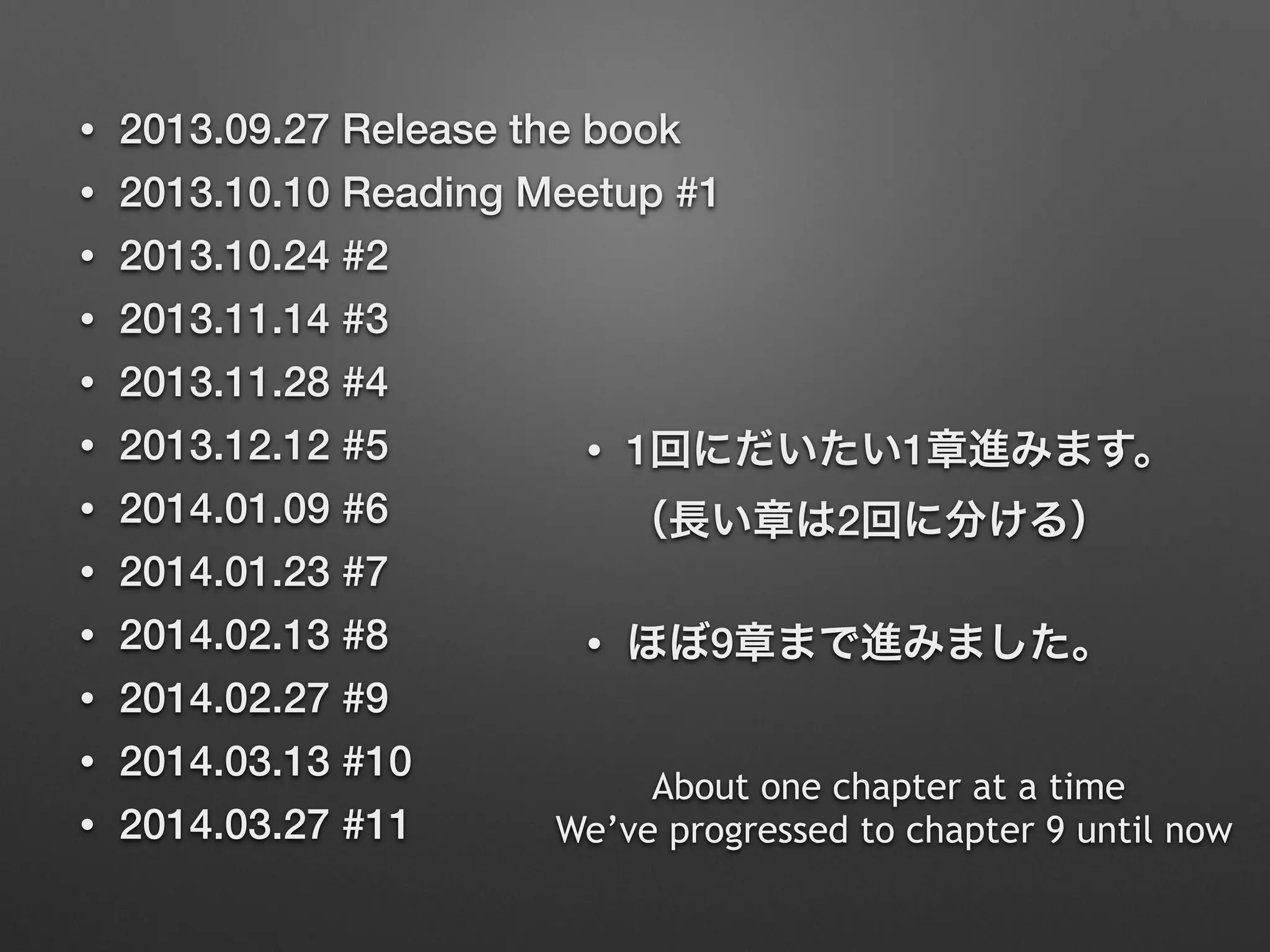
• 2013.09.27 Release the book
• 2013.10.10 Reading Meetup #1
• 2013.10.24 #2
• 2013.11.14 #3
• 2013.11.28 #4
• 2013.12.12 #5
• 2014.01.09 #6
• 2014.01.23 #7
• 2014.02.13 #8
• 2014.02.27 #9
• 2014.03.13 #10
• 2014.03.27 #11
• 1回にだいたい1章進みます。

(長い章は2回に分ける)
• ほぼ9章まで進みました。
About one chapter at a time
We’ve progressed to chapter 9 until now
次回
• 2014.04.24 #12
• http://www.circleaf.com/events/115
• RESTやWeb APIに興味のある方の参加をお待ちしてい
ます。
Next
Sendagaya.rb
• 地域Rubyコミュニティ
• 隔週月曜日の19:30∼21:30にここで開催しています。
• Next: 2014.04.28 #79

http://sendagayarb.doorkeeper.jp/events/10452
Regional Rubyist community
Meetup on every other Monday, also in this place
http://sendagayarb.doorkeeper.jp/
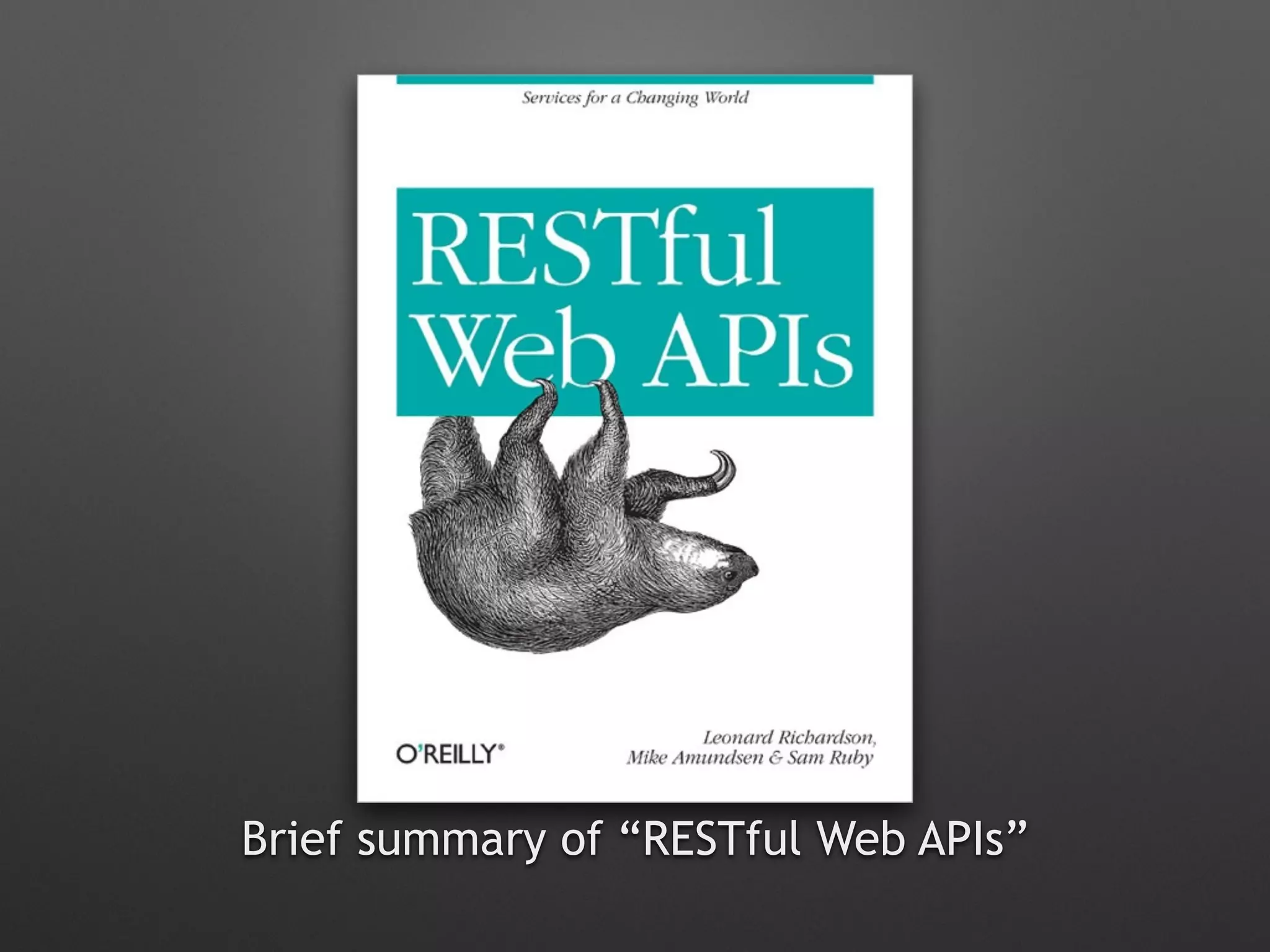
Brief summary of “RESTful Web APIs”
REST・ハイパーメディアと

それを利用した設計手法
この本に書いてあること
This book explains REST, Hypermedia and the design
procedure using them.
何ができるのか?
何が解決するのか?
そもそも今なにが問題なのか?
What can you do and what do you solve with this
knowledge?

What is a problem in the first place?
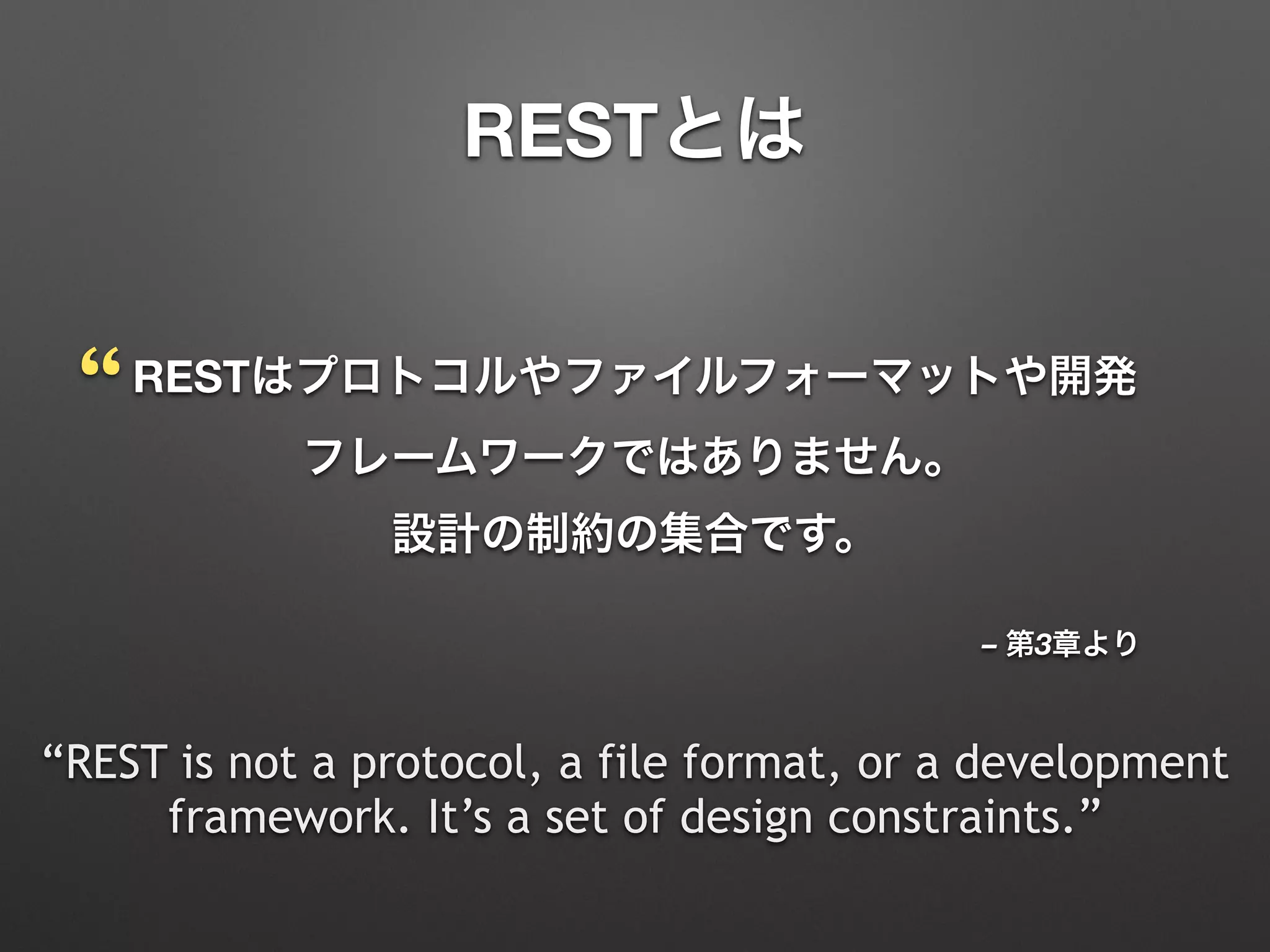
– 第3章より
RESTはプロトコルやファイルフォーマットや開発
フレームワークではありません。

設計の制約の集合です。
“REST is not a protocol, a file format, or a development
framework. It’s a set of design constraints.”
“
RESTとは
Webがうまく動くようにする
ためのしくみ
RESTとは、大ざっぱにいうと
Roughly speaking, REST is the mechanism

that makes the Web work well.
だがしかし
既存の Web API って
うまく動いていないところがあるのでは?
Today’s APIs don’t work well, do they?
– Introductionより
現在のほとんどのAPIには、大きな問題があります。
一度公開したら変更することができません。業界が変
化しつつも、何年も変わらない有名なAPIがたくさん
あります。変更があまりにも困難だからです。
“Most of today’s APIs have a big problem: once deployed, they can’t change.
There are big-name APIs that stay static for years at a time, as the industry
changes around them, because changing them would be too difficult.”
APIの問題 (1)
APIs can’t change
“
– Introductionより
“Twitter API”、“Facebook API”、“Google+ API”、

この3つのAPIは、同様のことを行います。すべてユーザー
アカウントの概念を持っているし、ユーザーがテキストを
自分のアカウントに投稿します。しかし、それぞれのAPI
は完全に異なる設計を持っています。1つのAPIを学んで
も、他のものには役に立ちません。
“We talk about the “Twitter API,” the “Facebook API,” and the “Google+ API.”
These three APIs do similar things. They all have some notion of user accounts
and (among other things) they all let users post a little bit of text to their
accounts. But each API has a completely different design. Learning one API
doesn’t help you learn the next one.”
APIの問題 (2)
“
Duplication of Effort
本来、RESTは変更をうまく扱えるし、

同じ意味のものは同じやり方で

扱えるはず
RESTful architectures are designed for managing change in
themselves.
なぜうまくいってない?
Why do they have problems?
RESTの要素である「ハイパーメディア」を

ちゃんと使えていないから
Because they don’t use hypermedia properly.
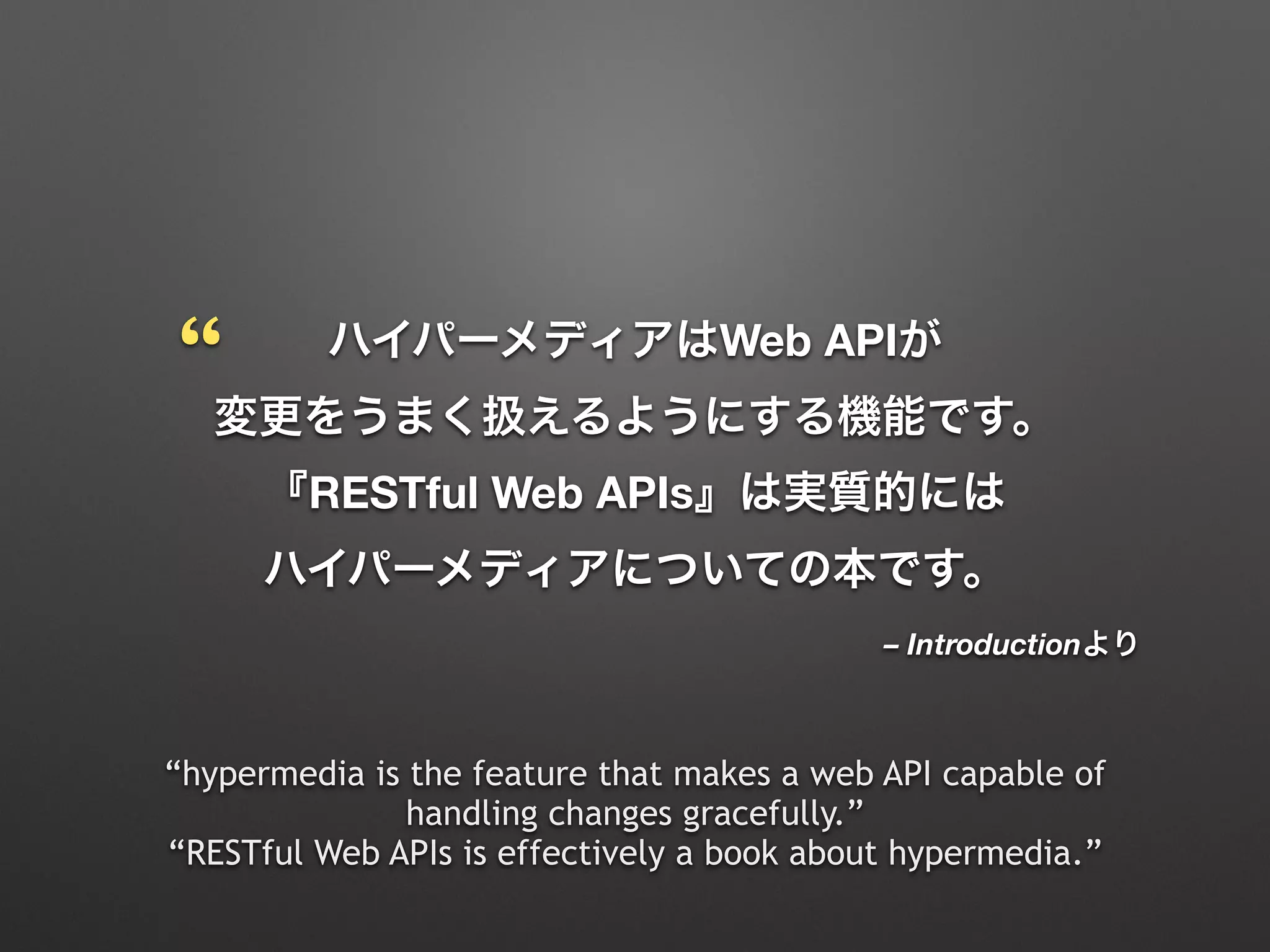
– Introductionより
ハイパーメディアはWeb APIが

変更をうまく扱えるようにする機能です。
『RESTful Web APIs』は実質的には

ハイパーメディアについての本です。
“hypermedia is the feature that makes a web API capable of
handling changes gracefully.”
“RESTful Web APIs is effectively a book about hypermedia.”
“
ハイパーメディア == リンク
Hypermedia == Link
ハイパーメディアは
Web APIに柔軟性を
あたえてくれる
Hypermedia gives web APIs flexibility.
ハイパーメディアを使うと

「意味付け」ができる
Hypermedia has ability of “giving the meanings”
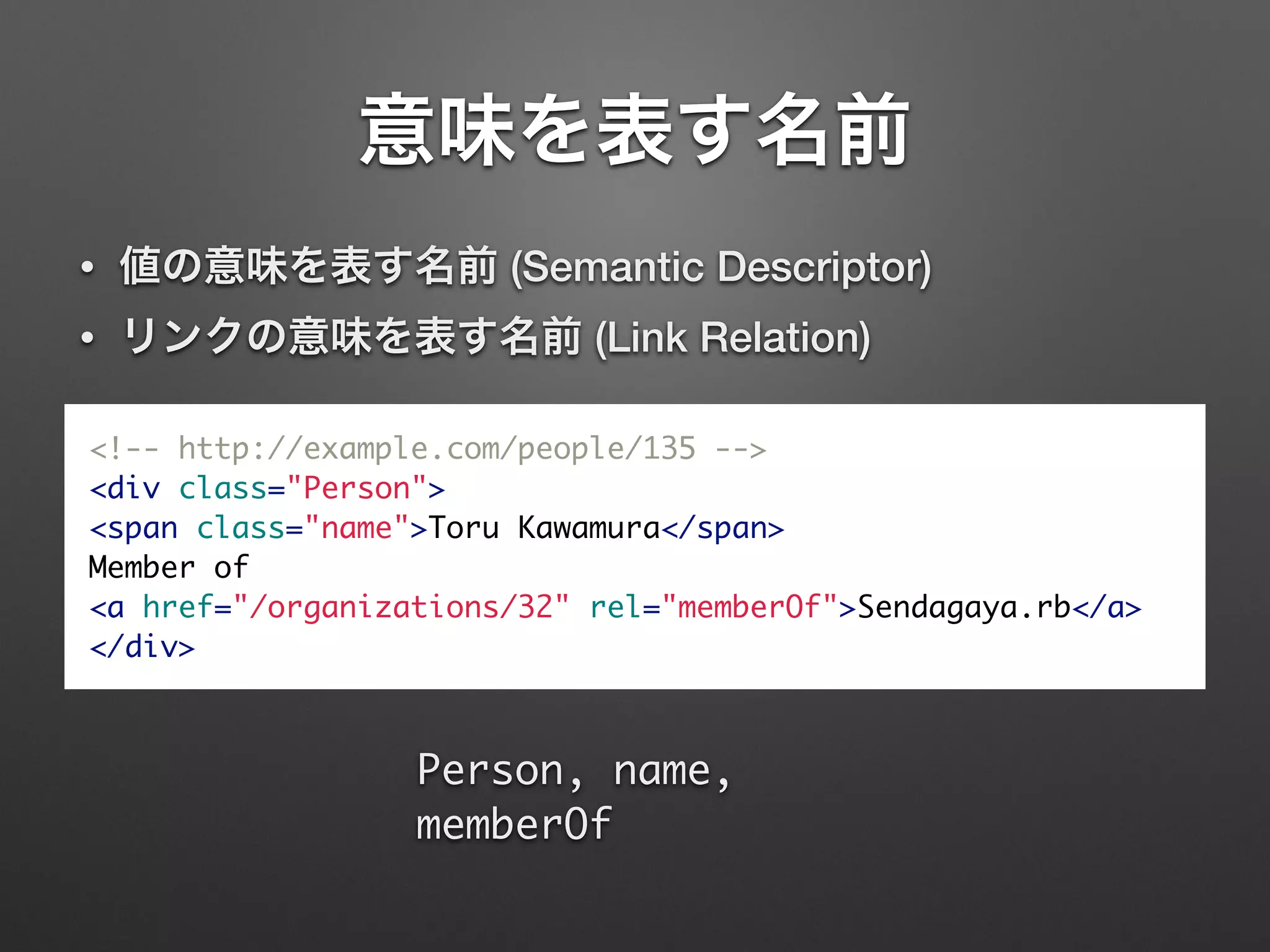
意味を表す名前
• 値の意味を表す名前 (Semantic Descriptor)
• リンクの意味を表す名前 (Link Relation)
Person, name, 

memberOf
<!-- http://example.com/people/135 -->	
<div class="Person">	
<span class="name">Toru Kawamura</span>	
Member of 

<a href="/organizations/32" rel="memberOf">Sendagaya.rb</a>	
</div>
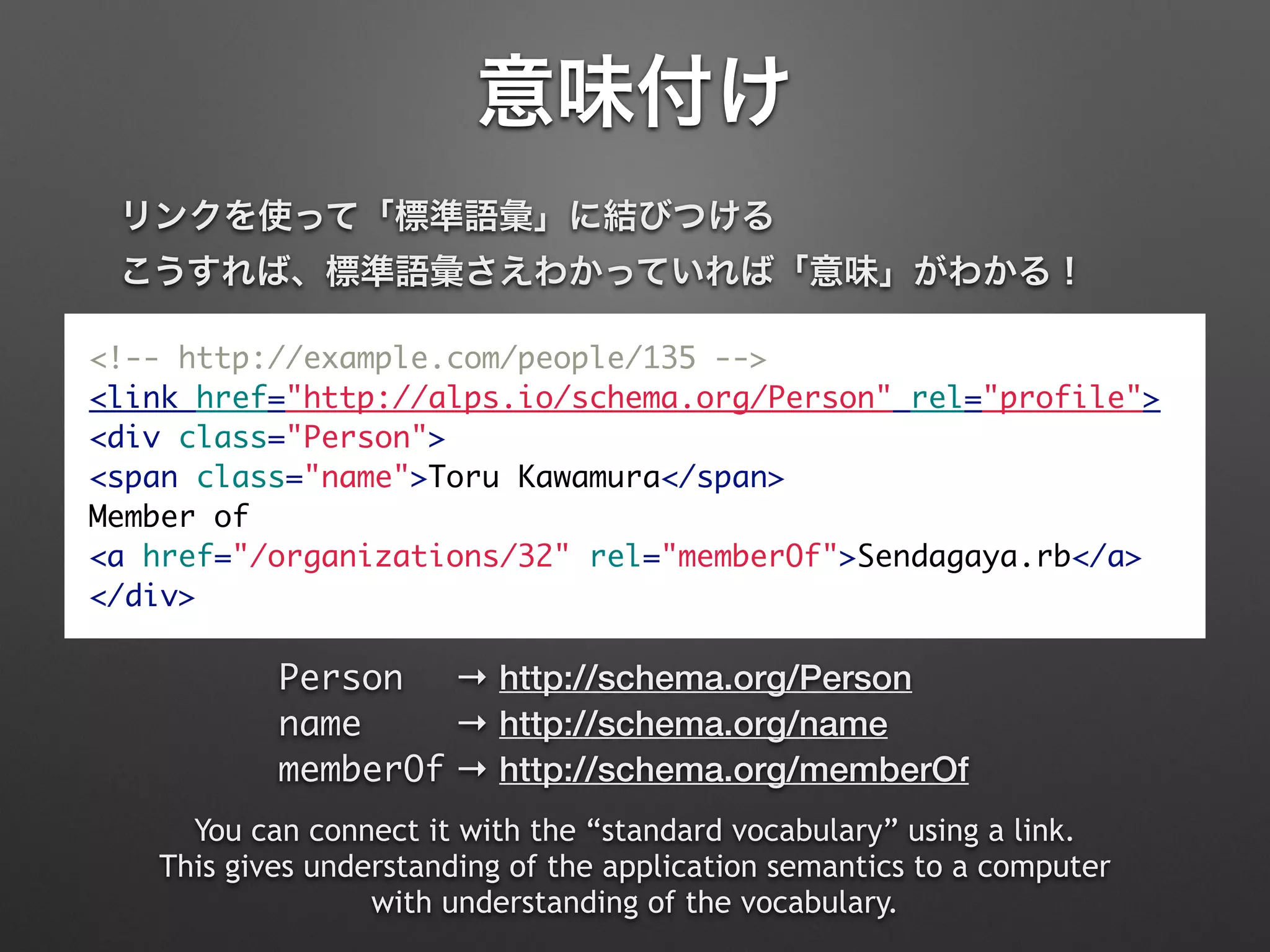
意味付け
リンクを使って「標準語彙」に結びつける

こうすれば、標準語彙さえわかっていれば「意味」がわかる!
<!-- http://example.com/people/135 -->	
<link href="http://alps.io/schema.org/Person" rel="profile">	
<div class="Person">	
<span class="name">Toru Kawamura</span>	
Member of 

<a href="/organizations/32" rel="memberOf">Sendagaya.rb</a>	
</div>
Person → http://schema.org/Person

name → http://schema.org/name

memberOf → http://schema.org/memberOf
You can connect it with the “standard vocabulary” using a link. 

This gives understanding of the application semantics to a computer
with understanding of the vocabulary.
夢の世界
person = Person.find('http://example.com/people/135')	
# fetch http://example.com/people/135	
# => <ActiveNantoka::Person>	
person.items_for('http://schema.org/name')	
# => ["Toru Kawamura"]	
person.links_for('http://schema.org/memberOf')	
# fetch http://example.com/organizations/32	
# => [<ActiveNantoka::Organization>]
「標準語彙名(standard vocabulary)」で値やリンクを取得できる
リンクは has_one/has_many 的リレーションに
Imagine…
何がうれしい?
{	
"fullname" : "Toru Kawamura",	
"organizations" : [	
{	
"title" : "Sendagaya.rb",	
"url" : "/organizations/32"	
}	
]	
}
fullname → http://schema.org/name

organizations.url → http://schema.org/memberOf
JSONでも標準語彙に結びつけてあれば、全く同様に扱える!
「意味」が同じであれば、APIの構造が違っても同一のインターフェイスで扱える
ハイパーメディアをちゃんと使えば
• APIのフォーマットや構造に依存しない

変更してもクライアントが壊れない
• クライアントがさまざまなAPIの中の情報を適切に扱える
Using hypermedia properly, clients won’t break
– Introductionより
ハイパーメディアは、RESTのまさに最も重要な側面で
あり、最も理解されていないものです。
“hypermedia is the single most important aspect of REST, 

and the least understood.”
“
その考え方がこの本には

まとまっています!
Those ideas are 

collected in this book.
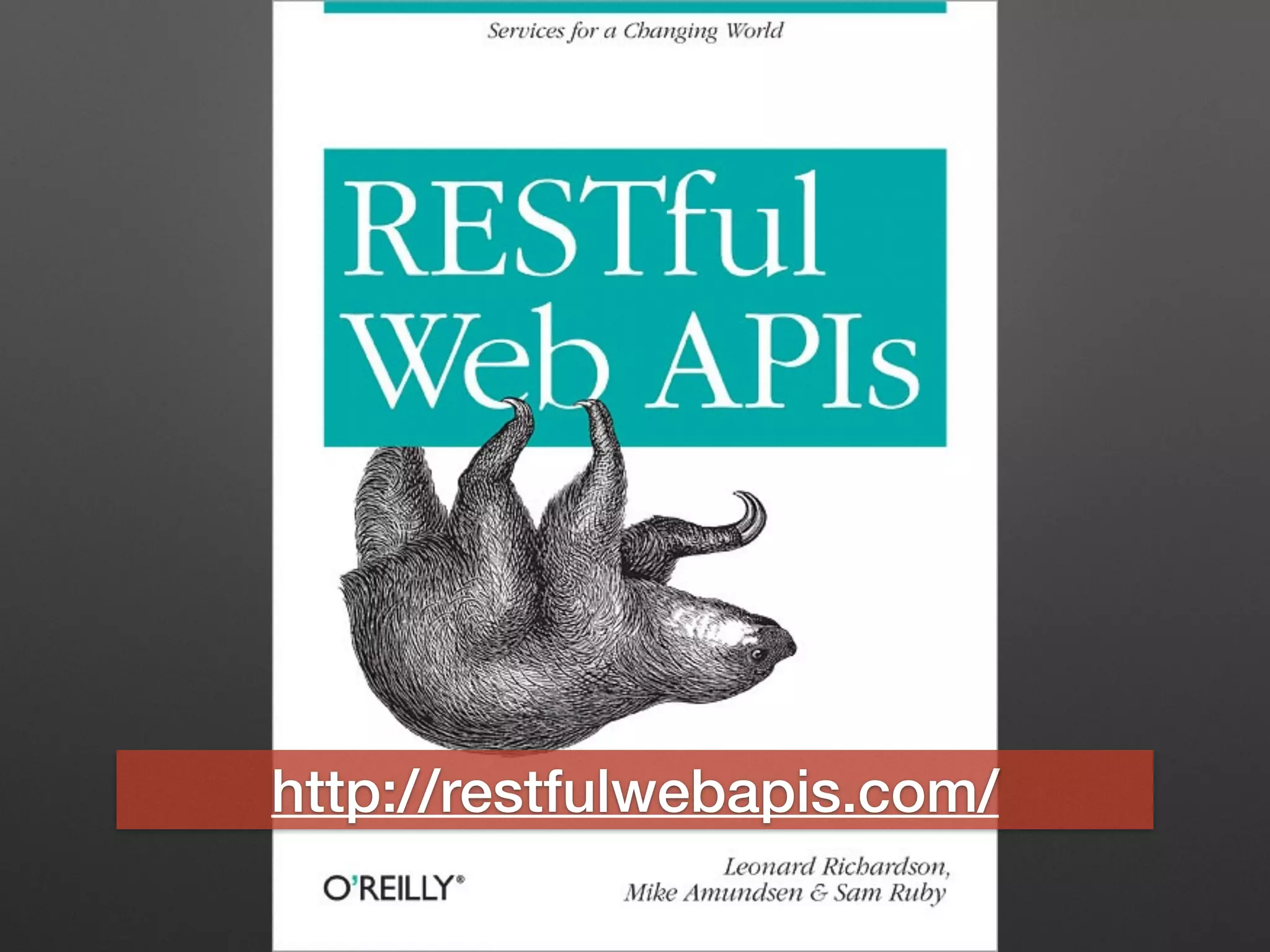
http://restfulwebapis.com/

RESTful Meetup vol.3 Introduction