REST WEB SERVICE? NO,
GRAPHQL PLEASE!
DIMITRI GIELIS
DIMITRI GIELIS
ABOUT ME
▸ Founder & CEO of APEX R&D
▸ 20+ years of Oracle Experience 

(OCP & APEX Certified)
▸ Oracle ACE Director
▸ “APEX Developer of the year 2009” by Oracle Magazine
▸ “Oracle Developer Choice award (ORDS)” in 2015
▸ Author Expert Oracle APEX
▸ Presenter at Conferences
www.apexofficeprint.comwww.apexRnD.be
http://dgielis.blogspot.com @dgielis
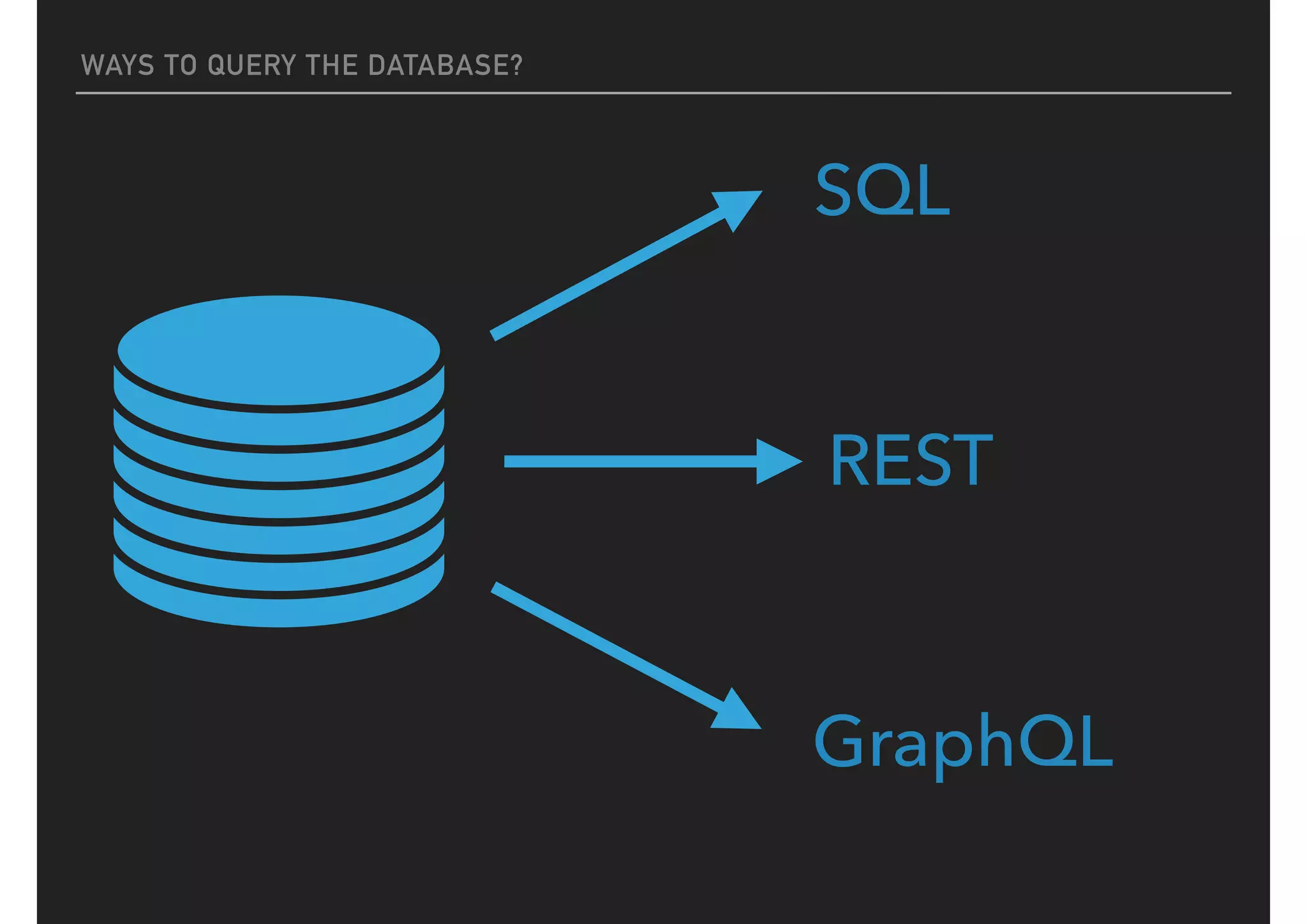
WAYS TO QUERY THE DATABASE?
SQL
REST
GraphQL
SQL
STRUCTUREDQL
GRAPHQL
REST
CREATE API?
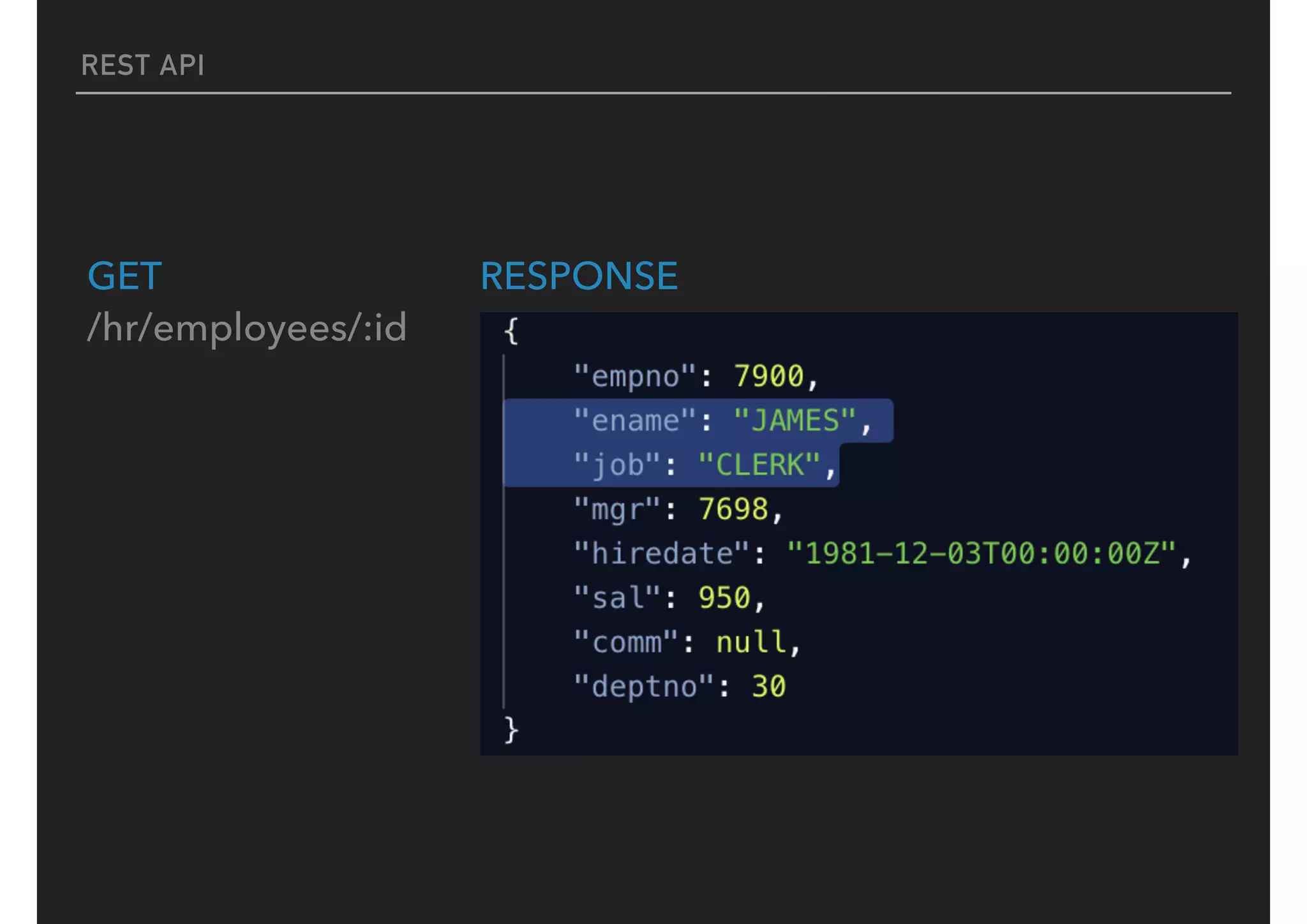
REST API
/hr/employees/:id
GET RESPONSE
REST API
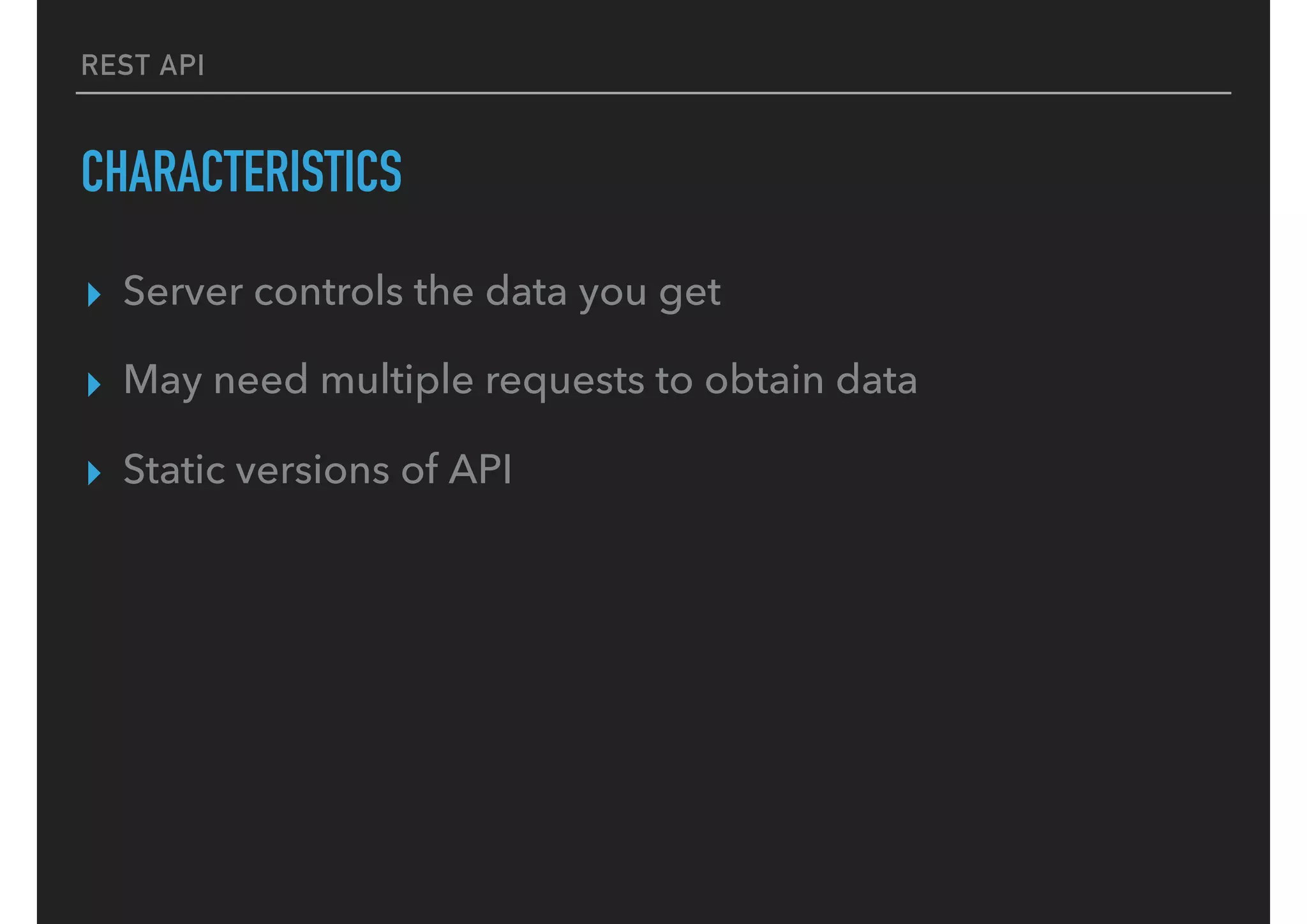
CHARACTERISTICS
▸ Server controls the data you get
▸ May need multiple requests to obtain data
▸ Static versions of API
GRAPHQL
CREATE API?
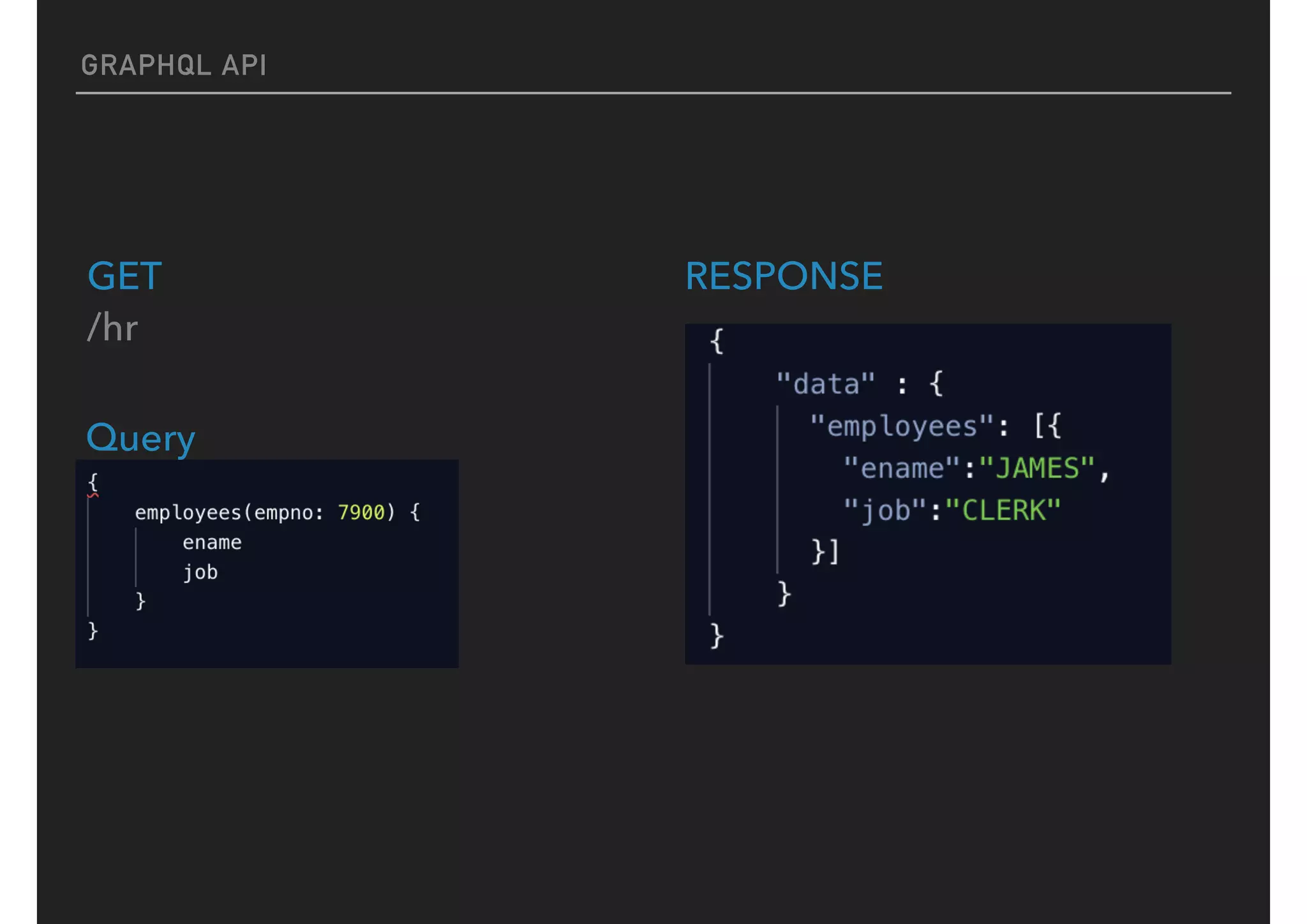
GRAPHQL API
/hr
GET RESPONSE
Query
GRAPHQL
CHARACTERISTICS
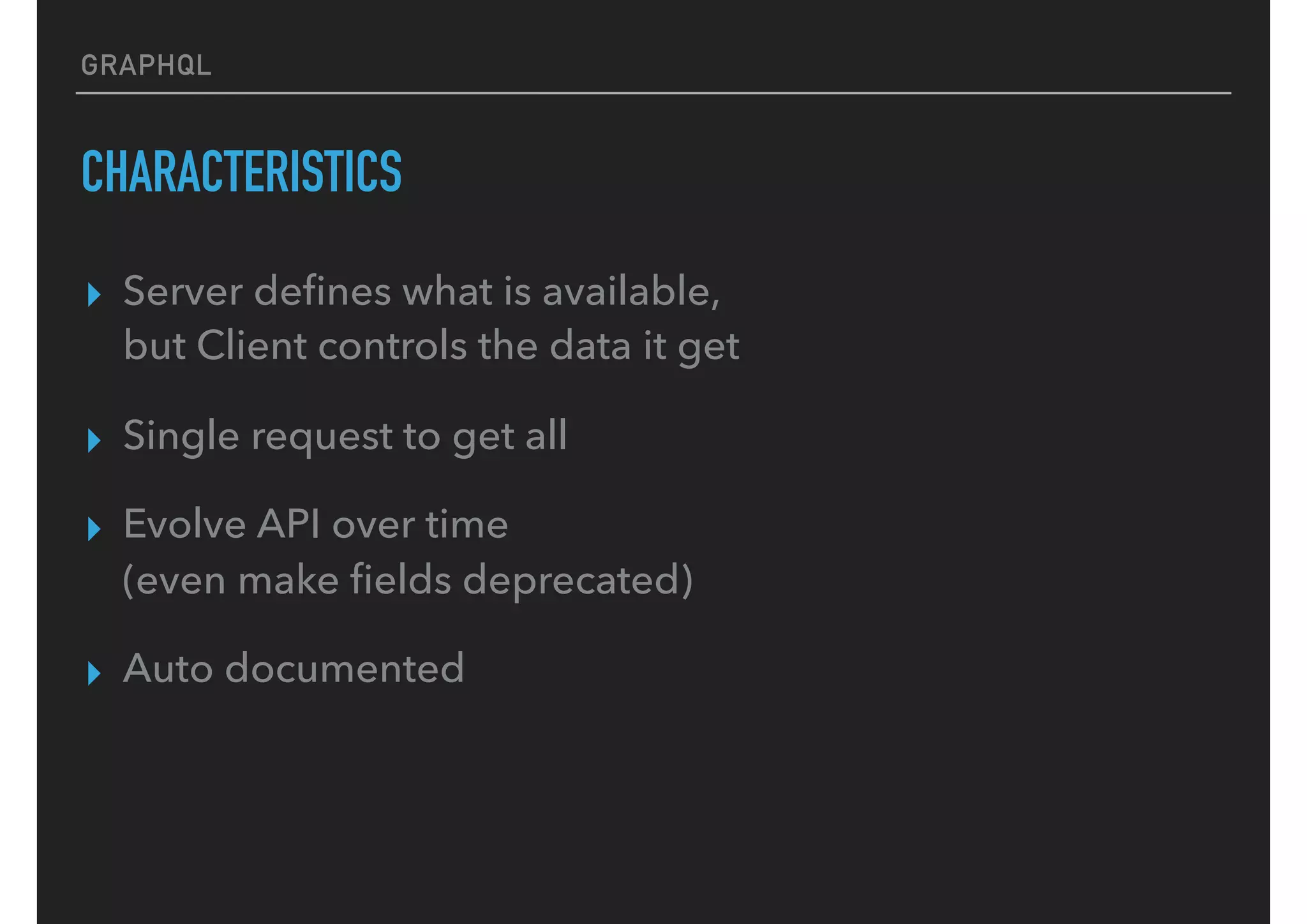
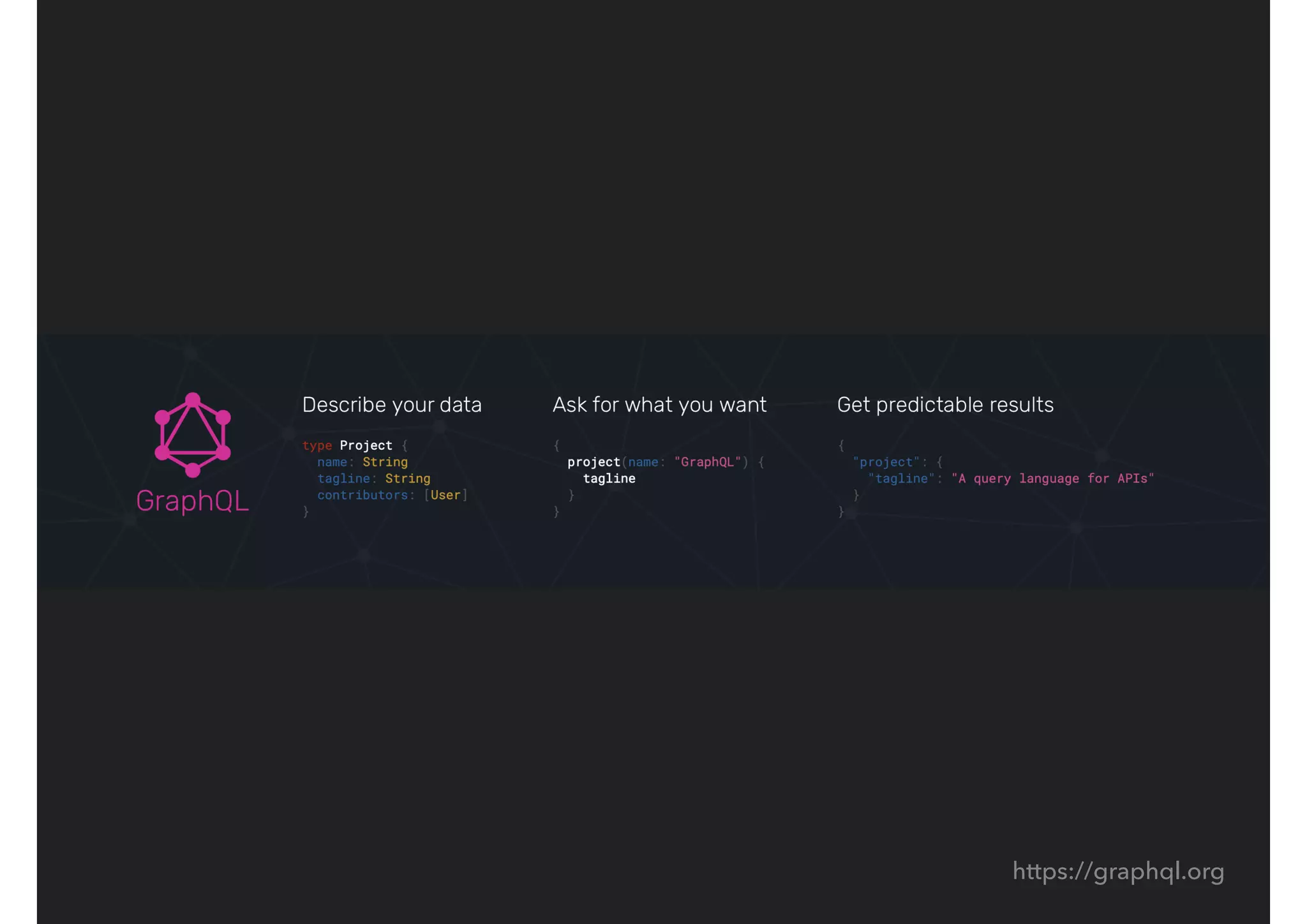
▸ Server defines what is available, 

but Client controls the data it get
▸ Single request to get all
▸ Evolve API over time 

(even make fields deprecated)
▸ Auto documented
https://graphql.org
GRAPHQL
HISTORY
▸ Facebook's mobile apps have been powered by GraphQL
since 2012.
▸ A GraphQL spec was open sourced in 2015
▸ Many implementations in different languages
▸ Used by many big companies e.g.
DEMO (CONSUMING)
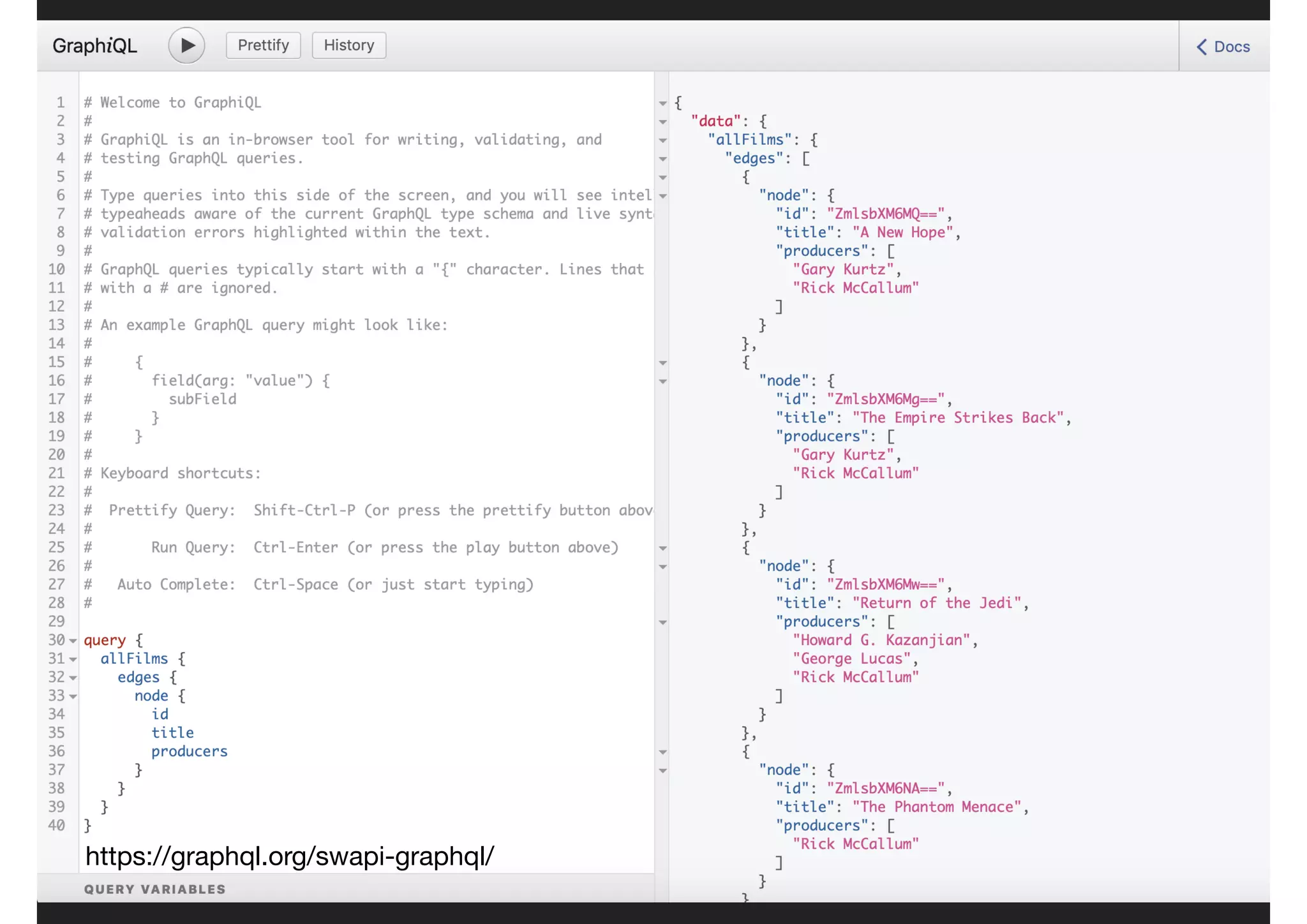
https://graphql.org/swapi-graphql/
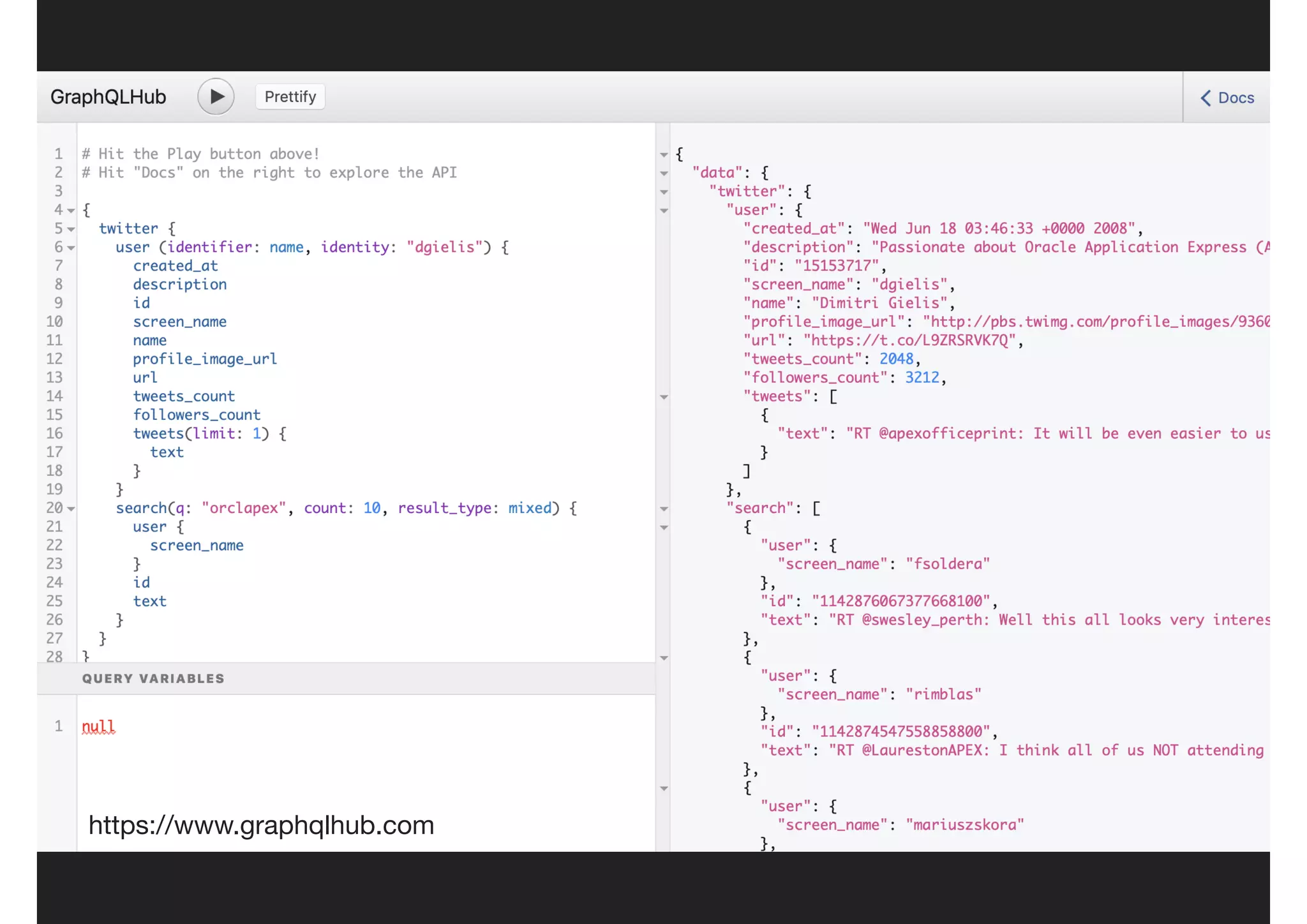
https://www.graphqlhub.com
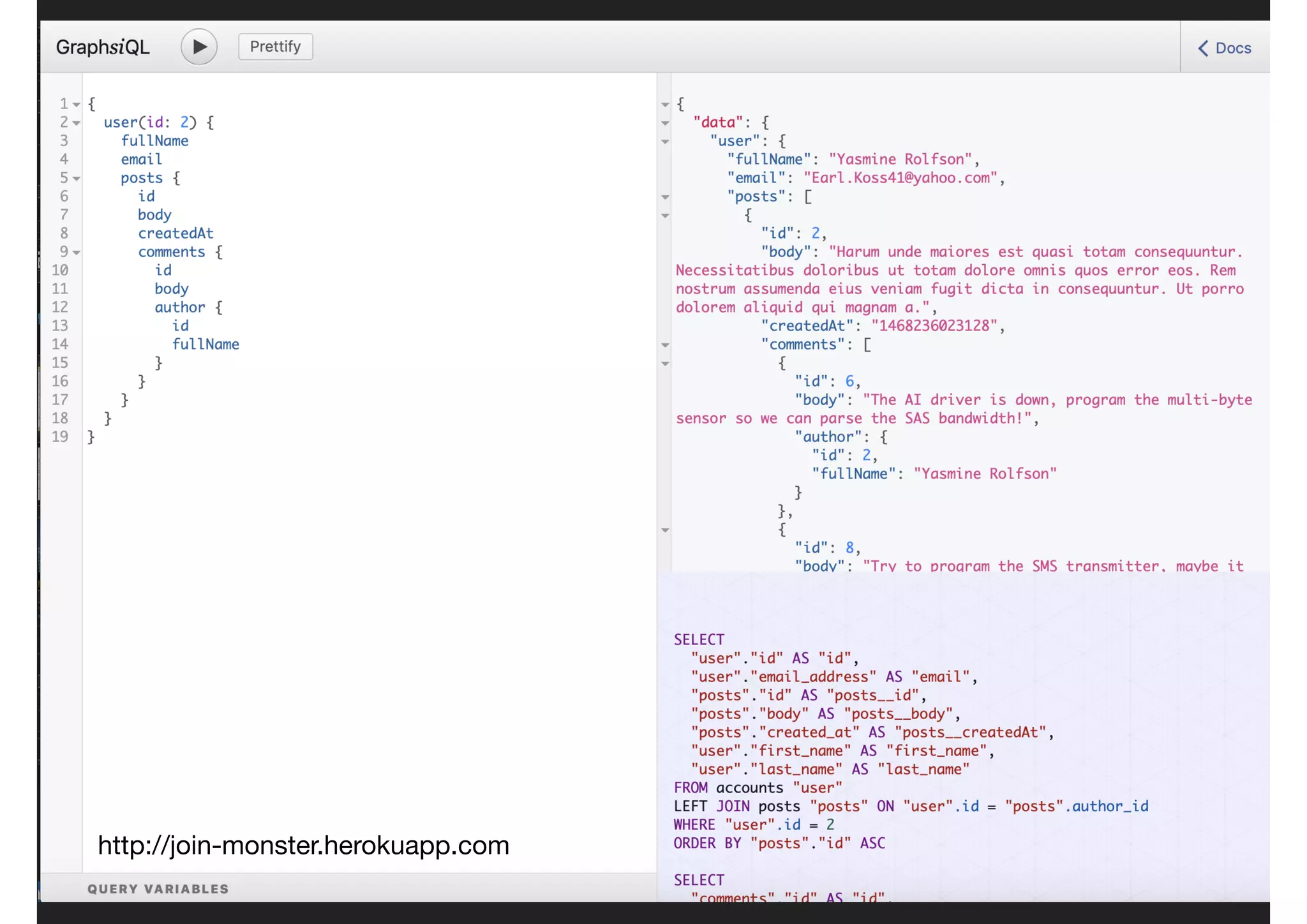
http://join-monster.herokuapp.com
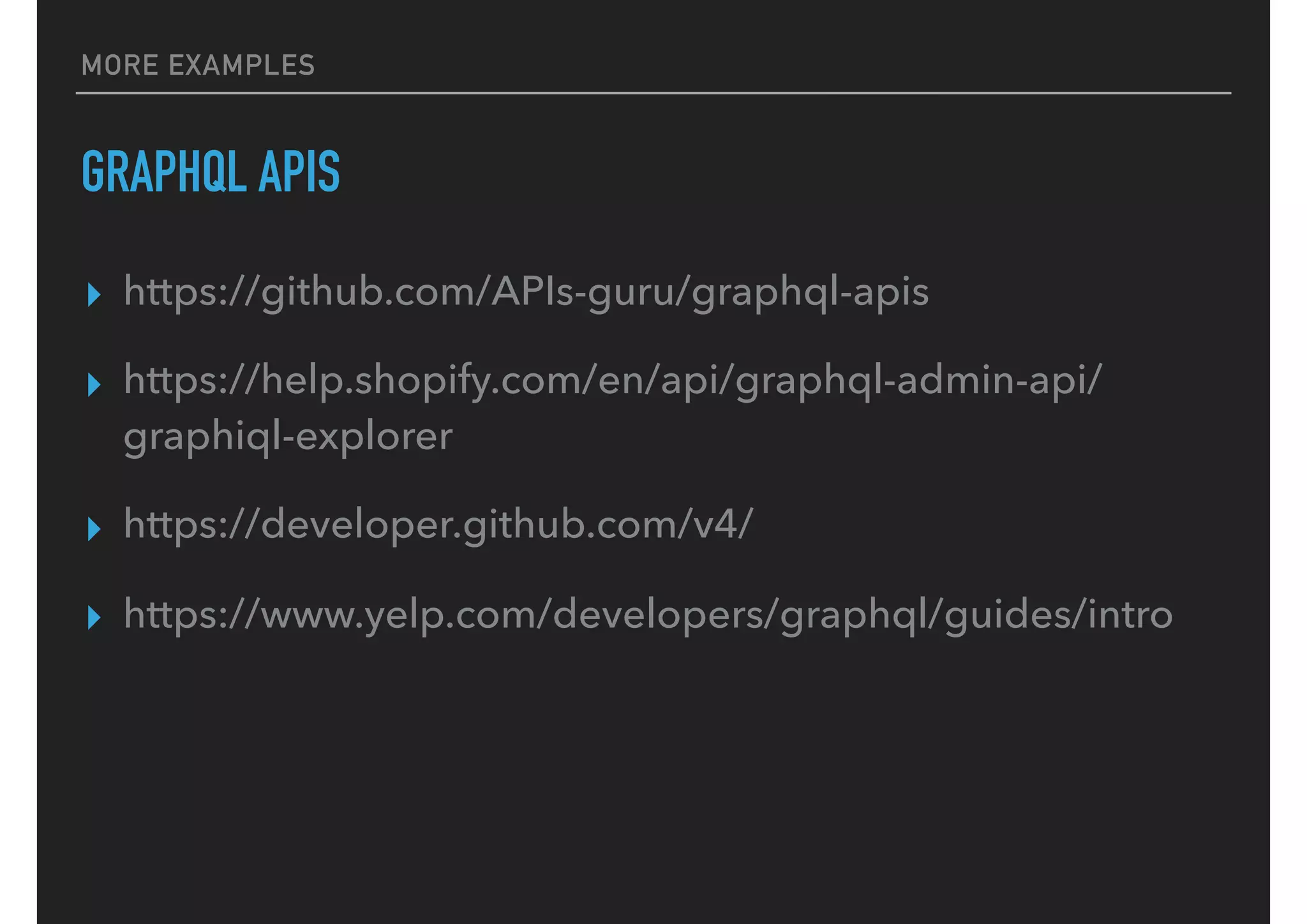
MORE EXAMPLES
GRAPHQL APIS
▸ https://github.com/APIs-guru/graphql-apis
▸ https://help.shopify.com/en/api/graphql-admin-api/
graphiql-explorer
▸ https://developer.github.com/v4/
▸ https://www.yelp.com/developers/graphql/guides/intro
GETTING
STARTED
GRAPHQL AND THE
ORACLE DATABASE
GRAPHQL AND THE ORACLE DATABASE
BUILDING BLOCKS
▸ Oracle Database
▸ node.js
▸ oracledb
▸ graphql
▸ apollo-server
MY DEVELOPMENT ENVIRONMENT
▸ Visual Studio Code
▸ Sqlcl
▸ Git
▸ node.js & nvm & npm
▸ Instant Oracle client / Oracle Database
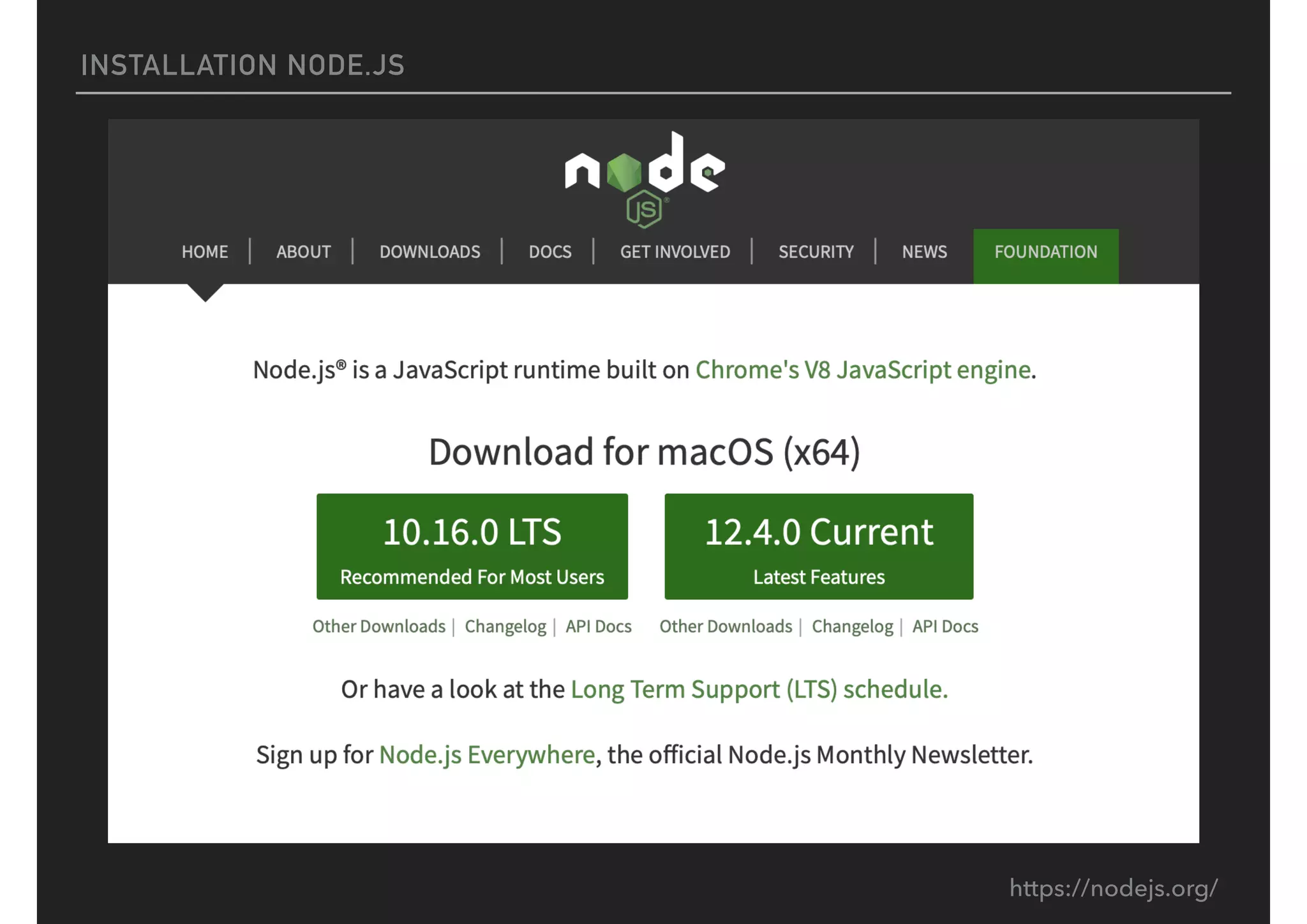
INSTALLATION NODE.JS
https://nodejs.org/
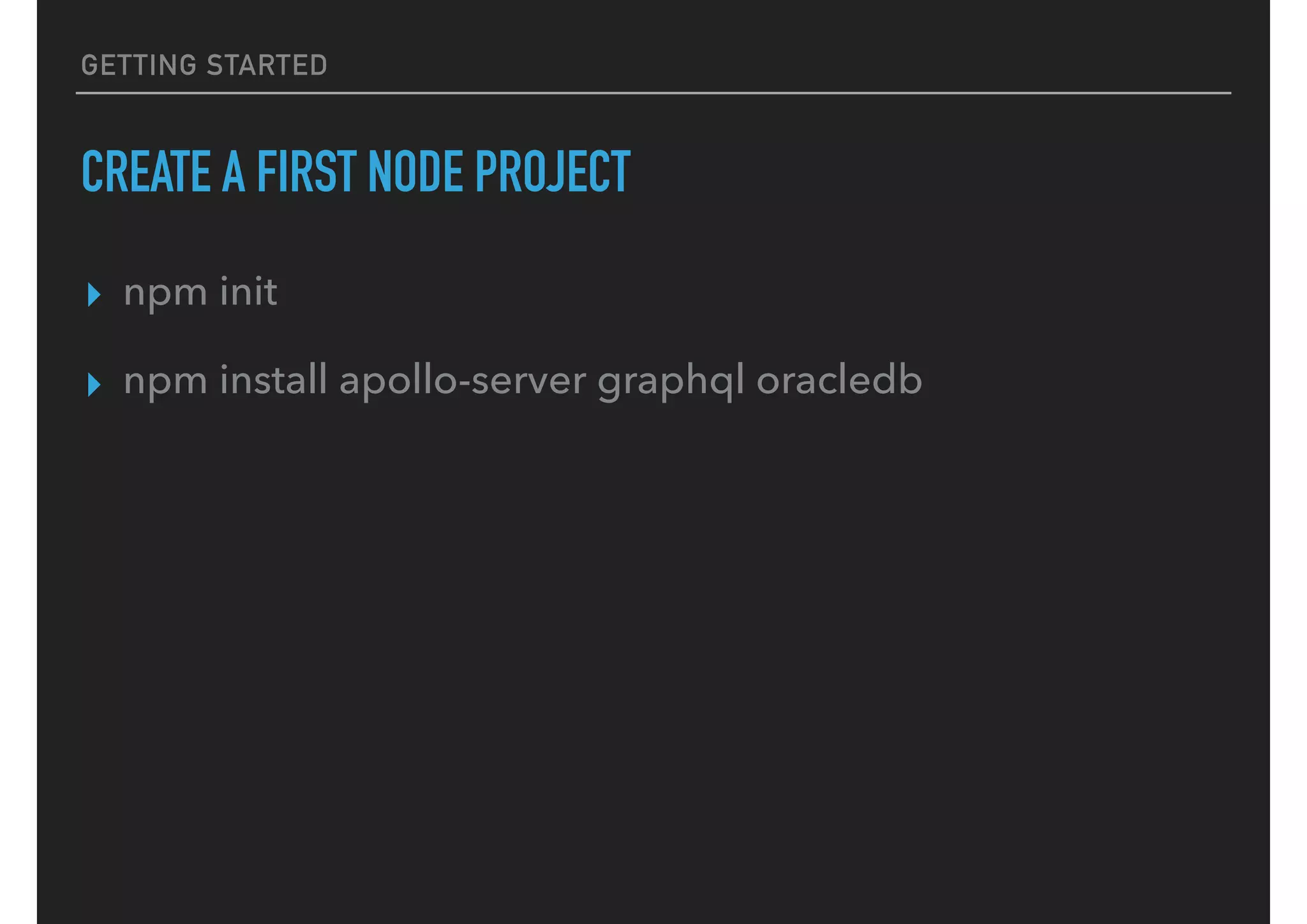
GETTING STARTED
CREATE A FIRST NODE PROJECT
▸ npm init
▸ npm install apollo-server graphql oracledb
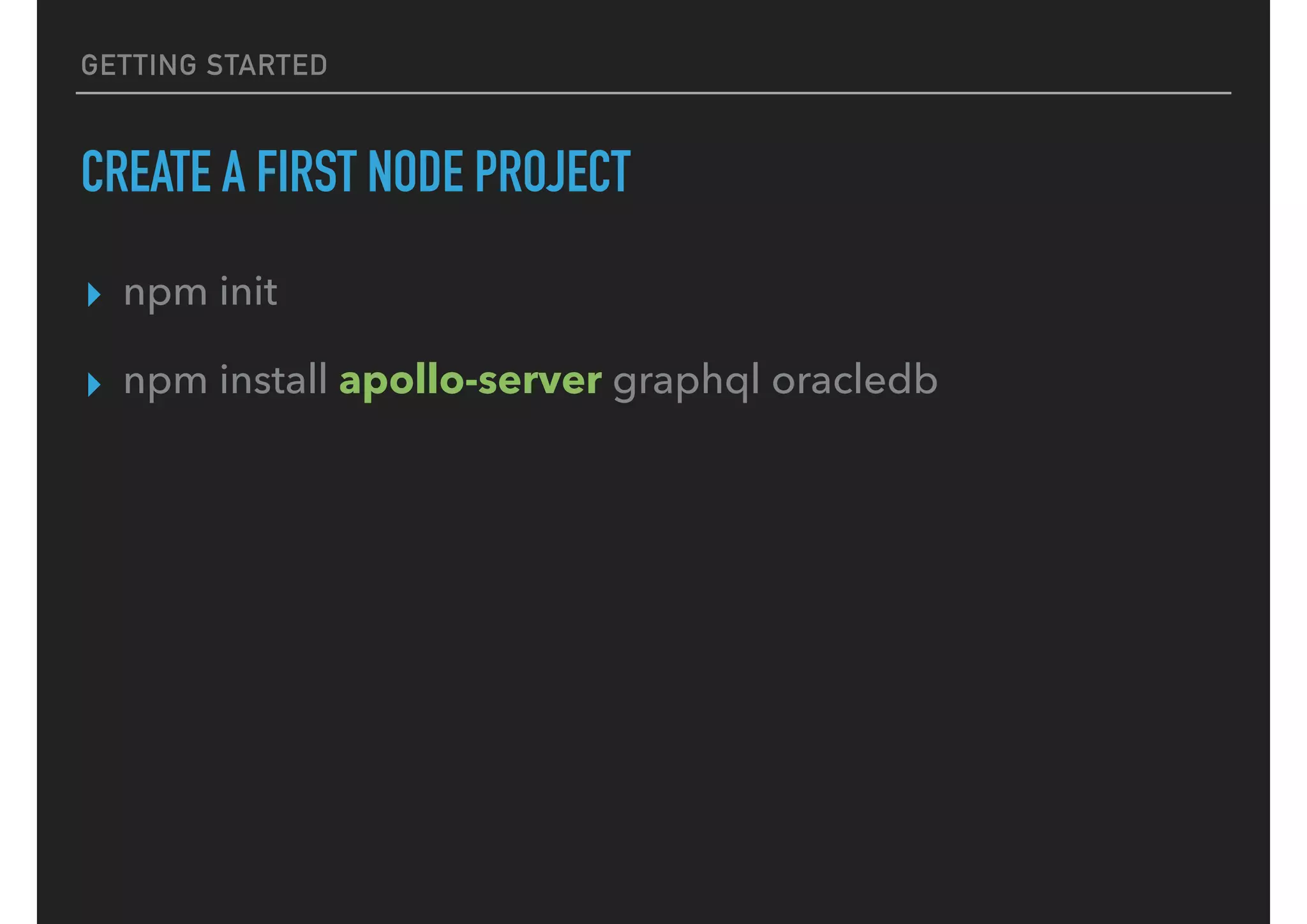
GETTING STARTED
CREATE A FIRST NODE PROJECT
▸ npm init
▸ npm install apollo-server graphql oracledb
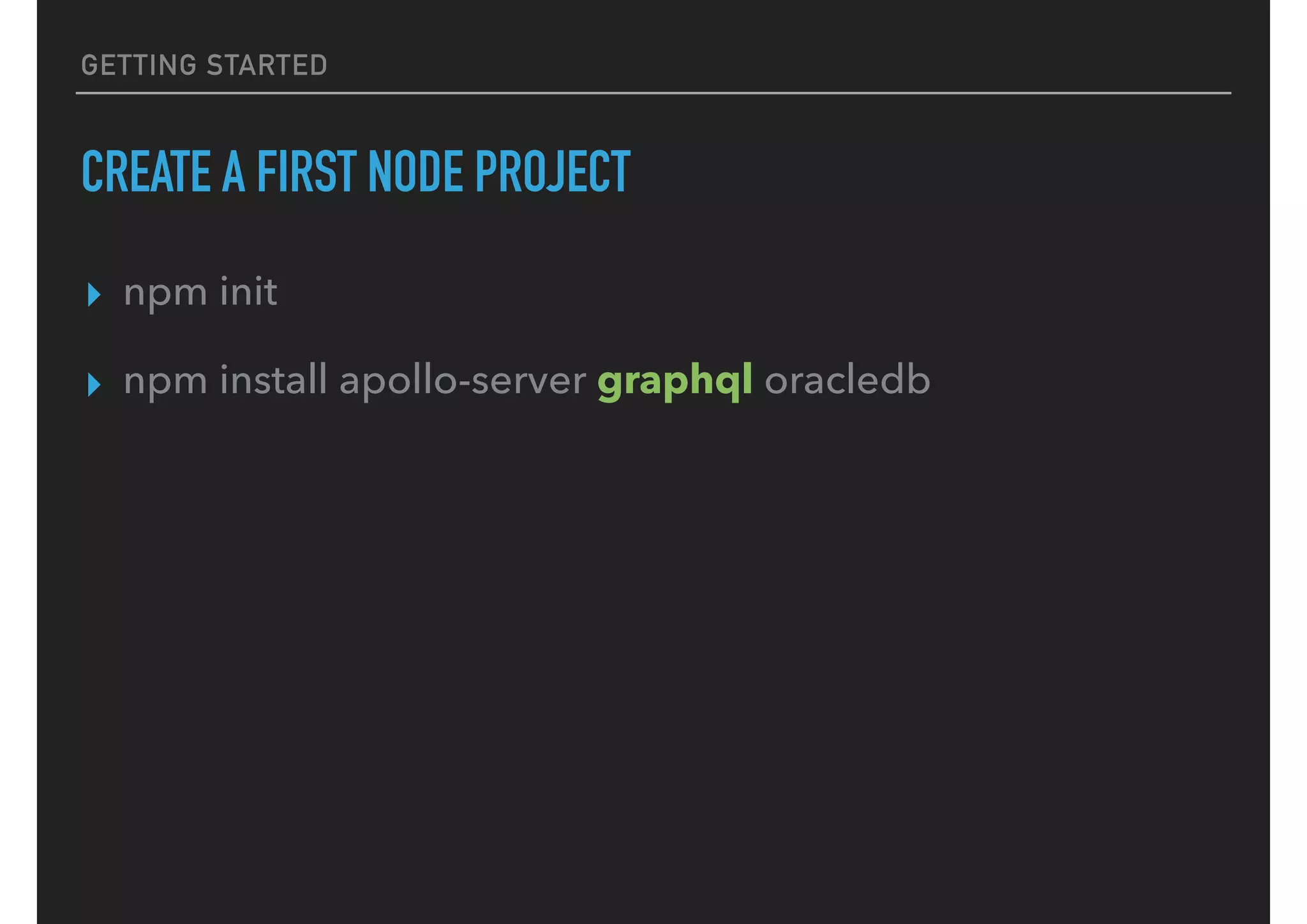
GETTING STARTED
CREATE A FIRST NODE PROJECT
▸ npm init
▸ npm install apollo-server graphql oracledb
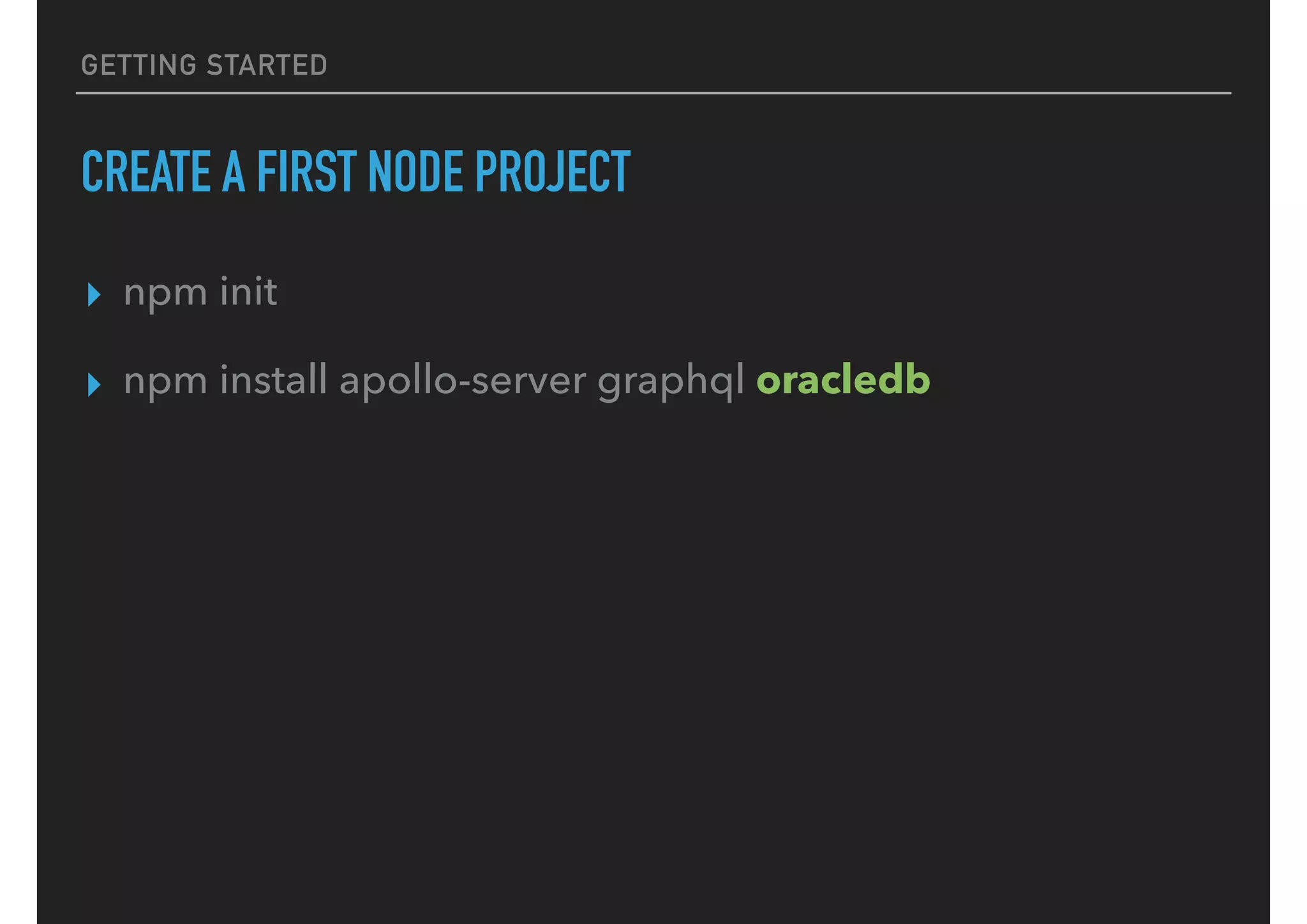
GETTING STARTED
CREATE A FIRST NODE PROJECT
▸ npm init
▸ npm install apollo-server graphql oracledb
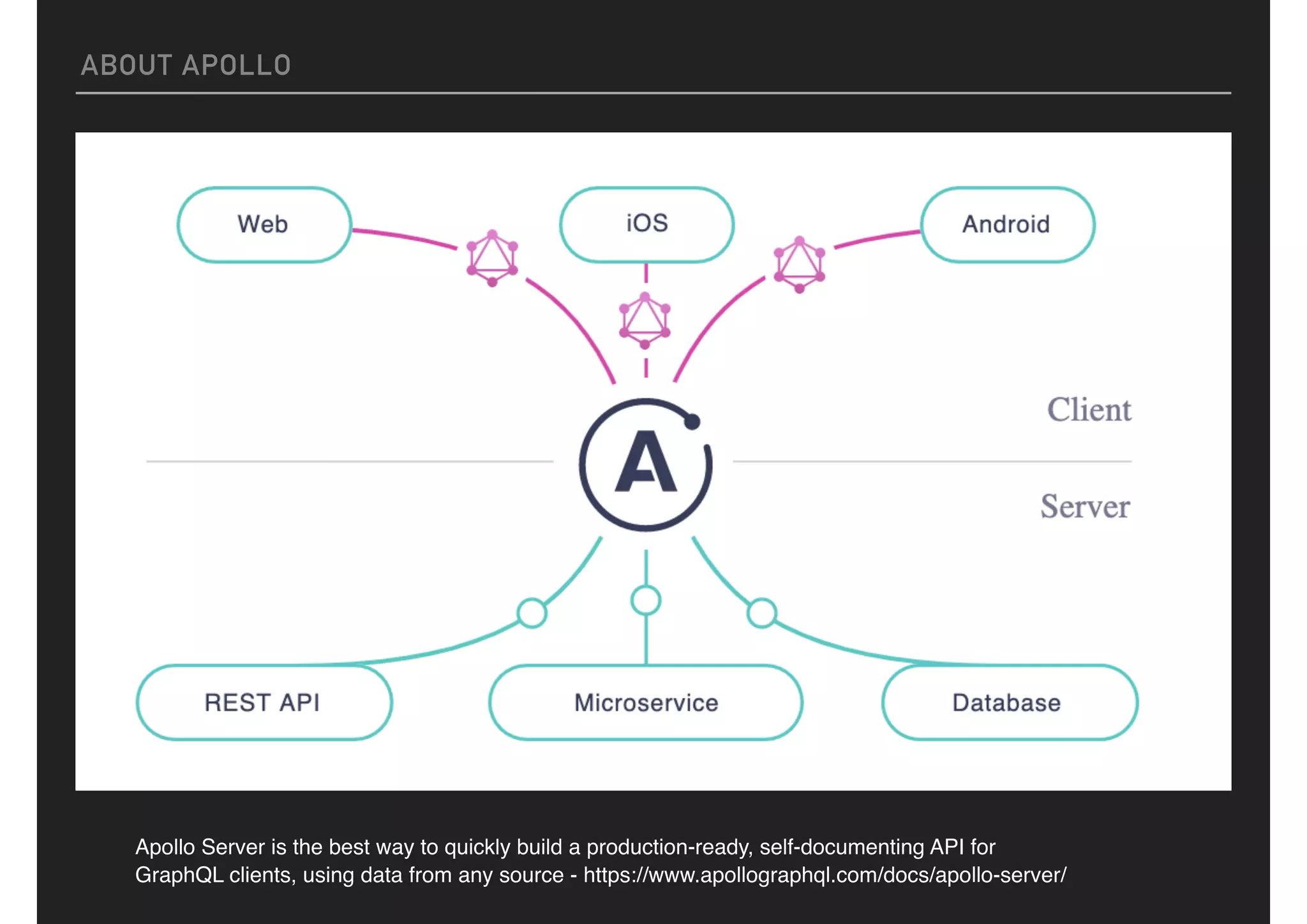
ABOUT APOLLO
Apollo Server is the best way to quickly build a production-ready, self-documenting API for
GraphQL clients, using data from any source - https://www.apollographql.com/docs/apollo-server/
CREATE AN APOLLO SERVER
const { ApolloServer, gql } = require('apollo-server');
// This is a (sample) collection of books
const books = [{title: 'Book1'},{title: 'Book2'}];
// Type definitions define the "shape" of your data
const typeDefs = gql`
type Book {title: String}
type Query {books: [Book]}
`;
// Resolvers define the technique for fetching the types
const resolvers = { Query: {books: () => books } };
// The Apollo Server can be started by passing
// type definitions and the resolvers
const server = new ApolloServer({ typeDefs, resolvers });
// This `listen` method launches a web-server
server.listen().then(({ url }) => {
console.log(`🚀 Server ready at ${url}`);
});
https://www.apollographql.com/docs/apollo-server/getting-started/
CREATE AN APOLLO SERVER
const { ApolloServer, gql } = require('apollo-server');
// This is a (sample) collection of books
const books = [{title: 'Book1'},{title: 'Book2'}];
// Type definitions define the "shape" of your data
const typeDefs = gql`
type Book {title: String}
type Query {books: [Book]}
`;
// Resolvers define the technique for fetching the types
const resolvers = { Query: {books: () => books } };
// The Apollo Server can be started by passing
// type definitions and the resolvers
const server = new ApolloServer({ typeDefs, resolvers });
// This `listen` method launches a web-server
server.listen().then(({ url }) => {
console.log(`🚀 Server ready at ${url}`);
});
https://www.apollographql.com/docs/apollo-server/getting-started/
CREATE AN APOLLO SERVER
const { ApolloServer, gql } = require('apollo-server');
// This is a (sample) collection of books
const books = [{title: 'Book1'},{title: 'Book2'}];
// Type definitions define the "shape" of your data
const typeDefs = gql`
type Book {title: String}
type Query {books: [Book]}
`;
// Resolvers define the technique for fetching the types
const resolvers = { Query: {books: () => books } };
// The Apollo Server can be started by passing
// type definitions and the resolvers
const server = new ApolloServer({ typeDefs, resolvers });
// This `listen` method launches a web-server
server.listen().then(({ url }) => {
console.log(`🚀 Server ready at ${url}`);
});
https://www.apollographql.com/docs/apollo-server/getting-started/
CREATE AN APOLLO SERVER
const { ApolloServer, gql } = require('apollo-server');
// This is a (sample) collection of books
const books = [{title: 'Book1'},{title: 'Book2'}];
// Type definitions define the "shape" of your data
const typeDefs = gql`
type Book {title: String}
type Query {books: [Book]}
`;
// Resolvers define the technique for fetching the types
const resolvers = { Query: {books: () => books } };
// The Apollo Server can be started by passing
// type definitions and the resolvers
const server = new ApolloServer({ typeDefs, resolvers });
// This `listen` method launches a web-server
server.listen().then(({ url }) => {
console.log(`🚀 Server ready at ${url}`);
});
https://www.apollographql.com/docs/apollo-server/getting-started/
CREATE AN APOLLO SERVER
const { ApolloServer, gql } = require('apollo-server');
// This is a (sample) collection of books
const books = [{title: 'Book1'},{title: 'Book2'}];
// Type definitions define the "shape" of your data
const typeDefs = gql`
type Book {title: String}
type Query {books: [Book]}
`;
// Resolvers define the technique for fetching the types
const resolvers = { Query: {books: () => books } };
// The Apollo Server can be started by passing
// type definitions and the resolvers
const server = new ApolloServer({ typeDefs, resolvers });
// This `listen` method launches a web-server
server.listen().then(({ url }) => {
console.log(`🚀 Server ready at ${url}`);
});
https://www.apollographql.com/docs/apollo-server/getting-started/
CREATE AN APOLLO SERVER
const { ApolloServer, gql } = require('apollo-server');
// This is a (sample) collection of books
const books = [{title: 'Book1'},{title: 'Book2'}];
// Type definitions define the "shape" of your data
const typeDefs = gql`
type Book {title: String}
type Query {books: [Book]}
`;
// Resolvers define the technique for fetching the types
const resolvers = { Query: {books: () => books } };
// The Apollo Server can be started by passing
// type definitions and the resolvers
const server = new ApolloServer({ typeDefs, resolvers });
// This `listen` method launches a web-server
server.listen().then(({ url }) => {
console.log(`🚀 Server ready at ${url}`);
});
https://www.apollographql.com/docs/apollo-server/getting-started/
CREATE AN APOLLO SERVER
const { ApolloServer, gql } = require('apollo-server');
// This is a (sample) collection of books
const books = [{title: 'Book1'},{title: 'Book2'}];
// Type definitions define the "shape" of your data
const typeDefs = gql`
type Book {title: String}
type Query {books: [Book]}
`;
// Resolvers define the technique for fetching the types
const resolvers = { Query: {books: () => books } };
// The Apollo Server can be started by passing
// type definitions and the resolvers
const server = new ApolloServer({ typeDefs, resolvers });
// This `listen` method launches a web-server
server.listen().then(({ url }) => {
console.log(`🚀 Server ready at ${url}`);
});
https://www.apollographql.com/docs/apollo-server/getting-started/
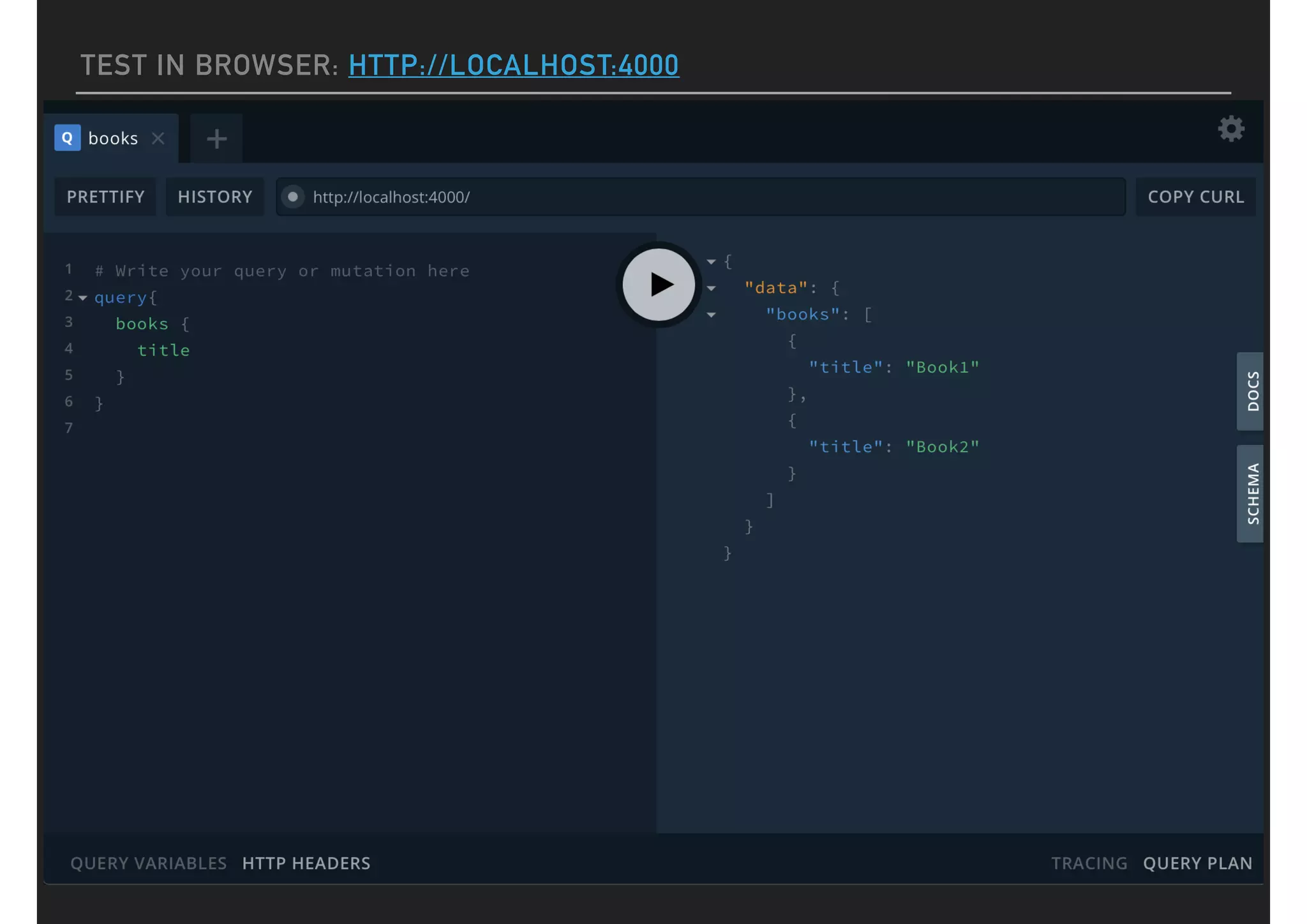
TEST IN BROWSER: HTTP://LOCALHOST:4000
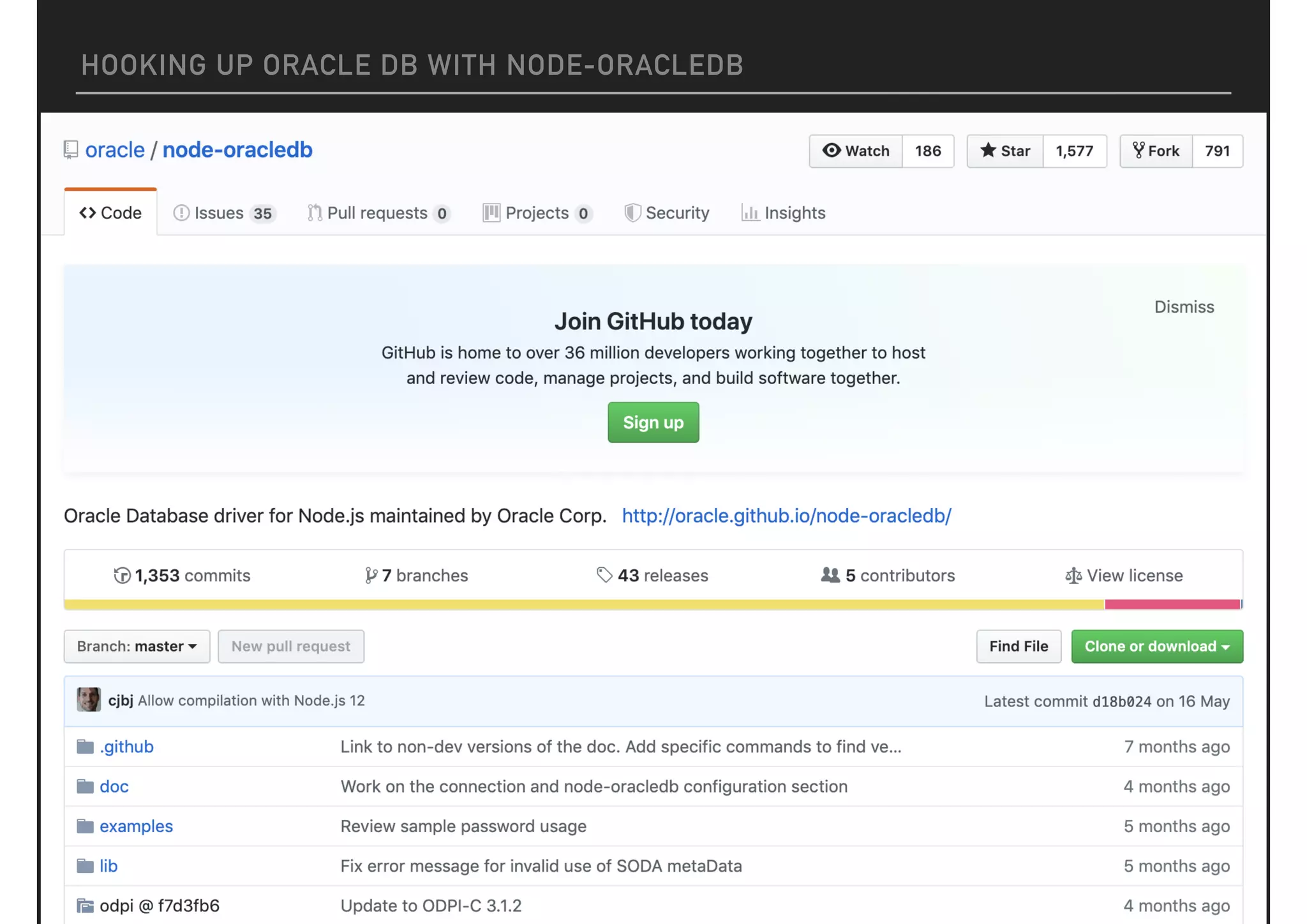
HOOKING UP ORACLE DB WITH NODE-ORACLEDB
QUERY ORACLE DB
var oracledb = require('oracledb');
async function run() {
let connection;
try {
connection = await oracledb.getConnection( {
user : "hr",
password : "hr",
connectString : "localhost/XEPDB1"
});
let result = await connection.execute(
`SELECT manager_id, department_id, department_name
FROM departments
WHERE manager_id = :id`,
[103], // bind value for :id
);
console.log(result.rows);
} catch (err) {
console.error(err);
} finally {
if (connection) {
try {
await connection.close();
} catch (err) {
console.error(err);
}
}
}
}
run();
https://oracle.github.io/node-oracledb/doc/api.html#getstarted
QUERY ORACLE DB
var oracledb = require('oracledb');
async function run() {
let connection;
try {
connection = await oracledb.getConnection( {
user : "hr",
password : "hr",
connectString : "localhost/XEPDB1"
});
let result = await connection.execute(
`SELECT manager_id, department_id, department_name
FROM departments
WHERE manager_id = :id`,
[103], // bind value for :id
);
console.log(result.rows);
} catch (err) {
console.error(err);
} finally {
if (connection) {
try {
await connection.close();
} catch (err) {
console.error(err);
}
}
}
}
run();
https://oracle.github.io/node-oracledb/doc/api.html#getstarted
QUERY ORACLE DB
var oracledb = require('oracledb');
async function run() {
let connection;
try {
connection = await oracledb.getConnection( {
user : "hr",
password : "hr",
connectString : "localhost/XEPDB1"
});
let result = await connection.execute(
`SELECT manager_id, department_id, department_name
FROM departments
WHERE manager_id = :id`,
[103], // bind value for :id
);
console.log(result.rows);
} catch (err) {
console.error(err);
} finally {
if (connection) {
try {
await connection.close();
} catch (err) {
console.error(err);
}
}
}
}
run();
https://oracle.github.io/node-oracledb/doc/api.html#getstarted
QUERY ORACLE DB
var oracledb = require('oracledb');
async function run() {
let connection;
try {
connection = await oracledb.getConnection( {
user : "hr",
password : "hr",
connectString : "localhost/XEPDB1"
});
let result = await connection.execute(
`SELECT manager_id, department_id, department_name
FROM departments
WHERE manager_id = :id`,
[103], // bind value for :id
);
console.log(result.rows);
} catch (err) {
console.error(err);
} finally {
if (connection) {
try {
await connection.close();
} catch (err) {
console.error(err);
}
}
}
}
run();
https://oracle.github.io/node-oracledb/doc/api.html#getstarted
GETTING STARTED
COMBINING APOLLO AND ORACLE
▸ Map SQL to Types
▸ TIP: 

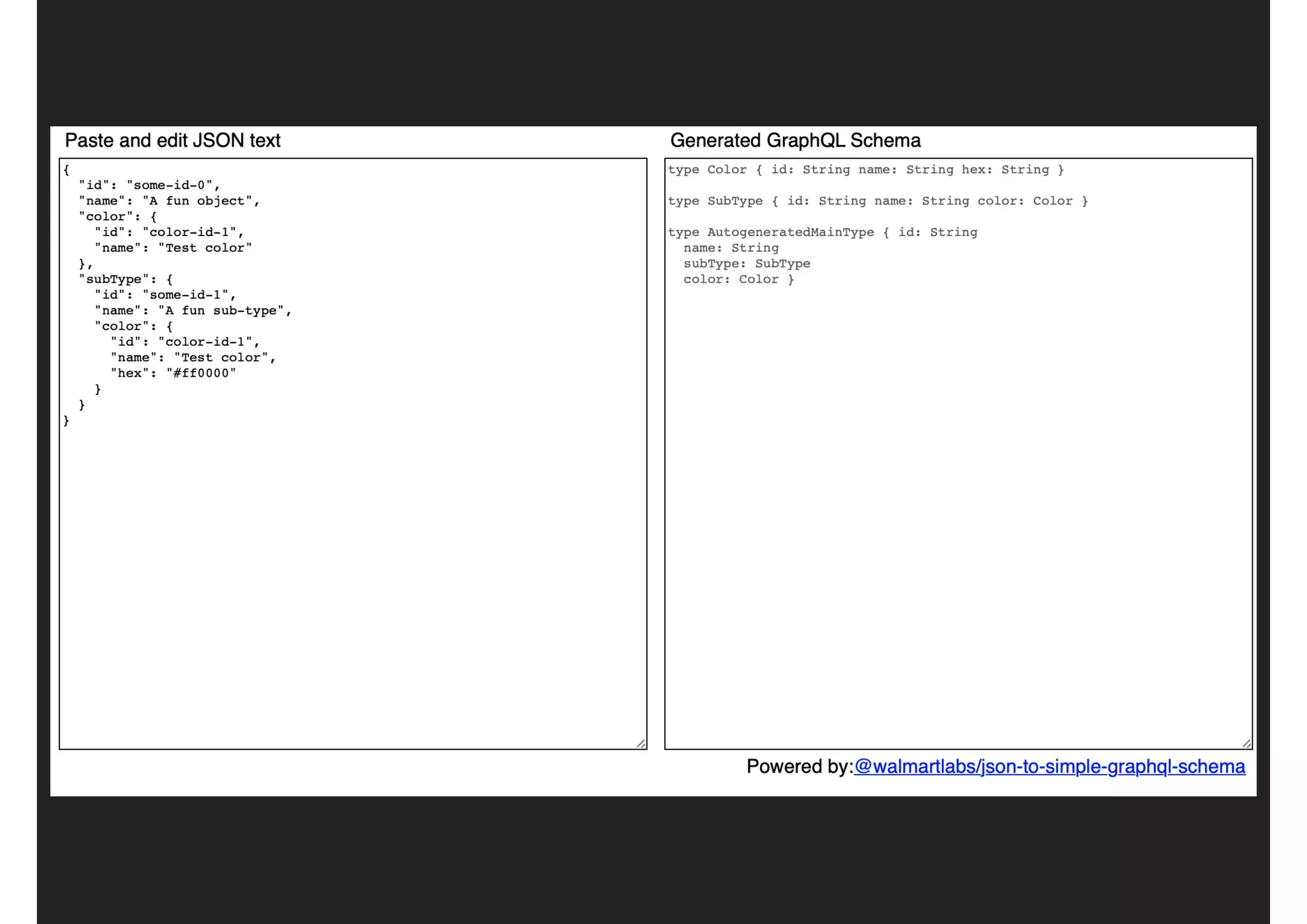
sqlcl to output SQL statement to JSON
▸ convert JSON to GraphQL Types automatically

https://walmartlabs.github.io/json-to-simple-graphql-schema/
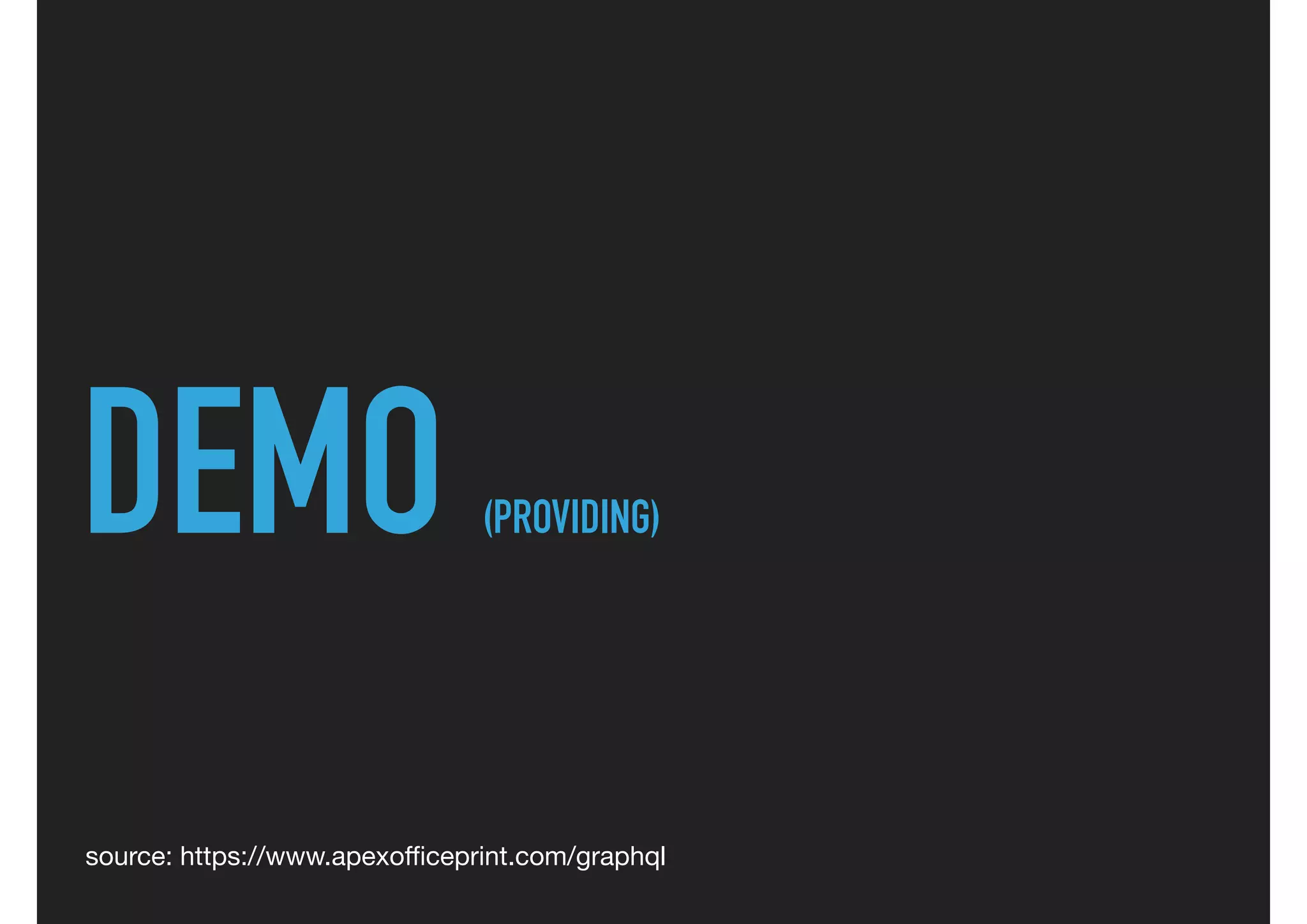
DEMO (PROVIDING)
source: https://www.apexofficeprint.com/graphql
MORE ADVANCED SQL & JOINS
JOIN MONSTER
▸ A GraphQL to SQL query execution layer for query
planning and batch data fetching.
https://github.com/acarl005/join-monster
DEMO (PROVIDING)
source: Dan McGhan presentation: emp/dept example
DETAILS OF GRAPHQL
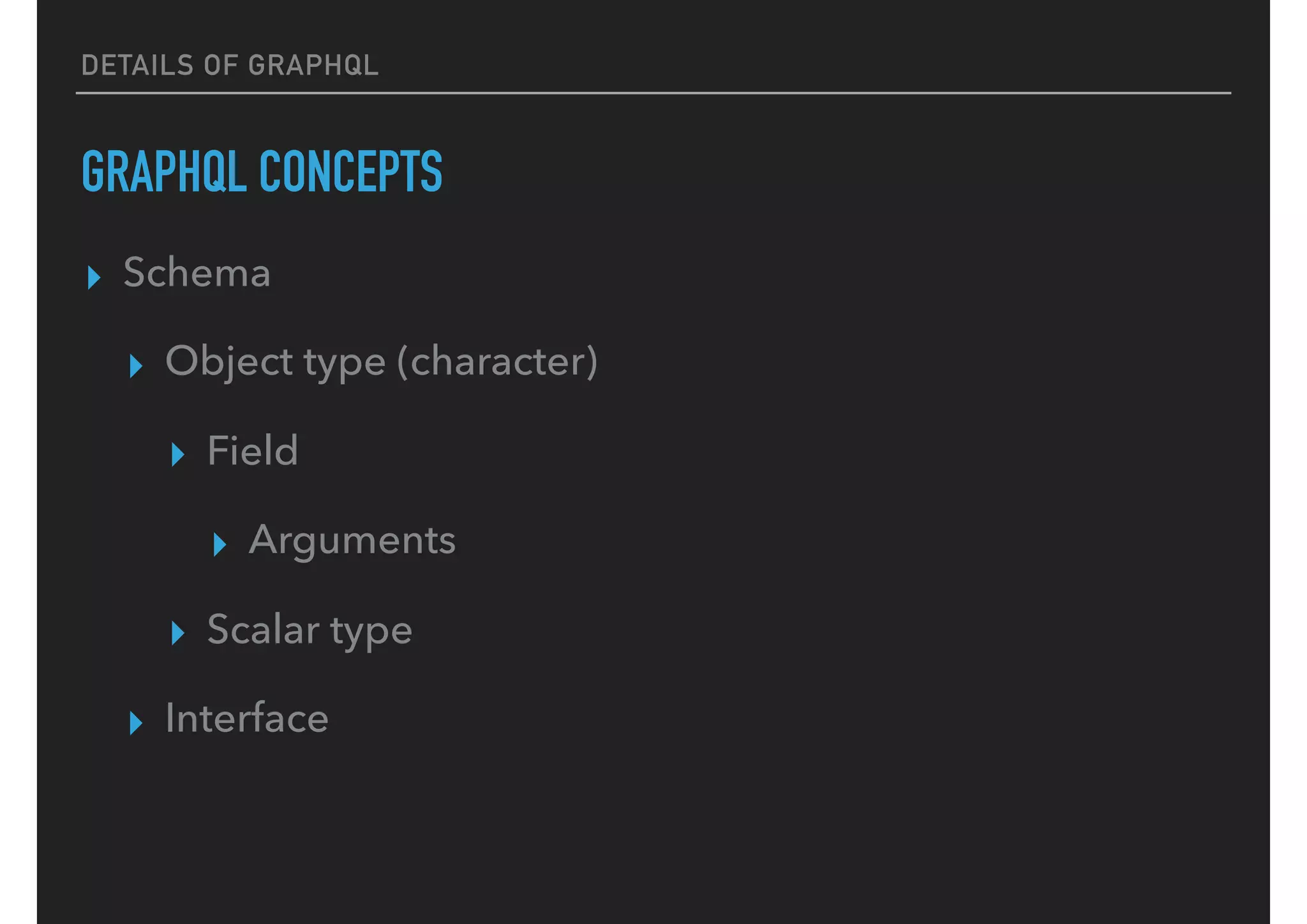
GRAPHQL CONCEPTS
▸ Schema
▸ Object type (character)
▸ Field
▸ Arguments
▸ Scalar type
▸ Interface
DETAILS OF GRAPHQL
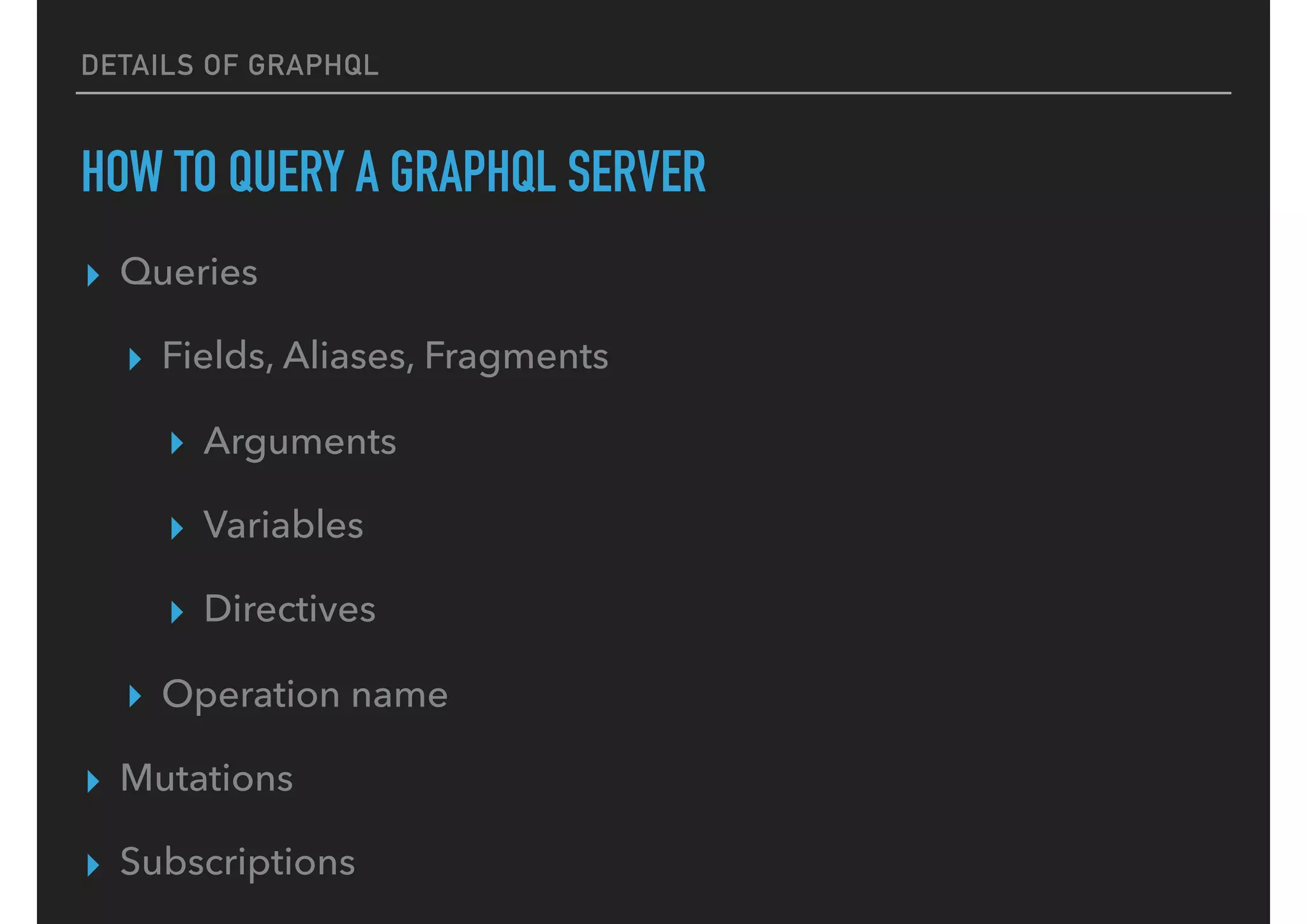
HOW TO QUERY A GRAPHQL SERVER
▸ Queries
▸ Fields, Aliases, Fragments
▸ Arguments
▸ Variables
▸ Directives
▸ Operation name
▸ Mutations
▸ Subscriptions
NEXT
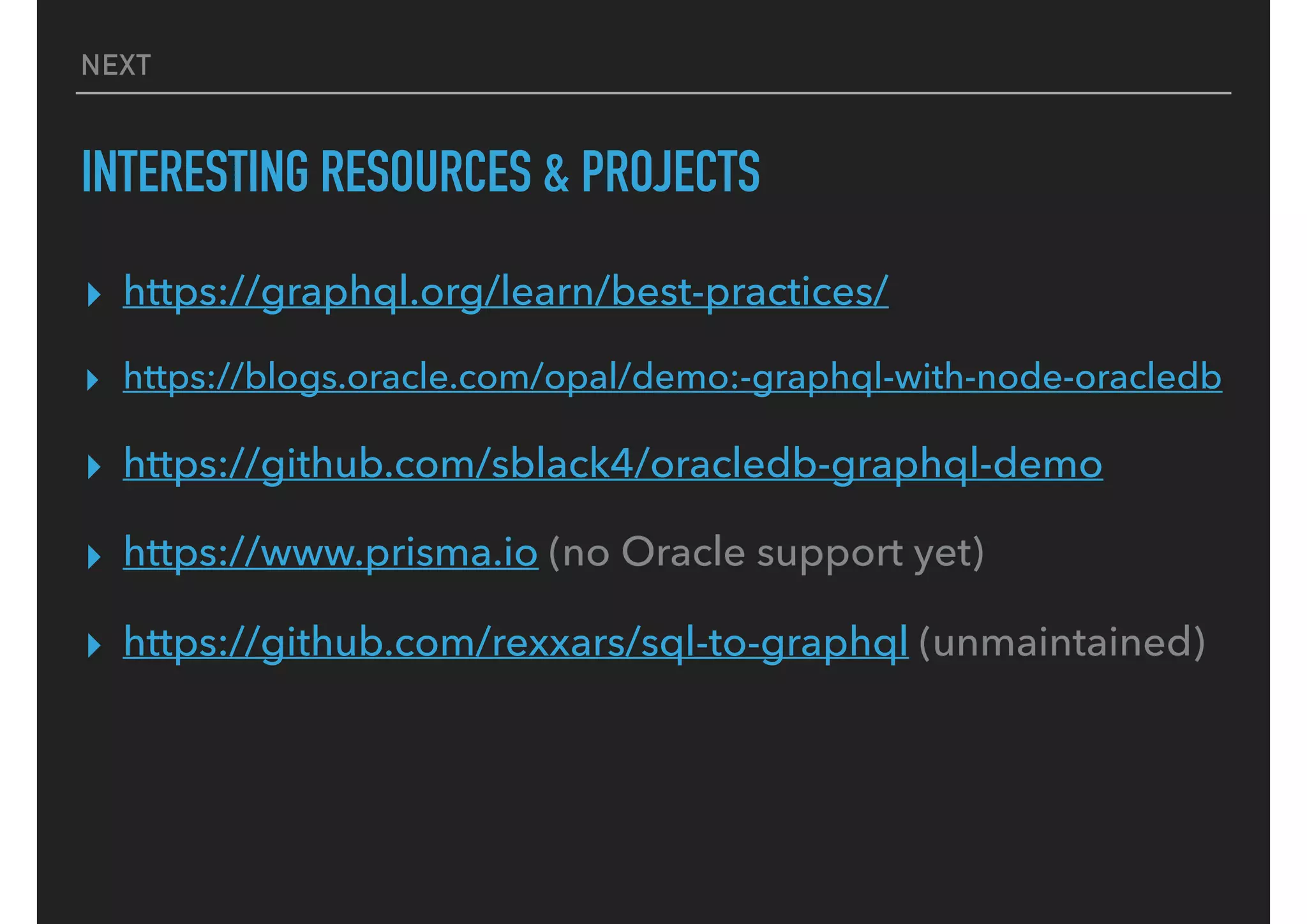
INTERESTING RESOURCES & PROJECTS
▸ https://graphql.org/learn/best-practices/
▸ https://blogs.oracle.com/opal/demo:-graphql-with-node-oracledb
▸ https://github.com/sblack4/oracledb-graphql-demo
▸ https://www.prisma.io (no Oracle support yet)
▸ https://github.com/rexxars/sql-to-graphql (unmaintained)

REST Web Service? No, GraphQL please!

  • 1.
    REST WEB SERVICE?NO, GRAPHQL PLEASE! DIMITRI GIELIS
  • 2.
    DIMITRI GIELIS ABOUT ME ▸Founder & CEO of APEX R&D ▸ 20+ years of Oracle Experience 
 (OCP & APEX Certified) ▸ Oracle ACE Director ▸ “APEX Developer of the year 2009” by Oracle Magazine ▸ “Oracle Developer Choice award (ORDS)” in 2015 ▸ Author Expert Oracle APEX ▸ Presenter at Conferences
  • 3.
  • 4.
  • 6.
    WAYS TO QUERYTHE DATABASE? SQL REST GraphQL
  • 7.
  • 8.
  • 9.
  • 11.
  • 12.
  • 13.
    REST API CHARACTERISTICS ▸ Servercontrols the data you get ▸ May need multiple requests to obtain data ▸ Static versions of API
  • 14.
  • 15.
  • 16.
    GRAPHQL CHARACTERISTICS ▸ Server defineswhat is available, 
 but Client controls the data it get ▸ Single request to get all ▸ Evolve API over time 
 (even make fields deprecated) ▸ Auto documented
  • 17.
  • 18.
    GRAPHQL HISTORY ▸ Facebook's mobileapps have been powered by GraphQL since 2012. ▸ A GraphQL spec was open sourced in 2015 ▸ Many implementations in different languages ▸ Used by many big companies e.g.
  • 19.
  • 20.
  • 21.
  • 22.
  • 23.
    MORE EXAMPLES GRAPHQL APIS ▸https://github.com/APIs-guru/graphql-apis ▸ https://help.shopify.com/en/api/graphql-admin-api/ graphiql-explorer ▸ https://developer.github.com/v4/ ▸ https://www.yelp.com/developers/graphql/guides/intro
  • 24.
  • 25.
    GRAPHQL AND THEORACLE DATABASE BUILDING BLOCKS ▸ Oracle Database ▸ node.js ▸ oracledb ▸ graphql ▸ apollo-server
  • 26.
    MY DEVELOPMENT ENVIRONMENT ▸Visual Studio Code ▸ Sqlcl ▸ Git ▸ node.js & nvm & npm ▸ Instant Oracle client / Oracle Database
  • 27.
  • 28.
    GETTING STARTED CREATE AFIRST NODE PROJECT ▸ npm init ▸ npm install apollo-server graphql oracledb
  • 29.
    GETTING STARTED CREATE AFIRST NODE PROJECT ▸ npm init ▸ npm install apollo-server graphql oracledb
  • 30.
    GETTING STARTED CREATE AFIRST NODE PROJECT ▸ npm init ▸ npm install apollo-server graphql oracledb
  • 31.
    GETTING STARTED CREATE AFIRST NODE PROJECT ▸ npm init ▸ npm install apollo-server graphql oracledb
  • 32.
    ABOUT APOLLO Apollo Serveris the best way to quickly build a production-ready, self-documenting API for GraphQL clients, using data from any source - https://www.apollographql.com/docs/apollo-server/
  • 33.
    CREATE AN APOLLOSERVER const { ApolloServer, gql } = require('apollo-server'); // This is a (sample) collection of books const books = [{title: 'Book1'},{title: 'Book2'}]; // Type definitions define the "shape" of your data const typeDefs = gql` type Book {title: String} type Query {books: [Book]} `; // Resolvers define the technique for fetching the types const resolvers = { Query: {books: () => books } }; // The Apollo Server can be started by passing // type definitions and the resolvers const server = new ApolloServer({ typeDefs, resolvers }); // This `listen` method launches a web-server server.listen().then(({ url }) => { console.log(`🚀 Server ready at ${url}`); }); https://www.apollographql.com/docs/apollo-server/getting-started/
  • 34.
    CREATE AN APOLLOSERVER const { ApolloServer, gql } = require('apollo-server'); // This is a (sample) collection of books const books = [{title: 'Book1'},{title: 'Book2'}]; // Type definitions define the "shape" of your data const typeDefs = gql` type Book {title: String} type Query {books: [Book]} `; // Resolvers define the technique for fetching the types const resolvers = { Query: {books: () => books } }; // The Apollo Server can be started by passing // type definitions and the resolvers const server = new ApolloServer({ typeDefs, resolvers }); // This `listen` method launches a web-server server.listen().then(({ url }) => { console.log(`🚀 Server ready at ${url}`); }); https://www.apollographql.com/docs/apollo-server/getting-started/
  • 35.
    CREATE AN APOLLOSERVER const { ApolloServer, gql } = require('apollo-server'); // This is a (sample) collection of books const books = [{title: 'Book1'},{title: 'Book2'}]; // Type definitions define the "shape" of your data const typeDefs = gql` type Book {title: String} type Query {books: [Book]} `; // Resolvers define the technique for fetching the types const resolvers = { Query: {books: () => books } }; // The Apollo Server can be started by passing // type definitions and the resolvers const server = new ApolloServer({ typeDefs, resolvers }); // This `listen` method launches a web-server server.listen().then(({ url }) => { console.log(`🚀 Server ready at ${url}`); }); https://www.apollographql.com/docs/apollo-server/getting-started/
  • 36.
    CREATE AN APOLLOSERVER const { ApolloServer, gql } = require('apollo-server'); // This is a (sample) collection of books const books = [{title: 'Book1'},{title: 'Book2'}]; // Type definitions define the "shape" of your data const typeDefs = gql` type Book {title: String} type Query {books: [Book]} `; // Resolvers define the technique for fetching the types const resolvers = { Query: {books: () => books } }; // The Apollo Server can be started by passing // type definitions and the resolvers const server = new ApolloServer({ typeDefs, resolvers }); // This `listen` method launches a web-server server.listen().then(({ url }) => { console.log(`🚀 Server ready at ${url}`); }); https://www.apollographql.com/docs/apollo-server/getting-started/
  • 37.
    CREATE AN APOLLOSERVER const { ApolloServer, gql } = require('apollo-server'); // This is a (sample) collection of books const books = [{title: 'Book1'},{title: 'Book2'}]; // Type definitions define the "shape" of your data const typeDefs = gql` type Book {title: String} type Query {books: [Book]} `; // Resolvers define the technique for fetching the types const resolvers = { Query: {books: () => books } }; // The Apollo Server can be started by passing // type definitions and the resolvers const server = new ApolloServer({ typeDefs, resolvers }); // This `listen` method launches a web-server server.listen().then(({ url }) => { console.log(`🚀 Server ready at ${url}`); }); https://www.apollographql.com/docs/apollo-server/getting-started/
  • 38.
    CREATE AN APOLLOSERVER const { ApolloServer, gql } = require('apollo-server'); // This is a (sample) collection of books const books = [{title: 'Book1'},{title: 'Book2'}]; // Type definitions define the "shape" of your data const typeDefs = gql` type Book {title: String} type Query {books: [Book]} `; // Resolvers define the technique for fetching the types const resolvers = { Query: {books: () => books } }; // The Apollo Server can be started by passing // type definitions and the resolvers const server = new ApolloServer({ typeDefs, resolvers }); // This `listen` method launches a web-server server.listen().then(({ url }) => { console.log(`🚀 Server ready at ${url}`); }); https://www.apollographql.com/docs/apollo-server/getting-started/
  • 39.
    CREATE AN APOLLOSERVER const { ApolloServer, gql } = require('apollo-server'); // This is a (sample) collection of books const books = [{title: 'Book1'},{title: 'Book2'}]; // Type definitions define the "shape" of your data const typeDefs = gql` type Book {title: String} type Query {books: [Book]} `; // Resolvers define the technique for fetching the types const resolvers = { Query: {books: () => books } }; // The Apollo Server can be started by passing // type definitions and the resolvers const server = new ApolloServer({ typeDefs, resolvers }); // This `listen` method launches a web-server server.listen().then(({ url }) => { console.log(`🚀 Server ready at ${url}`); }); https://www.apollographql.com/docs/apollo-server/getting-started/
  • 40.
    TEST IN BROWSER:HTTP://LOCALHOST:4000
  • 41.
    HOOKING UP ORACLEDB WITH NODE-ORACLEDB
  • 42.
    QUERY ORACLE DB varoracledb = require('oracledb'); async function run() { let connection; try { connection = await oracledb.getConnection( { user : "hr", password : "hr", connectString : "localhost/XEPDB1" }); let result = await connection.execute( `SELECT manager_id, department_id, department_name FROM departments WHERE manager_id = :id`, [103], // bind value for :id ); console.log(result.rows); } catch (err) { console.error(err); } finally { if (connection) { try { await connection.close(); } catch (err) { console.error(err); } } } } run(); https://oracle.github.io/node-oracledb/doc/api.html#getstarted
  • 43.
    QUERY ORACLE DB varoracledb = require('oracledb'); async function run() { let connection; try { connection = await oracledb.getConnection( { user : "hr", password : "hr", connectString : "localhost/XEPDB1" }); let result = await connection.execute( `SELECT manager_id, department_id, department_name FROM departments WHERE manager_id = :id`, [103], // bind value for :id ); console.log(result.rows); } catch (err) { console.error(err); } finally { if (connection) { try { await connection.close(); } catch (err) { console.error(err); } } } } run(); https://oracle.github.io/node-oracledb/doc/api.html#getstarted
  • 44.
    QUERY ORACLE DB varoracledb = require('oracledb'); async function run() { let connection; try { connection = await oracledb.getConnection( { user : "hr", password : "hr", connectString : "localhost/XEPDB1" }); let result = await connection.execute( `SELECT manager_id, department_id, department_name FROM departments WHERE manager_id = :id`, [103], // bind value for :id ); console.log(result.rows); } catch (err) { console.error(err); } finally { if (connection) { try { await connection.close(); } catch (err) { console.error(err); } } } } run(); https://oracle.github.io/node-oracledb/doc/api.html#getstarted
  • 45.
    QUERY ORACLE DB varoracledb = require('oracledb'); async function run() { let connection; try { connection = await oracledb.getConnection( { user : "hr", password : "hr", connectString : "localhost/XEPDB1" }); let result = await connection.execute( `SELECT manager_id, department_id, department_name FROM departments WHERE manager_id = :id`, [103], // bind value for :id ); console.log(result.rows); } catch (err) { console.error(err); } finally { if (connection) { try { await connection.close(); } catch (err) { console.error(err); } } } } run(); https://oracle.github.io/node-oracledb/doc/api.html#getstarted
  • 46.
    GETTING STARTED COMBINING APOLLOAND ORACLE ▸ Map SQL to Types ▸ TIP: 
 sqlcl to output SQL statement to JSON ▸ convert JSON to GraphQL Types automatically
 https://walmartlabs.github.io/json-to-simple-graphql-schema/
  • 48.
  • 49.
    MORE ADVANCED SQL& JOINS JOIN MONSTER ▸ A GraphQL to SQL query execution layer for query planning and batch data fetching. https://github.com/acarl005/join-monster
  • 50.
    DEMO (PROVIDING) source: DanMcGhan presentation: emp/dept example
  • 52.
    DETAILS OF GRAPHQL GRAPHQLCONCEPTS ▸ Schema ▸ Object type (character) ▸ Field ▸ Arguments ▸ Scalar type ▸ Interface
  • 53.
    DETAILS OF GRAPHQL HOWTO QUERY A GRAPHQL SERVER ▸ Queries ▸ Fields, Aliases, Fragments ▸ Arguments ▸ Variables ▸ Directives ▸ Operation name ▸ Mutations ▸ Subscriptions
  • 54.
    NEXT INTERESTING RESOURCES &PROJECTS ▸ https://graphql.org/learn/best-practices/ ▸ https://blogs.oracle.com/opal/demo:-graphql-with-node-oracledb ▸ https://github.com/sblack4/oracledb-graphql-demo ▸ https://www.prisma.io (no Oracle support yet) ▸ https://github.com/rexxars/sql-to-graphql (unmaintained)