28 March 2014
Responsive Information
Architectures
IA Summit
San Diego, CA
Presented by Andy Fitzgerald, PhD
#ResponsiveIA @andybywire
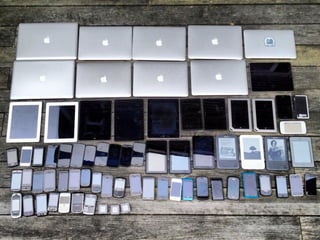
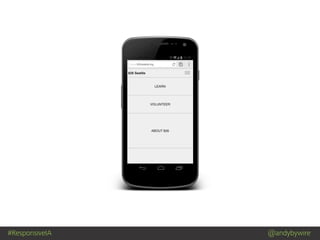
http://bradfrostweb.com/blog/post/device-fatigue/
#ResponsiveIA @andybywire
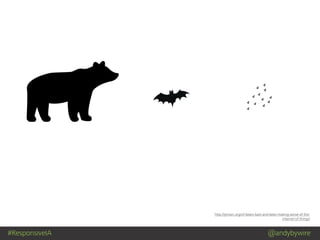
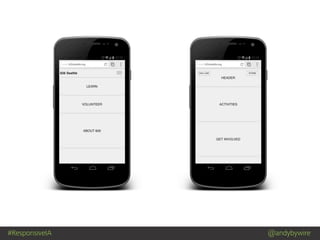
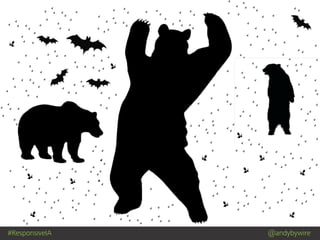
http://jenson.org/of-bears-bats-and-bees-making-sense-of-the-
internet-of-things/
#ResponsiveIA @andybywire
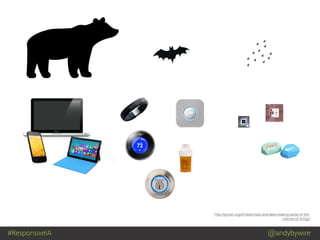
http://jenson.org/of-bears-bats-and-bees-making-sense-of-the-
internet-of-things/
#ResponsiveIA @andybywire
- Sara Wachter-Boettcher.
Content Everywhere
“The best we can all do is focus our limited
stock of human care and attention toward
designing systems [...] not obsessing over
individual pages for individual platforms.”
#ResponsiveIA @andybywire
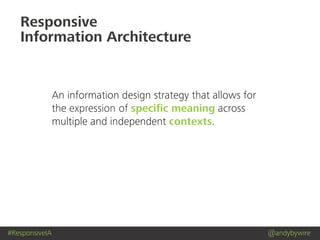
Responsive
Information Architecture
An information design strategy that allows for
the expression of specific meaning across
multiple and independent contexts.
#ResponsiveIA @andybywire
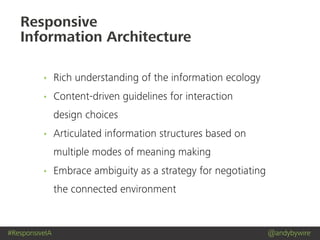
Rich understanding of the information ecology
Content-driven guidelines for interaction
design choices
Articulated information structures based on
multiple modes of meaning making
Embrace ambiguity as a strategy for negotiating
the connected environment
Responsive
Information Architecture
#ResponsiveIA @andybywire
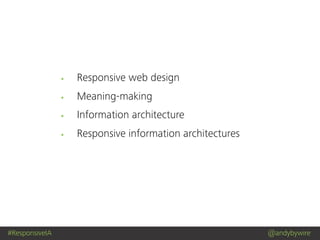
Responsive web design
Meaning-making
Information architecture
Responsive information architectures
Responsive web design
#ResponsiveIA @andybywire
- Ethan Marcotte. Responsive Web Design
“We can embrace the flexibility inherent to the
web, without surrendering the control we
require as designers.”
#ResponsiveIA @andybywire
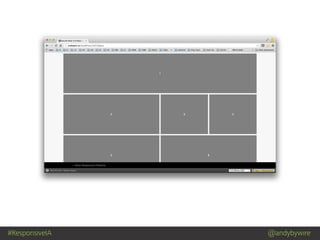
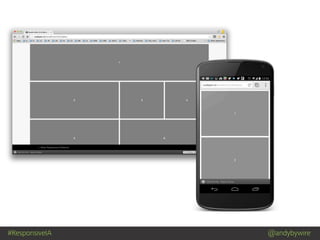
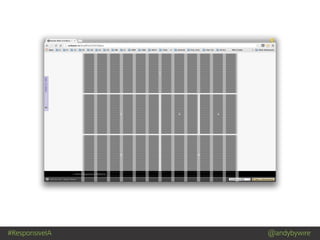
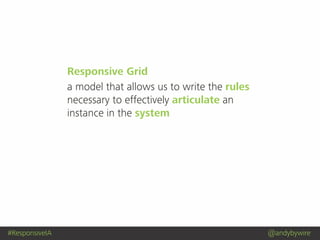
Responsive Grid
a model that allows us to write the rules
necessary to effectively articulate an
instance in the system
Making meaning
#ResponsiveIA @andybywire
- Richard Saul Wurman. Hats
“You can only understand something relative to
something you already understand.”
#ResponsiveIA @andybywire
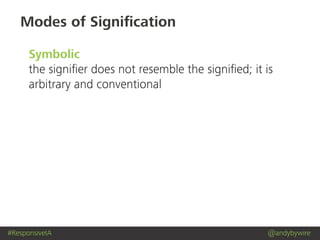
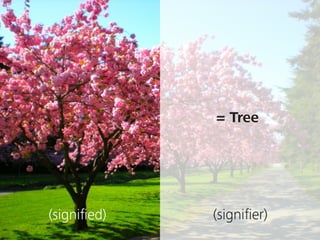
Modes of Signification
Symbolic
the signifier does not resemble the signified; it is
arbitrary and conventional
Text
= Tree
(signifier)(signified)

#ResponsiveIA @andybywire
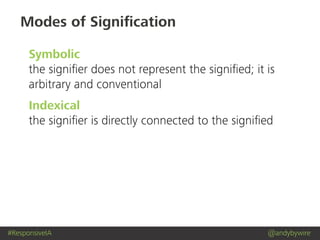
Modes of Signification
Symbolic
the signifier does not represent the signified; it is
arbitrary and conventional
Indexical
the signifier is directly connected to the signified
#ResponsiveIA @andybywire
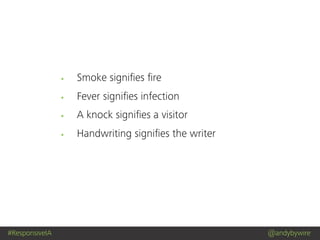
Smoke signifies fire
Fever signifies infection
A knock signifies a visitor
Handwriting signifies the writer
#ResponsiveIA @andybywire
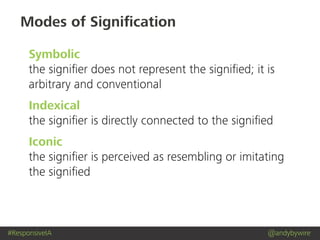
Modes of Signification
Symbolic
the signifier does not represent the signified; it is
arbitrary and conventional
Indexical
the signifier is directly connected to the signified
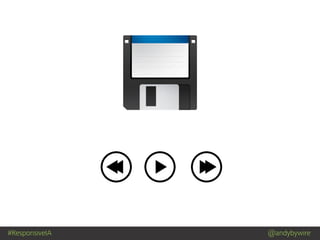
Iconic
the signifier is perceived as resembling or imitating
the signified
#ResponsiveIA @andybywire
- Daniel Chandler. Semiotics
“Iconic signifiers seem to present reality more
directly than symbolic signs.”
#ResponsiveIA @andybywire
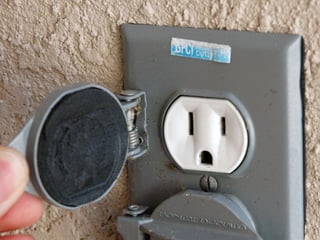
- Louise Barrett. Beyond the Brain
“This innate bias may not be for faces as such,
but for the particular kind of geometric
configuration that faces present.”
#ResponsiveIA @andybywire
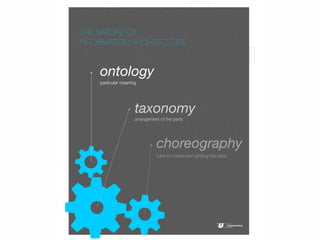
Information architecture
choreography
ontology
taxonomy
arrangement of the parts
particular meaning
rules for interaction among the parts
THE NATURE OF
INFORMATION ARCHITECTURE
#ResponsiveIA @andybywire
Ontology
• “Particular meaning”
• “What we mean when we say what we say”
• The argument: how we encourage users to think
about the content or functionality we are
offering
#ResponsiveIA @andybywire
Taxonomy
• “Arrangement of the parts”
• “Arrangement of meaning in and across contexts”
• How the pieces of the argument fit together – a
method of arrangement conceived to create a
particular kind of understanding.
#ResponsiveIA @andybywire
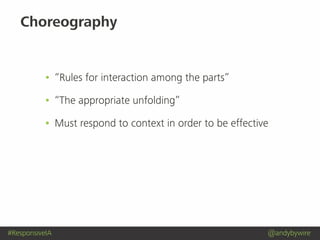
• “Rules for interaction among the parts”
• “The appropriate unfolding”
• Must respond to context in order to be effective
Choreography
#ResponsiveIA @andybywire
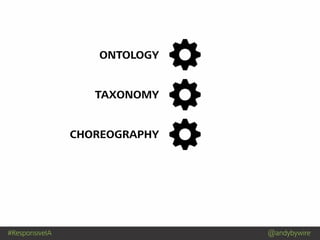
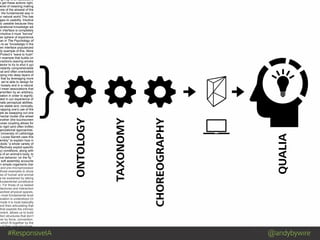
ONTOLOGY
TAXONOMY
CHOREOGRAPHY
#ResponsiveIA @andybywire
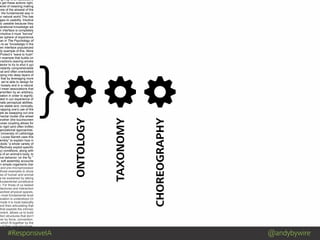
} ONTOLOGY
TAXONOMY
CHOREOGRAPHY
ng it up is an associative
e get these actions right,
level of meaning making
one of the slowest of the
: the fundamental way in
ur natural world.This has
ages to usability. Intuitive
ly useable because they
perational knowledge we
n interface is completely
intuitive it must “borrow”
her sphere of experience
man in The Psychology of
s to as “knowledge in the
een interface popularized
dy example of this. More
Protect’s ”wave to hush”
n example that builds on
eractions (waving smoke
tector to try to shut it up)
nstantly comprehensible
nal and often overlooked
pping into deep layers of
that by leveraging more
, we’re able to design for
r loosely and in a natural
I mean associations that
erwritten by an arbitrary,
ciation in order to signify;
oted in our experience of
nate perceptual abilities.
ore stable and, ironically,
mapping one’s use of the
ple as swapping out one
mental model (the wheel
another (the touchscreen
loose coupling allows for
to rigid (and often brittle)
ganizational approaches.
University of Lethbridge
Louise Barrett uses this
embly” to explain how in
obots “a whole variety of
effectively exploit specific
ry) conditions, along with
cs of an animal’s body, to
ive behavior ‘on the fly.’”
w soft assembly accounts
in simple organisms (her
and pre-microprocessor
those examples to show
ces of human and animal
e be explained by taking
fundamental constitutive
n. For those of us tasked
hitectures and interaction
worked physical spaces,
e most fundamental level
ociation is understood (in
mode it is most basically
and then articulating that
that exploits the intrinsic
nment, allows us to build
ation structures that don’t
her by force, convention,
which fit together by the
e of their core structures.
#ResponsiveIA @andybywire
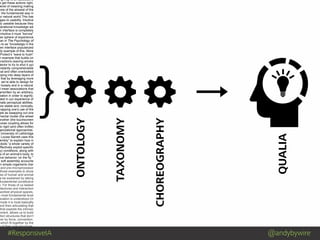
} ONTOLOGY
TAXONOMY
CHOREOGRAPHY
QUALIA
ng it up is an associative
e get these actions right,
level of meaning making
one of the slowest of the
: the fundamental way in
ur natural world.This has
ages to usability. Intuitive
ly useable because they
perational knowledge we
n interface is completely
intuitive it must “borrow”
her sphere of experience
man in The Psychology of
s to as “knowledge in the
een interface popularized
dy example of this. More
Protect’s ”wave to hush”
n example that builds on
eractions (waving smoke
tector to try to shut it up)
nstantly comprehensible
nal and often overlooked
pping into deep layers of
that by leveraging more
, we’re able to design for
r loosely and in a natural
I mean associations that
erwritten by an arbitrary,
ciation in order to signify;
oted in our experience of
nate perceptual abilities.
ore stable and, ironically,
mapping one’s use of the
ple as swapping out one
mental model (the wheel
another (the touchscreen
loose coupling allows for
to rigid (and often brittle)
ganizational approaches.
University of Lethbridge
Louise Barrett uses this
embly” to explain how in
obots “a whole variety of
effectively exploit specific
ry) conditions, along with
cs of an animal’s body, to
ive behavior ‘on the fly.’”
w soft assembly accounts
in simple organisms (her
and pre-microprocessor
those examples to show
ces of human and animal
e be explained by taking
fundamental constitutive
n. For those of us tasked
hitectures and interaction
worked physical spaces,
e most fundamental level
ociation is understood (in
mode it is most basically
and then articulating that
that exploits the intrinsic
nment, allows us to build
ation structures that don’t
her by force, convention,
which fit together by the
e of their core structures.
#ResponsiveIA @andybywire
} ONTOLOGY
TAXONOMY
CHOREOGRAPHY
QUALIA
Mind Blowing by Luis Prado from The Noun Project
ng it up is an associative
e get these actions right,
level of meaning making
one of the slowest of the
: the fundamental way in
ur natural world.This has
ages to usability. Intuitive
ly useable because they
perational knowledge we
n interface is completely
intuitive it must “borrow”
her sphere of experience
man in The Psychology of
s to as “knowledge in the
een interface popularized
dy example of this. More
Protect’s ”wave to hush”
n example that builds on
eractions (waving smoke
tector to try to shut it up)
nstantly comprehensible
nal and often overlooked
pping into deep layers of
that by leveraging more
, we’re able to design for
r loosely and in a natural
I mean associations that
erwritten by an arbitrary,
ciation in order to signify;
oted in our experience of
nate perceptual abilities.
ore stable and, ironically,
mapping one’s use of the
ple as swapping out one
mental model (the wheel
another (the touchscreen
loose coupling allows for
to rigid (and often brittle)
ganizational approaches.
University of Lethbridge
Louise Barrett uses this
embly” to explain how in
obots “a whole variety of
effectively exploit specific
ry) conditions, along with
cs of an animal’s body, to
ive behavior ‘on the fly.’”
w soft assembly accounts
in simple organisms (her
and pre-microprocessor
those examples to show
ces of human and animal
e be explained by taking
fundamental constitutive
n. For those of us tasked
hitectures and interaction
worked physical spaces,
e most fundamental level
ociation is understood (in
mode it is most basically
and then articulating that
that exploits the intrinsic
nment, allows us to build
ation structures that don’t
her by force, convention,
which fit together by the
e of their core structures.
#ResponsiveIA @andybywire
}
Mind Blowing by Luis Prado from The Noun Project
ng it up is an associative
e get these actions right,
level of meaning making
one of the slowest of the
: the fundamental way in
ur natural world.This has
ages to usability. Intuitive
ly useable because they
perational knowledge we
n interface is completely
intuitive it must “borrow”
her sphere of experience
man in The Psychology of
s to as “knowledge in the
een interface popularized
dy example of this. More
Protect’s ”wave to hush”
n example that builds on
eractions (waving smoke
tector to try to shut it up)
nstantly comprehensible
nal and often overlooked
pping into deep layers of
that by leveraging more
, we’re able to design for
r loosely and in a natural
I mean associations that
erwritten by an arbitrary,
ciation in order to signify;
oted in our experience of
nate perceptual abilities.
ore stable and, ironically,
mapping one’s use of the
ple as swapping out one
mental model (the wheel
another (the touchscreen
loose coupling allows for
to rigid (and often brittle)
ganizational approaches.
University of Lethbridge
Louise Barrett uses this
embly” to explain how in
obots “a whole variety of
effectively exploit specific
ry) conditions, along with
cs of an animal’s body, to
ive behavior ‘on the fly.’”
w soft assembly accounts
in simple organisms (her
and pre-microprocessor
those examples to show
ces of human and animal
e be explained by taking
fundamental constitutive
n. For those of us tasked
hitectures and interaction
worked physical spaces,
e most fundamental level
ociation is understood (in
mode it is most basically
and then articulating that
that exploits the intrinsic
nment, allows us to build
ation structures that don’t
her by force, convention,
which fit together by the
e of their core structures.
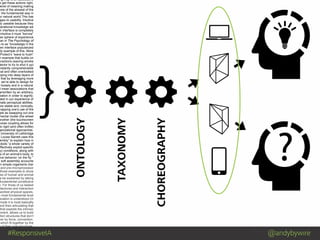
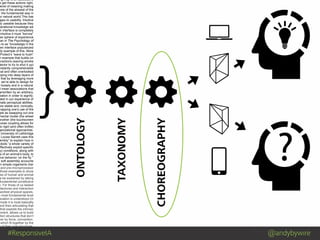
ONTOLOGY
TAXONOMY
CHOREOGRAPHY
#ResponsiveIA @andybywire
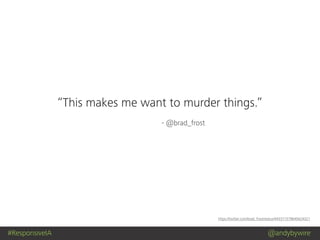
- @brad_frost
https://twitter.com/brad_frost/status/443371579645624321
“This makes me want to murder things.”
#ResponsiveIA @andybywire
}
Mind Blowing by Luis Prado from The Noun Project
ng it up is an associative
e get these actions right,
level of meaning making
one of the slowest of the
: the fundamental way in
ur natural world.This has
ages to usability. Intuitive
ly useable because they
perational knowledge we
n interface is completely
intuitive it must “borrow”
her sphere of experience
man in The Psychology of
s to as “knowledge in the
een interface popularized
dy example of this. More
Protect’s ”wave to hush”
n example that builds on
eractions (waving smoke
tector to try to shut it up)
nstantly comprehensible
nal and often overlooked
pping into deep layers of
that by leveraging more
, we’re able to design for
r loosely and in a natural
I mean associations that
erwritten by an arbitrary,
ciation in order to signify;
oted in our experience of
nate perceptual abilities.
ore stable and, ironically,
mapping one’s use of the
ple as swapping out one
mental model (the wheel
another (the touchscreen
loose coupling allows for
to rigid (and often brittle)
ganizational approaches.
University of Lethbridge
Louise Barrett uses this
embly” to explain how in
obots “a whole variety of
effectively exploit specific
ry) conditions, along with
cs of an animal’s body, to
ive behavior ‘on the fly.’”
w soft assembly accounts
in simple organisms (her
and pre-microprocessor
those examples to show
ces of human and animal
e be explained by taking
fundamental constitutive
n. For those of us tasked
hitectures and interaction
worked physical spaces,
e most fundamental level
ociation is understood (in
mode it is most basically
and then articulating that
that exploits the intrinsic
nment, allows us to build
ation structures that don’t
her by force, convention,
which fit together by the
e of their core structures.
ONTOLOGY
TAXONOMY
CHOREOGRAPHY
#ResponsiveIA @andybywire
}
Mind Blowing by Luis Prado from The Noun Project
ng it up is an associative
e get these actions right,
level of meaning making
one of the slowest of the
: the fundamental way in
ur natural world.This has
ages to usability. Intuitive
ly useable because they
perational knowledge we
n interface is completely
intuitive it must “borrow”
her sphere of experience
man in The Psychology of
s to as “knowledge in the
een interface popularized
dy example of this. More
Protect’s ”wave to hush”
n example that builds on
eractions (waving smoke
tector to try to shut it up)
nstantly comprehensible
nal and often overlooked
pping into deep layers of
that by leveraging more
, we’re able to design for
r loosely and in a natural
I mean associations that
erwritten by an arbitrary,
ciation in order to signify;
oted in our experience of
nate perceptual abilities.
ore stable and, ironically,
mapping one’s use of the
ple as swapping out one
mental model (the wheel
another (the touchscreen
loose coupling allows for
to rigid (and often brittle)
ganizational approaches.
University of Lethbridge
Louise Barrett uses this
embly” to explain how in
obots “a whole variety of
effectively exploit specific
ry) conditions, along with
cs of an animal’s body, to
ive behavior ‘on the fly.’”
w soft assembly accounts
in simple organisms (her
and pre-microprocessor
those examples to show
ces of human and animal
e be explained by taking
fundamental constitutive
n. For those of us tasked
hitectures and interaction
worked physical spaces,
e most fundamental level
ociation is understood (in
mode it is most basically
and then articulating that
that exploits the intrinsic
nment, allows us to build
ation structures that don’t
her by force, convention,
which fit together by the
e of their core structures.
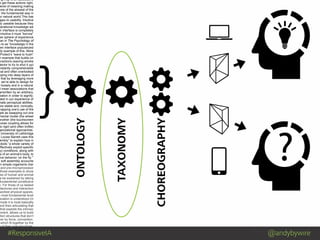
ONTOLOGY
TAXONOMY
CHOREOGRAPHY
Responsive information
architectures
#ResponsiveIA @andybywire
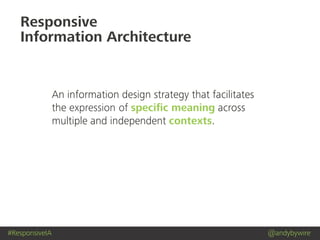
An information design strategy that facilitates
the expression of specific meaning across
multiple and independent contexts.
Responsive
Information Architecture
#ResponsiveIA @andybywire
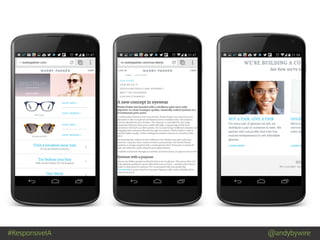
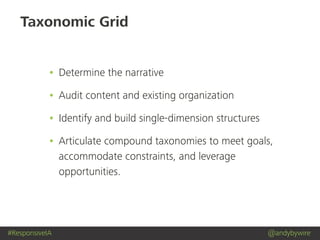
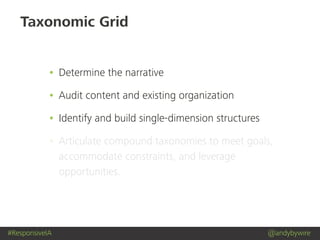
Taxonomic Grid
• Determine the narrative
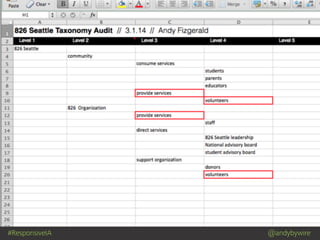
• Audit content and existing organization
• Identify and build single-dimension structures
• Articulate compound taxonomies to meet goals,
accommodate constraints, and leverage
opportunities.
#ResponsiveIA @andybywire
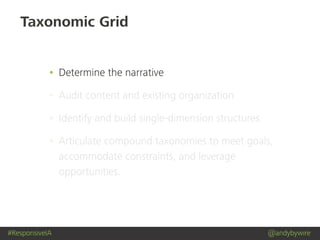
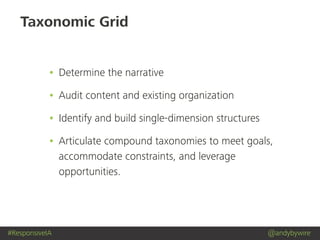
Taxonomic Grid
• Determine the narrative
• Audit content and existing organization
• Identify and build single-dimension structures
• Articulate compound taxonomies to meet goals,
accommodate constraints, and leverage
opportunities.
#ResponsiveIA @andybywire
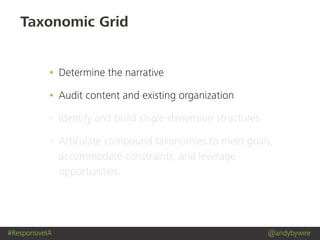
Taxonomic Grid
• Determine the narrative
• Audit content and existing organization
• Identify and build single-dimension structures
• Articulate compound taxonomies to meet goals,
accommodate constraints, and leverage
opportunities.
#ResponsiveIA @andybywire
#ResponsiveIA @andybywire#ResponsiveIA @andybywire
#ResponsiveIA @andybywire
#ResponsiveIA @andybywire#ResponsiveIA @andybywire
#ResponsiveIA @andybywire
Taxonomic Grid
• Determine the narrative
• Audit content and existing organization
• Identify and build single-dimension structures
• Articulate compound taxonomies to meet goals,
accommodate constraints, and leverage
opportunities.
#ResponsiveIA @andybywire
Taxonomic Grid
• Determine the narrative
• Audit content and existing organization
• Identify and build single-dimension structures
• Articulate compound taxonomies to meet goals,
accommodate constraints, and leverage
opportunities.
#ResponsiveIA @andybywire
http://pervasiveia.com/blog/embracing-ambiguity
- Luca Rosati. Embracing ambiguity:
Ambiguity as an emerging design pattern
“Embracing ambiguity — embracing the
possibility of not understanding exactly how the
pieces fit together — means designing systems
that surpass our expectations of them.”
#ResponsiveIA @andybywire
Rich understanding of the information ecology
Content-driven guidelines for interaction
design choices
Articulated information structures based on
multiple modes of meaning making
Embrace ambiguity as a strategy for negotiating
the connected environment
Responsive
Information Architecture
#ResponsiveIA @andybywire
Thank you.
Responsive Information Architectures
www.linkedin.com/in/andyfitzgerald
@andybywire
#ResponsiveIA

Responsive Information Architectures

  • 1.
    28 March 2014 ResponsiveInformation Architectures IA Summit San Diego, CA Presented by Andy Fitzgerald, PhD
  • 2.
  • 3.
  • 4.
  • 5.
  • 6.
  • 7.
    #ResponsiveIA @andybywire - SaraWachter-Boettcher. Content Everywhere “The best we can all do is focus our limited stock of human care and attention toward designing systems [...] not obsessing over individual pages for individual platforms.”
  • 8.
    #ResponsiveIA @andybywire Responsive Information Architecture Aninformation design strategy that allows for the expression of specific meaning across multiple and independent contexts.
  • 9.
    #ResponsiveIA @andybywire Rich understandingof the information ecology Content-driven guidelines for interaction design choices Articulated information structures based on multiple modes of meaning making Embrace ambiguity as a strategy for negotiating the connected environment Responsive Information Architecture
  • 10.
    #ResponsiveIA @andybywire Responsive webdesign Meaning-making Information architecture Responsive information architectures
  • 11.
  • 12.
    #ResponsiveIA @andybywire - EthanMarcotte. Responsive Web Design “We can embrace the flexibility inherent to the web, without surrendering the control we require as designers.”
  • 13.
  • 14.
  • 15.
  • 16.
  • 17.
  • 18.
  • 19.
  • 20.
  • 21.
    #ResponsiveIA @andybywire Responsive Grid amodel that allows us to write the rules necessary to effectively articulate an instance in the system
  • 22.
  • 23.
    #ResponsiveIA @andybywire - RichardSaul Wurman. Hats “You can only understand something relative to something you already understand.”
  • 24.
    #ResponsiveIA @andybywire Modes ofSignification Symbolic the signifier does not resemble the signified; it is arbitrary and conventional
  • 25.
  • 26.
  • 27.
    #ResponsiveIA @andybywire Modes ofSignification Symbolic the signifier does not represent the signified; it is arbitrary and conventional Indexical the signifier is directly connected to the signified
  • 28.
    #ResponsiveIA @andybywire Smoke signifiesfire Fever signifies infection A knock signifies a visitor Handwriting signifies the writer
  • 30.
    #ResponsiveIA @andybywire Modes ofSignification Symbolic the signifier does not represent the signified; it is arbitrary and conventional Indexical the signifier is directly connected to the signified Iconic the signifier is perceived as resembling or imitating the signified
  • 31.
    #ResponsiveIA @andybywire - DanielChandler. Semiotics “Iconic signifiers seem to present reality more directly than symbolic signs.”
  • 32.
  • 33.
  • 36.
    #ResponsiveIA @andybywire - LouiseBarrett. Beyond the Brain “This innate bias may not be for faces as such, but for the particular kind of geometric configuration that faces present.”
  • 37.
  • 38.
  • 39.
    choreography ontology taxonomy arrangement of theparts particular meaning rules for interaction among the parts THE NATURE OF INFORMATION ARCHITECTURE
  • 40.
    #ResponsiveIA @andybywire Ontology • “Particularmeaning” • “What we mean when we say what we say” • The argument: how we encourage users to think about the content or functionality we are offering
  • 41.
    #ResponsiveIA @andybywire Taxonomy • “Arrangementof the parts” • “Arrangement of meaning in and across contexts” • How the pieces of the argument fit together – a method of arrangement conceived to create a particular kind of understanding.
  • 42.
    #ResponsiveIA @andybywire • “Rulesfor interaction among the parts” • “The appropriate unfolding” • Must respond to context in order to be effective Choreography
  • 43.
  • 44.
    #ResponsiveIA @andybywire } ONTOLOGY TAXONOMY CHOREOGRAPHY ngit up is an associative e get these actions right, level of meaning making one of the slowest of the : the fundamental way in ur natural world.This has ages to usability. Intuitive ly useable because they perational knowledge we n interface is completely intuitive it must “borrow” her sphere of experience man in The Psychology of s to as “knowledge in the een interface popularized dy example of this. More Protect’s ”wave to hush” n example that builds on eractions (waving smoke tector to try to shut it up) nstantly comprehensible nal and often overlooked pping into deep layers of that by leveraging more , we’re able to design for r loosely and in a natural I mean associations that erwritten by an arbitrary, ciation in order to signify; oted in our experience of nate perceptual abilities. ore stable and, ironically, mapping one’s use of the ple as swapping out one mental model (the wheel another (the touchscreen loose coupling allows for to rigid (and often brittle) ganizational approaches. University of Lethbridge Louise Barrett uses this embly” to explain how in obots “a whole variety of effectively exploit specific ry) conditions, along with cs of an animal’s body, to ive behavior ‘on the fly.’” w soft assembly accounts in simple organisms (her and pre-microprocessor those examples to show ces of human and animal e be explained by taking fundamental constitutive n. For those of us tasked hitectures and interaction worked physical spaces, e most fundamental level ociation is understood (in mode it is most basically and then articulating that that exploits the intrinsic nment, allows us to build ation structures that don’t her by force, convention, which fit together by the e of their core structures.
  • 45.
    #ResponsiveIA @andybywire } ONTOLOGY TAXONOMY CHOREOGRAPHY QUALIA ngit up is an associative e get these actions right, level of meaning making one of the slowest of the : the fundamental way in ur natural world.This has ages to usability. Intuitive ly useable because they perational knowledge we n interface is completely intuitive it must “borrow” her sphere of experience man in The Psychology of s to as “knowledge in the een interface popularized dy example of this. More Protect’s ”wave to hush” n example that builds on eractions (waving smoke tector to try to shut it up) nstantly comprehensible nal and often overlooked pping into deep layers of that by leveraging more , we’re able to design for r loosely and in a natural I mean associations that erwritten by an arbitrary, ciation in order to signify; oted in our experience of nate perceptual abilities. ore stable and, ironically, mapping one’s use of the ple as swapping out one mental model (the wheel another (the touchscreen loose coupling allows for to rigid (and often brittle) ganizational approaches. University of Lethbridge Louise Barrett uses this embly” to explain how in obots “a whole variety of effectively exploit specific ry) conditions, along with cs of an animal’s body, to ive behavior ‘on the fly.’” w soft assembly accounts in simple organisms (her and pre-microprocessor those examples to show ces of human and animal e be explained by taking fundamental constitutive n. For those of us tasked hitectures and interaction worked physical spaces, e most fundamental level ociation is understood (in mode it is most basically and then articulating that that exploits the intrinsic nment, allows us to build ation structures that don’t her by force, convention, which fit together by the e of their core structures.
  • 46.
  • 47.
  • 48.
  • 49.
    #ResponsiveIA @andybywire } ONTOLOGY TAXONOMY CHOREOGRAPHY QUALIA MindBlowing by Luis Prado from The Noun Project ng it up is an associative e get these actions right, level of meaning making one of the slowest of the : the fundamental way in ur natural world.This has ages to usability. Intuitive ly useable because they perational knowledge we n interface is completely intuitive it must “borrow” her sphere of experience man in The Psychology of s to as “knowledge in the een interface popularized dy example of this. More Protect’s ”wave to hush” n example that builds on eractions (waving smoke tector to try to shut it up) nstantly comprehensible nal and often overlooked pping into deep layers of that by leveraging more , we’re able to design for r loosely and in a natural I mean associations that erwritten by an arbitrary, ciation in order to signify; oted in our experience of nate perceptual abilities. ore stable and, ironically, mapping one’s use of the ple as swapping out one mental model (the wheel another (the touchscreen loose coupling allows for to rigid (and often brittle) ganizational approaches. University of Lethbridge Louise Barrett uses this embly” to explain how in obots “a whole variety of effectively exploit specific ry) conditions, along with cs of an animal’s body, to ive behavior ‘on the fly.’” w soft assembly accounts in simple organisms (her and pre-microprocessor those examples to show ces of human and animal e be explained by taking fundamental constitutive n. For those of us tasked hitectures and interaction worked physical spaces, e most fundamental level ociation is understood (in mode it is most basically and then articulating that that exploits the intrinsic nment, allows us to build ation structures that don’t her by force, convention, which fit together by the e of their core structures.
  • 50.
  • 51.
    #ResponsiveIA @andybywire } Mind Blowingby Luis Prado from The Noun Project ng it up is an associative e get these actions right, level of meaning making one of the slowest of the : the fundamental way in ur natural world.This has ages to usability. Intuitive ly useable because they perational knowledge we n interface is completely intuitive it must “borrow” her sphere of experience man in The Psychology of s to as “knowledge in the een interface popularized dy example of this. More Protect’s ”wave to hush” n example that builds on eractions (waving smoke tector to try to shut it up) nstantly comprehensible nal and often overlooked pping into deep layers of that by leveraging more , we’re able to design for r loosely and in a natural I mean associations that erwritten by an arbitrary, ciation in order to signify; oted in our experience of nate perceptual abilities. ore stable and, ironically, mapping one’s use of the ple as swapping out one mental model (the wheel another (the touchscreen loose coupling allows for to rigid (and often brittle) ganizational approaches. University of Lethbridge Louise Barrett uses this embly” to explain how in obots “a whole variety of effectively exploit specific ry) conditions, along with cs of an animal’s body, to ive behavior ‘on the fly.’” w soft assembly accounts in simple organisms (her and pre-microprocessor those examples to show ces of human and animal e be explained by taking fundamental constitutive n. For those of us tasked hitectures and interaction worked physical spaces, e most fundamental level ociation is understood (in mode it is most basically and then articulating that that exploits the intrinsic nment, allows us to build ation structures that don’t her by force, convention, which fit together by the e of their core structures. ONTOLOGY TAXONOMY CHOREOGRAPHY
  • 52.
  • 53.
  • 54.
  • 55.
    #ResponsiveIA @andybywire } Mind Blowingby Luis Prado from The Noun Project ng it up is an associative e get these actions right, level of meaning making one of the slowest of the : the fundamental way in ur natural world.This has ages to usability. Intuitive ly useable because they perational knowledge we n interface is completely intuitive it must “borrow” her sphere of experience man in The Psychology of s to as “knowledge in the een interface popularized dy example of this. More Protect’s ”wave to hush” n example that builds on eractions (waving smoke tector to try to shut it up) nstantly comprehensible nal and often overlooked pping into deep layers of that by leveraging more , we’re able to design for r loosely and in a natural I mean associations that erwritten by an arbitrary, ciation in order to signify; oted in our experience of nate perceptual abilities. ore stable and, ironically, mapping one’s use of the ple as swapping out one mental model (the wheel another (the touchscreen loose coupling allows for to rigid (and often brittle) ganizational approaches. University of Lethbridge Louise Barrett uses this embly” to explain how in obots “a whole variety of effectively exploit specific ry) conditions, along with cs of an animal’s body, to ive behavior ‘on the fly.’” w soft assembly accounts in simple organisms (her and pre-microprocessor those examples to show ces of human and animal e be explained by taking fundamental constitutive n. For those of us tasked hitectures and interaction worked physical spaces, e most fundamental level ociation is understood (in mode it is most basically and then articulating that that exploits the intrinsic nment, allows us to build ation structures that don’t her by force, convention, which fit together by the e of their core structures. ONTOLOGY TAXONOMY CHOREOGRAPHY
  • 56.
    #ResponsiveIA @andybywire } Mind Blowingby Luis Prado from The Noun Project ng it up is an associative e get these actions right, level of meaning making one of the slowest of the : the fundamental way in ur natural world.This has ages to usability. Intuitive ly useable because they perational knowledge we n interface is completely intuitive it must “borrow” her sphere of experience man in The Psychology of s to as “knowledge in the een interface popularized dy example of this. More Protect’s ”wave to hush” n example that builds on eractions (waving smoke tector to try to shut it up) nstantly comprehensible nal and often overlooked pping into deep layers of that by leveraging more , we’re able to design for r loosely and in a natural I mean associations that erwritten by an arbitrary, ciation in order to signify; oted in our experience of nate perceptual abilities. ore stable and, ironically, mapping one’s use of the ple as swapping out one mental model (the wheel another (the touchscreen loose coupling allows for to rigid (and often brittle) ganizational approaches. University of Lethbridge Louise Barrett uses this embly” to explain how in obots “a whole variety of effectively exploit specific ry) conditions, along with cs of an animal’s body, to ive behavior ‘on the fly.’” w soft assembly accounts in simple organisms (her and pre-microprocessor those examples to show ces of human and animal e be explained by taking fundamental constitutive n. For those of us tasked hitectures and interaction worked physical spaces, e most fundamental level ociation is understood (in mode it is most basically and then articulating that that exploits the intrinsic nment, allows us to build ation structures that don’t her by force, convention, which fit together by the e of their core structures. ONTOLOGY TAXONOMY CHOREOGRAPHY
  • 57.
  • 58.
    #ResponsiveIA @andybywire An informationdesign strategy that facilitates the expression of specific meaning across multiple and independent contexts. Responsive Information Architecture
  • 59.
    #ResponsiveIA @andybywire Taxonomic Grid •Determine the narrative • Audit content and existing organization • Identify and build single-dimension structures • Articulate compound taxonomies to meet goals, accommodate constraints, and leverage opportunities.
  • 60.
  • 61.
  • 62.
    #ResponsiveIA @andybywire Taxonomic Grid •Determine the narrative • Audit content and existing organization • Identify and build single-dimension structures • Articulate compound taxonomies to meet goals, accommodate constraints, and leverage opportunities.
  • 63.
  • 64.
    #ResponsiveIA @andybywire Taxonomic Grid •Determine the narrative • Audit content and existing organization • Identify and build single-dimension structures • Articulate compound taxonomies to meet goals, accommodate constraints, and leverage opportunities.
  • 65.
  • 66.
  • 67.
  • 68.
  • 69.
  • 70.
  • 71.
    #ResponsiveIA @andybywire Taxonomic Grid •Determine the narrative • Audit content and existing organization • Identify and build single-dimension structures • Articulate compound taxonomies to meet goals, accommodate constraints, and leverage opportunities.
  • 72.
  • 73.
  • 74.
  • 75.
  • 76.
    #ResponsiveIA @andybywire Taxonomic Grid •Determine the narrative • Audit content and existing organization • Identify and build single-dimension structures • Articulate compound taxonomies to meet goals, accommodate constraints, and leverage opportunities.
  • 77.
  • 78.
  • 79.
  • 80.
    #ResponsiveIA @andybywire http://pervasiveia.com/blog/embracing-ambiguity - LucaRosati. Embracing ambiguity: Ambiguity as an emerging design pattern “Embracing ambiguity — embracing the possibility of not understanding exactly how the pieces fit together — means designing systems that surpass our expectations of them.”
  • 81.
    #ResponsiveIA @andybywire Rich understandingof the information ecology Content-driven guidelines for interaction design choices Articulated information structures based on multiple modes of meaning making Embrace ambiguity as a strategy for negotiating the connected environment Responsive Information Architecture
  • 82.
  • 84.
    Thank you. Responsive InformationArchitectures www.linkedin.com/in/andyfitzgerald @andybywire #ResponsiveIA