Go to
Section:
The Respiratory System
Go to
Section:
37–3 The Respiratory System
A. What Is Respiration?
B. The Human Respiratory System
C. Gas Exchange
D. Breathing
E. How Breathing Is Controlled
F. Diseases of the Respiratory System
Section 37-3
Section Outline
Go to
Section:
Section 37-2
What is respiration?
• Two different meanings in biology
• On the cellular level, it is the release of energy from food
molecules that occurs in mitochondria
• On an organismal level, it is the gas exchange that occurs
between the lungs and the environment
• Sometimes referred to as breathing
• Necessary for cellular respiration to continue
Go to
Section:
Section 37-2
Human Respiratory System
• Basic Function
• To bring about the exchange of O2 and CO2
between the blood, air and tissues
• Consists of a network of passageways that permit
air to flow into and out of the lungs
• Parts
• Nose (nasal cavity), pharynx, larynx, trachea,
bronchi and lungs (which contain alveoli)
Go to
Section:
Section 37-2
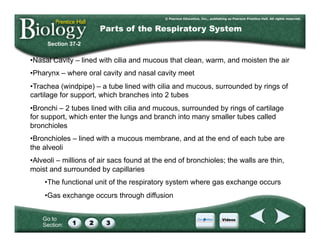
Parts of the Respiratory System
• Nasal Cavity – lined with cilia and mucous that clean, warm, and moisten the air
• Pharynx – where oral cavity and nasal cavity meet
• Trachea (windpipe) – a tube lined with cilia and mucous, surrounded by rings of
cartilage for support, which branches into 2 tubes
• Bronchi – 2 tubes lined with cilia and mucous, surrounded by rings of cartilage
for support, which enter the lungs and branch into many smaller tubes called
bronchioles
• Bronchioles – lined with a mucous membrane, and at the end of each tube are
the alveoli
• Alveoli – millions of air sacs found at the end of bronchioles; the walls are thin,
moist and surrounded by capillaries
• The functional unit of the respiratory system where gas exchange occurs
• Gas exchange occurs through diffusion
Go to
Section:
Section 37-3
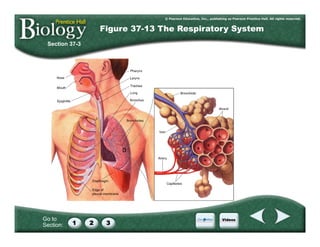
Figure 37-13 The Respiratory System
Go to
Section:
Section 37-3
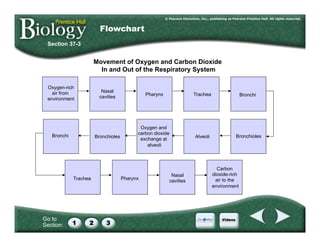
Flowchart
Movement of Oxygen and Carbon Dioxide
In and Out of the Respiratory System
Oxygen and
carbon dioxide
exchange at
alveoli
Oxygen-rich
air from
environment
Bronchioles
Nasal
cavities
Pharynx Trachea Bronchi
Bronchioles
Alveoli
Pharynx
Nasal
cavities
Carbon
dioxide-rich
air to the
environment
Bronchi
Trachea
Go to
Section:
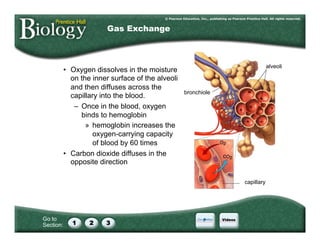
•  Oxygen dissolves in the moisture
on the inner surface of the alveoli
and then diffuses across the
capillary into the blood.
–  Once in the blood, oxygen
binds to hemoglobin
»  hemoglobin increases the
oxygen-carrying capacity
of blood by 60 times
•  Carbon dioxide diffuses in the
opposite direction
Gas Exchange
bronchiole
alveoli
capillary
Go to
Section:
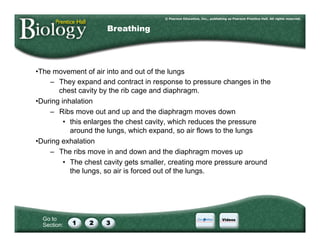
• The movement of air into and out of the lungs
–  They expand and contract in response to pressure changes in the
chest cavity by the rib cage and diaphragm.
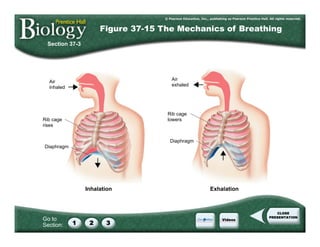
• During inhalation
–  Ribs move out and up and the diaphragm moves down
•  this enlarges the chest cavity, which reduces the pressure
around the lungs, which expand, so air flows to the lungs
• During exhalation
–  The ribs move in and down and the diaphragm moves up
•  The chest cavity gets smaller, creating more pressure around
the lungs, so air is forced out of the lungs.
Breathing
Go to
Section:
Air
inhaled
Diaphragm
Rib cage
rises
Air
exhaled
Diaphragm
Rib cage
lowers
Inhalation Exhalation
Section 37-3
Figure 37-15 The Mechanics of Breathing
Go to
Section:
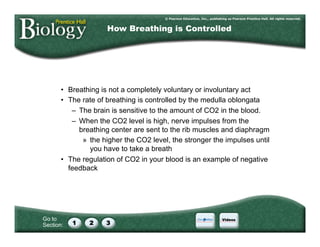
•  Breathing is not a completely voluntary or involuntary act
•  The rate of breathing is controlled by the medulla oblongata
–  The brain is sensitive to the amount of CO2 in the blood.
–  When the CO2 level is high, nerve impulses from the
breathing center are sent to the rib muscles and diaphragm
»  the higher the CO2 level, the stronger the impulses until
you have to take a breath
•  The regulation of CO2 in your blood is an example of negative
feedback
How Breathing is Controlled
Go to
Section:
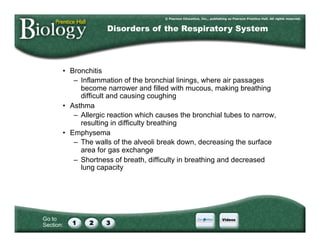
•  Bronchitis
–  Inflammation of the bronchial linings, where air passages
become narrower and filled with mucous, making breathing
difficult and causing coughing
•  Asthma
–  Allergic reaction which causes the bronchial tubes to narrow,
resulting in difficulty breathing
•  Emphysema
–  The walls of the alveoli break down, decreasing the surface
area for gas exchange
–  Shortness of breath, difficulty in breathing and decreased
lung capacity
Disorders of the Respiratory System
Video 2
Click the image to play the video segment.
Video 1
Human Respiration
Go to
Section:
Cardiovascular
(Circulatory)
System
Go to
Section:
1. Choose the longest vein you can see on the inner side of your wrist.
Starting as close to your wrist as possible, press your thumb on the
vein and slide it along the vein up your arm. Did the length of the vein
remain blue?
2. Repeat this process, but in the opposite direction, moving your thumb
along the vein from the far end to the end closest to your wrist. Did the
length of the vein remain blue?
3. In which direction is your blood flowing in this vein? How can you tell?
Can you tell where a valve is located? Explain your answer.
Section 37-1
Interest Grabber
Go to
Section:
37–1 The Circulatory System
A. Functions of the Circulatory System
B. The Heart
1. Circulation Through the Body
2. Circulation Through the Heart
C. Blood Vessels
1. Arteries
2. Capillaries
3. Veins
D. Blood Pressure
E. Diseases of the Circulatory System
1. High Blood Pressure
2. Consequences of Atherosclerosis
3. Circulatory System Health
Section 37-1
Section Outline
Go to
Section:
•  The majority of our cells are not in contact with the
environment.
–  Due to this, we can not rely on diffusion to transport
materials from cell to cell.
–  Most of the substances needed in one part of the
body are produced in another part.
•  Larger organisms, including humans, have evolved
circulatory systems to deal with transport of materials
around larger areas.
–  Our circulatory system is a closed system.
•  Our circulating fluid, blood, is contained within
vessels
•  The circulatory system consists of the heart, blood
vessels and blood.
Section 37-1
Functions of the Circulatory System
Go to
Section:
•  The heart is composed almost entirely of muscle (cardiac).
–  It is a hollow organ, surrounded by a tissue known as
pericardium.
•  It is divided into left and right sides, by a wall known as the
septum.
–  The septum prevents oxygen-rich blood and oxygen-poor
blood from mixing.
–  On either side of the septum are two chambers.
•  The upper chambers are called atria
–  They receive blood
•  The lower chambers are called ventricles
–  They pump blood out of the heart
–  The atria and ventricles are separated by valves.
•  The valves prevent blood from flowing back into the
atria.
Section 37-1
The Heart
Go to
Section:
•  Pulmonary circulation
–  Blood is pumped from the heart to the lungs
•  Systemic circulation
–  Blood is pumped from the heart to the rest of the body.
Section 37-1
Two pathways of circulation
Go to
Section:
•  Oxygen-poor blood enters the right atria from the superior
and inferior vena cavae.
•  It flows into the right ventricle and is pumped into the
pulmonary artery to go to the lungs.
•  At the lungs, CO2 leaves the blood and oxygen enters.
•  The oxygen-rich blood then enters the pulmonary vein and
returns to the heart.
•  The blood flows into the left atria and then flows into the left
ventricle.
•  It is then pumped into the aorta, which carries oxygen-rich
blood to the body.
Section 37-1
Pulmonary Circulation
Go to
Section:
Section 37-1
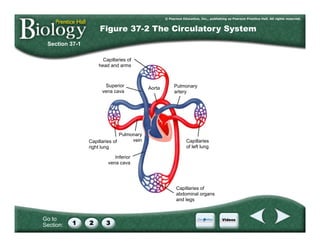
Figure 37-2 The Circulatory System
Capillaries of
head and arms
Capillaries of
abdominal organs
and legs
Inferior
vena cava
Pulmonary
vein
Capillaries of
right lung
Superior
vena cava
Aorta Pulmonary
artery
Capillaries
of left lung
Go to
Section:
Section 37-1
Go to
Section:
Section 37-1
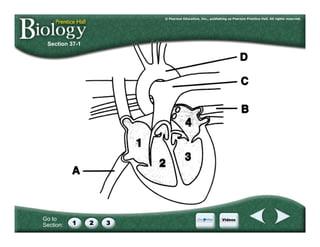
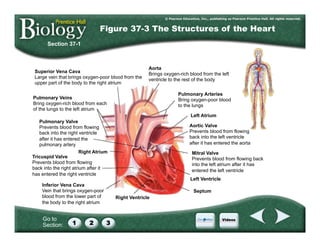
Figure 37-3 The Structures of the Heart
Right Ventricle
Right Atrium
Left Atrium
Inferior Vena Cava
Vein that brings oxygen-poor
blood from the lower part of
the body to the right atrium
Tricuspid Valve
Prevents blood from flowing
back into the right atrium after it
has entered the right ventricle
Pulmonary Valve
Prevents blood from flowing
back into the right ventricle
after it has entered the
pulmonary artery
Pulmonary Veins
Bring oxygen-rich blood from each
of the lungs to the left atrium
Superior Vena Cava
Large vein that brings oxygen-poor blood from the
upper part of the body to the right atrium
Aorta
Brings oxygen-rich blood from the left
ventricle to the rest of the body
Pulmonary Arteries
Bring oxygen-poor blood
to the lungs
Aortic Valve
Prevents blood from flowing
back into the left ventricle
after it has entered the aorta
Mitral Valve
Prevents blood from flowing back
into the left atrium after it has
entered the left ventricle
Left Ventricle
Septum
Go to
Section:
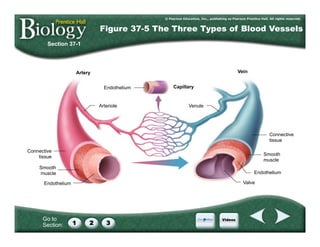
•  Three types of blood vessels
–  Arteries
•  Always carry blood away from the heart
–  With the exception of the pulmonary artery, they carry oxygen-rich
blood
•  They have very thick walls that help them withstand the pressure
produced when the heart contracts and blood is pushed in.
–  Capillaries
•  The smallest of the blood vessels
–  Only one-cell thick, so blood cells can only pass through single file.
–  All gas and nutrient exchange occurs here.
–  Veins
•  Always carry blood to the heart
–  With the exception of the pulmonary vein, they carry oxygen-poor
blood.
•  Contain valves, which help blood to keep moving towards the heart and
prevent it from pooling.
Section 37-1
Blood Vessels
Go to
Section:
Section 37-1
Figure 37-5 The Three Types of Blood Vessels
Capillary
Connective
tissue
Connective
tissue
Smooth
muscle
Smooth
muscle
Endothelium
Endothelium
Valve
Venule
Endothelium
Arteriole
Vein
Artery
Go to
Section:
•  The force of the blood on the walls of the arteries
•  Measured with a sphygmomanometer (blood pressure cuff)
•  Air is pumped into the cuff until an artery is blocked.
–  When the pressure is released, the tech listens to the
pulse and records two numbers
–  The first number is the systolic pressure
•  The force felt in the arteries when the ventricles
contract
–  The second number is the diastolic pressure
•  The force of the blood felt in the arteries when the
ventricles relax.
Section 37-1
Blood Pressure
Go to
Section:
•  Plasma (55% of the blood)
–  A straw-colored fluid which is about 90% water and 10%
dissolved gases, salts, nutrients, enzymes, hormones,
waste products and plasma proteins
•  Cells (45% of the blood)
–  RBC’s
•  Most numerous
–  Contain hemoglobin, which is the iron-containing
protein that binds oxygen
–  WBC’s (leukocytes)
•  They are the army of the circulatory system
•  May increase dramatically when the body is fighting an
infection
–  Platelets
•  Help in blood clotting by clumping together at the
injury to prevent blood from flowing out of the cut
Section 37-1
Parts of the Blood
Go to
Section:
Section 37-2
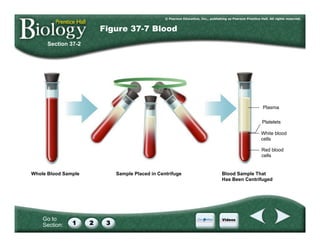
Figure 37-7 Blood
Whole Blood Sample
Red blood
cells
White blood
cells
Platelets
Plasma
Sample Placed in Centrifuge Blood Sample That
Has Been Centrifuged
Go to
Section:
Section 37-2
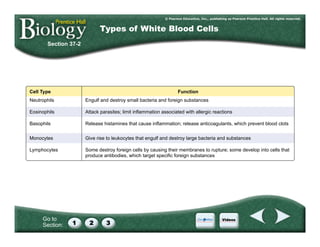
Types of White Blood Cells
Cell Type
Neutrophils
Eosinophils
Basophils
Monocytes
Lymphocytes
Function
Engulf and destroy small bacteria and foreign substances
Attack parasites; limit inflammation associated with allergic reactions
Release histamines that cause inflammation; release anticoagulants, which prevent blood clots
Give rise to leukocytes that engulf and destroy large bacteria and substances
Some destroy foreign cells by causing their membranes to rupture; some develop into cells that
produce antibodies, which target specific foreign substances
Go to
Section:
Section 37-2
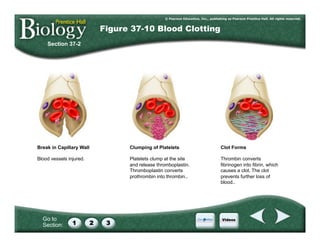
Figure 37-10 Blood Clotting
Break in Capillary Wall
Blood vessels injured.
Clumping of Platelets
Platelets clump at the site
and release thromboplastin.
Thromboplastin converts
prothrombin into thrombin..
Clot Forms
Thrombin converts
fibrinogen into fibrin, which
causes a clot. The clot
prevents further loss of
blood..
Go to
Section:
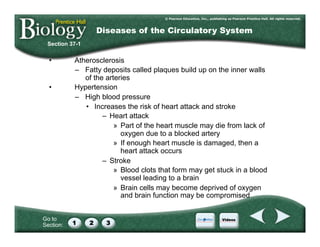
•  Atherosclerosis
–  Fatty deposits called plaques build up on the inner walls
of the arteries
•  Hypertension
–  High blood pressure
•  Increases the risk of heart attack and stroke
–  Heart attack
»  Part of the heart muscle may die from lack of
oxygen due to a blocked artery
»  If enough heart muscle is damaged, then a
heart attack occurs
–  Stroke
»  Blood clots that form may get stuck in a blood
vessel leading to a brain
»  Brain cells may become deprived of oxygen
and brain function may be compromised
Section 37-1
Diseases of the Circulatory System
Go to
Section:
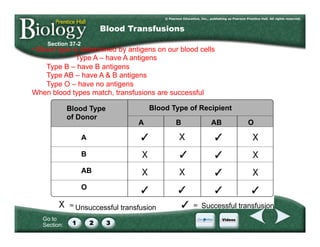
Blood Type
of Donor
A
B
AB
O
Blood Type of Recipient
A B AB O
Unsuccessful transfusion Successful transfusion
Section 37-2
Blood Transfusions
• Blood type is determined by antigens on our blood cells
Type A – have A antigens
Type B – have B antigens
Type AB – have A & B antigens
Type O – have no antigens
When blood types match, transfusions are successful
Go to
Section:
Video 1
Lymphatic System
• Collects fluid lost from the blood and return it back to the circulatory
system
–  Consists of a network of vessels, nodes and organs.
•  Lymph vessels – contain valves to prevents backflow
•  Spleen – main function is to destroy damaged red blood cells
and platelets
•  Thymus – certain WBC’s mature here before they can function
in the immune system
•  Nodes – act as filters to trap bacteria and other microorganisms
• Also plays a role in nutrient absorption
–  Helps absorb fats and fat-soluble vitamins from the intestines and
carry them to the blood
Go to
Section:
Section 37-2
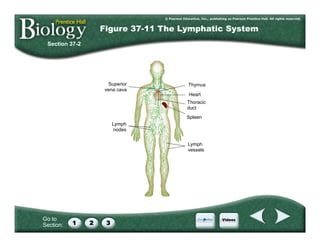
Figure 37-11 The Lymphatic System
Superior
vena cava
Lymph
nodes
Thymus
Heart
Thoracic
duct
Spleen
Lymph
vessels
Video 1
Click the image to play the video segment.
Video 2
Human Circulation

respiratory and circulatory system .pdf

  • 1.
  • 2.
    Go to Section: 37–3 TheRespiratory System A. What Is Respiration? B. The Human Respiratory System C. Gas Exchange D. Breathing E. How Breathing Is Controlled F. Diseases of the Respiratory System Section 37-3 Section Outline
  • 3.
    Go to Section: Section 37-2 Whatis respiration? • Two different meanings in biology • On the cellular level, it is the release of energy from food molecules that occurs in mitochondria • On an organismal level, it is the gas exchange that occurs between the lungs and the environment • Sometimes referred to as breathing • Necessary for cellular respiration to continue
  • 4.
    Go to Section: Section 37-2 HumanRespiratory System • Basic Function • To bring about the exchange of O2 and CO2 between the blood, air and tissues • Consists of a network of passageways that permit air to flow into and out of the lungs • Parts • Nose (nasal cavity), pharynx, larynx, trachea, bronchi and lungs (which contain alveoli)
  • 5.
    Go to Section: Section 37-2 Partsof the Respiratory System • Nasal Cavity – lined with cilia and mucous that clean, warm, and moisten the air • Pharynx – where oral cavity and nasal cavity meet • Trachea (windpipe) – a tube lined with cilia and mucous, surrounded by rings of cartilage for support, which branches into 2 tubes • Bronchi – 2 tubes lined with cilia and mucous, surrounded by rings of cartilage for support, which enter the lungs and branch into many smaller tubes called bronchioles • Bronchioles – lined with a mucous membrane, and at the end of each tube are the alveoli • Alveoli – millions of air sacs found at the end of bronchioles; the walls are thin, moist and surrounded by capillaries • The functional unit of the respiratory system where gas exchange occurs • Gas exchange occurs through diffusion
  • 6.
    Go to Section: Section 37-3 Figure37-13 The Respiratory System
  • 7.
    Go to Section: Section 37-3 Flowchart Movementof Oxygen and Carbon Dioxide In and Out of the Respiratory System Oxygen and carbon dioxide exchange at alveoli Oxygen-rich air from environment Bronchioles Nasal cavities Pharynx Trachea Bronchi Bronchioles Alveoli Pharynx Nasal cavities Carbon dioxide-rich air to the environment Bronchi Trachea
  • 8.
    Go to Section: •  Oxygendissolves in the moisture on the inner surface of the alveoli and then diffuses across the capillary into the blood. –  Once in the blood, oxygen binds to hemoglobin »  hemoglobin increases the oxygen-carrying capacity of blood by 60 times •  Carbon dioxide diffuses in the opposite direction Gas Exchange bronchiole alveoli capillary
  • 9.
    Go to Section: • The movementof air into and out of the lungs –  They expand and contract in response to pressure changes in the chest cavity by the rib cage and diaphragm. • During inhalation –  Ribs move out and up and the diaphragm moves down •  this enlarges the chest cavity, which reduces the pressure around the lungs, which expand, so air flows to the lungs • During exhalation –  The ribs move in and down and the diaphragm moves up •  The chest cavity gets smaller, creating more pressure around the lungs, so air is forced out of the lungs. Breathing
  • 10.
    Go to Section: Air inhaled Diaphragm Rib cage rises Air exhaled Diaphragm Ribcage lowers Inhalation Exhalation Section 37-3 Figure 37-15 The Mechanics of Breathing
  • 11.
    Go to Section: •  Breathingis not a completely voluntary or involuntary act •  The rate of breathing is controlled by the medulla oblongata –  The brain is sensitive to the amount of CO2 in the blood. –  When the CO2 level is high, nerve impulses from the breathing center are sent to the rib muscles and diaphragm »  the higher the CO2 level, the stronger the impulses until you have to take a breath •  The regulation of CO2 in your blood is an example of negative feedback How Breathing is Controlled
  • 12.
    Go to Section: •  Bronchitis – Inflammation of the bronchial linings, where air passages become narrower and filled with mucous, making breathing difficult and causing coughing •  Asthma –  Allergic reaction which causes the bronchial tubes to narrow, resulting in difficulty breathing •  Emphysema –  The walls of the alveoli break down, decreasing the surface area for gas exchange –  Shortness of breath, difficulty in breathing and decreased lung capacity Disorders of the Respiratory System
  • 13.
    Video 2 Click theimage to play the video segment. Video 1 Human Respiration
  • 14.
  • 15.
    Go to Section: 1. Choosethe longest vein you can see on the inner side of your wrist. Starting as close to your wrist as possible, press your thumb on the vein and slide it along the vein up your arm. Did the length of the vein remain blue? 2. Repeat this process, but in the opposite direction, moving your thumb along the vein from the far end to the end closest to your wrist. Did the length of the vein remain blue? 3. In which direction is your blood flowing in this vein? How can you tell? Can you tell where a valve is located? Explain your answer. Section 37-1 Interest Grabber
  • 16.
    Go to Section: 37–1 TheCirculatory System A. Functions of the Circulatory System B. The Heart 1. Circulation Through the Body 2. Circulation Through the Heart C. Blood Vessels 1. Arteries 2. Capillaries 3. Veins D. Blood Pressure E. Diseases of the Circulatory System 1. High Blood Pressure 2. Consequences of Atherosclerosis 3. Circulatory System Health Section 37-1 Section Outline
  • 17.
    Go to Section: •  Themajority of our cells are not in contact with the environment. –  Due to this, we can not rely on diffusion to transport materials from cell to cell. –  Most of the substances needed in one part of the body are produced in another part. •  Larger organisms, including humans, have evolved circulatory systems to deal with transport of materials around larger areas. –  Our circulatory system is a closed system. •  Our circulating fluid, blood, is contained within vessels •  The circulatory system consists of the heart, blood vessels and blood. Section 37-1 Functions of the Circulatory System
  • 18.
    Go to Section: •  Theheart is composed almost entirely of muscle (cardiac). –  It is a hollow organ, surrounded by a tissue known as pericardium. •  It is divided into left and right sides, by a wall known as the septum. –  The septum prevents oxygen-rich blood and oxygen-poor blood from mixing. –  On either side of the septum are two chambers. •  The upper chambers are called atria –  They receive blood •  The lower chambers are called ventricles –  They pump blood out of the heart –  The atria and ventricles are separated by valves. •  The valves prevent blood from flowing back into the atria. Section 37-1 The Heart
  • 19.
    Go to Section: •  Pulmonarycirculation –  Blood is pumped from the heart to the lungs •  Systemic circulation –  Blood is pumped from the heart to the rest of the body. Section 37-1 Two pathways of circulation
  • 20.
    Go to Section: •  Oxygen-poorblood enters the right atria from the superior and inferior vena cavae. •  It flows into the right ventricle and is pumped into the pulmonary artery to go to the lungs. •  At the lungs, CO2 leaves the blood and oxygen enters. •  The oxygen-rich blood then enters the pulmonary vein and returns to the heart. •  The blood flows into the left atria and then flows into the left ventricle. •  It is then pumped into the aorta, which carries oxygen-rich blood to the body. Section 37-1 Pulmonary Circulation
  • 21.
    Go to Section: Section 37-1 Figure37-2 The Circulatory System Capillaries of head and arms Capillaries of abdominal organs and legs Inferior vena cava Pulmonary vein Capillaries of right lung Superior vena cava Aorta Pulmonary artery Capillaries of left lung
  • 22.
  • 23.
    Go to Section: Section 37-1 Figure37-3 The Structures of the Heart Right Ventricle Right Atrium Left Atrium Inferior Vena Cava Vein that brings oxygen-poor blood from the lower part of the body to the right atrium Tricuspid Valve Prevents blood from flowing back into the right atrium after it has entered the right ventricle Pulmonary Valve Prevents blood from flowing back into the right ventricle after it has entered the pulmonary artery Pulmonary Veins Bring oxygen-rich blood from each of the lungs to the left atrium Superior Vena Cava Large vein that brings oxygen-poor blood from the upper part of the body to the right atrium Aorta Brings oxygen-rich blood from the left ventricle to the rest of the body Pulmonary Arteries Bring oxygen-poor blood to the lungs Aortic Valve Prevents blood from flowing back into the left ventricle after it has entered the aorta Mitral Valve Prevents blood from flowing back into the left atrium after it has entered the left ventricle Left Ventricle Septum
  • 24.
    Go to Section: •  Threetypes of blood vessels –  Arteries •  Always carry blood away from the heart –  With the exception of the pulmonary artery, they carry oxygen-rich blood •  They have very thick walls that help them withstand the pressure produced when the heart contracts and blood is pushed in. –  Capillaries •  The smallest of the blood vessels –  Only one-cell thick, so blood cells can only pass through single file. –  All gas and nutrient exchange occurs here. –  Veins •  Always carry blood to the heart –  With the exception of the pulmonary vein, they carry oxygen-poor blood. •  Contain valves, which help blood to keep moving towards the heart and prevent it from pooling. Section 37-1 Blood Vessels
  • 25.
    Go to Section: Section 37-1 Figure37-5 The Three Types of Blood Vessels Capillary Connective tissue Connective tissue Smooth muscle Smooth muscle Endothelium Endothelium Valve Venule Endothelium Arteriole Vein Artery
  • 26.
    Go to Section: •  Theforce of the blood on the walls of the arteries •  Measured with a sphygmomanometer (blood pressure cuff) •  Air is pumped into the cuff until an artery is blocked. –  When the pressure is released, the tech listens to the pulse and records two numbers –  The first number is the systolic pressure •  The force felt in the arteries when the ventricles contract –  The second number is the diastolic pressure •  The force of the blood felt in the arteries when the ventricles relax. Section 37-1 Blood Pressure
  • 27.
    Go to Section: •  Plasma(55% of the blood) –  A straw-colored fluid which is about 90% water and 10% dissolved gases, salts, nutrients, enzymes, hormones, waste products and plasma proteins •  Cells (45% of the blood) –  RBC’s •  Most numerous –  Contain hemoglobin, which is the iron-containing protein that binds oxygen –  WBC’s (leukocytes) •  They are the army of the circulatory system •  May increase dramatically when the body is fighting an infection –  Platelets •  Help in blood clotting by clumping together at the injury to prevent blood from flowing out of the cut Section 37-1 Parts of the Blood
  • 28.
    Go to Section: Section 37-2 Figure37-7 Blood Whole Blood Sample Red blood cells White blood cells Platelets Plasma Sample Placed in Centrifuge Blood Sample That Has Been Centrifuged
  • 29.
    Go to Section: Section 37-2 Typesof White Blood Cells Cell Type Neutrophils Eosinophils Basophils Monocytes Lymphocytes Function Engulf and destroy small bacteria and foreign substances Attack parasites; limit inflammation associated with allergic reactions Release histamines that cause inflammation; release anticoagulants, which prevent blood clots Give rise to leukocytes that engulf and destroy large bacteria and substances Some destroy foreign cells by causing their membranes to rupture; some develop into cells that produce antibodies, which target specific foreign substances
  • 30.
    Go to Section: Section 37-2 Figure37-10 Blood Clotting Break in Capillary Wall Blood vessels injured. Clumping of Platelets Platelets clump at the site and release thromboplastin. Thromboplastin converts prothrombin into thrombin.. Clot Forms Thrombin converts fibrinogen into fibrin, which causes a clot. The clot prevents further loss of blood..
  • 31.
    Go to Section: •  Atherosclerosis – Fatty deposits called plaques build up on the inner walls of the arteries •  Hypertension –  High blood pressure •  Increases the risk of heart attack and stroke –  Heart attack »  Part of the heart muscle may die from lack of oxygen due to a blocked artery »  If enough heart muscle is damaged, then a heart attack occurs –  Stroke »  Blood clots that form may get stuck in a blood vessel leading to a brain »  Brain cells may become deprived of oxygen and brain function may be compromised Section 37-1 Diseases of the Circulatory System
  • 32.
    Go to Section: Blood Type ofDonor A B AB O Blood Type of Recipient A B AB O Unsuccessful transfusion Successful transfusion Section 37-2 Blood Transfusions • Blood type is determined by antigens on our blood cells Type A – have A antigens Type B – have B antigens Type AB – have A & B antigens Type O – have no antigens When blood types match, transfusions are successful
  • 33.
    Go to Section: Video 1 LymphaticSystem • Collects fluid lost from the blood and return it back to the circulatory system –  Consists of a network of vessels, nodes and organs. •  Lymph vessels – contain valves to prevents backflow •  Spleen – main function is to destroy damaged red blood cells and platelets •  Thymus – certain WBC’s mature here before they can function in the immune system •  Nodes – act as filters to trap bacteria and other microorganisms • Also plays a role in nutrient absorption –  Helps absorb fats and fat-soluble vitamins from the intestines and carry them to the blood
  • 34.
    Go to Section: Section 37-2 Figure37-11 The Lymphatic System Superior vena cava Lymph nodes Thymus Heart Thoracic duct Spleen Lymph vessels
  • 35.
    Video 1 Click theimage to play the video segment. Video 2 Human Circulation