ELECTRONIC PRODUCTS
ASSEMBLY AND SERVICING
PSYCHOLOGY OF
COLORS
RED IS THE COLOR OF
ENERGY, PASSION,
ACTION, AMBITION AND
DETERMINATION.
ORANGE IS THE COLOR
OF SOCIAL
COMMUNICATION AND
OPTIMISM.
THE COLOR BROWN IS A
FRIENDLYYET SERIOUS,
DOWN-TO-EARTH COLOR
THAT RELATES TO SECURITY,
PROTECTION, COMFORT AND
MATERIAL WEALTH.
BLUE CALLS TO MIND FEELINGS
OF CALMNESS OR SERENITY. IT IS
OFTEN DESCRIBED AS PEACEFUL,
TRANQUIL, SECURE, AND
ORDERLY. BLUE IS OFTEN SEEN AS
A SIGN OF STABILITY AND
RELIABILITY.
GREEN PERSONALITY TYPE TENDS TO
BE ANALYTICAL, CALM, LOGICAL,WITH
A GREAT THIRST FOR KNOWLEDGE.
THEY ARE SOMETIMES DESCRIBED AS
STRATEGIC THINKERS AND VISIONARIES
THAT ARE ALSO BORN LEADERS.THEY
LIKE TO BE IN CHARGE AND LIVE THEIR
LIFE ON THEIR OWN TERMS.
RESISTANCE
MEASUREMENT
OBJECTIVES:
At the end of the lesson, the students should be able to:
1. Identify the color code value and tolerance of resistors
2. Determine a resistors value by examining its color bands
3. Perform the actual reading of resistors by its color bands
4. Recognize the importance of resistor’s color code and its
tolerance as one of electronic components in a circuit.
RESISTANCE (R) is measured in ohms,
symbolized by the Greek letter omega (Ω).
Ohms are named after Georg Simon Ohm (1784-
1854), a German physicist who studied the
relationship between VOLTAGE, CURRENT and
RESISTANCE. He is credited for formulating
OHM'S LAW.
E = I X R
VOLTS = AMPS X RESISTANCE
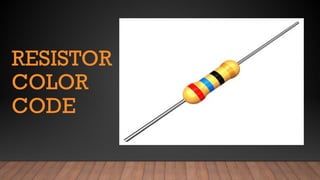
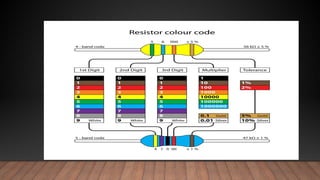
RESISTOR
COLOR
CODE
4-BAND
RESISTORS
• Resistors with ±5% and ±10% tolerance will have
4-bands.
• Convert nominal value to ohms (Ω).
• 1st
digit (from left to right) of nominal value = 1st
color band.
• 2nd
digit of nominal value = 2nd
band
• Number of zeros remaining = 3rd
(multiplier) band
• Tolerance = 4th
band
5-BAND
RESISTORS
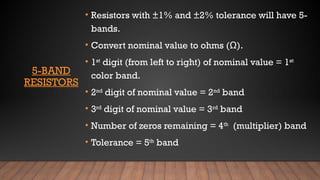
• Resistors with ±1% and ±2% tolerance will have 5-
bands.
• Convert nominal value to ohms (Ω).
• 1st
digit (from left to right) of nominal value = 1st
color band.
• 2nd
digit of nominal value = 2nd
band
• 3rd
digit of nominal value = 3rd
band
• Number of zeros remaining = 4th
(multiplier) band
• Tolerance = 5th
band
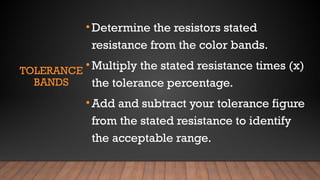
TOLERANCE
BANDS
•Determine the resistors stated
resistance from the color bands.
•Multiply the stated resistance times (x)
the tolerance percentage.
•Add and subtract your tolerance figure
from the stated resistance to identify
the acceptable range.
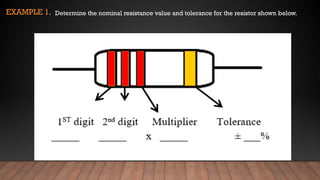
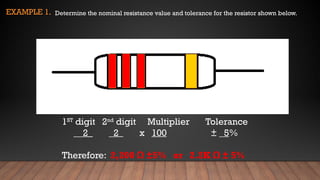
EXAMPLE 1. Determine the nominal resistance value and tolerance for the resistor shown below.
1ST
digit 2nd
digit Multiplier Tolerance
__2_ _2 x 100 ± _5%
Therefore: 2,200 Ω ±5% or 2.2K Ω ± 5%
EXAMPLE 1.
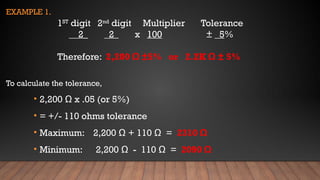
To calculate the tolerance,
• 2,200 Ω x .05 (or 5%)
• = +/- 110 ohms tolerance
• Maximum: 2,200 Ω + 110 Ω = 2310 Ω
• Minimum: 2,200 Ω - 110 Ω = 2090 Ω
1ST
digit 2nd
digit Multiplier Tolerance
__2_ _2 x 100 ± _5%
Therefore: 2,200 Ω ±5% or 2.2K Ω ± 5%
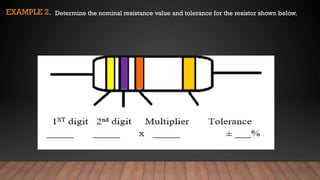
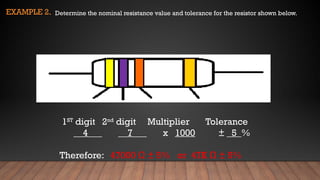
EXAMPLE 2. Determine the nominal resistance value and tolerance for the resistor shown below.
1ST
digit 2nd
digit Multiplier Tolerance
__4___ __7___ x 1000 ± _5_%
Therefore: 47000 Ω ± 5% or 47K Ω ± 5%
EXAMPLE 2.
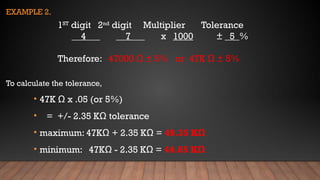
To calculate the tolerance,
• 47K Ω x .05 (or 5%)
• = +/- 2.35 KΩ tolerance
• maximum: 47KΩ + 2.35 KΩ = 49.35 KΩ
• minimum: 47KΩ - 2.35 KΩ = 44.65 KΩ
1ST
digit 2nd
digit Multiplier Tolerance
__4___ __7___ x 1000 ± _5_%
Therefore: 47000 Ω ± 5% or 47K Ω ± 5%
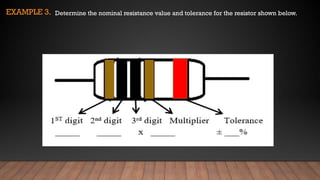
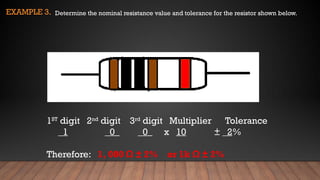
EXAMPLE 3. Determine the nominal resistance value and tolerance for the resistor shown below.
1ST
digit 2nd
digit 3rd
digit Multiplier Tolerance
_1 _0_ _0_ x 10 ± _2%
Therefore: 1, 000 Ω ± 2% or 1k Ω ± 2%
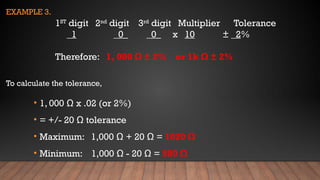
EXAMPLE 3.
To calculate the tolerance,
• 1, 000 Ω x .02 (or 2%)
• = +/- 20 Ω tolerance
• Maximum: 1,000 Ω + 20 Ω = 1020 Ω
• Minimum: 1,000 Ω - 20 Ω = 980 Ω
1ST
digit 2nd
digit 3rd
digit Multiplier Tolerance
_1 _0_ _0_ x 10 ± _2%
Therefore: 1, 000 Ω ± 2% or 1k Ω ± 2%
RESISTANCE
MEASUREMENT
ASSIGNMENT:
• 1.What is the series and parallel connection?
• 2. How to get the total resistance of the resistors in
series and parallel connection?
• Reference: Simple Electronics (BASIC), fully Illustrated by Antonio M.
Andres SR. pp. 108 – 110.

RESISTOR-COLOR-CODING-EDITED FOR ELECTRONICS.pptx

  • 1.
  • 2.
  • 3.
    RED IS THECOLOR OF ENERGY, PASSION, ACTION, AMBITION AND DETERMINATION.
  • 4.
    ORANGE IS THECOLOR OF SOCIAL COMMUNICATION AND OPTIMISM.
  • 5.
    THE COLOR BROWNIS A FRIENDLYYET SERIOUS, DOWN-TO-EARTH COLOR THAT RELATES TO SECURITY, PROTECTION, COMFORT AND MATERIAL WEALTH.
  • 6.
    BLUE CALLS TOMIND FEELINGS OF CALMNESS OR SERENITY. IT IS OFTEN DESCRIBED AS PEACEFUL, TRANQUIL, SECURE, AND ORDERLY. BLUE IS OFTEN SEEN AS A SIGN OF STABILITY AND RELIABILITY.
  • 7.
    GREEN PERSONALITY TYPETENDS TO BE ANALYTICAL, CALM, LOGICAL,WITH A GREAT THIRST FOR KNOWLEDGE. THEY ARE SOMETIMES DESCRIBED AS STRATEGIC THINKERS AND VISIONARIES THAT ARE ALSO BORN LEADERS.THEY LIKE TO BE IN CHARGE AND LIVE THEIR LIFE ON THEIR OWN TERMS.
  • 8.
  • 9.
    OBJECTIVES: At the endof the lesson, the students should be able to: 1. Identify the color code value and tolerance of resistors 2. Determine a resistors value by examining its color bands 3. Perform the actual reading of resistors by its color bands 4. Recognize the importance of resistor’s color code and its tolerance as one of electronic components in a circuit.
  • 10.
    RESISTANCE (R) ismeasured in ohms, symbolized by the Greek letter omega (Ω). Ohms are named after Georg Simon Ohm (1784- 1854), a German physicist who studied the relationship between VOLTAGE, CURRENT and RESISTANCE. He is credited for formulating OHM'S LAW.
  • 11.
    E = IX R VOLTS = AMPS X RESISTANCE
  • 12.
  • 14.
    4-BAND RESISTORS • Resistors with±5% and ±10% tolerance will have 4-bands. • Convert nominal value to ohms (Ω). • 1st digit (from left to right) of nominal value = 1st color band. • 2nd digit of nominal value = 2nd band • Number of zeros remaining = 3rd (multiplier) band • Tolerance = 4th band
  • 15.
    5-BAND RESISTORS • Resistors with±1% and ±2% tolerance will have 5- bands. • Convert nominal value to ohms (Ω). • 1st digit (from left to right) of nominal value = 1st color band. • 2nd digit of nominal value = 2nd band • 3rd digit of nominal value = 3rd band • Number of zeros remaining = 4th (multiplier) band • Tolerance = 5th band
  • 16.
    TOLERANCE BANDS •Determine the resistorsstated resistance from the color bands. •Multiply the stated resistance times (x) the tolerance percentage. •Add and subtract your tolerance figure from the stated resistance to identify the acceptable range.
  • 17.
    EXAMPLE 1. Determinethe nominal resistance value and tolerance for the resistor shown below.
  • 18.
    EXAMPLE 1. Determinethe nominal resistance value and tolerance for the resistor shown below. 1ST digit 2nd digit Multiplier Tolerance __2_ _2 x 100 ± _5% Therefore: 2,200 Ω ±5% or 2.2K Ω ± 5%
  • 19.
    EXAMPLE 1. To calculatethe tolerance, • 2,200 Ω x .05 (or 5%) • = +/- 110 ohms tolerance • Maximum: 2,200 Ω + 110 Ω = 2310 Ω • Minimum: 2,200 Ω - 110 Ω = 2090 Ω 1ST digit 2nd digit Multiplier Tolerance __2_ _2 x 100 ± _5% Therefore: 2,200 Ω ±5% or 2.2K Ω ± 5%
  • 20.
    EXAMPLE 2. Determinethe nominal resistance value and tolerance for the resistor shown below.
  • 21.
    EXAMPLE 2. Determinethe nominal resistance value and tolerance for the resistor shown below. 1ST digit 2nd digit Multiplier Tolerance __4___ __7___ x 1000 ± _5_% Therefore: 47000 Ω ± 5% or 47K Ω ± 5%
  • 22.
    EXAMPLE 2. To calculatethe tolerance, • 47K Ω x .05 (or 5%) • = +/- 2.35 KΩ tolerance • maximum: 47KΩ + 2.35 KΩ = 49.35 KΩ • minimum: 47KΩ - 2.35 KΩ = 44.65 KΩ 1ST digit 2nd digit Multiplier Tolerance __4___ __7___ x 1000 ± _5_% Therefore: 47000 Ω ± 5% or 47K Ω ± 5%
  • 23.
    EXAMPLE 3. Determinethe nominal resistance value and tolerance for the resistor shown below.
  • 24.
    EXAMPLE 3. Determinethe nominal resistance value and tolerance for the resistor shown below. 1ST digit 2nd digit 3rd digit Multiplier Tolerance _1 _0_ _0_ x 10 ± _2% Therefore: 1, 000 Ω ± 2% or 1k Ω ± 2%
  • 25.
    EXAMPLE 3. To calculatethe tolerance, • 1, 000 Ω x .02 (or 2%) • = +/- 20 Ω tolerance • Maximum: 1,000 Ω + 20 Ω = 1020 Ω • Minimum: 1,000 Ω - 20 Ω = 980 Ω 1ST digit 2nd digit 3rd digit Multiplier Tolerance _1 _0_ _0_ x 10 ± _2% Therefore: 1, 000 Ω ± 2% or 1k Ω ± 2%
  • 26.
  • 27.
    ASSIGNMENT: • 1.What isthe series and parallel connection? • 2. How to get the total resistance of the resistors in series and parallel connection? • Reference: Simple Electronics (BASIC), fully Illustrated by Antonio M. Andres SR. pp. 108 – 110.