Basic Electronic Elements
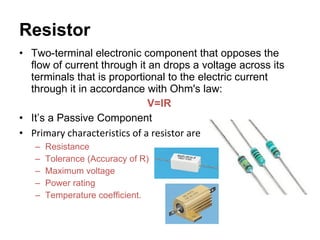
Resistor Two-terminal electronic component that opposes the flow of current through it an drops a voltage across its terminals that is proportional to the electric current through it in accordance with Ohm's law: V=IR It’s a Passive Component Primary characteristics of a resistor are  Resistance Tolerance (Accuracy of R) Maximum voltage Power rating Temperature coefficient.
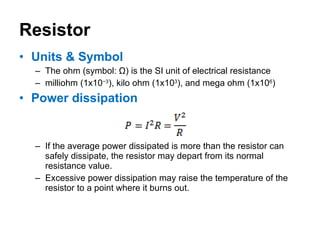
Resistor Units & Symbol The ohm (symbol: Ω) is the SI unit of electrical resistance milliohm (1x10 −3 ), kilo ohm (1x10 3 ), and mega ohm (1x10 6 ) Power dissipation If the average power dissipated is more than the resistor can safely dissipate, the resistor may depart from its normal resistance value. Excessive power dissipation may raise the temperature of the resistor to a point where it burns out.
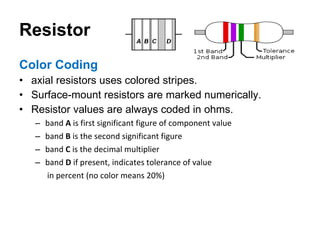
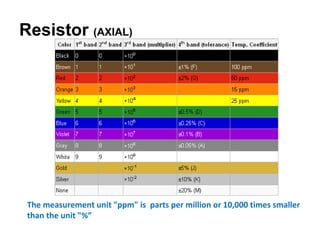
Resistor Color Coding axial resistors uses colored stripes. Surface-mount resistors are marked numerically. Resistor values are always coded in ohms. band  A  is first significant figure of component value band  B  is the second significant figure band  C  is the decimal multiplier band  D  if present, indicates tolerance of value   in percent (no color means 20%)
Resistor  (AXIAL) The measurement unit "ppm" is  parts per million or 10,000 times smaller than the unit "%”
Temperature Coefficient The "alpha" (α) constant is known as the  temperature coefficient of resistance , and symbolizes the resistance change factor per degree of temperature change. Resistor
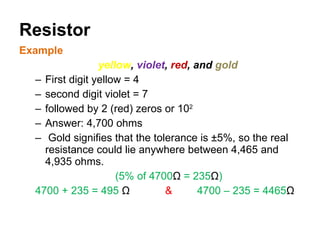
Resistor Example   yellow ,  violet ,  red , and  gold   First digit yellow = 4 second digit violet = 7  followed by 2 (red) zeros or 10 2 Answer: 4,700 ohms Gold signifies that the tolerance is ±5%, so the real resistance could lie anywhere between 4,465 and 4,935 ohms. (5% of 4700 Ω  = 235 Ω ) 4700 + 235 = 495  Ω     &    4700 – 235 = 4465 Ω
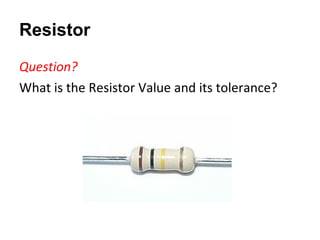
Resistor Question? What is the Resistor Value and its tolerance?
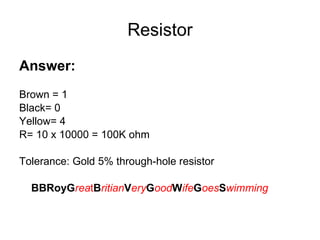
Resistor Answer: Brown = 1 Black= 0 Yellow= 4 R= 10 x 10000 = 100K ohm Tolerance: Gold 5% through-hole resistor BBRoyG rea t B ritian V ery G ood W ife G oes S wimming
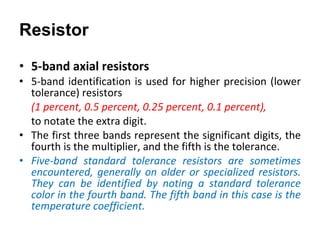
5-band axial resistors 5-band identification is used for higher precision (lower tolerance) resistors  (1 percent, 0.5 percent, 0.25 percent, 0.1 percent),  to notate the extra digit.  The first three bands represent the significant digits, the fourth is the multiplier, and the fifth is the tolerance. Five-band standard tolerance resistors are sometimes encountered, generally on older or specialized resistors. They can be identified by noting a standard tolerance color in the fourth band. The fifth band in this case is the temperature coefficient. Resistor
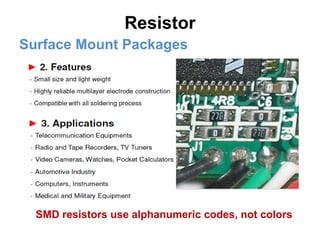
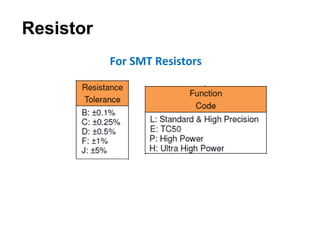
Resistor Surface Mount Packages SMD resistors use alphanumeric codes, not colors
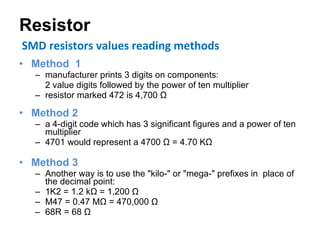
Resistor Method  1 manufacturer prints 3 digits on components:  2 value digits followed by the power of ten multiplier resistor marked 472 is 4,700 Ω Method 2 a 4-digit code which has 3 significant figures and a power of ten multiplier 4701 would represent a 4700 Ω = 4.70 KΩ Method 3 Another way is to use the "kilo-" or "mega-" prefixes in  place of the decimal point: 1K2 = 1.2 kΩ = 1,200 Ω  M47 = 0.47 MΩ = 470,000 Ω  68R = 68 Ω SMD resistors values reading methods
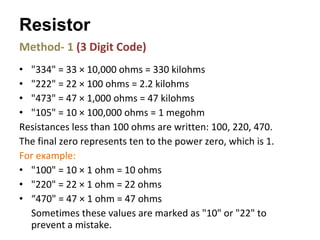
Method- 1  (3 Digit Code) "334" = 33 × 10,000 ohms = 330 kilohms  "222" = 22 × 100 ohms = 2.2 kilohms  "473" = 47 × 1,000 ohms = 47 kilohms  "105" = 10 × 100,000 ohms = 1 megohm  Resistances less than 100 ohms are written: 100, 220, 470.  The final zero represents ten to the power zero, which is 1.  For example: "100" = 10 × 1 ohm = 10 ohms  "220" = 22 × 1 ohm = 22 ohms  “ 470" = 47 × 1 ohm = 47 ohms Sometimes these values are marked as "10" or "22" to prevent a mistake. Resistor
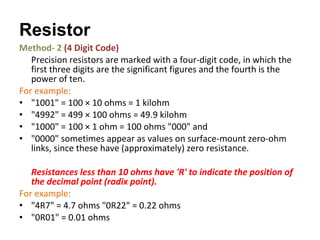
Method- 2  (4 Digit Code) Precision resistors are marked with a four-digit code, in which the first three digits are the significant figures and the fourth is the power of ten.  For example: "1001" = 100 × 10 ohms = 1 kilohm  "4992" = 499 × 100 ohms = 49.9 kilohm  "1000" = 100 × 1 ohm = 100 ohms "000" and  "0000" sometimes appear as values on surface-mount zero-ohm links, since these have (approximately) zero resistance. Resistances less than 10 ohms have 'R' to indicate the position of the decimal point (radix point).  For example: "4R7" = 4.7 ohms "0R22" = 0.22 ohms  "0R01" = 0.01 ohms  Resistor
Resistor For SMT Resistors
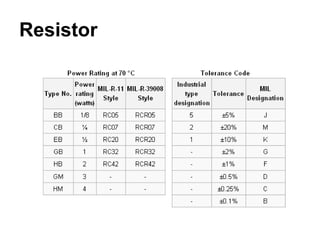
Resistor Industrial type designation Format:   [two letters]<space>[resistance value (three digit)] <nospace>  [ tolerance code(numerical - one digit)]   The operational temperature range distinguishes commercial grade, industrial grade and military grade components. Commercial grade: 0 °C to 70 °C Industrial grade: −40 °C to 85 °C (sometimes −25 °C to 85 °C) Military grade: −55 °C to 125 °C (sometimes -65 °C to 275 °C) Standard Grade -5°C to 60°C
Resistor
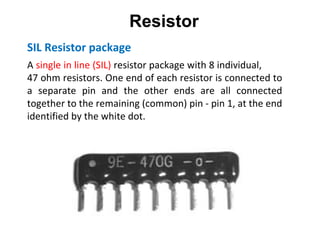
SIL Resistor package A  single in line (SIL)  resistor package with 8 individual,  47 ohm resistors. One end of each resistor is connected to a separate pin and the other ends are all connected together to the remaining (common) pin - pin 1, at the end identified by the white dot. Resistor
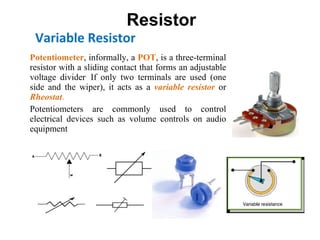
Variable Resistor Potentiometer , informally, a  POT , is a three-terminal resistor with a sliding contact that forms an adjustable voltage divider .  If only two terminals are used (one side and the wiper), it acts as a  variable resistor   or  Rheostat .  Potentiometers are commonly used to control electrical devices such as volume controls on audio equipment Resistor
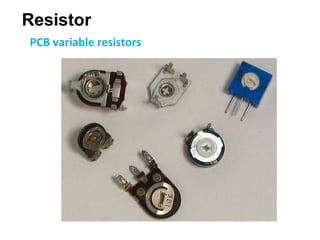
PCB variable resistors Resistor
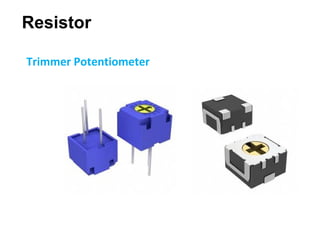
Trimmer Potentiometer Resistor
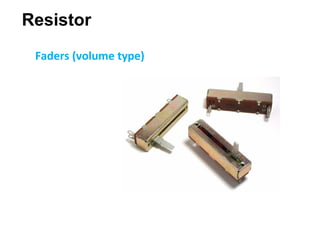
Faders (volume type) Resistor

Pcb lecture 1

  • 1.
  • 2.
    Resistor Two-terminal electroniccomponent that opposes the flow of current through it an drops a voltage across its terminals that is proportional to the electric current through it in accordance with Ohm's law: V=IR It’s a Passive Component Primary characteristics of a resistor are Resistance Tolerance (Accuracy of R) Maximum voltage Power rating Temperature coefficient.
  • 3.
    Resistor Units &Symbol The ohm (symbol: Ω) is the SI unit of electrical resistance milliohm (1x10 −3 ), kilo ohm (1x10 3 ), and mega ohm (1x10 6 ) Power dissipation If the average power dissipated is more than the resistor can safely dissipate, the resistor may depart from its normal resistance value. Excessive power dissipation may raise the temperature of the resistor to a point where it burns out.
  • 4.
    Resistor Color Codingaxial resistors uses colored stripes. Surface-mount resistors are marked numerically. Resistor values are always coded in ohms. band A is first significant figure of component value band B is the second significant figure band C is the decimal multiplier band D if present, indicates tolerance of value in percent (no color means 20%)
  • 5.
    Resistor (AXIAL)The measurement unit &quot;ppm&quot; is parts per million or 10,000 times smaller than the unit &quot;%”
  • 6.
    Temperature Coefficient The&quot;alpha&quot; (α) constant is known as the temperature coefficient of resistance , and symbolizes the resistance change factor per degree of temperature change. Resistor
  • 7.
    Resistor Example yellow , violet , red , and gold First digit yellow = 4 second digit violet = 7 followed by 2 (red) zeros or 10 2 Answer: 4,700 ohms Gold signifies that the tolerance is ±5%, so the real resistance could lie anywhere between 4,465 and 4,935 ohms. (5% of 4700 Ω = 235 Ω ) 4700 + 235 = 495 Ω & 4700 – 235 = 4465 Ω
  • 8.
    Resistor Question? Whatis the Resistor Value and its tolerance?
  • 9.
    Resistor Answer: Brown= 1 Black= 0 Yellow= 4 R= 10 x 10000 = 100K ohm Tolerance: Gold 5% through-hole resistor BBRoyG rea t B ritian V ery G ood W ife G oes S wimming
  • 10.
    5-band axial resistors5-band identification is used for higher precision (lower tolerance) resistors (1 percent, 0.5 percent, 0.25 percent, 0.1 percent), to notate the extra digit. The first three bands represent the significant digits, the fourth is the multiplier, and the fifth is the tolerance. Five-band standard tolerance resistors are sometimes encountered, generally on older or specialized resistors. They can be identified by noting a standard tolerance color in the fourth band. The fifth band in this case is the temperature coefficient. Resistor
  • 11.
    Resistor Surface MountPackages SMD resistors use alphanumeric codes, not colors
  • 12.
    Resistor Method 1 manufacturer prints 3 digits on components: 2 value digits followed by the power of ten multiplier resistor marked 472 is 4,700 Ω Method 2 a 4-digit code which has 3 significant figures and a power of ten multiplier 4701 would represent a 4700 Ω = 4.70 KΩ Method 3 Another way is to use the &quot;kilo-&quot; or &quot;mega-&quot; prefixes in place of the decimal point: 1K2 = 1.2 kΩ = 1,200 Ω M47 = 0.47 MΩ = 470,000 Ω 68R = 68 Ω SMD resistors values reading methods
  • 13.
    Method- 1 (3 Digit Code) &quot;334&quot; = 33 × 10,000 ohms = 330 kilohms &quot;222&quot; = 22 × 100 ohms = 2.2 kilohms &quot;473&quot; = 47 × 1,000 ohms = 47 kilohms &quot;105&quot; = 10 × 100,000 ohms = 1 megohm Resistances less than 100 ohms are written: 100, 220, 470. The final zero represents ten to the power zero, which is 1. For example: &quot;100&quot; = 10 × 1 ohm = 10 ohms &quot;220&quot; = 22 × 1 ohm = 22 ohms “ 470&quot; = 47 × 1 ohm = 47 ohms Sometimes these values are marked as &quot;10&quot; or &quot;22&quot; to prevent a mistake. Resistor
  • 14.
    Method- 2 (4 Digit Code) Precision resistors are marked with a four-digit code, in which the first three digits are the significant figures and the fourth is the power of ten. For example: &quot;1001&quot; = 100 × 10 ohms = 1 kilohm &quot;4992&quot; = 499 × 100 ohms = 49.9 kilohm &quot;1000&quot; = 100 × 1 ohm = 100 ohms &quot;000&quot; and &quot;0000&quot; sometimes appear as values on surface-mount zero-ohm links, since these have (approximately) zero resistance. Resistances less than 10 ohms have 'R' to indicate the position of the decimal point (radix point). For example: &quot;4R7&quot; = 4.7 ohms &quot;0R22&quot; = 0.22 ohms &quot;0R01&quot; = 0.01 ohms Resistor
  • 15.
  • 16.
    Resistor Industrial typedesignation Format: [two letters]<space>[resistance value (three digit)] <nospace> [ tolerance code(numerical - one digit)] The operational temperature range distinguishes commercial grade, industrial grade and military grade components. Commercial grade: 0 °C to 70 °C Industrial grade: −40 °C to 85 °C (sometimes −25 °C to 85 °C) Military grade: −55 °C to 125 °C (sometimes -65 °C to 275 °C) Standard Grade -5°C to 60°C
  • 17.
  • 18.
    SIL Resistor packageA single in line (SIL) resistor package with 8 individual, 47 ohm resistors. One end of each resistor is connected to a separate pin and the other ends are all connected together to the remaining (common) pin - pin 1, at the end identified by the white dot. Resistor
  • 19.
    Variable Resistor Potentiometer, informally, a POT , is a three-terminal resistor with a sliding contact that forms an adjustable voltage divider . If only two terminals are used (one side and the wiper), it acts as a variable resistor or Rheostat . Potentiometers are commonly used to control electrical devices such as volume controls on audio equipment Resistor
  • 20.
  • 21.
  • 22.