Understanding the
Resistor Color Code
Resistor Color Code
• Manufacturers typically use a color band
system known as the resistor color code
• Within this power point, you will learn how
to identify the nominal resistance and the
tolerance of a resistor
Resistor Color Code
 The power rating is not indicated in the resistor
color code and must be determined by experience
using the physical size of the resistor as a guide.
 For resistors with 5% or 10% tolerance, the
color code consists of 4 color bands.
 For resistors with 1% or 2% tolerance, the color
code consists of 5 bands.
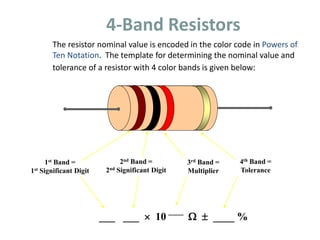
4-Band Resistors
The resistor nominal value is encoded in the color code in Powers of
Ten Notation. The template for determining the nominal value and
tolerance of a resistor with 4 color bands is given below:
1st Band =
1st Significant Digit
2nd Band =
2nd Significant Digit
3rd Band =
Multiplier
4th Band =
Tolerance
___ ___  10    ____ %
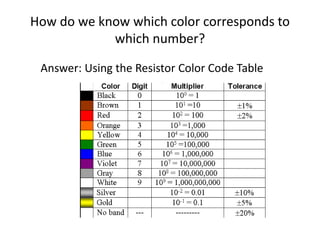
How do we know which color corresponds to
which number?
Answer: Using the Resistor Color Code Table
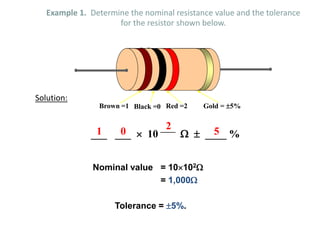
Example 1. Determine the nominal resistance value and the tolerance
for the resistor shown below.
Solution:
Nominal value = 10102
= 1,000
Tolerance = 5%.
___ ___  10    ____ %
1
Brown =1
0
Black =0
2
Red =2
5
Gold = 5%
• It is typical to express the resistance value in:
k if the resistance  1,000
M if the resistance  1,000,000.
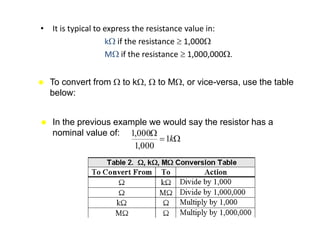
 To convert from  to k,  to M, or vice-versa, use the table
below:
 In the previous example we would say the resistor has a
nominal value of:



k
1
000
,
1
000
,
1
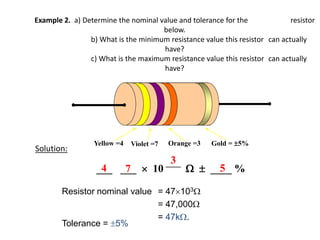
Example 2. a) Determine the nominal value and tolerance for the resistor
below.
b) What is the minimum resistance value this resistor can actually
have?
c) What is the maximum resistance value this resistor can actually
have?
Solution:
___ ___  10    ____ %
Resistor nominal value = 47103
= 47,000
= 47k.
Yellow =4
4
Violet =7
7
Orange =3
3
Gold = 5%
5
Tolerance = 5%
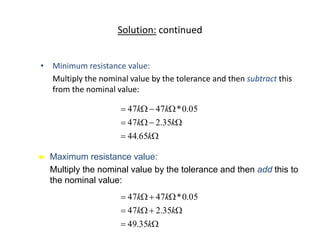
Solution: continued
• Minimum resistance value:
Multiply the nominal value by the tolerance and then subtract this
from the nominal value:










k
k
k
k
k
65
.
44
35
.
2
47
05
.
0
*
47
47
 Maximum resistance value:
Multiply the nominal value by the tolerance and then add this to
the nominal value:










k
k
k
k
k
35
.
49
35
.
2
47
05
.
0
*
47
47
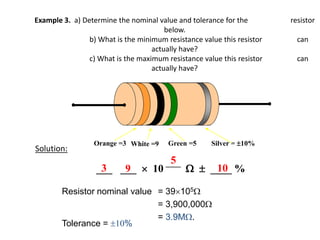
Example 3. a) Determine the nominal value and tolerance for the resistor
below.
b) What is the minimum resistance value this resistor can
actually have?
c) What is the maximum resistance value this resistor can
actually have?
Solution:
___ ___  10    ____ %
Resistor nominal value = 39105
= 3,900,000
= 3.9M.
Orange =3
3
White =9
9
Green =5
5
Silver = 10%
10
Tolerance = 10%
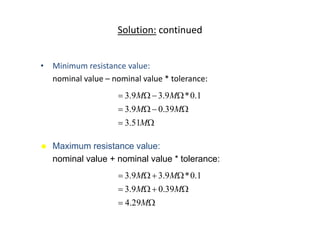
Solution: continued
• Minimum resistance value:
nominal value – nominal value * tolerance:










M
M
M
M
M
51
.
3
39
.
0
9
.
3
1
.
0
*
9
.
3
9
.
3
 Maximum resistance value:
nominal value + nominal value * tolerance:










M
M
M
M
M
29
.
4
39
.
0
9
.
3
1
.
0
*
9
.
3
9
.
3
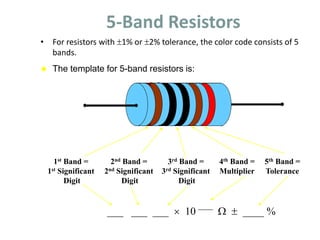
5-Band Resistors
• For resistors with 1% or 2% tolerance, the color code consists of 5
bands.
1st Band =
1st Significant
Digit
2nd Band =
2nd Significant
Digit
3rd Band =
3rd Significant
Digit
4th Band =
Multiplier
5th Band =
Tolerance
___ ___ ___  10    ____ %
 The template for 5-band resistors is:
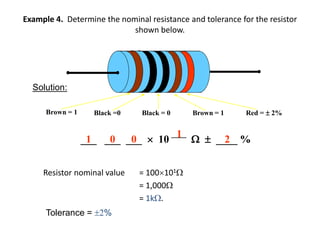
Example 4. Determine the nominal resistance and tolerance for the resistor
shown below.
Resistor nominal value = 100101
= 1,000
= 1k.
___ ___ ___  10    ____ %
Brown = 1
1
Black =0
0
Black = 0
0
Brown = 1
1
Red =  2%
2
Tolerance = 2%
Solution:
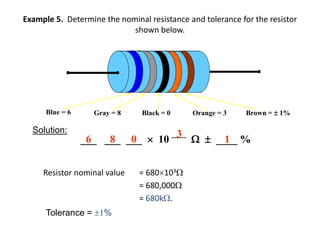
Example 5. Determine the nominal resistance and tolerance for the resistor
shown below.
Resistor nominal value = 680103
= 680,000
= 680k.
___ ___ ___  10    ____ %
Blue = 6
6
Gray = 8
8
Black = 0
0
Orange = 3
3
Brown =  1%
1
Tolerance = 1%
Solution:
Which side of a resistor do I read
from?
• A question that often arises when reading the color code
of real resistors is: how do I determine which side of a
resistor do I read from?
Answer:
• For 4-band resistors a gold or silver band is always the last
band.
• If the resistor has 5 bands or if there is no tolerance band
(20%), then the first band is the one located closest to a
lead.
Converting the Nominal Resistance and
Tolerance into the Color Code
We are given the nominal value and the tolerance and we have to
come up with the color code.
1. Resistors with 5% and 10% Tolerance will have 4-bands
4-Band Resistors
2. Convert nominal value to ohms ()
3. 1st digit (from left to right) of nominal value = 1st color band
4. 2nd digit of nominal value = 2nd band
5. Number of zeros remaining = 3rd (multiplier) band
6. Tolerance = 4th band
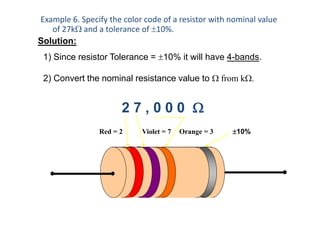
Example 6. Specify the color code of a resistor with nominal value
of 27k and a tolerance of 10%.
Solution:
2 7 , 0 0 0 
2) Convert the nominal resistance value to  from k.
1) Since resistor Tolerance = 10% it will have 4-bands.
Violet = 7
Red = 2 Orange = 3 10%
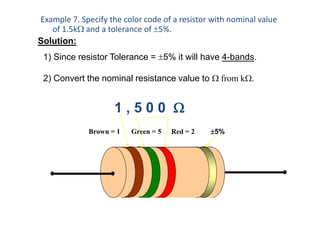
Example 7. Specify the color code of a resistor with nominal value
of 1.5k and a tolerance of 5%.
Solution:
1 , 5 0 0 
2) Convert the nominal resistance value to  from k.
1) Since resistor Tolerance = 5% it will have 4-bands.
Green = 5
Brown = 1 Red = 2 5%
Converting the Nominal Resistance and
Tolerance into the Color Code
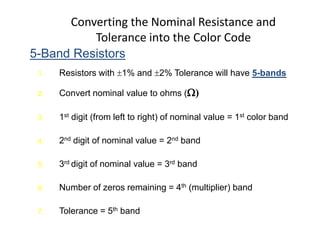
1. Resistors with 1% and 2% Tolerance will have 5-bands
5-Band Resistors
2. Convert nominal value to ohms ()
3. 1st digit (from left to right) of nominal value = 1st color band
4. 2nd digit of nominal value = 2nd band
5. 3rd digit of nominal value = 3rd band
6. Number of zeros remaining = 4th (multiplier) band
7. Tolerance = 5th band
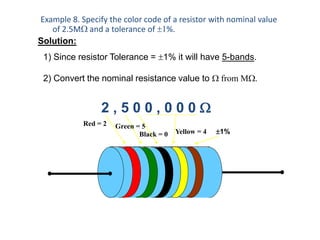
Example 8. Specify the color code of a resistor with nominal value
of 2.5M and a tolerance of 1%.
Solution:
2 , 5 0 0 , 0 0 0 
2) Convert the nominal resistance value to  from M.
1) Since resistor Tolerance = 1% it will have 5-bands.
Green = 5
Red = 2
Yellow = 4 1%
Black = 0

04 Color Coding.ppt

  • 1.
  • 2.
    Resistor Color Code •Manufacturers typically use a color band system known as the resistor color code • Within this power point, you will learn how to identify the nominal resistance and the tolerance of a resistor
  • 3.
    Resistor Color Code The power rating is not indicated in the resistor color code and must be determined by experience using the physical size of the resistor as a guide.  For resistors with 5% or 10% tolerance, the color code consists of 4 color bands.  For resistors with 1% or 2% tolerance, the color code consists of 5 bands.
  • 4.
    4-Band Resistors The resistornominal value is encoded in the color code in Powers of Ten Notation. The template for determining the nominal value and tolerance of a resistor with 4 color bands is given below: 1st Band = 1st Significant Digit 2nd Band = 2nd Significant Digit 3rd Band = Multiplier 4th Band = Tolerance ___ ___  10    ____ %
  • 5.
    How do weknow which color corresponds to which number? Answer: Using the Resistor Color Code Table
  • 6.
    Example 1. Determinethe nominal resistance value and the tolerance for the resistor shown below. Solution: Nominal value = 10102 = 1,000 Tolerance = 5%. ___ ___  10    ____ % 1 Brown =1 0 Black =0 2 Red =2 5 Gold = 5%
  • 7.
    • It istypical to express the resistance value in: k if the resistance  1,000 M if the resistance  1,000,000.  To convert from  to k,  to M, or vice-versa, use the table below:  In the previous example we would say the resistor has a nominal value of:    k 1 000 , 1 000 , 1
  • 8.
    Example 2. a)Determine the nominal value and tolerance for the resistor below. b) What is the minimum resistance value this resistor can actually have? c) What is the maximum resistance value this resistor can actually have? Solution: ___ ___  10    ____ % Resistor nominal value = 47103 = 47,000 = 47k. Yellow =4 4 Violet =7 7 Orange =3 3 Gold = 5% 5 Tolerance = 5%
  • 9.
    Solution: continued • Minimumresistance value: Multiply the nominal value by the tolerance and then subtract this from the nominal value:           k k k k k 65 . 44 35 . 2 47 05 . 0 * 47 47  Maximum resistance value: Multiply the nominal value by the tolerance and then add this to the nominal value:           k k k k k 35 . 49 35 . 2 47 05 . 0 * 47 47
  • 10.
    Example 3. a)Determine the nominal value and tolerance for the resistor below. b) What is the minimum resistance value this resistor can actually have? c) What is the maximum resistance value this resistor can actually have? Solution: ___ ___  10    ____ % Resistor nominal value = 39105 = 3,900,000 = 3.9M. Orange =3 3 White =9 9 Green =5 5 Silver = 10% 10 Tolerance = 10%
  • 11.
    Solution: continued • Minimumresistance value: nominal value – nominal value * tolerance:           M M M M M 51 . 3 39 . 0 9 . 3 1 . 0 * 9 . 3 9 . 3  Maximum resistance value: nominal value + nominal value * tolerance:           M M M M M 29 . 4 39 . 0 9 . 3 1 . 0 * 9 . 3 9 . 3
  • 12.
    5-Band Resistors • Forresistors with 1% or 2% tolerance, the color code consists of 5 bands. 1st Band = 1st Significant Digit 2nd Band = 2nd Significant Digit 3rd Band = 3rd Significant Digit 4th Band = Multiplier 5th Band = Tolerance ___ ___ ___  10    ____ %  The template for 5-band resistors is:
  • 13.
    Example 4. Determinethe nominal resistance and tolerance for the resistor shown below. Resistor nominal value = 100101 = 1,000 = 1k. ___ ___ ___  10    ____ % Brown = 1 1 Black =0 0 Black = 0 0 Brown = 1 1 Red =  2% 2 Tolerance = 2% Solution:
  • 14.
    Example 5. Determinethe nominal resistance and tolerance for the resistor shown below. Resistor nominal value = 680103 = 680,000 = 680k. ___ ___ ___  10    ____ % Blue = 6 6 Gray = 8 8 Black = 0 0 Orange = 3 3 Brown =  1% 1 Tolerance = 1% Solution:
  • 15.
    Which side ofa resistor do I read from? • A question that often arises when reading the color code of real resistors is: how do I determine which side of a resistor do I read from? Answer: • For 4-band resistors a gold or silver band is always the last band. • If the resistor has 5 bands or if there is no tolerance band (20%), then the first band is the one located closest to a lead.
  • 16.
    Converting the NominalResistance and Tolerance into the Color Code We are given the nominal value and the tolerance and we have to come up with the color code. 1. Resistors with 5% and 10% Tolerance will have 4-bands 4-Band Resistors 2. Convert nominal value to ohms () 3. 1st digit (from left to right) of nominal value = 1st color band 4. 2nd digit of nominal value = 2nd band 5. Number of zeros remaining = 3rd (multiplier) band 6. Tolerance = 4th band
  • 17.
    Example 6. Specifythe color code of a resistor with nominal value of 27k and a tolerance of 10%. Solution: 2 7 , 0 0 0  2) Convert the nominal resistance value to  from k. 1) Since resistor Tolerance = 10% it will have 4-bands. Violet = 7 Red = 2 Orange = 3 10%
  • 18.
    Example 7. Specifythe color code of a resistor with nominal value of 1.5k and a tolerance of 5%. Solution: 1 , 5 0 0  2) Convert the nominal resistance value to  from k. 1) Since resistor Tolerance = 5% it will have 4-bands. Green = 5 Brown = 1 Red = 2 5%
  • 19.
    Converting the NominalResistance and Tolerance into the Color Code 1. Resistors with 1% and 2% Tolerance will have 5-bands 5-Band Resistors 2. Convert nominal value to ohms () 3. 1st digit (from left to right) of nominal value = 1st color band 4. 2nd digit of nominal value = 2nd band 5. 3rd digit of nominal value = 3rd band 6. Number of zeros remaining = 4th (multiplier) band 7. Tolerance = 5th band
  • 20.
    Example 8. Specifythe color code of a resistor with nominal value of 2.5M and a tolerance of 1%. Solution: 2 , 5 0 0 , 0 0 0  2) Convert the nominal resistance value to  from M. 1) Since resistor Tolerance = 1% it will have 5-bands. Green = 5 Red = 2 Yellow = 4 1% Black = 0