QUANTITATIVE STUDY
DESIGNS:
GROUP 3
Asiimwe Boaz
Nalukwago Dorcus
Odeso Joseph
Bwambale Festo
QUANTITATIVE RESEARCH
• Quantitative research design is aimed at discovering how many
people think, act or feel in a specific way. Quantitative projects
involve large sample sizes, concentrating on the quantity of
responses, as opposed to gaining the more focused or emotional
insight.
Research Study design
• A study design is a systematic plan developed to enable a researcher
carry out research study effectively and efficiently.
• Having a design is important because it will determine the right
methodologies for the study.
• Using the right study design makes the results more credible, valid,
and coherent.
CONT…..
• A study design is critical to research study because it determines
exactly how a researcher will collect and analyze the data. It should
be noted that, if the study aims is to determine the relationship
between two variables, then an analytical study design is the right
choice.
Quantitative study Design
• A quantitative study design involves the utilization and analysis of
numerical data using specific statistical techniques to answer questions like
who, how much, what, where, when, how many, and how. It also describes
the methods of explaining an issue or phenomenon through gathering data
in numerical form.
• Analytical study designs can be experimental or observational and each type
has its own features.
Experimental VS observational
• In experimental studies, a researcher manipulates something in a population
of interest and examine its effects. These designs are used to establish a
causal link between two variables.
• In observational studies, in contrast, a researcher observes the effects of a
treatment or intervention without manipulating anything. Observational
studies are most often used to study larger patterns over longer period of
time.
Experimental study designs:
• Experimental studies help us establish causality (R/ship Btn cause and effect). This is
critical in science because we want to know whether one variable leads to a change, or
causes another. Establishing causality leads to higher internal validity and makes results
reproducible.
Experimental designs include;
• -Randomized control trials (RCTs).
• -Nonrandomized control trials (non-RCTs).
• -Crossover designs.
Randomized control trials.
• In an RCT, one group of individuals receives an intervention or a treatment, while
another does not. It’s then possible to investigate what happens to the participants
in each group.
• Another important feature of RCTs is that participants are randomly assigned to
study groups. This helps to limit certain biases and retain better control.
Randomization also lets researchers pinpoint any differences in outcomes to the
intervention received during the trial. RTCs are considered the gold standard in
biomedical research and are considered to provide the best kind of evidence.
Cont…..
• For example, one RCT looked at whether an exercise intervention has impacts in
depression. Researchers randomly placed patients with depressive symptoms into
intervention groups containing different types of exercise (i.e., light, moderate, or
strong). Another group received usual medications or no exercise interventions.
• Results showed that after the 12-week trial, patients in all exercise groups had
decreased depression levels compared to the control group. This means that by
using an RCT design, researchers can now safely assume that the exercise variable
has a positive impact on depression.
• However, RCTs are not without drawbacks. In the example above, we
don’t know if exercise still has a positive impact on depression in the
long term. This is because it’s not feasible to keep people under these
controlled settings for a long time.
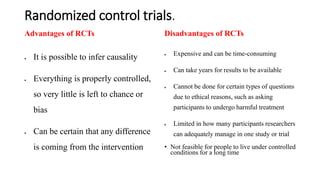
Randomized control trials.
Advantages of RCTs
 It is possible to infer causality
 Everything is properly controlled,
so very little is left to chance or
bias
 Can be certain that any difference
is coming from the intervention
Disadvantages of RCTs
 Expensive and can be time-consuming
 Can take years for results to be available
 Cannot be done for certain types of questions
due to ethical reasons, such as asking
participants to undergo harmful treatment
 Limited in how many participants researchers
can adequately manage in one study or trial
• Not feasible for people to live under controlled
conditions for a long time
Nonrandomized controlled trials.
• A type of nonrandomized controlled studies (NRS) where the
allocation of participants to intervention groups is not done randomly.
Here, researchers purposely assign some participants to one group and
others to another group based on certain features. Alternatively,
participants can sometimes also decide which group they want to be
in.
Cont……
• For example, in one study, clinicians were interested in the impact of stroke
recovery after being in an enriched versus non-enriched hospital
environment. Patients were selected for the trial if they fulfilled certain
requirements common to stroke recovery. Then, the intervention group was
given access to an enriched environment (i.e. internet access, reading, going
outside), and another group was not. Results showed that the enriched group
performed better on cognitive tasks.
Cont….
• NRS are useful in medical research because they help study
phenomena that would be difficult to measure with an RCT. However,
one of their major drawbacks is that we can-not be sure if the
intervention leads to the outcome. In the above example, we can’t say
for certain whether those patients improved after stroke because they
were in the enriched environment or whether there were other
variables at play.
Nonrandomized controlled trials.
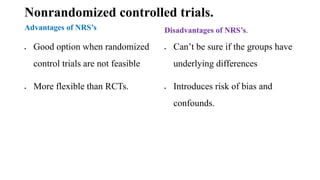
Advantages of NRS’s
 Good option when randomized
control trials are not feasible
 More flexible than RCTs.
Disadvantages of NRS’s.
 Can’t be sure if the groups have
underlying differences
 Introduces risk of bias and
confounds.
Crossover study
• In a crossover design, each participant receives a sequence of different
treatments. Crossover designs can be applied to RCTs, in which each
participant is randomly assigned to different study groups.
• For example, one study looked at the effects of replacing butter with
margarine on lipoproteins levels in individuals with cholesterol. Patients
were randomly assigned to a 6-week butter diet, followed by a 6-week
margarine diet. In between both diets, participants ate a normal diet for 5
weeks.
Cont….
• In the example above, each participant completed both interventions,
making them serve as their own control. However, we don’t know if
eating butter or margarine first leads to certain results in some
subjects. These designs help to reduce bias.
Crossover study
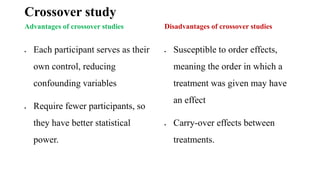
Advantages of crossover studies
 Each participant serves as their
own control, reducing
confounding variables
 Require fewer participants, so
they have better statistical
power.
Disadvantages of crossover studies
 Susceptible to order effects,
meaning the order in which a
treatment was given may have
an effect
 Carry-over effects between
treatments.
Observational study designs
• In observational studies, researchers watch (observe) the effects of a
treatment or intervention without trying to change anything in the
population. Observational studies help us establish broad trends and
patterns in large-scale datasets or populations. They are also a great
alternative when an experimental study is not an option.
CONT…..
• Unlike experimental research, observational studies do not help us establish
causality. This is because researchers do not actively control any variables.
Rather, they investigate statistical relationships between them. Often this is
done using a correlational approach.
• For example, researchers would like to examine the effects of daily fiber
intake on bone density. They conduct a large-scale survey of thousands of
individuals to examine correlations of fiber intake with different health
measures.
• The main observational studies include;
• Case-control design.
• Cohort design.
• Cross-sectional design.
Case-control design.
• A case-control is a type of observational design in which researchers
identify individuals with an existing health situation (cases) and a
similar group without the health issue (controls). The cases and the
controls are then compared based on some measurements
• Frequently, data collection in a case-control study is retroactive (i.e.,
backwards in time). This is because participants have already been
exposed to the event in question. Additionally, researchers must go
through records and patient files to obtain the records for this study
design. Case-control is ideal for situations where cases are easy to pick
out and compare. For instance, in studying rare diseases or outbreaks.
Case-control design.
Advantages of case-control studies.
 Feasible for rare diseases
 Cheaper and easier to do than
an RCT.
Disadvantages of case-control studies.
 Relies on patient records, which
could be lost or damaged
• Potential recall and selection
bias.
Cohort study (longitudinal).
• A cohort is a group of people who are linked in some way. For
instance, a birth year cohort is all people born in a specific year. In
cohort studies, researchers compare what happens to individuals in the
cohort that have been exposed to some variable compared with those
that haven’t on different variables. They’re also called longitudinal
studies.
CONT….
• The cohort is then repeatedly assessed on variables of interest over a
period of time. There is no set amount of time required for cohort
studies. They can range from a few weeks to many years.
• Cohort studies can be prospective. In this case, individuals are
followed for some time into the future. They can also be
retrospective, where data is collected on a cohort from records.
CONT…
• A cohort study design is a good option when you have a specific group
of people you want to study over time. However, a major drawback is
that they take a long time and lack control.
Cohort study (longitudinal).
Advantages of cohort studies.
 Ethically safe
 Allows you to study multiple
outcome variables
 Establish trends and patterns
Disadvantages of cohort studies.
 Time consuming and expensive
 Can take many years for results to
be revealed
 Too many variables to manage
 Depending on length of study, can
have many changes in research
personnel.
Cross-sectional study.
• Cross-sectional studies are also known as prevalence studies. They
look at the relationship of specific variables in a population in one
given time. In cross-sectional studies, the researcher does not try to
manipulate any of the variables, just study them using statistical
analyses. Cross-sectional studies are also called snapshots of a certain
variable or time.
CONT…..
• For example, researchers wanted to determine the prevalence of inappropriate antibiotic
use to study the growing concern about antibiotic resistance. Participants completed a
self-administered questionnaire assessing their knowledge and attitude toward antibiotic
use. Then, researcher performed statistical analysis on their responses to determine the
relationship between the variables.
• Cross-sectional study designs are ideal when gathering initial data on a research question.
And aims at a researcher knowing the general attitudes of the public towards antibiotics,
this information can then be relayed to physicians or public health authorities. However,
it’s often difficult to determine how long these results stay true.
Cross-sectional study.
Advantages of cross-sectional studies
 Fast and inexpensive
 Ethically safe
 Provides a great deal of
information for a given time point
 Leaves room for secondary
analysis.
Disadvantages of cross-sectional
studies.
 Requires a large sample to be accurate
 Not clear how long results remain true
for
 Do not provide information on causality
 Cannot be used to establish long-term
trends because data is only for a given
time.
Descriptive research
• is a method to describe the demographics of the research variables.
The demographics being “why, what, when, how” regarding the
subject variable. Rather than limiting its approach to qualitative or
quantitative, descriptive research is mostly observational. The reason
being obvious, the variables are not influenced by any external
variables and are observed to derive results from it.
CONT….
• Descriptive research aims to statistically analyze the data collected through
observations and surveys or case studies. The variables that are being
observed are not controlled. Being descriptive research, it helps researchers
get future insights depending on the pattern.
• Descriptive vs. analytical studies
• Study designs can be broadly divided into either descriptive or analytical.
Descriptive studies
• one in which your primary goal is to assess a sample at one specific
point in time without trying to make inferences or causal statements.
Describes characteristics such as patterns or trends. They answer the
questions of what, who, where, and when, and they generate
hypotheses. They include case reports and qualitative studies.
• In general, there are three primary reasons to conduct descriptive studies:
• To identify areas for further research.
• To help in planning resource allocation (needs assessment).
• To provide informal information about a condition or disease.
• Descriptive studies are helpful in revealing patterns and connections that
might otherwise go unnoticed. two types of descriptive studies; case reports
and cross-sectional.
Descriptive Case Report Study
• A descriptive case report study is a detailed profile of a subject or set of subjects and their
clinical or laboratory experience. The purpose of these studies is to identify potential
areas of research and generate interest and hypothesis formulation.
• Case reports are a first step for providing clues to identifying a new disease or adverse
health effect from an exposure or clinical experience. A classic example is the case report
study of 5 homosexual males who developed a rare pneumonia. This case report study led
to the eventual discovery of HIV. Case reports are most likely to be useful when the
disease or condition is uncommon and when the disease or condition is caused almost
exclusively by a single kind of exposure.
Descriptive Cross-Sectional Study
• A descriptive cross-sectional study is a study in which the disease or condition and
potentially related factors are measured at a specific point in time for a defined
population. Cross-sectional studies can be thought of as a "snapshot" of the frequency and
characteristics of a condition in a population at a particular point in time.
• This type of data can be used to assess the prevalence of conditions in a population.
However, since exposure and disease status are measured at the same point in time, causal
statements should not be made from this type of study. It is usually not possible to
distinguish whether the exposure proceeded or followed the condition.
Analytical study designs
• These quantify a relationship between different variables. They
answer the questions of why and how. They’re used to test
hypotheses and make predictions
• Analytic studies test hypotheses about exposureoutcome
relationships
• Measure the association between exposure and outcome
• Include a comparison group
SUMMARY
Descriptive studies
• Generate hypotheses
• Answer what, who, where, and
when
Analytic studies
• Test hypotheses
• Answer why and how

RESERCH PRESENTATION.pptx

  • 1.
    QUANTITATIVE STUDY DESIGNS: GROUP 3 AsiimweBoaz Nalukwago Dorcus Odeso Joseph Bwambale Festo
  • 2.
    QUANTITATIVE RESEARCH • Quantitativeresearch design is aimed at discovering how many people think, act or feel in a specific way. Quantitative projects involve large sample sizes, concentrating on the quantity of responses, as opposed to gaining the more focused or emotional insight.
  • 3.
    Research Study design •A study design is a systematic plan developed to enable a researcher carry out research study effectively and efficiently. • Having a design is important because it will determine the right methodologies for the study. • Using the right study design makes the results more credible, valid, and coherent.
  • 4.
    CONT….. • A studydesign is critical to research study because it determines exactly how a researcher will collect and analyze the data. It should be noted that, if the study aims is to determine the relationship between two variables, then an analytical study design is the right choice.
  • 5.
    Quantitative study Design •A quantitative study design involves the utilization and analysis of numerical data using specific statistical techniques to answer questions like who, how much, what, where, when, how many, and how. It also describes the methods of explaining an issue or phenomenon through gathering data in numerical form. • Analytical study designs can be experimental or observational and each type has its own features.
  • 6.
    Experimental VS observational •In experimental studies, a researcher manipulates something in a population of interest and examine its effects. These designs are used to establish a causal link between two variables. • In observational studies, in contrast, a researcher observes the effects of a treatment or intervention without manipulating anything. Observational studies are most often used to study larger patterns over longer period of time.
  • 7.
    Experimental study designs: •Experimental studies help us establish causality (R/ship Btn cause and effect). This is critical in science because we want to know whether one variable leads to a change, or causes another. Establishing causality leads to higher internal validity and makes results reproducible. Experimental designs include; • -Randomized control trials (RCTs). • -Nonrandomized control trials (non-RCTs). • -Crossover designs.
  • 8.
    Randomized control trials. •In an RCT, one group of individuals receives an intervention or a treatment, while another does not. It’s then possible to investigate what happens to the participants in each group. • Another important feature of RCTs is that participants are randomly assigned to study groups. This helps to limit certain biases and retain better control. Randomization also lets researchers pinpoint any differences in outcomes to the intervention received during the trial. RTCs are considered the gold standard in biomedical research and are considered to provide the best kind of evidence.
  • 9.
    Cont….. • For example,one RCT looked at whether an exercise intervention has impacts in depression. Researchers randomly placed patients with depressive symptoms into intervention groups containing different types of exercise (i.e., light, moderate, or strong). Another group received usual medications or no exercise interventions. • Results showed that after the 12-week trial, patients in all exercise groups had decreased depression levels compared to the control group. This means that by using an RCT design, researchers can now safely assume that the exercise variable has a positive impact on depression.
  • 10.
    • However, RCTsare not without drawbacks. In the example above, we don’t know if exercise still has a positive impact on depression in the long term. This is because it’s not feasible to keep people under these controlled settings for a long time.
  • 11.
    Randomized control trials. Advantagesof RCTs  It is possible to infer causality  Everything is properly controlled, so very little is left to chance or bias  Can be certain that any difference is coming from the intervention Disadvantages of RCTs  Expensive and can be time-consuming  Can take years for results to be available  Cannot be done for certain types of questions due to ethical reasons, such as asking participants to undergo harmful treatment  Limited in how many participants researchers can adequately manage in one study or trial • Not feasible for people to live under controlled conditions for a long time
  • 12.
    Nonrandomized controlled trials. •A type of nonrandomized controlled studies (NRS) where the allocation of participants to intervention groups is not done randomly. Here, researchers purposely assign some participants to one group and others to another group based on certain features. Alternatively, participants can sometimes also decide which group they want to be in.
  • 13.
    Cont…… • For example,in one study, clinicians were interested in the impact of stroke recovery after being in an enriched versus non-enriched hospital environment. Patients were selected for the trial if they fulfilled certain requirements common to stroke recovery. Then, the intervention group was given access to an enriched environment (i.e. internet access, reading, going outside), and another group was not. Results showed that the enriched group performed better on cognitive tasks.
  • 14.
    Cont…. • NRS areuseful in medical research because they help study phenomena that would be difficult to measure with an RCT. However, one of their major drawbacks is that we can-not be sure if the intervention leads to the outcome. In the above example, we can’t say for certain whether those patients improved after stroke because they were in the enriched environment or whether there were other variables at play.
  • 15.
    Nonrandomized controlled trials. Advantagesof NRS’s  Good option when randomized control trials are not feasible  More flexible than RCTs. Disadvantages of NRS’s.  Can’t be sure if the groups have underlying differences  Introduces risk of bias and confounds.
  • 16.
    Crossover study • Ina crossover design, each participant receives a sequence of different treatments. Crossover designs can be applied to RCTs, in which each participant is randomly assigned to different study groups. • For example, one study looked at the effects of replacing butter with margarine on lipoproteins levels in individuals with cholesterol. Patients were randomly assigned to a 6-week butter diet, followed by a 6-week margarine diet. In between both diets, participants ate a normal diet for 5 weeks.
  • 17.
    Cont…. • In theexample above, each participant completed both interventions, making them serve as their own control. However, we don’t know if eating butter or margarine first leads to certain results in some subjects. These designs help to reduce bias.
  • 18.
    Crossover study Advantages ofcrossover studies  Each participant serves as their own control, reducing confounding variables  Require fewer participants, so they have better statistical power. Disadvantages of crossover studies  Susceptible to order effects, meaning the order in which a treatment was given may have an effect  Carry-over effects between treatments.
  • 19.
    Observational study designs •In observational studies, researchers watch (observe) the effects of a treatment or intervention without trying to change anything in the population. Observational studies help us establish broad trends and patterns in large-scale datasets or populations. They are also a great alternative when an experimental study is not an option.
  • 20.
    CONT….. • Unlike experimentalresearch, observational studies do not help us establish causality. This is because researchers do not actively control any variables. Rather, they investigate statistical relationships between them. Often this is done using a correlational approach. • For example, researchers would like to examine the effects of daily fiber intake on bone density. They conduct a large-scale survey of thousands of individuals to examine correlations of fiber intake with different health measures.
  • 21.
    • The mainobservational studies include; • Case-control design. • Cohort design. • Cross-sectional design.
  • 22.
    Case-control design. • Acase-control is a type of observational design in which researchers identify individuals with an existing health situation (cases) and a similar group without the health issue (controls). The cases and the controls are then compared based on some measurements
  • 23.
    • Frequently, datacollection in a case-control study is retroactive (i.e., backwards in time). This is because participants have already been exposed to the event in question. Additionally, researchers must go through records and patient files to obtain the records for this study design. Case-control is ideal for situations where cases are easy to pick out and compare. For instance, in studying rare diseases or outbreaks.
  • 24.
    Case-control design. Advantages ofcase-control studies.  Feasible for rare diseases  Cheaper and easier to do than an RCT. Disadvantages of case-control studies.  Relies on patient records, which could be lost or damaged • Potential recall and selection bias.
  • 25.
    Cohort study (longitudinal). •A cohort is a group of people who are linked in some way. For instance, a birth year cohort is all people born in a specific year. In cohort studies, researchers compare what happens to individuals in the cohort that have been exposed to some variable compared with those that haven’t on different variables. They’re also called longitudinal studies.
  • 26.
    CONT…. • The cohortis then repeatedly assessed on variables of interest over a period of time. There is no set amount of time required for cohort studies. They can range from a few weeks to many years. • Cohort studies can be prospective. In this case, individuals are followed for some time into the future. They can also be retrospective, where data is collected on a cohort from records.
  • 27.
    CONT… • A cohortstudy design is a good option when you have a specific group of people you want to study over time. However, a major drawback is that they take a long time and lack control.
  • 28.
    Cohort study (longitudinal). Advantagesof cohort studies.  Ethically safe  Allows you to study multiple outcome variables  Establish trends and patterns Disadvantages of cohort studies.  Time consuming and expensive  Can take many years for results to be revealed  Too many variables to manage  Depending on length of study, can have many changes in research personnel.
  • 29.
    Cross-sectional study. • Cross-sectionalstudies are also known as prevalence studies. They look at the relationship of specific variables in a population in one given time. In cross-sectional studies, the researcher does not try to manipulate any of the variables, just study them using statistical analyses. Cross-sectional studies are also called snapshots of a certain variable or time.
  • 30.
    CONT….. • For example,researchers wanted to determine the prevalence of inappropriate antibiotic use to study the growing concern about antibiotic resistance. Participants completed a self-administered questionnaire assessing their knowledge and attitude toward antibiotic use. Then, researcher performed statistical analysis on their responses to determine the relationship between the variables. • Cross-sectional study designs are ideal when gathering initial data on a research question. And aims at a researcher knowing the general attitudes of the public towards antibiotics, this information can then be relayed to physicians or public health authorities. However, it’s often difficult to determine how long these results stay true.
  • 31.
    Cross-sectional study. Advantages ofcross-sectional studies  Fast and inexpensive  Ethically safe  Provides a great deal of information for a given time point  Leaves room for secondary analysis. Disadvantages of cross-sectional studies.  Requires a large sample to be accurate  Not clear how long results remain true for  Do not provide information on causality  Cannot be used to establish long-term trends because data is only for a given time.
  • 32.
    Descriptive research • isa method to describe the demographics of the research variables. The demographics being “why, what, when, how” regarding the subject variable. Rather than limiting its approach to qualitative or quantitative, descriptive research is mostly observational. The reason being obvious, the variables are not influenced by any external variables and are observed to derive results from it.
  • 33.
    CONT…. • Descriptive researchaims to statistically analyze the data collected through observations and surveys or case studies. The variables that are being observed are not controlled. Being descriptive research, it helps researchers get future insights depending on the pattern. • Descriptive vs. analytical studies • Study designs can be broadly divided into either descriptive or analytical.
  • 34.
    Descriptive studies • onein which your primary goal is to assess a sample at one specific point in time without trying to make inferences or causal statements. Describes characteristics such as patterns or trends. They answer the questions of what, who, where, and when, and they generate hypotheses. They include case reports and qualitative studies.
  • 35.
    • In general,there are three primary reasons to conduct descriptive studies: • To identify areas for further research. • To help in planning resource allocation (needs assessment). • To provide informal information about a condition or disease. • Descriptive studies are helpful in revealing patterns and connections that might otherwise go unnoticed. two types of descriptive studies; case reports and cross-sectional.
  • 36.
    Descriptive Case ReportStudy • A descriptive case report study is a detailed profile of a subject or set of subjects and their clinical or laboratory experience. The purpose of these studies is to identify potential areas of research and generate interest and hypothesis formulation. • Case reports are a first step for providing clues to identifying a new disease or adverse health effect from an exposure or clinical experience. A classic example is the case report study of 5 homosexual males who developed a rare pneumonia. This case report study led to the eventual discovery of HIV. Case reports are most likely to be useful when the disease or condition is uncommon and when the disease or condition is caused almost exclusively by a single kind of exposure.
  • 37.
    Descriptive Cross-Sectional Study •A descriptive cross-sectional study is a study in which the disease or condition and potentially related factors are measured at a specific point in time for a defined population. Cross-sectional studies can be thought of as a "snapshot" of the frequency and characteristics of a condition in a population at a particular point in time. • This type of data can be used to assess the prevalence of conditions in a population. However, since exposure and disease status are measured at the same point in time, causal statements should not be made from this type of study. It is usually not possible to distinguish whether the exposure proceeded or followed the condition.
  • 38.
    Analytical study designs •These quantify a relationship between different variables. They answer the questions of why and how. They’re used to test hypotheses and make predictions • Analytic studies test hypotheses about exposureoutcome relationships • Measure the association between exposure and outcome • Include a comparison group
  • 39.
    SUMMARY Descriptive studies • Generatehypotheses • Answer what, who, where, and when Analytic studies • Test hypotheses • Answer why and how