SAMPLE OF
RESEARCH OUTLINE
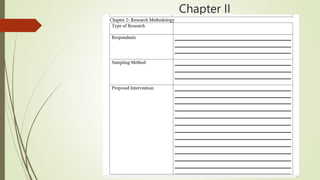
Chapter II
QUESTIONNAIRE
Sample Research Paper
CASCADE MODEL OF SPECIAL
EDUCATION: ENHANCING
SCHOOL EXPERIENCES OF PUPILS
WITH SPECIAL NEEDS
Vivian M. Carpio, Ph.D
Rationale and Review of Related Literature and Studies
DECS Order No. 26, s. 1997
entitled “The Institutionalization
of Special Education Programs in
all Schools ” is one of the many
interventions of the department
to provide access to basic
education among children with
special needs,
Rationale and Review of Related Literature and Studies
 Dipaculao Central School opened special education
class last August 2016 hence many actions still need to
be done. Insufficient funds and untrained teachers are
main problems.
 As the new school head of Dipaculao Central School,
initial investigation showed there was no established
individual educational plan for each pupil, additional
teacher and more capacity building is needed and
improvement for each pupil was not measured.
 From this scenario, the school head would like to work
on the continuation and sustainment of SPED class in
Dipacuao CS, determine and work on the needed
support and assess the initial improvement and tap
possible partners and eventually identify its implication.
As such, this study will employ
two types of method of research
of case study and action to solve
the problem by conducting a
Cascade Model of Special
Education to improve the pupils’
school experiences and test its
effectiveness on those pupils with
special needs.
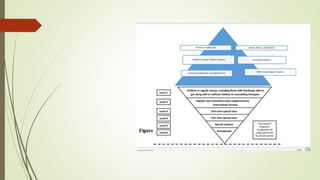
 This study was conceptualized
based on Deno’s Cascade Model
of Special Education. “ The term
“cascade” is used because the
services identified in the cascade
move from the most fully
integrated (i.e. the regular school
system) to the least integrated (i.e.
a fully segregated school or
residential institution). (retrieved
September 6, 2017)
Research Questions
1. How may the performance level of the pupils with special needs
be described in the pre and post assessment?
2. How may the Individualized Education Program (IEP) of each
special child be described?
3. What provisions of support may be given to the Diverse SPED
class in terms of:
a.Istructional supervision, b. Learning resources, c.Teacher’s
Training and development, d. Stakeholders’ partnership and
involvement, e).School Experiences
 4. Are there remarkable improvements in the performance of the
pupils with learning disabilities in the pre and post assessments?
 5. What are the implications of the findings of the study in
improving the learning programs for the pupils with special
needs?
Scope and Limitations
This study aimed at determining the
effectiveness of Cascade Model of Special
Education Class to pupils with special needs in
Dipaculao Central School for 29 pupils. It will
study the details of each pupil in terms of
behavior and academic development, develop
the effective Individual Education Plan (IEP) of
each pupil and eventually apply these to the
different instructional programs such as home
bound, mainstreamed, inclusive and resource
time.
Method
Type of Study action research and multiple case analysis/case
study
Participants 29 children with special needs. Specifically, the
participants were categorized as 2 pupils who are
crippled, 1 autism with ADHD, 12 learning
disabled, 5 deaf and mute, 3 pupils with Down
Syndrome, 4 pupils with Speech Defect,1 pupil
with behavioral problem, 2 pupils with cerebral
palsy, and 1 with multiple disability.
Sampling
Method
total enumeration or the total population
sampling
Sources of school head’s and teachers’ observations,
interview and anecdotal records, physician’s
assessment, result of assessment checklist and
tests results.
Method
Instruments a checklist ; Anecdotal records , interview guide
Data
Collection
First, an assessment on their performance level was
assessed through checklist which varies depending
on their disability. Anecdotal records on pre
assessment were recorded; and the IEP was prepared.
The implementation of the cascade model SPED class
was applied and monitored of development and
improvement. The improvement for the 1st and 2nd
quarter will be consolidated for analysis.
Ethical
Considerations
The profile of the pupils was confidential. Permit from
from parents will be asked and results will be used
for intellectual discussions and formal forum for the
improvement of DepEd’s services.
Data Analysis The result of pre assessment and post assessment
was compared using the checklist of indicators and
anecdotal records
Proposed Innovation of Intervention
 The intervention is called “the Cascade
Model of SPED: Enhancing School Experiences of
Pupils with Special Needs.”. It employed different
levels of SPED instructional programs or the levels
vis-a vis their IEP; specifically 2 pupils undergone
Level 1 and Level 2 who were crippled and
mainstreamed fully in regular class; 16 Learning
Disabled with behavior problems under Level 3
which they came to SPED class part time and
attended regular class for the remaining hours; 10
pupils under Level 4 in which had full time special
class and 5 belonged to Level 6 or Homebound.

research-outline-with-example (1).pptx

  • 1.
  • 4.
  • 5.
  • 6.
  • 7.
    CASCADE MODEL OFSPECIAL EDUCATION: ENHANCING SCHOOL EXPERIENCES OF PUPILS WITH SPECIAL NEEDS Vivian M. Carpio, Ph.D
  • 8.
    Rationale and Reviewof Related Literature and Studies DECS Order No. 26, s. 1997 entitled “The Institutionalization of Special Education Programs in all Schools ” is one of the many interventions of the department to provide access to basic education among children with special needs,
  • 9.
    Rationale and Reviewof Related Literature and Studies  Dipaculao Central School opened special education class last August 2016 hence many actions still need to be done. Insufficient funds and untrained teachers are main problems.  As the new school head of Dipaculao Central School, initial investigation showed there was no established individual educational plan for each pupil, additional teacher and more capacity building is needed and improvement for each pupil was not measured.  From this scenario, the school head would like to work on the continuation and sustainment of SPED class in Dipacuao CS, determine and work on the needed support and assess the initial improvement and tap possible partners and eventually identify its implication.
  • 10.
    As such, thisstudy will employ two types of method of research of case study and action to solve the problem by conducting a Cascade Model of Special Education to improve the pupils’ school experiences and test its effectiveness on those pupils with special needs.
  • 11.
     This studywas conceptualized based on Deno’s Cascade Model of Special Education. “ The term “cascade” is used because the services identified in the cascade move from the most fully integrated (i.e. the regular school system) to the least integrated (i.e. a fully segregated school or residential institution). (retrieved September 6, 2017)
  • 13.
    Research Questions 1. Howmay the performance level of the pupils with special needs be described in the pre and post assessment? 2. How may the Individualized Education Program (IEP) of each special child be described? 3. What provisions of support may be given to the Diverse SPED class in terms of: a.Istructional supervision, b. Learning resources, c.Teacher’s Training and development, d. Stakeholders’ partnership and involvement, e).School Experiences  4. Are there remarkable improvements in the performance of the pupils with learning disabilities in the pre and post assessments?  5. What are the implications of the findings of the study in improving the learning programs for the pupils with special needs?
  • 14.
    Scope and Limitations Thisstudy aimed at determining the effectiveness of Cascade Model of Special Education Class to pupils with special needs in Dipaculao Central School for 29 pupils. It will study the details of each pupil in terms of behavior and academic development, develop the effective Individual Education Plan (IEP) of each pupil and eventually apply these to the different instructional programs such as home bound, mainstreamed, inclusive and resource time.
  • 15.
    Method Type of Studyaction research and multiple case analysis/case study Participants 29 children with special needs. Specifically, the participants were categorized as 2 pupils who are crippled, 1 autism with ADHD, 12 learning disabled, 5 deaf and mute, 3 pupils with Down Syndrome, 4 pupils with Speech Defect,1 pupil with behavioral problem, 2 pupils with cerebral palsy, and 1 with multiple disability. Sampling Method total enumeration or the total population sampling Sources of school head’s and teachers’ observations, interview and anecdotal records, physician’s assessment, result of assessment checklist and tests results.
  • 16.
    Method Instruments a checklist; Anecdotal records , interview guide Data Collection First, an assessment on their performance level was assessed through checklist which varies depending on their disability. Anecdotal records on pre assessment were recorded; and the IEP was prepared. The implementation of the cascade model SPED class was applied and monitored of development and improvement. The improvement for the 1st and 2nd quarter will be consolidated for analysis. Ethical Considerations The profile of the pupils was confidential. Permit from from parents will be asked and results will be used for intellectual discussions and formal forum for the improvement of DepEd’s services. Data Analysis The result of pre assessment and post assessment was compared using the checklist of indicators and anecdotal records
  • 17.
    Proposed Innovation ofIntervention  The intervention is called “the Cascade Model of SPED: Enhancing School Experiences of Pupils with Special Needs.”. It employed different levels of SPED instructional programs or the levels vis-a vis their IEP; specifically 2 pupils undergone Level 1 and Level 2 who were crippled and mainstreamed fully in regular class; 16 Learning Disabled with behavior problems under Level 3 which they came to SPED class part time and attended regular class for the remaining hours; 10 pupils under Level 4 in which had full time special class and 5 belonged to Level 6 or Homebound.