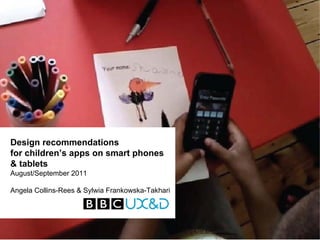
Design recommendations
for children’s apps on smart phones
& tablets
August/September 2011

Angela Collins-Rees & Sylwia Frankowska-Takhari
Summary


This talk discusses the findings from a piece of research
around children’s usage of touch-screen devices.
The attendees will gain practical recommendations for designing
applications for touch screen devices.


Case studies: Cbeebies & CBBC

Duration: about 60 minutes
Overview


1.   Background Information
2.   Methods & Objectives
3.   Recruitment
4.   Research Materials
5.   Top Findings & Recommendations
Background Information


• Touch-screen devices & the under 6’s
• Appetite for more focused research at the BBC
Methods and Objectives
Objectives
   • To investigate how the existing young users use ‘their’ touch screen
   devices & how the non-users embrace the new experience

   • To investigate what navigation mechanisms make their experiences
   with touch screen devices enjoyable and the ones that are problematic

   • To inspire development of applications for touch screen devices that would
   support children’s natural desire to independently explore content regardless
   of their age and skills

Methods
   • Depth interviews with parents
   • Drawing activity & taking photos
   • Observation

   Research environment
   • Home visits
Recruitment


Participants’ profiles
    • Children & parents
.
Familiarity with touch-screen devices & apps
    • Users vs. non-users

Skills
    • Computer skills
    • Literacy and numeracy
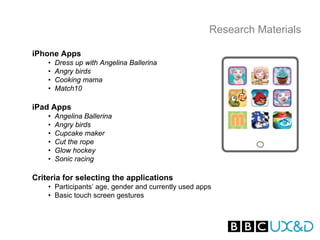
Research Materials

iPhone Apps
    •   Dress up with Angelina Ballerina
    •   Angry birds
    •   Cooking mama
    •   Match10

iPad Apps
    •   Angelina Ballerina
    •   Angry birds
    •   Cupcake maker
    •   Cut the rope
    •   Glow hockey
    •   Sonic racing

Criteria for selecting the applications
    • Participants’ age, gender and currently used apps
    • Basic touch screen gestures
Top Findings & Recommendations


Be aware of how parents’ attitudes may influence their
children’s skills and interests; remember
to include parents’ profiles in the recruitment brief for any
future research.
Top Findings & Recommendations


Ensure that challenges within apps are appropriate to age,
interest and skills. You can achieve this by offering a basic
linear route for everybody as well as the opportunity for
a free-roam experience for the more confident users.
This will maximise engagement and opportunity
for exploration.
Top Findings & Recommendations


Where possible, consider combining different types of
instructions e.g. animation with voice-overs, to enable all
children to engage with the activities independently.
Top Findings & Recommendations


Create opportunities to succeed for all users regardless
of their skills by allowing the ability to ‘Play again’ or skip
through to next option. Where possible, consider
incorporating a range of levels that target different skill sets
or offering practice sessions.
Top Findings & Recommendations


Implement positive encouragers e.g. a smiley face,
stars, thumbs up as well as positive language e.g.
‘Try Again’ rather than ‘You’ve Failed’.
Top Findings & Recommendations


Within an activity, incorporate a variety
of touch screen gestures to maintain engagement and
minimise fatigue.
Top Findings & Recommendations


Consider creating apps that allow children to include user
generated content such as photos and clips to enhance
the sense of ownership and engagement.
Top Findings & Recommendations


When designing an app that mimics an activity such as
following a recipe, ensure it reflects the logical real-life
steps as this increases learning through play.
Top Findings & Recommendations


If you want to appeal to both genders, use neutral colours
e.g. green, yellow or ones which do not have such strong
associations with gender like e.g. blue and pink.
Top Findings & Recommendations


When building a collaborative activity for parent
and child, keep the balance between guidance and equal
participation.
Top Findings & Recommendations


Consider the notion of a walled garden approach whereby
a safe area is created.
App collections and playlists within apps may offer a solution
for ensuring online safety.
Thank you!

If you are interested in this talk, please contact us at:
uxresearchers@gmail.com

Or else, see other talks in this series on the next slides
Other talks

Designing apps for children: findings & recommendations
   Summary: This talk provides practical advice around recruitment of child
   participants with a particular focus on ethics and the researchers’ ethical
   responsibility for participants.
   The attendees will gain practical tips on how to effectively recruit child
   participants for their projects and set up a safe research environment
   throughout the research sessions.

Methods for design research
   Summary: This talk presents an overview of the variety of methods &
   tools available to design researchers, both the more traditional ones and
   those that are more innovative, with a focus on 2 selected methods
   illustrated with case studies.
   The attendees will learn when it’s appropriate to use each
   of the methods in the product life cycle, what the potential challenges
   can be and how to overcome them by e.g. triangulating methods.
   All this illustrated with case studies and examples of interesting projects
   from across the BBC.
Other talks

Inclusive design & recruitment
     Summary: This talk with elements of experiential workshop gives
     an overview of different target audiences of a product, and their particular
     needs and expectations.
     The attendees will learn why it is important to include people with different
     needs in the research and what to consider when recruiting child
     participants and participants with disabilities for research in terms
     of recruitment criteria, ethics and logistics.

Design research in product life cycle
     Summary: This talk focuses mainly on the phases
     of product life cycle: idea generation, growth and maturity and explains
     how design research supports designers in each phase.
     The attendees will learn about the phases of a product life cycle and what
     research methods to use in each phase e.g.: formative vs. summative
     research methods.
Other talks


Design researchers’ skills/ competences
    Summary: This talk gives an overview of the role of Design Researchers.
    The attendees will learn about the key responsibilities of Design Researchers,
    how their jobs fit into the design industry, and what are the essential skills
    and competences required for the role.

Risks related to using inappropriate methodology & recruitment
    Summary: This talk discusses how using inappropriate research methods
    and tools can skew the research results and negatively affect the design work.
    The attendees will learn about the consequences of using inappropriate
    research methods, risks related to methods such as: guerrilla study or crowd-
    sourcing, and how to minimise those risks.

Research with children_case_study

  • 1.
    Design recommendations for children’sapps on smart phones & tablets August/September 2011 Angela Collins-Rees & Sylwia Frankowska-Takhari
  • 2.
    Summary This talk discussesthe findings from a piece of research around children’s usage of touch-screen devices. The attendees will gain practical recommendations for designing applications for touch screen devices. Case studies: Cbeebies & CBBC Duration: about 60 minutes
  • 3.
    Overview 1. Background Information 2. Methods & Objectives 3. Recruitment 4. Research Materials 5. Top Findings & Recommendations
  • 4.
    Background Information • Touch-screendevices & the under 6’s • Appetite for more focused research at the BBC
  • 5.
    Methods and Objectives Objectives • To investigate how the existing young users use ‘their’ touch screen devices & how the non-users embrace the new experience • To investigate what navigation mechanisms make their experiences with touch screen devices enjoyable and the ones that are problematic • To inspire development of applications for touch screen devices that would support children’s natural desire to independently explore content regardless of their age and skills Methods • Depth interviews with parents • Drawing activity & taking photos • Observation Research environment • Home visits
  • 6.
    Recruitment Participants’ profiles • Children & parents . Familiarity with touch-screen devices & apps • Users vs. non-users Skills • Computer skills • Literacy and numeracy
  • 7.
    Research Materials iPhone Apps • Dress up with Angelina Ballerina • Angry birds • Cooking mama • Match10 iPad Apps • Angelina Ballerina • Angry birds • Cupcake maker • Cut the rope • Glow hockey • Sonic racing Criteria for selecting the applications • Participants’ age, gender and currently used apps • Basic touch screen gestures
  • 8.
    Top Findings &Recommendations Be aware of how parents’ attitudes may influence their children’s skills and interests; remember to include parents’ profiles in the recruitment brief for any future research.
  • 9.
    Top Findings &Recommendations Ensure that challenges within apps are appropriate to age, interest and skills. You can achieve this by offering a basic linear route for everybody as well as the opportunity for a free-roam experience for the more confident users. This will maximise engagement and opportunity for exploration.
  • 10.
    Top Findings &Recommendations Where possible, consider combining different types of instructions e.g. animation with voice-overs, to enable all children to engage with the activities independently.
  • 11.
    Top Findings &Recommendations Create opportunities to succeed for all users regardless of their skills by allowing the ability to ‘Play again’ or skip through to next option. Where possible, consider incorporating a range of levels that target different skill sets or offering practice sessions.
  • 12.
    Top Findings &Recommendations Implement positive encouragers e.g. a smiley face, stars, thumbs up as well as positive language e.g. ‘Try Again’ rather than ‘You’ve Failed’.
  • 13.
    Top Findings &Recommendations Within an activity, incorporate a variety of touch screen gestures to maintain engagement and minimise fatigue.
  • 14.
    Top Findings &Recommendations Consider creating apps that allow children to include user generated content such as photos and clips to enhance the sense of ownership and engagement.
  • 15.
    Top Findings &Recommendations When designing an app that mimics an activity such as following a recipe, ensure it reflects the logical real-life steps as this increases learning through play.
  • 16.
    Top Findings &Recommendations If you want to appeal to both genders, use neutral colours e.g. green, yellow or ones which do not have such strong associations with gender like e.g. blue and pink.
  • 17.
    Top Findings &Recommendations When building a collaborative activity for parent and child, keep the balance between guidance and equal participation.
  • 18.
    Top Findings &Recommendations Consider the notion of a walled garden approach whereby a safe area is created. App collections and playlists within apps may offer a solution for ensuring online safety.
  • 19.
    Thank you! If youare interested in this talk, please contact us at: uxresearchers@gmail.com Or else, see other talks in this series on the next slides
  • 20.
    Other talks Designing appsfor children: findings & recommendations Summary: This talk provides practical advice around recruitment of child participants with a particular focus on ethics and the researchers’ ethical responsibility for participants. The attendees will gain practical tips on how to effectively recruit child participants for their projects and set up a safe research environment throughout the research sessions. Methods for design research Summary: This talk presents an overview of the variety of methods & tools available to design researchers, both the more traditional ones and those that are more innovative, with a focus on 2 selected methods illustrated with case studies. The attendees will learn when it’s appropriate to use each of the methods in the product life cycle, what the potential challenges can be and how to overcome them by e.g. triangulating methods. All this illustrated with case studies and examples of interesting projects from across the BBC.
  • 21.
    Other talks Inclusive design& recruitment Summary: This talk with elements of experiential workshop gives an overview of different target audiences of a product, and their particular needs and expectations. The attendees will learn why it is important to include people with different needs in the research and what to consider when recruiting child participants and participants with disabilities for research in terms of recruitment criteria, ethics and logistics. Design research in product life cycle Summary: This talk focuses mainly on the phases of product life cycle: idea generation, growth and maturity and explains how design research supports designers in each phase. The attendees will learn about the phases of a product life cycle and what research methods to use in each phase e.g.: formative vs. summative research methods.
  • 22.
    Other talks Design researchers’skills/ competences Summary: This talk gives an overview of the role of Design Researchers. The attendees will learn about the key responsibilities of Design Researchers, how their jobs fit into the design industry, and what are the essential skills and competences required for the role. Risks related to using inappropriate methodology & recruitment Summary: This talk discusses how using inappropriate research methods and tools can skew the research results and negatively affect the design work. The attendees will learn about the consequences of using inappropriate research methods, risks related to methods such as: guerrilla study or crowd- sourcing, and how to minimise those risks.