Animal Research and Testing
Questions to Consider:
• Is animal testing justified if humans benefit?
• Under what circumstances should animal research be used?
• Is there sufficient oversight and regulations for animal testing?
• Is testing on animals really necessary, or are there alternatives?
Research Ideas:
• What laws and oversight currently exist to regulate testing on animals?
• What types of products and research use animal testing?
• Where do researchers get the animals?
• What are some advances that have been made due to animal research?
• What are alternatives, such as computer models, to testing on animals?
• Should consumers be informed if a product or service involved animal testing?
Texting and Driving
Questions to Consider:
• Is texting and driving really a problem?
• Should texting and driving be considerd a crime on the level
of drinking and driving?
• Are texting and driving laws too harsh? Too lenient?
• Why do people text and drive even though it is dangerous?
Research Ideas:
• What are the laws about texting and driving in your state?
• How do the laws compare to other states?
• What are recent statistics of accidents involving texting and driving?
• What are some real-life examples of people who have been prosecuted for
crimes related to texting and driving (negligent driving / manslaugher)?
• What is the science behind how people become distracted while texting and
driving?
• What are the differences/similarities between drinking and driving and texting
and driving?
• What are the demographics of people who text and drive (age, gender etc...)
Childhood Immunization
Questions to Consider:
• Why are some people against routine childhood immunizations?
• Should immunizations be required for school attendance?
• Should immunizations be mandatory for all children?
• Should the government or parents decide whether children should be
immunized?
• Is public safety or individual rights more important in regard to immunizations?
Research Ideas:
• What are the risk factors of routine immunizations?
• What are the requirements for immunizations in your school
district? Your state?
• Can parents opt out of immunizing their children?
• What are some of the risks of immunization?
• What are some diseases that have been eradicated or
greatly reduced because of immunizations?
School Uniforms
Questions to Consider:
• Should uniforms be required in schools?
• What problems could be avoided by schools requiring uniforms?
• What problems could be caused by schools requiring uniforms?
• Who should decide whether school uniforms should be required?
• Does a dress code accomplish the same goals as requiring uniforms?
Research Ideas:
• What percentage of public schools require uniforms? Private schools?
• Do uniforms cut down on behavior problems in schools?
• Are uniforms more costly than a regular wardrobe?
• For schools that require uniforms, what reasons do they cite for the requirement?
• Is there a trend toward uniforms, or a trend away from uniforms?
Beauty Pageants
Questions to Consider:
• What purpose do pageants serve in society?
• Do pageants promote the objectification of women?
• Do pageants produce healthy role models for young girls?
• Should pageants eliminate swimsuit competitions?
• Are child beauty pageants positive or negative competition?
• Should transgendered people be allowed to compete in pageants?
Research Ideas:
• What are the requirements for different local and national pageant contestants?
• How much money do contestants typically spend on preparing for a pageant?
• How many pageant contestants have plastic surgery?
English as National Language
Questions to Consider:
• What would be the benefits of declaring English the national language of the
United States?
• What would be the drawbacks of declaring English the national language?
• Is it important for a country to have a national language?
• Why doesn’t the United States have a national language?
• How important is language in a national identity, culture, or values?
Research Ideas:
• What changes would be made if English was declared the national language?
• Why have attempts to make English the national language failed in the past?
• What are some of the savings or costs to having a national language?
• Which other countries have national languages? Which do not?
• How would English as a national language affect non-English speaking citizens?
ADD / ADHD Medications
Questions to Consider:
• Are doctors too quick to prescribe medications for ADD / ADHD?
• Should other avenues of treatment be explored before medications are
prescribed?
• Is ADD / ADHD overdiagnosed?
• Some preschoolers are being diagnosed with ADD / ADHD. Is this too young to
be diagnosed or medicated?
• How do ADD / ADHD prescription medications help patients?
Research Ideas:
• Why do some researchers think ADD / ADHD is overdiagnosed?
• What are the benefits to ADD / ADHD medications?
• What are the side effects?
• How many children are diagnosed with ADD / ADHD every year?
• What are alternative treatments besides prescription medication?
• What other diseases or disorders should be ruled out before a child
is diagnosed with ADD or ADHD?
Home Schooling
Questions to Consider:
• What are some reasons parents choose to home school their children?
• Can students get a quality education at home?
• Should home schools be regulated or monitored?
• Should home schooled children be required to participate in state testing?
• Why has home schooling been increasing in popularity?
Research Ideas:
• What are the laws in your state regarding home schooling?
• How many students in the United States are home schooled?
• What are college acceptance and graduation rates for home schooled students?
• What types of home schools exist?
• What resources are available for home schools?
• What reasons do parents or students give for choosing to home school?
Alternative Fuel Vehicles
Questions to Consider:
• Why are alternative fuel vehicles not already mainstream?
• Is the extra cost of alternative fuel vehicles worth the savings in fuel costs?
• Should the sales and use of alternative fuel vehicles be mandated by the
government?
• Are alternative fuel vehicles really more environmentally friendly than fossil
fuel vehicles?
• What are the consequences of continued dependence on fossil-fuel vehicles?
• Should the government fund research and development of alternative fuel
vehicles, or should it be left to private industry?
Research Ideas:
• What types of alternative fuels are currently available? What kind are in
development?
• Will consumers spend the extra money for alternative fuel vehicles?
• What is the average cost and savings of an alternative fuel vehicles?
• What are the obstacles to mass production and conversion to alternative fuel
vehicles?
• Does the government support development and research of alternative fuels?
Bottled Water
Questions to Consider:
• Is bottled water a necessary product, or is it manufactured demand?
• Is the convenience of bottled water worth the cost to the environment?
• Is bottled water necessary in places where a clean water supply is not
guaranteed, or are there alternatives?
• Is bottled water actually cleaner and healthier than tap water?
• Is the availability of bottled water a necessary, healthy alternative
to soft drinks?
Research Ideas:
• How much plastic ends up in landfills because of bottled water?
• What is the environmental impact of bottled water compared to other bottled
beverages?
• What are the differences between bottled water and tap water?
• What are alternatives to bottled water?
Illegal Immigration
Questions to Consider:
• Should illegal immigrants have access to public services funded by taxpayers?
• What should the process be for naturalization or citizenship?
• If one member of a family is in the U.S. illegally, should he or she be allowed to
stay in order not to break up a family?
• Should children who entered the U.S. illegally become legal as adults if living
in the U.S. is all they know?
Research Ideas:
• Why have some advocacy groups and news organizations dropped the term
“illegal” and use alternatives such as “undocumented workers” instead?
• Is the U.S. economy dependent on labor performed by illegal immigrants?
• What are the immigration policies of the U.S?
• What are the immigration policies of other countries?
• How many people enter the U.S. illegally every year?
Genetically Modified Foods
Questions to Consider:
• Should genetically modified foods be labeled as such?
• Why are genetically modified foods controversial?
• What are the advantages and disadvantages ot genetically modified foods?
• What should the government’s role be in oversight, testing, and labeling?
Research Ideas:
• Which foods are genetically modified?
• Why is labeling not currently required?
• What do studies show about the safety of genetically modified foods?
• What is the history of genetically modified foods?
• Why do producers want to modify certain foods?
• What measures have European nations taken against genetically modified
foods?
Organic Food
Questions to Consider:
•Why do people choose to eat organic foods?
• What is the environmental impact of producing organic food?
• Are organic foods worth the extra cost?
• What does “organic” really mean?
Research Ideas:
• What are the labeling laws for foods purported to be organic?
• Do organic foods have more nutritional value than conventional foods?
• Why do organic foods cost more than conventional foods?
• What are some organic food growing methods?
• Are there disadvantages to organic foods?
Childhood Obesity
Questions to Consider:
• Who or what is to blame for childhood obesity?
• What role does fast food play in childhood obesity?
• What should be done to combat the childhood obesity problem?
• What are some of the health and social issues surrounding
childhood obesity?
• Why has childhood obesity become a current issue?
Research Ideas:
• What percentage of children are considered overweight
or obese?
• How much have obesity rates risen in the past few decades?
• What are some causes of childhood obesity?
• Are genetic or environmental factors more important?
• What are the long-term affects of childhood obesity?
• What percentage of obese children become obese adults?
School Lunches
Questions to Consider:
• Should schools provide free lunch and breakfast? To whom?
• Should schools be able to dictate nutrition criteria for lunches brought from home?
• Are school lunches healthy?
• Do school lunches contribute to childhood obesity?
• Should children be required to take foods, such as vegetables, that they don’t like?
Research Ideas:
• What changes have been made recently to improve nutrition in school lunches?
• What is the cost of the school lunch program to taxpayers?
• Have changes in nutritional value of school lunches helped with the obesity
problem?
• Why do parents rely on school lunches rather than sending lunch from home?
• Are lunches brought from home more nutritious than school lunches?
Rising Cost of Higher Education
Questions to Consider:
• Does the cost of higher education pay off financially?
• Is cost the main consideration in pursuing higher education?
• What options are available for reducing the cost of higher education (online
etc...)
• How can parents and students prepare for the high cost of college?
• Does it make sense to go into debt to fund a college education?
Research Ideas:
• What has caused the recent increase in tuition and other student fees?
• Which schools are the best bargain? Which schools are the worst?
• How should a student decide how much to take out in loans?
• Is working while attending school feasible?
• What is the average overall lifetime financial benefits of a
degree in your chosen field?
Concussions in Youth Sports
Questions to Consider:
• Should there be age restrictions on contact sports such as football?
• What can be done to help prevent concussions and head injuries in youth sports?
• Should action be taken to diagnose, recognize, and manage this problem?
• Who is responsible for making sure players are safe?
• Is the risk of head injury simply an inherent risk that has to be taken to play
sports?
Research Ideas:
• How many youth sports-related head injuries are reported each year?
• Are repetitive head impacts dangerous even if they don’t result in a
concussion diagnosis?
• What are the current guidelines / restrictions for different local
or national youth sport programs?
• What are the long-term consequences of youth concussions?
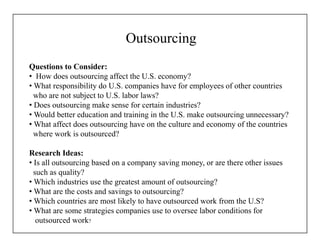
Outsourcing
Questions to Consider:
• How does outsourcing affect the U.S. economy?
• What responsibility do U.S. companies have for employees of other countries
who are not subject to U.S. labor laws?
• Does outsourcing make sense for certain industries?
• Would better education and training in the U.S. make outsourcing unnecessary?
• What affect does outsourcing have on the culture and economy of the countries
where work is outsourced?
Research Ideas:
• Is all outsourcing based on a company saving money, or are there other issues
such as quality?
• Which industries use the greatest amount of outsourcing?
• What are the costs and savings to outsourcing?
• Which countries are most likely to have outsourced work from the U.S?
• What are some strategies companies use to oversee labor conditions for
outsourced work?
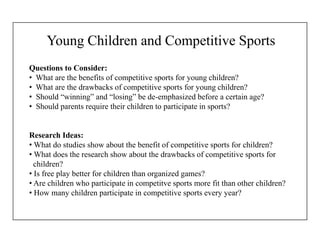
Young Children and Competitive Sports
Questions to Consider:
• What are the benefits of competitive sports for young children?
• What are the drawbacks of competitive sports for young children?
• Should “winning” and “losing” be de-emphasized before a certain age?
• Should parents require their children to participate in sports?
Research Ideas:
• What do studies show about the benefit of competitive sports for children?
• What does the research show about the drawbacks of competitive sports for
children?
• Is free play better for children than organized games?
• Are children who participate in competitve sports more fit than other children?
• How many children participate in competitive sports every year?
Online Security
Questions to Consider:
• What precautions should consumers take to protect
their personal information online?
• Is online shopping safe?
• Is online banking safe?
• What are the biggest threats to online security?
Research Ideas:
• How have large companies such as Target become victims of security breaches?
• Are there any foolproof systems to protect consumers?
• How much online fraud is documented each year in the U.S.?
• Is online shopping or banking really more dangerous than conventional
shopping and banking?
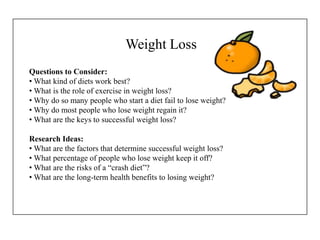
Weight Loss
Questions to Consider:
• What kind of diets work best?
• What is the role of exercise in weight loss?
• Why do so many people who start a diet fail to lose weight?
• Why do most people who lose weight regain it?
• What are the keys to successful weight loss?
Research Ideas:
• What are the factors that determine successful weight loss?
• What percentage of people who lose weight keep it off?
• What are the risks of a “crash diet”?
• What are the long-term health benefits to losing weight?
Academic Integrity
Questions to Consider:
• Has the problem of cheating in school gotten worse in recent years?
• What role does technology play in cheating?
• What motivates students to cheat?
• What are reasonable consequences for violations of academic integrity?
• What role does peer pressure play in academic integrity?
• What are some ways to encourage academic integrity?
Research Ideas:
• What policies and procedures regarding academic integrity are in place at your
school?
• What are some recent examples of plagiarism or breach of academic integrity
that have been publicized?
• What percent of students have admitted to cheating?
• What do students cite as reasons for cheating?
• Which policies at schools are most effective in preventing cheating?
Human Trafficking
Questions to Consider:
• What can be done to bring awareness to the problem of human trafficking?
• Why is this problem so widespread, even in the U.S?
• How do people become victims of traffickers?
• What help and resources should be provided to victims?
• How can the public recognize this problem?
Research Ideas:
• Which cities are “hot spots” for human trafficking in the U.S?
• How many victims come from overseas? How many victims are domestic?
• How many people per year are victimized?
• What programs or resources are available to victims?
• What are the laws and punishments for those who engage in this crime?
• How has this crime been able to flourish in the U.S?
Foster Kids – Aging Out
Questions to Consider:
• Why do so many foster kids who age out of the system become homeless?
• Is 18 years old too young to age out of the system?
• What resources should be offered to foster kids to ease the transition
out of foster care?
• How can we increase the rates of foster kids who go on to get
a college education?
Research Ideas:
• How many former foster kids are unemployed?
• How many former foster kids are homeless?
• How many former foster kids get a college education?
• What are the factors that cause foster kids to have high rates
of unemployment and homelessness?
• What kinds of programs have proven effective to help foster
kids transition out of the system?
Secondhand Smoke
Questions to Consider:
• What are the rights of smokers versus the rights of people
who wish to avoid secondhand smoke?
• San Rafael, CA, has banned smoking in certain private homes and apartments. Is
this going too far, or is it necessary to protect non-smokers and children?
• Some areas such as Houston, TX, have banned smoking in public housing. Is
this reasonable?
• Should parents have the freedom to smoke around their children?
Research Ideas:
• What are the health risks of secondhand smoke?
• Are there risks specific to babies and children who are exposed to secondhand
smoke?
• What laws and regulations are in place in your city regarding smoking in public
and private areas?
• What is the financial impact of secondhand smoke to the healthcare system?
Minimum Wage
Questions to Consider:
• What is a fair minimum wage?
• Should a full-time minimum wage worker expect a livable salary (above the
poverty line)?
• Should the government dictate raises in the minimum wage, or should market
forces be left to work?
• In determining a raise in the minimum wage, what factors, such as inflation,
should be taken into account?
Research Ideas:
• What are some of the possible negative effects from a raise in the minimum wage?
• What are some of the possible positive effects from a raise in the minimum wage?
• What is the minimum wage in your state and city?
• Why do some argue that raising the minimum wage could be counterproductive for
the working poor?
• When the minimum wage is raised, what strategies might companies use to help
defray the extra cost?
Social Media Addiction
Questions to Consider:
• How would you define addiction to social media?
• What adverse effects come from spending too much time on social media?
• Should parents and schools limit access to phones and social media?
• Why are some people more interested in social media than real-life interaction?
Research Ideas:
• What is the definition of “addiction”?
• What are the clinical reasons someone might become
addicted to social media?
• What are symptoms of social media addiction?
• What are some of the social consequences of social
media addiction?
Autotune
Questions to Consider:
• Are consumers being duped when they purchase music that has been autotuned?
• Are consumers being duped when they attend a live show that is being
autotuned?
• Is there any harm in autotuning someone’s voice so they sound better?
• Should consumers be told that a recording or live performance is autotuned?
• Is our culture and use of autotune idealizing people who promote a certain
image
rather than people with real talent?
Research Ideas:
• Which popular artists use autotune in live concerts?
• How does the autotune technology work?
• Is autotune allowed in talent competitions?
EBT (Food Stamp) Fraud
Questions to Consider:
• How can the government prevent people from selling their EBT cards?
• How can the government prevent stores from engaging in EBT fraud?
• What should be the reprecussions of food stamp fraud?
• Should food stamp fraud be considered a serious crime?
Research Ideas:
• What is the dollar amount of food stamp fraud each year in the U.S?
• What types of food stamp fraud exist?
• How can authorities crack down on food stamp fraud?
• Is part of the growth of the food stamp program in recent years partly because of
the ability to sell EBT cards for cash?
Prescription Drug Abuse
Questions to Consider:
• What role do patients, doctors, and pharmaceutical companies play in
prescription drug abuse?
• What precautions should doctors take to make sure their patients aren’t abusing
prescription drugs?
• Why is the abuse of prescription drugs so widespread?
• Are consumers aware of the risks of prescription abuse?
Research Ideas:
• What types of drugs are typically abused?
• What regulations are in place to control prescription drug abuse?
• What are some of the health effects of long-term prescription drug abuse?
• How many deaths each year in the U.S. are attributed to prescription drug
abuse?
Daycare vs. Parental Care
Questions to Consider:
• What are the advantages and disadvantages of stay-at-home parental care for
preschoolers?
• What are the advantages and disadvantages of daycare for preschoolers?
• At what age can children benefit from daycare?
• What factors should parents take into consideration when making care
decisions for their children?
• How can parents determine whether a daycare is good quality?
Research Ideas:
• What do studies show about children’s development in day care versus stay-at-
home care?
• What is the cost associated with daycare?
• Are there long-term benefits or consequences to either choice?
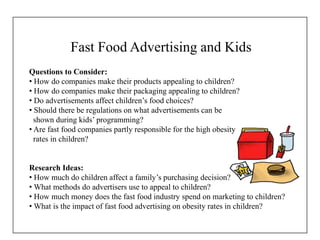
Fast Food Advertising and Kids
Questions to Consider:
• How do companies make their products appealing to children?
• How do companies make their packaging appealing to children?
• Do advertisements affect children’s food choices?
• Should there be regulations on what advertisements can be
shown during kids’ programming?
• Are fast food companies partly responsible for the high obesity
rates in children?
Research Ideas:
• How much do children affect a family’s purchasing decision?
• What methods do advertisers use to appeal to children?
• How much money does the fast food industry spend on marketing to children?
• What is the impact of fast food advertising on obesity rates in children?
Cyber Bullying
Questions to Consider:
• Is bullying more pervasive now with social media?
• Is there a way to prevent cyber bullying?
• Should schools get involved with cyber bullying cases even if they
are not happening on school grounds?
• Should parents be held responsible for their child’s cybe rbullying?
• Should cyber bullying be a crime?
• Should bullies be criminally charged if their bullying
leads to the victim’s psychologial damage or suicide?
Research Ideas:
• How many people claim to be victims of cyber bullying?
• Which social media are commonly used for cyber bullying?
• How can parents find out if their children are being cyber bullied?
• What types of behaviors are defined as cyber bullying?
• How can young people protect themselves from becoming victims?
Reality TV
Questions to Consider:
• How much of “reality TV” is actually true-to-life?
• What stereotypes might be promoted by reality TV shows?
• Is “reality” skewed when TV cameras and producers are present?
• Why are reality shows so popular?
• What are the positive aspects to reality TV?
• What are the negative aspects to reality TV?
Research Ideas:
• How has the show “Teen Mom” on MTV purportedly affected pregnancy rates
among teens?
• What percent of television programs are now reality shows?
• For what reason would someone want to appear on a reality show?
• Do reality TV shows script much of their programming?
• Do producers create false “characters” through editing?
• Are participants on the show encouraged to act a certain way in order to create
drama?
School Shooters and the Media
Questions to Consider:
• Does media coverage of school shooters lead to copycat crimes?
• Does showing pictures of the shooter and analyzing his or her life and motives
necessary for a news story, or is it sensationalism?
• Can the media cover a story effectively without mentioning the shooter’s name
or showing pictures of him or her?
• What responsibility does the media have not to sensationalize crimes such as
school shootings?
• Can the media be self-policing, or should there be limits on freedom on the press
if its proven that copycat crimes result from coverage?
Research Ideas:
• Do school shooters cite media coverage of previous events as motivation?
• Which school shootings seem to be copycat crimes?
• Do experts see a connection between media coverage and motivation of these
criminals?
• Do media professionals have a code of ethics that would prevent this type of
coverage?
Sweatshops
Questions to Consider:
• What responsibility do U.S. companies have to monitor labor
conditions in factories overseas where products or services are outsourced?
• Are consumers partly at fault for the problem because they demand cheaper
prices?
• Whose responsibility is it to make sure workers have reasonable working
conditions and hours?
Research Ideas:
• Where do sweatshops exist?
• What labor laws are in place in these countries, and are they enforced?
• Why do U.S. companies outsource labor to countries that may employ
sweatshops?
• Do U.S. companies have to outsource to be competitive in their industries?
Hate Crimes
Questions to Consider:
• What are hate crimes?
• Why are hate crimes in a separate category than other crimes?
• Can a hate crime only be committed against a minority group?
• Why do hate crimes occur?
Research Ideas:
• How is a hate crime defined?
• How many hate crimes occur each year?
• Where do hate crimes typically occur?
• Why is it difficult to track the prevalance of hate crimes?
Doping in Sports
Questions to Consider:
• What motivates athletes to use illegal substances in competition?
• Should athletes’ results be removed from the records if they are caught doping?
• What are appropriate sanctions against athletes who use illegal substances?
• Should coaches or teams be held responsible if their athletes are caught doping?
• Is doping most prevalent among professional athletes, or does it also happen
at the amateur level?
Research Ideas:
• Who are some high-profile athletes who have been caught doping?
• Are the current testing methods sufficient?
• What organizations are responsible for monitoring doping
among athletes?
• What are the methods of doping and how do they work?
• What are the long-term health risks of doping?
• Do severe sanctions act as a deterrent to doping?
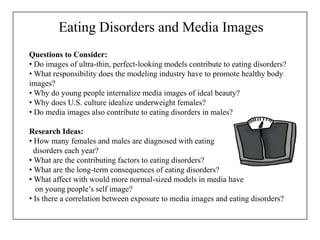
Eating Disorders and Media Images
Questions to Consider:
• Do images of ultra-thin, perfect-looking models contribute to eating disorders?
• What responsibility does the modeling industry have to promote healthy body
images?
• Why do young people internalize media images of ideal beauty?
• Why does U.S. culture idealize underweight females?
• Do media images also contribute to eating disorders in males?
Research Ideas:
• How many females and males are diagnosed with eating
disorders each year?
• What are the contributing factors to eating disorders?
• What are the long-term consequences of eating disorders?
• What affect with would more normal-sized models in media have
on young people’s self image?
• Is there a correlation between exposure to media images and eating disorders?
Illegal Music Downloads
Questions to Consider:
• If a song is available free online, is it unethical to download it if it violate
copyright?
• Should online sites that host illegal downloading be shut down?
• Is it unethical to share music files with a friend?
• How can copyright laws keep up with current technology?
Research Ideas:
• What are the specific copyright laws protecting artists?
• What is the Digital Millenium Copyright Act?
• What are the consequences of illegal file sharing?
• How will artists earn a profit if their music is downloaded for free?
• Why do some artists encourage free downloads?
Thank you for purchasing this product.
© Laura Torres 2014
The original purchaser of this document is granted permission to reproduce the pages in needed
quantities for the purchaser's classroom only. Minor editing is allowed; the document remains under
copyright even when edited.
Duplication for other classes or by other teachers or for use in wide distribution as within a school
district or on the internet in any form is strictly forbidden.
Violations are subject to the penalties of the Digital Millennium Copyright Act.

Research prompts

  • 2.
    Animal Research andTesting Questions to Consider: • Is animal testing justified if humans benefit? • Under what circumstances should animal research be used? • Is there sufficient oversight and regulations for animal testing? • Is testing on animals really necessary, or are there alternatives? Research Ideas: • What laws and oversight currently exist to regulate testing on animals? • What types of products and research use animal testing? • Where do researchers get the animals? • What are some advances that have been made due to animal research? • What are alternatives, such as computer models, to testing on animals? • Should consumers be informed if a product or service involved animal testing?
  • 3.
    Texting and Driving Questionsto Consider: • Is texting and driving really a problem? • Should texting and driving be considerd a crime on the level of drinking and driving? • Are texting and driving laws too harsh? Too lenient? • Why do people text and drive even though it is dangerous? Research Ideas: • What are the laws about texting and driving in your state? • How do the laws compare to other states? • What are recent statistics of accidents involving texting and driving? • What are some real-life examples of people who have been prosecuted for crimes related to texting and driving (negligent driving / manslaugher)? • What is the science behind how people become distracted while texting and driving? • What are the differences/similarities between drinking and driving and texting and driving? • What are the demographics of people who text and drive (age, gender etc...)
  • 4.
    Childhood Immunization Questions toConsider: • Why are some people against routine childhood immunizations? • Should immunizations be required for school attendance? • Should immunizations be mandatory for all children? • Should the government or parents decide whether children should be immunized? • Is public safety or individual rights more important in regard to immunizations? Research Ideas: • What are the risk factors of routine immunizations? • What are the requirements for immunizations in your school district? Your state? • Can parents opt out of immunizing their children? • What are some of the risks of immunization? • What are some diseases that have been eradicated or greatly reduced because of immunizations?
  • 5.
    School Uniforms Questions toConsider: • Should uniforms be required in schools? • What problems could be avoided by schools requiring uniforms? • What problems could be caused by schools requiring uniforms? • Who should decide whether school uniforms should be required? • Does a dress code accomplish the same goals as requiring uniforms? Research Ideas: • What percentage of public schools require uniforms? Private schools? • Do uniforms cut down on behavior problems in schools? • Are uniforms more costly than a regular wardrobe? • For schools that require uniforms, what reasons do they cite for the requirement? • Is there a trend toward uniforms, or a trend away from uniforms?
  • 6.
    Beauty Pageants Questions toConsider: • What purpose do pageants serve in society? • Do pageants promote the objectification of women? • Do pageants produce healthy role models for young girls? • Should pageants eliminate swimsuit competitions? • Are child beauty pageants positive or negative competition? • Should transgendered people be allowed to compete in pageants? Research Ideas: • What are the requirements for different local and national pageant contestants? • How much money do contestants typically spend on preparing for a pageant? • How many pageant contestants have plastic surgery?
  • 7.
    English as NationalLanguage Questions to Consider: • What would be the benefits of declaring English the national language of the United States? • What would be the drawbacks of declaring English the national language? • Is it important for a country to have a national language? • Why doesn’t the United States have a national language? • How important is language in a national identity, culture, or values? Research Ideas: • What changes would be made if English was declared the national language? • Why have attempts to make English the national language failed in the past? • What are some of the savings or costs to having a national language? • Which other countries have national languages? Which do not? • How would English as a national language affect non-English speaking citizens?
  • 8.
    ADD / ADHDMedications Questions to Consider: • Are doctors too quick to prescribe medications for ADD / ADHD? • Should other avenues of treatment be explored before medications are prescribed? • Is ADD / ADHD overdiagnosed? • Some preschoolers are being diagnosed with ADD / ADHD. Is this too young to be diagnosed or medicated? • How do ADD / ADHD prescription medications help patients? Research Ideas: • Why do some researchers think ADD / ADHD is overdiagnosed? • What are the benefits to ADD / ADHD medications? • What are the side effects? • How many children are diagnosed with ADD / ADHD every year? • What are alternative treatments besides prescription medication? • What other diseases or disorders should be ruled out before a child is diagnosed with ADD or ADHD?
  • 9.
    Home Schooling Questions toConsider: • What are some reasons parents choose to home school their children? • Can students get a quality education at home? • Should home schools be regulated or monitored? • Should home schooled children be required to participate in state testing? • Why has home schooling been increasing in popularity? Research Ideas: • What are the laws in your state regarding home schooling? • How many students in the United States are home schooled? • What are college acceptance and graduation rates for home schooled students? • What types of home schools exist? • What resources are available for home schools? • What reasons do parents or students give for choosing to home school?
  • 10.
    Alternative Fuel Vehicles Questionsto Consider: • Why are alternative fuel vehicles not already mainstream? • Is the extra cost of alternative fuel vehicles worth the savings in fuel costs? • Should the sales and use of alternative fuel vehicles be mandated by the government? • Are alternative fuel vehicles really more environmentally friendly than fossil fuel vehicles? • What are the consequences of continued dependence on fossil-fuel vehicles? • Should the government fund research and development of alternative fuel vehicles, or should it be left to private industry? Research Ideas: • What types of alternative fuels are currently available? What kind are in development? • Will consumers spend the extra money for alternative fuel vehicles? • What is the average cost and savings of an alternative fuel vehicles? • What are the obstacles to mass production and conversion to alternative fuel vehicles? • Does the government support development and research of alternative fuels?
  • 11.
    Bottled Water Questions toConsider: • Is bottled water a necessary product, or is it manufactured demand? • Is the convenience of bottled water worth the cost to the environment? • Is bottled water necessary in places where a clean water supply is not guaranteed, or are there alternatives? • Is bottled water actually cleaner and healthier than tap water? • Is the availability of bottled water a necessary, healthy alternative to soft drinks? Research Ideas: • How much plastic ends up in landfills because of bottled water? • What is the environmental impact of bottled water compared to other bottled beverages? • What are the differences between bottled water and tap water? • What are alternatives to bottled water?
  • 12.
    Illegal Immigration Questions toConsider: • Should illegal immigrants have access to public services funded by taxpayers? • What should the process be for naturalization or citizenship? • If one member of a family is in the U.S. illegally, should he or she be allowed to stay in order not to break up a family? • Should children who entered the U.S. illegally become legal as adults if living in the U.S. is all they know? Research Ideas: • Why have some advocacy groups and news organizations dropped the term “illegal” and use alternatives such as “undocumented workers” instead? • Is the U.S. economy dependent on labor performed by illegal immigrants? • What are the immigration policies of the U.S? • What are the immigration policies of other countries? • How many people enter the U.S. illegally every year?
  • 13.
    Genetically Modified Foods Questionsto Consider: • Should genetically modified foods be labeled as such? • Why are genetically modified foods controversial? • What are the advantages and disadvantages ot genetically modified foods? • What should the government’s role be in oversight, testing, and labeling? Research Ideas: • Which foods are genetically modified? • Why is labeling not currently required? • What do studies show about the safety of genetically modified foods? • What is the history of genetically modified foods? • Why do producers want to modify certain foods? • What measures have European nations taken against genetically modified foods?
  • 14.
    Organic Food Questions toConsider: •Why do people choose to eat organic foods? • What is the environmental impact of producing organic food? • Are organic foods worth the extra cost? • What does “organic” really mean? Research Ideas: • What are the labeling laws for foods purported to be organic? • Do organic foods have more nutritional value than conventional foods? • Why do organic foods cost more than conventional foods? • What are some organic food growing methods? • Are there disadvantages to organic foods?
  • 15.
    Childhood Obesity Questions toConsider: • Who or what is to blame for childhood obesity? • What role does fast food play in childhood obesity? • What should be done to combat the childhood obesity problem? • What are some of the health and social issues surrounding childhood obesity? • Why has childhood obesity become a current issue? Research Ideas: • What percentage of children are considered overweight or obese? • How much have obesity rates risen in the past few decades? • What are some causes of childhood obesity? • Are genetic or environmental factors more important? • What are the long-term affects of childhood obesity? • What percentage of obese children become obese adults?
  • 16.
    School Lunches Questions toConsider: • Should schools provide free lunch and breakfast? To whom? • Should schools be able to dictate nutrition criteria for lunches brought from home? • Are school lunches healthy? • Do school lunches contribute to childhood obesity? • Should children be required to take foods, such as vegetables, that they don’t like? Research Ideas: • What changes have been made recently to improve nutrition in school lunches? • What is the cost of the school lunch program to taxpayers? • Have changes in nutritional value of school lunches helped with the obesity problem? • Why do parents rely on school lunches rather than sending lunch from home? • Are lunches brought from home more nutritious than school lunches?
  • 17.
    Rising Cost ofHigher Education Questions to Consider: • Does the cost of higher education pay off financially? • Is cost the main consideration in pursuing higher education? • What options are available for reducing the cost of higher education (online etc...) • How can parents and students prepare for the high cost of college? • Does it make sense to go into debt to fund a college education? Research Ideas: • What has caused the recent increase in tuition and other student fees? • Which schools are the best bargain? Which schools are the worst? • How should a student decide how much to take out in loans? • Is working while attending school feasible? • What is the average overall lifetime financial benefits of a degree in your chosen field?
  • 18.
    Concussions in YouthSports Questions to Consider: • Should there be age restrictions on contact sports such as football? • What can be done to help prevent concussions and head injuries in youth sports? • Should action be taken to diagnose, recognize, and manage this problem? • Who is responsible for making sure players are safe? • Is the risk of head injury simply an inherent risk that has to be taken to play sports? Research Ideas: • How many youth sports-related head injuries are reported each year? • Are repetitive head impacts dangerous even if they don’t result in a concussion diagnosis? • What are the current guidelines / restrictions for different local or national youth sport programs? • What are the long-term consequences of youth concussions?
  • 19.
    Outsourcing Questions to Consider: •How does outsourcing affect the U.S. economy? • What responsibility do U.S. companies have for employees of other countries who are not subject to U.S. labor laws? • Does outsourcing make sense for certain industries? • Would better education and training in the U.S. make outsourcing unnecessary? • What affect does outsourcing have on the culture and economy of the countries where work is outsourced? Research Ideas: • Is all outsourcing based on a company saving money, or are there other issues such as quality? • Which industries use the greatest amount of outsourcing? • What are the costs and savings to outsourcing? • Which countries are most likely to have outsourced work from the U.S? • What are some strategies companies use to oversee labor conditions for outsourced work?
  • 20.
    Young Children andCompetitive Sports Questions to Consider: • What are the benefits of competitive sports for young children? • What are the drawbacks of competitive sports for young children? • Should “winning” and “losing” be de-emphasized before a certain age? • Should parents require their children to participate in sports? Research Ideas: • What do studies show about the benefit of competitive sports for children? • What does the research show about the drawbacks of competitive sports for children? • Is free play better for children than organized games? • Are children who participate in competitve sports more fit than other children? • How many children participate in competitive sports every year?
  • 21.
    Online Security Questions toConsider: • What precautions should consumers take to protect their personal information online? • Is online shopping safe? • Is online banking safe? • What are the biggest threats to online security? Research Ideas: • How have large companies such as Target become victims of security breaches? • Are there any foolproof systems to protect consumers? • How much online fraud is documented each year in the U.S.? • Is online shopping or banking really more dangerous than conventional shopping and banking?
  • 22.
    Weight Loss Questions toConsider: • What kind of diets work best? • What is the role of exercise in weight loss? • Why do so many people who start a diet fail to lose weight? • Why do most people who lose weight regain it? • What are the keys to successful weight loss? Research Ideas: • What are the factors that determine successful weight loss? • What percentage of people who lose weight keep it off? • What are the risks of a “crash diet”? • What are the long-term health benefits to losing weight?
  • 23.
    Academic Integrity Questions toConsider: • Has the problem of cheating in school gotten worse in recent years? • What role does technology play in cheating? • What motivates students to cheat? • What are reasonable consequences for violations of academic integrity? • What role does peer pressure play in academic integrity? • What are some ways to encourage academic integrity? Research Ideas: • What policies and procedures regarding academic integrity are in place at your school? • What are some recent examples of plagiarism or breach of academic integrity that have been publicized? • What percent of students have admitted to cheating? • What do students cite as reasons for cheating? • Which policies at schools are most effective in preventing cheating?
  • 24.
    Human Trafficking Questions toConsider: • What can be done to bring awareness to the problem of human trafficking? • Why is this problem so widespread, even in the U.S? • How do people become victims of traffickers? • What help and resources should be provided to victims? • How can the public recognize this problem? Research Ideas: • Which cities are “hot spots” for human trafficking in the U.S? • How many victims come from overseas? How many victims are domestic? • How many people per year are victimized? • What programs or resources are available to victims? • What are the laws and punishments for those who engage in this crime? • How has this crime been able to flourish in the U.S?
  • 25.
    Foster Kids –Aging Out Questions to Consider: • Why do so many foster kids who age out of the system become homeless? • Is 18 years old too young to age out of the system? • What resources should be offered to foster kids to ease the transition out of foster care? • How can we increase the rates of foster kids who go on to get a college education? Research Ideas: • How many former foster kids are unemployed? • How many former foster kids are homeless? • How many former foster kids get a college education? • What are the factors that cause foster kids to have high rates of unemployment and homelessness? • What kinds of programs have proven effective to help foster kids transition out of the system?
  • 26.
    Secondhand Smoke Questions toConsider: • What are the rights of smokers versus the rights of people who wish to avoid secondhand smoke? • San Rafael, CA, has banned smoking in certain private homes and apartments. Is this going too far, or is it necessary to protect non-smokers and children? • Some areas such as Houston, TX, have banned smoking in public housing. Is this reasonable? • Should parents have the freedom to smoke around their children? Research Ideas: • What are the health risks of secondhand smoke? • Are there risks specific to babies and children who are exposed to secondhand smoke? • What laws and regulations are in place in your city regarding smoking in public and private areas? • What is the financial impact of secondhand smoke to the healthcare system?
  • 27.
    Minimum Wage Questions toConsider: • What is a fair minimum wage? • Should a full-time minimum wage worker expect a livable salary (above the poverty line)? • Should the government dictate raises in the minimum wage, or should market forces be left to work? • In determining a raise in the minimum wage, what factors, such as inflation, should be taken into account? Research Ideas: • What are some of the possible negative effects from a raise in the minimum wage? • What are some of the possible positive effects from a raise in the minimum wage? • What is the minimum wage in your state and city? • Why do some argue that raising the minimum wage could be counterproductive for the working poor? • When the minimum wage is raised, what strategies might companies use to help defray the extra cost?
  • 28.
    Social Media Addiction Questionsto Consider: • How would you define addiction to social media? • What adverse effects come from spending too much time on social media? • Should parents and schools limit access to phones and social media? • Why are some people more interested in social media than real-life interaction? Research Ideas: • What is the definition of “addiction”? • What are the clinical reasons someone might become addicted to social media? • What are symptoms of social media addiction? • What are some of the social consequences of social media addiction?
  • 29.
    Autotune Questions to Consider: •Are consumers being duped when they purchase music that has been autotuned? • Are consumers being duped when they attend a live show that is being autotuned? • Is there any harm in autotuning someone’s voice so they sound better? • Should consumers be told that a recording or live performance is autotuned? • Is our culture and use of autotune idealizing people who promote a certain image rather than people with real talent? Research Ideas: • Which popular artists use autotune in live concerts? • How does the autotune technology work? • Is autotune allowed in talent competitions?
  • 30.
    EBT (Food Stamp)Fraud Questions to Consider: • How can the government prevent people from selling their EBT cards? • How can the government prevent stores from engaging in EBT fraud? • What should be the reprecussions of food stamp fraud? • Should food stamp fraud be considered a serious crime? Research Ideas: • What is the dollar amount of food stamp fraud each year in the U.S? • What types of food stamp fraud exist? • How can authorities crack down on food stamp fraud? • Is part of the growth of the food stamp program in recent years partly because of the ability to sell EBT cards for cash?
  • 31.
    Prescription Drug Abuse Questionsto Consider: • What role do patients, doctors, and pharmaceutical companies play in prescription drug abuse? • What precautions should doctors take to make sure their patients aren’t abusing prescription drugs? • Why is the abuse of prescription drugs so widespread? • Are consumers aware of the risks of prescription abuse? Research Ideas: • What types of drugs are typically abused? • What regulations are in place to control prescription drug abuse? • What are some of the health effects of long-term prescription drug abuse? • How many deaths each year in the U.S. are attributed to prescription drug abuse?
  • 32.
    Daycare vs. ParentalCare Questions to Consider: • What are the advantages and disadvantages of stay-at-home parental care for preschoolers? • What are the advantages and disadvantages of daycare for preschoolers? • At what age can children benefit from daycare? • What factors should parents take into consideration when making care decisions for their children? • How can parents determine whether a daycare is good quality? Research Ideas: • What do studies show about children’s development in day care versus stay-at- home care? • What is the cost associated with daycare? • Are there long-term benefits or consequences to either choice?
  • 33.
    Fast Food Advertisingand Kids Questions to Consider: • How do companies make their products appealing to children? • How do companies make their packaging appealing to children? • Do advertisements affect children’s food choices? • Should there be regulations on what advertisements can be shown during kids’ programming? • Are fast food companies partly responsible for the high obesity rates in children? Research Ideas: • How much do children affect a family’s purchasing decision? • What methods do advertisers use to appeal to children? • How much money does the fast food industry spend on marketing to children? • What is the impact of fast food advertising on obesity rates in children?
  • 34.
    Cyber Bullying Questions toConsider: • Is bullying more pervasive now with social media? • Is there a way to prevent cyber bullying? • Should schools get involved with cyber bullying cases even if they are not happening on school grounds? • Should parents be held responsible for their child’s cybe rbullying? • Should cyber bullying be a crime? • Should bullies be criminally charged if their bullying leads to the victim’s psychologial damage or suicide? Research Ideas: • How many people claim to be victims of cyber bullying? • Which social media are commonly used for cyber bullying? • How can parents find out if their children are being cyber bullied? • What types of behaviors are defined as cyber bullying? • How can young people protect themselves from becoming victims?
  • 35.
    Reality TV Questions toConsider: • How much of “reality TV” is actually true-to-life? • What stereotypes might be promoted by reality TV shows? • Is “reality” skewed when TV cameras and producers are present? • Why are reality shows so popular? • What are the positive aspects to reality TV? • What are the negative aspects to reality TV? Research Ideas: • How has the show “Teen Mom” on MTV purportedly affected pregnancy rates among teens? • What percent of television programs are now reality shows? • For what reason would someone want to appear on a reality show? • Do reality TV shows script much of their programming? • Do producers create false “characters” through editing? • Are participants on the show encouraged to act a certain way in order to create drama?
  • 36.
    School Shooters andthe Media Questions to Consider: • Does media coverage of school shooters lead to copycat crimes? • Does showing pictures of the shooter and analyzing his or her life and motives necessary for a news story, or is it sensationalism? • Can the media cover a story effectively without mentioning the shooter’s name or showing pictures of him or her? • What responsibility does the media have not to sensationalize crimes such as school shootings? • Can the media be self-policing, or should there be limits on freedom on the press if its proven that copycat crimes result from coverage? Research Ideas: • Do school shooters cite media coverage of previous events as motivation? • Which school shootings seem to be copycat crimes? • Do experts see a connection between media coverage and motivation of these criminals? • Do media professionals have a code of ethics that would prevent this type of coverage?
  • 37.
    Sweatshops Questions to Consider: •What responsibility do U.S. companies have to monitor labor conditions in factories overseas where products or services are outsourced? • Are consumers partly at fault for the problem because they demand cheaper prices? • Whose responsibility is it to make sure workers have reasonable working conditions and hours? Research Ideas: • Where do sweatshops exist? • What labor laws are in place in these countries, and are they enforced? • Why do U.S. companies outsource labor to countries that may employ sweatshops? • Do U.S. companies have to outsource to be competitive in their industries?
  • 38.
    Hate Crimes Questions toConsider: • What are hate crimes? • Why are hate crimes in a separate category than other crimes? • Can a hate crime only be committed against a minority group? • Why do hate crimes occur? Research Ideas: • How is a hate crime defined? • How many hate crimes occur each year? • Where do hate crimes typically occur? • Why is it difficult to track the prevalance of hate crimes?
  • 39.
    Doping in Sports Questionsto Consider: • What motivates athletes to use illegal substances in competition? • Should athletes’ results be removed from the records if they are caught doping? • What are appropriate sanctions against athletes who use illegal substances? • Should coaches or teams be held responsible if their athletes are caught doping? • Is doping most prevalent among professional athletes, or does it also happen at the amateur level? Research Ideas: • Who are some high-profile athletes who have been caught doping? • Are the current testing methods sufficient? • What organizations are responsible for monitoring doping among athletes? • What are the methods of doping and how do they work? • What are the long-term health risks of doping? • Do severe sanctions act as a deterrent to doping?
  • 40.
    Eating Disorders andMedia Images Questions to Consider: • Do images of ultra-thin, perfect-looking models contribute to eating disorders? • What responsibility does the modeling industry have to promote healthy body images? • Why do young people internalize media images of ideal beauty? • Why does U.S. culture idealize underweight females? • Do media images also contribute to eating disorders in males? Research Ideas: • How many females and males are diagnosed with eating disorders each year? • What are the contributing factors to eating disorders? • What are the long-term consequences of eating disorders? • What affect with would more normal-sized models in media have on young people’s self image? • Is there a correlation between exposure to media images and eating disorders?
  • 41.
    Illegal Music Downloads Questionsto Consider: • If a song is available free online, is it unethical to download it if it violate copyright? • Should online sites that host illegal downloading be shut down? • Is it unethical to share music files with a friend? • How can copyright laws keep up with current technology? Research Ideas: • What are the specific copyright laws protecting artists? • What is the Digital Millenium Copyright Act? • What are the consequences of illegal file sharing? • How will artists earn a profit if their music is downloaded for free? • Why do some artists encourage free downloads?
  • 42.
    Thank you forpurchasing this product. © Laura Torres 2014 The original purchaser of this document is granted permission to reproduce the pages in needed quantities for the purchaser's classroom only. Minor editing is allowed; the document remains under copyright even when edited. Duplication for other classes or by other teachers or for use in wide distribution as within a school district or on the internet in any form is strictly forbidden. Violations are subject to the penalties of the Digital Millennium Copyright Act.