Effects of Incompleteand
Dysfunctional Library in Banuang
Gurang National High School on the
Academic Performance of Grade 7-11
Students during the School Year 2023-
2024: A Study
GROUP 1
2.
INTRODUCTION
• This studyexamines the effects of an incomplete and dysfunctional
library in BGNHS on students' academic performance. A library is a
vital resource center that provides access to various educational
materials and supports learning and research. In the Philippines, the
legal basis for libraries is established through various laws and
regulations. Republic Act No. 7743, enacted in 1994, provides for the
establishment of congressional, city, and municipal libraries,
emphasizing the importance of accessible library services
nationwide. Additionally, Royal Order No. 689, issued in 1887, laid the
foundation for the present-day National Library of the Philippines.
3.
• These legalprovisions reflect the government's
commitment to the establishment and development of
libraries as essential educational and cultural institutions.
The inadequate or dysfunctional library can have
detrimental effects on students' academic performance,
including limited access to resources, a discouraging
study environment, and a lack of opportunities for
independent learning. Addressing these issues and
improving the library can enhance students' access to
information, promote better study habits, and contribute
to their overall academic success.
4.
Why did youchoose this study?
• Researchers choose this study because it addresses the
problem of students not utilizing books for learning due
to excessive use of phones and other gadgets. Many
students waste their time on these devices instead of
reading books. It is essential for students to allocate time
for reading. By examining the effects of not having a
complete and functional library, we can assess the
specific impact of this issue on the students and explore
potential strategies to address it.
5.
Describe the settingor the place where the
research will be taking place?
• This study entitled " Effects of Incomplete and Dysfunctional library
in Banuang Gurang National High School to the Academic Performance
of Grade 7 -11 students during the School year 2023-2024: A study."
focuses on the visible and observed effects on not having complete and
functional libraby. Moreover, the researchers will be identifying what are
the subject/area that needs book supply for the students references.
Along with this, demographic information of the student-
respondents will also be gathered such as Sex, Age and grade level.
Furthermore, this is delimited to Grades 7,8,9,10 and 11 of the present
school year. The exact number of the respondents will be identified
though the use of slovin's formula.
6.
Why is therea need for your
research/topic to be studied?
• To know the effects of not having
complete & functional library to
students Academic Performance
• (Suggestions/ Solution ) Ask for other
people (7,8,9,10 & teachers) for suggestions.
7.
What are theover-all benefits that may be
derived from your study?
• This research study will be beneficial to the following:
• Students: The research can empower students by
providing evidence of the impact of library facilities on
their academic performance. It can encourage them to
advocate for improvements in the library and motivate
them to utilize alternative resources to enhance their
learning.
8.
Parents: The researchcan help parents understand
the importance of a well-equipped library and its
influence on their children's academic success. It
can empower parents to actively participate in
advocating for better library facilities and
resources in schools.
Future Researchers: This research can serve as a
valuable resource for future researchers
interested in studying the effects of library
facilities on academic performance. It can provide
a foundation for further investigations and
contribute to the development of knowledge in
this field.
9.
Teachers: The researchfindings can help
teachers understand the limitations of an
incomplete and dysfunctional library and
inspire them to explore alternative resources
and teaching methods. It can encourage
teachers to adapt their approaches to support
students' learning despite the challenges
posed by the library.
Society: A well-equipped library contributes to the
overall educational development of society. This
research highlights the significance of investing in
library facilities and resources to ensure the
academic success of students, which ultimately
benefits society as a whole.
10.
DATA GATHERING PROCEDURE
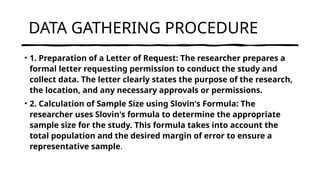
•1. Preparation of a Letter of Request: The researcher prepares a
formal letter requesting permission to conduct the study and
collect data. The letter clearly states the purpose of the research,
the location, and any necessary approvals or permissions.
• 2. Calculation of Sample Size using Slovin's Formula: The
researcher uses Slovin's formula to determine the appropriate
sample size for the study. This formula takes into account the
total population and the desired margin of error to ensure a
representative sample.
11.
DATA GATHERING PROCEDURE
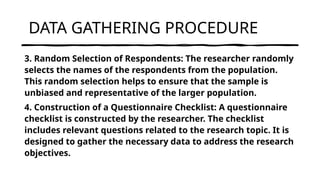
3.Random Selection of Respondents: The researcher randomly
selects the names of the respondents from the population.
This random selection helps to ensure that the sample is
unbiased and representative of the larger population.
4. Construction of a Questionnaire Checklist: A questionnaire
checklist is constructed by the researcher. The checklist
includes relevant questions related to the research topic. It is
designed to gather the necessary data to address the research
objectives.
12.
DATA GATHERING PROCEDURE
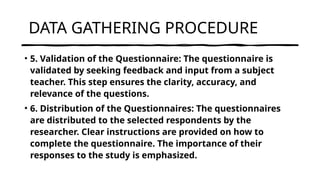
•5. Validation of the Questionnaire: The questionnaire is
validated by seeking feedback and input from a subject
teacher. This step ensures the clarity, accuracy, and
relevance of the questions.
• 6. Distribution of the Questionnaires: The questionnaires
are distributed to the selected respondents by the
researcher. Clear instructions are provided on how to
complete the questionnaire. The importance of their
responses to the study is emphasized.
13.
DATA GATHERING PROCEDURE
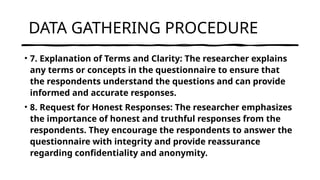
•7. Explanation of Terms and Clarity: The researcher explains
any terms or concepts in the questionnaire to ensure that
the respondents understand the questions and can provide
informed and accurate responses.
• 8. Request for Honest Responses: The researcher emphasizes
the importance of honest and truthful responses from the
respondents. They encourage the respondents to answer the
questionnaire with integrity and provide reassurance
regarding confidentiality and anonymity.
14.
DATA GATHERING PROCEDURE
•9. Data Collection and Tallying: The researcher collects the
completed questionnaires from the respondents and
organizes the data. The responses are tallied to facilitate
analysis and interpretation.
• 10. Statistical Analysis and Interpretation: The researcher
conducts a statistical analysis of the collected data using
appropriate tools and techniques. They may seek the
assistance of a statistician to ensure accurate analysis and
interpretation of the results.
15.
DATA GATHERING PROCEDURE
•11. Drawing Conclusions: Based on the findings from the
data analysis, the researcher draws conclusions that
address the research objectives. They summarize the key
findings and insights derived from the data.
• 12. Providing Recommendations: The researcher formulates
recommendations based on the conclusions drawn from the
data analysis. These recommendations offer practical
suggestions for addressing the research problem or
achieving the research objectives.
16.
STATEMENT OF THEPROBLEM
1. What is the Demographic profile of the respondents in term of:
a. Sex
b. Age
c. Grade level
2. What are the effects of not having a complete and functional library to
the students?
3. What grade level mostly having experience lock of books to be used?
4. What are the possible solutions/ Recommendations to the problem?