1
I. Context and Rationale
Modern day educators play a significant role in the improvement of science
pedagogies especially soon the part of classroom delivery of instruction. They are the
front liners in the provision of knowledge, information, skills and values to be acquired by
the pupils. It is for this reason that teachers should always endeavor to make the lives of
every pupil in the classroom worth remembering as to instructional delivery and
experiences are concerned.
Pupils learn from their own mistakes only if they are well-trained about it. It is on
this premise that teachers play an important role in shaping the minds of every pupil that
“feedbacking” is very important in the learning process. Here is where the counteractive
lecture comes in.
Improving the educational outcomes for students who are at risk for academic
failure is an important issue for educators and policymakers. Recently, before- and after-
school tutoring programs have been identified as having the potential to turn academic
failure into academic success.
Operationally, counteractive lecture is defined as “a specific remedial instruction
program administered through the conduct of tutorial sessions to provide opportunity for
the pupils who are underperforming to reach a desired level of academic performance”.
Though lecturing is considered the oldest method of teaching, it seems that most
lecturers still struggle with the mechanics that ensure the message is retained, the
audience stays awake and the lecturer receives a positive send off. It's a wonder that
lecturing as a teaching method has survived.
When a speaker brings vitality and enthusiasm to a lecture, people remain
attentive and likely benefit from the presentation. This, however, may suggest that
2
lecturing is quite similar to acting which may favor lecturers prone to a more energetic and
passionate delivery.
Lipit-Tomeeng Elementary School is one of the public schools in San Fabian
District II. It has a total land area of 13, 500sqm with sixteen (16) teachers including the
school principal. As of this writing, there are _______________pupils enrolled from
Kindergarten to Grade 6.
The researcheris the Grade 6 teacher where she handles Grade 6-Caballero class
with twenty-three (23) pupils. Based on the result of the First Periodic Test, the Grade 6
pupils posted only ______ mastery level. With that the researcher wants to propose the
study entitled, “Improving the Performance of the Grade 6 Pupils in Mathematics through
Counteractive Lecture and Discussion”.
II. Action Research Questions
This study aims to improve the performance of the Grade 6 pupils in solving
mathematical problems.
Specifically it will answer the following problem;
1. What is the performance of the Grade 6 pupils in Mathematics before and after
counteractive lecture and discussion?
2. Is there a significant difference in the performance of the Grade 6 pupils in
Mathematics before and after the counteractive lecture and discussion strategy?
III. Proposed Innovation, Intervention and Strategy
In the conduct of the action reserach, the proponent proposes the following
innovation, intervention and strategy.
The Grade 6 pupils will undergo a pre-test in order to identify the weakness
and strengths of the pupils in solving word problems in Mathematics. On the other
3
hand, parents of the pupils will be informed of the study being conducted in order
to improve their child’s perofrmance in Mathematics.
Counteractive lecture and disscusion will be employed in the conduct of the
study in improving the performance of the pupils in Mathematics.
Posttest will be conducted in orer to assess and evaluate the effectiveness of
the counteractive lecture and discussion in the performance of the Garde 2 pupisl
in mathematics.
In the conduct of the study, counteractive lecture will be done three (3) times a
week ( Monday, Wednesday and Friday) from 3:30 – 4:30 in the afternoon. This
is to ensure that other subjects will not be interrupted in the coundtc of the
intervention. The said intervention will be done from October 2018 – January
2019.
IV. Action Research Method
a. Participants and/other Sources of Data and Information
The respondents of the study will be the Grade 6 pupils who did not meet the
mastery level of 75% in the first quarter examination in Mathematics. Of the twenty-three
(23) pupils, fifteen (15) of them did not meet the mastery level of 75%. With that there are
eight (8) boys and seven (7) girls.
b. Data Gathering Methods
The researcher will be using a teacher-made pre-test and posttest on the least
learned competencies in the first quarter examination in Mathematics 6. A twenty-item
(20-item) test will be given to the pupils in the pre-test. A set of parallel 20-itemtest will be
given in the posttest.
4
c. Data Analysis Plan
The Microsoft Excel will be used for data analysis and interpretation as well as
manual computation will be done for rechecking purposes.
As for Problem 1, frequency and the percentage will be used Finally, in order to
compute the significant difference, t-test will be sued at 0.5 level of significance.
V. Action Research Work Plan and Timelines
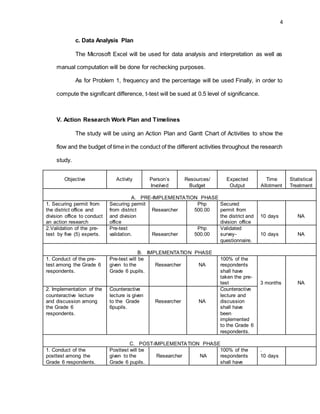
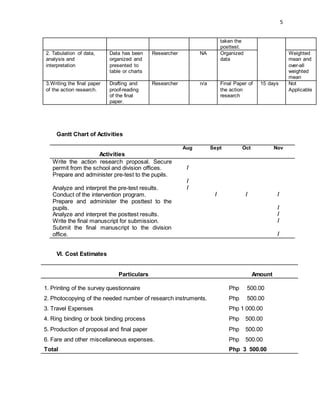
The study will be using an Action Plan and Gantt Chart of Activities to show the
flow and the budget of time in the conduct of the different activities throughout the research
study.
Objective Activity Person’s
Involved
Resources/
Budget
Expected
Output
Time
Allotment
Statistical
Treatment
A. PRE-IMPLEMENTATION PHASE
1. Securing permit from
the district office and
division office to conduct
an action research
Securing permit
from district
and division
office
Researcher
Php
500.00
Secured
permit from
the district and
division office
10 days NA
2.Validation of the pre-
test by five (5) experts.
Pre-test
validation. Researcher
Php
500.00
Validated
survey-
questionnaire.
10 days NA
B. IMPLEMENTATION PHASE
1. Conduct of the pre-
test among the Grade 6
respondents.
Pre-test will be
given to the
Grade 6 pupils.
Researcher NA
100% of the
respondents
shall have
taken the pre-
test 3 months NA
2. Implementation of the
counteractive lecture
and discussion among
the Grade 6
respondents.
Counteractive
lecture is given
to the Grade
6pupils.
Researcher NA
Counteractive
lecture and
discussion
shall have
been
implemented
to the Grade 6
respondents.
C. POST-IMPLEMENTATION PHASE
1. Conduct of the
posttest among the
Grade 6 respondents.
Posttest will be
given to the
Grade 6 pupils.
Researcher NA
100% of the
respondents
shall have
.
10 days
5
taken the
posttest.
2. Tabulation of data,
analysis and
interpretation
Data has been
organized and
presented to
table or charts
Researcher NA Organized
data
Weighted
mean and
over-all
weighted
mean
3.Writing the final paper
of the action research.
Drafting and
proof-reading
of the final
paper.
Researcher n/a Final Paper of
the action
research
15 days Not
Applicable
Gantt Chart of Activities
Activities
Aug Sept Oct Nov
Write the action research proposal. Secure
permit from the school and division offices. /
Prepare and administer pre-test to the pupils.
/
Analyze and interpret the pre-test results. /
Conduct of the intervention program. / / /
Prepare and administer the posttest to the
pupils. /
Analyze and interpret the posttest results. /
Write the final manuscript for submission. /
Submit the final manuscript to the division
office. /
VI. Cost Estimates
Particulars Amount
1. Printing of the survey questionnaire Php 500.00
2. Photocopying of the needed number of research instruments. Php 500.00
3. Travel Expenses Php 1 000.00
4. Ring binding or book binding process Php 500.00
5. Production of proposal and final paper Php 500.00
6. Fare and other miscellaneous expenses. Php 500.00
Total Php 3 500.00
6
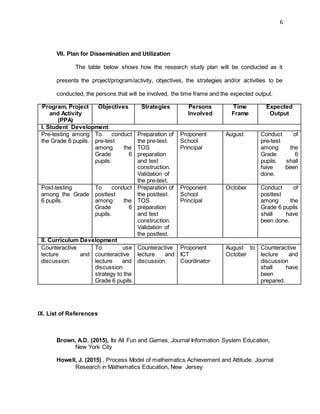
VII. Plan for Dissemination and Utilization
The table below shows how the research study plan will be conducted as it
presents the project/program/activity, objectives, the strategies and/or activities to be
conducted, the persons that will be involved, the time frame and the expected output.
Program, Project
and Activity
(PPA)
Objectives Strategies Persons
Involved
Time
Frame
Expected
Output
I. Student Development
Pre-testing among
the Grade 6 pupils.
To conduct
pre-test
among the
Grade 6
pupils.
Preparation of
the pre-test.
TOS
preparation
and test
construction.
Validation of
the pre-test.
Proponent
School
Principal
August Conduct of
pre-test
among the
Grade 6
pupils. shall
have been
done.
Post-testing
among the Grade
6 pupils.
To conduct
posttest
among the
Grade 6
pupils.
Preparation of
the posttest.
TOS
preparation
and test
construction.
Validation of
the posttest.
Proponent
School
Principal
October Conduct of
posttest
among the
Grade 6 pupils
shall have
been done.
II. Curriculum Development
Counteractive
lecture and
discussion.
To use
counteractive
lecture and
discussion
strategy to the
Grade 6 pupils
Counteractive
lecture and
discussion.
Proponent
ICT
Coordinator
August to
October
Counteractive
lecture and
discussion
shall have
been
prepared.
IX. List of References
Brown, A.D. (2015), Its All Fun and Games, Journal Information System Education,
New York City
Howell, J. (2015) , Process Model of mathematics Achievement and Attitude, Journal
Research in Mathematics Education, New Jersey
7
San Fabian District II
LIPIT-TOMEENG ELEMENTARY SCHOOL
San Fabian
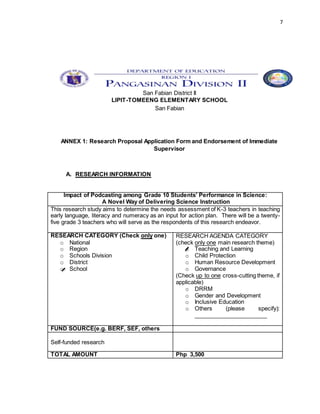
ANNEX 1: Research Proposal Application Form and Endorsement of Immediate
Supervisor
A. RESEARCH INFORMATION
Impact of Podcasting among Grade 10 Students’ Performance in Science:
A Novel Way of Delivering Science Instruction
This research study aims to determine the needs assessment of K-3 teachers in teaching
early language, literacy and numeracy as an input for action plan. There will be a twenty-
five grade 3 teachers who will serve as the respondents of this research endeavor.
RESEARCH CATEGORY (Check only one)
o National
o Region
o Schools Division
o District
o School
RESEARCH AGENDA CATEGORY
(check only one main research theme)
o Teaching and Learning
o Child Protection
o Human Resource Development
o Governance
(Check up to one cross-cutting theme, if
applicable)
o DRRM
o Gender and Development
o Inclusive Education
o Others (please specify):
_______________________
FUND SOURCE(e.g. BERF, SEF, others
Self-funded research
TOTAL AMOUNT Php 3,500
8
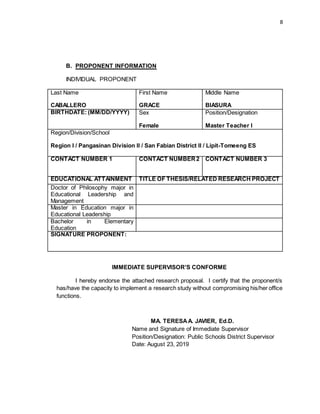
B. PROPONENT INFORMATION
INDIVIDUAL PROPONENT
Last Name
CABALLERO
First Name
GRACE
Middle Name
BIASURA
BIRTHDATE: (MM/DD/YYYY) Sex
Female
Position/Designation
Master Teacher I
Region/Division/School
Region I / Pangasinan Division II / San Fabian District II / Lipit-Tomeeng ES
CONTACT NUMBER 1 CONTACT NUMBER2 CONTACT NUMBER 3
EDUCATIONAL ATTAINMENT TITLE OF THESIS/RELATED RESEARCH PROJECT
Doctor of Philosophy major in
Educational Leadership and
Management
Master in Education major in
Educational Leadership
Bachelor in Elementary
Education
SIGNATURE PROPONENT:
IMMEDIATE SUPERVISOR’S CONFORME
I hereby endorse the attached research proposal. I certify that the proponent/s
has/have the capacity to implement a research study without compromising his/her office
functions.
MA. TERESAA. JAVIER, Ed.D.
Name and Signature of Immediate Supervisor
Position/Designation: Public Schools District Supervisor
Date: August 23, 2019
9
San Fabian District II
LIPIT-TOMEENG ELEMENTARY SCHOOL
San Fabian
Declaration of Anti-Plagiarism and Absence of Conflict of Interest
DECLARATION OF ANTI-PLAGIARISM
1. I, ________________________, understand that plagiarism is the act of taking and
using another’s ideas and works and passing them off as one’s own. This includes
explicitly copying the whole work of another person and/or using some parts of their work
without proper acknowledgment and referencing.
2. I hereby attest to the originality of this research proposal and has cited properly all the
references used. I further commit that all deliverables and the final research study
emanating from this proposal shall be of original content. I shall use appropriate citations
in referencing other works from various sources.
3. I understand that violation from this declaration and commitment shall be subject to
consequences and shall be dealt with accordingly by the Department of Education and
(insert grant mechanism).
PROPONENT: _______________________
SIGNATURE: ______________________
DATE: August 23, 2019

AR-mdm-grace-caballero.docx

  • 1.
    1 I. Context andRationale Modern day educators play a significant role in the improvement of science pedagogies especially soon the part of classroom delivery of instruction. They are the front liners in the provision of knowledge, information, skills and values to be acquired by the pupils. It is for this reason that teachers should always endeavor to make the lives of every pupil in the classroom worth remembering as to instructional delivery and experiences are concerned. Pupils learn from their own mistakes only if they are well-trained about it. It is on this premise that teachers play an important role in shaping the minds of every pupil that “feedbacking” is very important in the learning process. Here is where the counteractive lecture comes in. Improving the educational outcomes for students who are at risk for academic failure is an important issue for educators and policymakers. Recently, before- and after- school tutoring programs have been identified as having the potential to turn academic failure into academic success. Operationally, counteractive lecture is defined as “a specific remedial instruction program administered through the conduct of tutorial sessions to provide opportunity for the pupils who are underperforming to reach a desired level of academic performance”. Though lecturing is considered the oldest method of teaching, it seems that most lecturers still struggle with the mechanics that ensure the message is retained, the audience stays awake and the lecturer receives a positive send off. It's a wonder that lecturing as a teaching method has survived. When a speaker brings vitality and enthusiasm to a lecture, people remain attentive and likely benefit from the presentation. This, however, may suggest that
  • 2.
    2 lecturing is quitesimilar to acting which may favor lecturers prone to a more energetic and passionate delivery. Lipit-Tomeeng Elementary School is one of the public schools in San Fabian District II. It has a total land area of 13, 500sqm with sixteen (16) teachers including the school principal. As of this writing, there are _______________pupils enrolled from Kindergarten to Grade 6. The researcheris the Grade 6 teacher where she handles Grade 6-Caballero class with twenty-three (23) pupils. Based on the result of the First Periodic Test, the Grade 6 pupils posted only ______ mastery level. With that the researcher wants to propose the study entitled, “Improving the Performance of the Grade 6 Pupils in Mathematics through Counteractive Lecture and Discussion”. II. Action Research Questions This study aims to improve the performance of the Grade 6 pupils in solving mathematical problems. Specifically it will answer the following problem; 1. What is the performance of the Grade 6 pupils in Mathematics before and after counteractive lecture and discussion? 2. Is there a significant difference in the performance of the Grade 6 pupils in Mathematics before and after the counteractive lecture and discussion strategy? III. Proposed Innovation, Intervention and Strategy In the conduct of the action reserach, the proponent proposes the following innovation, intervention and strategy. The Grade 6 pupils will undergo a pre-test in order to identify the weakness and strengths of the pupils in solving word problems in Mathematics. On the other
  • 3.
    3 hand, parents ofthe pupils will be informed of the study being conducted in order to improve their child’s perofrmance in Mathematics. Counteractive lecture and disscusion will be employed in the conduct of the study in improving the performance of the pupils in Mathematics. Posttest will be conducted in orer to assess and evaluate the effectiveness of the counteractive lecture and discussion in the performance of the Garde 2 pupisl in mathematics. In the conduct of the study, counteractive lecture will be done three (3) times a week ( Monday, Wednesday and Friday) from 3:30 – 4:30 in the afternoon. This is to ensure that other subjects will not be interrupted in the coundtc of the intervention. The said intervention will be done from October 2018 – January 2019. IV. Action Research Method a. Participants and/other Sources of Data and Information The respondents of the study will be the Grade 6 pupils who did not meet the mastery level of 75% in the first quarter examination in Mathematics. Of the twenty-three (23) pupils, fifteen (15) of them did not meet the mastery level of 75%. With that there are eight (8) boys and seven (7) girls. b. Data Gathering Methods The researcher will be using a teacher-made pre-test and posttest on the least learned competencies in the first quarter examination in Mathematics 6. A twenty-item (20-item) test will be given to the pupils in the pre-test. A set of parallel 20-itemtest will be given in the posttest.
  • 4.
    4 c. Data AnalysisPlan The Microsoft Excel will be used for data analysis and interpretation as well as manual computation will be done for rechecking purposes. As for Problem 1, frequency and the percentage will be used Finally, in order to compute the significant difference, t-test will be sued at 0.5 level of significance. V. Action Research Work Plan and Timelines The study will be using an Action Plan and Gantt Chart of Activities to show the flow and the budget of time in the conduct of the different activities throughout the research study. Objective Activity Person’s Involved Resources/ Budget Expected Output Time Allotment Statistical Treatment A. PRE-IMPLEMENTATION PHASE 1. Securing permit from the district office and division office to conduct an action research Securing permit from district and division office Researcher Php 500.00 Secured permit from the district and division office 10 days NA 2.Validation of the pre- test by five (5) experts. Pre-test validation. Researcher Php 500.00 Validated survey- questionnaire. 10 days NA B. IMPLEMENTATION PHASE 1. Conduct of the pre- test among the Grade 6 respondents. Pre-test will be given to the Grade 6 pupils. Researcher NA 100% of the respondents shall have taken the pre- test 3 months NA 2. Implementation of the counteractive lecture and discussion among the Grade 6 respondents. Counteractive lecture is given to the Grade 6pupils. Researcher NA Counteractive lecture and discussion shall have been implemented to the Grade 6 respondents. C. POST-IMPLEMENTATION PHASE 1. Conduct of the posttest among the Grade 6 respondents. Posttest will be given to the Grade 6 pupils. Researcher NA 100% of the respondents shall have . 10 days
  • 5.
    5 taken the posttest. 2. Tabulationof data, analysis and interpretation Data has been organized and presented to table or charts Researcher NA Organized data Weighted mean and over-all weighted mean 3.Writing the final paper of the action research. Drafting and proof-reading of the final paper. Researcher n/a Final Paper of the action research 15 days Not Applicable Gantt Chart of Activities Activities Aug Sept Oct Nov Write the action research proposal. Secure permit from the school and division offices. / Prepare and administer pre-test to the pupils. / Analyze and interpret the pre-test results. / Conduct of the intervention program. / / / Prepare and administer the posttest to the pupils. / Analyze and interpret the posttest results. / Write the final manuscript for submission. / Submit the final manuscript to the division office. / VI. Cost Estimates Particulars Amount 1. Printing of the survey questionnaire Php 500.00 2. Photocopying of the needed number of research instruments. Php 500.00 3. Travel Expenses Php 1 000.00 4. Ring binding or book binding process Php 500.00 5. Production of proposal and final paper Php 500.00 6. Fare and other miscellaneous expenses. Php 500.00 Total Php 3 500.00
  • 6.
    6 VII. Plan forDissemination and Utilization The table below shows how the research study plan will be conducted as it presents the project/program/activity, objectives, the strategies and/or activities to be conducted, the persons that will be involved, the time frame and the expected output. Program, Project and Activity (PPA) Objectives Strategies Persons Involved Time Frame Expected Output I. Student Development Pre-testing among the Grade 6 pupils. To conduct pre-test among the Grade 6 pupils. Preparation of the pre-test. TOS preparation and test construction. Validation of the pre-test. Proponent School Principal August Conduct of pre-test among the Grade 6 pupils. shall have been done. Post-testing among the Grade 6 pupils. To conduct posttest among the Grade 6 pupils. Preparation of the posttest. TOS preparation and test construction. Validation of the posttest. Proponent School Principal October Conduct of posttest among the Grade 6 pupils shall have been done. II. Curriculum Development Counteractive lecture and discussion. To use counteractive lecture and discussion strategy to the Grade 6 pupils Counteractive lecture and discussion. Proponent ICT Coordinator August to October Counteractive lecture and discussion shall have been prepared. IX. List of References Brown, A.D. (2015), Its All Fun and Games, Journal Information System Education, New York City Howell, J. (2015) , Process Model of mathematics Achievement and Attitude, Journal Research in Mathematics Education, New Jersey
  • 7.
    7 San Fabian DistrictII LIPIT-TOMEENG ELEMENTARY SCHOOL San Fabian ANNEX 1: Research Proposal Application Form and Endorsement of Immediate Supervisor A. RESEARCH INFORMATION Impact of Podcasting among Grade 10 Students’ Performance in Science: A Novel Way of Delivering Science Instruction This research study aims to determine the needs assessment of K-3 teachers in teaching early language, literacy and numeracy as an input for action plan. There will be a twenty- five grade 3 teachers who will serve as the respondents of this research endeavor. RESEARCH CATEGORY (Check only one) o National o Region o Schools Division o District o School RESEARCH AGENDA CATEGORY (check only one main research theme) o Teaching and Learning o Child Protection o Human Resource Development o Governance (Check up to one cross-cutting theme, if applicable) o DRRM o Gender and Development o Inclusive Education o Others (please specify): _______________________ FUND SOURCE(e.g. BERF, SEF, others Self-funded research TOTAL AMOUNT Php 3,500
  • 8.
    8 B. PROPONENT INFORMATION INDIVIDUALPROPONENT Last Name CABALLERO First Name GRACE Middle Name BIASURA BIRTHDATE: (MM/DD/YYYY) Sex Female Position/Designation Master Teacher I Region/Division/School Region I / Pangasinan Division II / San Fabian District II / Lipit-Tomeeng ES CONTACT NUMBER 1 CONTACT NUMBER2 CONTACT NUMBER 3 EDUCATIONAL ATTAINMENT TITLE OF THESIS/RELATED RESEARCH PROJECT Doctor of Philosophy major in Educational Leadership and Management Master in Education major in Educational Leadership Bachelor in Elementary Education SIGNATURE PROPONENT: IMMEDIATE SUPERVISOR’S CONFORME I hereby endorse the attached research proposal. I certify that the proponent/s has/have the capacity to implement a research study without compromising his/her office functions. MA. TERESAA. JAVIER, Ed.D. Name and Signature of Immediate Supervisor Position/Designation: Public Schools District Supervisor Date: August 23, 2019
  • 9.
    9 San Fabian DistrictII LIPIT-TOMEENG ELEMENTARY SCHOOL San Fabian Declaration of Anti-Plagiarism and Absence of Conflict of Interest DECLARATION OF ANTI-PLAGIARISM 1. I, ________________________, understand that plagiarism is the act of taking and using another’s ideas and works and passing them off as one’s own. This includes explicitly copying the whole work of another person and/or using some parts of their work without proper acknowledgment and referencing. 2. I hereby attest to the originality of this research proposal and has cited properly all the references used. I further commit that all deliverables and the final research study emanating from this proposal shall be of original content. I shall use appropriate citations in referencing other works from various sources. 3. I understand that violation from this declaration and commitment shall be subject to consequences and shall be dealt with accordingly by the Department of Education and (insert grant mechanism). PROPONENT: _______________________ SIGNATURE: ______________________ DATE: August 23, 2019