what is research?
research is the systematic
investigation of any
subject
some different research types
fundamental / pure
applied
design research
practice based research
qualitative vs quantitative
inductive vs deductive
    vs abductive
induction - observation > pattern > hypothesis > theory
deduction - theory > hypothesis > observation > confirmation
synthesis


divergence               convergence


             analysis
research can be...
descriptive
relational
causal
decision making
prediction
noticing, collecting, thinking
sensemaking
research approach
understand context
ask good questions
gain better insights
improve situations
being a good researcher?
be inquisitive
read, then read more
refine skills
communicate, clearly
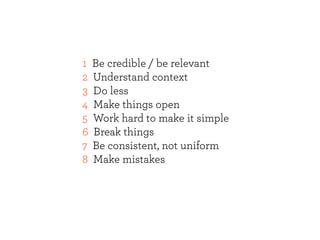
our research values
1   Be credible / be relevant
2   Understand context
3   Do less
4   Make things open
5   Work hard to make it simple
6   Break things
7   Be consistent, not uniform
8   Make mistakes
our research roles
1   researching (data collection, analysis)
2   new funding and proposal writing
3   report/paper/consultation writing
4   reviewing publications
5   general meetings e.g. PDR
6   literature administration
7   managing projects/researchers
8   administering projects
9   managing clients
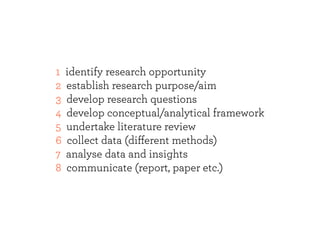
our general process
1   identify research opportunity
2   establish research purpose/aim
3   develop research questions
4   develop conceptual/analytical framework
5   undertake literature review
6   collect data (different methods)
7   analyse data and insights
8   communicate (report, paper etc.)
typical research tools
1   general (brain)
2   writing (word, scrivner)
3   bibliographic (zotero, mendeley)
4   qualitative (nvivo, dedoose)
5   quantitiative (spss, excel)
6   visual (illustrator, Yed)
understanding impact
Research Outputs    Research Transfer   Research Outcomes       Research Impact

e.g. Discoveries,   Engagement with     New or improved         Value-added
Publications, IP,   end-users           products, services or   improvements
Patents, etc…                           processes               achieved
Research Outputs    Research Transfer       Research Outcomes       Research Impact

e.g. Discoveries,   Engagement with         New or improved         Value-added
Publications, IP,   end-users               products, services or   improvements
Patents, etc…                               processes               achieved


Economic/           Licences, options,      New products,           Reduced risk
Commercial          assignments (no. and    services (no.)
                    value)                                          Increased productivity
                                            Gross revenue
                    Royalty agreements                              Reduced costs
                    (no. and value)         Start-ups/spin-outs
                                            (no. and revenue)       Increased competitiveness
                    Pilots, prototypes,
                    clinical trials (no.)   Joint ventures (no.     Increased employment
                                            and revenue)


Social/ Cultural/   Informing               Changed practice in     Reduced consumption of
Environmental/      government or           waste management        natural resources e.g.
                    industry policy                                 fossil fuels and water
                                            Uptake of recycling
                    Engagement in           techniques developed    Reduced waste
                    community groups
                                            New or improved         Improved health and/or
                                            government policy       wellbeing

Research presentation

  • 2.
  • 3.
    research is thesystematic investigation of any subject
  • 4.
  • 5.
    fundamental / pure applied designresearch practice based research
  • 6.
  • 7.
  • 8.
    induction - observation> pattern > hypothesis > theory deduction - theory > hypothesis > observation > confirmation
  • 9.
    synthesis divergence convergence analysis
  • 10.
  • 11.
  • 12.
  • 13.
  • 14.
  • 15.
    understand context ask goodquestions gain better insights improve situations
  • 16.
    being a goodresearcher?
  • 17.
    be inquisitive read, thenread more refine skills communicate, clearly
  • 18.
  • 19.
    1 Be credible / be relevant 2 Understand context 3 Do less 4 Make things open 5 Work hard to make it simple 6 Break things 7 Be consistent, not uniform 8 Make mistakes
  • 20.
  • 21.
    1 researching (data collection, analysis) 2 new funding and proposal writing 3 report/paper/consultation writing 4 reviewing publications 5 general meetings e.g. PDR 6 literature administration 7 managing projects/researchers 8 administering projects 9 managing clients
  • 22.
  • 23.
    1 identify research opportunity 2 establish research purpose/aim 3 develop research questions 4 develop conceptual/analytical framework 5 undertake literature review 6 collect data (different methods) 7 analyse data and insights 8 communicate (report, paper etc.)
  • 24.
  • 25.
    1 general (brain) 2 writing (word, scrivner) 3 bibliographic (zotero, mendeley) 4 qualitative (nvivo, dedoose) 5 quantitiative (spss, excel) 6 visual (illustrator, Yed)
  • 26.
  • 27.
    Research Outputs Research Transfer Research Outcomes Research Impact e.g. Discoveries, Engagement with New or improved Value-added Publications, IP, end-users products, services or improvements Patents, etc… processes achieved
  • 28.
    Research Outputs Research Transfer Research Outcomes Research Impact e.g. Discoveries, Engagement with New or improved Value-added Publications, IP, end-users products, services or improvements Patents, etc… processes achieved Economic/ Licences, options, New products, Reduced risk Commercial assignments (no. and services (no.) value) Increased productivity Gross revenue Royalty agreements Reduced costs (no. and value) Start-ups/spin-outs (no. and revenue) Increased competitiveness Pilots, prototypes, clinical trials (no.) Joint ventures (no. Increased employment and revenue) Social/ Cultural/ Informing Changed practice in Reduced consumption of Environmental/ government or waste management natural resources e.g. industry policy fossil fuels and water Uptake of recycling Engagement in techniques developed Reduced waste community groups New or improved Improved health and/or government policy wellbeing