RESEARCH PAPERS IN
FINTECH
PRESENTED BY:
SALONI AGRAWAL
170701022
• Fintech refers to financial technology, a growing industry that uses
technology to support activity and efficiency in finance. For example,
the technology that allows you to use your mobile phone for internet
banking stems from this industry, as does the ability to convert your
money from one currency to another on the same device.
• Fintech also covers a wide range of activities that the day-to-day
consumer may never be aware of, such as investment services and
cryptocurrencies. Overall, the industry combines technology and
innovation with the aim of improving financial services for the public
and organizations. As such, it has a tremendous influence both on our
daily lives and on the functioning of national and global economies.
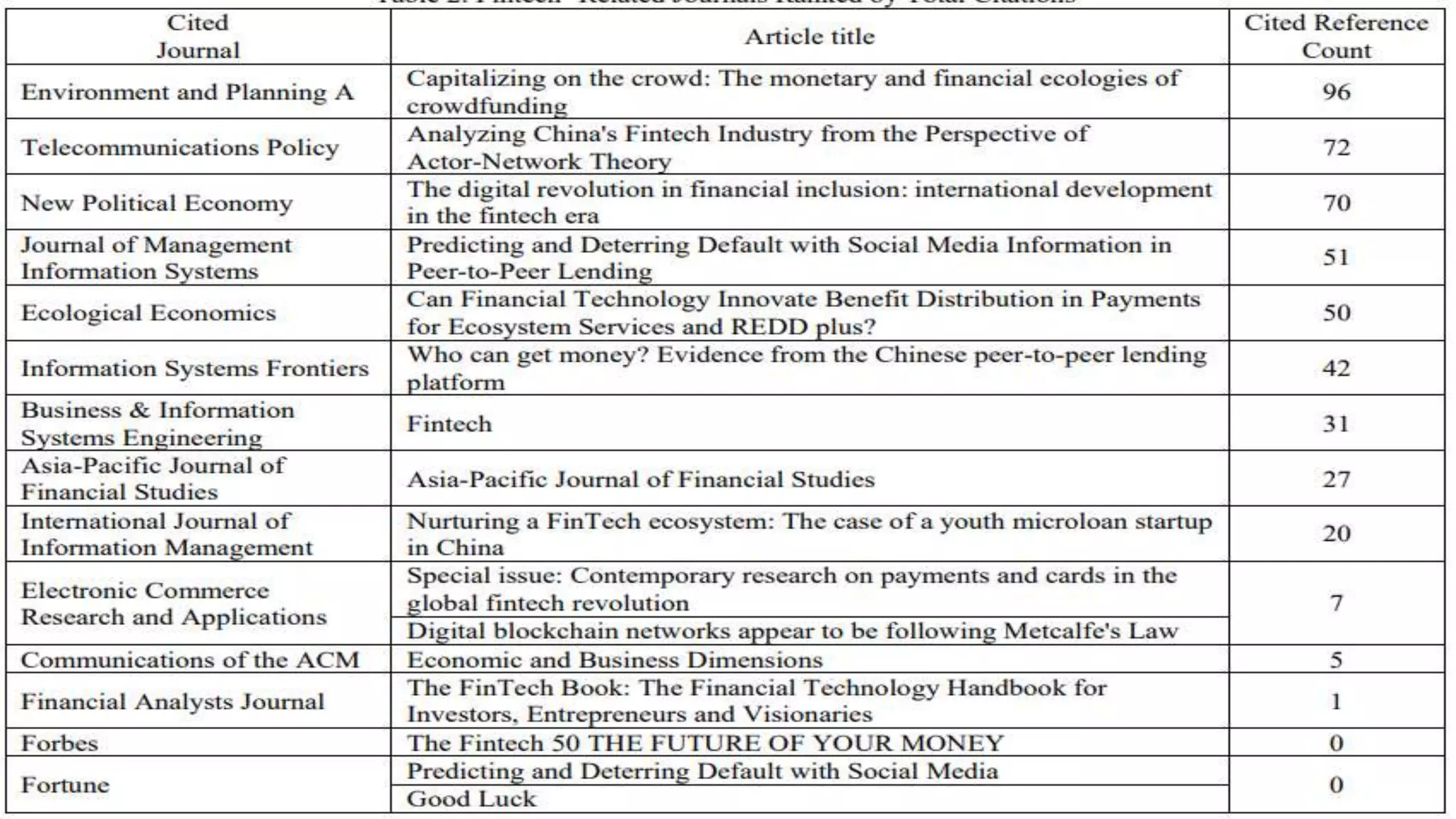
• Rankings of fintech-related journals on total citations: Table lists the
fourteen journals in ISI Web of Science with the greatest number of
total citations, ranked from highest to lowest. The first six journals
had contributed eighty percentage of published papers, with 96; 72;
70; 51; 50 and 42 total citations, respectively. Approximately one-
third of the total citations for first two journals are Environment and
Planning A and Telecommunications Policy, which focuses on urban
and regional issues, and concerned with the roles of information and
communication technologies (ICT) in the economy and society
The Top most popular fintech related papers on SSRN are:
• Is Bitcoin Really Un-Tethered? by John M. Griffin (University of Texas at
Austin) and Amin Shams (University of Texas at Austin)
• Blockchain Technologies: Principles and Applications by Marc Pilkington
(Université Bourgogne Franche Comté)
• Some Simple Economics of the Blockchain by Christian Catalini
(Massachusetts Institute of Technology) and Joshua S. Gans (University of
Toronto)
• 2017 Global Blockchain Benchmarking Study by Garrick Hileman (University
of Cambridge) and Michel Rauchs (University of Cambridge)
• Decentralized Blockchain Technology and the Rise of Lex Cryptographia by
Aaron Wright (Yeshiva University) and Primavera De Filippi (Université Paris
II – Panthéon-Assas)
• Cryptocurrencies: A Brief Thematic Review by Usman W. Chohan
(University of New South Wales)
• Initial Coin Offerings and the Value of Crypto Tokens by Christian Catalini
(Massachusetts Institute of Technology) and Joshua S. Gans (University of
Toronto)
• The Evolution of Fintech: A New Post-Crisis Paradigm? by Douglas W. Arner
(The University of Hong Kong), Janos Nathan Barberis (The University of
Hong Kong) and Ross P. Buckley (University of New South Wales)
• Blockchain Technology and Decentralized Governance: Is the State Still
Necessary? by Marcella Atzori (University College of London)
• Digital Tulips? Returns to Investors in Initial Coin Offerings by Hugo
Benedetti (Boston College) and Leonard Kostovetsky (Boston College)
Is Bitcoin Really Un-Tethered?
• Amin Shams
• University of Texas at Austin - Department of Finance
• Date Written: June 13, 2018
• Abstract
This paper investigates whether Tether, a digital currency pegged to U.S. dollars, influences
Bitcoin and other cryptocurrency prices during the recent boom. Using algorithms to
analyze the blockchain data, we find that purchases with Tether are timed following market
downturns and result in sizable increases in Bitcoin prices. Less than 1% of hours with such
heavy Tether transactions are associated with 50% of the meteoric rise in Bitcoin and 64%
of other top cryptocurrencies. The flow clusters below round prices, induces asymmetric
auto-correlations in Bitcoin, and suggests incomplete Tether backing before month-ends.
These patterns cannot be explained by investor demand proxies but are most consistent
with the supply-based hypothesis where Tether is used to provide price support and
manipulate cryptocurrency prices.
Blockchain Technology: Principles and
Applications
• Marc Pilkington
• Date Written: September 18, 2015
• Abstract
This paper expounds the main principles behind blockchain technology and
some of its cutting-edge applications. Firstly, present the core concepts at
the heart of the blockchain, and we discuss the potential risks and drawbacks
of public distributed ledgers, and the shift toward hybrid solutions. Secondly,
we expose the main features of decentralized public ledger platforms.
Thirdly, we show why the blockchain is a disruptive and foundational
technology, and fourthly, we sketch out a list of important applications,
bearing in mind the most recent evolutions.
Some Simple Economics of the Blockchain
• Christian Catalini
• Abstract
• They rely on economic theory to discuss how blockchain technology will shape the rate
and direction of innovation. We identify two key costs affected by the technology: 1) the
cost of verification; and 2) the cost of networking. The first cost relates to the ability to
cheaply verify the attributes of a transaction. The second one to the ability to bootstrap
and operate a marketplace without the need for a traditional intermediary: When
combined with a native token (as in Bitcoin and Ethereum), a blockchain allows a
decentralized network of economic agents to agree, at regular intervals, about the true
state of shared data. This shared data can represent exchanges of currency, intellectual
property, equity, information or other types of contracts and digital assets - making
blockchain a general purpose technology that can be used to trade scarce, digital
property rights and create novel types of digital platforms. The resulting marketplaces
are characterized by increased competition, lower barriers to entry and innovation, lower
privacy and censorship risk, and allow participants within the same ecosystem to make
investments to support and operate shared infrastructure without assigning market
power to a platform operator.
Initial Coin Offerings and the Value of Crypto
Tokens
• Abstract
• This paper explores how entrepreneurs can use initial coin offerings - whereby
they issue crypto tokens and commit to only accept those tokens as payment for
their products - to fund venture start-up costs. We show that the ICO mechanism
allows entrepreneurs to generate buyer competition for the token, giving it value.
We also find that venture returns are independent of any committed growth in
the supply of tokens over time, but that initial funds raised are maximized by
setting that growth to zero to encourage saving by early participants.
Nonetheless, since the value of the tokens depends on a single period of
demand, the ability to raise funds is more limited than in traditional equity
finance. Furthermore, a lack of commitment in monetary policy undermines
saving behavior, hence the cost of using tokens to fund start-up costs is
inflexibility in future capital raises. Crypto tokens can also facilitate coordination
among stakeholders within digital ecosystems when network effects are present
Research paper in fintech

Research paper in fintech

  • 1.
    RESEARCH PAPERS IN FINTECH PRESENTEDBY: SALONI AGRAWAL 170701022
  • 2.
    • Fintech refersto financial technology, a growing industry that uses technology to support activity and efficiency in finance. For example, the technology that allows you to use your mobile phone for internet banking stems from this industry, as does the ability to convert your money from one currency to another on the same device. • Fintech also covers a wide range of activities that the day-to-day consumer may never be aware of, such as investment services and cryptocurrencies. Overall, the industry combines technology and innovation with the aim of improving financial services for the public and organizations. As such, it has a tremendous influence both on our daily lives and on the functioning of national and global economies.
  • 3.
    • Rankings offintech-related journals on total citations: Table lists the fourteen journals in ISI Web of Science with the greatest number of total citations, ranked from highest to lowest. The first six journals had contributed eighty percentage of published papers, with 96; 72; 70; 51; 50 and 42 total citations, respectively. Approximately one- third of the total citations for first two journals are Environment and Planning A and Telecommunications Policy, which focuses on urban and regional issues, and concerned with the roles of information and communication technologies (ICT) in the economy and society
  • 6.
    The Top mostpopular fintech related papers on SSRN are: • Is Bitcoin Really Un-Tethered? by John M. Griffin (University of Texas at Austin) and Amin Shams (University of Texas at Austin) • Blockchain Technologies: Principles and Applications by Marc Pilkington (Université Bourgogne Franche Comté) • Some Simple Economics of the Blockchain by Christian Catalini (Massachusetts Institute of Technology) and Joshua S. Gans (University of Toronto) • 2017 Global Blockchain Benchmarking Study by Garrick Hileman (University of Cambridge) and Michel Rauchs (University of Cambridge) • Decentralized Blockchain Technology and the Rise of Lex Cryptographia by Aaron Wright (Yeshiva University) and Primavera De Filippi (Université Paris II – Panthéon-Assas)
  • 7.
    • Cryptocurrencies: ABrief Thematic Review by Usman W. Chohan (University of New South Wales) • Initial Coin Offerings and the Value of Crypto Tokens by Christian Catalini (Massachusetts Institute of Technology) and Joshua S. Gans (University of Toronto) • The Evolution of Fintech: A New Post-Crisis Paradigm? by Douglas W. Arner (The University of Hong Kong), Janos Nathan Barberis (The University of Hong Kong) and Ross P. Buckley (University of New South Wales) • Blockchain Technology and Decentralized Governance: Is the State Still Necessary? by Marcella Atzori (University College of London) • Digital Tulips? Returns to Investors in Initial Coin Offerings by Hugo Benedetti (Boston College) and Leonard Kostovetsky (Boston College)
  • 8.
    Is Bitcoin ReallyUn-Tethered? • Amin Shams • University of Texas at Austin - Department of Finance • Date Written: June 13, 2018 • Abstract This paper investigates whether Tether, a digital currency pegged to U.S. dollars, influences Bitcoin and other cryptocurrency prices during the recent boom. Using algorithms to analyze the blockchain data, we find that purchases with Tether are timed following market downturns and result in sizable increases in Bitcoin prices. Less than 1% of hours with such heavy Tether transactions are associated with 50% of the meteoric rise in Bitcoin and 64% of other top cryptocurrencies. The flow clusters below round prices, induces asymmetric auto-correlations in Bitcoin, and suggests incomplete Tether backing before month-ends. These patterns cannot be explained by investor demand proxies but are most consistent with the supply-based hypothesis where Tether is used to provide price support and manipulate cryptocurrency prices.
  • 9.
    Blockchain Technology: Principlesand Applications • Marc Pilkington • Date Written: September 18, 2015 • Abstract This paper expounds the main principles behind blockchain technology and some of its cutting-edge applications. Firstly, present the core concepts at the heart of the blockchain, and we discuss the potential risks and drawbacks of public distributed ledgers, and the shift toward hybrid solutions. Secondly, we expose the main features of decentralized public ledger platforms. Thirdly, we show why the blockchain is a disruptive and foundational technology, and fourthly, we sketch out a list of important applications, bearing in mind the most recent evolutions.
  • 10.
    Some Simple Economicsof the Blockchain • Christian Catalini • Abstract • They rely on economic theory to discuss how blockchain technology will shape the rate and direction of innovation. We identify two key costs affected by the technology: 1) the cost of verification; and 2) the cost of networking. The first cost relates to the ability to cheaply verify the attributes of a transaction. The second one to the ability to bootstrap and operate a marketplace without the need for a traditional intermediary: When combined with a native token (as in Bitcoin and Ethereum), a blockchain allows a decentralized network of economic agents to agree, at regular intervals, about the true state of shared data. This shared data can represent exchanges of currency, intellectual property, equity, information or other types of contracts and digital assets - making blockchain a general purpose technology that can be used to trade scarce, digital property rights and create novel types of digital platforms. The resulting marketplaces are characterized by increased competition, lower barriers to entry and innovation, lower privacy and censorship risk, and allow participants within the same ecosystem to make investments to support and operate shared infrastructure without assigning market power to a platform operator.
  • 11.
    Initial Coin Offeringsand the Value of Crypto Tokens • Abstract • This paper explores how entrepreneurs can use initial coin offerings - whereby they issue crypto tokens and commit to only accept those tokens as payment for their products - to fund venture start-up costs. We show that the ICO mechanism allows entrepreneurs to generate buyer competition for the token, giving it value. We also find that venture returns are independent of any committed growth in the supply of tokens over time, but that initial funds raised are maximized by setting that growth to zero to encourage saving by early participants. Nonetheless, since the value of the tokens depends on a single period of demand, the ability to raise funds is more limited than in traditional equity finance. Furthermore, a lack of commitment in monetary policy undermines saving behavior, hence the cost of using tokens to fund start-up costs is inflexibility in future capital raises. Crypto tokens can also facilitate coordination among stakeholders within digital ecosystems when network effects are present