I N T E R N A T I O N A L
IYVResearch
Program
I N T E R N AT I O N A L
For more information
on this and other
research projects visit
www.nonprofitscan.ca
I N T E R N AT I O N A L
Y E A R O F
V O L U N T E E R S
V O L U N T E E R S
Y E A R O F
University Students as Volunteers
University students
as volunteers
The more education a person has, the
more likely he or she is to volunteer.
Today’s university students are likely
to be an important source of volunteers
for decades to come. What do we know
about these young people?
University students who volunteer
have the same personal and economic
characteristics as those who do not
volunteer, but they show a greater
openness to experience, according to
research undertaken for the
International Year of Volunteers.1
These students are characterized by
intellectual curiosity, active
imaginations, independent judgment,
and a preference for variety in their
lives.
Where they volunteer
and what they do
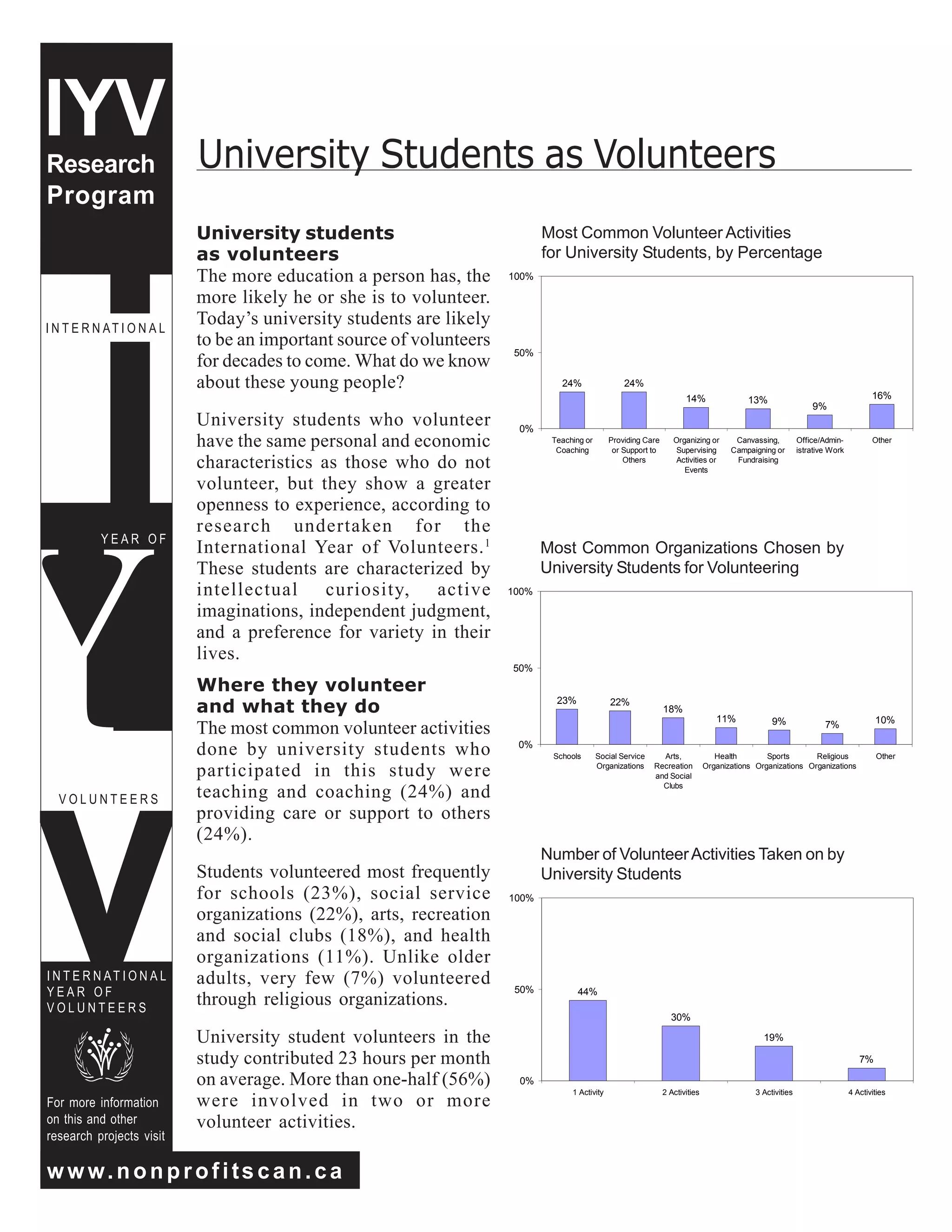
The most common volunteer activities
done by university students who
participated in this study were
teaching and coaching (24%) and
providing care or support to others
(24%).
Students volunteered most frequently
for schools (23%), social service
organizations (22%), arts, recreation
and social clubs (18%), and health
organizations (11%). Unlike older
adults, very few (7%) volunteered
through religious organizations.
University student volunteers in the
study contributed 23 hours per month
on average. More than one-half (56%)
were involved in two or more
volunteer activities.
Most Common Volunteer Activities
for University Students, by Percentage
Most Common Organizations Chosen by
University Students for Volunteering
Number of VolunteerActivities Taken on by
University Students
24% 24%
14% 13%
9%
16%
0%
50%
100%
Teaching or
Coaching
Providing Care
or Support to
Others
Organizing or
Supervising
Activities or
Events
Canvassing,
Campaigning or
Fundraising
Office/Admin-
istrative Work
Other
23% 22%
18%
11% 9% 7% 10%
0%
50%
100%
Schools Social Service
Organizations
Arts,
Recreation
and Social
Clubs
Health
Organizations
Sports
Organizations
Religious
Organizations
Other
44%
30%
19%
7%
0%
50%
100%
1 Activity 2 Activities 3 Activities 4 Activities
www.nonprofitscan.ca
IYVResearch
Program
For more information
on this and other
research projects visit
I N T E R N AT I O N A L
Y E A R O F
V O L U N T E E R S
Research Program, Canadian Centre for Philanthropy
425 University Avenue, Suite 600
Toronto, Ontario M5G 1T6
Tel: 416.597.2293 Fax: 416.597.2294 E-mail: ccpresearch@ccp.ca
For more information on the International Year of Volunteers,
visit www.nonprofitscan.ca.
The Community Engagement Division of Human Resources
Development Canada (HRDC) provided financial support to this
project. The views expressed in this publication do not necessarily
reflect those of HRDC, the Canadian Centre for Philanthropy, or
Volunteer Canada.
© 2002 Canadian Centre for Philanthropy
Susan Phillips
Carleton University
Brian R. Little
Carleton University
Laura Goodine
Carleton University
Quick Fact
Students who are satisfied
with their volunteer
activites report greater
satisfaction with their
academic work, their
physical health, and life in
general. They have a
greater sense of meaning
and purpose in life.
University Students’ Reasons
for Volunteering
1
The study surveyed 146 volunteers and non-volunteers from
first-year psychology courses at an Ontario university.
2
For each volunteer project that they were engaged in, students
were asked to give the reasons (as many as they wanted) they
were involved in it.
68%
34%
23% 22%
16% 15%
12%
4%
0%
50%
100%
Values Under-
standing
Enjoyment/
Fun
Enhance-
ment
Social Career Required Other
Why university
students volunteer
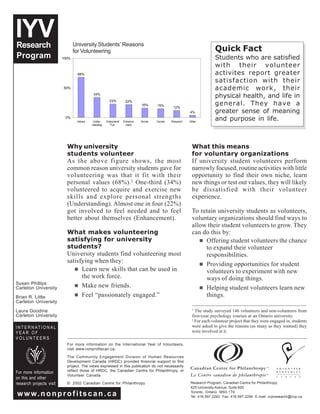
As the above figure shows, the most
common reason university students gave for
volunteering was that it fit with their
personal values (68%).2
One-third (34%)
volunteered to acquire and exercise new
skills and explore personal strengths
(Understanding). Almost one in four (22%)
got involved to feel needed and to feel
better about themselves (Enhancement).
What makes volunteering
satisfying for university
students?
University students find volunteering most
satisfying when they:
Learn new skills that can be used in
the work force.
Make new friends.
Feel “passionately engaged.”
What this means
for voluntary organizations
If university student volunteers perform
narrowly focused, routine activities with little
opportunity to find their own niche, learn
new things or test out values, they will likely
be dissatisfied with their volunteer
experience.
To retain university students as volunteers,
voluntary organizations should find ways to
allow their student volunteers to grow. They
can do this by:
Offering student volunteers the chance
to expand their volunteer
responsibilities.
Providing opportunities for student
volunteers to experiment with new
ways of doing things.
Helping student volunteers learn new
things.

Research on Student Volunteers

  • 1.
    I N TE R N A T I O N A L IYVResearch Program I N T E R N AT I O N A L For more information on this and other research projects visit www.nonprofitscan.ca I N T E R N AT I O N A L Y E A R O F V O L U N T E E R S V O L U N T E E R S Y E A R O F University Students as Volunteers University students as volunteers The more education a person has, the more likely he or she is to volunteer. Today’s university students are likely to be an important source of volunteers for decades to come. What do we know about these young people? University students who volunteer have the same personal and economic characteristics as those who do not volunteer, but they show a greater openness to experience, according to research undertaken for the International Year of Volunteers.1 These students are characterized by intellectual curiosity, active imaginations, independent judgment, and a preference for variety in their lives. Where they volunteer and what they do The most common volunteer activities done by university students who participated in this study were teaching and coaching (24%) and providing care or support to others (24%). Students volunteered most frequently for schools (23%), social service organizations (22%), arts, recreation and social clubs (18%), and health organizations (11%). Unlike older adults, very few (7%) volunteered through religious organizations. University student volunteers in the study contributed 23 hours per month on average. More than one-half (56%) were involved in two or more volunteer activities. Most Common Volunteer Activities for University Students, by Percentage Most Common Organizations Chosen by University Students for Volunteering Number of VolunteerActivities Taken on by University Students 24% 24% 14% 13% 9% 16% 0% 50% 100% Teaching or Coaching Providing Care or Support to Others Organizing or Supervising Activities or Events Canvassing, Campaigning or Fundraising Office/Admin- istrative Work Other 23% 22% 18% 11% 9% 7% 10% 0% 50% 100% Schools Social Service Organizations Arts, Recreation and Social Clubs Health Organizations Sports Organizations Religious Organizations Other 44% 30% 19% 7% 0% 50% 100% 1 Activity 2 Activities 3 Activities 4 Activities
  • 2.
    www.nonprofitscan.ca IYVResearch Program For more information onthis and other research projects visit I N T E R N AT I O N A L Y E A R O F V O L U N T E E R S Research Program, Canadian Centre for Philanthropy 425 University Avenue, Suite 600 Toronto, Ontario M5G 1T6 Tel: 416.597.2293 Fax: 416.597.2294 E-mail: ccpresearch@ccp.ca For more information on the International Year of Volunteers, visit www.nonprofitscan.ca. The Community Engagement Division of Human Resources Development Canada (HRDC) provided financial support to this project. The views expressed in this publication do not necessarily reflect those of HRDC, the Canadian Centre for Philanthropy, or Volunteer Canada. © 2002 Canadian Centre for Philanthropy Susan Phillips Carleton University Brian R. Little Carleton University Laura Goodine Carleton University Quick Fact Students who are satisfied with their volunteer activites report greater satisfaction with their academic work, their physical health, and life in general. They have a greater sense of meaning and purpose in life. University Students’ Reasons for Volunteering 1 The study surveyed 146 volunteers and non-volunteers from first-year psychology courses at an Ontario university. 2 For each volunteer project that they were engaged in, students were asked to give the reasons (as many as they wanted) they were involved in it. 68% 34% 23% 22% 16% 15% 12% 4% 0% 50% 100% Values Under- standing Enjoyment/ Fun Enhance- ment Social Career Required Other Why university students volunteer As the above figure shows, the most common reason university students gave for volunteering was that it fit with their personal values (68%).2 One-third (34%) volunteered to acquire and exercise new skills and explore personal strengths (Understanding). Almost one in four (22%) got involved to feel needed and to feel better about themselves (Enhancement). What makes volunteering satisfying for university students? University students find volunteering most satisfying when they: Learn new skills that can be used in the work force. Make new friends. Feel “passionately engaged.” What this means for voluntary organizations If university student volunteers perform narrowly focused, routine activities with little opportunity to find their own niche, learn new things or test out values, they will likely be dissatisfied with their volunteer experience. To retain university students as volunteers, voluntary organizations should find ways to allow their student volunteers to grow. They can do this by: Offering student volunteers the chance to expand their volunteer responsibilities. Providing opportunities for student volunteers to experiment with new ways of doing things. Helping student volunteers learn new things.