Research Methods in U.S. History
                                                                   1


                           AMH 3170
                  Civil War and Reconstruction
                         Farley Jenkins
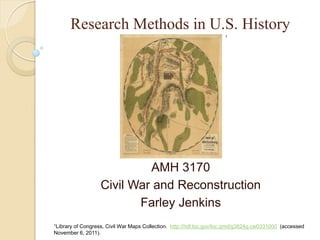
1Library
      of Congress, Civil War Maps Collection. http://hdl.loc.gov/loc.gmd/g3824g.cw0331000 (accessed
November 6, 2011).
What is history?
                                                                                  2


      • History is what happened
      • Concerned with the broad overview of events
      • Synthesis of many different forms of inquiry
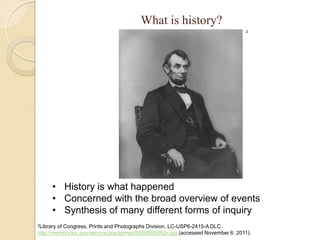
2Library of Congress, Prints and Photographs Division, LC-USP6-2415-A DLC.
http://memory.loc.gov/service/pnp/ppmsc/00000/00052v.jpg (accessed November 6, 2011).
Historical Research
                                                                                  3


     • Must be objective
     • Consider the source
     • Consider the context
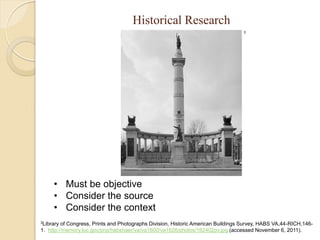
3Library of Congress, Prints and Photographs Division, Historic American Buildings Survey, HABS VA,44-RICH,146-
1. http://memory.loc.gov/pnp/habshaer/va/va1600/va1628/photos/162402pv.jpg (accessed November 6, 2011).
Types of Resources
                                                       4                                                 5


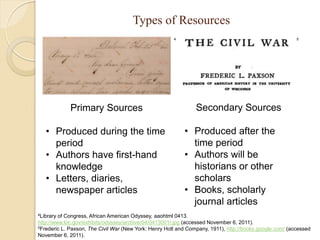
             Primary Sources                                    Secondary Sources

   • Produced during the time                              • Produced after the
     period                                                  time period
   • Authors have first-hand                               • Authors will be
     knowledge                                               historians or other
   • Letters, diaries,                                       scholars
     newspaper articles                                    • Books, scholarly
                                                             journal articles
4Library of Congress, African American Odyssey, aaohtml 0413.
http://www.loc.gov/exhibits/odyssey/archive/04/0413001r.jpg (accessed November 6, 2011).
5Frederic L. Paxson, The Civil War (New York: Henry Holt and Company, 1911), http://books.google.com/ (accessed

November 6, 2011).
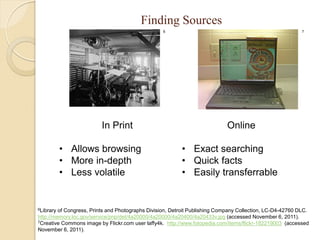
Finding Sources
                                                  6                                                        7


                         In Print                                           Online

           • Allows browsing                              • Exact searching
           • More in-depth                                • Quick facts
           • Less volatile                                • Easily transferrable


6Library of Congress, Prints and Photographs Division, Detroit Publishing Company Collection, LC-D4-42760 DLC.
http://memory.loc.gov/service/pnp/det/4a20000/4a20000/4a20400/4a20433v.jpg (accessed November 6, 2011).
7Creative Commons image by Flickr.com user laffy4k. http://www.fotopedia.com/items/flickr-182219003 (accessed

November 6, 2011).
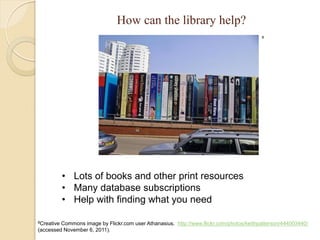
How can the library help?
                                                                                         8


            • Lots of books and other print resources
            • Many database subscriptions
            • Help with finding what you need

8CreativeCommons image by Flickr.com user Athanasius. http://www.flickr.com/photos/keithpatterson/444003440/
(accessed November 6, 2011).
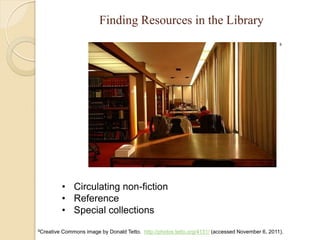
Finding Resources in the Library
                                                                                                   9


            • Circulating non-fiction
            • Reference
            • Special collections
9Creative   Commons image by Donald Tetto. http://photos.tetto.org/4131/ (accessed November 6, 2011).
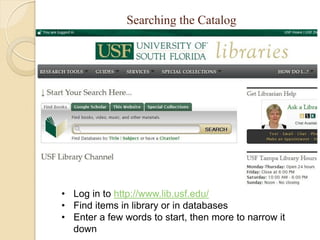
Searching the Catalog


• Log in to http://www.lib.usf.edu/
• Find items in library or in databases
• Enter a few words to start, then more to narrow it
  down
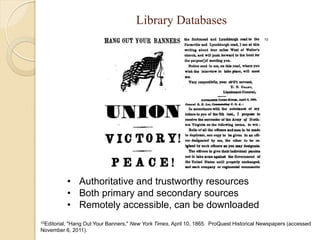
Library Databases
                                                                                       10


               • Authoritative and trustworthy resources
               • Both primary and secondary sources
               • Remotely accessible, can be downloaded
10Editorial,
         "Hang Out Your Banners," New York Times, April 10, 1865. ProQuest Historical Newspapers (accessed
November 6, 2011).
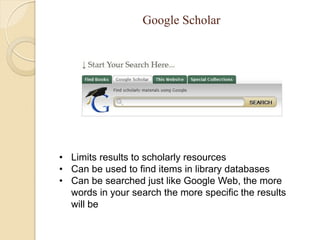
Google Scholar


• Limits results to scholarly resources
• Can be used to find items in library databases
• Can be searched just like Google Web, the more
  words in your search the more specific the results
  will be
omg u can txt ur ?s!


•   Stop by 1st floor reference desk
•   Call (813) 974-2729
•   Text (813) 344-2795
•   Visit the Website to email a question, get help via
    instant messaging or schedule a time to meet with a
    librarian for in-depth research assistance
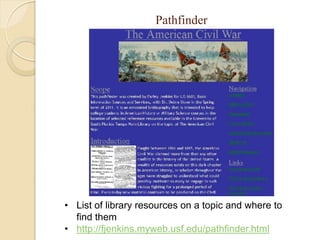
Pathfinder


• List of library resources on a topic and where to
  find them
• http://fjenkins.myweb.usf.edu/pathfinder.html
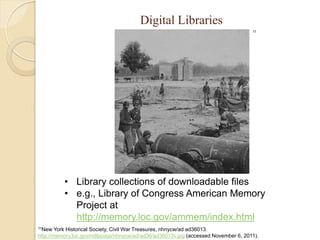
Digital Libraries
                                                                                    11


          • Library collections of downloadable files
          • e.g., Library of Congress American Memory
            Project at
            http://memory.loc.gov/ammem/index.html
11New   York Historical Society, Civil War Treasures, nhnycw/ad ad36013.
http://memory.loc.gov/ndlpcoop/nhnycw/ad/ad36/ad36013v.jpg (accessed November 6, 2011).
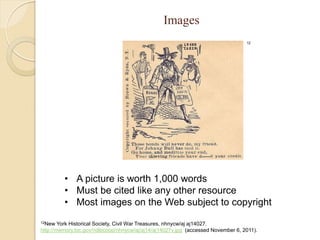
Images
                                                                                  12


         • A picture is worth 1,000 words
         • Must be cited like any other resource
         • Most images on the Web subject to copyright
12New   York Historical Society, Civil War Treasures, nhnycw/aj aj14027.
http://memory.loc.gov/ndlpcoop/nhnycw/aj/aj14/aj14027v.jpg (accessed November 6, 2011).
Plagiarism


• Using someone else’s words or ideas and not
  giving them credit
• Can result in failing a course or dismissal from the
  university
• When in doubt, cite!
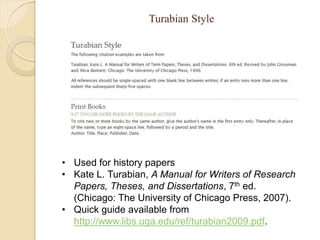
Turabian Style


• Used for history papers
• Kate L. Turabian, A Manual for Writers of Research
  Papers, Theses, and Dissertations, 7th ed.
  (Chicago: The University of Chicago Press, 2007).
• Quick guide available from
  http://www.libs.uga.edu/ref/turabian2009.pdf.
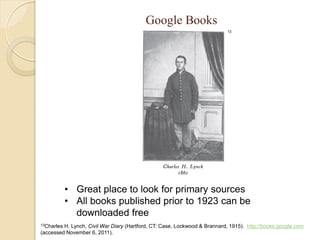
Google Books
                                                                            13


            • Great place to look for primary sources
            • All books published prior to 1923 can be
              downloaded free
13CharlesH. Lynch, Civil War Diary (Hartford, CT: Case, Lockwood & Brannard, 1915). http://books.google.com
(accessed November 6, 2011).
Discussion Questions
                                                                                      14


       • Why is an objective understanding of history
         important?
       • What is the difference between scholarly and
         popular history?
       • Why did you choose to study history?
14CreativeCommons image by Flickr.com user Susan Sermoneta. http://www.flickr.com/photos/en321/28927666/
(accessed November 6, 2011).
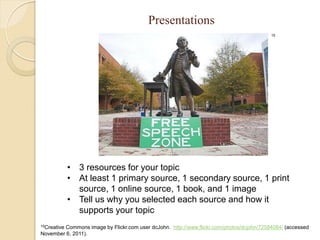
Presentations
                                                                                         15


             • 3 resources for your topic
             • At least 1 primary source, 1 secondary source, 1 print
               source, 1 online source, 1 book, and 1 image
             • Tell us why you selected each source and how it
               supports your topic
15Creative
        Commons image by Flickr.com user dcJohn. http://www.flickr.com/photos/dcjohn/72584084/ (accessed
November 6, 2011).
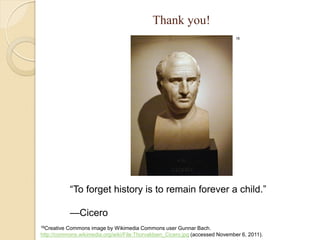
Thank you!
                                                                               16


             “To forget history is to remain forever a child.”

             —Cicero
16CreativeCommons image by Wikimedia Commons user Gunnar Bach.
http://commons.wikimedia.org/wiki/File:Thorvaldsen_Cicero.jpg (accessed November 6, 2011).

Research Methods in U. S. History

  • 1.
    Research Methods inU.S. History 1 AMH 3170 Civil War and Reconstruction Farley Jenkins 1Library of Congress, Civil War Maps Collection. http://hdl.loc.gov/loc.gmd/g3824g.cw0331000 (accessed November 6, 2011).
  • 2.
    What is history? 2 • History is what happened • Concerned with the broad overview of events • Synthesis of many different forms of inquiry 2Library of Congress, Prints and Photographs Division, LC-USP6-2415-A DLC. http://memory.loc.gov/service/pnp/ppmsc/00000/00052v.jpg (accessed November 6, 2011).
  • 3.
    Historical Research 3 • Must be objective • Consider the source • Consider the context 3Library of Congress, Prints and Photographs Division, Historic American Buildings Survey, HABS VA,44-RICH,146- 1. http://memory.loc.gov/pnp/habshaer/va/va1600/va1628/photos/162402pv.jpg (accessed November 6, 2011).
  • 4.
    Types of Resources 4 5 Primary Sources Secondary Sources • Produced during the time • Produced after the period time period • Authors have first-hand • Authors will be knowledge historians or other • Letters, diaries, scholars newspaper articles • Books, scholarly journal articles 4Library of Congress, African American Odyssey, aaohtml 0413. http://www.loc.gov/exhibits/odyssey/archive/04/0413001r.jpg (accessed November 6, 2011). 5Frederic L. Paxson, The Civil War (New York: Henry Holt and Company, 1911), http://books.google.com/ (accessed November 6, 2011).
  • 5.
    Finding Sources 6 7 In Print Online • Allows browsing • Exact searching • More in-depth • Quick facts • Less volatile • Easily transferrable 6Library of Congress, Prints and Photographs Division, Detroit Publishing Company Collection, LC-D4-42760 DLC. http://memory.loc.gov/service/pnp/det/4a20000/4a20000/4a20400/4a20433v.jpg (accessed November 6, 2011). 7Creative Commons image by Flickr.com user laffy4k. http://www.fotopedia.com/items/flickr-182219003 (accessed November 6, 2011).
  • 6.
    How can thelibrary help? 8 • Lots of books and other print resources • Many database subscriptions • Help with finding what you need 8CreativeCommons image by Flickr.com user Athanasius. http://www.flickr.com/photos/keithpatterson/444003440/ (accessed November 6, 2011).
  • 7.
    Finding Resources inthe Library 9 • Circulating non-fiction • Reference • Special collections 9Creative Commons image by Donald Tetto. http://photos.tetto.org/4131/ (accessed November 6, 2011).
  • 8.
    Searching the Catalog •Log in to http://www.lib.usf.edu/ • Find items in library or in databases • Enter a few words to start, then more to narrow it down
  • 9.
    Library Databases 10 • Authoritative and trustworthy resources • Both primary and secondary sources • Remotely accessible, can be downloaded 10Editorial, "Hang Out Your Banners," New York Times, April 10, 1865. ProQuest Historical Newspapers (accessed November 6, 2011).
  • 10.
    Google Scholar • Limitsresults to scholarly resources • Can be used to find items in library databases • Can be searched just like Google Web, the more words in your search the more specific the results will be
  • 11.
    omg u cantxt ur ?s! • Stop by 1st floor reference desk • Call (813) 974-2729 • Text (813) 344-2795 • Visit the Website to email a question, get help via instant messaging or schedule a time to meet with a librarian for in-depth research assistance
  • 12.
    Pathfinder • List oflibrary resources on a topic and where to find them • http://fjenkins.myweb.usf.edu/pathfinder.html
  • 13.
    Digital Libraries 11 • Library collections of downloadable files • e.g., Library of Congress American Memory Project at http://memory.loc.gov/ammem/index.html 11New York Historical Society, Civil War Treasures, nhnycw/ad ad36013. http://memory.loc.gov/ndlpcoop/nhnycw/ad/ad36/ad36013v.jpg (accessed November 6, 2011).
  • 14.
    Images 12 • A picture is worth 1,000 words • Must be cited like any other resource • Most images on the Web subject to copyright 12New York Historical Society, Civil War Treasures, nhnycw/aj aj14027. http://memory.loc.gov/ndlpcoop/nhnycw/aj/aj14/aj14027v.jpg (accessed November 6, 2011).
  • 15.
    Plagiarism • Using someoneelse’s words or ideas and not giving them credit • Can result in failing a course or dismissal from the university • When in doubt, cite!
  • 16.
    Turabian Style • Usedfor history papers • Kate L. Turabian, A Manual for Writers of Research Papers, Theses, and Dissertations, 7th ed. (Chicago: The University of Chicago Press, 2007). • Quick guide available from http://www.libs.uga.edu/ref/turabian2009.pdf.
  • 17.
    Google Books 13 • Great place to look for primary sources • All books published prior to 1923 can be downloaded free 13CharlesH. Lynch, Civil War Diary (Hartford, CT: Case, Lockwood & Brannard, 1915). http://books.google.com (accessed November 6, 2011).
  • 18.
    Discussion Questions 14 • Why is an objective understanding of history important? • What is the difference between scholarly and popular history? • Why did you choose to study history? 14CreativeCommons image by Flickr.com user Susan Sermoneta. http://www.flickr.com/photos/en321/28927666/ (accessed November 6, 2011).
  • 19.
    Presentations 15 • 3 resources for your topic • At least 1 primary source, 1 secondary source, 1 print source, 1 online source, 1 book, and 1 image • Tell us why you selected each source and how it supports your topic 15Creative Commons image by Flickr.com user dcJohn. http://www.flickr.com/photos/dcjohn/72584084/ (accessed November 6, 2011).
  • 20.
    Thank you! 16 “To forget history is to remain forever a child.” —Cicero 16CreativeCommons image by Wikimedia Commons user Gunnar Bach. http://commons.wikimedia.org/wiki/File:Thorvaldsen_Cicero.jpg (accessed November 6, 2011).