Research into Conventions
DAISY MAULE
General conventions of music videos
 CAMERA:
 Music videos often include a variety of close ups, mid shots and long shots. This is
to create a focus towards the artist, location and any emotions that are meant to
be conveyed to the audience.
 Also, close ups are also used to reflect the words of the song with the movement
of the lips of the artist (lip-syncing). This is done to promote the artist and give the
audience a sense of the lyrics.
 The movement of the camera often follows and is used to trace the artist or band.
Camera movements include tilts, pans, tracking and crane shots. General
conventions of camera movements change over decades, for example, in the 80’s
lots of shots were looking up at artists but that is done less now.
 MISE-EN-SCENE:
 Mise-en-scene: This refers to the arrangement of performers and props
on stage or in a scene for a production of a music video or any other
media text.
 Mise-en- scene is often shown in a way that is meant to represent
something.
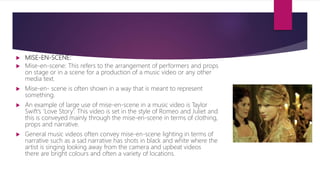
 An example of large use of mise-en-scene in a music video is Taylor
Swift’s ‘Love Story’. This video is set in the style of Romeo and Juliet and
this is conveyed mainly through the mise-en-scene in terms of clothing,
props and narrative.
 General music videos often convey mise-en-scene lighting in terms of
narrative such as a sad narrative has shots in black and white where the
artist is singing looking away from the camera and upbeat videos
there are bright colours and often a variety of locations.
 EDITING:
 Common editing techniques used in music videos include fade, jump-cut and dissolve. Many
pop videos are cut very simply in order to show the artist in the best way possible.
 In terms of sound editing, cutting to the beat is used frequently to create a stronger
between the lyrics and visuals.
 The length of shot is often reflected by the beat of the song also, for example, a fast paced
will have quick shots and a slower song will have longer shots. However, this can vary within
music video such as a fast paced chorus and slower verses.
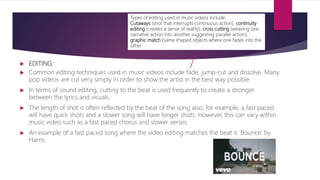
 An example of a fast paced song where the video editing matches the beat is ‘Bounce’ by
Harris
Types of editing used in music videos include:
Cutaways (shot that interrupts continuous action), continuity
editing (creates a sense of reality), cross cutting (weaving one
narrative action into another suggesting parallel action),
graphic match (same shaped objects where one fades into the
other
Conventions of electronic pop music videos
 CAMERA:
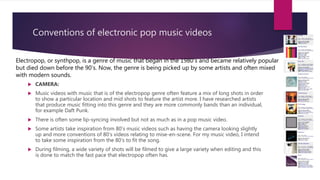
 Music videos with music that is of the electropop genre often feature a mix of long shots in order
to show a particular location and mid shots to feature the artist more. I have researched artists
that produce music fitting into this genre and they are more commonly bands than an individual,
for example Daft Punk.
 There is often some lip-syncing involved but not as much as in a pop music video.
 Some artists take inspiration from 80’s music videos such as having the camera looking slightly
up and more conventions of 80’s videos relating to mise-en-scene. For my music video, I intend
to take some inspiration from the 80’s to fit the song.
 During filming, a wide variety of shots will be filmed to give a large variety when editing and this
is done to match the fast pace that electropop often has.
Electropop, or synthpop, is a genre of music that began in the 1980’s and became relatively popular
but died down before the 90’s. Now, the genre is being picked up by some artists and often mixed
with modern sounds.
 MISE-EN-SCENE:
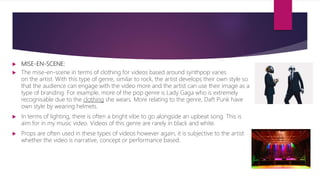
 The mise-en-scene in terms of clothing for videos based around synthpop varies
on the artist. With this type of genre, similar to rock, the artist develops their own style so
that the audience can engage with the video more and the artist can use their image as a
type of branding. For example, more of the pop genre is Lady Gaga who is extremely
recognisable due to the clothing she wears. More relating to the genre, Daft Punk have
own style by wearing helmets.
 In terms of lighting, there is often a bright vibe to go alongside an upbeat song. This is
aim for in my music video. Videos of this genre are rarely in black and white.
 Props are often used in these types of videos however again, it is subjective to the artist
whether the video is narrative, concept or performance based.
 EDITING:
 Editing for videos with synthpop music is usually fast paced with many different shots.
Transitions such as jump-cuts are more popular here because of the fast beat, in
comparison to fade or dissolve which often match slower paced songs.
 Similar to pop music videos, cutting to the beat is often used alongside other editing
conventions which I will trial and see which ones look best for my video.
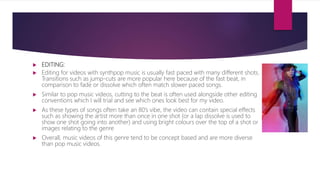
 As these types of songs often take an 80’s vibe, the video can contain special effects
such as showing the artist more than once in one shot (or a lap dissolve is used to
show one shot going into another) and using bright colours over the top of a shot or
images relating to the genre
 Overall, music videos of this genre tend to be concept based and are more diverse
than pop music videos.
 For my music video, I intend to adopt the conventions of electropop music videos,
incorporating inspiration from the 1980’s in terms of editing (adding effects) and mise-en-
scene (clothing and make-up) but with a modern vibe in terms of filming.
 I also intend to show the relationship between lyrics and visuals by including ‘love’ as a
theme which will be persistent throughout the video in the form of mise-en-scene (props,
clothing and lighting)to correspond with the lyrics.
 To show evidence of trialling the mise-en-scene while filming, see ‘Filming Shots 1’

Research into conventions

  • 1.
  • 2.
    General conventions ofmusic videos  CAMERA:  Music videos often include a variety of close ups, mid shots and long shots. This is to create a focus towards the artist, location and any emotions that are meant to be conveyed to the audience.  Also, close ups are also used to reflect the words of the song with the movement of the lips of the artist (lip-syncing). This is done to promote the artist and give the audience a sense of the lyrics.  The movement of the camera often follows and is used to trace the artist or band. Camera movements include tilts, pans, tracking and crane shots. General conventions of camera movements change over decades, for example, in the 80’s lots of shots were looking up at artists but that is done less now.
  • 3.
     MISE-EN-SCENE:  Mise-en-scene:This refers to the arrangement of performers and props on stage or in a scene for a production of a music video or any other media text.  Mise-en- scene is often shown in a way that is meant to represent something.  An example of large use of mise-en-scene in a music video is Taylor Swift’s ‘Love Story’. This video is set in the style of Romeo and Juliet and this is conveyed mainly through the mise-en-scene in terms of clothing, props and narrative.  General music videos often convey mise-en-scene lighting in terms of narrative such as a sad narrative has shots in black and white where the artist is singing looking away from the camera and upbeat videos there are bright colours and often a variety of locations.
  • 4.
     EDITING:  Commonediting techniques used in music videos include fade, jump-cut and dissolve. Many pop videos are cut very simply in order to show the artist in the best way possible.  In terms of sound editing, cutting to the beat is used frequently to create a stronger between the lyrics and visuals.  The length of shot is often reflected by the beat of the song also, for example, a fast paced will have quick shots and a slower song will have longer shots. However, this can vary within music video such as a fast paced chorus and slower verses.  An example of a fast paced song where the video editing matches the beat is ‘Bounce’ by Harris Types of editing used in music videos include: Cutaways (shot that interrupts continuous action), continuity editing (creates a sense of reality), cross cutting (weaving one narrative action into another suggesting parallel action), graphic match (same shaped objects where one fades into the other
  • 5.
    Conventions of electronicpop music videos  CAMERA:  Music videos with music that is of the electropop genre often feature a mix of long shots in order to show a particular location and mid shots to feature the artist more. I have researched artists that produce music fitting into this genre and they are more commonly bands than an individual, for example Daft Punk.  There is often some lip-syncing involved but not as much as in a pop music video.  Some artists take inspiration from 80’s music videos such as having the camera looking slightly up and more conventions of 80’s videos relating to mise-en-scene. For my music video, I intend to take some inspiration from the 80’s to fit the song.  During filming, a wide variety of shots will be filmed to give a large variety when editing and this is done to match the fast pace that electropop often has. Electropop, or synthpop, is a genre of music that began in the 1980’s and became relatively popular but died down before the 90’s. Now, the genre is being picked up by some artists and often mixed with modern sounds.
  • 6.
     MISE-EN-SCENE:  Themise-en-scene in terms of clothing for videos based around synthpop varies on the artist. With this type of genre, similar to rock, the artist develops their own style so that the audience can engage with the video more and the artist can use their image as a type of branding. For example, more of the pop genre is Lady Gaga who is extremely recognisable due to the clothing she wears. More relating to the genre, Daft Punk have own style by wearing helmets.  In terms of lighting, there is often a bright vibe to go alongside an upbeat song. This is aim for in my music video. Videos of this genre are rarely in black and white.  Props are often used in these types of videos however again, it is subjective to the artist whether the video is narrative, concept or performance based.
  • 7.
     EDITING:  Editingfor videos with synthpop music is usually fast paced with many different shots. Transitions such as jump-cuts are more popular here because of the fast beat, in comparison to fade or dissolve which often match slower paced songs.  Similar to pop music videos, cutting to the beat is often used alongside other editing conventions which I will trial and see which ones look best for my video.  As these types of songs often take an 80’s vibe, the video can contain special effects such as showing the artist more than once in one shot (or a lap dissolve is used to show one shot going into another) and using bright colours over the top of a shot or images relating to the genre  Overall, music videos of this genre tend to be concept based and are more diverse than pop music videos.
  • 8.
     For mymusic video, I intend to adopt the conventions of electropop music videos, incorporating inspiration from the 1980’s in terms of editing (adding effects) and mise-en- scene (clothing and make-up) but with a modern vibe in terms of filming.  I also intend to show the relationship between lyrics and visuals by including ‘love’ as a theme which will be persistent throughout the video in the form of mise-en-scene (props, clothing and lighting)to correspond with the lyrics.  To show evidence of trialling the mise-en-scene while filming, see ‘Filming Shots 1’