Research & Design through Community 
Informatics 
Lessons from Participatory Engagement with Seniors 
Cristhian Parra, Vincenzo D’Andrea and David Hakken 
Community Informatics Research Network Conference 
October 14th, 2014
Community 
for Research 
and Design
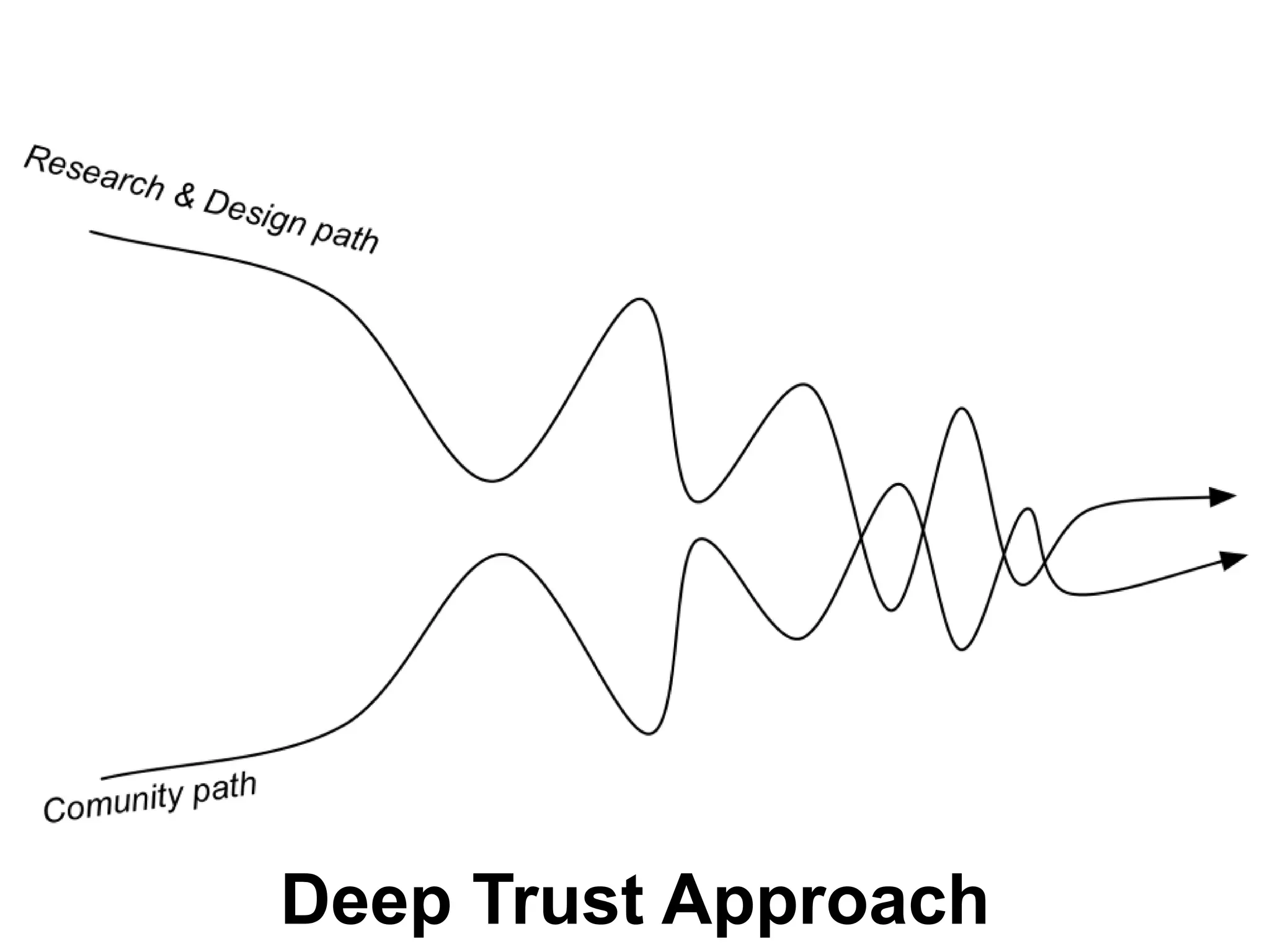
Deep Trust Approach
Participator 
y 
Engagement 
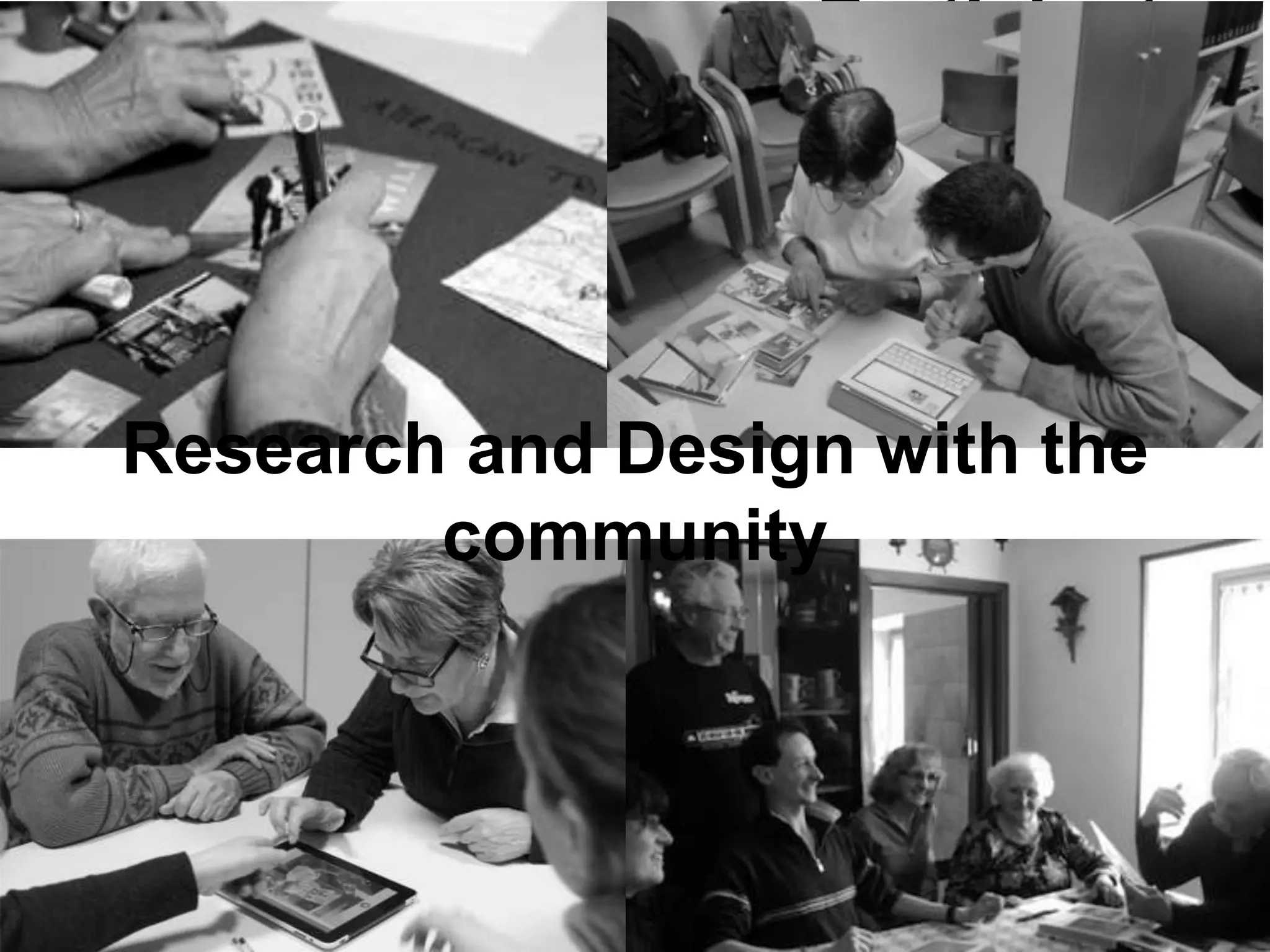
Research and Design with the 
community
Lessons Learned 
• In searching for social interaction opportunities, we 
had, inadvertently, created one. We were doing 
community informatics without knowing, developing a 
deep trust with the community. 
• Research & Design activities became community 
offerings: the community appropriated them as part of 
the community activities and this was fundamental for 
the project to continue 
• The community shaped and reshaped the project as it 
proceeded, and required us to assemble a 
multidisciplinary team and to develop interdisciplinary 
skills.
Lessons Learned 
• A deep trust approach by which researchers/designers 
come to be part of the community themselves highlight 
the promise of CI research that directly benefits 
communities by building and reinforcing them. 
• This kind of project can help to achieve community 
(i.e., to form, build, and sustain it). Fostering active 
ageing is one domain to which this is relevant; fostering 
civic participation may be another. 
• The long-term engagement engendered by deep trust 
projects open doors to other research projects and 
future collaborations, some independent of the initial 
researchers.
Questions 
• Sustainability. How can community-based research and 
design become sustainable in time, even after 
researchers are no longer there? 
• Exit from the community. Do you really ever exit the 
community you have befriended? 
• Generalization. How much can grounded theory 
constructed from these contexts be generalized? 
• Participatory Design. How can the experiences of CIRN 
and PD communities can help each others in supporting 
more of these projects?
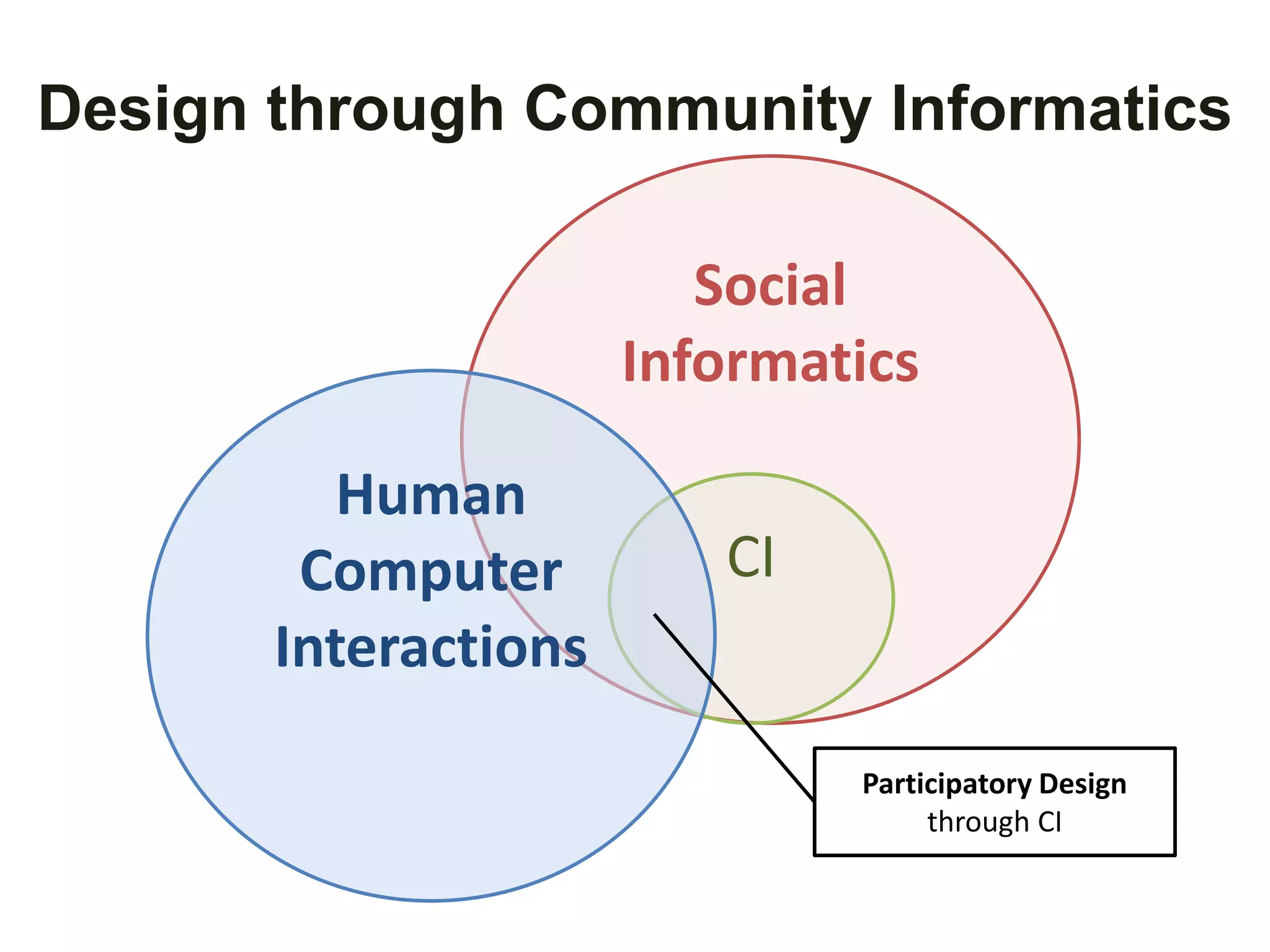
Design through Community Informatics 
Social 
Informatics 
CI 
Human 
Computer 
Interactions 
Participatory Design 
through CI
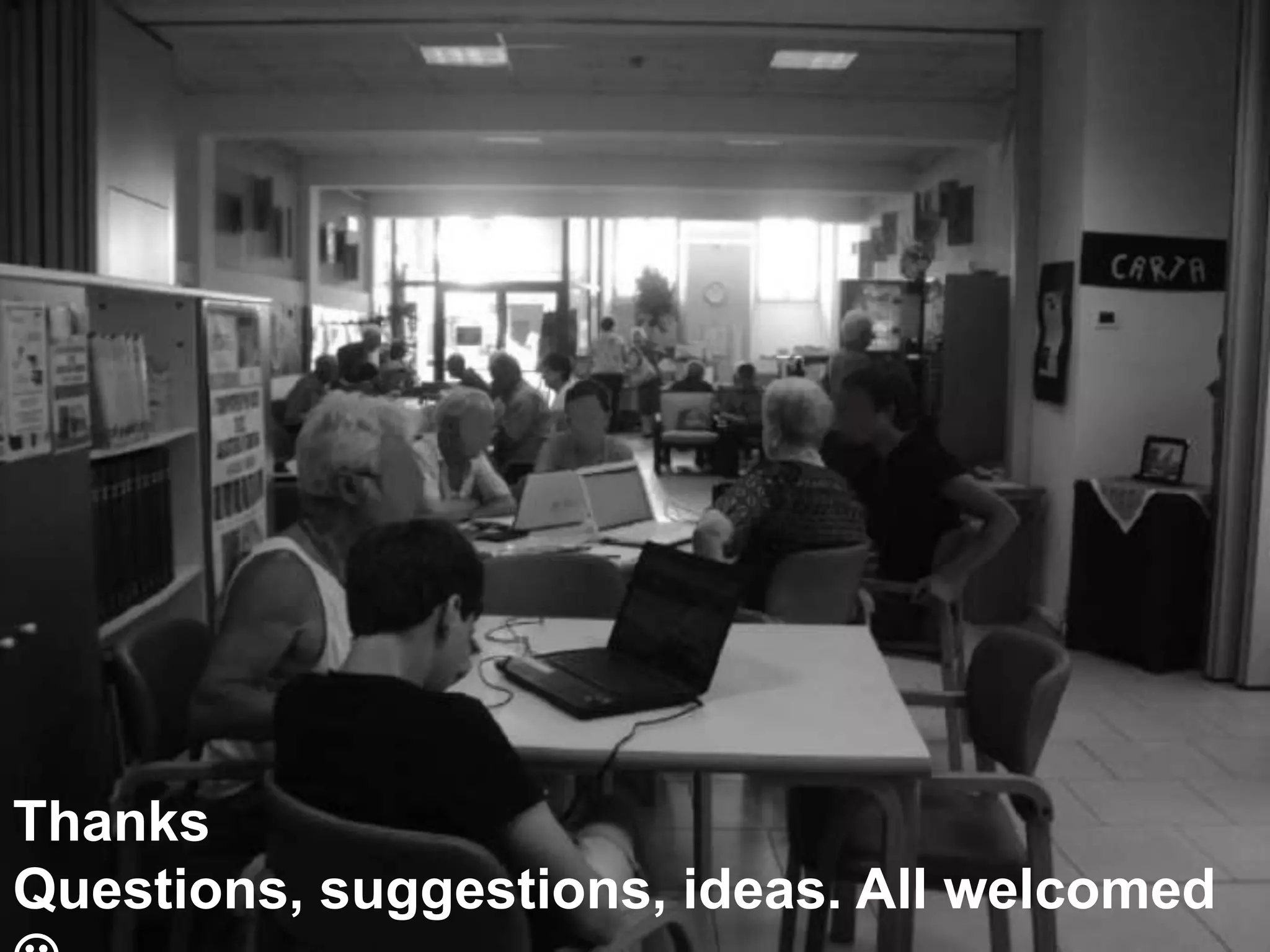
Thanks 
Questions, suggestions, ideas. All welcomed 


Research and Design through Community Informatics - CIRN2014 presentation

  • 1.
    Research & Designthrough Community Informatics Lessons from Participatory Engagement with Seniors Cristhian Parra, Vincenzo D’Andrea and David Hakken Community Informatics Research Network Conference October 14th, 2014
  • 2.
  • 3.
  • 4.
    Participator y Engagement Research and Design with the community
  • 5.
    Lessons Learned •In searching for social interaction opportunities, we had, inadvertently, created one. We were doing community informatics without knowing, developing a deep trust with the community. • Research & Design activities became community offerings: the community appropriated them as part of the community activities and this was fundamental for the project to continue • The community shaped and reshaped the project as it proceeded, and required us to assemble a multidisciplinary team and to develop interdisciplinary skills.
  • 6.
    Lessons Learned •A deep trust approach by which researchers/designers come to be part of the community themselves highlight the promise of CI research that directly benefits communities by building and reinforcing them. • This kind of project can help to achieve community (i.e., to form, build, and sustain it). Fostering active ageing is one domain to which this is relevant; fostering civic participation may be another. • The long-term engagement engendered by deep trust projects open doors to other research projects and future collaborations, some independent of the initial researchers.
  • 7.
    Questions • Sustainability.How can community-based research and design become sustainable in time, even after researchers are no longer there? • Exit from the community. Do you really ever exit the community you have befriended? • Generalization. How much can grounded theory constructed from these contexts be generalized? • Participatory Design. How can the experiences of CIRN and PD communities can help each others in supporting more of these projects?
  • 8.
    Design through CommunityInformatics Social Informatics CI Human Computer Interactions Participatory Design through CI
  • 9.
    Thanks Questions, suggestions,ideas. All welcomed 

Editor's Notes

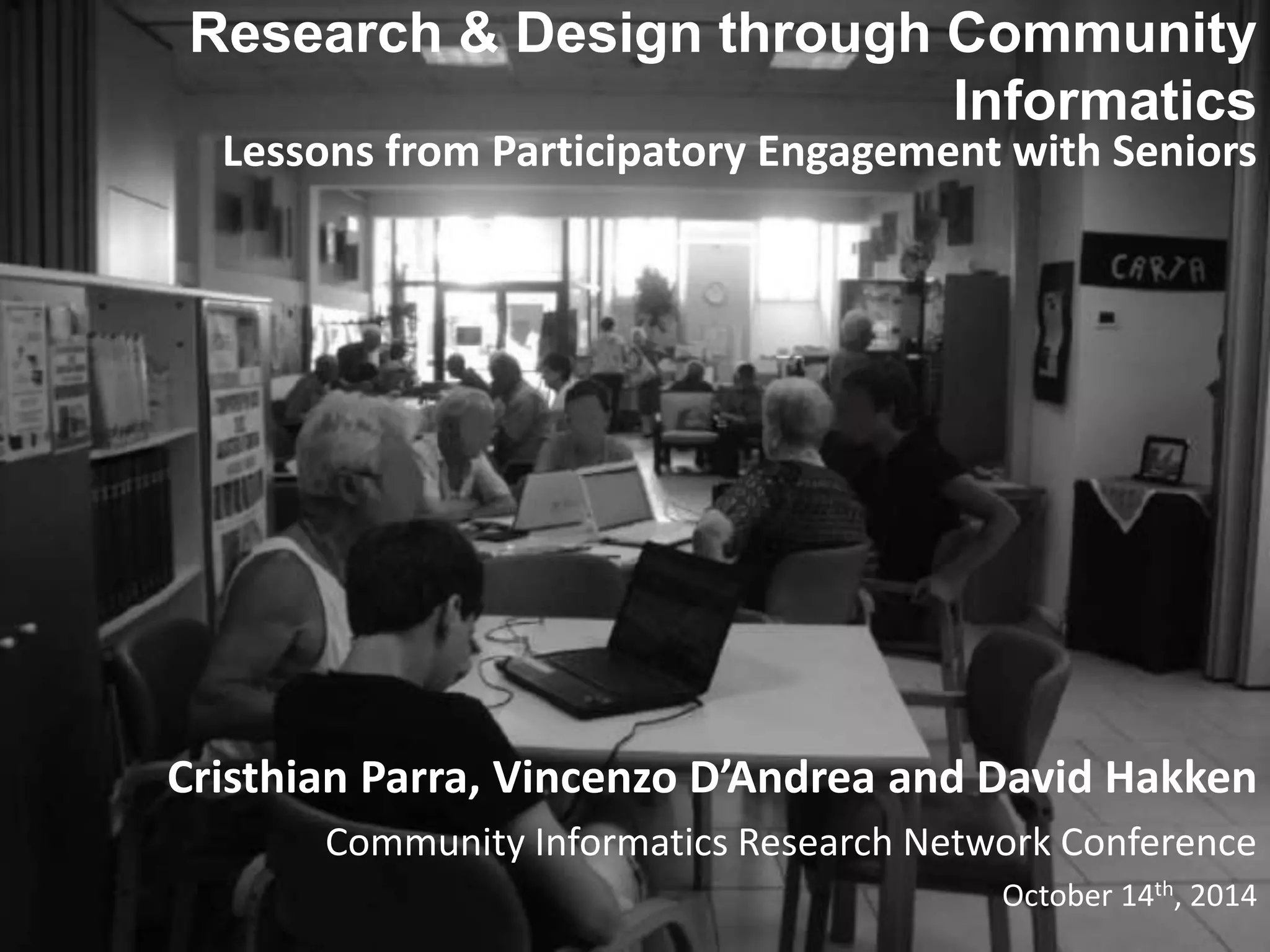
  • #2 Good morning everyone. My name is Cristhian Parra and I am postdoctoral researcher at the University of Trento. Two years ago, I had the chance to share here some initial reflections of what at the time was my phd project, which was a computer science Ph.D. that seeked to understand the role of and design ICT for intergenerational interactions and active ageing.
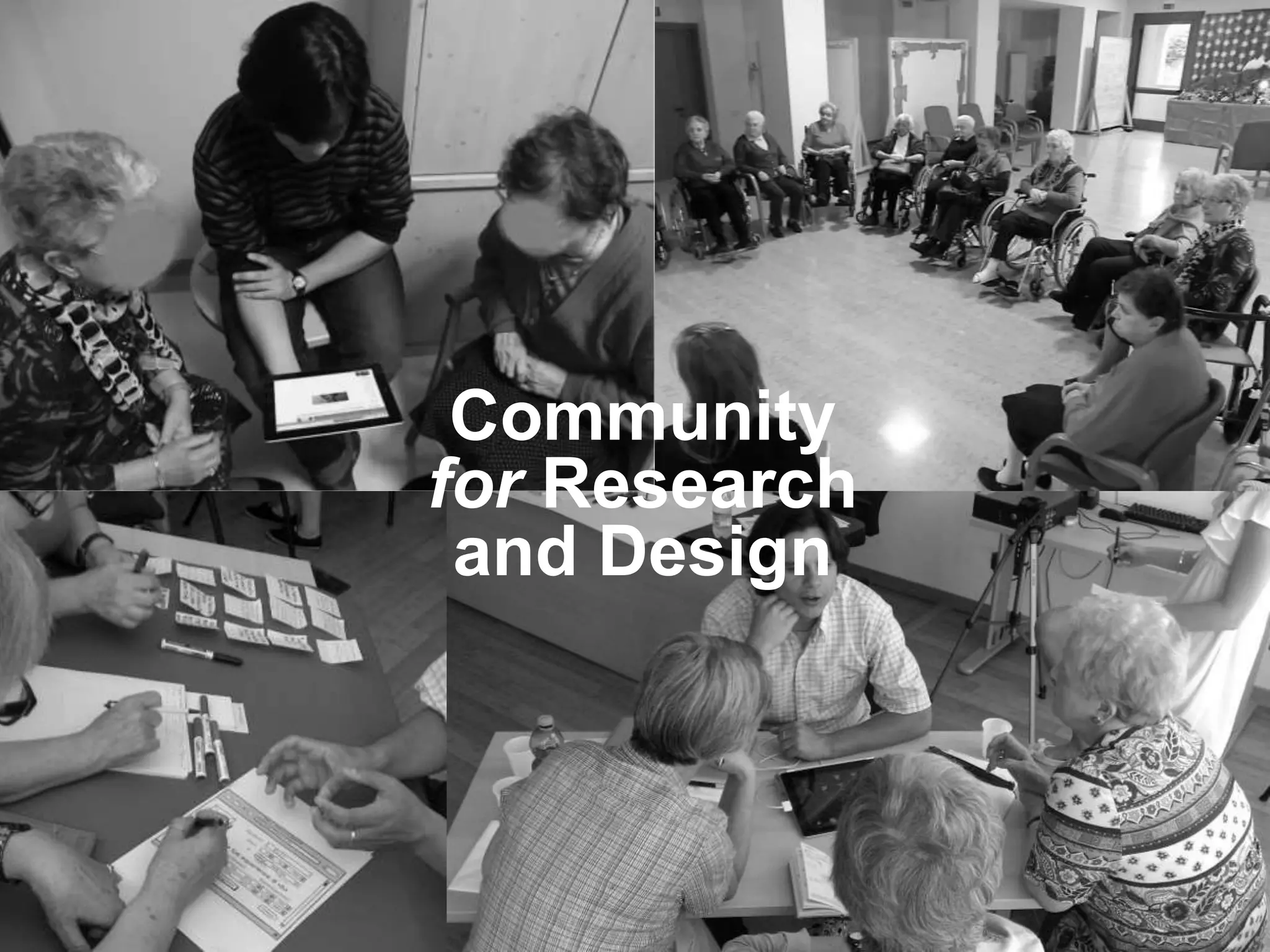
  • #3 Within the context of that Ph.D. project, we started by conducting a series of workshops where “we”, the researchers, engaged with “them”, the older adults, in a ethnographic exploration of the possibilities that ICT could bring to them. In a way, we were looking to the community to involve them in our research and design. So, the community for research and design. Despite our good intentions, however, that initial approach was faced with some barriers: one of the communities we looked to involve was doubtful of participating in yet “another research project”. A previous experience where a technology intervention was introduced for a year and left without leaving nothing behind had left them with a sour feeling. We understood that another approach was needed. An approach that would be attentive to the needs and realities of the community.
  • #4 Following a personal interest in participatory design (Ehn, 1993) as a methodological and ethical stance for research and design, we started an engagement with this local Community Center for Older Adults, but instead of bringing our fully predesigned research program, all previously pre-packaged for them, we adopted the goal of collaboratively creating a space where our research and design efforts could be intermingled with the reality of the community. From there on, our interactions can be summarized by this picture, where the paths of both our research and of the community progressively became closer and more frequently intermingled. Research and design activities were no longer just and extra activity or an isolated event: it was an activity offered by and established within the community. The narrative of our research and design project follows the same trajectory of interest to studies of community, that of social relations becoming relationships. Our commitment to participatory design principles, coupled with our research interests, led us to become closely involved with a group of people, already part of a bigger senior center community. As these seniors became more closely involved, we were able to do participatory action research. Along the way, project activities inadvertently became ways to increase participation in the community, both building and reinforcing it This is what we would refer to a deep trust approach.
  • #5 In a way, our research transformed in “Reseach and Design with (rather than for) the community”: a participatory community based research and design program. The pictures on screen highlight the activities that were part of this the long-term engagement, upon which our reflections in this paper are based. They summarize two years of regular interactions with the same community of local and active senior citizens, aged between 60 and 80 years old; who are all members of a cooperative-managed services center for older adults (the CSA). From weekly laboratories of mutual learning to design workshops and a study about intergenerational interactions aided by technology.
  • #6 Community Informatics provided us with a practice and theory framework for the kind of work we were doing, as well with examples and concepts that helped our project achieve greater responsiveness to the community in what we came to call a the “deep trust” approach. Perhaps the most important outcome of our project was that the goal of active ageing was also realized through community members becoming more actively and easily engaged with the research and design efforts that surrounds them. In searching for social interaction opportunities, we had, inadvertently, created one. We were doing community informatics without knowing, developing a deep trust with the community. Research & Design activities became community offerings: the community appropriated them as part of the community activities and this was fundamental for the project to continue We also learned that adopting this approach was not easy. Being attentive to the needs of a community shaped and reshaped the project as it proceeded. In addition to demanding a research program that was highly flexible, the approach also required assembling a multidisciplinary team
  • #7  Deep trust highlights the promise of CI research that directly benefits communities by building and reinforcing them. This kind of  CI often aims directly to achieve community (i.e., to form, build, and sustain it). Fostering active ageing is one domain to which this is relevant; fostering civic participation may be another. The long-term engagement engendered by deep trust projects open doors to other research projects and future collaborations, some independent of the initial researchers. One key message of our paper is that community informatics (CI) can be done in a deep trust way that takes community seriously— that is, is attentive to the dynamics of the community, shapes research and design activities to contribute to the continuous growth and development of the community, and reinforces the process by which relations turn into relationships. Another message is that doing deep trust CI is not easy, requiring more time and effort. Probably makes it unavoidable that researchers themselves develop relationships with the community, becoming members of it and advocates for its development. Nonetheless, we think the benefits of deep trust CI are so substantial that the onus should be on those who would not do it this way to justify their choice. We also learned that adopting this approach was not easy. Being attentive to the needs of a community shaped and reshaped the project as it proceeded. In addition to demanding a research program that was highly flexible, the approach also required assembling a multidisciplinary team
  • #9 In this Ph.D. research project, we have explored, designed and evaluated information technologies in three problem domains, resulting of a process of progressively scoping down to a more narrow subject: first, the focus was set on the general domain of active ageing, socialization, social reminiscence