2
Introduction
A hospital’s Emergency Department provides a vital health service and is a very common
destination for seniors in need of medical attention. This is especially true for the Emergency
Department at the Kingston General Hospital, as it is the largest hospital in the Kingston and its
surrounding areas. Issues related to senior healthcare experiences at the emergency level are
reported to exist by seniors and hospital staff alike. These issues serve as barriers to a positive
healthcare experience and the successful navigation of the Emergency Department by senior
patients.
These barriers can be overcome using two approaches:
(1) Informing long-term changes to the social and physical environments of the Emergency
Department by making and supporting changes to the physical and social environments of
the KGH Emergency Department based on best geriatric care practices and senior
narratives;
(2) Educating and empowering the senior community on how to better navigate the
healthcare system in Kingston and on ways to better control one’s own health and well-
being.
Purpose of this Report
This report is a collaboration between senior community members (as represented by the
Kingston Frontenac Council on Aging (KF-COA)), and the Queen’s School of Rehabilitation
Therapy (SRT). The purpose of this report is evaluate the interaction of seniors at the triage level
of Kingston General Hospital’s (KGH) Emergency Department and provide recommendations to
improve that interaction. During this ongoing process of collaboration and evaluation, KF-COA
and the SRT seek to develop effective relationships with KGH staff and management, in order to
foster an open dialogue to collaboratively build on strengths and development of services for the
improvement of senior patient care.
Literature Review
With the assistance of the librarian at Providence Care, 87 articles were identified for
review using the following search terms: senior/aged geriatric care/use in the ER. Search terms
were kept within last eight years in order to reflect current practice and to avoid redundancy. All
articles matching those criteria were reviewed and 12 articles were chosen to inform this report
due to their relevance and their congruence with our recommendations. Please refer to the legend
below for article synopses.
3
1. Latham, L. P., & Ackroyd-Stolarz, S. (2014). Emergency Department Utilization by Older
Adults: a Descriptive Study. Canadian Geriatrics Journal, 17(4), 118.
(Seniors and ED utilization, Canadian perspective)
The following themes were identified:
s Seniors (+65 present unique needs, and their care needs, and complexity, increase with age)
s Canadian study found 75% of seniors who presented at ED received a CTAS of 1-3; 25% of
seniors left ED without a definitive diagnosis.
s Found a substantial number of seniors present at ED when a better level of care and follow-
up may be able to be provided in a different setting. (ie. Primary Care Family doctor, or
family health team).
2. Aldeen, A. Z., Courtney, D. M., Lindquist, L. A., Dresden, S. M., & Gravenor, S. J. (2014).
Geriatric Emergency Department Innovations: Preliminary Data for the Geriatric Nurse Liaison
Model. Journal of the American Geriatrics Society, 62(9), 1781-1785.
(THE GEDI NURSE LIAISON MODEL)
s Nurse Liaison in ED completing Screening for:
o Cognition
o Delirium
o Falls Risk
o Function Status (ADLS)
o Care Transition
o Caregiver Strain
s Nurse liaison Then Liaises with Inter Professional Team to create care-plan for discharge
from ED
s Telephone follow-up: 3days posts discharge and 14 days post-discharge
s Issues are being identified earlier and patients are being admitted more proactively.
Evidence is forthcoming but seems to suggest a decreased length of stay for hospital visits
when patients are proactively screened and issues are caught before they become more
complex.
3. Shankar, K. N., Bhatia, B. K., & Schuur, J. D. (2014). Toward patient-centered care: a
systematic review of older adults’ views of quality emergency care. Annals of emergency
medicine, 63(5), 529-550.
s Meta-analysis of the Western Hospital systems and seniors perceptions of care. Diverse
findings, with recommendations to improve quality care of seniors in ED.
s health care providers should assume a leadership role in both the medical and social needs of
the patient
4
s provider communication significantly decreased senior’s anxiety and managed expectations
s Health care providers should minimize barriers to communication by proactively
questioning seniors and tailoring conversations based on the patients level of knowledge
s elderly patients requiring prolonged care, should have staff check-in regularly to
communicate with them about their status and their evaluations
s elderly patients are particularly sensitive to the distress caused by a variety of physical
discomforts, ie. stretchers and a lack of privacy
s Elders experience anxiety in ED surrounding basic needs such as: pain-control, nutrition.
Clear care-transitions planning, and involving the patient's caregiver can help alleviate this.
s ED Staff must be cognizant of the increased level of coordination required for discharge into
community. (between patients, caregivers, social supports, and their healthcare providers)
s ED’s must be more focused on being patient-centric; consider changes in culture, attitude
and practice of the staff to engage elderly patients in a more meaningful way
4. Sanon, M., Baumlin, K. M., Kaplan, S. S., & Grudzen, C. R. (2014). Care and respect for elders
in emergencies program: a preliminary report of a volunteer approach to enhance care in the
emergency department. Journal of the American Geriatrics Society, 62(2), 365-370.
s Volunteer program for providing non-medical care to seniors 65+ in ED. Interventions
include individualized talking/reassurance, provision of Brain games, stress balls, provision
of visual and/or hearing assistance.
s Program volunteers available 9am-12am, 7days/week
s Volunteers are cognizant of areas of concern for elders (abuse, neglect, depression, family-
conflicts, cognitive issues/delirium etc.) reports all areas of concern or clinical care-needs to
patient’s assigned nurse.
s Outcome: Volunteers provide elders with additional attention, improving satisfaction and
preventing potential decline.
5. Schoenenberger, A. W., & Exadaktylos, A. K. (2014). Can geriatric approaches support the care
of old patients in emergency departments? A review from a Swiss ED. Swiss Med Wkly, 144,
w14040
s Geriatric ED must consider and assess:
o Cognitive function/Delirium
o Impaired Mobility
o ADL difficulties
o Poly-pharmacy & Adverse effects
o Co-morbidity and
o Atypical Presentation
s Earlier screen and detection of issues can prevent issues (ie. delirium) Completed by a team
or a specialized geriatric practitioner
5
s 5 Recommendations for geriatric friendly ED:
o 1) the implementation of brief screening tools for functional deficits along with
appropriate management tailored to the specific needs of emergency physicians;
o 2) the systematic implementation of computerised systems reducing
inappropriate medications and prescription errors;
o 3) the implementation of interventions improving continuity during transitions of
care (e.g., integration of primary care physicians in the ED management of their
patients);
o 4) education; and
o 5), last but not least, implementation of elder care boards and collaboration with
interdisciplinary teams supported by geriatric specialists experienced in
emergency care.
6. Banerjee, J., Conroy, S., & Cooke, M. W. (2012). Quality care for older people with urgent and
emergency care needs in UK emergency departments. Emergency Medicine Journal, emermed-
2012
s (Geri-Recommendations/approaches to ED, UK approach, Silver Report)
s need assessment for falls, mobility, sensory loss or depression
s At the earliest opportunity obtain information on activities of daily living, dementia,
incontinence, safeguarding issues and any existing plans with regards to end of life care.
s falls, incontinence, cognitive impairment (delirium, dementia or both) and immobility,
should trigger a more detailed comprehensive geriatric assessment.
s Presentation with intentional self-harm should be considered as for failed suicide and these
older people are at increased risk of further harm.
s Food and Drink should be readily available and help with nutrition should be provided when
necessary.
s Recommend a quieter, preferably separate, area of the department where observation is
possible but noise, interruption and over-stimulation is minimized.
7. McCusker, J., Verdon, J., Vadeboncoeur, A., Lévesque, J. F., Sinha, S. K., Kim, K. Y., &
Belzile, E. (2012). The Elder Friendly Emergency Department Assessment Tool: Development
of a Quality Assessment Tool for Emergency Department–Based Geriatric Care. Journal of the
American Geriatrics Society, 60(8), 1534-1539.
s Developed an ED evaluation tool looking for the following criteria:
s interprofessional team available for senior care (Liaison Nurse, Geriatric Nurse Clinician,
Social Worker, Pharmacist, Physiotherapist, Occupational Therapist, Gerontologist or other
consulting specialist. All with a designated health professional to coordinate the geriatric
services
s Screen/Assessment of: medication(s), Cognitive status, ADL/functional status, & delirium
6
s Assessment of Seniors : Medical and Psycho-social needs
s Communication methods in place to transfer to care providers in community and vice-versa
(i.e. Primary Care physician, home supports, community care services)
s Discharge planning protocol for seniors
s Post-discharge follow-up
8. Sinha, S. K., Bessman, E. S., Flomenbaum, N., & Leff, B. (2011). A systematic review and
qualitative analysis to inform the development of a new emergency department-based geriatric
case management model. Annals of emergency medicine, 57(6), 672-682.
s A systematic review found 8 core characteristics for ED based Geriatric Care:
o Evidence based practice model
o Nursing clinical delivery involvement of leadership
o High Risk Screening
o Focused Geriatric Assessment
o Initiation of care and disposition planning in ED
o Interprofessional and Capacity-Building work practices
o Post-ED Discharge follow-up with patients
o Establishment of Evaluation and monitoring Processes
s Acknowledged the need to consider both health and social interventions in Geri-Care.
s Integration of emergency management practitioners with strong interpersonal skills to
facilitate capacity building within and beyond ED setting.
s Suggest that socially trained nurses are better suited for this role than social workers, due to
their medical background.
9. Mortimer, C., Emmerton, L., & Lum, E. (2011). The impact of an aged care pharmacist in a
department of emergency medicine. Journal of evaluation in clinical practice, 17(3), 478-485.
s Aged Care Pharmacist (ACP) added as a quality assurance mechanism within ED to avoid
issues of poly-pharmacy and adverse events.
s ED doctors often did not investigate medication-related problems. rather they changed
medication without consulting other doctors in the continuum of care.
s The dominant medication-related issue identified by the ACP was incorrect use of
medication.
s ACP to monitor incorrect use and adherence related problems to medication.
s ACP reduced admissions through ED because medication issues were resolved; resulting in
greater patient throughput
10. Rogers, D. (2009). The increasing geriatric population and overcrowding in the emergency
department: one hospital’s approach. Journal of Emergency Nursing, 35(5), 447-450.
7
s Geriatric Emergency Medicine Systems (GEMS) Nurse work with all care team members to:
expedite care and reduce the length of ED wait time, answer patient and family questions,
and work with outside agencies and facilities.
s GEMS will receive a phone call from a referral source before a patient’s arrival.
s GEMS Nurse receives report on the patient, and this information is relayed to the triage
nurse.
s Patients are greeted when they arrive at the triage area. Their comfort level increases when
they learn a GEMS nurse was expecting them in the emergency department.
s GEMS nurse then explains the ED process including what type of testing they may have
during the evaluation; personally checks on her GEMS patients throughout the day and
keeps in touch with the referral sources and other ED team members.
s GEMS program runs Mon-Fri, 9am-5:30pm
11. Terrell, K. M., Hustey, F. M., Hwang, U., Gerson, L. W., Wenger, N. S., & Miller, D. K. (2009).
Quality indicators for geriatric emergency care. Academic Emergency Medicine, 16(5), 441-449.
s Study provides Quality indicators for Cognitive Assessment:
o 1. Cognitive Assessment should be completed
o 2. if positive for impairment (determine if this is a change from baseline)
o 3. if impaired and discharged home document level of supports and
o 4. If impaired and discharged home, plan for follow-up
o 5. if impaired but same as baseline, determine if there is a diagnosis (i.e
alzheimers)
o 6. if impaired, but stable, and no diagnosis…refer to outpatient services for
follow-up
s Quality indicators for Pain Management
o 1.) acute Pain Assessment within 1 hr of arrival to ED
o 2.) If waiting in ED for more than 6hrs, complete 2nd pain Ax.
o 3.) If provided intervention for pain in ED , Re-Ax pain prior to discharge.
o 4.) For pain greater than 4/10, provide treatment (or document why it was not
provided)
o 5.) Do not give Seniors Meperidine (Associated with delirium, fractures, and
death)
o 6.) If senior is given an opioid prescription, education on a bowel regime must
also be provided. (or document why this was not provided)
12. Shanley, C., Sutherland, S., Tumeth, R., Stott, K., & Whitmore, E. (2009). Caring for the older
person in the emergency department: the ASET program and the role of the ASET clinical nurse
consultant in South Western Sydney, Australia. Journal of Emergency Nursing, 35(2), 129-133.
8
s Aged-Care Emergency Treatment Team (ASET) focuses on patients with comorbid and
complex issues. Does not target those with Single-system diseases.
s Core aspects of the ASET program include the following:
s a senior aged-care nurse being located full time within the emergency department;
s a systematic approach to screening the most vulnerable older patients;
s comprehensive geriatric assessments with inclusion of premorbid functional status;
s active networking with and referral to health and community services that can support older
persons in the community;
s informal and formal education for ED staff about the needs of frail older patients;
s Advocacy for older patients within the emergency department.
s Specialized care team, that works within the ED, but is not comprised of ED Staff, rather the
ASET nurse coordinator helps liaise with Senior patients and frequent users or those with
high-complexity health needs.
Summary and Overall Themes
s Importance of ER-specific considerations for seniors
s Multidisciplinary assessments of seniors for risk factors (in hopes of early intervention to
prevent repeat visits)
s Senior-specific training for professionals: especially nurses and pharmacists
s Follow-up post-discharge from hospitals used as a means to prevent re-admission (i.e. tele-
health, tele-medicine contact or direct-service provision)
s Ultimately, increased monitoring of seniors will provide better service and prevent
hospitalization because most issues can be caught in the earlier, less severe stages
s Both the social and medical components of health when addressing senior care should be
considered
s In more recent studies, there is a call for suggestions to manage seniors in the community or
within the primary care sector of the healthcare continuum, instead of waiting for them to
reach the Emergency Department.
s Ultimately, literature has shown that there is an increased need for comprehensive
assessment and screening within the health system, and open and two-way communication
and coordination between all team-members in the best interest of patient-centred care and
the seniors overall health and wellbeing.
9
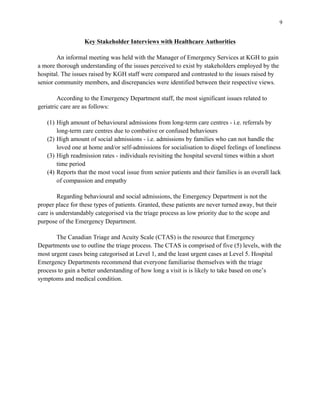
Key Stakeholder Interviews with Healthcare Authorities
An informal meeting was held with the Manager of Emergency Services at KGH to gain
a more thorough understanding of the issues perceived to exist by stakeholders employed by the
hospital. The issues raised by KGH staff were compared and contrasted to the issues raised by
senior community members, and discrepancies were identified between their respective views.
According to the Emergency Department staff, the most significant issues related to
geriatric care are as follows:
(1) High amount of behavioural admissions from long-term care centres - i.e. referrals by
long-term care centres due to combative or confused behaviours
(2) High amount of social admissions - i.e. admissions by families who can not handle the
loved one at home and/or self-admissions for socialisation to dispel feelings of loneliness
(3) High readmission rates - individuals revisiting the hospital several times within a short
time period
(4) Reports that the most vocal issue from senior patients and their families is an overall lack
of compassion and empathy
Regarding behavioural and social admissions, the Emergency Department is not the
proper place for these types of patients. Granted, these patients are never turned away, but their
care is understandably categorised via the triage process as low priority due to the scope and
purpose of the Emergency Department.
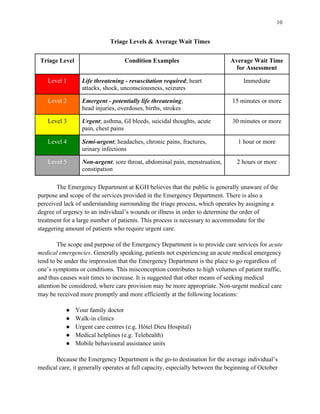
The Canadian Triage and Acuity Scale (CTAS) is the resource that Emergency
Departments use to outline the triage process. The CTAS is comprised of five (5) levels, with the
most urgent cases being categorised at Level 1, and the least urgent cases at Level 5. Hospital
Emergency Departments recommend that everyone familiarise themselves with the triage
process to gain a better understanding of how long a visit is is likely to take based on one’s
symptoms and medical condition.
10
Triage Levels & Average Wait Times
Triage Level Condition Examples Average Wait Time
for Assessment
Level 1 Life threatening - resuscitation required; heart
attacks, shock, unconsciousness, seizures
Immediate
Level 2 Emergent - potentially life threatening;
head injuries, overdoses, births, strokes
15 minutes or more
Level 3 Urgent; asthma, GI bleeds, suicidal thoughts, acute
pain, chest pains
30 minutes or more
Level 4 Semi-urgent; headaches, chronic pains, fractures,
urinary infections
1 hour or more
Level 5 Non-urgent; sore throat, abdominal pain, menstruation,
constipation
2 hours or more
The Emergency Department at KGH believes that the public is generally unaware of the
purpose and scope of the services provided in the Emergency Department. There is also a
perceived lack of understanding surrounding the triage process, which operates by assigning a
degree of urgency to an individual’s wounds or illness in order to determine the order of
treatment for a large number of patients. This process is necessary to accommodate for the
staggering amount of patients who require urgent care.
The scope and purpose of the Emergency Department is to provide care services for acute
medical emergencies. Generally speaking, patients not experiencing an acute medical emergency
tend to be under the impression that the Emergency Department is the place to go regardless of
one’s symptoms or conditions. This misconception contributes to high volumes of patient traffic,
and thus causes wait times to increase. It is suggested that other means of seeking medical
attention be considered, where care provision may be more appropriate. Non-urgent medical care
may be received more promptly and more efficiently at the following locations:
● Your family doctor
● Walk-in clinics
● Urgent care centres (e.g. Hôtel Dieu Hospital)
● Medical helplines (e.g. Telehealth)
● Mobile behavioural assistance units
Because the Emergency Department is the go-to destination for the average individual’s
medical care, it generally operates at full capacity, especially between the beginning of October
11
and the end of February. This period is when you can expect the Emergency Department to be
busiest, with the longest wait times.
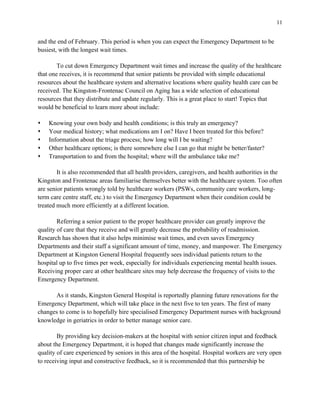
To cut down Emergency Department wait times and increase the quality of the healthcare
that one receives, it is recommend that senior patients be provided with simple educational
resources about the healthcare system and alternative locations where quality health care can be
received. The Kingston-Frontenac Council on Aging has a wide selection of educational
resources that they distribute and update regularly. This is a great place to start! Topics that
would be beneficial to learn more about include:
s Knowing your own body and health conditions; is this truly an emergency?
s Your medical history; what medications am I on? Have I been treated for this before?
s Information about the triage process; how long will I be waiting?
s Other healthcare options; is there somewhere else I can go that might be better/faster?
s Transportation to and from the hospital; where will the ambulance take me?
It is also recommended that all health providers, caregivers, and health authorities in the
Kingston and Frontenac areas familiarise themselves better with the healthcare system. Too often
are senior patients wrongly told by healthcare workers (PSWs, community care workers, long-
term care centre staff, etc.) to visit the Emergency Department when their condition could be
treated much more efficiently at a different location.
Referring a senior patient to the proper healthcare provider can greatly improve the
quality of care that they receive and will greatly decrease the probability of readmission.
Research has shown that it also helps minimise wait times, and even saves Emergency
Departments and their staff a significant amount of time, money, and manpower. The Emergency
Department at Kingston General Hospital frequently sees individual patients return to the
hospital up to five times per week, especially for individuals experiencing mental health issues.
Receiving proper care at other healthcare sites may help decrease the frequency of visits to the
Emergency Department.
As it stands, Kingston General Hospital is reportedly planning future renovations for the
Emergency Department, which will take place in the next five to ten years. The first of many
changes to come is to hopefully hire specialised Emergency Department nurses with background
knowledge in geriatrics in order to better manage senior care.
By providing key decision-makers at the hospital with senior citizen input and feedback
about the Emergency Department, it is hoped that changes made significantly increase the
quality of care experienced by seniors in this area of the hospital. Hospital workers are very open
to receiving input and constructive feedback, so it is recommended that this partnership be
12
maintained in order to ensure that mutually beneficial changes are put into place based on
seniors’ current needs.
Focus Groups with Senior Community Members
The views and opinions of seniors in the Kingston and Frontenac communities are of
vital importance when considering recommendations for change to the Emergency Department.
Focus groups were conducted in order to collect a sample of key issues representative of the best
interests of the senior community.
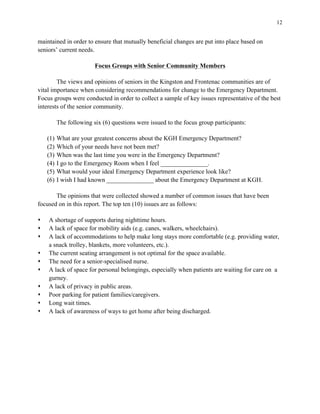
The following six (6) questions were issued to the focus group participants:
(1) What are your greatest concerns about the KGH Emergency Department?
(2) Which of your needs have not been met?
(3) When was the last time you were in the Emergency Department?
(4) I go to the Emergency Room when I feel _______________.
(5) What would your ideal Emergency Department experience look like?
(6) I wish I had known _______________ about the Emergency Department at KGH.
The opinions that were collected showed a number of common issues that have been
focused on in this report. The top ten (10) issues are as follows:
s A shortage of supports during nighttime hours.
s A lack of space for mobility aids (e.g. canes, walkers, wheelchairs).
s A lack of accommodations to help make long stays more comfortable (e.g. providing water,
a snack trolley, blankets, more volunteers, etc.).
s The current seating arrangement is not optimal for the space available.
s The need for a senior-specialised nurse.
s A lack of space for personal belongings, especially when patients are waiting for care on a
gurney.
s A lack of privacy in public areas.
s Poor parking for patient families/caregivers.
s Long wait times.
s A lack of awareness of ways to get home after being discharged.
13
Recommendations
The following recommendations are based on the input provided by senior community
members and current best practice guidelines for Emergency Department services as outlined by
scholarly literature entries.
s Begin involving Hôtel Dieu Hospital as stakeholder to give their inputs regarding the
continuum of care and transfers between their urgent care centre and the Emergency
Department at KGH.
s Consider pushing for the implementation of tele-triage (an add-on to tele-medicine line,
could help prioritize referrals to ER and minimize discomfort/space flow of waiting in ED in
person). May also be able to provide an estimated wait-time.
s Hiring on a great number of volunteers dedicated to assisting seniors with navigation
through the Emergency Department.
s Request that KGH begin providing basic accommodations for long wait times. These can
include water, a snack trolley, and blankets for waiting patients.
s Streamline the flow of the Emergency Department by either painting navigation lines on the
floor, or forming a cordoned-off queue. Increase the amount of signage in the Emergency
Department in way that is conducive to senior understanding and navigation (e.g. bright,
vibrant colours, large fonts, arrows, etc.).
s A registration desk dedicated to serving seniors, with specially trained staff to better manage
geriatric-specific issues.
s Hire on geriatric nurses to assist in the Emergency Department with senior care provision,
initial interviews, and seniors’ rights advocacy.
s Pharmacists made available upon request via tele-pharmacy for medication reviews and
consultations.
s Changes to registration areas to improve patient privacy during sensitive or health-related
discussions. Consider a blood donation-style space that implements sound-proof, plush
barriers.
s Provision of pocket-talkers for Emergency Department staff to facilitate discussions with the
hard of hearing.
14
s KGH begin to conduct post-discharge follow-ups over the telephone to prevent readmissions
at a pre-determined interval (e.g. 3 days post-discharge).
s The KFCoA to create pamphlets to inform seniors about triage levels and where one can
access appropriate services as an alternative to the Emergency Department.
s The KFCoA to divide their 86-page “Navigating the Healthcare System” manual into
smaller, more accessible resources on particular topics (e.g. Packing for a trip to the
hospital).
s Brainstorm a new way to distribute the very valuable information that is found within the
“Navigating the Healthcare System” manual for a reduced cost. Alternatively, hold
education sessions or Q&A events with groups of seniors about the content of the book.
s Increase Emergency Department staffing to ensure that all 3 triage pod rooms are open for
assessment as new patients arrive. Staff breaks should be covered so that each desk is
manned at all times.
s Attempt to increase hospital volunteer hours for 24/7 assistance to facilitate Emergency
Department navigation during nighttime hours (as a significant amount of seniors admit
after-hours).
s Push for the start of a shuttle bus service between KGH and Hôtel Dieu to facilitate patient
flow and to provide proper services for inappropriate referrals during regular hours. Shuttle
bus could move between destinations at half-hour or full-hour intervals. Schedules for
shuttle buses could be posted throughout the Emergency Department.
s Install more screens throughout the Emergency Department so that every patient in the room
can see broadcasted information. Add information about triage levels to the screen’s
rotation.
Acknowledgements & Limitations
It must be acknowledged that this report is not exhaustive, nor is it an all-encompassing account
of all potential stakeholder and community partners’ perspectives. This report is meant to spark
discussion and open a dialogue to promote changes that are well informed and considerate of all
key stakeholders; senior community members, hospital workers, and community agencies (e.g.
Kingston-Frontenac Council on Aging). This report was created with the assistance and guidance
of the KFCoA. Special acknowledgement to all stakeholders, especially Kingston’s delightful
senior community) who graciously donated their time to participate and provide their invaluable
input.
15
References
Aldeen, A. Z., Courtney, D. M., Lindquist, L. A., Dresden, S. M., & Gravenor, S. J. (2014).
Geriatric Emergency Department Innovations: Preliminary Data for the Geriatric Nurse
Liaison Model. Journal of the American Geriatrics Society, 62(9), 1781-1785.
Banerjee, J., Conroy, S., & Cooke, M. W. (2012). Quality care for older people with urgent and
emergency care needs in UK emergency departments. Emergency Medicine Journal,
emermed-2012.
Guinther, L., Carll-White, A., & Real, K. (2014). One size does not fit all: A diagnostic post-
occupancy evaluation model for an emergency department. Health environments research
& design journal, 7(3), 15-37.
Latham, L. P., & Ackroyd-Stolarz, S. (2014). Emergency Department Utilization by Older
Adults: a Descriptive Study. Canadian Geriatrics Journal, 17(4), 118.
McCusker, J., Verdon, J., Vadeboncoeur, A., Lévesque, J. F., Sinha, S. K., Kim, K. Y., &
Belzile, E. (2012). The Elder Friendly Emergency Department Assessment Tool:
Development of a Quality Assessment Tool for Emergency Department–Based Geriatric
Care. Journal of the American Geriatrics Society, 60(8), 1534-1539.
Mortimer, C., Emmerton, L., & Lum, E. (2011). The impact of an aged care pharmacist in a
department of emergency medicine. Journal of evaluation in clinical practice, 17(3), 478-
485.
Rogers, D. (2009). The increasing geriatric population and overcrowding in the emergency
department: one hospital’s approach. Journal of Emergency Nursing, 35(5), 447-450.
Sanon, M., Baumlin, K. M., Kaplan, S. S., & Grudzen, C. R. (2014). Care and respect for elders
in emergencies program: a preliminary report of a volunteer approach to enhance care in
the emergency department. Journal of the American Geriatrics Society, 62(2), 365-370.
Schoenenberger, A. W., & Exadaktylos, A. K. (2014). Can geriatric approaches support the care
of old patients in emergency departments? A review from a Swiss ED. Swiss Med Wkly,
144, w14040
Shankar, K. N., Bhatia, B. K., & Schuur, J. D. (2014). Toward patient-centered care: a
systematic review of older adults’ views of quality emergency care. Annals of emergency
medicine, 63(5), 529-550.
16
Shanley, C., Sutherland, S., Tumeth, R., Stott, K., & Whitmore, E. (2009). Caring for the older
person in the emergency department: the ASET program and the role of the ASET clinical
nurse consultant in South Western Sydney, Australia. Journal of Emergency Nursing,
35(2), 129-133.
Sinha, S. K., Bessman, E. S., Flomenbaum, N., & Leff, B. (2011). A systematic review and
qualitative analysis to inform the development of a new emergency department-based
geriatric case management model. Annals of emergency medicine, 57(6), 672-682.
Terrell, K. M., Hustey, F. M., Hwang, U., Gerson, L. W., Wenger, N. S., & Miller, D. K. (2009).
Quality indicators for geriatric emergency care. Academic Emergency Medicine, 16(5),
441-449.
University of Leicester. (n.d.). Quality care for older people with urgent and emergency care
needs. Retrieved from: https://www2.le.ac.uk/departments/cardiovascular-
sciences/people/conroy/docs/the-silver-book-
subsections/SILVER_BOOK_FINAL_CLINICAL.pdf

Report for KFCoA

  • 2.
    2 Introduction A hospital’s EmergencyDepartment provides a vital health service and is a very common destination for seniors in need of medical attention. This is especially true for the Emergency Department at the Kingston General Hospital, as it is the largest hospital in the Kingston and its surrounding areas. Issues related to senior healthcare experiences at the emergency level are reported to exist by seniors and hospital staff alike. These issues serve as barriers to a positive healthcare experience and the successful navigation of the Emergency Department by senior patients. These barriers can be overcome using two approaches: (1) Informing long-term changes to the social and physical environments of the Emergency Department by making and supporting changes to the physical and social environments of the KGH Emergency Department based on best geriatric care practices and senior narratives; (2) Educating and empowering the senior community on how to better navigate the healthcare system in Kingston and on ways to better control one’s own health and well- being. Purpose of this Report This report is a collaboration between senior community members (as represented by the Kingston Frontenac Council on Aging (KF-COA)), and the Queen’s School of Rehabilitation Therapy (SRT). The purpose of this report is evaluate the interaction of seniors at the triage level of Kingston General Hospital’s (KGH) Emergency Department and provide recommendations to improve that interaction. During this ongoing process of collaboration and evaluation, KF-COA and the SRT seek to develop effective relationships with KGH staff and management, in order to foster an open dialogue to collaboratively build on strengths and development of services for the improvement of senior patient care. Literature Review With the assistance of the librarian at Providence Care, 87 articles were identified for review using the following search terms: senior/aged geriatric care/use in the ER. Search terms were kept within last eight years in order to reflect current practice and to avoid redundancy. All articles matching those criteria were reviewed and 12 articles were chosen to inform this report due to their relevance and their congruence with our recommendations. Please refer to the legend below for article synopses.
  • 3.
    3 1. Latham, L.P., & Ackroyd-Stolarz, S. (2014). Emergency Department Utilization by Older Adults: a Descriptive Study. Canadian Geriatrics Journal, 17(4), 118. (Seniors and ED utilization, Canadian perspective) The following themes were identified: s Seniors (+65 present unique needs, and their care needs, and complexity, increase with age) s Canadian study found 75% of seniors who presented at ED received a CTAS of 1-3; 25% of seniors left ED without a definitive diagnosis. s Found a substantial number of seniors present at ED when a better level of care and follow- up may be able to be provided in a different setting. (ie. Primary Care Family doctor, or family health team). 2. Aldeen, A. Z., Courtney, D. M., Lindquist, L. A., Dresden, S. M., & Gravenor, S. J. (2014). Geriatric Emergency Department Innovations: Preliminary Data for the Geriatric Nurse Liaison Model. Journal of the American Geriatrics Society, 62(9), 1781-1785. (THE GEDI NURSE LIAISON MODEL) s Nurse Liaison in ED completing Screening for: o Cognition o Delirium o Falls Risk o Function Status (ADLS) o Care Transition o Caregiver Strain s Nurse liaison Then Liaises with Inter Professional Team to create care-plan for discharge from ED s Telephone follow-up: 3days posts discharge and 14 days post-discharge s Issues are being identified earlier and patients are being admitted more proactively. Evidence is forthcoming but seems to suggest a decreased length of stay for hospital visits when patients are proactively screened and issues are caught before they become more complex. 3. Shankar, K. N., Bhatia, B. K., & Schuur, J. D. (2014). Toward patient-centered care: a systematic review of older adults’ views of quality emergency care. Annals of emergency medicine, 63(5), 529-550. s Meta-analysis of the Western Hospital systems and seniors perceptions of care. Diverse findings, with recommendations to improve quality care of seniors in ED. s health care providers should assume a leadership role in both the medical and social needs of the patient
  • 4.
    4 s provider communicationsignificantly decreased senior’s anxiety and managed expectations s Health care providers should minimize barriers to communication by proactively questioning seniors and tailoring conversations based on the patients level of knowledge s elderly patients requiring prolonged care, should have staff check-in regularly to communicate with them about their status and their evaluations s elderly patients are particularly sensitive to the distress caused by a variety of physical discomforts, ie. stretchers and a lack of privacy s Elders experience anxiety in ED surrounding basic needs such as: pain-control, nutrition. Clear care-transitions planning, and involving the patient's caregiver can help alleviate this. s ED Staff must be cognizant of the increased level of coordination required for discharge into community. (between patients, caregivers, social supports, and their healthcare providers) s ED’s must be more focused on being patient-centric; consider changes in culture, attitude and practice of the staff to engage elderly patients in a more meaningful way 4. Sanon, M., Baumlin, K. M., Kaplan, S. S., & Grudzen, C. R. (2014). Care and respect for elders in emergencies program: a preliminary report of a volunteer approach to enhance care in the emergency department. Journal of the American Geriatrics Society, 62(2), 365-370. s Volunteer program for providing non-medical care to seniors 65+ in ED. Interventions include individualized talking/reassurance, provision of Brain games, stress balls, provision of visual and/or hearing assistance. s Program volunteers available 9am-12am, 7days/week s Volunteers are cognizant of areas of concern for elders (abuse, neglect, depression, family- conflicts, cognitive issues/delirium etc.) reports all areas of concern or clinical care-needs to patient’s assigned nurse. s Outcome: Volunteers provide elders with additional attention, improving satisfaction and preventing potential decline. 5. Schoenenberger, A. W., & Exadaktylos, A. K. (2014). Can geriatric approaches support the care of old patients in emergency departments? A review from a Swiss ED. Swiss Med Wkly, 144, w14040 s Geriatric ED must consider and assess: o Cognitive function/Delirium o Impaired Mobility o ADL difficulties o Poly-pharmacy & Adverse effects o Co-morbidity and o Atypical Presentation s Earlier screen and detection of issues can prevent issues (ie. delirium) Completed by a team or a specialized geriatric practitioner
  • 5.
    5 s 5 Recommendationsfor geriatric friendly ED: o 1) the implementation of brief screening tools for functional deficits along with appropriate management tailored to the specific needs of emergency physicians; o 2) the systematic implementation of computerised systems reducing inappropriate medications and prescription errors; o 3) the implementation of interventions improving continuity during transitions of care (e.g., integration of primary care physicians in the ED management of their patients); o 4) education; and o 5), last but not least, implementation of elder care boards and collaboration with interdisciplinary teams supported by geriatric specialists experienced in emergency care. 6. Banerjee, J., Conroy, S., & Cooke, M. W. (2012). Quality care for older people with urgent and emergency care needs in UK emergency departments. Emergency Medicine Journal, emermed- 2012 s (Geri-Recommendations/approaches to ED, UK approach, Silver Report) s need assessment for falls, mobility, sensory loss or depression s At the earliest opportunity obtain information on activities of daily living, dementia, incontinence, safeguarding issues and any existing plans with regards to end of life care. s falls, incontinence, cognitive impairment (delirium, dementia or both) and immobility, should trigger a more detailed comprehensive geriatric assessment. s Presentation with intentional self-harm should be considered as for failed suicide and these older people are at increased risk of further harm. s Food and Drink should be readily available and help with nutrition should be provided when necessary. s Recommend a quieter, preferably separate, area of the department where observation is possible but noise, interruption and over-stimulation is minimized. 7. McCusker, J., Verdon, J., Vadeboncoeur, A., Lévesque, J. F., Sinha, S. K., Kim, K. Y., & Belzile, E. (2012). The Elder Friendly Emergency Department Assessment Tool: Development of a Quality Assessment Tool for Emergency Department–Based Geriatric Care. Journal of the American Geriatrics Society, 60(8), 1534-1539. s Developed an ED evaluation tool looking for the following criteria: s interprofessional team available for senior care (Liaison Nurse, Geriatric Nurse Clinician, Social Worker, Pharmacist, Physiotherapist, Occupational Therapist, Gerontologist or other consulting specialist. All with a designated health professional to coordinate the geriatric services s Screen/Assessment of: medication(s), Cognitive status, ADL/functional status, & delirium
  • 6.
    6 s Assessment ofSeniors : Medical and Psycho-social needs s Communication methods in place to transfer to care providers in community and vice-versa (i.e. Primary Care physician, home supports, community care services) s Discharge planning protocol for seniors s Post-discharge follow-up 8. Sinha, S. K., Bessman, E. S., Flomenbaum, N., & Leff, B. (2011). A systematic review and qualitative analysis to inform the development of a new emergency department-based geriatric case management model. Annals of emergency medicine, 57(6), 672-682. s A systematic review found 8 core characteristics for ED based Geriatric Care: o Evidence based practice model o Nursing clinical delivery involvement of leadership o High Risk Screening o Focused Geriatric Assessment o Initiation of care and disposition planning in ED o Interprofessional and Capacity-Building work practices o Post-ED Discharge follow-up with patients o Establishment of Evaluation and monitoring Processes s Acknowledged the need to consider both health and social interventions in Geri-Care. s Integration of emergency management practitioners with strong interpersonal skills to facilitate capacity building within and beyond ED setting. s Suggest that socially trained nurses are better suited for this role than social workers, due to their medical background. 9. Mortimer, C., Emmerton, L., & Lum, E. (2011). The impact of an aged care pharmacist in a department of emergency medicine. Journal of evaluation in clinical practice, 17(3), 478-485. s Aged Care Pharmacist (ACP) added as a quality assurance mechanism within ED to avoid issues of poly-pharmacy and adverse events. s ED doctors often did not investigate medication-related problems. rather they changed medication without consulting other doctors in the continuum of care. s The dominant medication-related issue identified by the ACP was incorrect use of medication. s ACP to monitor incorrect use and adherence related problems to medication. s ACP reduced admissions through ED because medication issues were resolved; resulting in greater patient throughput 10. Rogers, D. (2009). The increasing geriatric population and overcrowding in the emergency department: one hospital’s approach. Journal of Emergency Nursing, 35(5), 447-450.
  • 7.
    7 s Geriatric EmergencyMedicine Systems (GEMS) Nurse work with all care team members to: expedite care and reduce the length of ED wait time, answer patient and family questions, and work with outside agencies and facilities. s GEMS will receive a phone call from a referral source before a patient’s arrival. s GEMS Nurse receives report on the patient, and this information is relayed to the triage nurse. s Patients are greeted when they arrive at the triage area. Their comfort level increases when they learn a GEMS nurse was expecting them in the emergency department. s GEMS nurse then explains the ED process including what type of testing they may have during the evaluation; personally checks on her GEMS patients throughout the day and keeps in touch with the referral sources and other ED team members. s GEMS program runs Mon-Fri, 9am-5:30pm 11. Terrell, K. M., Hustey, F. M., Hwang, U., Gerson, L. W., Wenger, N. S., & Miller, D. K. (2009). Quality indicators for geriatric emergency care. Academic Emergency Medicine, 16(5), 441-449. s Study provides Quality indicators for Cognitive Assessment: o 1. Cognitive Assessment should be completed o 2. if positive for impairment (determine if this is a change from baseline) o 3. if impaired and discharged home document level of supports and o 4. If impaired and discharged home, plan for follow-up o 5. if impaired but same as baseline, determine if there is a diagnosis (i.e alzheimers) o 6. if impaired, but stable, and no diagnosis…refer to outpatient services for follow-up s Quality indicators for Pain Management o 1.) acute Pain Assessment within 1 hr of arrival to ED o 2.) If waiting in ED for more than 6hrs, complete 2nd pain Ax. o 3.) If provided intervention for pain in ED , Re-Ax pain prior to discharge. o 4.) For pain greater than 4/10, provide treatment (or document why it was not provided) o 5.) Do not give Seniors Meperidine (Associated with delirium, fractures, and death) o 6.) If senior is given an opioid prescription, education on a bowel regime must also be provided. (or document why this was not provided) 12. Shanley, C., Sutherland, S., Tumeth, R., Stott, K., & Whitmore, E. (2009). Caring for the older person in the emergency department: the ASET program and the role of the ASET clinical nurse consultant in South Western Sydney, Australia. Journal of Emergency Nursing, 35(2), 129-133.
  • 8.
    8 s Aged-Care EmergencyTreatment Team (ASET) focuses on patients with comorbid and complex issues. Does not target those with Single-system diseases. s Core aspects of the ASET program include the following: s a senior aged-care nurse being located full time within the emergency department; s a systematic approach to screening the most vulnerable older patients; s comprehensive geriatric assessments with inclusion of premorbid functional status; s active networking with and referral to health and community services that can support older persons in the community; s informal and formal education for ED staff about the needs of frail older patients; s Advocacy for older patients within the emergency department. s Specialized care team, that works within the ED, but is not comprised of ED Staff, rather the ASET nurse coordinator helps liaise with Senior patients and frequent users or those with high-complexity health needs. Summary and Overall Themes s Importance of ER-specific considerations for seniors s Multidisciplinary assessments of seniors for risk factors (in hopes of early intervention to prevent repeat visits) s Senior-specific training for professionals: especially nurses and pharmacists s Follow-up post-discharge from hospitals used as a means to prevent re-admission (i.e. tele- health, tele-medicine contact or direct-service provision) s Ultimately, increased monitoring of seniors will provide better service and prevent hospitalization because most issues can be caught in the earlier, less severe stages s Both the social and medical components of health when addressing senior care should be considered s In more recent studies, there is a call for suggestions to manage seniors in the community or within the primary care sector of the healthcare continuum, instead of waiting for them to reach the Emergency Department. s Ultimately, literature has shown that there is an increased need for comprehensive assessment and screening within the health system, and open and two-way communication and coordination between all team-members in the best interest of patient-centred care and the seniors overall health and wellbeing.
  • 9.
    9 Key Stakeholder Interviewswith Healthcare Authorities An informal meeting was held with the Manager of Emergency Services at KGH to gain a more thorough understanding of the issues perceived to exist by stakeholders employed by the hospital. The issues raised by KGH staff were compared and contrasted to the issues raised by senior community members, and discrepancies were identified between their respective views. According to the Emergency Department staff, the most significant issues related to geriatric care are as follows: (1) High amount of behavioural admissions from long-term care centres - i.e. referrals by long-term care centres due to combative or confused behaviours (2) High amount of social admissions - i.e. admissions by families who can not handle the loved one at home and/or self-admissions for socialisation to dispel feelings of loneliness (3) High readmission rates - individuals revisiting the hospital several times within a short time period (4) Reports that the most vocal issue from senior patients and their families is an overall lack of compassion and empathy Regarding behavioural and social admissions, the Emergency Department is not the proper place for these types of patients. Granted, these patients are never turned away, but their care is understandably categorised via the triage process as low priority due to the scope and purpose of the Emergency Department. The Canadian Triage and Acuity Scale (CTAS) is the resource that Emergency Departments use to outline the triage process. The CTAS is comprised of five (5) levels, with the most urgent cases being categorised at Level 1, and the least urgent cases at Level 5. Hospital Emergency Departments recommend that everyone familiarise themselves with the triage process to gain a better understanding of how long a visit is is likely to take based on one’s symptoms and medical condition.
  • 10.
    10 Triage Levels &Average Wait Times Triage Level Condition Examples Average Wait Time for Assessment Level 1 Life threatening - resuscitation required; heart attacks, shock, unconsciousness, seizures Immediate Level 2 Emergent - potentially life threatening; head injuries, overdoses, births, strokes 15 minutes or more Level 3 Urgent; asthma, GI bleeds, suicidal thoughts, acute pain, chest pains 30 minutes or more Level 4 Semi-urgent; headaches, chronic pains, fractures, urinary infections 1 hour or more Level 5 Non-urgent; sore throat, abdominal pain, menstruation, constipation 2 hours or more The Emergency Department at KGH believes that the public is generally unaware of the purpose and scope of the services provided in the Emergency Department. There is also a perceived lack of understanding surrounding the triage process, which operates by assigning a degree of urgency to an individual’s wounds or illness in order to determine the order of treatment for a large number of patients. This process is necessary to accommodate for the staggering amount of patients who require urgent care. The scope and purpose of the Emergency Department is to provide care services for acute medical emergencies. Generally speaking, patients not experiencing an acute medical emergency tend to be under the impression that the Emergency Department is the place to go regardless of one’s symptoms or conditions. This misconception contributes to high volumes of patient traffic, and thus causes wait times to increase. It is suggested that other means of seeking medical attention be considered, where care provision may be more appropriate. Non-urgent medical care may be received more promptly and more efficiently at the following locations: ● Your family doctor ● Walk-in clinics ● Urgent care centres (e.g. Hôtel Dieu Hospital) ● Medical helplines (e.g. Telehealth) ● Mobile behavioural assistance units Because the Emergency Department is the go-to destination for the average individual’s medical care, it generally operates at full capacity, especially between the beginning of October
  • 11.
    11 and the endof February. This period is when you can expect the Emergency Department to be busiest, with the longest wait times. To cut down Emergency Department wait times and increase the quality of the healthcare that one receives, it is recommend that senior patients be provided with simple educational resources about the healthcare system and alternative locations where quality health care can be received. The Kingston-Frontenac Council on Aging has a wide selection of educational resources that they distribute and update regularly. This is a great place to start! Topics that would be beneficial to learn more about include: s Knowing your own body and health conditions; is this truly an emergency? s Your medical history; what medications am I on? Have I been treated for this before? s Information about the triage process; how long will I be waiting? s Other healthcare options; is there somewhere else I can go that might be better/faster? s Transportation to and from the hospital; where will the ambulance take me? It is also recommended that all health providers, caregivers, and health authorities in the Kingston and Frontenac areas familiarise themselves better with the healthcare system. Too often are senior patients wrongly told by healthcare workers (PSWs, community care workers, long- term care centre staff, etc.) to visit the Emergency Department when their condition could be treated much more efficiently at a different location. Referring a senior patient to the proper healthcare provider can greatly improve the quality of care that they receive and will greatly decrease the probability of readmission. Research has shown that it also helps minimise wait times, and even saves Emergency Departments and their staff a significant amount of time, money, and manpower. The Emergency Department at Kingston General Hospital frequently sees individual patients return to the hospital up to five times per week, especially for individuals experiencing mental health issues. Receiving proper care at other healthcare sites may help decrease the frequency of visits to the Emergency Department. As it stands, Kingston General Hospital is reportedly planning future renovations for the Emergency Department, which will take place in the next five to ten years. The first of many changes to come is to hopefully hire specialised Emergency Department nurses with background knowledge in geriatrics in order to better manage senior care. By providing key decision-makers at the hospital with senior citizen input and feedback about the Emergency Department, it is hoped that changes made significantly increase the quality of care experienced by seniors in this area of the hospital. Hospital workers are very open to receiving input and constructive feedback, so it is recommended that this partnership be
  • 12.
    12 maintained in orderto ensure that mutually beneficial changes are put into place based on seniors’ current needs. Focus Groups with Senior Community Members The views and opinions of seniors in the Kingston and Frontenac communities are of vital importance when considering recommendations for change to the Emergency Department. Focus groups were conducted in order to collect a sample of key issues representative of the best interests of the senior community. The following six (6) questions were issued to the focus group participants: (1) What are your greatest concerns about the KGH Emergency Department? (2) Which of your needs have not been met? (3) When was the last time you were in the Emergency Department? (4) I go to the Emergency Room when I feel _______________. (5) What would your ideal Emergency Department experience look like? (6) I wish I had known _______________ about the Emergency Department at KGH. The opinions that were collected showed a number of common issues that have been focused on in this report. The top ten (10) issues are as follows: s A shortage of supports during nighttime hours. s A lack of space for mobility aids (e.g. canes, walkers, wheelchairs). s A lack of accommodations to help make long stays more comfortable (e.g. providing water, a snack trolley, blankets, more volunteers, etc.). s The current seating arrangement is not optimal for the space available. s The need for a senior-specialised nurse. s A lack of space for personal belongings, especially when patients are waiting for care on a gurney. s A lack of privacy in public areas. s Poor parking for patient families/caregivers. s Long wait times. s A lack of awareness of ways to get home after being discharged.
  • 13.
    13 Recommendations The following recommendationsare based on the input provided by senior community members and current best practice guidelines for Emergency Department services as outlined by scholarly literature entries. s Begin involving Hôtel Dieu Hospital as stakeholder to give their inputs regarding the continuum of care and transfers between their urgent care centre and the Emergency Department at KGH. s Consider pushing for the implementation of tele-triage (an add-on to tele-medicine line, could help prioritize referrals to ER and minimize discomfort/space flow of waiting in ED in person). May also be able to provide an estimated wait-time. s Hiring on a great number of volunteers dedicated to assisting seniors with navigation through the Emergency Department. s Request that KGH begin providing basic accommodations for long wait times. These can include water, a snack trolley, and blankets for waiting patients. s Streamline the flow of the Emergency Department by either painting navigation lines on the floor, or forming a cordoned-off queue. Increase the amount of signage in the Emergency Department in way that is conducive to senior understanding and navigation (e.g. bright, vibrant colours, large fonts, arrows, etc.). s A registration desk dedicated to serving seniors, with specially trained staff to better manage geriatric-specific issues. s Hire on geriatric nurses to assist in the Emergency Department with senior care provision, initial interviews, and seniors’ rights advocacy. s Pharmacists made available upon request via tele-pharmacy for medication reviews and consultations. s Changes to registration areas to improve patient privacy during sensitive or health-related discussions. Consider a blood donation-style space that implements sound-proof, plush barriers. s Provision of pocket-talkers for Emergency Department staff to facilitate discussions with the hard of hearing.
  • 14.
    14 s KGH beginto conduct post-discharge follow-ups over the telephone to prevent readmissions at a pre-determined interval (e.g. 3 days post-discharge). s The KFCoA to create pamphlets to inform seniors about triage levels and where one can access appropriate services as an alternative to the Emergency Department. s The KFCoA to divide their 86-page “Navigating the Healthcare System” manual into smaller, more accessible resources on particular topics (e.g. Packing for a trip to the hospital). s Brainstorm a new way to distribute the very valuable information that is found within the “Navigating the Healthcare System” manual for a reduced cost. Alternatively, hold education sessions or Q&A events with groups of seniors about the content of the book. s Increase Emergency Department staffing to ensure that all 3 triage pod rooms are open for assessment as new patients arrive. Staff breaks should be covered so that each desk is manned at all times. s Attempt to increase hospital volunteer hours for 24/7 assistance to facilitate Emergency Department navigation during nighttime hours (as a significant amount of seniors admit after-hours). s Push for the start of a shuttle bus service between KGH and Hôtel Dieu to facilitate patient flow and to provide proper services for inappropriate referrals during regular hours. Shuttle bus could move between destinations at half-hour or full-hour intervals. Schedules for shuttle buses could be posted throughout the Emergency Department. s Install more screens throughout the Emergency Department so that every patient in the room can see broadcasted information. Add information about triage levels to the screen’s rotation. Acknowledgements & Limitations It must be acknowledged that this report is not exhaustive, nor is it an all-encompassing account of all potential stakeholder and community partners’ perspectives. This report is meant to spark discussion and open a dialogue to promote changes that are well informed and considerate of all key stakeholders; senior community members, hospital workers, and community agencies (e.g. Kingston-Frontenac Council on Aging). This report was created with the assistance and guidance of the KFCoA. Special acknowledgement to all stakeholders, especially Kingston’s delightful senior community) who graciously donated their time to participate and provide their invaluable input.
  • 15.
    15 References Aldeen, A. Z.,Courtney, D. M., Lindquist, L. A., Dresden, S. M., & Gravenor, S. J. (2014). Geriatric Emergency Department Innovations: Preliminary Data for the Geriatric Nurse Liaison Model. Journal of the American Geriatrics Society, 62(9), 1781-1785. Banerjee, J., Conroy, S., & Cooke, M. W. (2012). Quality care for older people with urgent and emergency care needs in UK emergency departments. Emergency Medicine Journal, emermed-2012. Guinther, L., Carll-White, A., & Real, K. (2014). One size does not fit all: A diagnostic post- occupancy evaluation model for an emergency department. Health environments research & design journal, 7(3), 15-37. Latham, L. P., & Ackroyd-Stolarz, S. (2014). Emergency Department Utilization by Older Adults: a Descriptive Study. Canadian Geriatrics Journal, 17(4), 118. McCusker, J., Verdon, J., Vadeboncoeur, A., Lévesque, J. F., Sinha, S. K., Kim, K. Y., & Belzile, E. (2012). The Elder Friendly Emergency Department Assessment Tool: Development of a Quality Assessment Tool for Emergency Department–Based Geriatric Care. Journal of the American Geriatrics Society, 60(8), 1534-1539. Mortimer, C., Emmerton, L., & Lum, E. (2011). The impact of an aged care pharmacist in a department of emergency medicine. Journal of evaluation in clinical practice, 17(3), 478- 485. Rogers, D. (2009). The increasing geriatric population and overcrowding in the emergency department: one hospital’s approach. Journal of Emergency Nursing, 35(5), 447-450. Sanon, M., Baumlin, K. M., Kaplan, S. S., & Grudzen, C. R. (2014). Care and respect for elders in emergencies program: a preliminary report of a volunteer approach to enhance care in the emergency department. Journal of the American Geriatrics Society, 62(2), 365-370. Schoenenberger, A. W., & Exadaktylos, A. K. (2014). Can geriatric approaches support the care of old patients in emergency departments? A review from a Swiss ED. Swiss Med Wkly, 144, w14040 Shankar, K. N., Bhatia, B. K., & Schuur, J. D. (2014). Toward patient-centered care: a systematic review of older adults’ views of quality emergency care. Annals of emergency medicine, 63(5), 529-550.
  • 16.
    16 Shanley, C., Sutherland,S., Tumeth, R., Stott, K., & Whitmore, E. (2009). Caring for the older person in the emergency department: the ASET program and the role of the ASET clinical nurse consultant in South Western Sydney, Australia. Journal of Emergency Nursing, 35(2), 129-133. Sinha, S. K., Bessman, E. S., Flomenbaum, N., & Leff, B. (2011). A systematic review and qualitative analysis to inform the development of a new emergency department-based geriatric case management model. Annals of emergency medicine, 57(6), 672-682. Terrell, K. M., Hustey, F. M., Hwang, U., Gerson, L. W., Wenger, N. S., & Miller, D. K. (2009). Quality indicators for geriatric emergency care. Academic Emergency Medicine, 16(5), 441-449. University of Leicester. (n.d.). Quality care for older people with urgent and emergency care needs. Retrieved from: https://www2.le.ac.uk/departments/cardiovascular- sciences/people/conroy/docs/the-silver-book- subsections/SILVER_BOOK_FINAL_CLINICAL.pdf