Supporting Public Institutions in the Education Sector
– Lessons from the DRC
Maud Seghers, VVOB
Live and Learn — Exploring Education in Fragile Contexts
Brussels, 2/6/2015
1. So what?
 Education as a site for statebuilding
 Importance of TVET in fragile contexts
2. Context
 The DRC’s fragile state
 The fragile state in / of education
3. VVOB’s work in the DRC
 Who, where, what
 Principles & practice
Intro // Structure of the presentation
1. So what?
So what? // Education as a site for statebuilding
Education and statebuilding
 Education is highly visible and highly prized
 Education is the «face» of the state and hence associated with
its (perceived) legitimacy
 Risks to state legitimacy when education (reform) takes back
seat to other statebuilding efforts
So what? // Importance of TVET in fragile contexts
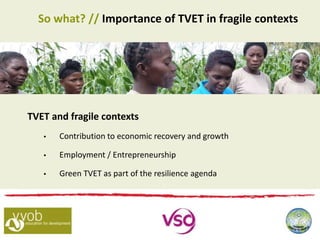
TVET and fragile contexts
 Contribution to economic recovery and growth
 Employment / Entrepreneurship
 Green TVET as part of the resilience agenda
2. Context
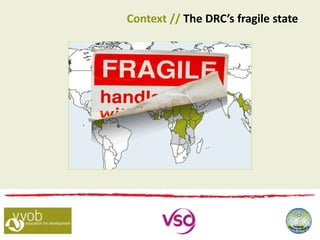
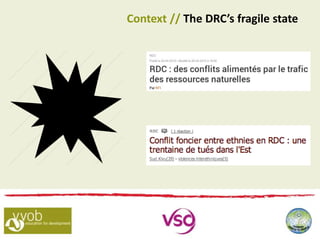
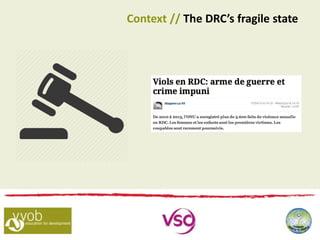
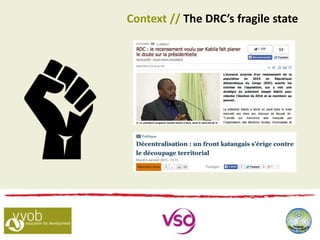
Context // The DRC’s fragile state
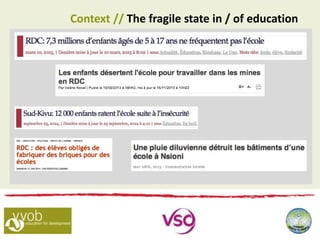
Context // The fragile state in / of education
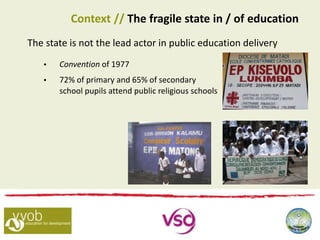
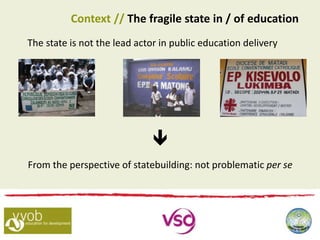
The state is not the lead actor in public education delivery
 Convention of 1977
 72% of primary and 65% of secondary
school pupils attend public religious schools
Context // The fragile state in / of education
The state is not the lead actor in public education delivery
Context // The fragile state in / of education

From the perspective of statebuilding: not problematic per se
Not problematic per se … BUT
Public education is (still) financed primarily by households
Context // The fragile state in / of education
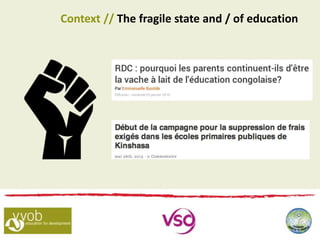
Context // The fragile state and / of education
Not problematic per se … BUT
Public education is delivered inequitably
 Regional inequities
 Socio-economic inequities
Context // The fragile state in / of education
3. VVOB in DRC
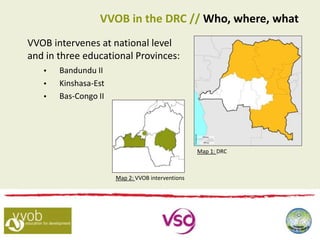
VVOB intervenes at national level
and in three educational Provinces:
 Bandundu II
 Kinshasa-Est
 Bas-Congo II
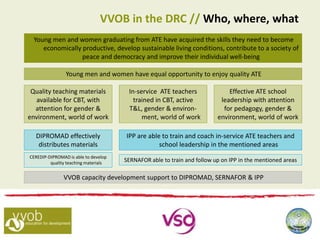
VVOB in the DRC // Who, where, what
Map 1: DRC
Map 2: VVOB interventions
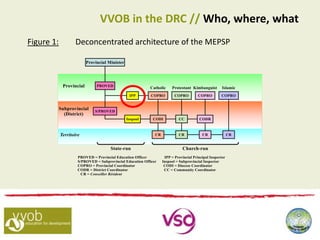
Figure 1: Deconcentrated architecture of the MEPSP
VVOB in the DRC // Who, where, what
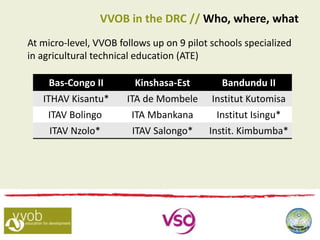
Bas-Congo II Kinshasa-Est Bandundu II
ITHAV Kisantu* ITA de Mombele Institut Kutomisa
ITAV Bolingo ITA Mbankana Institut Isingu*
ITAV Nzolo* ITAV Salongo* Instit. Kimbumba*
At micro-level, VVOB follows up on 9 pilot schools specialized
in agricultural technical education (ATE)
VVOB in the DRC // Who, where, what
Young men and women graduating from ATE have acquired the skills they need to become
economically productive, develop sustainable living conditions, contribute to a society of
peace and democracy and improve their individual well-being
Young men and women have equal opportunity to enjoy quality ATE
In-service ATE teachers
trained in CBT, active
T&L, gender & environ-
ment, world of work
Effective ATE school
leadership with attention
for pedagogy, gender &
environment, world of work
Quality teaching materials
available for CBT, with
attention for gender &
environment, world of work
IPP are able to train and coach in-service ATE teachers and
school leadership in the mentioned areas
DIPROMAD effectively
distributes materials
SERNAFOR able to train and follow up on IPP in the mentioned areas
CEREDIP-DIPROMAD is able to develop
quality teaching materials
VVOB capacity development support to DIPROMAD, SERNAFOR & IPP
Principle #1 Building on what’s there
In practice, VVOB
 implements the existing framework, however imperfectly, and
then works to adjust it
 builds on existing practice and seeks to address « discrete »
institutional barriers
VVOB in the DRC // Principles & practice
Principle #1 Building on what’s there
In practice, VVOB
 implements the existing framework, however imperfectly, and
then works to adjust it
 builds on existing practice and seeks to address « discrete »
institutional barriers
Principle #2 Moving beyond policy advice
In practice, VVOB
 engages technical assistance to support the implementation of
policies
VVOB in the DRC // Principles & practice
Principle #3 Acting as facilitators
In practice, VVOB
 helps to facilitate and mediate a local dialogue about problems
and solutions
VVOB in the DRC // Principles & practice
Principle #3 Acting as facilitators
In practice, VVOB
 helps to facilitate and mediate a local dialogue about problems
and solutions
Principle #4 Using macro – meso – micro levels as windows
of opportunity
In practice, VVOB
 adapts its support to emerging opportunities (and emerging
obstacles)
VVOB in the DRC // Principles & practice
Some concrete achievements
 new competency-based curricula for training in agriculture
officially approved (and being rolled out)
 IPP agricole and teachers trained in the use of these curricula
 competency-based exams organized for the first time on national
scale
 manual for apprenticeships developed and distributed in all ATE in
3 pilot Provinces
 43 apprenticeship contracts signed at local level
VVOB in the DRC // Principles & practice
Attention points
 TVET co-ordination and close collaboration with other
implementing agencies
 Technical assistance works in an inherently political context …
ensuring that the most vulnerable are reached is a challenge
VVOB in the DRC // Principles & practice
Thank you!
Welcome to get in touch: maud.seghers@vvob.be

Supporting Public Institutions in the Public Sector - Lessons from the DRC

  • 1.
    Supporting Public Institutionsin the Education Sector – Lessons from the DRC Maud Seghers, VVOB Live and Learn — Exploring Education in Fragile Contexts Brussels, 2/6/2015
  • 2.
    1. So what? Education as a site for statebuilding  Importance of TVET in fragile contexts 2. Context  The DRC’s fragile state  The fragile state in / of education 3. VVOB’s work in the DRC  Who, where, what  Principles & practice Intro // Structure of the presentation
  • 3.
  • 4.
    So what? //Education as a site for statebuilding Education and statebuilding  Education is highly visible and highly prized  Education is the «face» of the state and hence associated with its (perceived) legitimacy  Risks to state legitimacy when education (reform) takes back seat to other statebuilding efforts
  • 5.
    So what? //Importance of TVET in fragile contexts TVET and fragile contexts  Contribution to economic recovery and growth  Employment / Entrepreneurship  Green TVET as part of the resilience agenda
  • 6.
  • 7.
    Context // TheDRC’s fragile state
  • 8.
    Context // TheDRC’s fragile state
  • 9.
    Context // TheDRC’s fragile state
  • 10.
    Context // TheDRC’s fragile state
  • 11.
    Context // Thefragile state in / of education
  • 12.
    The state isnot the lead actor in public education delivery  Convention of 1977  72% of primary and 65% of secondary school pupils attend public religious schools Context // The fragile state in / of education
  • 13.
    The state isnot the lead actor in public education delivery Context // The fragile state in / of education  From the perspective of statebuilding: not problematic per se
  • 14.
    Not problematic perse … BUT Public education is (still) financed primarily by households Context // The fragile state in / of education
  • 15.
    Context // Thefragile state and / of education
  • 16.
    Not problematic perse … BUT Public education is delivered inequitably  Regional inequities  Socio-economic inequities Context // The fragile state in / of education
  • 17.
  • 18.
    VVOB intervenes atnational level and in three educational Provinces:  Bandundu II  Kinshasa-Est  Bas-Congo II VVOB in the DRC // Who, where, what Map 1: DRC Map 2: VVOB interventions
  • 19.
    Figure 1: Deconcentratedarchitecture of the MEPSP VVOB in the DRC // Who, where, what
  • 20.
    VVOB in theDRC // Who, where, what Bas-Congo II Kinshasa-Est Bandundu II ITHAV Kisantu* ITA de Mombele Institut Kutomisa ITAV Bolingo ITA Mbankana Institut Isingu* ITAV Nzolo* ITAV Salongo* Instit. Kimbumba* At micro-level, VVOB follows up on 9 pilot schools specialized in agricultural technical education (ATE)
  • 21.
    VVOB in theDRC // Who, where, what Young men and women graduating from ATE have acquired the skills they need to become economically productive, develop sustainable living conditions, contribute to a society of peace and democracy and improve their individual well-being Young men and women have equal opportunity to enjoy quality ATE In-service ATE teachers trained in CBT, active T&L, gender & environ- ment, world of work Effective ATE school leadership with attention for pedagogy, gender & environment, world of work Quality teaching materials available for CBT, with attention for gender & environment, world of work IPP are able to train and coach in-service ATE teachers and school leadership in the mentioned areas DIPROMAD effectively distributes materials SERNAFOR able to train and follow up on IPP in the mentioned areas CEREDIP-DIPROMAD is able to develop quality teaching materials VVOB capacity development support to DIPROMAD, SERNAFOR & IPP
  • 22.
    Principle #1 Buildingon what’s there In practice, VVOB  implements the existing framework, however imperfectly, and then works to adjust it  builds on existing practice and seeks to address « discrete » institutional barriers VVOB in the DRC // Principles & practice
  • 23.
    Principle #1 Buildingon what’s there In practice, VVOB  implements the existing framework, however imperfectly, and then works to adjust it  builds on existing practice and seeks to address « discrete » institutional barriers Principle #2 Moving beyond policy advice In practice, VVOB  engages technical assistance to support the implementation of policies VVOB in the DRC // Principles & practice
  • 24.
    Principle #3 Actingas facilitators In practice, VVOB  helps to facilitate and mediate a local dialogue about problems and solutions VVOB in the DRC // Principles & practice
  • 25.
    Principle #3 Actingas facilitators In practice, VVOB  helps to facilitate and mediate a local dialogue about problems and solutions Principle #4 Using macro – meso – micro levels as windows of opportunity In practice, VVOB  adapts its support to emerging opportunities (and emerging obstacles) VVOB in the DRC // Principles & practice
  • 26.
    Some concrete achievements new competency-based curricula for training in agriculture officially approved (and being rolled out)  IPP agricole and teachers trained in the use of these curricula  competency-based exams organized for the first time on national scale  manual for apprenticeships developed and distributed in all ATE in 3 pilot Provinces  43 apprenticeship contracts signed at local level VVOB in the DRC // Principles & practice
  • 27.
    Attention points  TVETco-ordination and close collaboration with other implementing agencies  Technical assistance works in an inherently political context … ensuring that the most vulnerable are reached is a challenge VVOB in the DRC // Principles & practice
  • 28.
    Thank you! Welcome toget in touch: maud.seghers@vvob.be

Editor's Notes

  • #5 So what? Why does VVOB care about the topic of education in fragile situations? Why should other European education practitioners? To answer the question of « why this topic matters to VVOB », first a quick word about the nature of our work. VVOB currently works in 9 countries in Sub-Sahara Africa, Latin America and the Caribbean and South-East Asia. Across countries, our interventions ultimately aim at providing quality education for all, so that all learners – boys and girls – gain the knowledge, skills and attitudes they need to succeed in life and to build a democratic, equitable and sustainable society. To achieve this goal, VVOB provides capacity development support to public institutions in the education sector. Ministries of Education are our strategic partners, specifically those departments responsible for the initial training and continuous professional development of teachers and school leaders. We work to strengthen these departments and their related (pedagogical) services and institutions both at the national and decentralized or deconcentrated level. While VVOB does not specifically «seek out» fragile situations, we do believe that our way of working has a specific added value in such contexts, particularly from the perspective of statebuilding. According to the Fragile States Principles (FSPs) of the OECD – specifically Principle 3 – statebuilding the central objective of international engagement in fragile contexts.1 As you know, the 10 FSPs were first adopted by OECD ministers in 2007 and in the meantime they are widely accepted as a point of reference for actors involved in development co-operation and humanitarian action in fragile and conflict-affected states. The principles were established because fragile states require different responses than those applied in better performing countries. Education, we would argue, is one of the most visible and far-reaching services that states provide, given that there is a school in every town or, just as important, citizens’ expectation of a school in every town. Demand for education is almost always high in fragile contexts. Delivering education services therefore plays an important part in statebuilding. Over the last ten years, at least five studies have examined in depth the role of education in building state legitimacy and capacity in fragile contexts. Collectively, these studies draw on case study research in 24 regions and countries, among which the DRC. This body of research firmly demonstrates the importance of education service delivery in building citizens’ trust in their government. Just as important, there are considerable risks to state legitimacy when education sector reforms take a back seat to other statebuilding efforts.2 For this reason, other European education practitioners should also be interested in the topic of today’s seminar. NOTES: 1 See: http://www.oecd.org/dacfragilestates/the10fragilestatesprinciples.htm 2 See: Withrop, R. & Matsui, E. (2013). A new agenda for education in fragile states. Working Paper 10, Center for Universal Education of the Brookings Institute. [Online] Available at: http://www.brookings.edu/research/papers/2013/08/education-agenda-fragile-states-winthrop
  • #6 So what? Why does VVOB care about TVET in fragile situations? Why should other European education practitioners? Fragility impedes economic development and, according to the World Bank’s 2011 World Development Report 2011, lack of economic opportunities and high unemployment are key sources of fragility. In fragile states, economic recovery and growth should therefore be among the core priorities of donors and implementing agencies. The empowerment of poor people – economic, political and social enables them to contribute to, participate in and benefit from this growth and longer-term statebuilding and peacebuilding. And while education specialists no longer claim that TVET in itself is a motor for economic recovery and growth or that investing in TVET autimatically leads to employment, it is clear to all that economic development will be impeded when no appropriately skilled workforce is available. Similarly, it is clear that possessing relevant skills is an advantage when seeking employment or starting a business.   The focus of VVOB’s intervention in the DRC is on agricultural technical education, because: - Agriculture is the pillar of the Congolese economy but remains largely unexploited. - Firms in DRC experience skills shortage in this growth sector - There is low level of education and lack of training in agriculture. A recent World Bank study on Demand and Supply of Skills in Agriculture in Bandundu and Bas Congo provinces (where VVOB is active), indicated that there is a low level of education in the active agriculture labor force, not only among seasonal workers and individual farmers but also among executives and owners of agro-businesses. The lack of appropriate training and illiteracy are issues that both enterprises and farmers perceived as key obstacles to improve their performance. In addition, the choice for agricultural technical education allows VVOB to establish linkages with the disaster risk reduction and climate change agenda, that is also of great importance to fragile contexts. Our efforts include incorporating environmental issues such as deforestation and energy conservation into teaching and learning materials and into teacher professional development. Empowering learners to contribute to environmental preservation and pro­tection through environmental education and green TVET helps to make education more relevant and responsive to contemporary and emerging challenges, including sustainable development.
  • #8 As you know, there is no internationally-agreed definition or shared understanding of fragility among those working in development and humanitarian aid. On different agencies’ lists, different countries feature as «fragile». Moreover, the lists tend to change, sometimes drastically, over time, as they are made up with hindsight but usually lack in predictive value. The OECD’s classification of fragile states, which serves as a point of reference for many donor governments – including the Belgian Directorate-General of Development Co-operation and Humanitarian Aid (DGD) – is frequently challenged for its own fragile conceptual basis.3 That said, few would argue with the OECD’s assessment that the DRC is indeed a highly fragile country. Why is this the case? NOTES: 3 See: http://www.fragilestates.org/2015/04/17/what-the-oecd-still-does-not-understand-about-fragile-states/
  • #9 For starters, continuing armed conflicts, particularly in the East, remain to be resolved, as do their underlying societal grievances, such as ethnic divisions, disagreements over land, resources and economic opportunities.
  • #10 Manifest injustice can and does continue on a large scale.4 NOTES: 4 See: http://www.hrw.org/sites/default/files/related_material/DRC0614_briefingpaper_brochure%20coverJune%209%202014.pdf ; http://law.uoregon.edu/org/oril/docs/15-1/Ruffer.pdf
  • #11 And the legitimacy of the political regime is frequently challenged.5 NOTES: 5 F.ex., recent amendments to the law on elections and specifically the introduction of a provision stating that a census must be carried out before the elections which are due to take place in 2016 + the precipitated découpage of the country into 26 Provinces from the current 11, have been strongly criticized this year as a move to delay President Kabila’s retreat from power. See: http://www.swisspeace.ch/fileadmin/user_upload/Media/Publications/Newsletter/2015/NL_137_en.pdf; https://www.foreignaffairs.com/articles/democratic-republic-congo/2015-05-21/carving-congo
  • #12 In addition, the following two features are frequently mentioned – and these are also important to understand both the « fragility » of the state in the education sector and the « fragility » of the education sector itself: - The inability of the state to deliver basic public services and / or to meet public expectations about service delivery And - The inequitable delivery of basic public services Just like access to justice and personal safety beyond the basic level provided in state survival, service delivery is one of the expected functions of the state. Expected functions relate to the legitimacy of the state,6 or – as in the case of the DRC – the lack thereof. NOTES: 6 Herbert, S. (2014). Sequencing reforms in fragile states: Topic guide. Birmingham, UK: GSDRC, University of Birmingham. [Online] Available at: http://www.gsdrc.org/docs/open/GSDRC_SRFS_topic_guide.pdf
  • #13 Certainly, in the DRC, the state is by no means the lead actor in the delivery of public education. In fact, non-state actors have been present in the education sector since colonial times, as the colonial state gave a near monopoly to the churches (Catholic and Protestant) to organize the education sector. This arrangement was continued after independence, and confirmed in 1977 through the signature of the so-called “Convention”, an agreement for the management of national schools between the state and the churches. Following the convention, the public education sector was divided into five networks: the official network or “non-conventionized” schools (non conventionnés) which are directly managed by the state, and the four “conventionized” networks, in which the schools are each managed by a different religious network: the Catholic, Kimbanguist, Protestant and Islamic networks. Each of these networks has its own administration and, as such, religious associations exercise considerable day-to-day oversight and managerial autonomy over their respective schools. The agents who work in these administrations are, however, civil servants, who receive state salaries. And the state did also retain the organizational power (pouvoir organisateur) over the sector. But while the state is officially in the driver’s seat, non-state actors de facto play the leading role in the delivery of education services and the state must ally itself with these in order to maintain its limited presence and authority. As such a concept of “negotiated statehood” has arisen between the state and non-state actors. In the context of weak state capacity, the relationship is one of “brokered autonomy”, where the state gains cooperation from non-state actors, who in return are granted significant autonomy within their own domains.7 Currently, 72% of all primary and 65% of secondary school pupils attend public religious schools (écoles conventionnés). Secular state-run public schools cater to 19% of primary and 21% of secondary school pupils. Private education accounts for the remainder of those enrolled.8 NOTES: 7 Titeca, K. & De Herdt, T. (2011). Real governance beyond the ‘failed state’: negotiating education in the Democratic Republic of the Congo. In African Affairs, 110(439): 1-19. 8 UNICEF & IIEP Pôle de Dakar (2014). Rapport d’état du système éducatif – République Démocratique du Congo. Pour une éducation au service de la croissance et de la paix. [Online] Available at: https://www.iipe-poledakar.org/sites/default/files/fields/publication_files/resen-rdc-2014-resume.pdf
  • #14 From the perspective of statebuilding, this need not be problematic per se. Citizens’ trust in their government can be built even when governments are not directly delivering education services but instead are ensuring that non-state actors are doing so. In contexts where government capacity to deliver services of basic quality is minimal, governments are often better off outsourcing good-quality service delivery than delivering poor quality services themselves, presumably while they build and strengthen their own systems. In this case it is of course still essential that the government is taking responsibility for the services provided to its citizens and it is important that the government’s leadership is visible.8 NOTES: 8 See: Withrop, R. & Matsui, E. (2013). A new agenda for education in fragile states. Working Paper 10, Center for Universal Education of the Brookings Institute. [Online] Available at: http://www.brookings.edu/research/papers/2013/08/education-agenda-fragile-states-winthrop
  • #15 While it is not necessarily problematic from a statebuilding perspective that non-state actors play a major role in education service delivery in the DRC, there are nevertheless important indications of the education sector’s and the state’s fragility. For example, public education continues to be financed primarily by households. In 2012, households contributed up to 77% of the current budget of primary and secondary education, through various expenses such as registration fees (minerval), insurance, functioning costs, motivation fees (teacher top-ups), etc.8 While this is a decrease vis-à-vis the 90% contribution in 2005,9 these numbers do still class the DRC among the countries where household contributions are among the most substantial. In the case of TVET, the figures have not changed much since 2005.10 TVET provision is more costly than primary and general education, and this translates into tuition fees that are above those due in the general education system. In addition to the more typical fees, parents who stimulate their children to opt for TVET can count on paying for consumables and supplies and they may need to reckon with the cost of renting machines or equipment, when the school lacks proper workshops. Unsurprisingly, the cost of education is a major cause of non-enrolment and early leaving. NOTES: 8 See: UNICEF & IIEP Pôle de Dakar (2014). Rapport d’état du système éducatif – République Démocratique du Congo. Pour une éducation au service de la croissance et de la paix. [Online] Available at: https://www.iipe-poledakar.org/sites/default/files/fields/publication_files/resen-rdc-2014-resume.pdf 9 See: Titeca, K. & De Herdt, T. (2011). Real governance beyond the ‘failed state’: negotiating education in the Democratic Republic of the Congo. In African Affairs, ??(??): 1-19. 10 See: AfDB / OECD (2008). African Economic Outlook – DRC. [Online] Available at: http://www.oecd.org/dev/emea/40577125.pdf
  • #16 As the angry newspaper headlines on the slide shows, this sorry state of affairs does not help the legitimacy of the Congolese education system or of the (state) actors that organize it. (Exorbitant) school fees continue to be a major bone of contention. Understandably so, because it is almost a decade ago that free and compulsory primary education was written into the Constitution (2006, article 46). NOTES: 8 See: UNICEF & IIEP Pôle de Dakar (2014). Rapport d’état du système éducatif – République Démocratique du Congo. Pour une éducation au service de la croissance et de la paix. [Online] Available at: https://www.iipe-poledakar.org/sites/default/files/fields/publication_files/resen-rdc-2014-resume.pdf 9 See: Titeca, K. & De Herdt, T. (2011). Real governance beyond the ‘failed state’: negotiating education in the Democratic Republic of the Congo. In African Affairs, ??(??): 1-19. 10 See: AfDB / OECD (2008). African Economic Outlook – DRC. [Online] Available at: http://www.oecd.org/dev/emea/40577125.pdf
  • #19 VVOB intervenes at the national as well as the first decentralized level of the education sector. At the national level, VVOB’s strategic partner is the Ministère de l’Enseignement Primaire, Secondaire et Professionnel (MEPSP), or more precisely, the former MEPSP. In 2014, a government reshuffle established a new Ministry of TVET (Ministère de l’Enseignement Technique et Professionnel, METP). The former Ministère de l’Enseignement Primaire, Secondaire et Professionnel (MEPSP) has been renamed Ministère de l’Enseignement Primaire, Secondaire et Initiation à la Citoyenneté (MEPS-INC), following the transfer of vocational training to the new ministry (METP) and the addition of a new responsibility for “citizenship initiation”. However, as the new METP is still in the process of establishing its administration, and the organizational consequences of the reshuffle are not yet clear, I continue to refer to the old structure. VVOB works together with 2 directorates of the former MEPSP: With the National Service for Training (Service National de Formation, SERNAFOR) of the former MEPSP’s General Inspection (Inspection Générale). This service is responsible for teachers’ continuous professional development and it has specialized services for each cycle of primary and secondary education, including TVET. And With the directorate responsible for curriculum reform and textbooks – the School Programs and Materials Directorate (Direction des PROgrammes scolaires et MAtériel Didactique, DIPROMAD). At the decentralized level, VVOB intervenes in 3 educational provinces: Bandundu II, Kinshasa-Est and Bas-Congo II. The DRC has a total of 11 – and soon 26 – administrative provinces. The education sector, however, is decentralized into 30 educational provinces. As the maps show, the 3 educational provinces where VVOB works, are far removed from the 6 so-called “conflict provinces” (Equateur, Orientale, North and South Kivu, Maniema and Katanga).
  • #20 At the provincial level, VVOB’s operational partner is the office of the Provincial Principal Inspector (Inspecteur Principal Provincial, IPP), which falls under the authority of the General Inspection (Inspection Générale) at national level. The IPP deals with teacher training, educational supervision and evaluation.
  • #21 At micro-level, VVOB follows up on 9 pilot schools specialized in agricultural technical education. 4 out of 9 of these are state-managed; the majority are managed by religious orders – a mix of conventionnées caholiques and conventionnées protestantes – and they are indicated with a * in the table. The sample is to some extent representative, as TVET provision, like eduction service delivery in general, is also dominated by the écoles conventionnées.
  • #22 As the slide shows, VVOB’s role is to provide capacity development support to DIPROMAD, SERNAFOR and the IPPs. This support is intended to reinforce these public institutions in their existing mandate. In a country such as the DRC, where the state is not the lead actor in education service delivery it is essential that the government takes re­sponsibility for the services provided to its citizens. To build the legitimacy of the state, it is also important that the government’s leadership becomes visible. The aim is to improve the quality of agricultural technical education … at the very least in the 3 pilot educational provinces, but – if all goes well – also on a wider scale. VVOB’s support focuses predominantly on : - Teacher professional development - Effective school leadership Because research has shown that, more so than anything else, these factors are key to quality education, even in contexts where the “hardware” – proper infrastructure (f.ex. for workshops) and equipment – is lacking. It is estimated that between 70% and 90% of the DRC’s TVET institutions lack the necessary “hardware” … clearly a challenge that cannot be addressed in the short run and that requires a massive financial investment. The advantage of focusing on agricultural technical education, in these circumstances, is that the schools usually do have land in abundance, and that even simple technologies can provide meaningful pedagogic experiences. The focus on quality is deliberate. There is growing recognition that education’s full potential for advancing the welfare of people in fragile states will only be fulfilled, like in any contexts, when it is of reasonably good quality. In the DRC, as in most fragile states quality learning lags far behind and receives limited attention from policy-makers who tend to be heavily focused on restoring access.
  • #23 When providing capacity development support around the world, VVOB values and practices a number of principles. Some of these seem to be particularly important to our work in the DRC … and possibly in other fragile contexts as well. Principle #1 : Building on what’s there In practice, VVOB - builds on existing practice and seeks to address « discrete » institutional barriers Rather than seeking wholesale simultaneous change, we (now) opt for incremental, adaptive change. - implements the existing framework, however imperfectly, and then works to adjust it In other words, we (try to) resist the tendency to want to start afresh with a revised legal, policy or regulatory framework. In a way, these are principles are actually lessons learned. In 2009, when VVOB started to work in agricultural TVET in the DRC, we actually collaborated with BTC, APEFE and UNESCO to formulate a strategie for the development of the TVET sub-sector. This proved a mitigated success: only part of the strategy was taken up by the government in its own stratégie quinquennale (2010/2011-2015/2016) pour le développement du sous-secteur de l’EPSP. VVOB adjusted its strategy and decided to support the Minister / Ministry in the implementation of their own strategy. Within this existing framework, it was still possible for VVOB to focus on priorities such as TVET quality and relevance and strengthening public institutions.
  • #24 The second principle is closely related to the first. Principle #2 Moving beyond policy advice In practice, VVOB - engages technical assistance to support the implementation of policies Very often, technical assistance – even when it has the purpose of statebuilding, or hopes to bolster the legitimacy of public institutions as a “side effect” – is engaged to advise on the content of policies. While we do provide such advice under certain circumstances (f.ex. windows of opportunity), our focus in the DRC is on policy implementation. To improve the legitimacy of public institutions “on the ground”, they need to become more visible and they need to be able to take the lead in certain processes. Especially in fragile contexts, this is more urgent that perfect policy documents.
  • #25 Principle #3 Acting as facilitators In practice, VVOB - helps to facilitate and mediate a local dialogue about problems and solutions We frequently see external agencies provide the Ministry and our operational partners with “take it or lave it” technical advice. VVOB hopes to be an antidote: our capacity development typology and intervention logic explicitly foresees an evolution from more “hands on” “expert” advice to more “hands off” process facilitation or accompaniment, coaching and mentoring. This evolution is monitored throughout the program cycle and it is part of annual reporting.
  • #26  Principle #4 Using macro – meso – micro levels as windows of opportunity In practice, VVOB - adapts its support to emerging opportunities (and emerging obstacles) When working in fragile contexts, it is necessary to remain adaptive and flexible, while keeping your eyes on results. The context tends to change rapidly, and often in unforeseen ways, and as an external actor, VVOB needs to be able to adjust. For example, the government reshuffle and creation of a Ministry of TVET that was mentioned earlier, came as somewhat of a surprise to VVOB … despite close and regular contacts with the former MEPSP. The fact that the administration of the new Ministry is not yet in place, makes it difficult at the moment to advance with some of our national-level goals. The macro-meso-micro approach that we opted for, allows us to continue operations and obtain results.