Mobile working for teams, managers, employees
• Working remotely will become second nature
when you do it all the time.
• But if you need to suddenly transition to
remote work, you won't necessarily have
effective systems in place.
• Remote work is not only dispatching and
managing tasks, it is trust management and
servant leadership.
• Therefore:
• Mimic your company culture
• Accept social times
• Enhance transparency
• Brainstorm differently
• Flexibility vs. Normalcy
Remote work for teams
Remote work for managers
Remote work for employees
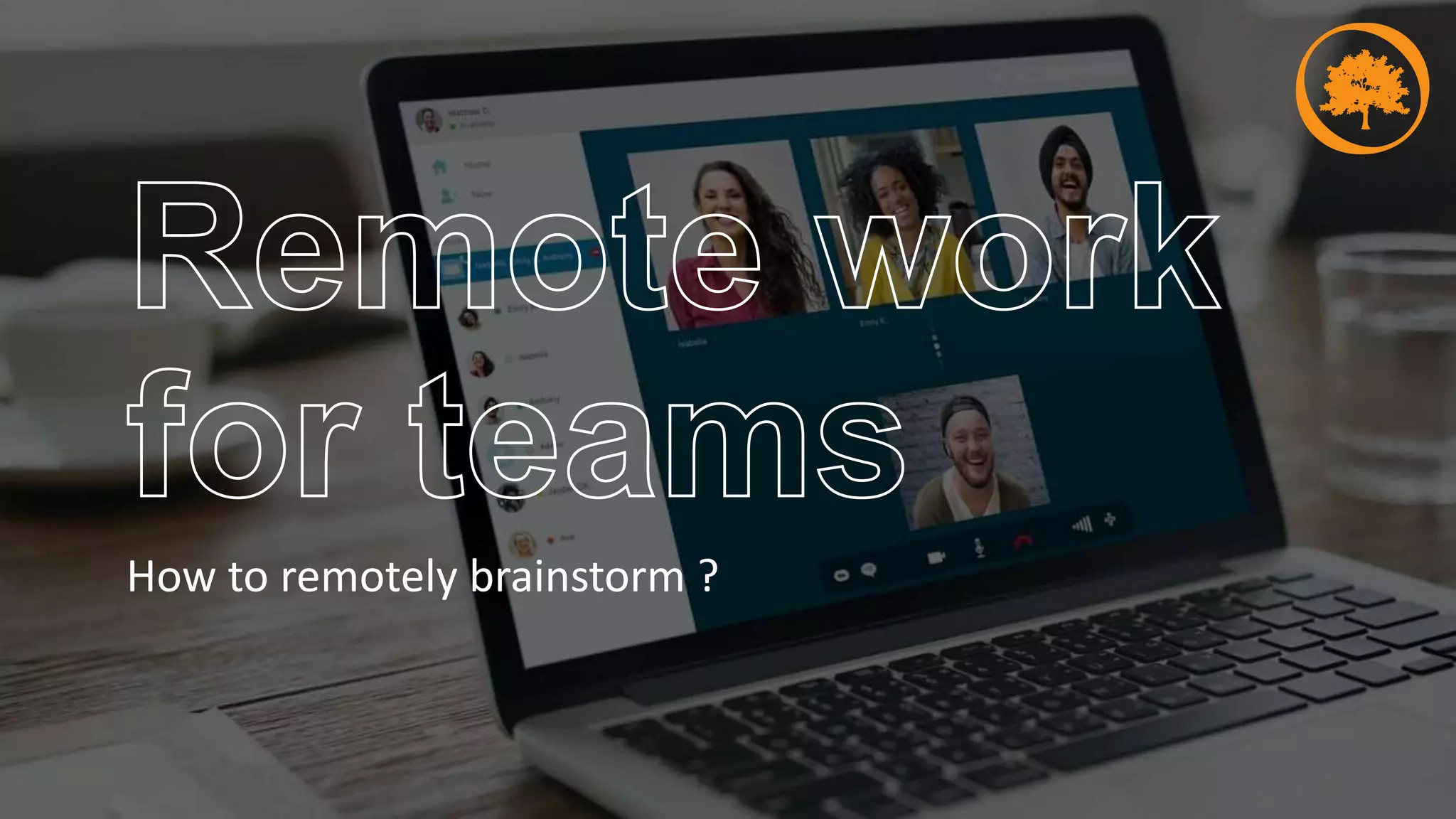
How to remotely brainstorm ?
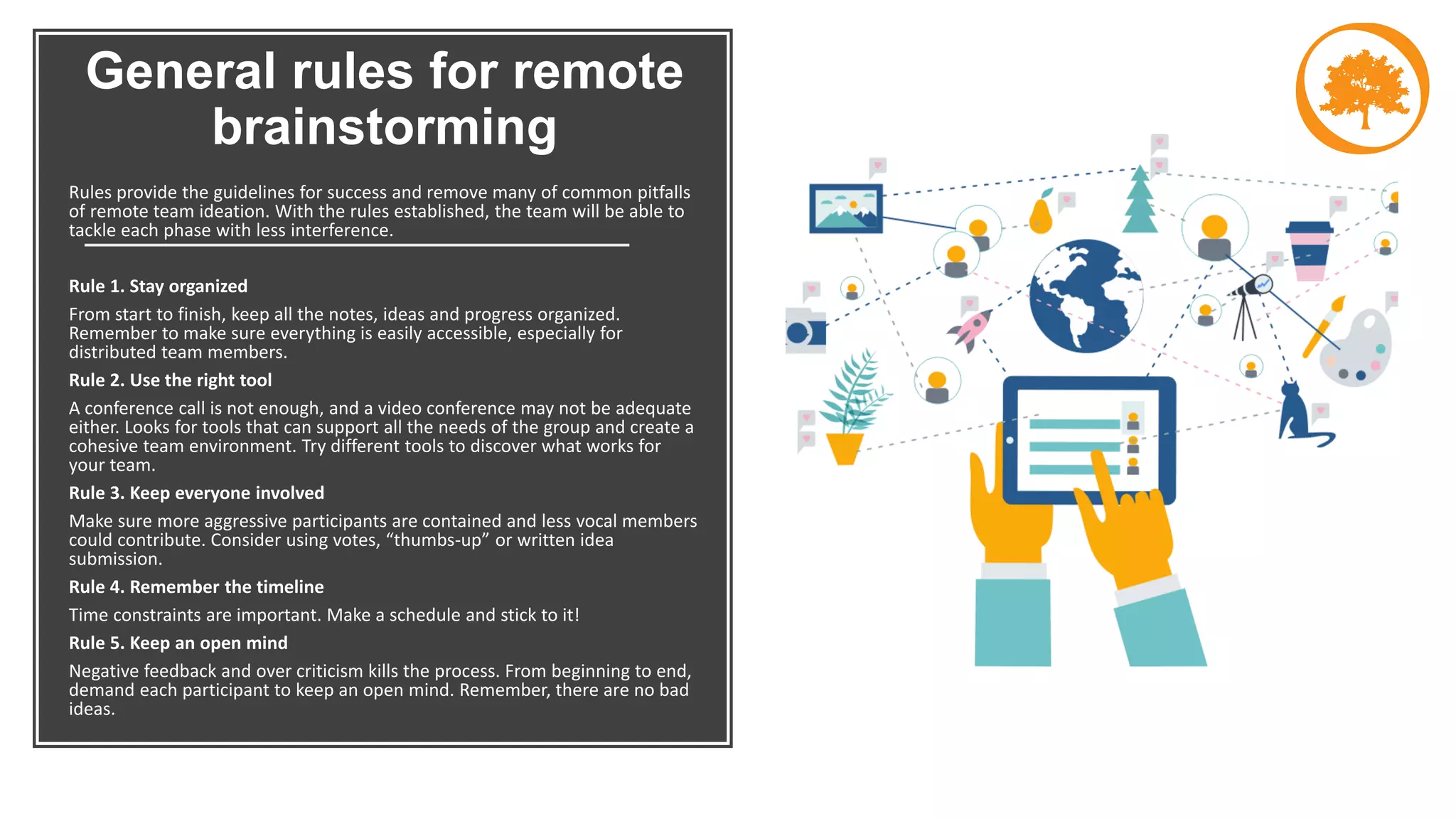
General rules for remote
brainstorming
Rules provide the guidelines for success and remove many of common pitfalls
of remote team ideation. With the rules established, the team will be able to
tackle each phase with less interference.
Rule 1. Stay organized
From start to finish, keep all the notes, ideas and progress organized.
Remember to make sure everything is easily accessible, especially for
distributed team members.
Rule 2. Use the right tool
A conference call is not enough, and a video conference may not be adequate
either. Looks for tools that can support all the needs of the group and create a
cohesive team environment. Try different tools to discover what works for
your team.
Rule 3. Keep everyone involved
Make sure more aggressive participants are contained and less vocal members
could contribute. Consider using votes, “thumbs-up” or written idea
submission.
Rule 4. Remember the timeline
Time constraints are important. Make a schedule and stick to it!
Rule 5. Keep an open mind
Negative feedback and over criticism kills the process. From beginning to end,
demand each participant to keep an open mind. Remember, there are no bad
ideas.
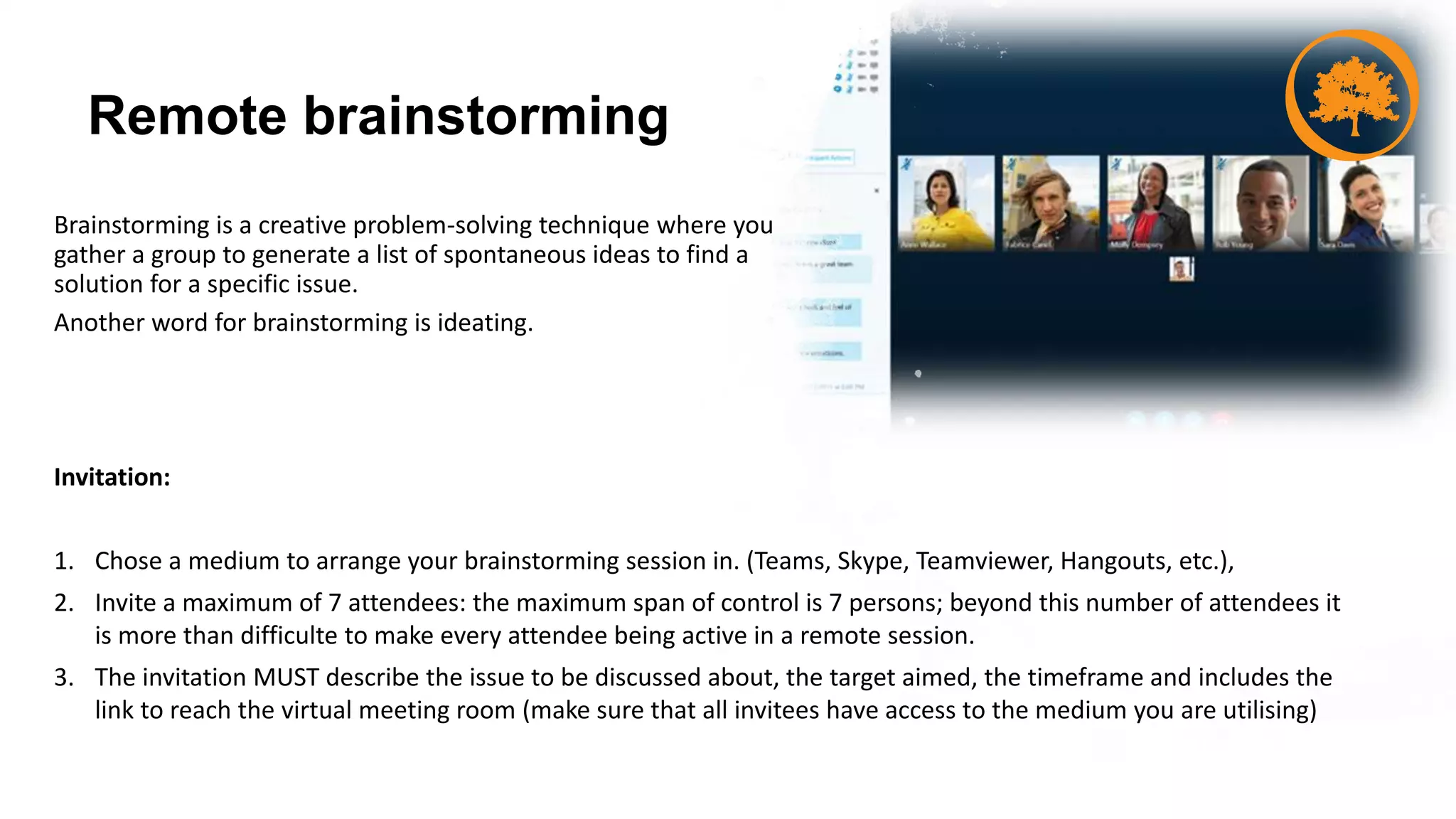
Remote brainstorming
Brainstorming is a creative problem-solving technique where you
gather a group to generate a list of spontaneous ideas to find a
solution for a specific issue.
Another word for brainstorming is ideating.
Invitation:
1. Chose a medium to arrange your brainstorming session in. (Teams, Skype, Teamviewer, Hangouts, etc.),
2. Invite a maximum of 7 attendees: the maximum span of control is 7 persons; beyond this number of attendees it
is more than difficulte to make every attendee being active in a remote session.
3. The invitation MUST describe the issue to be discussed about, the target aimed, the timeframe and includes the
link to reach the virtual meeting room (make sure that all invitees have access to the medium you are utilising)
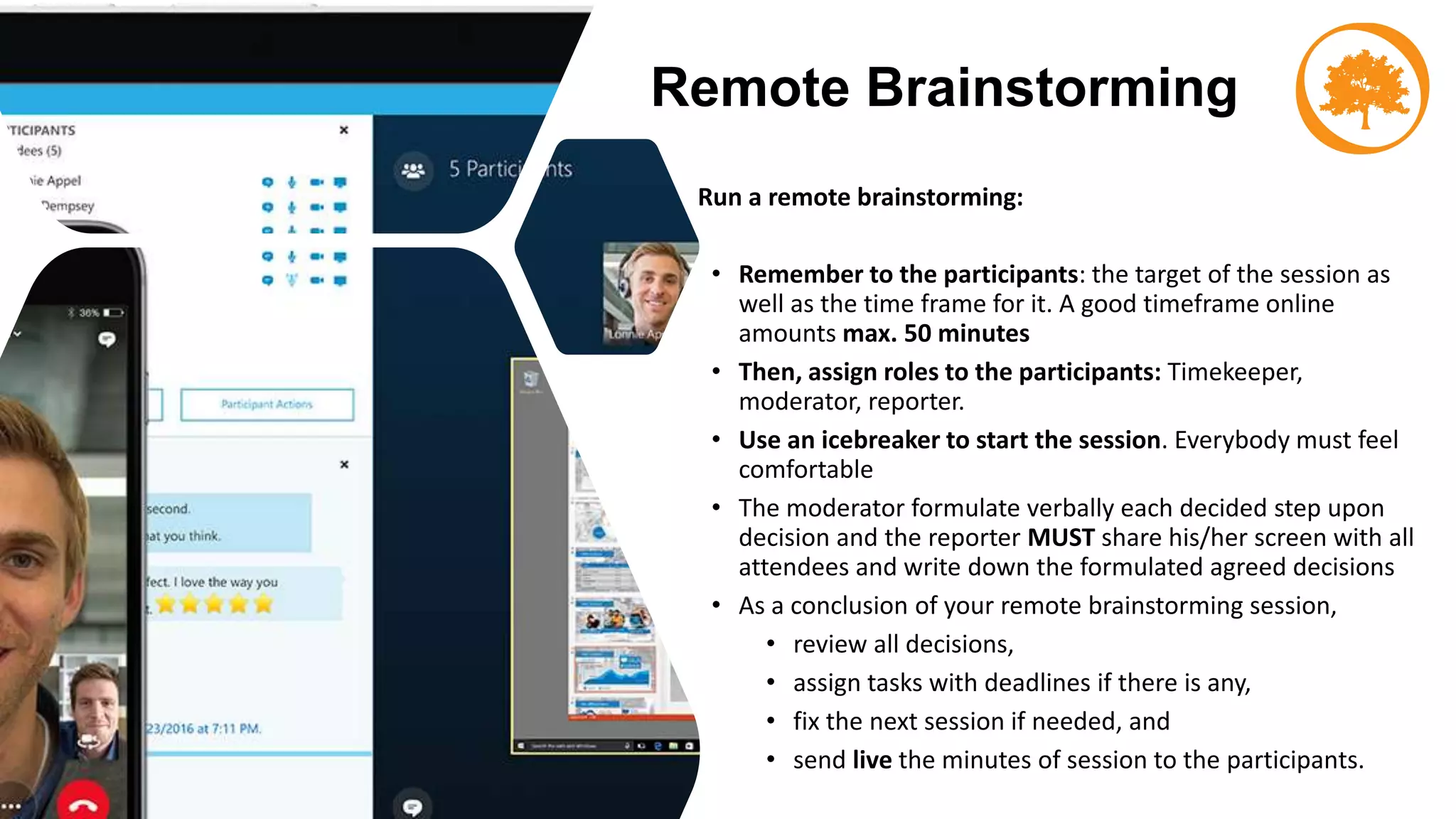
Remote Brainstorming
Run a remote brainstorming:
• Remember to the participants: the target of the session as
well as the time frame for it. A good timeframe online
amounts max. 50 minutes
• Then, assign roles to the participants: Timekeeper,
moderator, reporter.
• Use an icebreaker to start the session. Everybody must feel
comfortable
• The moderator formulate verbally each decided step upon
decision and the reporter MUST share his/her screen with all
attendees and write down the formulated agreed decisions
• As a conclusion of your remote brainstorming session,
• review all decisions,
• assign tasks with deadlines if there is any,
• fix the next session if needed, and
• send live the minutes of session to the participants.
From trust building to getting valuable output
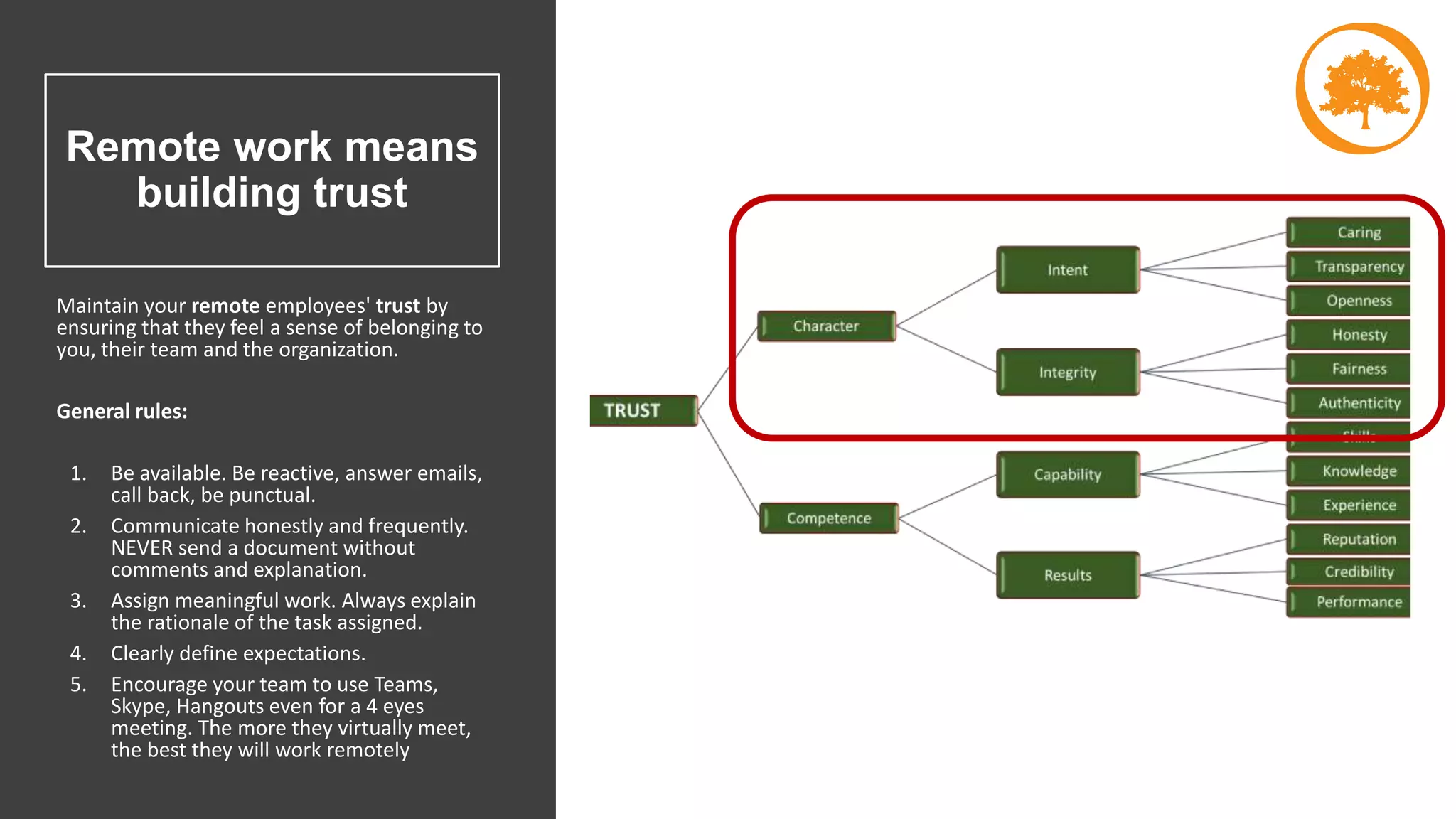
Remote work means
building trust
Maintain your remote employees' trust by
ensuring that they feel a sense of belonging to
you, their team and the organization.
General rules:
1. Be available. Be reactive, answer emails,
call back, be punctual.
2. Communicate honestly and frequently.
NEVER send a document without
comments and explanation.
3. Assign meaningful work. Always explain
the rationale of the task assigned.
4. Clearly define expectations.
5. Encourage your team to use Teams,
Skype, Hangouts even for a 4 eyes
meeting. The more they virtually meet,
the best they will work remotely
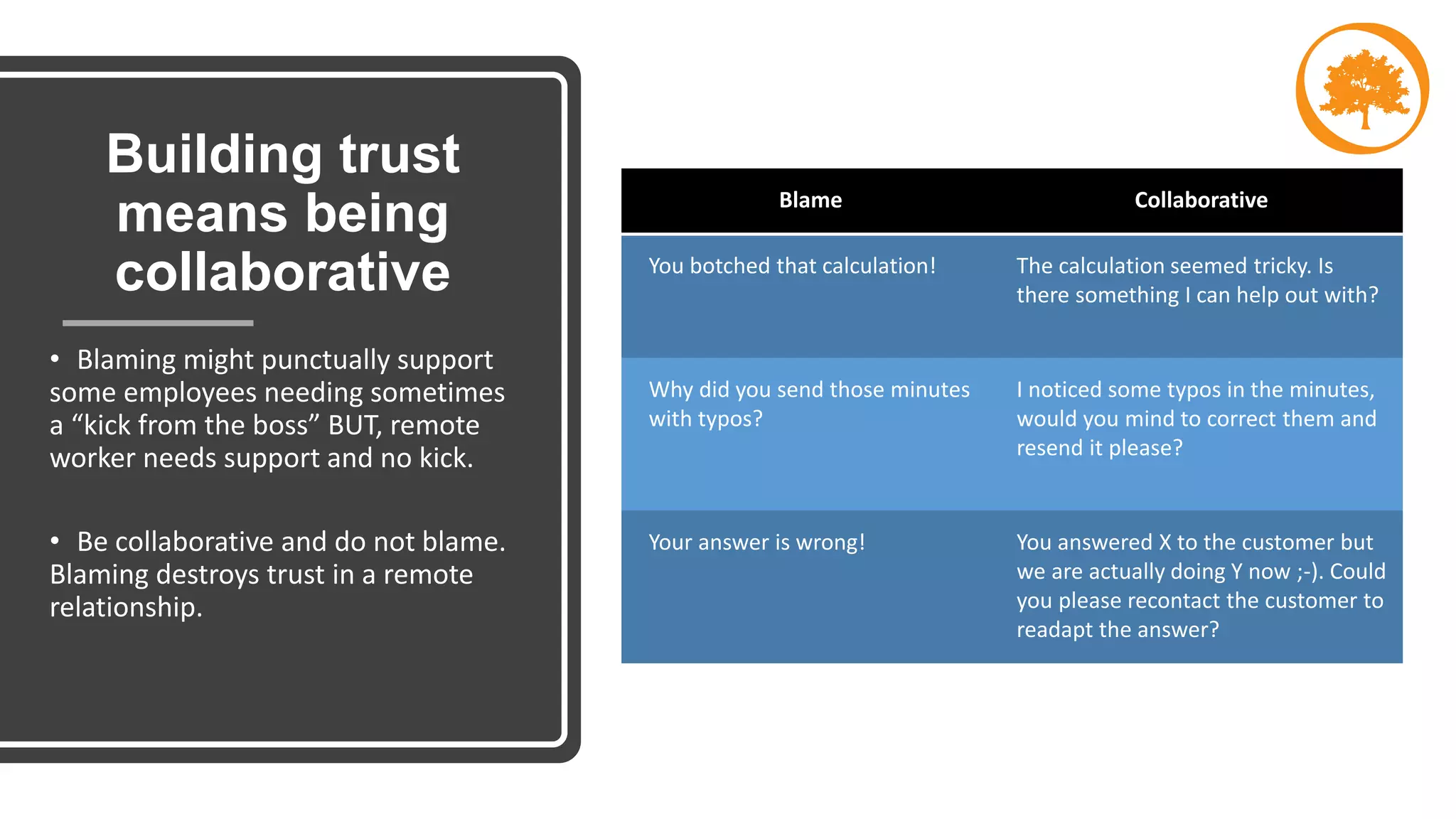
Building trust
means being
collaborative
• Blaming might punctually support
some employees needing sometimes
a “kick from the boss” BUT, remote
worker needs support and no kick.
• Be collaborative and do not blame.
Blaming destroys trust in a remote
relationship.
Blame Collaborative
You botched that calculation! The calculation seemed tricky. Is
there something I can help out with?
Why did you send those minutes
with typos?
I noticed some typos in the minutes,
would you mind to correct them and
resend it please?
Your answer is wrong! You answered X to the customer but
we are actually doing Y now ;-). Could
you please recontact the customer to
readapt the answer?
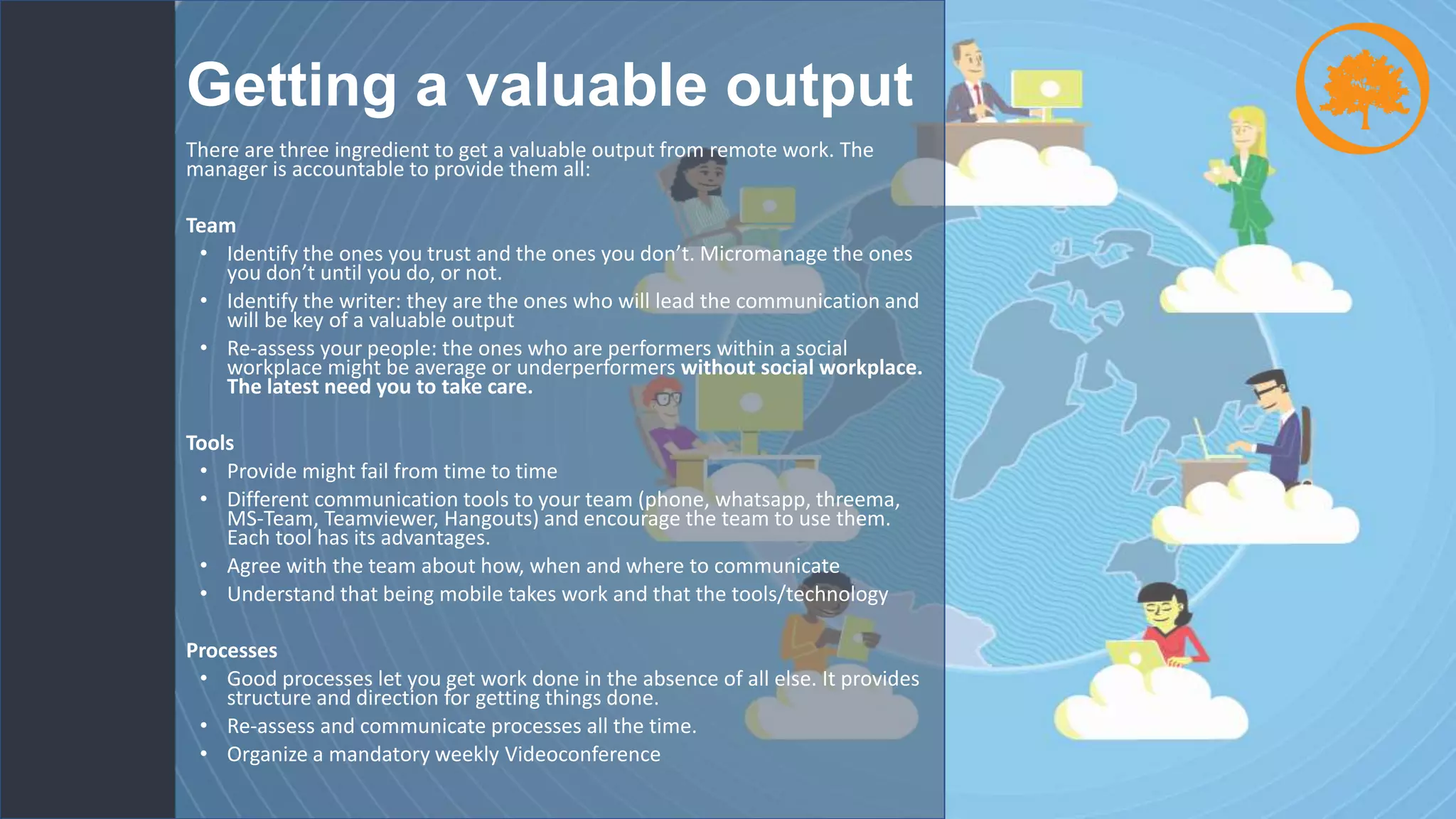
Getting a valuable output
There are three ingredient to get a valuable output from remote work. The
manager is accountable to provide them all:
Team
• Identify the ones you trust and the ones you don’t. Micromanage the ones
you don’t until you do, or not.
• Identify the writer: they are the ones who will lead the communication and
will be key of a valuable output
• Re-assess your people: the ones who are performers within a social
workplace might be average or underperformers without social workplace.
The latest need you to take care.
Tools
• Provide might fail from time to time
• Different communication tools to your team (phone, whatsapp, threema,
MS-Team, Teamviewer, Hangouts) and encourage the team to use them.
Each tool has its advantages.
• Agree with the team about how, when and where to communicate
• Understand that being mobile takes work and that the tools/technology
Processes
• Good processes let you get work done in the absence of all else. It provides
structure and direction for getting things done.
• Re-assess and communicate processes all the time.
• Organize a mandatory weekly Videoconference
From organizing a routine to staying connected with the
team
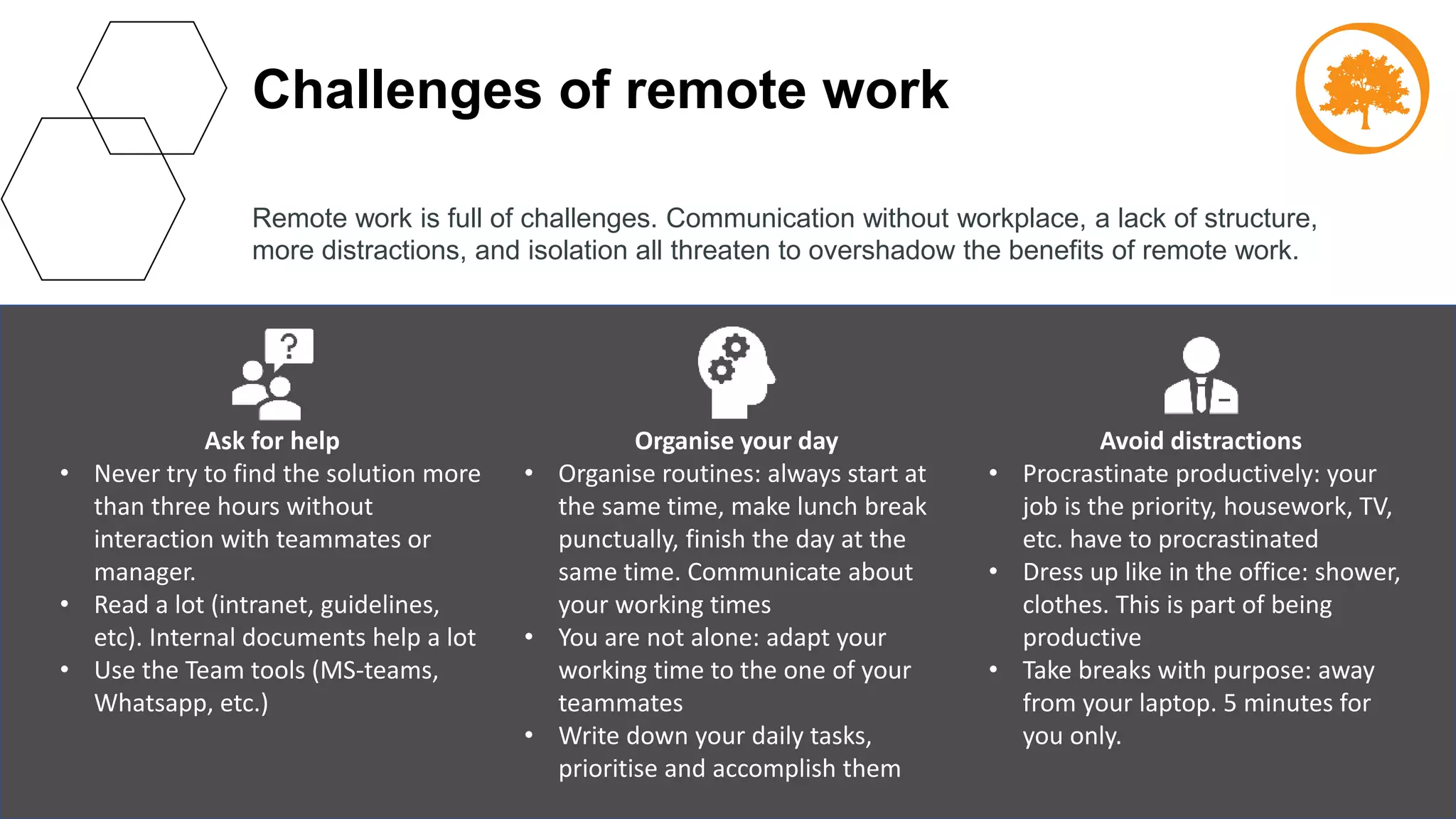
Challenges of remote work
Remote work is full of challenges. Communication without workplace, a lack of structure,
more distractions, and isolation all threaten to overshadow the benefits of remote work.
Ask for help
• Never try to find the solution more
than three hours without
interaction with teammates or
manager.
• Read a lot (intranet, guidelines,
etc). Internal documents help a lot
• Use the Team tools (MS-teams,
Whatsapp, etc.)
Organise your day
• Organise routines: always start at
the same time, make lunch break
punctually, finish the day at the
same time. Communicate about
your working times
• You are not alone: adapt your
working time to the one of your
teammates
• Write down your daily tasks,
prioritise and accomplish them
Avoid distractions
• Procrastinate productively: your
job is the priority, housework, TV,
etc. have to procrastinated
• Dress up like in the office: shower,
clothes. This is part of being
productive
• Take breaks with purpose: away
from your laptop. 5 minutes for
you only.
Gilles Roux

Remote Work

  • 1.
    Mobile working forteams, managers, employees
  • 2.
    • Working remotelywill become second nature when you do it all the time. • But if you need to suddenly transition to remote work, you won't necessarily have effective systems in place. • Remote work is not only dispatching and managing tasks, it is trust management and servant leadership. • Therefore: • Mimic your company culture • Accept social times • Enhance transparency • Brainstorm differently • Flexibility vs. Normalcy
  • 3.
    Remote work forteams Remote work for managers Remote work for employees
  • 4.
    How to remotelybrainstorm ?
  • 5.
    General rules forremote brainstorming Rules provide the guidelines for success and remove many of common pitfalls of remote team ideation. With the rules established, the team will be able to tackle each phase with less interference. Rule 1. Stay organized From start to finish, keep all the notes, ideas and progress organized. Remember to make sure everything is easily accessible, especially for distributed team members. Rule 2. Use the right tool A conference call is not enough, and a video conference may not be adequate either. Looks for tools that can support all the needs of the group and create a cohesive team environment. Try different tools to discover what works for your team. Rule 3. Keep everyone involved Make sure more aggressive participants are contained and less vocal members could contribute. Consider using votes, “thumbs-up” or written idea submission. Rule 4. Remember the timeline Time constraints are important. Make a schedule and stick to it! Rule 5. Keep an open mind Negative feedback and over criticism kills the process. From beginning to end, demand each participant to keep an open mind. Remember, there are no bad ideas.
  • 6.
    Remote brainstorming Brainstorming isa creative problem-solving technique where you gather a group to generate a list of spontaneous ideas to find a solution for a specific issue. Another word for brainstorming is ideating. Invitation: 1. Chose a medium to arrange your brainstorming session in. (Teams, Skype, Teamviewer, Hangouts, etc.), 2. Invite a maximum of 7 attendees: the maximum span of control is 7 persons; beyond this number of attendees it is more than difficulte to make every attendee being active in a remote session. 3. The invitation MUST describe the issue to be discussed about, the target aimed, the timeframe and includes the link to reach the virtual meeting room (make sure that all invitees have access to the medium you are utilising)
  • 7.
    Remote Brainstorming Run aremote brainstorming: • Remember to the participants: the target of the session as well as the time frame for it. A good timeframe online amounts max. 50 minutes • Then, assign roles to the participants: Timekeeper, moderator, reporter. • Use an icebreaker to start the session. Everybody must feel comfortable • The moderator formulate verbally each decided step upon decision and the reporter MUST share his/her screen with all attendees and write down the formulated agreed decisions • As a conclusion of your remote brainstorming session, • review all decisions, • assign tasks with deadlines if there is any, • fix the next session if needed, and • send live the minutes of session to the participants.
  • 8.
    From trust buildingto getting valuable output
  • 9.
    Remote work means buildingtrust Maintain your remote employees' trust by ensuring that they feel a sense of belonging to you, their team and the organization. General rules: 1. Be available. Be reactive, answer emails, call back, be punctual. 2. Communicate honestly and frequently. NEVER send a document without comments and explanation. 3. Assign meaningful work. Always explain the rationale of the task assigned. 4. Clearly define expectations. 5. Encourage your team to use Teams, Skype, Hangouts even for a 4 eyes meeting. The more they virtually meet, the best they will work remotely
  • 10.
    Building trust means being collaborative •Blaming might punctually support some employees needing sometimes a “kick from the boss” BUT, remote worker needs support and no kick. • Be collaborative and do not blame. Blaming destroys trust in a remote relationship. Blame Collaborative You botched that calculation! The calculation seemed tricky. Is there something I can help out with? Why did you send those minutes with typos? I noticed some typos in the minutes, would you mind to correct them and resend it please? Your answer is wrong! You answered X to the customer but we are actually doing Y now ;-). Could you please recontact the customer to readapt the answer?
  • 11.
    Getting a valuableoutput There are three ingredient to get a valuable output from remote work. The manager is accountable to provide them all: Team • Identify the ones you trust and the ones you don’t. Micromanage the ones you don’t until you do, or not. • Identify the writer: they are the ones who will lead the communication and will be key of a valuable output • Re-assess your people: the ones who are performers within a social workplace might be average or underperformers without social workplace. The latest need you to take care. Tools • Provide might fail from time to time • Different communication tools to your team (phone, whatsapp, threema, MS-Team, Teamviewer, Hangouts) and encourage the team to use them. Each tool has its advantages. • Agree with the team about how, when and where to communicate • Understand that being mobile takes work and that the tools/technology Processes • Good processes let you get work done in the absence of all else. It provides structure and direction for getting things done. • Re-assess and communicate processes all the time. • Organize a mandatory weekly Videoconference
  • 12.
    From organizing aroutine to staying connected with the team
  • 13.
    Challenges of remotework Remote work is full of challenges. Communication without workplace, a lack of structure, more distractions, and isolation all threaten to overshadow the benefits of remote work. Ask for help • Never try to find the solution more than three hours without interaction with teammates or manager. • Read a lot (intranet, guidelines, etc). Internal documents help a lot • Use the Team tools (MS-teams, Whatsapp, etc.) Organise your day • Organise routines: always start at the same time, make lunch break punctually, finish the day at the same time. Communicate about your working times • You are not alone: adapt your working time to the one of your teammates • Write down your daily tasks, prioritise and accomplish them Avoid distractions • Procrastinate productively: your job is the priority, housework, TV, etc. have to procrastinated • Dress up like in the office: shower, clothes. This is part of being productive • Take breaks with purpose: away from your laptop. 5 minutes for you only.
  • 14.