Symbol from NEM
Technical Reference
Version 0.9.6.3
July 23, 2020
Contents
Preface vi
Typographical Conventions vii
1 Introduction 1
1.1 Network Fingerprint . . . . . . . . . . . . . . . . . . . . . . . . . . . . . . 2
2 System 3
2.1 Transaction Plugins . . . . . . . . . . . . . . . . . . . . . . . . . . . . . . . 3
2.2 Symbol Extensions . . . . . . . . . . . . . . . . . . . . . . . . . . . . . . . 4
2.3 Server . . . . . . . . . . . . . . . . . . . . . . . . . . . . . . . . . . . . . . 5
2.3.1 Cache Database . . . . . . . . . . . . . . . . . . . . . . . . . . . . . 6
2.4 Broker . . . . . . . . . . . . . . . . . . . . . . . . . . . . . . . . . . . . . . 7
2.5 Recovery . . . . . . . . . . . . . . . . . . . . . . . . . . . . . . . . . . . . . 8
2.6 Common Topologies . . . . . . . . . . . . . . . . . . . . . . . . . . . . . . 8
3 Cryptography 9
3.1 Public/Private Key Pair . . . . . . . . . . . . . . . . . . . . . . . . . . . . 9
3.2 Signing and Verification . . . . . . . . . . . . . . . . . . . . . . . . . . . . 10
3.2.1 Batch Verification . . . . . . . . . . . . . . . . . . . . . . . . . . . . 10
3.3 Verifiable Random Function (VRF) . . . . . . . . . . . . . . . . . . . . . . 11
4 Trees 13
4.1 Merkle Tree . . . . . . . . . . . . . . . . . . . . . . . . . . . . . . . . . . . 13
4.2 Patricia Tree . . . . . . . . . . . . . . . . . . . . . . . . . . . . . . . . . . 14
4.3 Merkle Patricia Tree . . . . . . . . . . . . . . . . . . . . . . . . . . . . . . 16
4.4 Merkle Patricia Tree Proofs . . . . . . . . . . . . . . . . . . . . . . . . . . 17
5 Accounts and Addresses 19
5.1 Addresses . . . . . . . . . . . . . . . . . . . . . . . . . . . . . . . . . . . . 19
5.1.1 Address Derivation . . . . . . . . . . . . . . . . . . . . . . . . . . . 20
5.1.2 Address Aliases . . . . . . . . . . . . . . . . . . . . . . . . . . . . . 22
5.1.3 Intentional Address Collision . . . . . . . . . . . . . . . . . . . . . . 22
5.2 Public Keys . . . . . . . . . . . . . . . . . . . . . . . . . . . . . . . . . . . 22
6 Transactions 24
6.1 Basic Transaction . . . . . . . . . . . . . . . . . . . . . . . . . . . . . . . . 24
6.2 Aggregate Transaction . . . . . . . . . . . . . . . . . . . . . . . . . . . . . 26
6.2.1 Embedded Transaction . . . . . . . . . . . . . . . . . . . . . . . . . 27
6.2.2 Cosignature . . . . . . . . . . . . . . . . . . . . . . . . . . . . . . . 28
6.2.3 Extended Layout . . . . . . . . . . . . . . . . . . . . . . . . . . . . 30
6.3 Transaction Hashes . . . . . . . . . . . . . . . . . . . . . . . . . . . . . . . 30
7 Blocks 32
7.1 Block Fields . . . . . . . . . . . . . . . . . . . . . . . . . . . . . . . . . . . 32
7.2 Receipts . . . . . . . . . . . . . . . . . . . . . . . . . . . . . . . . . . . . . 34
7.2.1 Receipt Source . . . . . . . . . . . . . . . . . . . . . . . . . . . . . 35
7.2.2 Transaction Statement . . . . . . . . . . . . . . . . . . . . . . . . . 35
7.2.3 Resolution Statements . . . . . . . . . . . . . . . . . . . . . . . . . 36
7.2.4 Receipts Hash . . . . . . . . . . . . . . . . . . . . . . . . . . . . . . 37
7.3 State Hash . . . . . . . . . . . . . . . . . . . . . . . . . . . . . . . . . . . . 38
7.4 Extended Layout . . . . . . . . . . . . . . . . . . . . . . . . . . . . . . . . 38
7.5 Block Hashes . . . . . . . . . . . . . . . . . . . . . . . . . . . . . . . . . . 39
8 Blockchain 40
8.1 Block Difficulty . . . . . . . . . . . . . . . . . . . . . . . . . . . . . . . . . 40
8.2 Block Score . . . . . . . . . . . . . . . . . . . . . . . . . . . . . . . . . . . 41
8.3 Block Generation . . . . . . . . . . . . . . . . . . . . . . . . . . . . . . . . 41
8.4 Block Generation Hash . . . . . . . . . . . . . . . . . . . . . . . . . . . . . 44
8.5 Block Hit and Target . . . . . . . . . . . . . . . . . . . . . . . . . . . . . . 44
8.6 Automatic Delegated Harvester Detection . . . . . . . . . . . . . . . . . . 46
8.7 Blockchain Synchronization . . . . . . . . . . . . . . . . . . . . . . . . . . 48
8.8 Blockchain Processing . . . . . . . . . . . . . . . . . . . . . . . . . . . . . 49
9 Disruptor 51
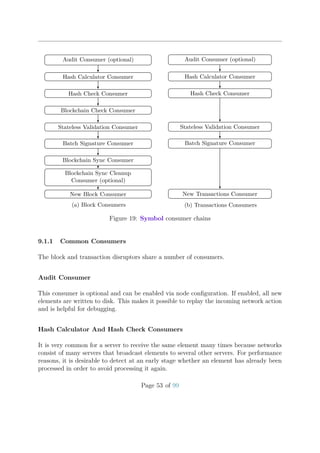
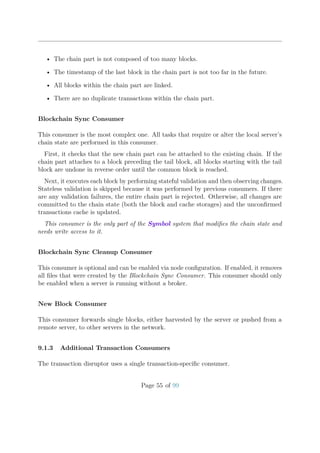
9.1 Consumers . . . . . . . . . . . . . . . . . . . . . . . . . . . . . . . . . . . . 52
9.1.1 Common Consumers . . . . . . . . . . . . . . . . . . . . . . . . . . 53
9.1.2 Additional Block Consumers . . . . . . . . . . . . . . . . . . . . . . 54
9.1.3 Additional Transaction Consumers . . . . . . . . . . . . . . . . . . 55
10 Unconfirmed Transactions 57
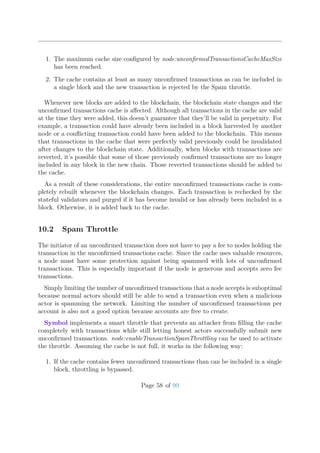
10.1 Unconfirmed Transactions Cache . . . . . . . . . . . . . . . . . . . . . . . 57
10.2 Spam Throttle . . . . . . . . . . . . . . . . . . . . . . . . . . . . . . . . . . 58
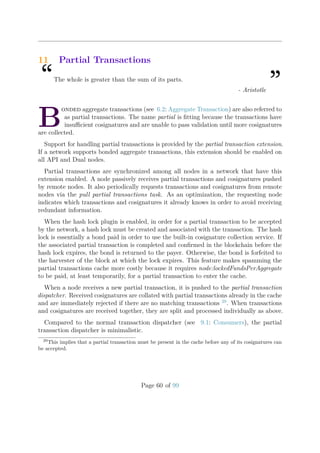
11 Partial Transactions 60
11.1 Partial Transaction Processing . . . . . . . . . . . . . . . . . . . . . . . . . 61
12 Network 64
12.1 Beacon Nodes . . . . . . . . . . . . . . . . . . . . . . . . . . . . . . . . . . 64
12.2 Connection Handshake . . . . . . . . . . . . . . . . . . . . . . . . . . . . . 65
12.3 Packets . . . . . . . . . . . . . . . . . . . . . . . . . . . . . . . . . . . . . 65
12.4 Connection Types . . . . . . . . . . . . . . . . . . . . . . . . . . . . . . . . 66
12.5 Peer Provenance . . . . . . . . . . . . . . . . . . . . . . . . . . . . . . . . 67
12.6 Node Discovery . . . . . . . . . . . . . . . . . . . . . . . . . . . . . . . . . 68
13 Reputation 70
13.1 Connection Management . . . . . . . . . . . . . . . . . . . . . . . . . . . . 70
13.2 Weight Based Node Selection . . . . . . . . . . . . . . . . . . . . . . . . . 71
13.3 Node Banning . . . . . . . . . . . . . . . . . . . . . . . . . . . . . . . . . . 72
14 Consensus 75
14.1 Weighting Algorithm . . . . . . . . . . . . . . . . . . . . . . . . . . . . . . 76
14.2 Sybil Attack . . . . . . . . . . . . . . . . . . . . . . . . . . . . . . . . . . . 78
14.3 Nothing at Stake Attack . . . . . . . . . . . . . . . . . . . . . . . . . . . . 80
14.4 Fee Attack . . . . . . . . . . . . . . . . . . . . . . . . . . . . . . . . . . . . 81
15 Time Synchronization 86
15.1 Gathering Samples . . . . . . . . . . . . . . . . . . . . . . . . . . . . . . . 86
15.2 Applying Filters to Remove Bad Data . . . . . . . . . . . . . . . . . . . . 87
15.3 Calculation of the Effective Offset . . . . . . . . . . . . . . . . . . . . . . . 88
15.4 Coupling and Threshold . . . . . . . . . . . . . . . . . . . . . . . . . . . . 89
16 Messaging 91
16.1 Message Channels and Topics . . . . . . . . . . . . . . . . . . . . . . . . . 91
16.2 Connection and Subscriptions . . . . . . . . . . . . . . . . . . . . . . . . . 92
16.3 Block Messages . . . . . . . . . . . . . . . . . . . . . . . . . . . . . . . . . 92
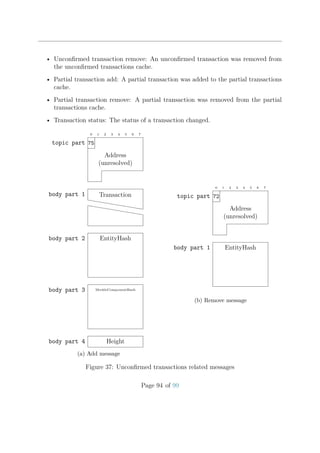
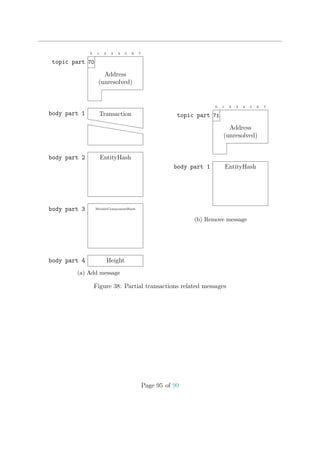
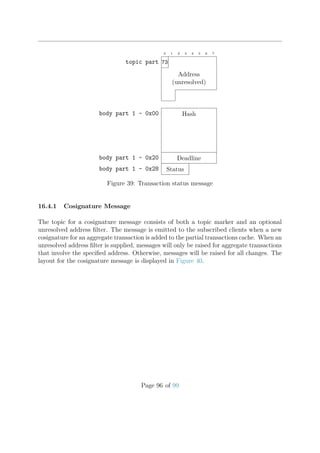
16.4 Transaction Messages . . . . . . . . . . . . . . . . . . . . . . . . . . . . . . 93
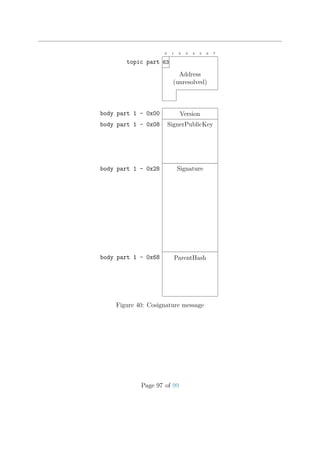
16.4.1 Cosignature Message . . . . . . . . . . . . . . . . . . . . . . . . . . 96
References 98
Index 99
Preface
“You miss 100% of the shots you don’t take.
”- Wayne Gretzky
N
EM had its humble beginnings as a ”call for participation” on a bitcointalk thread
in January 2014. The cryptospace had just experienced a boom at the tail end
of 2013 - although nowhere near where it would go a few years later - and there
was a lot of enthusiasm in the space. NXT had just launched as one of the first PoS
blockchains, and much of the early NEM community was inspired by and had connections
to the NXT community. This includes all three of the remaining core developers.
Although there was some initial discussion on what to build, we quickly decided to
create something new from scratch. This allowed for more design flexibility as well as the
use of high coding standards from the very beginning. This also gave us the opportunity to
contribute something new to the blockchain landscape. As a result of lots of effort - mostly
nights and weekends - this culminated in the release of NIS1 mainnet in March 2015.
We were pleased with what we built, but knew we took a few shortcuts, and continued
improving it. Eventually, we came to the realization that the original solution would need
a rearchitecture to fix some central performance bottlenecks and allow faster innovation in
the future.
We are grateful to Tech Bureau who provided support for us to build a completely new
chain from scratch - Symbol. We are hopeful that this fixes many of the problems inherent
in NIS1 and provides a solid foundation for future improvements and enhancements. Our
mandate was to build a high performance *blockchain* - not a DAG or dBFT based
system. In this, we think, we succeeded.
This has been a long journey for us, but we are excited to see what yet is to come
and what novel things you use Symbol to build. We would like to once again thank the
contributors and the many people who have inspired us. . .
BloodyRookie gimre Jaguar0625
Typographical Conventions
Description Attributes Example
Project name bold, colored Symbol
Classes fixed-width font ProcessBootstrapper
Fields fixed-width font FeeMultiplier
File paths fixed-width font commit step.dat
Configuration settings (prefixed with con-
figuration filename) in text mode
italic network:maxDifficul-
tyBlocks
Configuration settings (without configu-
ration filename) in equations and formu-
las
regular maxDifficultyBlocks
Fields in equations and formulas regular T::SignerPublicKey
Function names in equations and formu-
las
regular VerifiableDataBuffer()
Table 1: Typographical conventions used in this document
1 Introduction
“From the ashes a fire shall be woken,
A light from the shadows shall spring;
Renewed shall be blade that was broken,
The crownless again shall be king.
”- J.R.R. Tolkien
T
rustless, high-performance, layered-architecture, blockchain-based DLT protocol
- these are the first principles that influenced the development of Symbol. While
other DLT protocols were considered, including DAG and dBFT, blockchain
was quickly chosen as the protocol most true to the ideal of trustlessness. Any node can
download a complete copy of the chain and can independently verify it at all times. Nodes
with sufficient harvesting power can always create blocks and never need to rely on a
leader. These choices necessarily sacrifice some throughput relative to other protocols, but
they seem most consistent with the philosophical underpinnings of Bitcoin[Nak09].
As part of a focus on trustlessness, the following features were added relative to NEM:
• Block headers can be synced without transaction data, while allowing verification of
chain integrity.
• Transaction Merkle trees allow cryptographic proofs of transaction containment (or
not) within blocks.
• Receipts increase the transparency of indirectly triggered state changes.
• State proofs allow trustless verification of specific state within the blockchain.
In Symbol, there is a single server executable that can be customized by loading
different plugins (for transaction support) and extensions (for functionality). There are
three primary configurations (per network), but further customized hybrid configurations
are possible by enabling or disabling specific extensions.
The three primary configurations are:
1. Peer: These nodes are the backbone of the network and create new blocks.
2. API: These nodes store data in a MongoDB database for easier querying and can be
used in combination with a NodeJS REST server.
3. Dual: These nodes perform the functions of both Peer and API nodes.
Page 1 of 99
A strong network will typically have a large number of Peer nodes and enough API nodes
to support incoming client requests. Allowing the composition of nodes to vary dynamically
based on real needs, should lead to a more globally resource-optimized network.
Basing the core block and transaction pipelines on the disruptor pattern - and using
parallel processing wherever possible - allows high rates of transactions per second relative
to a typical blockchain protocol.
NIS1 was a worthy entry into the blockchain landscape and Symbol is an even worthier
evolution of it. This is not the end but a new beginning. There is more work to be done.
1.1 Network Fingerprint
Each network has a unique fingerprint that is composed of the following:
1. Network Identifier - One byte identifier that can be shared across networks. All
addresses compatible with a network must have this value as their first byte.
2. Generation Hash Seed - Random 32 byte value that must be globally unique across
networks. This value is prepended to transaction data prior to hashing or signing in
order to prevent cross network replay attacks.
Page 2 of 99
2 System
“A new technology can transform society, but when the technology is in its
infancy, very few people can see its full potential.
”- Liu Cixin
S
ymbol supports high customization at both the network and individual node levels.
Network-wide settings, specified in network, must be the same for all nodes in a
network. In contrast, node-specific settings can vary across all nodes in the same
network, and are located in node.
Symbol was designed to use a plugin / extension approach instead of supporting Turing
complete smart contracts. While the latter can allow for more user flexibility, it’s also
more error prone from the user perspective. A plugin model limits the operations that can
be performed on a blockchain and consequently has a smaller attack surface. Additionally,
it’s much simplier to optimize the performance of a discrete set of operations than an
infinite set. This helps Symbol achieve the high throughput for which it was designed.
2.1 Transaction Plugins
All nodes in a network must support the same types of transactions and process them in
exactly the same manner so that all nodes can agree on the global blockchain state. The
network requires each node to load a set of transaction plugins, and this set determines
the kinds of transactions the network supports. This set is determined by the presence of
network:plugin* sections in the network configuration. Any changes, additions or deletions
of these plugins must be coordinated and accepted by all network nodes. If only a subset
of nodes agree to these modifications, those nodes will be on a fork. All built-in Symbol
transactions are built using this plugin model in order to validate its extensibility.
A plugin is a separate dynamically-linked library that exposes a single entry point in
the following form 1
:
extern "C" PLUGIN_API
void RegisterSubsystem(
catapult :: plugins :: PluginManager& manager );
PluginManager provides access to the subset of configuration that plugins need to
initialize themselves. Through this class, a plugin can register zero or more of the
1
Format of plugins depends on target operating system and compiler used, so all host applications and
plugins must be built with the same compiler version and options.
Page 3 of 99
following:
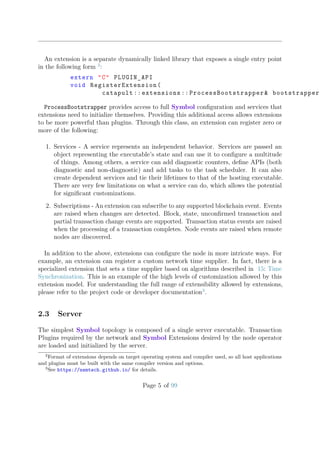
1. Transactions - New transaction types and the mapping of those types to parsing rules
can be specified. Specifically, the plugin defines rules for translating a transaction
into component notifications that are used in further processing. A handful of
processing constraints can also be specified, such as indicating a transaction can only
appear within an aggregate transaction (see 6.2: Aggregate Transaction).
2. Caches - New cache types and rules for serializing and deserializing model types
to and from binary can be specified. Each state-related cache can optionally be
included in the calculation of a block’s StateHash (see 7.3: State Hash) when that
feature is enabled.
3. Handlers - These are APIs that are always accessible.
4. Diagnostics - These are APIs and counters that are accessible only when the node is
running in diagnostic mode.
5. Validators - Stateless and stateful validators process the notifications produced by
block and transaction processing. The registered validators can subscribe to general
or plugin-defined notifications and reject disallowed values or state changes.
6. Observers - Observers process the notifications produced by block and transaction
processing. The registered observers can subscribe to general or plugin-defined
notifications and update blockchain state based on their values. Observers don’t
require any validation logic because they are only called after all applicable validators
succeed.
7. Resolvers - Custom mappings from unresolved to resolved types can be specified. For
example, this is used by the namespace plugin to add support for alias resolutions.
2.2 Symbol Extensions
Individual nodes within a network are allowed to support a heterogeneous mix of capabilities.
For example, some nodes might want to store data in a database or publish events to a
message queue. These capabilities are all optional because none of them impact consensus.
Such capabilities are determined by the set of extensions a node loads as specified in
extensions-{process}:extensions. Most built-in Symbol functionality is built using this
extension model in order to validate its extensibility.
Page 4 of 99
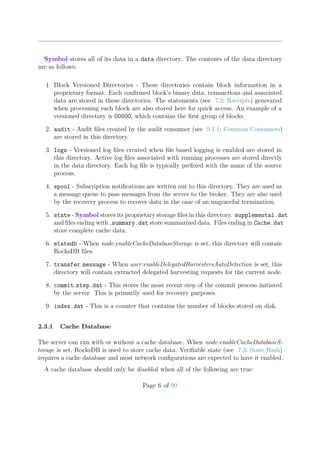
An extension is a separate dynamically linked library that exposes a single entry point
in the following form 2
:
extern "C" PLUGIN_API
void RegisterExtension(
catapult :: extensions :: ProcessBootstrapper& bootstrapper
ProcessBootstrapper provides access to full Symbol configuration and services that
extensions need to initialize themselves. Providing this additional access allows extensions
to be more powerful than plugins. Through this class, an extension can register zero or
more of the following:
1. Services - A service represents an independent behavior. Services are passed an
object representing the executable’s state and can use it to configure a multitude
of things. Among others, a service can add diagnostic counters, define APIs (both
diagnostic and non-diagnostic) and add tasks to the task scheduler. It can also
create dependent services and tie their lifetimes to that of the hosting executable.
There are very few limitations on what a service can do, which allows the potential
for significant customizations.
2. Subscriptions - An extension can subscribe to any supported blockchain event. Events
are raised when changes are detected. Block, state, unconfirmed transaction and
partial transaction change events are supported. Transaction status events are raised
when the processing of a transaction completes. Node events are raised when remote
nodes are discovered.
In addition to the above, extensions can configure the node in more intricate ways. For
example, an extension can register a custom network time supplier. In fact, there is a
specialized extension that sets a time supplier based on algorithms described in 15: Time
Synchronization. This is an example of the high levels of customization allowed by this
extension model. For understanding the full range of extensibility allowed by extensions,
please refer to the project code or developer documentation3
.
2.3 Server
The simplest Symbol topology is composed of a single server executable. Transaction
Plugins required by the network and Symbol Extensions desired by the node operator
are loaded and initialized by the server.
2
Format of extensions depends on target operating system and compiler used, so all host applications
and plugins must be built with the same compiler version and options.
3
See https://nemtech.github.io/ for details.
Page 5 of 99
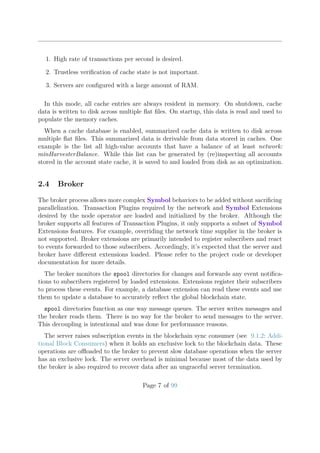
Symbol stores all of its data in a data directory. The contents of the data directory
are as follows:
1. Block Versioned Directories - These directories contain block information in a
proprietary format. Each confirmed block’s binary data, transactions and associated
data are stored in these directories. The statements (see 7.2: Receipts) generated
when processing each block are also stored here for quick access. An example of a
versioned directory is 00000, which contains the first group of blocks.
2. audit - Audit files created by the audit consumer (see 9.1.1: Common Consumers)
are stored in this directory.
3. logs - Versioned log files created when file based logging is enabled are stored in
this directory. Active log files associated with running processes are stored directly
in the data directory. Each log file is typically prefixed with the name of the source
process.
4. spool - Subscription notifications are written out to this directory. They are used as
a message queue to pass messages from the server to the broker. They are also used
by the recovery process to recover data in the case of an ungraceful termination.
5. state - Symbol stores its proprietary storage files in this directory. supplemental.dat
and files ending with summary.dat store summarized data. Files ending in Cache.dat
store complete cache data.
6. statedb - When node:enableCacheDatabaseStorage is set, this directory will contain
RocksDB files.
7. transfer message - When user:enableDelegatedHarvestersAutoDetection is set, this
directory will contain extracted delegated harvesting requests for the current node.
8. commit step.dat - This stores the most recent step of the commit process initiated
by the server. This is primarily used for recovery purposes.
9. index.dat - This is a counter that contains the number of blocks stored on disk.
2.3.1 Cache Database
The server can run with or without a cache database. When node:enableCacheDatabaseS-
torage is set, RocksDB is used to store cache data. Verifiable state (see 7.3: State Hash)
requires a cache database and most network configurations are expected to have it enabled.
A cache database should only be disabled when all of the following are true:
Page 6 of 99
1. High rate of transactions per second is desired.
2. Trustless verification of cache state is not important.
3. Servers are configured with a large amount of RAM.
In this mode, all cache entries are always resident in memory. On shutdown, cache
data is written to disk across multiple flat files. On startup, this data is read and used to
populate the memory caches.
When a cache database is enabled, summarized cache data is written to disk across
multiple flat files. This summarized data is derivable from data stored in caches. One
example is the list all high-value accounts that have a balance of at least network:
minHarvesterBalance. While this list can be generated by (re)inspecting all accounts
stored in the account state cache, it is saved to and loaded from disk as an optimization.
2.4 Broker
The broker process allows more complex Symbol behaviors to be added without sacrificing
parallelization. Transaction Plugins required by the network and Symbol Extensions
desired by the node operator are loaded and initialized by the broker. Although the
broker supports all features of Transaction Plugins, it only supports a subset of Symbol
Extensions features. For example, overriding the network time supplier in the broker is
not supported. Broker extensions are primarily intended to register subscribers and react
to events forwarded to those subscribers. Accordingly, it’s expected that the server and
broker have different extensions loaded. Please refer to the project code or developer
documentation for more details.
The broker monitors the spool directories for changes and forwards any event notifica-
tions to subscribers registered by loaded extensions. Extensions register their subscribers
to process these events. For example, a database extension can read these events and use
them to update a database to accurately reflect the global blockchain state.
spool directories function as one way message queues. The server writes messages and
the broker reads them. There is no way for the broker to send messages to the server.
This decoupling is intentional and was done for performance reasons.
The server raises subscription events in the blockchain sync consumer (see 9.1.2: Addi-
tional Block Consumers) when it holds an exclusive lock to the blockchain data. These
operations are offloaded to the broker to prevent slow database operations when the server
has an exclusive lock. The server overhead is minimal because most of the data used by
the broker is also required to recover data after an ungraceful server termination.
Page 7 of 99
2.5 Recovery
The recovery process is used to repair the global blockchain state after an ungraceful server
and/or broker termination. Transaction Plugins required by the network and Symbol
Extensions desired by the node operator are loaded and initialized by the recovery process.
When a broker is used, the recovery process must load the same extensions as the broker.
The specific recovery procedure depends on the process configuration and the value of
the commit step.dat file. Generally, if the server exited after state changes were flushed
to disk, those changes will be reapplied. The blockchain state will be the same as if the
server had applied and committed those changes. Otherwise, if the server exited before
state changes were flushed to disk, pending changes will be discarded. The blockchain
state will be the same as if the server had never attempted to process those changes.
After the recovery process completes, the blockchain state should be indistinguishable
from the state of a node that never terminated ungracefully. spool directories are repaired
and processed. Block and cache data stored on disk are reconciled and updated. Pending
state changes, if applicable, are applied. Other files indicating the presence of an ungraceful
termination are updated or removed.
2.6 Common Topologies
Although a network can be composed of a large number of heterogeneous topologies, it
is likely that most nodes will fall into one of three categories: Peer, API or Dual. The
same server process is used across all of these topologies. The only difference is in what
extensions each loads.
Peer nodes are lightweight nodes. They have enough functionality to add security to
the blockchain network, but little beyond that. They can synchronize with other nodes
and harvest new blocks.
API nodes are more heavyweight nodes. They can synchronize with other nodes,
but cannot harvest new blocks. They support hosting bonded aggregate transactions
and collecting cosignatures to complete them. They require a broker process, which is
configured to write data into a MongoDB database and propagate changes over public
message queues to subscribers. The REST API is dependent on both of these capabilities
and is typically co-located with an API node for performance reasons in order to minimize
latency.
Dual nodes are simply a superset of Peer and API nodes. They support all capabilities
of both node types. Since these nodes support all API node capabilities, they also require
a broker.
Page 8 of 99
3 Cryptography
“I understood the importance in principle of public key cryptography but it’s
all moved much faster than I expected. I did not expect it to be a mainstay of
advanced communications technology.
”- Whitfield Diffie
B
lockchain technology demands the use of some cryptographic concepts. Symbol
uses cryptography based on Elliptic Curve Cryptography (ECC). The choice of
the underlying curve is important in order to guarantee security and speed.
Symbol uses the Ed25519 digital signature algorithm. This algorithm uses the following
Twisted Edwards curve:
−x2
+ y2
= 1 −
121665
121666
x2
y2
over the finite field defined by the prime number 2255
−19. The base point for the correspond-
ing group G is called B. The group has q = 2252
+27742317777372353535851937790883648493
elements. It was developed by D. J. Bernstein et al. and is one of the safest and fastest
digital signature algorithms [Ber+11].
Importantly for Symbol purposes, the algorithm produces short 64-byte signatures and
supports fast signature verification. Neither key generation nor signing is used during
block processing, so the speed of these operations is unimportant.
3.1 Public/Private Key Pair
A private key is a random 256-bit integer k. To derive the public key A from it, the
following steps are taken:
H(k) = (h0, h1, . . . , h511) (1)
a = 2254
+
3≤i≤253
2i
hi (2)
A = aB (3)
Since A is a group element, it can be encoded into a 256-bit integer A, which serves as
the public key.
Page 9 of 99
3.2 Signing and Verification
Given a message M, private key k and its associated public key A, the following steps are
taken to create a signature:
H(k) = (h0, h1, . . . , h511) (4)
r = H(h256, . . . , h511, M) where the comma means concatenation (5)
R = rB (6)
S = (r + H(R, A, M)a) mod q (7)
Then (R, S) is the signature for the message M under the private key k. Note that only
signatures where S < q and S > 0 are considered as valid to prevent the problem of
signature malleability.
To verify the signature (R, S) for the given message M and public key A, the verifier
checks S < q and S > 0 and then calculates
˜R = SB − H(R, A, M)A
and verifies that
˜R = R (8)
If S was computed as shown in (7) then
SB = rB + (H(R, A, M)a)B = R + H(R, A, M)A
so (8) will hold.
3.2.1 Batch Verification
When lots of signatures have to be verified, a batch signature verification can speed up the
process by about 80%. Symbol uses the algorithm outlined in [Ber+11]. Given a batch of
(Mi, Ai, Ri, Si) where (Ri, Si) is the signature for the message Mi with public key Ai, let
Hi = H(Ri, Ai, Mi). Additionally, assume a corresponding number of uniform distributed
128-bit independent random integers zi are generated. Now consider the equation:
−
i
ziSi mod q B +
i
ziRi +
i
(ziHi mod q)Ai = 0 (9)
Setting Pi = 8Ri + 8HiAi − 8SiB, then if (9) holds, it implies
i
ziPi = 0 (10)
Page 10 of 99
All Pi are elements of a cyclic group (remember q is a prime). If some Pi is not zero, for
example P2, it means that for given integers z0, z1, z3, z4 . . ., there is exactly one choice
for z2 to satisfy (10). The chance for that is 2−128
. Therefore, if (9) holds, it is a near
certainty that Pi = 0 for all i. This implies that the signatures are valid.
If (9) does not hold, it means that there is at least one invalid signature. In that case,
Symbol falls back to single signature verification to identify the invalid signatures.
3.3 Verifiable Random Function (VRF)
A verifiable random function (VRF) uses a public/private key pair to generate pseudo-
random values. Only the owner of the private key can generate a value such that it cannot
be predetermined by an adversary. Anyone with the public key can verify whether or
not the value was generated by its associated private key. Symbol uses the ECVRF-
EDWARDS25519-SHA512-TAI defined in [Gol+20].
To generate a proof4
given a public key Y corresponding to a private key SK = xB and
an input seed alpha5
:
H = map to group element(alpha, Y )
γ = xH
k = generate nonce(H)
c = IetfHash(3, 2, H, γ, kB, kH)[0..15]
s = (k + cx) mod q
proof = (γ, c, s)
The proof produced by the function above can be verified with the following procedure:
H = map to group element(alpha, Y )
U = sB − cY
V = sH − cγ
verification hash = IetfHash(3, 2, H, γ, U, V )[0..15]
When the calculated verification hash matches the c part of the proof, the verification
of the random value is successful.
4
This is typically called proving, not to be confused with verifying, because the private key owner
needs to prove that it generated the random value with its private key.
5
The listings provided in this section do not define auxiliary functions. Full descriptions of these
functions can be found in [Gol+20].
Page 11 of 99
A proof hash, also called a VRF hash output, can be derived from γ of a validated proof:
proof hash = IetfHash(3, 3, 8γ) (11)
Page 12 of 99
4 Trees
“All our wisdom is stored in the trees.
”- Santosh Kalwar
S
ymbol uses tree structures in order to support trustless light clients. Merkle trees
allow a client to cryptographically confirm the existence of data stored within
them. Patricia trees allow a client to cryptographically confirm the existence or
non-existence of data stored within them.
4.1 Merkle Tree
A Merkle tree[Mer88] is a tree of hashes that allows efficient existence proofs. Within
Symbol, all basic merkle trees are constrained to being balanced and binary. Each leaf
node contains a hash of some data. Each non-leaf node is constructed by hashing the
hashes stored in child nodes. In the Symbol implementation, when any (non-root) layer
contains an odd number of hashes, the last hash is doubled when calculating the parent
hash.
Merkle Hash = HRoot =
H(HABCD, HEE2 )
HABCD =
H(HAB, HCD)
HAB =
H(H(A), H(B))
H(A)
A
H(B)
B
HCD =
H(H(C), H(D))
H(C)
C
H(D)
D
HEE2 =
H(HEE, HEE)
HEE =
H(H(E), H(E))
H(E)
E
Figure 1: Four level Merkle tree composed of five data items
A benefit of using merkle trees is that the existence of a hash in a tree can be proven
with only log(N) hashes. This allows for existence proofs with relatively low bandwidth
requirements.
Page 13 of 99
Merkle Hash = HRoot =
H(HABCD, HEE2 )
HABCD =
H(HAB, HCD)
HAB =
H(H(A), H(B))
H(A)
A
H(B)
B
HCD =
H(H(C), H(D))
H(C)
C
H(D)
D
HEE2 =
H(HEE, HEE)
HEE =
H(H(E), H(E))
H(E)
E
Figure 2: Merkle proof required for proving existence of B in the tree
A merkle proof for existence requires a single hash from each level of the tree. In order
to prove the existence of B, a client must:
1. Calculate H(B).
2. Obtain HRoot; in Symbol, this is stored in the block header.
3. Request H(A), HCD, HEE2 .
4. Calculate HRoot = H(H(H(H(A), H(B)), HCD), HEE2 ).
5. Compare HRoot and HRoot ; if they match, H(B) must be stored in the tree.
4.2 Patricia Tree
A Patricia tree[Mor68] is a deterministically ordered tree. It is constructed from key value
pairs, and supports both existence and non-existence proofs requiring only log(N) hashes.
Non-existence proofs are possible because this tree is deterministically sorted by keys. The
application of the same data, in any order, will always result in the same tree.
When inserting a new key value pair into the tree, the key is decomposed into nibbles
and each nibble is logically its own node in the tree. All keys within a single tree are
required to have the same length, which allows slightly optimized algorithms.
Page 14 of 99
For illustration, consider the following key value pairs in Table 2. Some examples will
use ASCII keys to more clearly elucidate concepts, while others will use hex keys to more
accurately depict Symbol implementations.
Figure 3 depicts a full Patricia tree where each letter is represented by a separate node.
Although this tree is logically correct, it is quite expansive and uses a lot of memory. A
typical key is a 32 byte hash value, which implies that storing a single value could require
up to 64 nodes. In order to work around this limitation, successive empty branch nodes
can be collapsed into either a branch node with at least two connections or a leaf node.
This leads to a different but more compact tree, as depicted in Figure 4.
key hex-key value
do** 646F0000 verb
dog* 646F6700 puppy
doge 646F6765 mascot
hors 686F7273 stallion
Table 2: Patricia tree example data
Root
D
O
*
* [verb]
G
* [puppy] E [mascot]
H
O
R
S [stallion]
Figure 3: Conceptual (expanded) Patricia tree composed of four data items
Page 15 of 99
Root
DO
** [verb] G
* [puppy] E [mascot]
HORS [stallion]
Figure 4: Conceptual (compact) patricia tree composed of four data items
4.3 Merkle Patricia Tree
A Merkle Patricia tree is a combination of Merkle and Patricia trees. The Symbol
implementation centers around two types of nodes: leaf nodes and branch nodes. Each
leaf node contains a hash of some data. Each branch node contains up to sixteen pointers
to child nodes.
Like in a basic Merkle tree, each Merkle Patricia tree has a root hash, but the hashes
stored in the Merkle Patricia tree are slightly more complex.
Every node in the tree has a tree node path. This path is composed of a sentinel nibble
followed by zero or more path nibbles. If the path represents a leaf node, 0x2 will be set
in the sentinel nibble. If the path is composed of an odd number of nibbles, 0x1 will be
set in the sentinel nibble and the second nibble will contain the first path nibble. If the
path is composed of an even number, the second nibble will be set to 0x0 and the second
byte will contain the first path nibble.
A leaf node is composed of the following two items:
1. TreeNodePath: Encoded tree node path (with leaf bit set).
2. ValueHash: Hash of the value associated with the key ending at the leaf.
The hash of a leaf node can be calculated by hashing its component parts:
H(Leaf ) = H(TreeNodePath, ValueHash)
.
A branch node is composed of the following items:
Page 16 of 99
odd path 0 0 bleaf 1 nibble1 nibble2..nibbleN[odd]
sentinel nibble
byte 1
even path 0 0 bleaf 0 0000 nibble1..nibbleN[even]
sentinel nibble
byte 1
Figure 5: Tree node path encoding
1. TreeNodePath: Encoded tree node path (with leaf bit unset).
2. LinkHash0, . . . , LinkHash15: Hashes of children where the index is the next nibble
part of the path. When no child is present at an index, a zero hash should be used
instead.
The hash of a branch node can be calculated by hashing its component parts:
H(Branch) = H(TreeNodePath, LinkHash0, . . . , LinkHash15)
.
Reconstructing the earlier example with hex keys yields a tree that illustrates a more
accurate view of how a Symbol tree is constructed. Notice that each branch node index
composes a single nibble of the path. This is depicted in Figure 6.
4.4 Merkle Patricia Tree Proofs
A Merkle proof for existence requires a single node from each level of the tree. In order to
prove the existence of {key = 646F6765, value = H(mascot)}, a client must:
1. Calculate H(mascot) (remember, all leaf values are hashes).
2. Request all nodes on the path 646F6765: Node6, Node646F , Node646F67.
3. Verify that Node646F67 :: Link[6] is equal to H(Leaf(mascot)).
Page 17 of 99
6
6F
000 [verb] 7
0 [puppy] 5 [mascot]
6F7273 [stallion]
4 8
0 6
0 6
Figure 6: Realistic Patricia tree with branch and leaf nodes and all optimizations. Path to
mascot [646F6765] is highlighted.
4. Calculate H(Node646F67) and verify that Node6467 :: Link[6] is equal to H(Node646F67).
5. Calculate H(Node6467) and verify that Node6 :: Link[4] is equal to H(Node6467).
6. Existence is proven if all calculated and actual hashes match.
A Merkle proof for non-existence requires a single node from each level of the tree. In
order to prove the non-existence of {key = 646F6764, value = H(mascot)}, a client must:
1. Calculate H(mascot) (remember, all leaf values are hashes).
2. Request all nodes on the path 646F6764: Node6, Node646F , Node646F67.
3. Verify that Node646F67 :: Link[5] is equal to H(Leaf(mascot)). Since Link[5] is unset,
this check will fail. If the value being searched for was in the tree, it must be linked
to this node because of the determinism of the tree.
Page 18 of 99
5 Accounts and Addresses
“A beginning is the time for taking the most delicate care that the balances are
correct.
”- Frank Herbert
S
ymbol uses elliptic curve cryptography to ensure confidentiality, authenticity and
non-repudiability of all transactions. An account is uniquely identified by an
address, which is partially derived from a one way mutation of its signing public
key. Each account is linked to mutable state that is updated when transactions are
accepted by the network. This state is globally consistent and may contain zero or more
public keys.
5.1 Addresses
A decoded address is a 24 byte value composed of the following three parts:
• network byte
• 160-bit hash of an account’s signing public key
• 3 byte checksum
The checksum allows for quick recognition of mistyped addresses. It is possible to send
mosaics6
to any valid address even if the address has not previously participated in any
transaction. If nobody owns the private key of the account to which the mosaics are sent,
the mosaics are most likely lost forever.
An encoded address is a Base327
encoding of a decoded address. It is human readable
and used in clients.
Notice that the Base32 encoding of binary data has an expansion factor of 8
5
, and a
decoded address’s size is not evenly divisible by five. Accordingly, any Base32 representation
of a decoded address will contain some extra information. While this is not inherently
problematic, when encoding a decoded address, the extra input byte is set to zero by
convention for consistency across clients. Additionally, the last byte of the resulting 40
character string is dropped.
6
A mosaic is a digital asset defined on Symbol. Other technologies refer to mosaics as tokens.
7
http://en.wikipedia.org/wiki/Base32
Page 19 of 99
5.1.1 Address Derivation
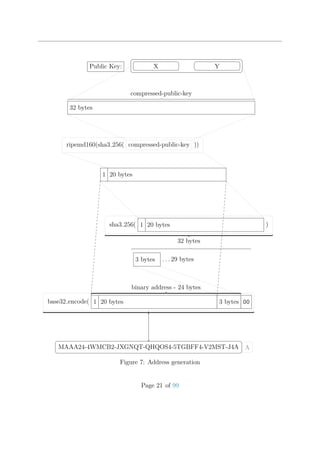
In order to convert a public key to an address, the following steps are performed:
1. Perform 256-bit SHA3 on the public key.
2. Perform 160-bit RIPEMD 160 of hash resulting from step 1.
3. Prepend network version byte to RIPEMD 160 hash.
4. Perform 256-bit SHA3 on the result, take the first three bytes as a checksum.
5. Concatenate output of step 3 and the checksum from step 4.
6. Encode result using Base32.
Page 20 of 99
Public Key: X Y
32 bytes
compressed-public-key
ripemd160(sha3 256( compressed-public-key ))
1 20 bytes
sha3 256( 1 20 bytes )
32 bytes
. . . 29 bytes3 bytes
003 bytes20 bytes1base32 encode(
binary address - 24 bytes
MAAA24-4WMCB2-JXGNQT-QHQOS4-5TGBFF4-V2MST-J4A A
Figure 7: Address generation
Page 21 of 99
5.1.2 Address Aliases
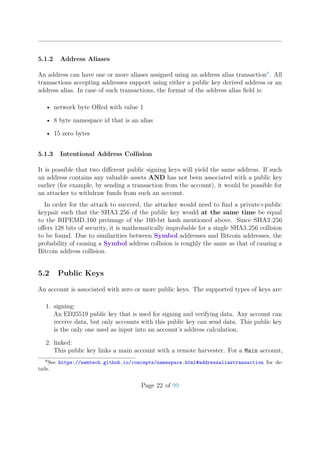
An address can have one or more aliases assigned using an address alias transaction8
. All
transactions accepting addresses support using either a public key derived address or an
address alias. In case of such transactions, the format of the address alias field is:
• network byte ORed with value 1
• 8 byte namespace id that is an alias
• 15 zero bytes
5.1.3 Intentional Address Collision
It is possible that two different public signing keys will yield the same address. If such
an address contains any valuable assets AND has not been associated with a public key
earlier (for example, by sending a transaction from the account), it would be possible for
an attacker to withdraw funds from such an account.
In order for the attack to succeed, the attacker would need to find a private+public
keypair such that the SHA3 256 of the public key would at the same time be equal
to the RIPEMD 160 preimage of the 160-bit hash mentioned above. Since SHA3 256
offers 128 bits of security, it is mathematically improbable for a single SHA3 256 collision
to be found. Due to similarities between Symbol addresses and Bitcoin addresses, the
probability of causing a Symbol address collision is roughly the same as that of causing a
Bitcoin address collision.
5.2 Public Keys
An account is associated with zero or more public keys. The supported types of keys are:
1. signing:
An ED25519 public key that is used for signing and verifying data. Any account can
receive data, but only accounts with this public key can send data. This public key
is the only one used as input into an account’s address calculation.
2. linked:
This public key links a main account with a remote harvester. For a Main account,
8
See https://nemtech.github.io/concepts/namespace.html#addressaliastransaction for de-
tails.
Page 22 of 99
this public key specifies the remote harvester account that can sign blocks on its
behalf. For a Remote account, this public key specifies the main account for which it
can sign blocks. These links are bidirectional and always set in pairs.
3. node:
This public key is set on a Main account. It specifies the public key of the node that
it can delegate harvest on. Importantly, this does not indicate that the remote is
actively harvesting on the node, but only that it has the permission to do so. As
long as either the harvesting account or the node owner is honest, the account will
be restricted to delegate harvesting on a single node at a time.
An honest harvester should only send its remote harvester private key to a single
node at a time. Changing its remote will invalidate all previous remote harvesting
permissions granted to all other nodes (and implies forward security of delegated
keys). Any older remote harvester private keys will no longer be valid and unable to
be used for harvesting blocks. An honest node owner should only ever remote harvest
with a remote harvester private key that is currently linked to its node public key
4. VRF:
An ED25519 public key that is used for generating and verifying random values.
This public key must be set on a Main account in order for the account to be eligible
to harvest.
5. voting:
Placeholder that will be used for finalization.
Page 23 of 99
6 Transactions
“In fact, a large part of what we think of as economic activity is designed to
accomplish what high transaction costs would otherwise prevent or to reduce
transaction costs so that individuals can negotiate freely and we can take
advantage of that diffused knowledge of which Friedrich Hayek has told us.
”- Ronald Coase
T
ransactions are instructions that modify the global chain state. They are
processed atomically and grouped into blocks. If any part of a transaction fails
processing, the global chain state is reset to the state prior to the transaction
application attempt.
There are two fundamental types of transactions: basic transactions and aggregate
transactions. Basic transactions represent a single operation and require a single signature.
Aggregate transactions are containers of one or more transactions that may require multiple
signatures.
Aggregate transactions allow basic transactions to be combined into potentially complex
operations and executed atomically. This increases developer flexibility relative to a
system that only guarantees atomicity for individual operations while still constraining
the global set of operations allowed to a finite set. It does not require the introduction of
a Turing-complete language and all of its inherent disadvantages. Developers do not need
to learn any new languages nor develop bespoke contract implementations from scratch.
The composition of transactions should be less error-prone and lead to fewer bugs than
implementing computationally complete programs.
6.1 Basic Transaction
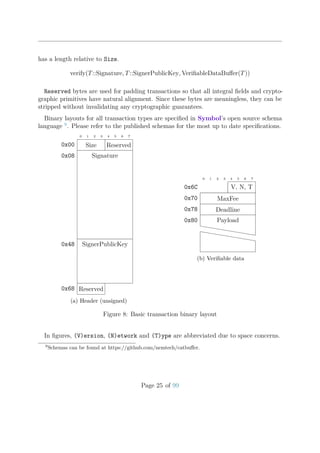
A basic transaction is composed of both cryptographically verifiable and unverifiable data.
All verifiable data is contiguous and is signed by the transaction signer. All unverifiable
data is either ignored (e.g. padding bytes) or deterministically computable from verifiable
data. Each basic transaction requires verification of exactly one signature.
None of the unverifiable header fields need to be verified. Size is the serialized size of
the transaction and can always be derived from verifiable transaction data. Signature
is an output from signing and an input to verification. SignerPublicKey is an input to
both signing and verification. In order for a transaction T to pass signature verification,
both Signature and SignerPublicKey must be matched with the verifiable data, which
Page 24 of 99
has a length relative to Size.
verify(T::Signature, T::SignerPublicKey, VerifiableDataBuffer(T))
Reserved bytes are used for padding transactions so that all integral fields and crypto-
graphic primitives have natural alignment. Since these bytes are meaningless, they can be
stripped without invalidating any cryptographic guarantees.
Binary layouts for all transaction types are specified in Symbol’s open source schema
language 9
. Please refer to the published schemas for the most up to date specifications.
0 1 2 3 4 5 6 7
Size Reserved0x00
Signature0x08
SignerPublicKey0x48
Reserved0x68
(a) Header (unsigned)
0 1 2 3 4 5 6 7
V, N, T0x6C
MaxFee0x70
Deadline0x78
Payload0x80
hhhhhhhhhhh
hhhhhhhhhhh
(b) Verifiable data
Figure 8: Basic transaction binary layout
In figures, (V)ersion, (N)etwork and (T)ype are abbreviated due to space concerns.
9
Schemas can be found at https://github.com/nemtech/catbuffer.
Page 25 of 99
6.2 Aggregate Transaction
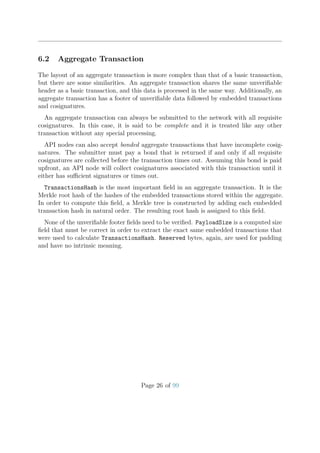
The layout of an aggregate transaction is more complex than that of a basic transaction,
but there are some similarities. An aggregate transaction shares the same unverifiable
header as a basic transaction, and this data is processed in the same way. Additionally, an
aggregate transaction has a footer of unverifiable data followed by embedded transactions
and cosignatures.
An aggregate transaction can always be submitted to the network with all requisite
cosignatures. In this case, it is said to be complete and it is treated like any other
transaction without any special processing.
API nodes can also accept bonded aggregate transactions that have incomplete cosig-
natures. The submitter must pay a bond that is returned if and only if all requisite
cosignatures are collected before the transaction times out. Assuming this bond is paid
upfront, an API node will collect cosignatures associated with this transaction until it
either has sufficient signatures or times out.
TransactionsHash is the most important field in an aggregate transaction. It is the
Merkle root hash of the hashes of the embedded transactions stored within the aggregate.
In order to compute this field, a Merkle tree is constructed by adding each embedded
transaction hash in natural order. The resulting root hash is assigned to this field.
None of the unverifiable footer fields need to be verified. PayloadSize is a computed size
field that must be correct in order to extract the exact same embedded transactions that
were used to calculate TransactionsHash. Reserved bytes, again, are used for padding
and have no intrinsic meaning.
Page 26 of 99
0 1 2 3 4 5 6 7
Size Reserved0x00
Signature0x08
SignerPublicKey0x48
Reserved0x68
(a) Header (unsigned)
0 1 2 3 4 5 6 7
V, N, T0x6C
MaxFee0x70
Deadline0x78
TransactionsHash0x80
(b) Verifiable data
0 1 2 3 4 5 6 7
PayloadSize Reserved0x88
Embedded0x90
hhhhhhhhhhh
hhhhhhhhhhh
Transactions
Cosignatures
hhhhhhhhhhh
hhhhhhhhhhh
(c) Unverifiable footer
Figure 9: Aggregate transaction header binary layout
6.2.1 Embedded Transaction
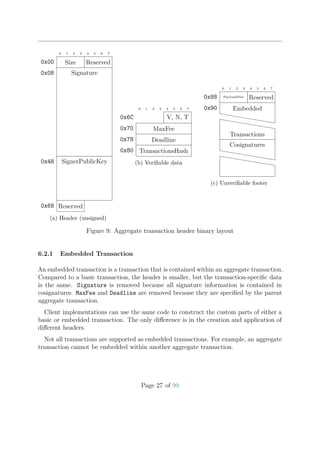
An embedded transaction is a transaction that is contained within an aggregate transaction.
Compared to a basic transaction, the header is smaller, but the transaction-specific data
is the same. Signature is removed because all signature information is contained in
cosignatures. MaxFee and Deadline are removed because they are specified by the parent
aggregate transaction.
Client implementations can use the same code to construct the custom parts of either a
basic or embedded transaction. The only difference is in the creation and application of
different headers.
Not all transactions are supported as embedded transactions. For example, an aggregate
transaction cannot be embedded within another aggregate transaction.
Page 27 of 99
0 1 2 3 4 5 6 7
Size Reserved0x00
SignerPublicKey0x08
Reserved0x28
(a) Header (unsigned)
0 1 2 3 4 5 6 7
V, N, T0x2C
Payload0x30
hhhhhhhhhhh
hhhhhhhhhhh
(b) Verifiable data
Figure 10: Embedded transaction binary layout
6.2.2 Cosignature
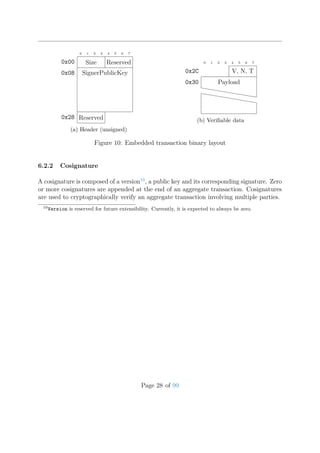
A cosignature is composed of a version10
, a public key and its corresponding signature. Zero
or more cosignatures are appended at the end of an aggregate transaction. Cosignatures
are used to cryptographically verify an aggregate transaction involving multiple parties.
10
Version is reserved for future extensibility. Currently, it is expected to always be zero.
Page 28 of 99
0 1 2 3 4 5 6 7
Version0x00
SignerPublicKey0x08
Signature0x28
Figure 11: Cosignature binary layout
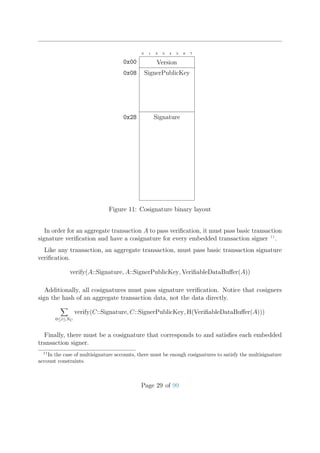
In order for an aggregate transaction A to pass verification, it must pass basic transaction
signature verification and have a cosignature for every embedded transaction signer 11
.
Like any transaction, an aggregate transaction, must pass basic transaction signature
verification.
verify(A::Signature, A::SignerPublicKey, VerifiableDataBuffer(A))
Additionally, all cosignatures must pass signature verification. Notice that cosigners
sign the hash of an aggregate transaction data, not the data directly.
0≤i≤NC
verify(C::Signature, C::SignerPublicKey, H(VerifiableDataBuffer(A)))
Finally, there must be a cosignature that corresponds to and satisfies each embedded
transaction signer.
11
In the case of multisignature accounts, there must be enough cosignatures to satisfy the multisignature
account constraints.
Page 29 of 99
6.2.3 Extended Layout
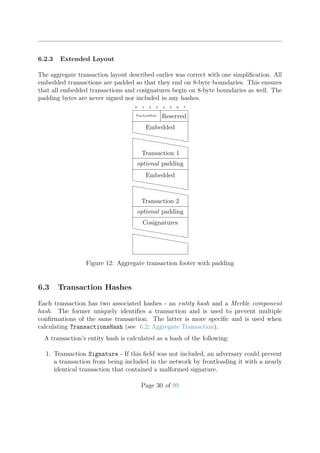
The aggregate transaction layout described earlier was correct with one simplification. All
embedded transactions are padded so that they end on 8-byte boundaries. This ensures
that all embedded transactions and cosignatures begin on 8-byte boundaries as well. The
padding bytes are never signed nor included in any hashes.
0 1 2 3 4 5 6 7
PayloadSize Reserved
Embedded
hhhhhhhhhhh
hhhhhhhhhhh
Transaction 1
optional padding
Embedded
hhhhhhhhhhh
hhhhhhhhhhh
Transaction 2
optional padding
Cosignatures
hhhhhhhhhhh
hhhhhhhhhhh
Figure 12: Aggregate transaction footer with padding
6.3 Transaction Hashes
Each transaction has two associated hashes - an entity hash and a Merkle component
hash. The former uniquely identifies a transaction and is used to prevent multiple
confirmations of the same transaction. The latter is more specific and is used when
calculating TransactionsHash (see 6.2: Aggregate Transaction).
A transaction’s entity hash is calculated as a hash of the following:
1. Transaction Signature - If this field was not included, an adversary could prevent
a transaction from being included in the network by frontloading it with a nearly
identical transaction that contained a malformed signature.
Page 30 of 99
2. Transaction SignerPublicKey - If this field was not included, an adversary could
prevent a transaction from being included in the network by frontloading it with a
nearly identical transaction that contained a malformed signer public key.
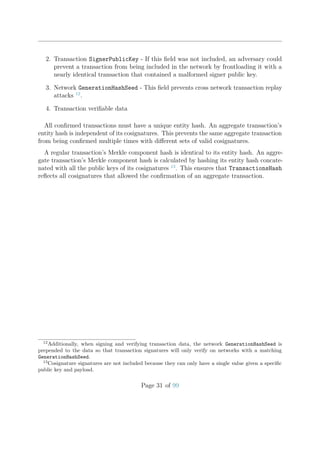
3. Network GenerationHashSeed - This field prevents cross network transaction replay
attacks 12
.
4. Transaction verifiable data
All confirmed transactions must have a unique entity hash. An aggregate transaction’s
entity hash is independent of its cosignatures. This prevents the same aggregate transaction
from being confirmed multiple times with different sets of valid cosignatures.
A regular transaction’s Merkle component hash is identical to its entity hash. An aggre-
gate transaction’s Merkle component hash is calculated by hashing its entity hash concate-
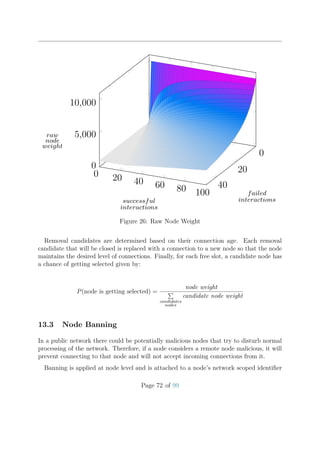
nated with all the public keys of its cosignatures 13
. This ensures that TransactionsHash
reflects all cosignatures that allowed the confirmation of an aggregate transaction.
12
Additionally, when signing and verifying transaction data, the network GenerationHashSeed is
prepended to the data so that transaction signatures will only verify on networks with a matching
GenerationHashSeed.
13
Cosignature signatures are not included because they can only have a single value given a specific
public key and payload.
Page 31 of 99
7 Blocks
“A stumbling block to the pessimist is a stepping-stone to the optimist.
”- Eleanor Roosevelt
S
ymbol is, at its core, a blockchain. A blockchain is an ordered collection of blocks.
Understanding the parts of a Symbol block is fundamental to understanding the
platform’s capabilities.
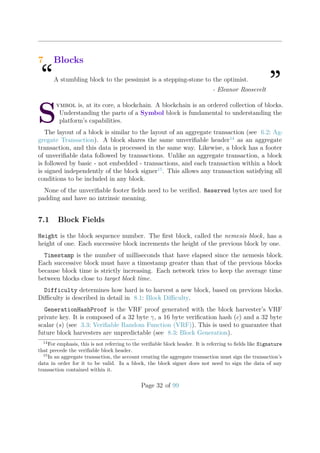
The layout of a block is similar to the layout of an aggregate transaction (see 6.2: Ag-
gregate Transaction). A block shares the same unverifiable header14
as an aggregate
transaction, and this data is processed in the same way. Likewise, a block has a footer
of unverifiable data followed by transactions. Unlike an aggregate transaction, a block
is followed by basic - not embedded - transactions, and each transaction within a block
is signed independently of the block signer15
. This allows any transaction satisfying all
conditions to be included in any block.
None of the unverifiable footer fields need to be verified. Reserved bytes are used for
padding and have no intrinsic meaning.
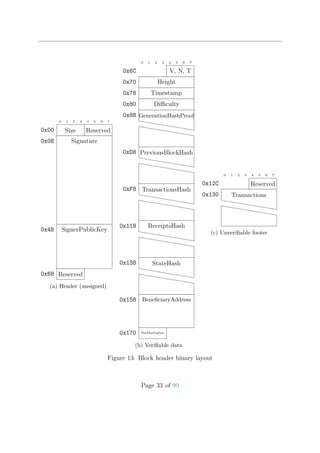
7.1 Block Fields
Height is the block sequence number. The first block, called the nemesis block, has a
height of one. Each successive block increments the height of the previous block by one.
Timestamp is the number of milliseconds that have elapsed since the nemesis block.
Each successive block must have a timestamp greater than that of the previous blocks
because block time is strictly increasing. Each network tries to keep the average time
between blocks close to target block time.
Difficulty determines how hard is to harvest a new block, based on previous blocks.
Difficulty is described in detail in 8.1: Block Difficulty.
GenerationHashProof is the VRF proof generated with the block harvester’s VRF
private key. It is composed of a 32 byte γ, a 16 byte verification hash (c) and a 32 byte
scalar (s) (see 3.3: Verifiable Random Function (VRF)). This is used to guarantee that
future block harvesters are unpredictable (see 8.3: Block Generation).
14
For emphasis, this is not referring to the verifiable block header. It is referring to fields like Signature
that precede the verifiable block header.
15
In an aggregate transaction, the account creating the aggregate transaction must sign the transaction’s
data in order for it to be valid. In a block, the block signer does not need to sign the data of any
transaction contained within it.
Page 32 of 99
0 1 2 3 4 5 6 7
Size Reserved0x00
Signature0x08
SignerPublicKey0x48
Reserved0x68
(a) Header (unsigned)
0 1 2 3 4 5 6 7
V, N, T0x6C
Height0x70
Timestamp0x78
Difficulty0x80
GenerationHashProof0x88
hhhhhhhhhhh
hhhhhhhhhhh
PreviousBlockHash0xD8
hhhhhhhhhhh
hhhhhhhhhhh
TransactionsHash0xF8
hhhhhhhhhhh
hhhhhhhhhhh
ReceiptsHash0x118
hhhhhhhhhhh
hhhhhhhhhhh
StateHash0x138
hhhhhhhhhhh
hhhhhhhhhhh
BeneficiaryAddress0x158
FeeMultiplier0x170
(b) Verifiable data
0 1 2 3 4 5 6 7
Reserved0x12C
Transactions0x130
hhhhhhhhhhh
hhhhhhhhhhh
(c) Unverifiable footer
Figure 13: Block header binary layout
Page 33 of 99
PreviousBlockHash is the hash of the previous block. This is used to guarantee that
all blocks within a blockchain are linked and deterministically ordered.
TransactionsHash is the Merkle root hash of the hashes of the transactions stored
within the block 16
. In order to compute this field, a Merkle tree is constructed by adding
each transaction hash in natural order. The resulting root hash is assigned to this field.
ReceiptsHash is the Merkle root hash of the hashes of the receipts produced while pro-
cessing the block. When a network is configured without network:enableVerifiableReceipts,
this field must be zeroed in all blocks (see 7.2: Receipts).
StateHash is the hash of the global blockchain state after processing the block. When
a network is configured without network:enableVerifiableState, this field must be zeroed in
all blocks. Otherwise, it’s calculated as described in 7.3: State Hash.
BeneficiaryAddress is the account that will be allocated the block’s beneficiary share
when the network has a nonzero network:harvestBeneficiaryPercentage. This field can be
set to any account, even one that isn’t yet known to the network. This field is set by the
node owner when a new block is harvested. If this account is set to one owned by the node
owner, the node owner will share in fees paid in all blocks harvested on its node. This, in
turn, incentivizes the node owner to run a strong node with many delegated harvesters.
FeeMultiplier is a multiplier that is used to calculate the effective fee of each transaction
contained within a block. The node:minFeeMultiplier is set by the node owner and can
be used to accomplish varying goals, including maximization of profits or confirmed
transactions. Assuming a block B containing a transaction T, the effective transaction fee
can be calculated as:
effectiveFee(T) = B::FeeMultiplier · sizeof(T)
If the effective fee is greater than the transaction MaxFee, the transaction signer keeps
the difference. Only the effective fee is deducted from the transaction signer and credited
to the harvester. Further information about fee multipliers can be found in 8.3: Block
Generation.
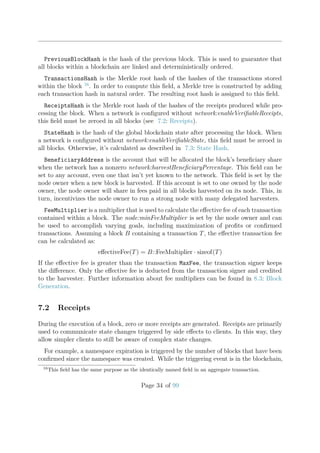
7.2 Receipts
During the execution of a block, zero or more receipts are generated. Receipts are primarily
used to communicate state changes triggered by side effects to clients. In this way, they
allow simpler clients to still be aware of complex state changes.
For example, a namespace expiration is triggered by the number of blocks that have been
confirmed since the namespace was created. While the triggering event is in the blockchain,
16
This field has the same purpose as the identically named field in an aggregate transaction.
Page 34 of 99
there is no indication of this state change in the block at which the expiration occurs.
Without receipts, a client would need to keep track of all namespaces and expiration
heights. With receipts, a client merely needs to monitor for expiration receipts.
Another example is around harvest rewards. Receipts are produced that indicate the
main - not delegated - account that gets credited and any beneficiary splits. They also
communicate the amount of currency created by inflation.
Receipts are grouped into three different types of statements and collated by receipt
sources. The three types of statements are transaction, address resolution and mosaic
resolution.
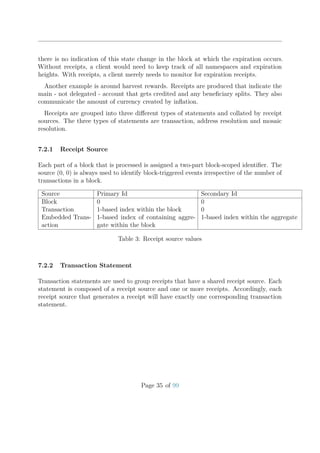
7.2.1 Receipt Source
Each part of a block that is processed is assigned a two-part block-scoped identifier. The
source (0, 0) is always used to identify block-triggered events irrespective of the number of
transactions in a block.
Source Primary Id Secondary Id
Block 0 0
Transaction 1-based index within the block 0
Embedded Trans-
action
1-based index of containing aggre-
gate within the block
1-based index within the aggregate
Table 3: Receipt source values
7.2.2 Transaction Statement
Transaction statements are used to group receipts that have a shared receipt source. Each
statement is composed of a receipt source and one or more receipts. Accordingly, each
receipt source that generates a receipt will have exactly one corresponding transaction
statement.
Page 35 of 99
0 1 2 3 4 5 6 7
Size V T0x00
ReceiptSource0x08
Receipts0x10
hhhhhhhhhhh
hhhhhhhhhhh
(a) Transaction statement binary layout
0 1 2 3 4 5 6 7
Size V T0x00
Payload0x08
hhhhhhhhhhh
hhhhhhhhhhh
(b) Receipt binary layout
Figure 14: Transaction statement layout
Transaction statement data is not padded because it is only written during processing
and never read, so padding yields no server performance benefit. A transaction statement
hash is constructed by concatenating and hashing all statement data excepting Size fields,
which are derivable from other data.
7.2.3 Resolution Statements
Resolution statements are used exclusively for indicating alias resolutions. They allow
a client to always resolve an unresolved value even when it changes within a block.
Theoretically, two unresolved aliases within the same block could resolve to different
values if there is an alias change between their usages. Each statement is composed of an
unresolved value and one or more resolutions in order to support this.
There are two types of resolution statements - address and mosaic - corresponding to
the two types of aliases. Although Figure 15 illustrates the layout of a mosaic resolution
statement, the layout of an address resolution statement is nearly identical. The only
difference is that the resolved and unresolved values are 25-byte addresses instead of 8-byte
mosaic ids.
Page 36 of 99
0 1 2 3 4 5 6 7
Size V T0x00
MosaicId Unresolved0x08
Resolution0x10
hhhhhhhhhhh
hhhhhhhhhhh
Entries
(a) Mosaic resolution statement binary layout
0 1 2 3 4 5 6 7
ReceiptSource0x00
MosaicId Resolved0x08
(b) Resolution entry binary layout
Figure 15: Mosaic resolution statement layout
Resolution statement data is not padded because it is only written during processing
and never read, so padding yields no server performance benefit. A resolution statement
hash is constructed by concatenating and hashing all statement data excepting Size fields,
which are derivable from other data.
It is important to note that a resolution statement is only produced when a resolution
occurs. If an alias is registered or changed in a block, but not used in that block, no
resolution statement will be produced. However, a resolution statement will be produced
by each block that contains that alias and requires it to be resolved.
7.2.4 Receipts Hash
In order to calculate a block’s receipt hash, first all statements generated during block
processing are collected. Then a Merkle tree is created by adding all statement hashes in
the following order:
1. Hashes of transaction statements ordered by receipt source.
2. Hashes of address resolution statements ordered by unresolved address.
3. Hashes of mosaic resolution statements ordered by unresolved mosaic id.
When a network is configured with network:enableVerifiableReceipts, the root hash of
this merkle tree is set as the block’s ReceiptHash. A client can perform a Merkle proof to
prove a particular statement was produced during the processing of a specific block.
Page 37 of 99
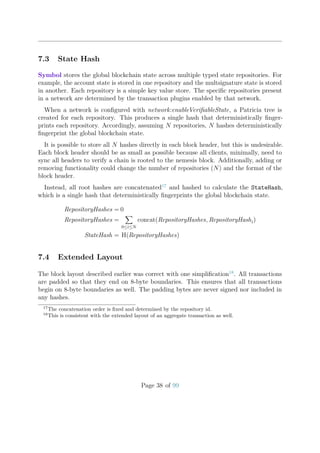
7.3 State Hash
Symbol stores the global blockchain state across multiple typed state repositories. For
example, the account state is stored in one repository and the multsignature state is stored
in another. Each repository is a simple key value store. The specific repositories present
in a network are determined by the transaction plugins enabled by that network.
When a network is configured with network:enableVerifiableState, a Patricia tree is
created for each repository. This produces a single hash that deterministically finger-
prints each repository. Accordingly, assuming N repositories, N hashes deterministically
fingerprint the global blockchain state.
It is possible to store all N hashes directly in each block header, but this is undesirable.
Each block header should be as small as possible because all clients, minimally, need to
sync all headers to verify a chain is rooted to the nemesis block. Additionally, adding or
removing functionality could change the number of repositories (N) and the format of the
block header.
Instead, all root hashes are concatenated17
and hashed to calculate the StateHash,
which is a single hash that deterministically fingerprints the global blockchain state.
RepositoryHashes = 0
RepositoryHashes =
0≤i≤N
concat(RepositoryHashes, RepositoryHashi)
StateHash = H(RepositoryHashes)
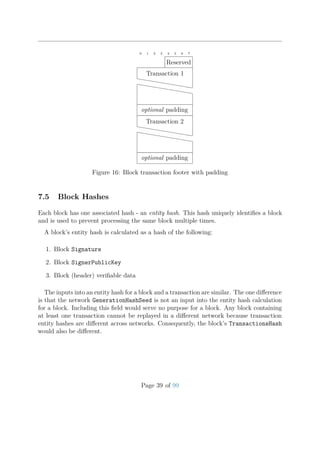
7.4 Extended Layout
The block layout described earlier was correct with one simplification18
. All transactions
are padded so that they end on 8-byte boundaries. This ensures that all transactions
begin on 8-byte boundaries as well. The padding bytes are never signed nor included in
any hashes.
17
The concatenation order is fixed and determined by the repository id.
18
This is consistent with the extended layout of an aggregate transaction as well.
Page 38 of 99
0 1 2 3 4 5 6 7
Reserved
Transaction 1
hhhhhhhhhhh
hhhhhhhhhhh
optional padding
Transaction 2
hhhhhhhhhhh
hhhhhhhhhhh
optional padding
Figure 16: Block transaction footer with padding
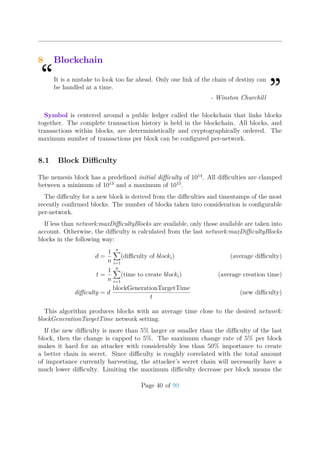
7.5 Block Hashes
Each block has one associated hash - an entity hash. This hash uniquely identifies a block
and is used to prevent processing the same block multiple times.
A block’s entity hash is calculated as a hash of the following:
1. Block Signature
2. Block SignerPublicKey
3. Block (header) verifiable data
The inputs into an entity hash for a block and a transaction are similar. The one difference
is that the network GenerationHashSeed is not an input into the entity hash calculation
for a block. Including this field would serve no purpose for a block. Any block containing
at least one transaction cannot be replayed in a different network because transaction
entity hashes are different across networks. Consequently, the block’s TransactionsHash
would also be different.
Page 39 of 99
8 Blockchain
“It is a mistake to look too far ahead. Only one link of the chain of destiny can
be handled at a time.
”- Winston Churchill
Symbol is centered around a public ledger called the blockchain that links blocks
together. The complete transaction history is held in the blockchain. All blocks, and
transactions within blocks, are deterministically and cryptographically ordered. The
maximum number of transactions per block can be configured per-network.
8.1 Block Difficulty
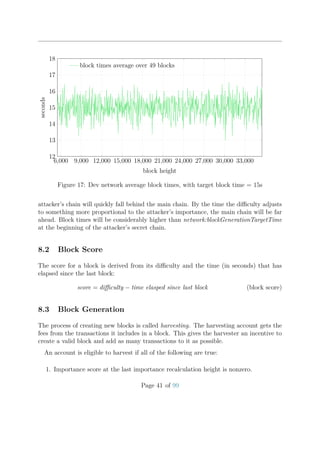
The nemesis block has a predefined initial difficulty of 1014
. All difficulties are clamped
between a minimum of 1013
and a maximum of 1015
.
The difficulty for a new block is derived from the difficulties and timestamps of the most
recently confirmed blocks. The number of blocks taken into consideration is configurable
per-network.
If less than network:maxDifficultyBlocks are available, only those available are taken into
account. Otherwise, the difficulty is calculated from the last network:maxDifficultyBlocks
blocks in the following way:
d =
1
n
n
i=1
(difficulty of blocki) (average difficulty)
t =
1
n
n
i=1
(time to create blocki) (average creation time)
difficulty = d
blockGenerationTargetTime
t
(new difficulty)
This algorithm produces blocks with an average time close to the desired network:
blockGenerationTargetTime network setting.
If the new difficulty is more than 5% larger or smaller than the difficulty of the last
block, then the change is capped to 5%. The maximum change rate of 5% per block
makes it hard for an attacker with considerably less than 50% importance to create
a better chain in secret. Since difficulty is roughly correlated with the total amount
of importance currently harvesting, the attacker’s secret chain will necessarily have a
much lower difficulty. Limiting the maximum difficulty decrease per block means the
Page 40 of 99
6,000 9,000 12,000 15,000 18,000 21,000 24,000 27,000 30,000 33,000
12
13
14
15
16
17
18
block height
seconds
block times average over 49 blocks
Figure 17: Dev network average block times, with target block time = 15s
attacker’s chain will quickly fall behind the main chain. By the time the difficulty adjusts
to something more proportional to the attacker’s importance, the main chain will be far
ahead. Block times will be considerably higher than network:blockGenerationTargetTime
at the beginning of the attacker’s secret chain.
8.2 Block Score
The score for a block is derived from its difficulty and the time (in seconds) that has
elapsed since the last block:
score = difficulty − time elasped since last block (block score)
8.3 Block Generation
The process of creating new blocks is called harvesting. The harvesting account gets the
fees from the transactions it includes in a block. This gives the harvester an incentive to
create a valid block and add as many transactions to it as possible.
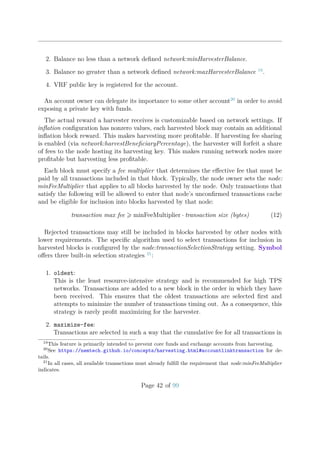
An account is eligible to harvest if all of the following are true:
1. Importance score at the last importance recalculation height is nonzero.
Page 41 of 99
2. Balance no less than a network defined network:minHarvesterBalance.
3. Balance no greater than a network defined network:maxHarvesterBalance 19
.
4. VRF public key is registered for the account.
An account owner can delegate its importance to some other account20
in order to avoid
exposing a private key with funds.
The actual reward a harvester receives is customizable based on network settings. If
inflation configuration has nonzero values, each harvested block may contain an additional
inflation block reward. This makes harvesting more profitable. If harvesting fee sharing
is enabled (via network:harvestBeneficiaryPercentage), the harvester will forfeit a share
of fees to the node hosting its harvesting key. This makes running network nodes more
profitable but harvesting less profitable.
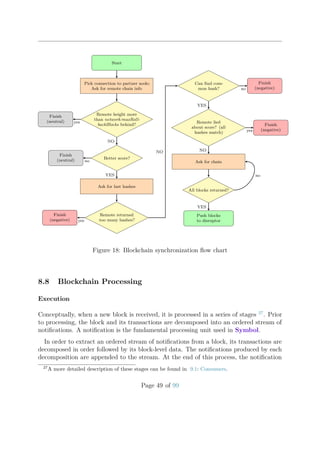
Each block must specify a fee multiplier that determines the effective fee that must be
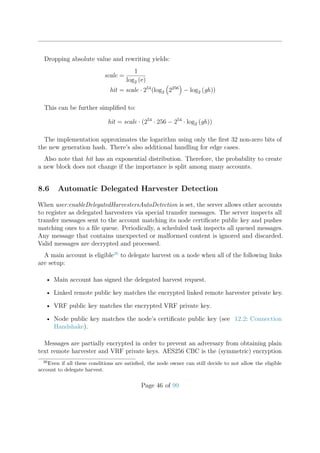
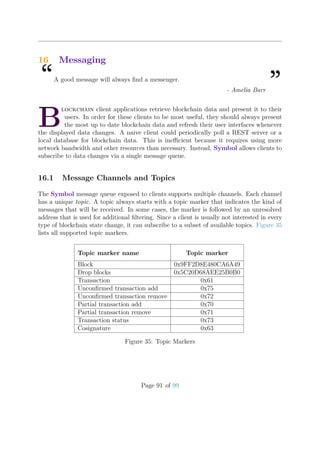
paid by all transactions included in that block. Typically, the node owner sets the node:
minFeeMultiplier that applies to all blocks harvested by the node. Only transactions that
satisfy the following will be allowed to enter that node’s unconfirmed transactions cache
and be eligible for inclusion into blocks harvested by that node:
transaction max fee minFeeMultiplier · transaction size (bytes) (12)
Rejected transactions may still be included in blocks harvested by other nodes with
lower requirements. The specific algorithm used to select transactions for inclusion in
harvested blocks is configured by the node:transactionSelectionStrategy setting. Symbol
offers three built-in selection strategies 21
:
1. oldest:
This is the least resource-intensive strategy and is recommended for high TPS
networks. Transactions are added to a new block in the order in which they have
been received. This ensures that the oldest transactions are selected first and
attempts to minimize the number of transactions timing out. As a consequence, this
strategy is rarely profit maximizing for the harvester.
2. maximize-fee:
Transactions are selected in such a way that the cumulative fee for all transactions in
19
This feature is primarily intended to prevent core funds and exchange accounts from harvesting.
20
See https://nemtech.github.io/concepts/harvesting.html#accountlinktransaction for de-
tails.
21
In all cases, all available transactions must already fulfill the requirement that node:minFeeMultiplier
indicates.
Page 42 of 99
a block is maximized. A profit-optimizing node will pick this strategy. Maximizing
the total block fee does not necessarily mean that the number of transactions included
is maximized as well. In fact, in many cases, the harvester will only include a subset
of the transactions that are available.
3. minimize-fee:
Transactions with the lowest maximum fee multipliers are selected first by this
strategy. Altruistic nodes will pick this strategy together with a very low node:
minFeeMultiplier. If this setting is zero, then the harvester will include transactions
with zero fees first. This allows users to send transactions that get included in
the blockchain for free! In practice, it is likely that only a few nodes will support
this. Even with such a subset of nodes running, zero fee transactions will still have
the lowest probability of getting included in a block because they will always be
supported by the least number of nodes in the network.
Transactions can initiate transfers of both static and dynamic amounts. Static amounts
are fixed and independent of external factors. For example, the amount specified in a
transfer transaction22
is static. The exact amount specified is always transferred from
sender to recipient. In contrast, dynamic amounts are variable relative to the average
transaction cost. These are typically reserved for fees paid to acquire unique network
artifacts, like namespaces or mosaics. For such artifacts, a flat fee is undesirable because it
would be unresponsive to the market. Likewise, solely using a single block’s FeeMultiplier
is problematic because harvesters could cheat and receive artifacts for free by including
registrations in self-harvested blocks with zero fees. Instead, a dynamic fee multiplier is
used. This multiplier is calculated as the median of the FeeMultiplier values in the last
network:maxDifficultyBlocks blocks. network:defaultDynamicFeeMultiplier is used when
there are not enough values and as a replacement for zero values. The latter adjustment
ensures that the effective amounts are always nonzero. In order to arrive at the effective
amount, the base amount is multiplied by the dynamic fee multiplier.
effective amount = base amount · dynamic fee multiplier
22
See https://nemtech.github.io/concepts/transfer-transaction.html for details.
Page 43 of 99
8.4 Block Generation Hash
The generation hash of a block is derived from the previous block generation hash and the
VRF proof included in the block:
gh(1) = generationHash (generation hash)
gh(N) = verify vrf proof(proof(block(N)), gh(N − 1), VRF public key of account)
Making the generation hash dependent on a VRF makes it effectively random and
unpredictable. This is important because it makes the identity of the next harvester
unknown even for an adversary with perfect information. Until a block is pushed to
the network, its generation hash is unknown to all but its harvester. Accordingly, until
the best block is pushed to the network, since each generation hash is dependent on the
preceding generation hash, the input into the generation hash calculation for the next
block is unknown until that point.
A VRF public key needs to be registered on the blockchain before it can be used to
harvest a block. This preregistration requirement prevents an adversary from choosing an
arbitrary VRF public key that can maximize its hit on the next block. As a result, the
adversary is unable to produce many blocks in an attempt to maximize its hit.
8.5 Block Hit and Target
To check if an account is allowed to create a new block at a specific network time, the
following values are compared:
• hit: defines per-block value that needs to be hit.
• target: defines per-harvester power that increases as time since last harvested block
increases.
An account is allowed to create a new block whenever hit < target. Since target is
proportional to the elapsed time, a new block will be created after a certain amount of
time even if all accounts are unlucky and generate a very high hit.
In the case of delegated harvesting, the importance of the original account is used instead
of the importance of the delegated account.
Page 44 of 99
The target is calculated as follows 23
:
multiplier = 264
t = time in seconds since last block
b = 8999999998 · (account importance)
i = total chain importance
d = new block difficulty
target =
multiplier · t · b
i · d
Block time smoothing can be enabled, which results in more stable block times. If
enabled, multiplier above is calculated in the following way 24
:
factor = blockTimeSmoothingFactor/1000.0
tt = blockGenerationTargetTime
power = factor ·
time in seconds since last block − tt
tt
smoothing = min (epower
, 100.0)
multiplier = integer 254
· smoothing · 210
Hit is 64-bit approximation of 254
ln gh
2256 , where gh is a new generation hash 25
.
First, let’s rewrite value above using log with base 2:
hit =
254
log2 (e)
· log2
gh
2256
Note, that gh
2256 is always < 1, therefore log will always yield negative value.
Now, log2
gh
2256 , can be rewritten as log2 (gh) − log2 (2256
).
23
The implementation uses 256-bit integer instead of floating point arithmetic in order to avoid any
problems due to rounding.
24
The implementation uses fixed point instead of floating point arithmetic in order to avoid any problems
due to rounding. Specifically, 128-bit fixed point numbers are used where the 112 high bits represent the
integer part and the 16 low bits represent the decimal part. log2(e) is approximated as 14426950408 /
10000000000. If the calculated power is too negative, smoothing will be set to zero.
25
The implementation uses 128-bit integer instead of floating point arithmetic in order to avoid any
problems due to rounding. log2(e) is approximated as 14426950408889634 / 10000000000000000.
Page 45 of 99
Dropping absolute value and rewriting yields:
scale =
1
log2 (e)
hit = scale · 254
(log2 2256
− log2 (gh))
This can be further simplified to:
hit = scale · (254
· 256 − 254
· log2 (gh))
The implementation approximates the logarithm using only the first 32 non-zero bits of
the new generation hash. There’s also additional handling for edge cases.
Also note that hit has an exponential distribution. Therefore, the probability to create
a new block does not change if the importance is split among many accounts.
8.6 Automatic Delegated Harvester Detection
When user:enableDelegatedHarvestersAutoDetection is set, the server allows other accounts
to register as delegated harvesters via special transfer messages. The server inspects all
transfer messages sent to the account matching its node certificate public key and pushes
matching ones to a file queue. Periodically, a scheduled task inspects all queued messages.
Any message that contains unexpected or malformed content is ignored and discarded.
Valid messages are decrypted and processed.
A main account is eligible26
to delegate harvest on a node when all of the following links
are setup:
• Main account has signed the delegated harvest request.
• Linked remote public key matches the encrypted linked remote harvester private key.
• VRF public key matches the encrypted VRF private key.
• Node public key matches the node’s certificate public key (see 12.2: Connection
Handshake).
Messages are partially encrypted in order to prevent an adversary from obtaining plain
text remote harvester and VRF private keys. AES256 CBC is the (symmetric) encryption
26
Even if all these conditions are satisfied, the node owner can still decide to not allow the eligible
account to delegate harvest.
Page 46 of 99
scheme used. The encryption key is derived from the server’s node certificate key pair and
a random ephemeral key pair generated by the client.
Each message is expected to have the following contents:
Name Size Encrypted? Description
0xE201735761802AFE 8 bytes No Magic bytes indicating the message is a
harvest request
Ephemeral public key 32 bytes No Public key used to derive the symmetric
encryption key
AES CBC IV 16 bytes No Initialization vector for AES CBC algo-
rithm
Signing private key 32 bytes Yes Remote harvester signing private key
linked to the main account
VRF private key 32 bytes Yes VRF private key linked to the main ac-
count
AES padding 16 bytes No Padding defined by the AES CBC algo-
rithm
Table 4: Harvest request message format
If possible, announced delegated harvester private keys will be used by the server to
harvest blocks. A server can have at most harvesting:maxUnlockedAccounts harvesters.
Upon reaching that limit, the evaluation of any new delegated harvester is based on the
harvesting:delegatePrioritizationPolicy setting. When the policy is set to Age, accounts
announced earlier are preferred. As a result, a new delegated harvester cannot replace any
existing delegated harvester. When the policy is set to Importance, accounts with higher
importances are preferred. As a result, a new delegated harvester can replace an existing
delegated harvester with less importance.
Successful announcements are stored in the harvesters.dat file. Accepted delegated
harvesters are persisted across server reboots. The server does not provide any explicit
confirmation that it is or is not currently harvesting with a specific delegated harvester.
The blockchain only stores a record of all the links related to delegated harvesting, but
not the current activity.
Page 47 of 99
8.7 Blockchain Synchronization
A score can be assigned to any chain of blocks by summing the scores of the component
blocks:
score =
block∈blocks
block score (blockchain score)
Blockchain synchronization is crucial to maintaining distributed consensus. Periodically,
a local node will ask a remote node about its chain. The remote node is selected from a
set of partners based on various factors, including reputation (see 13: Reputation).
If the remote node promises a chain with a higher score, the local node attempts to find
the last common block by inspecting the hashes provided by remote node. If successful,
the remote node will supply as many blocks as settings allow.
If the supplied chain is valid, the local node will replace its own chain with the remote
chain. If the supplied chain is invalid, the local node will reject the chain and consider the
synchronization attempt with the remote node to have failed.
Figure 18 illustrates the process in more detail.
Page 48 of 99
Start
Pick connection to partner node;
Ask for remote chain info
Remote height more
than network:maxRoll-
backBlocks behind?
Finish
(neutral)
Better score?
Finish
(neutral)
Ask for last hashes
Remote returned
too many hashes?
Finish
(negative)
Can find com-
mon hash?
Finish
(negative)
Remote lied
about score? (all
hashes match)
Finish
(negative)
Ask for chain
All blocks returned?
Push blocks
to disruptor
yes
NO
no
YES
yes
NO
no
YES
yes
NO
no
YES
Figure 18: Blockchain synchronization flow chart
8.8 Blockchain Processing
Execution
Conceptually, when a new block is received, it is processed in a series of stages 27
. Prior
to processing, the block and its transactions are decomposed into an ordered stream of
notifications. A notification is the fundamental processing unit used in Symbol.
In order to extract an ordered stream of notifications from a block, its transactions are
decomposed in order followed by its block-level data. The notifications produced by each
decomposition are appended to the stream. At the end of this process, the notification
27
A more detailed description of these stages can be found in 9.1: Consumers.
Page 49 of 99
stream completely describes all state changes specified in the block and its transactions.
Once the stream of notifications is prepared, each notification is processed individually.
First, it is validated independent of blockchain state. Next, it is validated against the
current blockchain state. If any validation fails, the containing block is rejected. Otherwise,
the changes specified by the notification are made to the in memory blockchain state and
the next notification is processed. This sequence allows transactions in a block to be
dependent on changes made by previous transactions in the same block.
After all notifications produced by a block are processed, the ReceiptsHash (see
7.2.4: Receipts Hash) and StateHash (see 7.3: State Hash) fields are calculated and
checked for correctness. Importantly, when network:enableVerifiableState is enabled, this
is the point at which all state Patricia trees get updated.
Rollback
Occasionally, a block that has been previously confirmed needs to be undone. This is
required in order to allow fork resolution. For example, to replace a worse block with a
better block. In Symbol, at most network:maxRollbackBlocks can be rolled back at once.
Forks larger than this setting are irreconcilable.
When a block is being rolled back, it is decomposed into an ordered stream of notifications.
This stream is reversed relative to the stream used during execution. Since transactions in
a block may be dependent on changes made by previous transactions in the same block,
they need to be undone before their dependencies are undone.
Once the stream of notifications is prepared, each notification is processed individually.
No validation is needed because the rollback operation is returning the blockchain to a
previous state that is known to be valid. Instead, the changes specified by the notification
are simply reverted from the in memory blockchain state and the next notification is
processed.
After all notifications produced by a blockchain part are processed, the previous
blockchain state is restored. When network:enableVerifiableState is enabled, the in memory
state hash still needs to be updated. Instead of individually applying all tree changes, the
in memory state hash is forcibly reset to the state hash of the common block prior to the
last rolled back block.
Page 50 of 99
9 Disruptor
“Death is the great disruptor. It thrusts us opposite life’s mirror, invites our
truthful exploration, and reveals the naked truth from which rebirth is possible
and we are free to reinvent ourselves anew.
”- B.G. Bowers
O
ne main goal of Symbol is to achieve high throughput. In order to help achieve
this goal, the disruptor28
pattern is used to perform most data processing.
A disruptor uses a ring buffer data structure to hold all elements in need of
processing. New elements are inserted into the next free slot of the ring buffer. Fully
processed elements are removed to make space for new elements. Since the ring buffer
has a finite number of slots, it can run out of space if processing can’t keep up with new
insertions. The behavior of Symbol, in such a case, can be configured to either exit the
server or discard new data until a slot becomes available.
Circular Buffer
1
2
3
4
5
6
7
8
910
11
12
13
14
15
16
17
18
Free slots
Occupied slots
Next free slot
Each element in the ring buffer is processed by one or more consumers. Each consumer
takes a single element as input. Some consumers calculate data from the input and attach
it to the element, while others validate the element or alter the global chain state using
the element’s data. Some consumers depend on the work done by previous consumers.
Therefore, consumers always need to act on input elements in a predefined order. To
ensure this, each consumer has an associated barrier. The barrier prevents a consumer
from processing an element that has not yet been processed by its immediately preceding
consumer. The last consumer reclaims all memory that was used during processing.
28
https://en.wikipedia.org/wiki/Disruptor_(software)
Page 51 of 99
Consumers can set an element’s completion status to CompletionStatus::Aborted in
case it is already known or invalid for some reason. Subsequent consumers ignore aborted
elements.
Consumer 1
Consumer 1
Barrier
Consumer 2
Consumer 2
Barrier
Consumer 3
Consumer 3
Barrier
Reclaim Memory
Consumer
14 13 12 11 10 9 8 7 6 5 4 3 2 1
9.1 Consumers
In Symbol, a block disruptor is used to process incoming blocks and blockchain parts.
A blockchain part is an input element composed of multiple blocks. This disruptor is
primarily responsible for validating, reconciling and growing the blockchain.
A transaction disruptor is used to process incoming, unconfirmed transactions. Transac-
tions that are fully processed get added to the unconfirmed transactions cache.
All disruptors are associated with a chain of consumers that perform all processing of
their input elements. Different disruptors are customized by using different consumer
chains. All consumers can inspect the data being processed and some can modify it.
Page 52 of 99
Audit Consumer (optional)
Hash Calculator Consumer
Hash Check Consumer
Blockchain Check Consumer
Stateless Validation Consumer
Batch Signature Consumer
Blockchain Sync Consumer
Blockchain Sync Cleanup
Consumer (optional)
New Block Consumer
(a) Block Consumers
Audit Consumer (optional)
Hash Calculator Consumer
Hash Check Consumer
Stateless Validation Consumer
Batch Signature Consumer
New Transactions Consumer
(b) Transactions Consumers
Figure 19: Symbol consumer chains
9.1.1 Common Consumers
The block and transaction disruptors share a number of consumers.
Audit Consumer
This consumer is optional and can be enabled via node configuration. If enabled, all new
elements are written to disk. This makes it possible to replay the incoming network action
and is helpful for debugging.
Hash Calculator And Hash Check Consumers
It is very common for a server to receive the same element many times because networks
consist of many servers that broadcast elements to several other servers. For performance
reasons, it is desirable to detect at an early stage whether an element has already been
processed in order to avoid processing it again.
Page 53 of 99
The hash calculator consumer calculates all the hashes associated with an element. The
hash check consumer uses the hashes to search the recency cache, which contains the
hashes of all recently seen elements. The consumer used by the transaction disruptor
will also search the hash cache (containing hashes of confirmed transactions) and the
unconfirmed transactions cache. If the hash is found in any cache, the element is marked
as CompletionStatus::Aborted and further processing is bypassed.
Stateless Validation Consumer
This consumer handles state independent validation by validating each entity in an element.
This can be done in parallel using many threads. Each plugin can add stateless validators.
An example of a stateless validation is the validation that a block does not contain
more transactions than allowed by the network. This check depends on the network
configuration but not on the global blockchain state.
Batch Signature Consumer
This consumer validates all signatures of all entities in an element. This is separate
from the Stateless Validation Consumer because it uses batch verification. For improved
performance, this consumer processes many signatures at once in a batch instead of
individually. This can be done in parallel using many threads.
Reclaim Memory Consumer
This consumer completes the processing of an element and frees all memory associated
with it. It triggers downstream propagation of the statuses of all transactions that were
updated during processing. The overall result of the sync operation is used to update the
reputation of - and possibly ban - the sync partner (see 13: Reputation)).
9.1.2 Additional Block Consumers
The block disruptor also uses a few block-specific consumers.
Blockchain Check Consumer
This consumer performs state-independent integrity checks of the chain part contained
within an element. It checks that:
Page 54 of 99
• The chain part is not composed of too many blocks.
• The timestamp of the last block in the chain part is not too far in the future.
• All blocks within the chain part are linked.
• There are no duplicate transactions within the chain part.
Blockchain Sync Consumer
This consumer is the most complex one. All tasks that require or alter the local server’s
chain state are performed in this consumer.
First, it checks that the new chain part can be attached to the existing chain. If the
chain part attaches to a block preceding the tail block, all blocks starting with the tail
block are undone in reverse order until the common block is reached.
Next, it executes each block by performing stateful validation and then observing changes.
Stateless validation is skipped because it was performed by previous consumers. If there
are any validation failures, the entire chain part is rejected. Otherwise, all changes are
committed to the chain state (both the block and cache storages) and the unconfirmed
transactions cache is updated.
This consumer is the only part of the Symbol system that modifies the chain state and
needs write access to it.
Blockchain Sync Cleanup Consumer
This consumer is optional and can be enabled via node configuration. If enabled, it removes
all files that were created by the Blockchain Sync Consumer. This consumer should only
be enabled when a server is running without a broker.
New Block Consumer
This consumer forwards single blocks, either harvested by the server or pushed from a
remote server, to other servers in the network.
9.1.3 Additional Transaction Consumers
The transaction disruptor uses a single transaction-specific consumer.
Page 55 of 99
New Transactions Consumer
This consumer forwards all transactions that have valid signatures and have passed stateless
validation to the network. Stateful validation is not performed on transactions until they’re
added to the unconfirmed transactions cache. Forwarding is intentionally done before
stateful validation because one server might reject transactions that could be accepted by
other servers (e.g. if the transaction has too low a fee for the local server). Subsequently,
stateful validation is performed on the forwarded transactions, and the valid ones are
stored in the unconfirmed transactions cache.
Page 56 of 99
10 Unconfirmed Transactions
“I don’t believe one reads to escape reality. A person reads to confirm a reality
he knows is there, but which he has not experienced.
”- Lawrence Durrell
A
ny transaction that is not yet included in a block is called an unconfirmed
transaction. These transactions may be valid or invalid. Valid unconfirmed
transactions are eligible for inclusion in a harvested block. Once a transaction
is added to a block that is accepted in the blockchain, it is confirmed.
Unconfirmed transactions can arrive at a node when:
1. A client sends a new transaction directly to the node.
2. A bonded aggregate transaction is completed with all requisite cosignatures and is
promoted from the partial transactions cache.
3. A Peer node broadcasts transactions to the node.
4. A Peer node responds to the node’s request for unconfirmed transactions. As an
optimization, the requesting node indicates what transactions it already knows
in order to avoid receiving redundant transactions. Additionally, it supplies the
minimum fee multiplier (see 8.3: Block Generation) it uses when creating blocks.
This prevents the remote node from returning unconfirmed transactions that will be
immediately rejected by the requesting node.
When an unconfirmed transaction arrives at a node, it is added to the transaction
disruptor (see 9: Disruptor). All transactions that haven’t been previously seen and pass
stateless validation will be broadcast to peer nodes. At this point, it is still possible for
the node to reject the broadcast transactions because stateful validation is performed
after broadcasting. Due to different node settings, it’s possible for some nodes to accept
a specific unconfirmed transaction and other nodes to reject it. For example, the nodes
could have different node:minFeeMultiplier settings.
10.1 Unconfirmed Transactions Cache
When a transaction passes all validation, it is eligible for inclusion in a harvested block.
At this point, the node tries to add it to the unconfirmed transactions cache. This can fail
for two reasons:
Page 57 of 99
1. The maximum cache size configured by node:unconfirmedTransactionsCacheMaxSize
has been reached.
2. The cache contains at least as many unconfirmed transactions as can be included in
a single block and the new transaction is rejected by the Spam throttle.
Whenever new blocks are added to the blockchain, the blockchain state changes and the
unconfirmed transactions cache is affected. Although all transactions in the cache are valid
at the time they were added, this doesn’t guarantee that they’ll be valid in perpetuity. For
example, a transaction could have already been included in a block harvested by another
node or a conflicting transaction could have been added to the blockchain. This means
that transactions in the cache that were perfectly valid previously could be invalidated
after changes to the blockchain state. Additionally, when blocks with transactions are
reverted, it’s possible that some of those previously confirmed transactions are no longer
included in any block in the new chain. Those reverted transactions should be added to
the cache.
As a result of these considerations, the entire unconfirmed transactions cache is com-
pletely rebuilt whenever the blockchain changes. Each transaction is rechecked by the
stateful validators and purged if it has become invalid or has already been included in a
block. Otherwise, it is added back to the cache.
10.2 Spam Throttle
The initiator of an unconfirmed transaction does not have to pay a fee to nodes holding the
transaction in the unconfirmed transactions cache. Since the cache uses valuable resources,
a node must have some protection against being spammed with lots of unconfirmed
transactions. This is especially important if the node is generous and accepts zero fee
transactions.
Simply limiting the number of unconfirmed transactions that a node accepts is suboptimal
because normal actors should still be able to send a transaction even when a malicious
actor is spamming the network. Limiting the number of unconfirmed transactions per
account is also not a good option because accounts are free to create.
Symbol implements a smart throttle that prevents an attacker from filling the cache
completely with transactions while still letting honest actors successfully submit new
unconfirmed transactions. node:enableTransactionSpamThrottling can be used to activate
the throttle. Assuming the cache is not full, it works in the following way:
1. If the cache contains fewer unconfirmed transactions than can be included in a single
block, throttling is bypassed.
Page 58 of 99
2. If the new transaction is a bonded aggregate transaction, throttling is bypassed.
3. Else the Spam throttle is applied.
Let curSize be the current number of transactions in the cache and maxSize the config-
ured maximum size of the cache. Also let rel. importance of A be the relative importance
of A, i.e. a number between 0 and 1. If a new unconfirmed transaction T with signer A
arrives, then the fair share for account A is calculated:
maxBoostFee = transactionSpamThrottlingMaxBoostFee
maxFee = min(maxBoostFee, T::MaxFee)
eff. importance = (rel. importance of A) + 0.01 ·
maxFee
maxBoostFee
fair share = 100 · (eff. importance) · (maxSize − curSize) · exp −3
curSize
maxSize
If account A already has as many transactions in the cache as its fair share, then
the new transaction is rejected. Otherwise, it is accepted. The formula shows that an
increase in a transaction’s maximum fee increases the number of slots available in the
cache. Nonetheless, this mechanism for boosting the effective importance is limited by
node:transactionSpamThrottlingMaxBoostFee.
10 20 30 40 50 60 70 80 90 100
0
20
40
cache fill level [%]
fairshare
0.01%
0.005%
0.001%
Figure 20: Fair share for various effective importances with max cache size = 10000
Figure 20 shows the fair share of slots relative to the fill level of the cache for various
effective importances. An attacker that tries to occupy many slots cannot gain much
by using many accounts because the importance of each account will be very low. The
attacker can increase maximum transaction fees but that will be more costly and expend
funds at a faster rate.
Page 59 of 99
11 Partial Transactions
“The whole is greater than the sum of its parts.
”- Aristotle
B
onded aggregate transactions (see 6.2: Aggregate Transaction) are also referred to
as partial transactions. The name partial is fitting because the transactions have
insufficient cosignatures and are unable to pass validation until more cosignatures
are collected.
Support for handling partial transactions is provided by the partial transaction extension.
If a network supports bonded aggregate transactions, this extension should be enabled on
all API and Dual nodes.
Partial transactions are synchronized among all nodes in a network that have this
extension enabled. A node passively receives partial transactions and cosignatures pushed
by remote nodes. It also periodically requests transactions and cosignatures from remote
nodes via the pull partial transactions task. As an optimization, the requesting node
indicates which transactions and cosignatures it already knows in order to avoid receiving
redundant information.
When the hash lock plugin is enabled, in order for a partial transaction to be accepted
by the network, a hash lock must be created and associated with the transaction. The hash
lock is essentially a bond paid in order to use the built-in cosignature collection service. If
the associated partial transaction is completed and confirmed in the blockchain before the
hash lock expires, the bond is returned to the payer. Otherwise, the bond is forfeited to
the harvester of the block at which the lock expires. This feature makes spamming the
partial transactions cache more costly because it requires node:lockedFundsPerAggregate
to be paid, at least temporarily, for a partial transaction to enter the cache.
When a node receives a new partial transaction, it is pushed to the partial transaction
dispatcher. Received cosignatures are collated with partial transactions already in the cache
and are immediately rejected if there are no matching transactions 29
. When transactions
and cosignatures are received together, they are split and processed individually as above.
Compared to the normal transaction dispatcher (see 9.1: Consumers), the partial
transaction dispatcher is minimalistic.
29
This implies that a partial transaction must be present in the cache before any of its cosignatures can
be accepted.
Page 60 of 99
Hash Calculator Consumer
Hash Check Consumer
New Transactions Consumer
Figure 21: Partial transaction consumers
The hash calculator and hash check consumers work as described for the transaction dis-
patcher in 9.1.1: Common Consumers. The one difference is that the hash check consumer
will additionally search the partial transactions cache for previously seen transactions. The
new transaction consumer has a similar purpose to the one described in 9.1.3: Additional
Transaction Consumers. The difference is that it broadcasts and processes partial transac-
tions instead of unconfirmed transactions. Specifically, it broadcasts partial transactions
to the network and then adds valid ones to the partial transactions cache.
11.1 Partial Transaction Processing
The partial transactions cache contains all partial transactions that are waiting for addi-
tional cosignatures. When a new partial transaction is received that passes all validation,
it is added to the cache. It will stay in the cache until a sufficient number of cosignatures
are collected or it becomes invalid. For example, the transaction will be purged if its
associated hash lock expires. Whenever a partial transaction is completed by collecting
sufficient cosignatures, it will immediately be forwarded to the transaction dispatcher and
be processed as an unconfirmed transaction.
The partial transactions cache collates all new cosignatures with the transactions it
already contains. In order to be added to the cache, a cosignature must be new, verifiable
and associated with an existing partial transaction. It is possible for a previously accepted
cosignature to become invalid, in which case it should be purged. For example, a cosignature
could become invalid if its signer was removed from a multisignature account participating
in the partial transaction. The cosignature collation process is intricate enough to handle
such edge cases.
Page 61 of 99
Start
Is transaction al-
ready in PT cache?
Extract cosigna-
tures and process
them (see Fig-
ure 23: Processing
of a cosignature)
Run validators
Is partial trans-
action valid?
Reject and notify
transaction
status subscribers
Add partial trans-
action to PT cache
Is partial trans-
action complete?
Remove from
PT cache
Send to transac-
tion dispatcher
yes
no
no
yes
no
yes
Figure 22: Processing of a partial transaction
Page 62 of 99
Start
Is associated trans-
action already
in PT cache?
Finish, cosignature
can be ignored
Validate partial transaction
with existing signatures
and new cosignature
Is cosignature from
this cosignatory
already present?
Is eligible?
Is cosignature crypto-
graphically verifiable?
Add cosignature to PT cache
Is partial trans-
action complete?
Finish, need to
wait for more
cosignatures
Remove from
PT cache
Send to transac-
tion dispatcher
Validate partial transaction
only with new cosignature
Is eligible?
Find and remove
stale cosignatures
no
yes
yes
no
no
yes
no (invalid)
yes (valid)
no
yes
no
yes
Figure 23: Processing of a cosignature
Page 63 of 99
12 Network
“Pulling a good network together takes effort, sincerity and time.
”- Alan Collins
D
ynamic discovery of nodes allows a peer-to-peer network to grow. Symbol
implements this dynamic discovery in the node discovery extension. Public
networks are typically open and allow any node to join. Private networks can
restrict the nodes that are allowed to join and behave as a federated system 30
. Symbol
is flexible enough to even allow private networks to specify all node relationships via
configuration files.
Symbol supports a configurable node identification policy configured by network:
nodeEqualityStrategy. Valid policies allow identifying a node by either its resolved IP
(host) 31
or public boot key (public-key). The former is preferred for public networks.
12.1 Beacon Nodes
A freshly booted node is initially isolated and not connected with any peers. It needs to join
a network before it can make any meaningful contributions, like validating or harvesting
blocks. In Symbol, a list of static beacon nodes are stored in a peers configuration file.
In order to join a network, a new node first connects to these nodes. These files don’t
need to be identical across all nodes in a network.
A public network is recommended to specify a set of high availability beacon node
candidates. Each node’s peers configuration file should contain a random subset of these
nodes. The random subset can be selected once before connecting to the network for
the first time or more frequently before every boot. The important thing is that beacon
nodes are well distributed. This reduces stress on individual beacon nodes and makes
DoS attacks on beacon nodes more difficult. These nodes are given slight preference in
node selection (see 13.2: Weight Based Node Selection) relative to non-beacon nodes
because they are assumed to have high-availability. They aren’t conferred any other special
privileges or responsibilities. They can be thought of as doors into the network.
Certain extensions may require their own set of beacon nodes. For example, the partial
transaction extension stores its own set of beacon nodes in a separate peers configuration
30
By carefully distributing harvesting and currency mosaics, a private network can delegate permissions
to different accounts. For example, only accounts owning sufficient harvesting mosaic can create blocks
and only accounts with nonzero currency can initiate transactions with nonzero fees.
31
A node’s resolved IP is only broadcast to other nodes when it doesn’t specify a hostname. Hostnames
are preferentially propagated in order to support nodes with dynamic IPs.
Page 64 of 99
file. Nodes with this extension enabled need to additionally synchronize partial transactions
among other nodes that also have this extension enabled (see 11: Partial Transactions).
A node’s roles specify the capabilities it supports. Typically, these are used by a
connecting node to choose appropriate partners. Nodes with the Peer role support basic
synchronization. Nodes with the API role support partial transaction synchronization.
Roles are not mutually exclusive. Nodes are allowed to support multiple roles.
12.2 Connection Handshake
All connections among Symbol nodes are made over TLS v1.3 with a custom verification
procedure. Each node is expected to have a two level deep X509 certificate chain composed
of a root certificate and a node certificate. All certificates must be X25519 certificates.
Symbol doesn’t support any other certificate types.
The root certificate is expected to be self-signed with an account’s signing private
key. This account is assumed to be a node’s unique owner. Cryptographically linking
a node and an account allows selection algorithms to perform node weighting based on
the node owner’s importance. Additionally, partner nodes use this verified identity to
collate reputation (see 13: Reputation) information32
. Importantly, this certificate is only
used for signing the node certificate. For security, its private key should not be kept on a
running server.
The node certificate is signed by the root certificate. It can contain a random public/pri-
vate key pair. This certificate is used for authenticating TLS sessions and deriving shared
encryption keys for encrypting optional data33
. It can be rotated as often as desired.
This authentication procedure is performed independently by each partner node. If
either node fails the handshake, the connection is immediately terminated.
12.3 Packets
Symbol uses TCP for network communication on the port specified by node:port. Com-
munication is centered around a higher level packet model on top of and distinct from
TCP packets. All packets begin with an 8-byte header that specifies each packet’s size
and type. Once a complete packet is received, it is ready for further processing.
32
In the public network, nodes are primarily identified by their resolved IP.
33
Currently, the only encryption key derived is the one used to encrypt and decrypt messages related to
automatic delegated harvester detection (see 8.6: Automatic Delegated Harvester Detection).
Page 65 of 99
0 1 2 3 4 5 6 7
Size Type0x00
Figure 24: Packet header binary layout
A mix of long lived and short lived connections are used. Long lived connections are
used for repetitive activities like syncing blocks or transactions. They support both
push and request/response semantics. The connections are allowed to last for node:
maxConnectionAge selection rounds (see 13.1: Connection Management) before they are
eligible for recycling. Connections older than this setting are recycled primarily to allow
direct interactions with other partner nodes and secondarily as a precaution against zombie
connections.
Short lived connections are used for more complex multistage interactions between
nodes. For example, they are used for node discovery (see 12.6: Node Discovery) and time
synchronization (see 15: Time Synchronization). Short lived connections help prevent
sync starvation, which can occur when all long lived connections are in use and no sync
partners are available.
Handlers are used to process packets. Each handler is registered to accept all packets
with a specified packet type. When a complete packet is ready for processing, it is
dispatched to the handler registered with its type. All handlers must accept matching
packets for processing. Some handlers can also write response packets in order to allow
request/response protocols.
12.4 Connection Types
In Symbol, long lived connections are primarily identified as readers or writers. This is
orthogonal to whether they are incoming or outgoing. They are secondarily identified by
purpose, or service identifier 34
. This allows connections to be selected by capability and
more granular logging.
Reader connections are mostly passive and used to receive data from other nodes. Each
server asynchronously reads from each reader connection. Whenever a new packet is
received in its entirety, it is dispatched to an appropriate handler. If no matching handler
is available, the connection is closed immediately.
The node:maxIncomingConnectionsPerIdentity limit is applied across all services and
long and short lived connections. Any incoming connections above this limit will be
immediately closed. This limit can be hit when multiple short lived connections are
34
Although the terminology is similar, these are unrelated to services described in 2.2: Symbol
Extensions.
Page 66 of 99
initiated with the same remote node for different operations. This is more likely when
connection tasks are more aggressively scheduled immediately after a node boots up. These
errors are typically transient and can be safely ignored if they don’t persist.
Writer connections are more active and used to send data to other nodes. Broadcast
operations push data to all active and available writers. Additionally, writers can be
selected individually and used for request/response protocols. In order to simplify recipient
processing, writers participating in an ongoing request/response protocol are not sent
broadcast packets.
Service identifiers are only assigned to long lived connections. Sync service is used to
manage outgoing connections to nodes with Peer role. API partial service is used to
manage outgoing connections to nodes with API role. Readers service is used to manage
incoming connections. API writers service is experimental and allows incoming connections
on port node:apiPort to register as writers.
Identifier Name Direction
0x50415254 pt.writers outgoing
0x52454144 readers incoming
0x53594E43 sync outgoing
Figure 25: Service Identifiers
For the purposes of node selection described in 13.2: Weight Based Node Selection, node
aging and selection are both scoped per service. Reputational information is aggregated
across all services. Specifically, assume a node has made both a Sync and API partial
connection to another node. Each connection can have a different age because age is
scoped per service. Interaction results, from any connection, are always attributed to the
node, not the service.
12.5 Peer Provenance
A node collects data about all nodes in its network. The reputability of the data is
dependent on its provenance. Possible provenances, ranked from best to worst are:
1. Local - Node is specified in node:localnode.
2. Static - Node is in one of the peers configuration files.
3. Dynamic - Node was discovered and supports connections.
4. Dynamic Incoming - Node has made a connection but does not support connections.
Page 67 of 99
It is important to note that the distinguishing characteristic of a static node is that it
is listed in at least one local peers configuration file. For emphasis, it is possible for one
partner to view a node as static while another partner views it as dynamic. Excepting the
local node, all other nodes are dynamic. A subset of dynamic nodes are incoming. These
nodes have only been seen in incoming but not outgoing connections. As a result, their
preferred port is unknown and they can’t be connected with.
Existing node data can only be updated if the new data does not have worse provenance
than the existing data. For example, updated information about a static node with
dynamic provenance is discarded, but updated information about a dynamic node with
dynamic or static provenance is allowed.
The above is a slight simplification due to how connections are actually managed. When
a node disconnects completely from a remote node and reconnects, the update can be
a two step process. Consider a dynamic node that attempts to reconnect to a remote
with a different identity public key. When the node initiates a connection, the remote
will classify the connection as dynamic incoming, which has a worse provenance than
dynamic. As a result, the remote will not update the node’s information. Instead, it will
set a flag indicating a possible identity update in progress. Later on, when the remote
directly connects to the node, it will get the same updated information as before. At this
point, the remote will update the information even though an active (dynamic incoming)

connection is present because an in progress identity update was detected previously.
Without this flag, the active connection with worse provenance would block updates, which
is undesirable.
When network:nodeEqualityStrategy is public-key, the secondary identity component
is the resolved IP. When there are no active connections, this is allowed to change. This
strategy does not support reputational migration.
When network:nodeEqualityStrategy is host, the secondary identity component is the
node identity public key. When there are no active connections, this is allowed to change.
The resolved IP primary identity component can also be changed when there are no active
connections assuming the secondary identity component is unchanged. In this case, all
reputation data associated with the original host is migrated to the new host. When there
is an ambiguous match, data with the matching primary identity component is migrated
and data with the matching secondary identity component is discarded.
12.6 Node Discovery
After starting up, a node attempts to make short lived connections to all static nodes it
has loaded from its peers configuration files. These connections are primarily intended to
retrieve the resolved IP addresses of all static nodes. This allows hostnames to be used
Page 68 of 99
in the peers configuration files and simplifies node management. As long as the node is
running, this procedure is periodically repeated with a linear backoff.
Periodically, a node will broadcast identifying information about itself to its remote
partner nodes. The remote will process the received payload and check it for validity
and compatibility. In order to be valid, the identity public key specified by the node
must match the public key of its root X509 certificate. In order to be compatible, both
the broadcasting and receiving nodes must target the same network. If no hostname is
provided, the node’s resolved IP will be used in place. If all checks succeed, the node will
be added as a new potential partner and will be eligible for selection in the next sync
round.
Periodically, a node will request all known peers from its remote partner nodes. The
remote nodes will respond with all of their active static and dynamic peers. To the
requesting node, these will all be treated as dynamic nodes. The original node will request
the identifying information from each of these nodes directly. This direct communication
is required to prevent a malicious actor from relaying false information about other nodes
and to ensure a connection can be established with each new node. The original node will
process the received payload and check it for validity and compatibility as above. If all
checks succeed, the new node will be added as a new potential partner and will be eligible
for selection in the next sync round.
Page 69 of 99
13 Reputation
“It takes many good deeds to build a good reputation, and only one bad one to
lose it.
”- Benjamin Franklin
S
ymbol uses a peer-to-peer (P2P) network. P2P networks have the great advantage
of being robust because they cannot be shut down by eliminating a single node.
Nevertheless, a public network comes with its own challenges. The participants of
the network are anonymous and anyone can join. This makes it very easy to inject hostile
nodes into the network that spread invalid information or try to disturb the network in
some way.
There is a need to identify hostile nodes and reduce communication with them. There
have been many approaches to achieve this. One of the most successful is building a
reputation system for nodes. Symbol follows this approach by implementing a simple
reputation system. This system attempts to prioritize connections to well-behaved nodes
over those to misbehaving nodes. Importantly, reputation doesn’t affect the blockchain
consensus at all. It only influences the network graph. This chapter will outline the
heuristics used.
13.1 Connection Management
Each node can establish at most node:maxConnections persistent connections at once.
This limit is expected to be much smaller than the hundreds of thousands of nodes that
make up the network as a whole. In order to avoid isolated node groups from forming,
a node will periodically drop existing connections to make room for new connections to
different nodes.
When determining the nodes from which to disconnect, a node inspects the ages of all
of its connections. In order to minimize connection overhead, only connections that have
been established for at least node:maxConnectionAge rounds are eligible for removal. The
next time a node selection round is done, these connections are dropped and replaced
with new connections to other nodes. This guarantees that over time each node will make
connections to many different nodes in the network.
Page 70 of 99
13.2 Weight Based Node Selection
Nodes primarily communicate with each other via the current persistent connections they
have established. A node can query another node for new transactions or blocks, or ask
for a list of other nodes with which the partner node has interacted. Nodes can also
voluntarily send data to other nodes. Each communication between nodes is considered
an interaction and each interaction is scored as either successful, neutral or failed. For
example, when a remote node sends new valid data, the interaction is considered successful
because it has contributed to the synchronization of the two nodes. If the remote node
has no new data, the interaction is neutral. Otherwise, the interaction is considered failed.
Each node keeps track of the outcomes of its own interactions with other nodes. These
outcomes are only used locally and not shared with other nodes. A node’s interactions
with other nodes influence the partner nodes it selects. Interaction results are stored for
at most one week but reset on node restart. These results are time-limited to allow nodes
that are having transient failures to reestablish themselves as good partners.
When selecting partner nodes, a node first determines a set of candidate nodes. Each
candidate node is assigned a raw weight between 500 and 10000 according to the following
criteria:
• If there were 3 or fewer non-neutral interactions with the remote node, it is given a
medium raw weight of 5000. This gives new nodes a good chance of getting selected.
• Else let s be the number of successful and f the number of failed interactions. Then
the raw weight is calculated by the following formula:
rawWeight = max 500,
s · 10000
s + 9 · f
This formula guarantees that failed interactions rapidly decrease the weight of a remote
node and its likelihood of getting selected. The presence of a minimum score still gives a
node with many failures a slight chance for being selected and possibly improving its score
with more interactions.
The raw weight is multiplied with a weight multiplier to give the final weight of a node.
For static nodes, the multiplier is 2. For dynamic nodes, it is 1. If a node is banned due
to consecutive interaction failures (see 13.3: Node Banning), the multiplier is decreased
by 1. This ensures that a node does not connect to dynamic banned nodes. The chance of
connecting to static banned nodes is reduced by half.
Page 71 of 99
0 20 40 60 80 100
0
20
40
0
5,000
10,000
successful
interactions
failed
interactions
raw
node
weight
Figure 26: Raw Node Weight
Removal candidates are determined based on their connection age. Each removal
candidate that will be closed is replaced with a connection to a new node so that the node
maintains the desired level of connections. Finally, for each free slot, a candidate node has
a chance of getting selected given by:
P(node is getting selected) =
node weight
candidates
nodes
candidate node weight
13.3 Node Banning
In a public network there could be potentially malicious nodes that try to disturb normal
processing of the network. Therefore, if a node considers a remote node malicious, it will
prevent connecting to that node and will not accept incoming connections from it.
Banning is applied at node level and is attached to a node’s network scoped identifier
Page 72 of 99
(see 12.6: Node Discovery). A misbehaving node will be immediately banned for a period
of node:defaultBanDuration. Even after a node is no longer actively banned, the local
node will remember for some time (node:keepAliveDuration) that the node was behaving
badly and treat repeat violations more severely by banning the node for longer periods
up to node:maxBanDuration. During banning, no connections with the banned node will
be established. After banning has expired, the node is treated like a normal interaction
partner again. There are various scenarios where a remote node will get banned. The
penalties vary based on the cause.
Connection
closed
Remote
can
reconnect
Remote
can be
selected
Remote
can send
data
Consecutive
interaction
failures
No -
Yes Static
No Dynamic
Yes
Invalid
data
Yes - All35
No No No
Exceeded
read rate
Yes - All No No No
Unexpected
data
Yes Yes
Yes
(after reconnect)
Yes
(after reconnect)
Figure 27: Banning Rules
Consecutive Interaction Failures
If interactions with the same node fail for too many consecutive times due to networking
or stateful failures, it is better to suspend all interactions with that node for some time,
hoping the node will behave better in the future. The number of consecutive interaction
failures before the node gets banned as an interaction partner can be configured. The
amount of time the node gets banned is measured in selection rounds and can also be
configured. While the node is banned, it will not be actively selected as an interaction
partner, but it still can send new data. This violation, therefore, only results in a partial
ban.
35
All active connections associated with the misbehaving node are closed immediately, not just the
connection triggering the violation.
Page 73 of 99
Invalid Data
Data can be invalid in many ways. For example, if a remote node is on a fork, it might
send a new block that does not fit into the local node’s chain. Little forks with a depth of
one or two blocks happen frequently. Though the sent data is invalid, it is not considered
malicious because the remote node’s internal state was understandably different. On the
other hand, sending data with invalid signatures clearly indicates that the remote node is
malicious because signature verification is independent of a node’s state. The same is true
for other verification failures that do not depend on the state of a node. In all those cases,
the remote node gets banned.
Exceeded Read Data Rate
Each node monitors the read rates of all sockets accepting data from peers. This allows a
node to detect when a faulty peer is producing an unexpected amount of data. If the data
read during a configured time interval exceeds a maximum, the socket is closed and the
node is banned. The maximum read rate is configurable.
Unexpectedly Receiving Data
There are situations during node communication where the local node is not expecting
to receive any data from the remote. If the remote still sends data in such a situation,
it is violating the protocol and the connection is closed. In this case, the connection is
immediately closed but there is no persistent banning of the node.
Page 74 of 99
14 Consensus
“You know what, sometimes it seems to me we’re living in a world that we
fabricate for ourselves. We decide what’s good and what isn’t, we draw maps
of meanings for ourselves... And then we spend our whole lives struggling with
what we have invented for ourselves. The problem is that each of us has our
own version of it, so people find it hard to understand each other.
”- Olga Tokarczuk
B
yzantine consensus is a key problem faced by all decentralized systems. Es-
sentially, the crux of the problem is finding a way to get independent actors
to cooperate without cheating. Bitcoin’s key innovation was a solution to this
problem that is based on Proof of Work (PoW). After each new block is accepted into
Bitcoin’s main chain, all miners begin a competition to find the next block. All miners
are incentivized to extend the main chain instead of forks because the chain with the
greatest cumulative hashing power is the reference chain. Miners calculate hashes as
quickly as possible until one produces a candidate block with a hash below the current
network difficulty target. A miner’s probability of mining a block is proportional to the
miner’s hash rate relative to the network’s total hash rate. This necessarily leads to a
computational arms race and uses a lot of electricity.
Proof of Stake (PoS)[KN12][BCN13] blockchains were introduced after Bitcoin. They
presented an alternative solution to the Byzantine consensus problem that did not require
significant power consumption. Fundamentally, these chains behaved similarly to Bitcoin
with one important difference. Instead of predicating the probability of creating a block
on a node’s relative hash rate, the probability is based on a node’s relative stake in the
network. Since richer accounts are able to produce more blocks than poorer accounts, this
scheme tends to allow the rich to get richer.
Symbol uses a modified version of PoS that attempts to award users preferentially
relative to hoarders. It strives to calculate a holistic score of an account’s importance
without sacrificing performance and scalability.
There are multiple factors that contribute to a healthy ecosystem. All else equal,
accounts with larger stakes making more transactions and running nodes have more skin in
the game and should be rewarded accordingly. Firstly, accounts with larger balances have
larger stakes in the network and have greater incentives to see the ecosystem as a whole
succeed. The amount of the currency an account owns is a measure of its stake. Secondly,
accounts should be encouraged to use the network by making transactions. Network usage
can be approximated by the total amount of transaction fees paid by an account. Thirdly,
accounts should be encouraged to run nodes to strengthen the network. This can be
Page 75 of 99
approximated by the number of times an account is the beneficiary of a block 36
. Since
the node owner has complete control over defining its beneficiary, any benevolent node
owner can alternatively boost this measure for a third-party.
Importances are recalculated every network:importanceGrouping blocks. This reduces
the pressure on the blockchain because the importance calculation is relatively expensive
and processing it every block would be prohibitive. Additionally, recalculating impor-
tances periodically allows for automatic state aging. Overall, it is beneficial to calculate
importances periodically rather than every block.
In order to encourage good behavior, accounts active in an older time period should not
obtain an eternal advantage due to their previous virtuous behavior. Instead, importance
boosts granted by transaction and node scores are time limited. The boost lasts for five
network:importanceGrouping intervals.
14.1 Weighting Algorithm
All accounts that have a balance of at least network:minHarvesterBalance participate in the
importance calculation and are called high value accounts. Notice that this set of accounts
is a superset of the set of accounts eligible for block generation (see 8.3: Block Generation).
In other words, a nonzero importance at the most recent importance recalculation is a
necessary but not sufficient condition for block generation.
An account’s importance score is calculated by combining three component scores: stake,
transaction and node.
The stake score, SA, for an account A is the percentage of currency it owns relative
to the total currency owned by all high value accounts. This percentage is no less than
the percentage of currency the account owns relative to all outstanding currency. Let BA
represent the amount of currency owned by account A. The stake score for account A is
calculated for each eligible account as follows:
SA =
BA
a∈high value accounts
Ba
(13)
The transaction score, TA, for an account A is the percentage of transaction fees it
has paid relative to all fees paid by high value accounts within a time period P. Let
FeesPaid A represent the amount of fees paid by A in the time period P. The transaction
36
This measure is strongly correlated with stake when all accounts are actively running nodes. Its intent
is to differentiate accounts running nodes from accounts idling.
Page 76 of 99
score for account A is calculated for each eligible account as follows:
TA =
FeesPaid(A)
a∈high value accounts
FeesPaid(a)
(14)
The node score, NA, for an account A is the percentage of times it has been specified as
a beneficiary relative to the total number of high value account beneficiaries within a time
period P. Let BeneficiaryCount A represent the number of times A has been specified as
a beneficiary in the time period P. The node score for account A is calculated for each
eligible account as follows:
NA =
BeneficiaryCount(A)
a∈high value accounts
BeneficiaryCount(a)
(15)
Together, the transaction and node scores are called the activity score because they
are both dynamic and derived from an account’s activity as opposed to its stake. The
transaction score is weighted at 80% and the node score at 20%. Additionally, the combined
score is scaled relative to an account’s balance so that there is a dampening effect of
activity on importance as stake increases 37
. This effectively allows active smaller accounts
to gain an outsized boost relative to active larger accounts. This partially redistributes
importance away from rich accounts towards poorer accounts and somewhat counteracts
the rich getting richer phenomenon inherent in PoS. The prominence of activity relative
to stake can be configured by network:importanceActivityPercentage. When this value
is zero, Symbol behaves like a pure PoS blockchain. Setting this to too a high value
could weaken blockchain security by lowering the cost for an attacker to obtain majority
importance and execute a 51% attack.
As a performance optimization, activity information is only collected for accounts that
are high value at the time of the most recent importance calculation. Between importance
recalculations, new data is stored in a working bucket. At each importance recalculation,
existing buckets are shifted, the working bucket is finalized and a new working bucket
is created. Each bucket influences at most five importance recalculations. As a result,
activity information quickly expires.
The network:totalChainImportance setting specifies the total importance that is dis-
tributed among all accounts in a network. Given that, the spot importance of the account
37
The activity score is rescaled after dampening so that it contributes the desired network:importance-
ActivityPercentage to the importance calculation.
Page 77 of 99
buckets 1 2 3 4 5 6 7 8 9 W
bucket group 5
bucket group 6
bucket group 7
bucket group 8
bucket group 9
Figure 28: Activity buckets
A, IA, can be calculated as follows 38
:
γ = importanceActivityPercentage
ActivityScoreA =
minHarvesterBalance
BA
· (0.8 · TA + 0.2 · NA)
ActivityScoreA =
ActivityScoreA
a∈high value accounts
ActivityScorea
IA = totalChainImportance · ((1 − γ) · SA + γ · ActivityScoreA)
The final importance score, IA for account A is calculated as the minimum of IA at the
current and previous importance calculations. This serves as a precaution against a stake
grinding attack and a general incentive to minimize unnecessary stake movement. There
is no rescaling, so the sum of IA for all high value accounts might be less than network:
totalChainImportance.
14.2 Sybil Attack
A Sybil attack on a peer-to-peer network occurs when an attacker creates multiple identities
in order to gain a disproportionately large influence over the network or some other
advantage. In Symbol, an attacker might attempt such an attack to boost importance.
Each component of the importance score needs to be robust against such attacks.
As described in 14.1: Weighting Algorithm, an account’s activity score is dampened
relative to its balance. Accordingly, splitting an account’s balance among multiple accounts
38
There is some additional edge case handling that is not reflected in the equation around how zero
component scores are handled. If either the transaction or node scores is zero, the other will be scaled up
and serve as the fully weighted activity score. If both are zero, the stake score will be scaled up and used
exclusively.
Page 78 of 99
will lower the average dampening factor applied. Assuming a constant level of activity
is sustained before and after redistribution, the cumulative importance will be higher
post split 39
. This effect is by design and encourages virtuous behavior because the
importance boost is only realized if activity is sustained. Preservation of the transaction
score encourages transacting and paying fees from multiple accounts. Preservation of the
node score encourages running additional nodes and connecting them to the network.
Assume µ := minHarvesterBalance and an attacker that owns N · µ total currency.
Consider two extremes:
1. The attacker has a single account with N · µ currency.
2. The attacker has N accounts with µ currency.
Boosting Stake Score
In both extremes, the total currency owned by the attacker is the same. Accordingly,
the stake score is the same and there is no benefit gained from splitting accounts. For
emphasis:
BA =
a∈{1,... ,N}
Ba (16)
Boosting Node Score
Symbol allows a node owner to specify a beneficiary for every block harvested on their
node. Each time an account is specified as a beneficiary, assuming it is already a high
value account, it will get a slight boost in its node score.
In both extremes, the total beneficiary count for the attacker is the same. Accordingly,
the node score is the same and there is no undeserved benefit gained from splitting accounts.
For emphasis:
BeneficiaryCount(A) =
a∈{1,... ,N}
BeneficiaryCount(a) (17)
The attacker might obtain a higher node score if running more nodes allows the attacker’s
nodes to host more delegated harvesters. This is not a bad outcome and by design. It
39
This assumes that only one account splits. The effect is lessened when multiple accounts split because
activity scores are relative.
Page 79 of 99
encourages more nodes in the network, which is a good thing that strengthens the network.
The attacker could try to cheat by setting up N virtual nodes pointing to a single
physical machine. Each of these virtual nodes would be treated by the rest of the network
as a normal node, and the underlying physical node would be interacted with N times
more often than a normal node in the network. This implies that the virtual nodes are
running on a strong physical server, which is still beneficial to the network relative to a
weaker physical server.
Boosting Transaction Score
The transaction score is solely based on fees. There is no difference between one huge
account spending X on fees and N smaller accounts, each spending X
N
on fees. For
emphasis:
FeesPaid(A) =
a∈{1,... ,N}
FeesPaid(a) (18)
The only possibility to boost transaction score is a fee attack, which is discussed in
detail in 14.4: Fee Attack.
14.3 Nothing at Stake Attack
A general criticism of PoS consensus is the nothing at stake attack. This attack theoretically
exists when the opportunity cost of creating a block is negligible. There are two variations
of this attack.
In the first variation, all harvesters except the attacker harvest on all forks. Simplifying
the description to assume a binary fork, the attacker would submit a payment to one
branch and immediately start harvesting on the other branch. Assuming the attacker
has sufficient importance to harvest blocks, eventually the branch without the attacker’s
payment will become the reference chain because it will have a higher score 40
. The
attacker’s payment is not included in this branch, so the attacker’s funds are effectively
returned.
There are three primary defenses against this attack. First, the attacker has a limited
amount of time to produce a better chain because at most network:maxRollbackBlocks
blocks can be rolled back. If the merchant waits to render services until at least this many
40
This assumes that there is only a single attacker or all attackers collude to withhold harvesting from
the same branch.
Page 80 of 99
blocks are confirmed, the attack is impossible. Second, in order to execute a successful
nothing at stake attack, the attacker must own a significant importance in the network 41
.
Third, successful execution of this attack against the network will likely have a negative
influence on the currency value. Since other harvesters, by harvesting on all forks, enable
this attack, profit-maximizing harvesters should only harvest on a single chain to preclude
it.
In the second variation, a single attacker harvests on all forks and attempts to capture
all fees irrespective of which chain becomes the reference chain. An attacker could harvest
on all forks starting from the second block searching for the chain in which the attacker
has harvested the most fees. Since block acceptance is probabilistic, in theory, an attacker
could spend infinite time building the perfect chain in which the attacker has harvested
all blocks.
Most theoretical nothing at stake attacks imagine an idealized blockchain and ignore
protocol-level safeguards that protect against such attacks. In practice, this type of attack
is impractical if the attacker owns a minority of currency. The aforementioned two defenses
are also applicable here. In addition, changes in block difficulty (see 8.1: Block Difficulty)
are capped at 5%. It will take some time for the difficulty of the attacker’s chain to
adjust downward, which will cause the block times at the beginning of the secret chain to
significantly lag those of the main chain. These large time differences will make it unlikely
for the attacker to produce a chain with a better score (see 8.2: Block Score).
A small amount of stake aging also decreases the likelihood of this second variation.
Requiring accounts to have nonzero importances for two consecutive importance recalcula-
tions as a precondition for harvesting makes generation hash grinding42
attacks nonviable.
In order to exploit this, the attacker would need to move all currency to a specific account
more than network:importanceGrouping blocks before the attack could be carried out.
Since the attacker can’t know all the blocks that will be confirmed in the intervening
period, such movement cannot result in any benefit.
14.4 Fee Attack
A fee attack is an attempt by an attacker to exploit the transaction score by paying large
fees in order to boost its own importance. The attack is considered effective if it yields a
positive expected value.
41
Theoretically, an attacker would need just network:minHarvesterBalance to execute this attack. In
practice, in order to guarantee successful execution, the attacker would need a large enough importance
to always harvest a block within the rollback interval.
42
This is an attempt to brute force the block hit (see 8.3: Block Generation), which is dependent on
generation hash.
Page 81 of 99
The analysis in this section will be performed using the recommended public network
settings. These include network:totalChainImportance equal to 9 billion, network:impor-
tanceGrouping equal to 359 blocks and minHarvesterBalance:equal to 10000 currency.
Additionally, network:importanceActivityPercentage is 5, so the cumulative transaction
score (see Equation 14.1: Weighting Algorithm) accounts for 4% of importance.
Large Account
Consider an account that is large enough to harvest one block per importance recalculation
interval without any activity boosting. Assuming only 2 of 9 billion currency is actively
harvesting, the account will need at least 5.57 million currency to harvest this frequently.
The account might try to make a profit by adding a transaction with a high fee to one
of its own harvested blocks each recalculation interval. This would boost the account’s
importance and allow it to harvest more blocks in the future and, consequently, collect
more fees. However, this activity is not risk free. The account risks paying the high fee
if a better block replaces its block. When the original block is unwound, the high fee
transaction will enter the unconfirmed transactions cache and be eligible for inclusion in a
new block created by a different harvester. This scenario is a net loss because the account
will have to pay the high fee.
Let P be the probability of a fork resulting in a loss, F be the high fee in a block, and
¯F be the average fee in a block. The expected value, EV , can be approximated as follows:
β = 0.04 ·
1
557
·
F
359 · ¯F + F
(importance boost)
EV = β ·
359
P
· ¯F − F (expected value)
The expected value is positive for small values of P. As P or F increases, it quickly
becomes negative. Using the recommended public network settings, P needs to be less
than 0.0001 for the expected value to be positive. This implies a fork resulting in a loss
occurs less than once every 10000 blocks. Given the mechanism of distributed consensus,
this is a near impossibility. Small one or two block forks occur quite frequently.
Page 82 of 99
2.5 · 10−5
5 · 10−5
7.5 · 10−5
1 · 10−4
−100
100
P
EV ¯F = 0.1 ¯F = 1 ¯F = 10
Figure 29: Fee attack large account analysis (F = 100)
Small Account
Consider an account that has a balance equal to network:minHarvesterBalance. Assume
the account makes one transaction with high fees in two consecutive recalculation intervals.
These fees are lost to other harvesters because the probability of the account harvesting a
block is quite small. The high fees paid boost the account’s importance enough so that it
is able to harvest at least one block per importance recalculation interval. From this point
forward, the account behaves like the large account in the previous section. It will also
add a transaction with a high fee to one of its own harvested blocks each recalculation
interval. The account owner hopes that due to the increased probability of harvesting a
block, its additional collected fees will exceed its costs.
1 · 10−2
2 · 10−2
3 · 10−2
4 · 10−2
−100
100
P
EV large medium small
Figure 30: Fee attack balance sensitivity (F = 100, ¯F = 1)
Let P be the probability of a fork resulting in a loss, F be the high fee in a block, and
¯F be the average fee in a block. The expected value, EV , excluding the initial transaction
fees, can be approximated as follows43
:
β = 0.04 ·
F
359 · ¯F + F
(importance boost)
EV = β ·
359
P
· ¯F − F (expected value)
43
The difference relative to the large account example is that the damping factor is completely removed.
Page 83 of 99
The expected value is positive for larger values of P than in the large account scenario.
A fee attack confers an outsized benefit to a small account relative to a large account
because the activity scores of the latter are dampened more aggressively than those of
the former. Specifically, a damping factor of 1
557
is applied to the large account’s activity
score, but no damping factor is applied to the small account’s activity score.
The expected value increases as ¯F increases. As P or F increases, it quickly becomes
negative. Using the recommended public network settings, P needs to be less than 0.05
for the expected value to be positive. This implies a fork resulting in a loss occurs less
than once every 20 blocks. Given the mechanism of distributed consensus, this is possible.
1 · 10−2
2 · 10−2
3 · 10−2
4 · 10−2
−100
100
P
EV ¯F = 0.1 ¯F = 1 ¯F = 10
Figure 31: Fee attack small account analysis (F = 100)
Further Discussion
Although a single small account can obtain a positive expected value by executing this
attack, the payoff decreases as multiple accounts attempt it simultaneously. Since there is
a positive expected value, profit maximizing actors should all attempt this attack. As more
accounts attempt it, the importance boost obtained by each individual account decreases
rapidly and, consequently, the expected value also decreases.44
.
Additionally, there is an upper limit on the number of small accounts that can execute
this attack simultaneously. In order for this attack to be successful, an account needs to be
able to harvest at least one block per importance recalculation interval. This presupposes
the small account can boost its importance score by exploiting the transaction score
component. There is a theoretical limit on the number of accounts that can achieve a
significant enough boost because both the importance allotted to the transaction score
and the recalculation interval are finite. Considering the recommended public network
settings, this limit is approximately 0.04 ÷ 1
359
≈ 14.36 accounts.
44
As more accounts produce high fee transactions to attempt this attack, ¯F increases. For large numbers
of attackers, if F is not raised in proportion, the expected value of the attack can increase even though
the importance boost per account decreases. This is an expected outcome since the value of blocks also
increases significantly.
Page 84 of 99
Let N be the number of small accounts attempting the attack, P be the probability of
a fork resulting in a loss, F be the high fee in a block, and ¯F be the average fee in a block.
The expected value, EV , can be approximated as follows:
β = 0.04 ·
F
359 · ¯F + N · F
(importance boost)
EV = β ·
359
P
· ¯F +
(N − 1) · F · P
359
− F (expected value)
1 · 10−2
2 · 10−2
3 · 10−2
4 · 10−2
−100
100
P
EV one two eight
Figure 32: Fee attack declining with more attackers (F = 100, ¯F = 1)
Page 85 of 99
15 Time Synchronization
“Time and Tide wait for no man.
”- Geoffrey Chaucer
L
ike most other blockchains, Symbol relies on timestamps for the ordering of
transactions and blocks. Ideally, all nodes in the network should be synchronized
with respect to time. Even though most modern operating systems have time
synchronization integrated, nodes can still have local clocks that deviate from real time by
more than a minute. This causes those nodes to reject valid transactions or blocks, which
makes it impossible for them to synchronize with the network.
It is therefore needed to have a synchronization mechanism to ensure all nodes agree on
time. There are basically two ways to do this:
1. Use an existing protocol, such as Network Time Protocol (NTP)45
.
2. Use a custom protocol.
The advantage of using an existing protocol like NTP is that it is easy to implement
and the network time will always be near real time. This has the disadvantage that the
network relies on servers outside the network.
Using a custom protocol that only relies on the P2P network itself solves this problem,
but there is a trade off. It is impossible to guarantee that the network time is always
near real time. For an overview of different custom protocols see [Sci09]. Symbol uses a
custom protocol based on Chapter 3 of this thesis in order to be completely independent
from any outside entity. The protocol is implemented in the timesync extension.
15.1 Gathering Samples
Each node in the network manages an integer offset that is set to 0 at start. The local
system time in milliseconds adjusted by the offset (which can be negative) is the network
time (again in milliseconds) of the node.
After the start up of a node is completed, the node (hereafter called local node) selects
partner nodes for performing a time synchronization round.
For each selected partner, the local node sends out a request asking the partner for
its current network time. The local node remembers the network timestamps when each
45
https://en.wikipedia.org/wiki/Network_Time_Protocol
Page 86 of 99
t1
t2 t3
t4
request
local node
partner node
response
network time
network time
Figure 33: Communication between local and partner node.
request was sent and when each response was received. Each partner node responds with
a sample that contains the timestamp of the arrival of the request and the timestamp
of the response. The partner node uses its own network time to create the timestamps.
Figure 33 illustrates the communication between the nodes.
Using the timestamps, the local node can calculate the round trip time
rtt = (t4 − t1) − (t3 − t2)
and then estimate the offset o between the network time used by the two nodes as
o = t2 − t1 −
rtt
2
This is repeated for every time synchronization partner until the local node has a list of
offset estimations.
15.2 Applying Filters to Remove Bad Data
There could be bad samples due to various reasons:
• A malicious node supplies incorrect timestamps.
• An honest node has a clock far from real time without knowing it and without having
synchronized yet.
• The round trip time is highly asymmetric due to internet problems or one of the
nodes being very busy. This is known as channel asymmetry and cannot be avoided.
Filters are applied that try to remove the bad samples. The filtering is done in three
steps:
Page 87 of 99
1. If the response from a partner is not received within an expected time frame (i.e. if
t4 − t1 > 1000ms) the sample is discarded.
2. If the calculated offset is not within certain bounds, the sample is discarded. The
allowable bounds decrease as a node’s uptime increases. When a node first joins
the network, it tolerates a high offset in order to adjust to the existing consensus of
network time within the network. As time passes, the node gets less tolerant with
respect to reported offsets. This ensures that malicious nodes reporting huge offsets
are ignored after some time.
3. The remaining samples are ordered by their offset and then alpha trimmed on both
ends. In other words, on both sides a certain portion of the samples is discarded.
15.3 Calculation of the Effective Offset
The reported offset is weighted with the importance of the node reporting the offset. Only
nodes that expose a minimum importance are considered as partners in order to avoid
solely picking nodes with nearly zero importance. This is done to prevent Sybil attacks.
An attacker that tries to influence the calculated offset by running many nodes with
low importances reporting offsets close to the tolerated bound will therefore not have a
bigger influence than a single node having the same cumulative importance reporting the
same offset. The influence of the attacker will be equal to the influence of the single node
on a macro level.
Also, the numbers of samples that are available and the cumulative importance of all
partner nodes should be incorporated. Each offset is therefore multiplied with a scaling
factor.
Let Ij be the importance of the node reporting the j-th offset oj, n be the number
of nodes that were eligible for the last importance calculation and s be the number of
samples.
Then the scaling factor used is
scale = min
1
j Ij
,
1
s
n
This gives the formula for the effective offset o
o = scale
j
Ij oj
Page 88 of 99
0 5 10 15 20
0.2
0.4
0.6
0.8
1
round
coupling
Figure 34: Coupling factor
Note that the influence of an account with large importance is artificially limited because
the term n
s
caps the scale. Such an account can raise its influence on a macro level by
splitting its balance into accounts that are not capped. But, doing so will likely decrease
its influence on individual partners because the probability that all of its split accounts
are chosen as time-sync partners for any single node is low.
15.4 Coupling and Threshold
New nodes that just joined the network need to quickly adjust their offset to the already
established network time. In contrast, old nodes should behave a lot more rigid in order
to not get influenced by malicious nodes or newcomers too much.
In order to enable this, nodes only adjust a portion of the reported effective offset.
Nodes multiply the effective offset with a coupling factor to build the final offset.
Each node keeps track of the number of time synchronization rounds it has performed.
This is called the node age.
The formula for this coupling factor c is:
c = max e−0.3a
, 0.1 where a = max(nodeAge − 5, 0)
This ensures that the coupling factor will be 1 for 5 rounds and then decay exponentially
to 0.1.
Finally, a node only adds any calculated final offset to its internal offset if the absolute
value is above a given threshold (currently set to 75ms). This is effective in preventing
Page 89 of 99
slow drifts of the network time due to the communication between nodes having channel
asymmetry.
Page 90 of 99
16 Messaging
“A good message will always find a messenger.
”- Amelia Barr
B
lockchain client applications retrieve blockchain data and present it to their
users. In order for these clients to be most useful, they should always present
the most up to date blockchain data and refresh their user interfaces whenever
the displayed data changes. A naive client could periodically poll a REST server or a
local database for blockchain data. This is inefficient because it requires using more
network bandwidth and other resources than necessary. Instead, Symbol allows clients to
subscribe to data changes via a single message queue.
16.1 Message Channels and Topics
The Symbol message queue exposed to clients supports multiple channels. Each channel
has a unique topic. A topic always starts with a topic marker that indicates the kind of
messages that will be received. In some cases, the marker is followed by an unresolved
address that is used for additional filtering. Since a client is usually not interested in every
type of blockchain state change, it can subscribe to a subset of available topics. Figure 35
lists all supported topic markers.
Topic marker name Topic marker
Block 0x9FF2D8E480CA6A49
Drop blocks 0x5C20D68AEE25B0B0
Transaction 0x61
Unconfirmed transaction add 0x75
Unconfirmed transaction remove 0x72
Partial transaction add 0x70
Partial transaction remove 0x71
Transaction status 0x73
Cosignature 0x63
Figure 35: Topic Markers
Page 91 of 99
16.2 Connection and Subscriptions
Support for messaging is added by the zeromq extension. If a node wants to support
messaging, this extension must be enabled in the broker process. The extension registers
subscribers for block and transaction related events (see 2.2: Symbol Extensions) and
maps those events to message queue messages. When enabled, the broker listens on port
messaging:subscriberPort for new subscribers. Clients can connect and subscribe to the
message queue for one or more topics.
16.3 Block Messages
The topics for block messages only consist of a topic marker. The layouts for all block
messages are displayed in Figure 36. The following block messages are supported:
• Block: A new block was added to the chain.
• Drop blocks: Blocks after a given height were dropped.
Page 92 of 99
0 1 2 3 4 5 6 7
9FF2D8E480CA6A49topic part
Blockbody part 1
hhhhhhhhhhh
hhhhhhhhhhh
EntityHashbody part 2
GenerationHashbody part 3
(a) Block message layout
0 1 2 3 4 5 6 7
5C20D68AEE25B0B0topic part
Heightbody part 1
(b) Drop blocks message layout
Figure 36: Block related messages
16.4 Transaction Messages
The topics for transaction messages consist of both a topic marker and an optional
unresolved address filter. When an unresolved address filter is supplied, only messages
that involve the specified unresolved address will be raised. For example, a message will
be raised for a transfer transaction only if the specified unresolved address is the sender or
the recipient of the transfer. When no unresolved address filter is supplied, messages will
be raised for all transactions. The layouts for all transaction messages are displayed in
Figure 37 , Figure 38 and Figure 39. The following transaction messages are supported:
• Transaction: A transaction was confirmed, i.e. is part of a block.
• Unconfirmed transaction add: An unconfirmed transaction was added to the uncon-
firmed transactions cache.
Page 93 of 99
• Unconfirmed transaction remove: An unconfirmed transaction was removed from
the unconfirmed transactions cache.
• Partial transaction add: A partial transaction was added to the partial transactions
cache.
• Partial transaction remove: A partial transaction was removed from the partial
transactions cache.
• Transaction status: The status of a transaction changed.
0 1 2 3 4 5 6 7
75topic part
Address
(unresolved)
Transactionbody part 1
hhhhhhhhhhh
hhhhhhhhhhh
EntityHashbody part 2
MerkleComponentHashbody part 3
Heightbody part 4
(a) Add message
0 1 2 3 4 5 6 7
72topic part
Address
(unresolved)
EntityHashbody part 1
(b) Remove message
Figure 37: Unconfirmed transactions related messages
Page 94 of 99
0 1 2 3 4 5 6 7
70topic part
Address
(unresolved)
Transactionbody part 1
hhhhhhhhhhh
hhhhhhhhhhh
EntityHashbody part 2
MerkleComponentHashbody part 3
Heightbody part 4
(a) Add message
0 1 2 3 4 5 6 7
71topic part
Address
(unresolved)
EntityHashbody part 1
(b) Remove message
Figure 38: Partial transactions related messages
Page 95 of 99
0 1 2 3 4 5 6 7
73topic part
Address
(unresolved)
Hashbody part 1 - 0x00
Deadlinebody part 1 - 0x20
Statusbody part 1 - 0x28
Figure 39: Transaction status message
16.4.1 Cosignature Message
The topic for a cosignature message consists of both a topic marker and an optional
unresolved address filter. The message is emitted to the subscribed clients when a new
cosignature for an aggregate transaction is added to the partial transactions cache. When an
unresolved address filter is supplied, messages will only be raised for aggregate transactions
that involve the specified address. Otherwise, messages will be raised for all changes. The
layout for the cosignature message is displayed in Figure 40.
Page 96 of 99
0 1 2 3 4 5 6 7
63topic part
Address
(unresolved)
Versionbody part 1 - 0x00
SignerPublicKeybody part 1 - 0x08
Signaturebody part 1 - 0x28
ParentHashbody part 1 - 0x68
Figure 40: Cosignature message
Page 97 of 99
References
[BCN13] BCNext. Whitepaper:Nxt. Web document. 2013. url: https://nxtwiki.org/
wiki/Whitepaper:Nxt#Blocks.
[Ber+11] Daniel J. Bernstein et al. “High-Speed High-Security Signatures”. In: Crypto-
graphic Hardware and Embedded Systems - CHES 2011 - 13th International
Workshop, Nara, Japan, September 28 - October 1, 2011. Proceedings. 2011,
pp. 124–142. doi: 10.1007/978-3-642-23951-9_9. url: http://dx.doi.
org/10.1007/978-3-642-23951-9_9.
[Gol+20] Sharon Goldberg et al. Verifiable Random Functions (VRFs). Internet-Draft
draft-irtf-cfrg-vrf-07. Work in Progress. Internet Engineering Task Force, June
2020. 39 pp. url: https://datatracker.ietf.org/doc/html/draft-irtf-
cfrg-vrf-07.
[KN12] Sunny King and Scott Nadal. PPCoin: Peer-to-Peer Crypto-Currency with
Proof-of-Stake. Web document. Aug. 2012. url: https : / / decred . org /
research/king2012.pdf.
[Mer88] R. C. Merkle. “A Digital Signature Based on a Conventional Encryption
Function”. In: Advances in Cryptology — CRYPTO ’87. 1988, pp. 369–378.
[Mor68] Donald R. Morrison. “PATRICIA - Practical Algorithm to Retrieve Information
Coded in Alphanumeric”. In: Journal of the ACM, 15(4). 1968, pp. 514–534.
[Nak09] Satoshi Nakamoto. Bitcoin: A peer-to-peer electronic cash system. 2009. url:
http://www.bitcoin.org/bitcoin.pdf.
[Sci09] Sirio Scipioni. “Algorithms and Services for Peer-to-Peer Internal Clock Syn-
chronization”. PhD thesis. Universit‘a degli Studi di Roma „La Sapienza”,
2009.
Page 98 of 99
Index
address
decoded, 19
encoded, 19
alias address, 22
block
difficulty, 40
fee multiplier, 42
generation, 41
generation hash, 44
hit, 44
nemesis, 32
score, 41
synchronization, 48
target, 44
time smoothing, 45
consumers, 52
block, 54
common, 53
transaction, 55
Ed25519, 9
extensions, 4
fingerprint, 2
generation hash, 44
harvesting, 41
initial difficulty, 40
messaging
channels, 91
messages, 92
nemesis block, 32
network time, 86
node, 64
banning, 72
dynamic, 68
selection, 71
static, 64
plugins, 3
private key, 9
public key, 9
reputation
connection management, 70
node banning, see node, banning
node selection, see node, selection
score
importance, 76
node, 77
stake, 76
transaction, 76
signature, 10
malleability, 10
sybil attack, 78
synchronization, 48
target block time, 32
time offset, 86
TLS, 65
tree
branch, 16
leaf, 16
unconfirmed transactions
cache, 57
spam throttle, 58
VRF, 11
99

Symbol from NEM Whitepaper 0.9.6.3

  • 1.
    Symbol from NEM TechnicalReference Version 0.9.6.3 July 23, 2020
  • 2.
    Contents Preface vi Typographical Conventionsvii 1 Introduction 1 1.1 Network Fingerprint . . . . . . . . . . . . . . . . . . . . . . . . . . . . . . 2 2 System 3 2.1 Transaction Plugins . . . . . . . . . . . . . . . . . . . . . . . . . . . . . . . 3 2.2 Symbol Extensions . . . . . . . . . . . . . . . . . . . . . . . . . . . . . . . 4 2.3 Server . . . . . . . . . . . . . . . . . . . . . . . . . . . . . . . . . . . . . . 5 2.3.1 Cache Database . . . . . . . . . . . . . . . . . . . . . . . . . . . . . 6 2.4 Broker . . . . . . . . . . . . . . . . . . . . . . . . . . . . . . . . . . . . . . 7 2.5 Recovery . . . . . . . . . . . . . . . . . . . . . . . . . . . . . . . . . . . . . 8 2.6 Common Topologies . . . . . . . . . . . . . . . . . . . . . . . . . . . . . . 8 3 Cryptography 9 3.1 Public/Private Key Pair . . . . . . . . . . . . . . . . . . . . . . . . . . . . 9 3.2 Signing and Verification . . . . . . . . . . . . . . . . . . . . . . . . . . . . 10 3.2.1 Batch Verification . . . . . . . . . . . . . . . . . . . . . . . . . . . . 10 3.3 Verifiable Random Function (VRF) . . . . . . . . . . . . . . . . . . . . . . 11 4 Trees 13 4.1 Merkle Tree . . . . . . . . . . . . . . . . . . . . . . . . . . . . . . . . . . . 13 4.2 Patricia Tree . . . . . . . . . . . . . . . . . . . . . . . . . . . . . . . . . . 14 4.3 Merkle Patricia Tree . . . . . . . . . . . . . . . . . . . . . . . . . . . . . . 16 4.4 Merkle Patricia Tree Proofs . . . . . . . . . . . . . . . . . . . . . . . . . . 17 5 Accounts and Addresses 19 5.1 Addresses . . . . . . . . . . . . . . . . . . . . . . . . . . . . . . . . . . . . 19 5.1.1 Address Derivation . . . . . . . . . . . . . . . . . . . . . . . . . . . 20 5.1.2 Address Aliases . . . . . . . . . . . . . . . . . . . . . . . . . . . . . 22 5.1.3 Intentional Address Collision . . . . . . . . . . . . . . . . . . . . . . 22
  • 3.
    5.2 Public Keys. . . . . . . . . . . . . . . . . . . . . . . . . . . . . . . . . . . 22 6 Transactions 24 6.1 Basic Transaction . . . . . . . . . . . . . . . . . . . . . . . . . . . . . . . . 24 6.2 Aggregate Transaction . . . . . . . . . . . . . . . . . . . . . . . . . . . . . 26 6.2.1 Embedded Transaction . . . . . . . . . . . . . . . . . . . . . . . . . 27 6.2.2 Cosignature . . . . . . . . . . . . . . . . . . . . . . . . . . . . . . . 28 6.2.3 Extended Layout . . . . . . . . . . . . . . . . . . . . . . . . . . . . 30 6.3 Transaction Hashes . . . . . . . . . . . . . . . . . . . . . . . . . . . . . . . 30 7 Blocks 32 7.1 Block Fields . . . . . . . . . . . . . . . . . . . . . . . . . . . . . . . . . . . 32 7.2 Receipts . . . . . . . . . . . . . . . . . . . . . . . . . . . . . . . . . . . . . 34 7.2.1 Receipt Source . . . . . . . . . . . . . . . . . . . . . . . . . . . . . 35 7.2.2 Transaction Statement . . . . . . . . . . . . . . . . . . . . . . . . . 35 7.2.3 Resolution Statements . . . . . . . . . . . . . . . . . . . . . . . . . 36 7.2.4 Receipts Hash . . . . . . . . . . . . . . . . . . . . . . . . . . . . . . 37 7.3 State Hash . . . . . . . . . . . . . . . . . . . . . . . . . . . . . . . . . . . . 38 7.4 Extended Layout . . . . . . . . . . . . . . . . . . . . . . . . . . . . . . . . 38 7.5 Block Hashes . . . . . . . . . . . . . . . . . . . . . . . . . . . . . . . . . . 39 8 Blockchain 40 8.1 Block Difficulty . . . . . . . . . . . . . . . . . . . . . . . . . . . . . . . . . 40 8.2 Block Score . . . . . . . . . . . . . . . . . . . . . . . . . . . . . . . . . . . 41 8.3 Block Generation . . . . . . . . . . . . . . . . . . . . . . . . . . . . . . . . 41 8.4 Block Generation Hash . . . . . . . . . . . . . . . . . . . . . . . . . . . . . 44 8.5 Block Hit and Target . . . . . . . . . . . . . . . . . . . . . . . . . . . . . . 44 8.6 Automatic Delegated Harvester Detection . . . . . . . . . . . . . . . . . . 46 8.7 Blockchain Synchronization . . . . . . . . . . . . . . . . . . . . . . . . . . 48 8.8 Blockchain Processing . . . . . . . . . . . . . . . . . . . . . . . . . . . . . 49 9 Disruptor 51 9.1 Consumers . . . . . . . . . . . . . . . . . . . . . . . . . . . . . . . . . . . . 52 9.1.1 Common Consumers . . . . . . . . . . . . . . . . . . . . . . . . . . 53 9.1.2 Additional Block Consumers . . . . . . . . . . . . . . . . . . . . . . 54
  • 4.
    9.1.3 Additional TransactionConsumers . . . . . . . . . . . . . . . . . . 55 10 Unconfirmed Transactions 57 10.1 Unconfirmed Transactions Cache . . . . . . . . . . . . . . . . . . . . . . . 57 10.2 Spam Throttle . . . . . . . . . . . . . . . . . . . . . . . . . . . . . . . . . . 58 11 Partial Transactions 60 11.1 Partial Transaction Processing . . . . . . . . . . . . . . . . . . . . . . . . . 61 12 Network 64 12.1 Beacon Nodes . . . . . . . . . . . . . . . . . . . . . . . . . . . . . . . . . . 64 12.2 Connection Handshake . . . . . . . . . . . . . . . . . . . . . . . . . . . . . 65 12.3 Packets . . . . . . . . . . . . . . . . . . . . . . . . . . . . . . . . . . . . . 65 12.4 Connection Types . . . . . . . . . . . . . . . . . . . . . . . . . . . . . . . . 66 12.5 Peer Provenance . . . . . . . . . . . . . . . . . . . . . . . . . . . . . . . . 67 12.6 Node Discovery . . . . . . . . . . . . . . . . . . . . . . . . . . . . . . . . . 68 13 Reputation 70 13.1 Connection Management . . . . . . . . . . . . . . . . . . . . . . . . . . . . 70 13.2 Weight Based Node Selection . . . . . . . . . . . . . . . . . . . . . . . . . 71 13.3 Node Banning . . . . . . . . . . . . . . . . . . . . . . . . . . . . . . . . . . 72 14 Consensus 75 14.1 Weighting Algorithm . . . . . . . . . . . . . . . . . . . . . . . . . . . . . . 76 14.2 Sybil Attack . . . . . . . . . . . . . . . . . . . . . . . . . . . . . . . . . . . 78 14.3 Nothing at Stake Attack . . . . . . . . . . . . . . . . . . . . . . . . . . . . 80 14.4 Fee Attack . . . . . . . . . . . . . . . . . . . . . . . . . . . . . . . . . . . . 81 15 Time Synchronization 86 15.1 Gathering Samples . . . . . . . . . . . . . . . . . . . . . . . . . . . . . . . 86 15.2 Applying Filters to Remove Bad Data . . . . . . . . . . . . . . . . . . . . 87 15.3 Calculation of the Effective Offset . . . . . . . . . . . . . . . . . . . . . . . 88 15.4 Coupling and Threshold . . . . . . . . . . . . . . . . . . . . . . . . . . . . 89 16 Messaging 91
  • 5.
    16.1 Message Channelsand Topics . . . . . . . . . . . . . . . . . . . . . . . . . 91 16.2 Connection and Subscriptions . . . . . . . . . . . . . . . . . . . . . . . . . 92 16.3 Block Messages . . . . . . . . . . . . . . . . . . . . . . . . . . . . . . . . . 92 16.4 Transaction Messages . . . . . . . . . . . . . . . . . . . . . . . . . . . . . . 93 16.4.1 Cosignature Message . . . . . . . . . . . . . . . . . . . . . . . . . . 96 References 98 Index 99
  • 6.
    Preface “You miss 100%of the shots you don’t take. ”- Wayne Gretzky N EM had its humble beginnings as a ”call for participation” on a bitcointalk thread in January 2014. The cryptospace had just experienced a boom at the tail end of 2013 - although nowhere near where it would go a few years later - and there was a lot of enthusiasm in the space. NXT had just launched as one of the first PoS blockchains, and much of the early NEM community was inspired by and had connections to the NXT community. This includes all three of the remaining core developers. Although there was some initial discussion on what to build, we quickly decided to create something new from scratch. This allowed for more design flexibility as well as the use of high coding standards from the very beginning. This also gave us the opportunity to contribute something new to the blockchain landscape. As a result of lots of effort - mostly nights and weekends - this culminated in the release of NIS1 mainnet in March 2015. We were pleased with what we built, but knew we took a few shortcuts, and continued improving it. Eventually, we came to the realization that the original solution would need a rearchitecture to fix some central performance bottlenecks and allow faster innovation in the future. We are grateful to Tech Bureau who provided support for us to build a completely new chain from scratch - Symbol. We are hopeful that this fixes many of the problems inherent in NIS1 and provides a solid foundation for future improvements and enhancements. Our mandate was to build a high performance *blockchain* - not a DAG or dBFT based system. In this, we think, we succeeded. This has been a long journey for us, but we are excited to see what yet is to come and what novel things you use Symbol to build. We would like to once again thank the contributors and the many people who have inspired us. . . BloodyRookie gimre Jaguar0625
  • 7.
    Typographical Conventions Description AttributesExample Project name bold, colored Symbol Classes fixed-width font ProcessBootstrapper Fields fixed-width font FeeMultiplier File paths fixed-width font commit step.dat Configuration settings (prefixed with con- figuration filename) in text mode italic network:maxDifficul- tyBlocks Configuration settings (without configu- ration filename) in equations and formu- las regular maxDifficultyBlocks Fields in equations and formulas regular T::SignerPublicKey Function names in equations and formu- las regular VerifiableDataBuffer() Table 1: Typographical conventions used in this document
  • 8.
    1 Introduction “From theashes a fire shall be woken, A light from the shadows shall spring; Renewed shall be blade that was broken, The crownless again shall be king. ”- J.R.R. Tolkien T rustless, high-performance, layered-architecture, blockchain-based DLT protocol - these are the first principles that influenced the development of Symbol. While other DLT protocols were considered, including DAG and dBFT, blockchain was quickly chosen as the protocol most true to the ideal of trustlessness. Any node can download a complete copy of the chain and can independently verify it at all times. Nodes with sufficient harvesting power can always create blocks and never need to rely on a leader. These choices necessarily sacrifice some throughput relative to other protocols, but they seem most consistent with the philosophical underpinnings of Bitcoin[Nak09]. As part of a focus on trustlessness, the following features were added relative to NEM: • Block headers can be synced without transaction data, while allowing verification of chain integrity. • Transaction Merkle trees allow cryptographic proofs of transaction containment (or not) within blocks. • Receipts increase the transparency of indirectly triggered state changes. • State proofs allow trustless verification of specific state within the blockchain. In Symbol, there is a single server executable that can be customized by loading different plugins (for transaction support) and extensions (for functionality). There are three primary configurations (per network), but further customized hybrid configurations are possible by enabling or disabling specific extensions. The three primary configurations are: 1. Peer: These nodes are the backbone of the network and create new blocks. 2. API: These nodes store data in a MongoDB database for easier querying and can be used in combination with a NodeJS REST server. 3. Dual: These nodes perform the functions of both Peer and API nodes. Page 1 of 99
  • 9.
    A strong networkwill typically have a large number of Peer nodes and enough API nodes to support incoming client requests. Allowing the composition of nodes to vary dynamically based on real needs, should lead to a more globally resource-optimized network. Basing the core block and transaction pipelines on the disruptor pattern - and using parallel processing wherever possible - allows high rates of transactions per second relative to a typical blockchain protocol. NIS1 was a worthy entry into the blockchain landscape and Symbol is an even worthier evolution of it. This is not the end but a new beginning. There is more work to be done. 1.1 Network Fingerprint Each network has a unique fingerprint that is composed of the following: 1. Network Identifier - One byte identifier that can be shared across networks. All addresses compatible with a network must have this value as their first byte. 2. Generation Hash Seed - Random 32 byte value that must be globally unique across networks. This value is prepended to transaction data prior to hashing or signing in order to prevent cross network replay attacks. Page 2 of 99
  • 10.
    2 System “A newtechnology can transform society, but when the technology is in its infancy, very few people can see its full potential. ”- Liu Cixin S ymbol supports high customization at both the network and individual node levels. Network-wide settings, specified in network, must be the same for all nodes in a network. In contrast, node-specific settings can vary across all nodes in the same network, and are located in node. Symbol was designed to use a plugin / extension approach instead of supporting Turing complete smart contracts. While the latter can allow for more user flexibility, it’s also more error prone from the user perspective. A plugin model limits the operations that can be performed on a blockchain and consequently has a smaller attack surface. Additionally, it’s much simplier to optimize the performance of a discrete set of operations than an infinite set. This helps Symbol achieve the high throughput for which it was designed. 2.1 Transaction Plugins All nodes in a network must support the same types of transactions and process them in exactly the same manner so that all nodes can agree on the global blockchain state. The network requires each node to load a set of transaction plugins, and this set determines the kinds of transactions the network supports. This set is determined by the presence of network:plugin* sections in the network configuration. Any changes, additions or deletions of these plugins must be coordinated and accepted by all network nodes. If only a subset of nodes agree to these modifications, those nodes will be on a fork. All built-in Symbol transactions are built using this plugin model in order to validate its extensibility. A plugin is a separate dynamically-linked library that exposes a single entry point in the following form 1 : extern "C" PLUGIN_API void RegisterSubsystem( catapult :: plugins :: PluginManager& manager ); PluginManager provides access to the subset of configuration that plugins need to initialize themselves. Through this class, a plugin can register zero or more of the 1 Format of plugins depends on target operating system and compiler used, so all host applications and plugins must be built with the same compiler version and options. Page 3 of 99
  • 11.
    following: 1. Transactions -New transaction types and the mapping of those types to parsing rules can be specified. Specifically, the plugin defines rules for translating a transaction into component notifications that are used in further processing. A handful of processing constraints can also be specified, such as indicating a transaction can only appear within an aggregate transaction (see 6.2: Aggregate Transaction). 2. Caches - New cache types and rules for serializing and deserializing model types to and from binary can be specified. Each state-related cache can optionally be included in the calculation of a block’s StateHash (see 7.3: State Hash) when that feature is enabled. 3. Handlers - These are APIs that are always accessible. 4. Diagnostics - These are APIs and counters that are accessible only when the node is running in diagnostic mode. 5. Validators - Stateless and stateful validators process the notifications produced by block and transaction processing. The registered validators can subscribe to general or plugin-defined notifications and reject disallowed values or state changes. 6. Observers - Observers process the notifications produced by block and transaction processing. The registered observers can subscribe to general or plugin-defined notifications and update blockchain state based on their values. Observers don’t require any validation logic because they are only called after all applicable validators succeed. 7. Resolvers - Custom mappings from unresolved to resolved types can be specified. For example, this is used by the namespace plugin to add support for alias resolutions. 2.2 Symbol Extensions Individual nodes within a network are allowed to support a heterogeneous mix of capabilities. For example, some nodes might want to store data in a database or publish events to a message queue. These capabilities are all optional because none of them impact consensus. Such capabilities are determined by the set of extensions a node loads as specified in extensions-{process}:extensions. Most built-in Symbol functionality is built using this extension model in order to validate its extensibility. Page 4 of 99
  • 12.
    An extension isa separate dynamically linked library that exposes a single entry point in the following form 2 : extern "C" PLUGIN_API void RegisterExtension( catapult :: extensions :: ProcessBootstrapper& bootstrapper ProcessBootstrapper provides access to full Symbol configuration and services that extensions need to initialize themselves. Providing this additional access allows extensions to be more powerful than plugins. Through this class, an extension can register zero or more of the following: 1. Services - A service represents an independent behavior. Services are passed an object representing the executable’s state and can use it to configure a multitude of things. Among others, a service can add diagnostic counters, define APIs (both diagnostic and non-diagnostic) and add tasks to the task scheduler. It can also create dependent services and tie their lifetimes to that of the hosting executable. There are very few limitations on what a service can do, which allows the potential for significant customizations. 2. Subscriptions - An extension can subscribe to any supported blockchain event. Events are raised when changes are detected. Block, state, unconfirmed transaction and partial transaction change events are supported. Transaction status events are raised when the processing of a transaction completes. Node events are raised when remote nodes are discovered. In addition to the above, extensions can configure the node in more intricate ways. For example, an extension can register a custom network time supplier. In fact, there is a specialized extension that sets a time supplier based on algorithms described in 15: Time Synchronization. This is an example of the high levels of customization allowed by this extension model. For understanding the full range of extensibility allowed by extensions, please refer to the project code or developer documentation3 . 2.3 Server The simplest Symbol topology is composed of a single server executable. Transaction Plugins required by the network and Symbol Extensions desired by the node operator are loaded and initialized by the server. 2 Format of extensions depends on target operating system and compiler used, so all host applications and plugins must be built with the same compiler version and options. 3 See https://nemtech.github.io/ for details. Page 5 of 99
  • 13.
    Symbol stores allof its data in a data directory. The contents of the data directory are as follows: 1. Block Versioned Directories - These directories contain block information in a proprietary format. Each confirmed block’s binary data, transactions and associated data are stored in these directories. The statements (see 7.2: Receipts) generated when processing each block are also stored here for quick access. An example of a versioned directory is 00000, which contains the first group of blocks. 2. audit - Audit files created by the audit consumer (see 9.1.1: Common Consumers) are stored in this directory. 3. logs - Versioned log files created when file based logging is enabled are stored in this directory. Active log files associated with running processes are stored directly in the data directory. Each log file is typically prefixed with the name of the source process. 4. spool - Subscription notifications are written out to this directory. They are used as a message queue to pass messages from the server to the broker. They are also used by the recovery process to recover data in the case of an ungraceful termination. 5. state - Symbol stores its proprietary storage files in this directory. supplemental.dat and files ending with summary.dat store summarized data. Files ending in Cache.dat store complete cache data. 6. statedb - When node:enableCacheDatabaseStorage is set, this directory will contain RocksDB files. 7. transfer message - When user:enableDelegatedHarvestersAutoDetection is set, this directory will contain extracted delegated harvesting requests for the current node. 8. commit step.dat - This stores the most recent step of the commit process initiated by the server. This is primarily used for recovery purposes. 9. index.dat - This is a counter that contains the number of blocks stored on disk. 2.3.1 Cache Database The server can run with or without a cache database. When node:enableCacheDatabaseS- torage is set, RocksDB is used to store cache data. Verifiable state (see 7.3: State Hash) requires a cache database and most network configurations are expected to have it enabled. A cache database should only be disabled when all of the following are true: Page 6 of 99
  • 14.
    1. High rateof transactions per second is desired. 2. Trustless verification of cache state is not important. 3. Servers are configured with a large amount of RAM. In this mode, all cache entries are always resident in memory. On shutdown, cache data is written to disk across multiple flat files. On startup, this data is read and used to populate the memory caches. When a cache database is enabled, summarized cache data is written to disk across multiple flat files. This summarized data is derivable from data stored in caches. One example is the list all high-value accounts that have a balance of at least network: minHarvesterBalance. While this list can be generated by (re)inspecting all accounts stored in the account state cache, it is saved to and loaded from disk as an optimization. 2.4 Broker The broker process allows more complex Symbol behaviors to be added without sacrificing parallelization. Transaction Plugins required by the network and Symbol Extensions desired by the node operator are loaded and initialized by the broker. Although the broker supports all features of Transaction Plugins, it only supports a subset of Symbol Extensions features. For example, overriding the network time supplier in the broker is not supported. Broker extensions are primarily intended to register subscribers and react to events forwarded to those subscribers. Accordingly, it’s expected that the server and broker have different extensions loaded. Please refer to the project code or developer documentation for more details. The broker monitors the spool directories for changes and forwards any event notifica- tions to subscribers registered by loaded extensions. Extensions register their subscribers to process these events. For example, a database extension can read these events and use them to update a database to accurately reflect the global blockchain state. spool directories function as one way message queues. The server writes messages and the broker reads them. There is no way for the broker to send messages to the server. This decoupling is intentional and was done for performance reasons. The server raises subscription events in the blockchain sync consumer (see 9.1.2: Addi- tional Block Consumers) when it holds an exclusive lock to the blockchain data. These operations are offloaded to the broker to prevent slow database operations when the server has an exclusive lock. The server overhead is minimal because most of the data used by the broker is also required to recover data after an ungraceful server termination. Page 7 of 99
  • 15.
    2.5 Recovery The recoveryprocess is used to repair the global blockchain state after an ungraceful server and/or broker termination. Transaction Plugins required by the network and Symbol Extensions desired by the node operator are loaded and initialized by the recovery process. When a broker is used, the recovery process must load the same extensions as the broker. The specific recovery procedure depends on the process configuration and the value of the commit step.dat file. Generally, if the server exited after state changes were flushed to disk, those changes will be reapplied. The blockchain state will be the same as if the server had applied and committed those changes. Otherwise, if the server exited before state changes were flushed to disk, pending changes will be discarded. The blockchain state will be the same as if the server had never attempted to process those changes. After the recovery process completes, the blockchain state should be indistinguishable from the state of a node that never terminated ungracefully. spool directories are repaired and processed. Block and cache data stored on disk are reconciled and updated. Pending state changes, if applicable, are applied. Other files indicating the presence of an ungraceful termination are updated or removed. 2.6 Common Topologies Although a network can be composed of a large number of heterogeneous topologies, it is likely that most nodes will fall into one of three categories: Peer, API or Dual. The same server process is used across all of these topologies. The only difference is in what extensions each loads. Peer nodes are lightweight nodes. They have enough functionality to add security to the blockchain network, but little beyond that. They can synchronize with other nodes and harvest new blocks. API nodes are more heavyweight nodes. They can synchronize with other nodes, but cannot harvest new blocks. They support hosting bonded aggregate transactions and collecting cosignatures to complete them. They require a broker process, which is configured to write data into a MongoDB database and propagate changes over public message queues to subscribers. The REST API is dependent on both of these capabilities and is typically co-located with an API node for performance reasons in order to minimize latency. Dual nodes are simply a superset of Peer and API nodes. They support all capabilities of both node types. Since these nodes support all API node capabilities, they also require a broker. Page 8 of 99
  • 16.
    3 Cryptography “I understoodthe importance in principle of public key cryptography but it’s all moved much faster than I expected. I did not expect it to be a mainstay of advanced communications technology. ”- Whitfield Diffie B lockchain technology demands the use of some cryptographic concepts. Symbol uses cryptography based on Elliptic Curve Cryptography (ECC). The choice of the underlying curve is important in order to guarantee security and speed. Symbol uses the Ed25519 digital signature algorithm. This algorithm uses the following Twisted Edwards curve: −x2 + y2 = 1 − 121665 121666 x2 y2 over the finite field defined by the prime number 2255 −19. The base point for the correspond- ing group G is called B. The group has q = 2252 +27742317777372353535851937790883648493 elements. It was developed by D. J. Bernstein et al. and is one of the safest and fastest digital signature algorithms [Ber+11]. Importantly for Symbol purposes, the algorithm produces short 64-byte signatures and supports fast signature verification. Neither key generation nor signing is used during block processing, so the speed of these operations is unimportant. 3.1 Public/Private Key Pair A private key is a random 256-bit integer k. To derive the public key A from it, the following steps are taken: H(k) = (h0, h1, . . . , h511) (1) a = 2254 + 3≤i≤253 2i hi (2) A = aB (3) Since A is a group element, it can be encoded into a 256-bit integer A, which serves as the public key. Page 9 of 99
  • 17.
    3.2 Signing andVerification Given a message M, private key k and its associated public key A, the following steps are taken to create a signature: H(k) = (h0, h1, . . . , h511) (4) r = H(h256, . . . , h511, M) where the comma means concatenation (5) R = rB (6) S = (r + H(R, A, M)a) mod q (7) Then (R, S) is the signature for the message M under the private key k. Note that only signatures where S < q and S > 0 are considered as valid to prevent the problem of signature malleability. To verify the signature (R, S) for the given message M and public key A, the verifier checks S < q and S > 0 and then calculates ˜R = SB − H(R, A, M)A and verifies that ˜R = R (8) If S was computed as shown in (7) then SB = rB + (H(R, A, M)a)B = R + H(R, A, M)A so (8) will hold. 3.2.1 Batch Verification When lots of signatures have to be verified, a batch signature verification can speed up the process by about 80%. Symbol uses the algorithm outlined in [Ber+11]. Given a batch of (Mi, Ai, Ri, Si) where (Ri, Si) is the signature for the message Mi with public key Ai, let Hi = H(Ri, Ai, Mi). Additionally, assume a corresponding number of uniform distributed 128-bit independent random integers zi are generated. Now consider the equation: − i ziSi mod q B + i ziRi + i (ziHi mod q)Ai = 0 (9) Setting Pi = 8Ri + 8HiAi − 8SiB, then if (9) holds, it implies i ziPi = 0 (10) Page 10 of 99
  • 18.
    All Pi areelements of a cyclic group (remember q is a prime). If some Pi is not zero, for example P2, it means that for given integers z0, z1, z3, z4 . . ., there is exactly one choice for z2 to satisfy (10). The chance for that is 2−128 . Therefore, if (9) holds, it is a near certainty that Pi = 0 for all i. This implies that the signatures are valid. If (9) does not hold, it means that there is at least one invalid signature. In that case, Symbol falls back to single signature verification to identify the invalid signatures. 3.3 Verifiable Random Function (VRF) A verifiable random function (VRF) uses a public/private key pair to generate pseudo- random values. Only the owner of the private key can generate a value such that it cannot be predetermined by an adversary. Anyone with the public key can verify whether or not the value was generated by its associated private key. Symbol uses the ECVRF- EDWARDS25519-SHA512-TAI defined in [Gol+20]. To generate a proof4 given a public key Y corresponding to a private key SK = xB and an input seed alpha5 : H = map to group element(alpha, Y ) γ = xH k = generate nonce(H) c = IetfHash(3, 2, H, γ, kB, kH)[0..15] s = (k + cx) mod q proof = (γ, c, s) The proof produced by the function above can be verified with the following procedure: H = map to group element(alpha, Y ) U = sB − cY V = sH − cγ verification hash = IetfHash(3, 2, H, γ, U, V )[0..15] When the calculated verification hash matches the c part of the proof, the verification of the random value is successful. 4 This is typically called proving, not to be confused with verifying, because the private key owner needs to prove that it generated the random value with its private key. 5 The listings provided in this section do not define auxiliary functions. Full descriptions of these functions can be found in [Gol+20]. Page 11 of 99
  • 19.
    A proof hash,also called a VRF hash output, can be derived from γ of a validated proof: proof hash = IetfHash(3, 3, 8γ) (11) Page 12 of 99
  • 20.
    4 Trees “All ourwisdom is stored in the trees. ”- Santosh Kalwar S ymbol uses tree structures in order to support trustless light clients. Merkle trees allow a client to cryptographically confirm the existence of data stored within them. Patricia trees allow a client to cryptographically confirm the existence or non-existence of data stored within them. 4.1 Merkle Tree A Merkle tree[Mer88] is a tree of hashes that allows efficient existence proofs. Within Symbol, all basic merkle trees are constrained to being balanced and binary. Each leaf node contains a hash of some data. Each non-leaf node is constructed by hashing the hashes stored in child nodes. In the Symbol implementation, when any (non-root) layer contains an odd number of hashes, the last hash is doubled when calculating the parent hash. Merkle Hash = HRoot = H(HABCD, HEE2 ) HABCD = H(HAB, HCD) HAB = H(H(A), H(B)) H(A) A H(B) B HCD = H(H(C), H(D)) H(C) C H(D) D HEE2 = H(HEE, HEE) HEE = H(H(E), H(E)) H(E) E Figure 1: Four level Merkle tree composed of five data items A benefit of using merkle trees is that the existence of a hash in a tree can be proven with only log(N) hashes. This allows for existence proofs with relatively low bandwidth requirements. Page 13 of 99
  • 21.
    Merkle Hash =HRoot = H(HABCD, HEE2 ) HABCD = H(HAB, HCD) HAB = H(H(A), H(B)) H(A) A H(B) B HCD = H(H(C), H(D)) H(C) C H(D) D HEE2 = H(HEE, HEE) HEE = H(H(E), H(E)) H(E) E Figure 2: Merkle proof required for proving existence of B in the tree A merkle proof for existence requires a single hash from each level of the tree. In order to prove the existence of B, a client must: 1. Calculate H(B). 2. Obtain HRoot; in Symbol, this is stored in the block header. 3. Request H(A), HCD, HEE2 . 4. Calculate HRoot = H(H(H(H(A), H(B)), HCD), HEE2 ). 5. Compare HRoot and HRoot ; if they match, H(B) must be stored in the tree. 4.2 Patricia Tree A Patricia tree[Mor68] is a deterministically ordered tree. It is constructed from key value pairs, and supports both existence and non-existence proofs requiring only log(N) hashes. Non-existence proofs are possible because this tree is deterministically sorted by keys. The application of the same data, in any order, will always result in the same tree. When inserting a new key value pair into the tree, the key is decomposed into nibbles and each nibble is logically its own node in the tree. All keys within a single tree are required to have the same length, which allows slightly optimized algorithms. Page 14 of 99
  • 22.
    For illustration, considerthe following key value pairs in Table 2. Some examples will use ASCII keys to more clearly elucidate concepts, while others will use hex keys to more accurately depict Symbol implementations. Figure 3 depicts a full Patricia tree where each letter is represented by a separate node. Although this tree is logically correct, it is quite expansive and uses a lot of memory. A typical key is a 32 byte hash value, which implies that storing a single value could require up to 64 nodes. In order to work around this limitation, successive empty branch nodes can be collapsed into either a branch node with at least two connections or a leaf node. This leads to a different but more compact tree, as depicted in Figure 4. key hex-key value do** 646F0000 verb dog* 646F6700 puppy doge 646F6765 mascot hors 686F7273 stallion Table 2: Patricia tree example data Root D O * * [verb] G * [puppy] E [mascot] H O R S [stallion] Figure 3: Conceptual (expanded) Patricia tree composed of four data items Page 15 of 99
  • 23.
    Root DO ** [verb] G *[puppy] E [mascot] HORS [stallion] Figure 4: Conceptual (compact) patricia tree composed of four data items 4.3 Merkle Patricia Tree A Merkle Patricia tree is a combination of Merkle and Patricia trees. The Symbol implementation centers around two types of nodes: leaf nodes and branch nodes. Each leaf node contains a hash of some data. Each branch node contains up to sixteen pointers to child nodes. Like in a basic Merkle tree, each Merkle Patricia tree has a root hash, but the hashes stored in the Merkle Patricia tree are slightly more complex. Every node in the tree has a tree node path. This path is composed of a sentinel nibble followed by zero or more path nibbles. If the path represents a leaf node, 0x2 will be set in the sentinel nibble. If the path is composed of an odd number of nibbles, 0x1 will be set in the sentinel nibble and the second nibble will contain the first path nibble. If the path is composed of an even number, the second nibble will be set to 0x0 and the second byte will contain the first path nibble. A leaf node is composed of the following two items: 1. TreeNodePath: Encoded tree node path (with leaf bit set). 2. ValueHash: Hash of the value associated with the key ending at the leaf. The hash of a leaf node can be calculated by hashing its component parts: H(Leaf ) = H(TreeNodePath, ValueHash) . A branch node is composed of the following items: Page 16 of 99
  • 24.
    odd path 00 bleaf 1 nibble1 nibble2..nibbleN[odd] sentinel nibble byte 1 even path 0 0 bleaf 0 0000 nibble1..nibbleN[even] sentinel nibble byte 1 Figure 5: Tree node path encoding 1. TreeNodePath: Encoded tree node path (with leaf bit unset). 2. LinkHash0, . . . , LinkHash15: Hashes of children where the index is the next nibble part of the path. When no child is present at an index, a zero hash should be used instead. The hash of a branch node can be calculated by hashing its component parts: H(Branch) = H(TreeNodePath, LinkHash0, . . . , LinkHash15) . Reconstructing the earlier example with hex keys yields a tree that illustrates a more accurate view of how a Symbol tree is constructed. Notice that each branch node index composes a single nibble of the path. This is depicted in Figure 6. 4.4 Merkle Patricia Tree Proofs A Merkle proof for existence requires a single node from each level of the tree. In order to prove the existence of {key = 646F6765, value = H(mascot)}, a client must: 1. Calculate H(mascot) (remember, all leaf values are hashes). 2. Request all nodes on the path 646F6765: Node6, Node646F , Node646F67. 3. Verify that Node646F67 :: Link[6] is equal to H(Leaf(mascot)). Page 17 of 99
  • 25.
    6 6F 000 [verb] 7 0[puppy] 5 [mascot] 6F7273 [stallion] 4 8 0 6 0 6 Figure 6: Realistic Patricia tree with branch and leaf nodes and all optimizations. Path to mascot [646F6765] is highlighted. 4. Calculate H(Node646F67) and verify that Node6467 :: Link[6] is equal to H(Node646F67). 5. Calculate H(Node6467) and verify that Node6 :: Link[4] is equal to H(Node6467). 6. Existence is proven if all calculated and actual hashes match. A Merkle proof for non-existence requires a single node from each level of the tree. In order to prove the non-existence of {key = 646F6764, value = H(mascot)}, a client must: 1. Calculate H(mascot) (remember, all leaf values are hashes). 2. Request all nodes on the path 646F6764: Node6, Node646F , Node646F67. 3. Verify that Node646F67 :: Link[5] is equal to H(Leaf(mascot)). Since Link[5] is unset, this check will fail. If the value being searched for was in the tree, it must be linked to this node because of the determinism of the tree. Page 18 of 99
  • 26.
    5 Accounts andAddresses “A beginning is the time for taking the most delicate care that the balances are correct. ”- Frank Herbert S ymbol uses elliptic curve cryptography to ensure confidentiality, authenticity and non-repudiability of all transactions. An account is uniquely identified by an address, which is partially derived from a one way mutation of its signing public key. Each account is linked to mutable state that is updated when transactions are accepted by the network. This state is globally consistent and may contain zero or more public keys. 5.1 Addresses A decoded address is a 24 byte value composed of the following three parts: • network byte • 160-bit hash of an account’s signing public key • 3 byte checksum The checksum allows for quick recognition of mistyped addresses. It is possible to send mosaics6 to any valid address even if the address has not previously participated in any transaction. If nobody owns the private key of the account to which the mosaics are sent, the mosaics are most likely lost forever. An encoded address is a Base327 encoding of a decoded address. It is human readable and used in clients. Notice that the Base32 encoding of binary data has an expansion factor of 8 5 , and a decoded address’s size is not evenly divisible by five. Accordingly, any Base32 representation of a decoded address will contain some extra information. While this is not inherently problematic, when encoding a decoded address, the extra input byte is set to zero by convention for consistency across clients. Additionally, the last byte of the resulting 40 character string is dropped. 6 A mosaic is a digital asset defined on Symbol. Other technologies refer to mosaics as tokens. 7 http://en.wikipedia.org/wiki/Base32 Page 19 of 99
  • 27.
    5.1.1 Address Derivation Inorder to convert a public key to an address, the following steps are performed: 1. Perform 256-bit SHA3 on the public key. 2. Perform 160-bit RIPEMD 160 of hash resulting from step 1. 3. Prepend network version byte to RIPEMD 160 hash. 4. Perform 256-bit SHA3 on the result, take the first three bytes as a checksum. 5. Concatenate output of step 3 and the checksum from step 4. 6. Encode result using Base32. Page 20 of 99
  • 28.
    Public Key: XY 32 bytes compressed-public-key ripemd160(sha3 256( compressed-public-key )) 1 20 bytes sha3 256( 1 20 bytes ) 32 bytes . . . 29 bytes3 bytes 003 bytes20 bytes1base32 encode( binary address - 24 bytes MAAA24-4WMCB2-JXGNQT-QHQOS4-5TGBFF4-V2MST-J4A A Figure 7: Address generation Page 21 of 99
  • 29.
    5.1.2 Address Aliases Anaddress can have one or more aliases assigned using an address alias transaction8 . All transactions accepting addresses support using either a public key derived address or an address alias. In case of such transactions, the format of the address alias field is: • network byte ORed with value 1 • 8 byte namespace id that is an alias • 15 zero bytes 5.1.3 Intentional Address Collision It is possible that two different public signing keys will yield the same address. If such an address contains any valuable assets AND has not been associated with a public key earlier (for example, by sending a transaction from the account), it would be possible for an attacker to withdraw funds from such an account. In order for the attack to succeed, the attacker would need to find a private+public keypair such that the SHA3 256 of the public key would at the same time be equal to the RIPEMD 160 preimage of the 160-bit hash mentioned above. Since SHA3 256 offers 128 bits of security, it is mathematically improbable for a single SHA3 256 collision to be found. Due to similarities between Symbol addresses and Bitcoin addresses, the probability of causing a Symbol address collision is roughly the same as that of causing a Bitcoin address collision. 5.2 Public Keys An account is associated with zero or more public keys. The supported types of keys are: 1. signing: An ED25519 public key that is used for signing and verifying data. Any account can receive data, but only accounts with this public key can send data. This public key is the only one used as input into an account’s address calculation. 2. linked: This public key links a main account with a remote harvester. For a Main account, 8 See https://nemtech.github.io/concepts/namespace.html#addressaliastransaction for de- tails. Page 22 of 99
  • 30.
    this public keyspecifies the remote harvester account that can sign blocks on its behalf. For a Remote account, this public key specifies the main account for which it can sign blocks. These links are bidirectional and always set in pairs. 3. node: This public key is set on a Main account. It specifies the public key of the node that it can delegate harvest on. Importantly, this does not indicate that the remote is actively harvesting on the node, but only that it has the permission to do so. As long as either the harvesting account or the node owner is honest, the account will be restricted to delegate harvesting on a single node at a time. An honest harvester should only send its remote harvester private key to a single node at a time. Changing its remote will invalidate all previous remote harvesting permissions granted to all other nodes (and implies forward security of delegated keys). Any older remote harvester private keys will no longer be valid and unable to be used for harvesting blocks. An honest node owner should only ever remote harvest with a remote harvester private key that is currently linked to its node public key 4. VRF: An ED25519 public key that is used for generating and verifying random values. This public key must be set on a Main account in order for the account to be eligible to harvest. 5. voting: Placeholder that will be used for finalization. Page 23 of 99
  • 31.
    6 Transactions “In fact,a large part of what we think of as economic activity is designed to accomplish what high transaction costs would otherwise prevent or to reduce transaction costs so that individuals can negotiate freely and we can take advantage of that diffused knowledge of which Friedrich Hayek has told us. ”- Ronald Coase T ransactions are instructions that modify the global chain state. They are processed atomically and grouped into blocks. If any part of a transaction fails processing, the global chain state is reset to the state prior to the transaction application attempt. There are two fundamental types of transactions: basic transactions and aggregate transactions. Basic transactions represent a single operation and require a single signature. Aggregate transactions are containers of one or more transactions that may require multiple signatures. Aggregate transactions allow basic transactions to be combined into potentially complex operations and executed atomically. This increases developer flexibility relative to a system that only guarantees atomicity for individual operations while still constraining the global set of operations allowed to a finite set. It does not require the introduction of a Turing-complete language and all of its inherent disadvantages. Developers do not need to learn any new languages nor develop bespoke contract implementations from scratch. The composition of transactions should be less error-prone and lead to fewer bugs than implementing computationally complete programs. 6.1 Basic Transaction A basic transaction is composed of both cryptographically verifiable and unverifiable data. All verifiable data is contiguous and is signed by the transaction signer. All unverifiable data is either ignored (e.g. padding bytes) or deterministically computable from verifiable data. Each basic transaction requires verification of exactly one signature. None of the unverifiable header fields need to be verified. Size is the serialized size of the transaction and can always be derived from verifiable transaction data. Signature is an output from signing and an input to verification. SignerPublicKey is an input to both signing and verification. In order for a transaction T to pass signature verification, both Signature and SignerPublicKey must be matched with the verifiable data, which Page 24 of 99
  • 32.
    has a lengthrelative to Size. verify(T::Signature, T::SignerPublicKey, VerifiableDataBuffer(T)) Reserved bytes are used for padding transactions so that all integral fields and crypto- graphic primitives have natural alignment. Since these bytes are meaningless, they can be stripped without invalidating any cryptographic guarantees. Binary layouts for all transaction types are specified in Symbol’s open source schema language 9 . Please refer to the published schemas for the most up to date specifications. 0 1 2 3 4 5 6 7 Size Reserved0x00 Signature0x08 SignerPublicKey0x48 Reserved0x68 (a) Header (unsigned) 0 1 2 3 4 5 6 7 V, N, T0x6C MaxFee0x70 Deadline0x78 Payload0x80 hhhhhhhhhhh hhhhhhhhhhh (b) Verifiable data Figure 8: Basic transaction binary layout In figures, (V)ersion, (N)etwork and (T)ype are abbreviated due to space concerns. 9 Schemas can be found at https://github.com/nemtech/catbuffer. Page 25 of 99
  • 33.
    6.2 Aggregate Transaction Thelayout of an aggregate transaction is more complex than that of a basic transaction, but there are some similarities. An aggregate transaction shares the same unverifiable header as a basic transaction, and this data is processed in the same way. Additionally, an aggregate transaction has a footer of unverifiable data followed by embedded transactions and cosignatures. An aggregate transaction can always be submitted to the network with all requisite cosignatures. In this case, it is said to be complete and it is treated like any other transaction without any special processing. API nodes can also accept bonded aggregate transactions that have incomplete cosig- natures. The submitter must pay a bond that is returned if and only if all requisite cosignatures are collected before the transaction times out. Assuming this bond is paid upfront, an API node will collect cosignatures associated with this transaction until it either has sufficient signatures or times out. TransactionsHash is the most important field in an aggregate transaction. It is the Merkle root hash of the hashes of the embedded transactions stored within the aggregate. In order to compute this field, a Merkle tree is constructed by adding each embedded transaction hash in natural order. The resulting root hash is assigned to this field. None of the unverifiable footer fields need to be verified. PayloadSize is a computed size field that must be correct in order to extract the exact same embedded transactions that were used to calculate TransactionsHash. Reserved bytes, again, are used for padding and have no intrinsic meaning. Page 26 of 99
  • 34.
    0 1 23 4 5 6 7 Size Reserved0x00 Signature0x08 SignerPublicKey0x48 Reserved0x68 (a) Header (unsigned) 0 1 2 3 4 5 6 7 V, N, T0x6C MaxFee0x70 Deadline0x78 TransactionsHash0x80 (b) Verifiable data 0 1 2 3 4 5 6 7 PayloadSize Reserved0x88 Embedded0x90 hhhhhhhhhhh hhhhhhhhhhh Transactions Cosignatures hhhhhhhhhhh hhhhhhhhhhh (c) Unverifiable footer Figure 9: Aggregate transaction header binary layout 6.2.1 Embedded Transaction An embedded transaction is a transaction that is contained within an aggregate transaction. Compared to a basic transaction, the header is smaller, but the transaction-specific data is the same. Signature is removed because all signature information is contained in cosignatures. MaxFee and Deadline are removed because they are specified by the parent aggregate transaction. Client implementations can use the same code to construct the custom parts of either a basic or embedded transaction. The only difference is in the creation and application of different headers. Not all transactions are supported as embedded transactions. For example, an aggregate transaction cannot be embedded within another aggregate transaction. Page 27 of 99
  • 35.
    0 1 23 4 5 6 7 Size Reserved0x00 SignerPublicKey0x08 Reserved0x28 (a) Header (unsigned) 0 1 2 3 4 5 6 7 V, N, T0x2C Payload0x30 hhhhhhhhhhh hhhhhhhhhhh (b) Verifiable data Figure 10: Embedded transaction binary layout 6.2.2 Cosignature A cosignature is composed of a version10 , a public key and its corresponding signature. Zero or more cosignatures are appended at the end of an aggregate transaction. Cosignatures are used to cryptographically verify an aggregate transaction involving multiple parties. 10 Version is reserved for future extensibility. Currently, it is expected to always be zero. Page 28 of 99
  • 36.
    0 1 23 4 5 6 7 Version0x00 SignerPublicKey0x08 Signature0x28 Figure 11: Cosignature binary layout In order for an aggregate transaction A to pass verification, it must pass basic transaction signature verification and have a cosignature for every embedded transaction signer 11 . Like any transaction, an aggregate transaction, must pass basic transaction signature verification. verify(A::Signature, A::SignerPublicKey, VerifiableDataBuffer(A)) Additionally, all cosignatures must pass signature verification. Notice that cosigners sign the hash of an aggregate transaction data, not the data directly. 0≤i≤NC verify(C::Signature, C::SignerPublicKey, H(VerifiableDataBuffer(A))) Finally, there must be a cosignature that corresponds to and satisfies each embedded transaction signer. 11 In the case of multisignature accounts, there must be enough cosignatures to satisfy the multisignature account constraints. Page 29 of 99
  • 37.
    6.2.3 Extended Layout Theaggregate transaction layout described earlier was correct with one simplification. All embedded transactions are padded so that they end on 8-byte boundaries. This ensures that all embedded transactions and cosignatures begin on 8-byte boundaries as well. The padding bytes are never signed nor included in any hashes. 0 1 2 3 4 5 6 7 PayloadSize Reserved Embedded hhhhhhhhhhh hhhhhhhhhhh Transaction 1 optional padding Embedded hhhhhhhhhhh hhhhhhhhhhh Transaction 2 optional padding Cosignatures hhhhhhhhhhh hhhhhhhhhhh Figure 12: Aggregate transaction footer with padding 6.3 Transaction Hashes Each transaction has two associated hashes - an entity hash and a Merkle component hash. The former uniquely identifies a transaction and is used to prevent multiple confirmations of the same transaction. The latter is more specific and is used when calculating TransactionsHash (see 6.2: Aggregate Transaction). A transaction’s entity hash is calculated as a hash of the following: 1. Transaction Signature - If this field was not included, an adversary could prevent a transaction from being included in the network by frontloading it with a nearly identical transaction that contained a malformed signature. Page 30 of 99
  • 38.
    2. Transaction SignerPublicKey- If this field was not included, an adversary could prevent a transaction from being included in the network by frontloading it with a nearly identical transaction that contained a malformed signer public key. 3. Network GenerationHashSeed - This field prevents cross network transaction replay attacks 12 . 4. Transaction verifiable data All confirmed transactions must have a unique entity hash. An aggregate transaction’s entity hash is independent of its cosignatures. This prevents the same aggregate transaction from being confirmed multiple times with different sets of valid cosignatures. A regular transaction’s Merkle component hash is identical to its entity hash. An aggre- gate transaction’s Merkle component hash is calculated by hashing its entity hash concate- nated with all the public keys of its cosignatures 13 . This ensures that TransactionsHash reflects all cosignatures that allowed the confirmation of an aggregate transaction. 12 Additionally, when signing and verifying transaction data, the network GenerationHashSeed is prepended to the data so that transaction signatures will only verify on networks with a matching GenerationHashSeed. 13 Cosignature signatures are not included because they can only have a single value given a specific public key and payload. Page 31 of 99
  • 39.
    7 Blocks “A stumblingblock to the pessimist is a stepping-stone to the optimist. ”- Eleanor Roosevelt S ymbol is, at its core, a blockchain. A blockchain is an ordered collection of blocks. Understanding the parts of a Symbol block is fundamental to understanding the platform’s capabilities. The layout of a block is similar to the layout of an aggregate transaction (see 6.2: Ag- gregate Transaction). A block shares the same unverifiable header14 as an aggregate transaction, and this data is processed in the same way. Likewise, a block has a footer of unverifiable data followed by transactions. Unlike an aggregate transaction, a block is followed by basic - not embedded - transactions, and each transaction within a block is signed independently of the block signer15 . This allows any transaction satisfying all conditions to be included in any block. None of the unverifiable footer fields need to be verified. Reserved bytes are used for padding and have no intrinsic meaning. 7.1 Block Fields Height is the block sequence number. The first block, called the nemesis block, has a height of one. Each successive block increments the height of the previous block by one. Timestamp is the number of milliseconds that have elapsed since the nemesis block. Each successive block must have a timestamp greater than that of the previous blocks because block time is strictly increasing. Each network tries to keep the average time between blocks close to target block time. Difficulty determines how hard is to harvest a new block, based on previous blocks. Difficulty is described in detail in 8.1: Block Difficulty. GenerationHashProof is the VRF proof generated with the block harvester’s VRF private key. It is composed of a 32 byte γ, a 16 byte verification hash (c) and a 32 byte scalar (s) (see 3.3: Verifiable Random Function (VRF)). This is used to guarantee that future block harvesters are unpredictable (see 8.3: Block Generation). 14 For emphasis, this is not referring to the verifiable block header. It is referring to fields like Signature that precede the verifiable block header. 15 In an aggregate transaction, the account creating the aggregate transaction must sign the transaction’s data in order for it to be valid. In a block, the block signer does not need to sign the data of any transaction contained within it. Page 32 of 99
  • 40.
    0 1 23 4 5 6 7 Size Reserved0x00 Signature0x08 SignerPublicKey0x48 Reserved0x68 (a) Header (unsigned) 0 1 2 3 4 5 6 7 V, N, T0x6C Height0x70 Timestamp0x78 Difficulty0x80 GenerationHashProof0x88 hhhhhhhhhhh hhhhhhhhhhh PreviousBlockHash0xD8 hhhhhhhhhhh hhhhhhhhhhh TransactionsHash0xF8 hhhhhhhhhhh hhhhhhhhhhh ReceiptsHash0x118 hhhhhhhhhhh hhhhhhhhhhh StateHash0x138 hhhhhhhhhhh hhhhhhhhhhh BeneficiaryAddress0x158 FeeMultiplier0x170 (b) Verifiable data 0 1 2 3 4 5 6 7 Reserved0x12C Transactions0x130 hhhhhhhhhhh hhhhhhhhhhh (c) Unverifiable footer Figure 13: Block header binary layout Page 33 of 99
  • 41.
    PreviousBlockHash is thehash of the previous block. This is used to guarantee that all blocks within a blockchain are linked and deterministically ordered. TransactionsHash is the Merkle root hash of the hashes of the transactions stored within the block 16 . In order to compute this field, a Merkle tree is constructed by adding each transaction hash in natural order. The resulting root hash is assigned to this field. ReceiptsHash is the Merkle root hash of the hashes of the receipts produced while pro- cessing the block. When a network is configured without network:enableVerifiableReceipts, this field must be zeroed in all blocks (see 7.2: Receipts). StateHash is the hash of the global blockchain state after processing the block. When a network is configured without network:enableVerifiableState, this field must be zeroed in all blocks. Otherwise, it’s calculated as described in 7.3: State Hash. BeneficiaryAddress is the account that will be allocated the block’s beneficiary share when the network has a nonzero network:harvestBeneficiaryPercentage. This field can be set to any account, even one that isn’t yet known to the network. This field is set by the node owner when a new block is harvested. If this account is set to one owned by the node owner, the node owner will share in fees paid in all blocks harvested on its node. This, in turn, incentivizes the node owner to run a strong node with many delegated harvesters. FeeMultiplier is a multiplier that is used to calculate the effective fee of each transaction contained within a block. The node:minFeeMultiplier is set by the node owner and can be used to accomplish varying goals, including maximization of profits or confirmed transactions. Assuming a block B containing a transaction T, the effective transaction fee can be calculated as: effectiveFee(T) = B::FeeMultiplier · sizeof(T) If the effective fee is greater than the transaction MaxFee, the transaction signer keeps the difference. Only the effective fee is deducted from the transaction signer and credited to the harvester. Further information about fee multipliers can be found in 8.3: Block Generation. 7.2 Receipts During the execution of a block, zero or more receipts are generated. Receipts are primarily used to communicate state changes triggered by side effects to clients. In this way, they allow simpler clients to still be aware of complex state changes. For example, a namespace expiration is triggered by the number of blocks that have been confirmed since the namespace was created. While the triggering event is in the blockchain, 16 This field has the same purpose as the identically named field in an aggregate transaction. Page 34 of 99
  • 42.
    there is noindication of this state change in the block at which the expiration occurs. Without receipts, a client would need to keep track of all namespaces and expiration heights. With receipts, a client merely needs to monitor for expiration receipts. Another example is around harvest rewards. Receipts are produced that indicate the main - not delegated - account that gets credited and any beneficiary splits. They also communicate the amount of currency created by inflation. Receipts are grouped into three different types of statements and collated by receipt sources. The three types of statements are transaction, address resolution and mosaic resolution. 7.2.1 Receipt Source Each part of a block that is processed is assigned a two-part block-scoped identifier. The source (0, 0) is always used to identify block-triggered events irrespective of the number of transactions in a block. Source Primary Id Secondary Id Block 0 0 Transaction 1-based index within the block 0 Embedded Trans- action 1-based index of containing aggre- gate within the block 1-based index within the aggregate Table 3: Receipt source values 7.2.2 Transaction Statement Transaction statements are used to group receipts that have a shared receipt source. Each statement is composed of a receipt source and one or more receipts. Accordingly, each receipt source that generates a receipt will have exactly one corresponding transaction statement. Page 35 of 99
  • 43.
    0 1 23 4 5 6 7 Size V T0x00 ReceiptSource0x08 Receipts0x10 hhhhhhhhhhh hhhhhhhhhhh (a) Transaction statement binary layout 0 1 2 3 4 5 6 7 Size V T0x00 Payload0x08 hhhhhhhhhhh hhhhhhhhhhh (b) Receipt binary layout Figure 14: Transaction statement layout Transaction statement data is not padded because it is only written during processing and never read, so padding yields no server performance benefit. A transaction statement hash is constructed by concatenating and hashing all statement data excepting Size fields, which are derivable from other data. 7.2.3 Resolution Statements Resolution statements are used exclusively for indicating alias resolutions. They allow a client to always resolve an unresolved value even when it changes within a block. Theoretically, two unresolved aliases within the same block could resolve to different values if there is an alias change between their usages. Each statement is composed of an unresolved value and one or more resolutions in order to support this. There are two types of resolution statements - address and mosaic - corresponding to the two types of aliases. Although Figure 15 illustrates the layout of a mosaic resolution statement, the layout of an address resolution statement is nearly identical. The only difference is that the resolved and unresolved values are 25-byte addresses instead of 8-byte mosaic ids. Page 36 of 99
  • 44.
    0 1 23 4 5 6 7 Size V T0x00 MosaicId Unresolved0x08 Resolution0x10 hhhhhhhhhhh hhhhhhhhhhh Entries (a) Mosaic resolution statement binary layout 0 1 2 3 4 5 6 7 ReceiptSource0x00 MosaicId Resolved0x08 (b) Resolution entry binary layout Figure 15: Mosaic resolution statement layout Resolution statement data is not padded because it is only written during processing and never read, so padding yields no server performance benefit. A resolution statement hash is constructed by concatenating and hashing all statement data excepting Size fields, which are derivable from other data. It is important to note that a resolution statement is only produced when a resolution occurs. If an alias is registered or changed in a block, but not used in that block, no resolution statement will be produced. However, a resolution statement will be produced by each block that contains that alias and requires it to be resolved. 7.2.4 Receipts Hash In order to calculate a block’s receipt hash, first all statements generated during block processing are collected. Then a Merkle tree is created by adding all statement hashes in the following order: 1. Hashes of transaction statements ordered by receipt source. 2. Hashes of address resolution statements ordered by unresolved address. 3. Hashes of mosaic resolution statements ordered by unresolved mosaic id. When a network is configured with network:enableVerifiableReceipts, the root hash of this merkle tree is set as the block’s ReceiptHash. A client can perform a Merkle proof to prove a particular statement was produced during the processing of a specific block. Page 37 of 99
  • 45.
    7.3 State Hash Symbolstores the global blockchain state across multiple typed state repositories. For example, the account state is stored in one repository and the multsignature state is stored in another. Each repository is a simple key value store. The specific repositories present in a network are determined by the transaction plugins enabled by that network. When a network is configured with network:enableVerifiableState, a Patricia tree is created for each repository. This produces a single hash that deterministically finger- prints each repository. Accordingly, assuming N repositories, N hashes deterministically fingerprint the global blockchain state. It is possible to store all N hashes directly in each block header, but this is undesirable. Each block header should be as small as possible because all clients, minimally, need to sync all headers to verify a chain is rooted to the nemesis block. Additionally, adding or removing functionality could change the number of repositories (N) and the format of the block header. Instead, all root hashes are concatenated17 and hashed to calculate the StateHash, which is a single hash that deterministically fingerprints the global blockchain state. RepositoryHashes = 0 RepositoryHashes = 0≤i≤N concat(RepositoryHashes, RepositoryHashi) StateHash = H(RepositoryHashes) 7.4 Extended Layout The block layout described earlier was correct with one simplification18 . All transactions are padded so that they end on 8-byte boundaries. This ensures that all transactions begin on 8-byte boundaries as well. The padding bytes are never signed nor included in any hashes. 17 The concatenation order is fixed and determined by the repository id. 18 This is consistent with the extended layout of an aggregate transaction as well. Page 38 of 99
  • 46.
    0 1 23 4 5 6 7 Reserved Transaction 1 hhhhhhhhhhh hhhhhhhhhhh optional padding Transaction 2 hhhhhhhhhhh hhhhhhhhhhh optional padding Figure 16: Block transaction footer with padding 7.5 Block Hashes Each block has one associated hash - an entity hash. This hash uniquely identifies a block and is used to prevent processing the same block multiple times. A block’s entity hash is calculated as a hash of the following: 1. Block Signature 2. Block SignerPublicKey 3. Block (header) verifiable data The inputs into an entity hash for a block and a transaction are similar. The one difference is that the network GenerationHashSeed is not an input into the entity hash calculation for a block. Including this field would serve no purpose for a block. Any block containing at least one transaction cannot be replayed in a different network because transaction entity hashes are different across networks. Consequently, the block’s TransactionsHash would also be different. Page 39 of 99
  • 47.
    8 Blockchain “It isa mistake to look too far ahead. Only one link of the chain of destiny can be handled at a time. ”- Winston Churchill Symbol is centered around a public ledger called the blockchain that links blocks together. The complete transaction history is held in the blockchain. All blocks, and transactions within blocks, are deterministically and cryptographically ordered. The maximum number of transactions per block can be configured per-network. 8.1 Block Difficulty The nemesis block has a predefined initial difficulty of 1014 . All difficulties are clamped between a minimum of 1013 and a maximum of 1015 . The difficulty for a new block is derived from the difficulties and timestamps of the most recently confirmed blocks. The number of blocks taken into consideration is configurable per-network. If less than network:maxDifficultyBlocks are available, only those available are taken into account. Otherwise, the difficulty is calculated from the last network:maxDifficultyBlocks blocks in the following way: d = 1 n n i=1 (difficulty of blocki) (average difficulty) t = 1 n n i=1 (time to create blocki) (average creation time) difficulty = d blockGenerationTargetTime t (new difficulty) This algorithm produces blocks with an average time close to the desired network: blockGenerationTargetTime network setting. If the new difficulty is more than 5% larger or smaller than the difficulty of the last block, then the change is capped to 5%. The maximum change rate of 5% per block makes it hard for an attacker with considerably less than 50% importance to create a better chain in secret. Since difficulty is roughly correlated with the total amount of importance currently harvesting, the attacker’s secret chain will necessarily have a much lower difficulty. Limiting the maximum difficulty decrease per block means the Page 40 of 99
  • 48.
    6,000 9,000 12,00015,000 18,000 21,000 24,000 27,000 30,000 33,000 12 13 14 15 16 17 18 block height seconds block times average over 49 blocks Figure 17: Dev network average block times, with target block time = 15s attacker’s chain will quickly fall behind the main chain. By the time the difficulty adjusts to something more proportional to the attacker’s importance, the main chain will be far ahead. Block times will be considerably higher than network:blockGenerationTargetTime at the beginning of the attacker’s secret chain. 8.2 Block Score The score for a block is derived from its difficulty and the time (in seconds) that has elapsed since the last block: score = difficulty − time elasped since last block (block score) 8.3 Block Generation The process of creating new blocks is called harvesting. The harvesting account gets the fees from the transactions it includes in a block. This gives the harvester an incentive to create a valid block and add as many transactions to it as possible. An account is eligible to harvest if all of the following are true: 1. Importance score at the last importance recalculation height is nonzero. Page 41 of 99
  • 49.
    2. Balance noless than a network defined network:minHarvesterBalance. 3. Balance no greater than a network defined network:maxHarvesterBalance 19 . 4. VRF public key is registered for the account. An account owner can delegate its importance to some other account20 in order to avoid exposing a private key with funds. The actual reward a harvester receives is customizable based on network settings. If inflation configuration has nonzero values, each harvested block may contain an additional inflation block reward. This makes harvesting more profitable. If harvesting fee sharing is enabled (via network:harvestBeneficiaryPercentage), the harvester will forfeit a share of fees to the node hosting its harvesting key. This makes running network nodes more profitable but harvesting less profitable. Each block must specify a fee multiplier that determines the effective fee that must be paid by all transactions included in that block. Typically, the node owner sets the node: minFeeMultiplier that applies to all blocks harvested by the node. Only transactions that satisfy the following will be allowed to enter that node’s unconfirmed transactions cache and be eligible for inclusion into blocks harvested by that node: transaction max fee minFeeMultiplier · transaction size (bytes) (12) Rejected transactions may still be included in blocks harvested by other nodes with lower requirements. The specific algorithm used to select transactions for inclusion in harvested blocks is configured by the node:transactionSelectionStrategy setting. Symbol offers three built-in selection strategies 21 : 1. oldest: This is the least resource-intensive strategy and is recommended for high TPS networks. Transactions are added to a new block in the order in which they have been received. This ensures that the oldest transactions are selected first and attempts to minimize the number of transactions timing out. As a consequence, this strategy is rarely profit maximizing for the harvester. 2. maximize-fee: Transactions are selected in such a way that the cumulative fee for all transactions in 19 This feature is primarily intended to prevent core funds and exchange accounts from harvesting. 20 See https://nemtech.github.io/concepts/harvesting.html#accountlinktransaction for de- tails. 21 In all cases, all available transactions must already fulfill the requirement that node:minFeeMultiplier indicates. Page 42 of 99
  • 50.
    a block ismaximized. A profit-optimizing node will pick this strategy. Maximizing the total block fee does not necessarily mean that the number of transactions included is maximized as well. In fact, in many cases, the harvester will only include a subset of the transactions that are available. 3. minimize-fee: Transactions with the lowest maximum fee multipliers are selected first by this strategy. Altruistic nodes will pick this strategy together with a very low node: minFeeMultiplier. If this setting is zero, then the harvester will include transactions with zero fees first. This allows users to send transactions that get included in the blockchain for free! In practice, it is likely that only a few nodes will support this. Even with such a subset of nodes running, zero fee transactions will still have the lowest probability of getting included in a block because they will always be supported by the least number of nodes in the network. Transactions can initiate transfers of both static and dynamic amounts. Static amounts are fixed and independent of external factors. For example, the amount specified in a transfer transaction22 is static. The exact amount specified is always transferred from sender to recipient. In contrast, dynamic amounts are variable relative to the average transaction cost. These are typically reserved for fees paid to acquire unique network artifacts, like namespaces or mosaics. For such artifacts, a flat fee is undesirable because it would be unresponsive to the market. Likewise, solely using a single block’s FeeMultiplier is problematic because harvesters could cheat and receive artifacts for free by including registrations in self-harvested blocks with zero fees. Instead, a dynamic fee multiplier is used. This multiplier is calculated as the median of the FeeMultiplier values in the last network:maxDifficultyBlocks blocks. network:defaultDynamicFeeMultiplier is used when there are not enough values and as a replacement for zero values. The latter adjustment ensures that the effective amounts are always nonzero. In order to arrive at the effective amount, the base amount is multiplied by the dynamic fee multiplier. effective amount = base amount · dynamic fee multiplier 22 See https://nemtech.github.io/concepts/transfer-transaction.html for details. Page 43 of 99
  • 51.
    8.4 Block GenerationHash The generation hash of a block is derived from the previous block generation hash and the VRF proof included in the block: gh(1) = generationHash (generation hash) gh(N) = verify vrf proof(proof(block(N)), gh(N − 1), VRF public key of account) Making the generation hash dependent on a VRF makes it effectively random and unpredictable. This is important because it makes the identity of the next harvester unknown even for an adversary with perfect information. Until a block is pushed to the network, its generation hash is unknown to all but its harvester. Accordingly, until the best block is pushed to the network, since each generation hash is dependent on the preceding generation hash, the input into the generation hash calculation for the next block is unknown until that point. A VRF public key needs to be registered on the blockchain before it can be used to harvest a block. This preregistration requirement prevents an adversary from choosing an arbitrary VRF public key that can maximize its hit on the next block. As a result, the adversary is unable to produce many blocks in an attempt to maximize its hit. 8.5 Block Hit and Target To check if an account is allowed to create a new block at a specific network time, the following values are compared: • hit: defines per-block value that needs to be hit. • target: defines per-harvester power that increases as time since last harvested block increases. An account is allowed to create a new block whenever hit < target. Since target is proportional to the elapsed time, a new block will be created after a certain amount of time even if all accounts are unlucky and generate a very high hit. In the case of delegated harvesting, the importance of the original account is used instead of the importance of the delegated account. Page 44 of 99
  • 52.
    The target iscalculated as follows 23 : multiplier = 264 t = time in seconds since last block b = 8999999998 · (account importance) i = total chain importance d = new block difficulty target = multiplier · t · b i · d Block time smoothing can be enabled, which results in more stable block times. If enabled, multiplier above is calculated in the following way 24 : factor = blockTimeSmoothingFactor/1000.0 tt = blockGenerationTargetTime power = factor · time in seconds since last block − tt tt smoothing = min (epower , 100.0) multiplier = integer 254 · smoothing · 210 Hit is 64-bit approximation of 254 ln gh 2256 , where gh is a new generation hash 25 . First, let’s rewrite value above using log with base 2: hit = 254 log2 (e) · log2 gh 2256 Note, that gh 2256 is always < 1, therefore log will always yield negative value. Now, log2 gh 2256 , can be rewritten as log2 (gh) − log2 (2256 ). 23 The implementation uses 256-bit integer instead of floating point arithmetic in order to avoid any problems due to rounding. 24 The implementation uses fixed point instead of floating point arithmetic in order to avoid any problems due to rounding. Specifically, 128-bit fixed point numbers are used where the 112 high bits represent the integer part and the 16 low bits represent the decimal part. log2(e) is approximated as 14426950408 / 10000000000. If the calculated power is too negative, smoothing will be set to zero. 25 The implementation uses 128-bit integer instead of floating point arithmetic in order to avoid any problems due to rounding. log2(e) is approximated as 14426950408889634 / 10000000000000000. Page 45 of 99
  • 53.
    Dropping absolute valueand rewriting yields: scale = 1 log2 (e) hit = scale · 254 (log2 2256 − log2 (gh)) This can be further simplified to: hit = scale · (254 · 256 − 254 · log2 (gh)) The implementation approximates the logarithm using only the first 32 non-zero bits of the new generation hash. There’s also additional handling for edge cases. Also note that hit has an exponential distribution. Therefore, the probability to create a new block does not change if the importance is split among many accounts. 8.6 Automatic Delegated Harvester Detection When user:enableDelegatedHarvestersAutoDetection is set, the server allows other accounts to register as delegated harvesters via special transfer messages. The server inspects all transfer messages sent to the account matching its node certificate public key and pushes matching ones to a file queue. Periodically, a scheduled task inspects all queued messages. Any message that contains unexpected or malformed content is ignored and discarded. Valid messages are decrypted and processed. A main account is eligible26 to delegate harvest on a node when all of the following links are setup: • Main account has signed the delegated harvest request. • Linked remote public key matches the encrypted linked remote harvester private key. • VRF public key matches the encrypted VRF private key. • Node public key matches the node’s certificate public key (see 12.2: Connection Handshake). Messages are partially encrypted in order to prevent an adversary from obtaining plain text remote harvester and VRF private keys. AES256 CBC is the (symmetric) encryption 26 Even if all these conditions are satisfied, the node owner can still decide to not allow the eligible account to delegate harvest. Page 46 of 99
  • 54.
    scheme used. Theencryption key is derived from the server’s node certificate key pair and a random ephemeral key pair generated by the client. Each message is expected to have the following contents: Name Size Encrypted? Description 0xE201735761802AFE 8 bytes No Magic bytes indicating the message is a harvest request Ephemeral public key 32 bytes No Public key used to derive the symmetric encryption key AES CBC IV 16 bytes No Initialization vector for AES CBC algo- rithm Signing private key 32 bytes Yes Remote harvester signing private key linked to the main account VRF private key 32 bytes Yes VRF private key linked to the main ac- count AES padding 16 bytes No Padding defined by the AES CBC algo- rithm Table 4: Harvest request message format If possible, announced delegated harvester private keys will be used by the server to harvest blocks. A server can have at most harvesting:maxUnlockedAccounts harvesters. Upon reaching that limit, the evaluation of any new delegated harvester is based on the harvesting:delegatePrioritizationPolicy setting. When the policy is set to Age, accounts announced earlier are preferred. As a result, a new delegated harvester cannot replace any existing delegated harvester. When the policy is set to Importance, accounts with higher importances are preferred. As a result, a new delegated harvester can replace an existing delegated harvester with less importance. Successful announcements are stored in the harvesters.dat file. Accepted delegated harvesters are persisted across server reboots. The server does not provide any explicit confirmation that it is or is not currently harvesting with a specific delegated harvester. The blockchain only stores a record of all the links related to delegated harvesting, but not the current activity. Page 47 of 99
  • 55.
    8.7 Blockchain Synchronization Ascore can be assigned to any chain of blocks by summing the scores of the component blocks: score = block∈blocks block score (blockchain score) Blockchain synchronization is crucial to maintaining distributed consensus. Periodically, a local node will ask a remote node about its chain. The remote node is selected from a set of partners based on various factors, including reputation (see 13: Reputation). If the remote node promises a chain with a higher score, the local node attempts to find the last common block by inspecting the hashes provided by remote node. If successful, the remote node will supply as many blocks as settings allow. If the supplied chain is valid, the local node will replace its own chain with the remote chain. If the supplied chain is invalid, the local node will reject the chain and consider the synchronization attempt with the remote node to have failed. Figure 18 illustrates the process in more detail. Page 48 of 99
  • 56.
    Start Pick connection topartner node; Ask for remote chain info Remote height more than network:maxRoll- backBlocks behind? Finish (neutral) Better score? Finish (neutral) Ask for last hashes Remote returned too many hashes? Finish (negative) Can find com- mon hash? Finish (negative) Remote lied about score? (all hashes match) Finish (negative) Ask for chain All blocks returned? Push blocks to disruptor yes NO no YES yes NO no YES yes NO no YES Figure 18: Blockchain synchronization flow chart 8.8 Blockchain Processing Execution Conceptually, when a new block is received, it is processed in a series of stages 27 . Prior to processing, the block and its transactions are decomposed into an ordered stream of notifications. A notification is the fundamental processing unit used in Symbol. In order to extract an ordered stream of notifications from a block, its transactions are decomposed in order followed by its block-level data. The notifications produced by each decomposition are appended to the stream. At the end of this process, the notification 27 A more detailed description of these stages can be found in 9.1: Consumers. Page 49 of 99
  • 57.
    stream completely describesall state changes specified in the block and its transactions. Once the stream of notifications is prepared, each notification is processed individually. First, it is validated independent of blockchain state. Next, it is validated against the current blockchain state. If any validation fails, the containing block is rejected. Otherwise, the changes specified by the notification are made to the in memory blockchain state and the next notification is processed. This sequence allows transactions in a block to be dependent on changes made by previous transactions in the same block. After all notifications produced by a block are processed, the ReceiptsHash (see 7.2.4: Receipts Hash) and StateHash (see 7.3: State Hash) fields are calculated and checked for correctness. Importantly, when network:enableVerifiableState is enabled, this is the point at which all state Patricia trees get updated. Rollback Occasionally, a block that has been previously confirmed needs to be undone. This is required in order to allow fork resolution. For example, to replace a worse block with a better block. In Symbol, at most network:maxRollbackBlocks can be rolled back at once. Forks larger than this setting are irreconcilable. When a block is being rolled back, it is decomposed into an ordered stream of notifications. This stream is reversed relative to the stream used during execution. Since transactions in a block may be dependent on changes made by previous transactions in the same block, they need to be undone before their dependencies are undone. Once the stream of notifications is prepared, each notification is processed individually. No validation is needed because the rollback operation is returning the blockchain to a previous state that is known to be valid. Instead, the changes specified by the notification are simply reverted from the in memory blockchain state and the next notification is processed. After all notifications produced by a blockchain part are processed, the previous blockchain state is restored. When network:enableVerifiableState is enabled, the in memory state hash still needs to be updated. Instead of individually applying all tree changes, the in memory state hash is forcibly reset to the state hash of the common block prior to the last rolled back block. Page 50 of 99
  • 58.
    9 Disruptor “Death isthe great disruptor. It thrusts us opposite life’s mirror, invites our truthful exploration, and reveals the naked truth from which rebirth is possible and we are free to reinvent ourselves anew. ”- B.G. Bowers O ne main goal of Symbol is to achieve high throughput. In order to help achieve this goal, the disruptor28 pattern is used to perform most data processing. A disruptor uses a ring buffer data structure to hold all elements in need of processing. New elements are inserted into the next free slot of the ring buffer. Fully processed elements are removed to make space for new elements. Since the ring buffer has a finite number of slots, it can run out of space if processing can’t keep up with new insertions. The behavior of Symbol, in such a case, can be configured to either exit the server or discard new data until a slot becomes available. Circular Buffer 1 2 3 4 5 6 7 8 910 11 12 13 14 15 16 17 18 Free slots Occupied slots Next free slot Each element in the ring buffer is processed by one or more consumers. Each consumer takes a single element as input. Some consumers calculate data from the input and attach it to the element, while others validate the element or alter the global chain state using the element’s data. Some consumers depend on the work done by previous consumers. Therefore, consumers always need to act on input elements in a predefined order. To ensure this, each consumer has an associated barrier. The barrier prevents a consumer from processing an element that has not yet been processed by its immediately preceding consumer. The last consumer reclaims all memory that was used during processing. 28 https://en.wikipedia.org/wiki/Disruptor_(software) Page 51 of 99
  • 59.
    Consumers can setan element’s completion status to CompletionStatus::Aborted in case it is already known or invalid for some reason. Subsequent consumers ignore aborted elements. Consumer 1 Consumer 1 Barrier Consumer 2 Consumer 2 Barrier Consumer 3 Consumer 3 Barrier Reclaim Memory Consumer 14 13 12 11 10 9 8 7 6 5 4 3 2 1 9.1 Consumers In Symbol, a block disruptor is used to process incoming blocks and blockchain parts. A blockchain part is an input element composed of multiple blocks. This disruptor is primarily responsible for validating, reconciling and growing the blockchain. A transaction disruptor is used to process incoming, unconfirmed transactions. Transac- tions that are fully processed get added to the unconfirmed transactions cache. All disruptors are associated with a chain of consumers that perform all processing of their input elements. Different disruptors are customized by using different consumer chains. All consumers can inspect the data being processed and some can modify it. Page 52 of 99
  • 60.
    Audit Consumer (optional) HashCalculator Consumer Hash Check Consumer Blockchain Check Consumer Stateless Validation Consumer Batch Signature Consumer Blockchain Sync Consumer Blockchain Sync Cleanup Consumer (optional) New Block Consumer (a) Block Consumers Audit Consumer (optional) Hash Calculator Consumer Hash Check Consumer Stateless Validation Consumer Batch Signature Consumer New Transactions Consumer (b) Transactions Consumers Figure 19: Symbol consumer chains 9.1.1 Common Consumers The block and transaction disruptors share a number of consumers. Audit Consumer This consumer is optional and can be enabled via node configuration. If enabled, all new elements are written to disk. This makes it possible to replay the incoming network action and is helpful for debugging. Hash Calculator And Hash Check Consumers It is very common for a server to receive the same element many times because networks consist of many servers that broadcast elements to several other servers. For performance reasons, it is desirable to detect at an early stage whether an element has already been processed in order to avoid processing it again. Page 53 of 99
  • 61.
    The hash calculatorconsumer calculates all the hashes associated with an element. The hash check consumer uses the hashes to search the recency cache, which contains the hashes of all recently seen elements. The consumer used by the transaction disruptor will also search the hash cache (containing hashes of confirmed transactions) and the unconfirmed transactions cache. If the hash is found in any cache, the element is marked as CompletionStatus::Aborted and further processing is bypassed. Stateless Validation Consumer This consumer handles state independent validation by validating each entity in an element. This can be done in parallel using many threads. Each plugin can add stateless validators. An example of a stateless validation is the validation that a block does not contain more transactions than allowed by the network. This check depends on the network configuration but not on the global blockchain state. Batch Signature Consumer This consumer validates all signatures of all entities in an element. This is separate from the Stateless Validation Consumer because it uses batch verification. For improved performance, this consumer processes many signatures at once in a batch instead of individually. This can be done in parallel using many threads. Reclaim Memory Consumer This consumer completes the processing of an element and frees all memory associated with it. It triggers downstream propagation of the statuses of all transactions that were updated during processing. The overall result of the sync operation is used to update the reputation of - and possibly ban - the sync partner (see 13: Reputation)). 9.1.2 Additional Block Consumers The block disruptor also uses a few block-specific consumers. Blockchain Check Consumer This consumer performs state-independent integrity checks of the chain part contained within an element. It checks that: Page 54 of 99
  • 62.
    • The chainpart is not composed of too many blocks. • The timestamp of the last block in the chain part is not too far in the future. • All blocks within the chain part are linked. • There are no duplicate transactions within the chain part. Blockchain Sync Consumer This consumer is the most complex one. All tasks that require or alter the local server’s chain state are performed in this consumer. First, it checks that the new chain part can be attached to the existing chain. If the chain part attaches to a block preceding the tail block, all blocks starting with the tail block are undone in reverse order until the common block is reached. Next, it executes each block by performing stateful validation and then observing changes. Stateless validation is skipped because it was performed by previous consumers. If there are any validation failures, the entire chain part is rejected. Otherwise, all changes are committed to the chain state (both the block and cache storages) and the unconfirmed transactions cache is updated. This consumer is the only part of the Symbol system that modifies the chain state and needs write access to it. Blockchain Sync Cleanup Consumer This consumer is optional and can be enabled via node configuration. If enabled, it removes all files that were created by the Blockchain Sync Consumer. This consumer should only be enabled when a server is running without a broker. New Block Consumer This consumer forwards single blocks, either harvested by the server or pushed from a remote server, to other servers in the network. 9.1.3 Additional Transaction Consumers The transaction disruptor uses a single transaction-specific consumer. Page 55 of 99
  • 63.
    New Transactions Consumer Thisconsumer forwards all transactions that have valid signatures and have passed stateless validation to the network. Stateful validation is not performed on transactions until they’re added to the unconfirmed transactions cache. Forwarding is intentionally done before stateful validation because one server might reject transactions that could be accepted by other servers (e.g. if the transaction has too low a fee for the local server). Subsequently, stateful validation is performed on the forwarded transactions, and the valid ones are stored in the unconfirmed transactions cache. Page 56 of 99
  • 64.
    10 Unconfirmed Transactions “Idon’t believe one reads to escape reality. A person reads to confirm a reality he knows is there, but which he has not experienced. ”- Lawrence Durrell A ny transaction that is not yet included in a block is called an unconfirmed transaction. These transactions may be valid or invalid. Valid unconfirmed transactions are eligible for inclusion in a harvested block. Once a transaction is added to a block that is accepted in the blockchain, it is confirmed. Unconfirmed transactions can arrive at a node when: 1. A client sends a new transaction directly to the node. 2. A bonded aggregate transaction is completed with all requisite cosignatures and is promoted from the partial transactions cache. 3. A Peer node broadcasts transactions to the node. 4. A Peer node responds to the node’s request for unconfirmed transactions. As an optimization, the requesting node indicates what transactions it already knows in order to avoid receiving redundant transactions. Additionally, it supplies the minimum fee multiplier (see 8.3: Block Generation) it uses when creating blocks. This prevents the remote node from returning unconfirmed transactions that will be immediately rejected by the requesting node. When an unconfirmed transaction arrives at a node, it is added to the transaction disruptor (see 9: Disruptor). All transactions that haven’t been previously seen and pass stateless validation will be broadcast to peer nodes. At this point, it is still possible for the node to reject the broadcast transactions because stateful validation is performed after broadcasting. Due to different node settings, it’s possible for some nodes to accept a specific unconfirmed transaction and other nodes to reject it. For example, the nodes could have different node:minFeeMultiplier settings. 10.1 Unconfirmed Transactions Cache When a transaction passes all validation, it is eligible for inclusion in a harvested block. At this point, the node tries to add it to the unconfirmed transactions cache. This can fail for two reasons: Page 57 of 99
  • 65.
    1. The maximumcache size configured by node:unconfirmedTransactionsCacheMaxSize has been reached. 2. The cache contains at least as many unconfirmed transactions as can be included in a single block and the new transaction is rejected by the Spam throttle. Whenever new blocks are added to the blockchain, the blockchain state changes and the unconfirmed transactions cache is affected. Although all transactions in the cache are valid at the time they were added, this doesn’t guarantee that they’ll be valid in perpetuity. For example, a transaction could have already been included in a block harvested by another node or a conflicting transaction could have been added to the blockchain. This means that transactions in the cache that were perfectly valid previously could be invalidated after changes to the blockchain state. Additionally, when blocks with transactions are reverted, it’s possible that some of those previously confirmed transactions are no longer included in any block in the new chain. Those reverted transactions should be added to the cache. As a result of these considerations, the entire unconfirmed transactions cache is com- pletely rebuilt whenever the blockchain changes. Each transaction is rechecked by the stateful validators and purged if it has become invalid or has already been included in a block. Otherwise, it is added back to the cache. 10.2 Spam Throttle The initiator of an unconfirmed transaction does not have to pay a fee to nodes holding the transaction in the unconfirmed transactions cache. Since the cache uses valuable resources, a node must have some protection against being spammed with lots of unconfirmed transactions. This is especially important if the node is generous and accepts zero fee transactions. Simply limiting the number of unconfirmed transactions that a node accepts is suboptimal because normal actors should still be able to send a transaction even when a malicious actor is spamming the network. Limiting the number of unconfirmed transactions per account is also not a good option because accounts are free to create. Symbol implements a smart throttle that prevents an attacker from filling the cache completely with transactions while still letting honest actors successfully submit new unconfirmed transactions. node:enableTransactionSpamThrottling can be used to activate the throttle. Assuming the cache is not full, it works in the following way: 1. If the cache contains fewer unconfirmed transactions than can be included in a single block, throttling is bypassed. Page 58 of 99
  • 66.
    2. If thenew transaction is a bonded aggregate transaction, throttling is bypassed. 3. Else the Spam throttle is applied. Let curSize be the current number of transactions in the cache and maxSize the config- ured maximum size of the cache. Also let rel. importance of A be the relative importance of A, i.e. a number between 0 and 1. If a new unconfirmed transaction T with signer A arrives, then the fair share for account A is calculated: maxBoostFee = transactionSpamThrottlingMaxBoostFee maxFee = min(maxBoostFee, T::MaxFee) eff. importance = (rel. importance of A) + 0.01 · maxFee maxBoostFee fair share = 100 · (eff. importance) · (maxSize − curSize) · exp −3 curSize maxSize If account A already has as many transactions in the cache as its fair share, then the new transaction is rejected. Otherwise, it is accepted. The formula shows that an increase in a transaction’s maximum fee increases the number of slots available in the cache. Nonetheless, this mechanism for boosting the effective importance is limited by node:transactionSpamThrottlingMaxBoostFee. 10 20 30 40 50 60 70 80 90 100 0 20 40 cache fill level [%] fairshare 0.01% 0.005% 0.001% Figure 20: Fair share for various effective importances with max cache size = 10000 Figure 20 shows the fair share of slots relative to the fill level of the cache for various effective importances. An attacker that tries to occupy many slots cannot gain much by using many accounts because the importance of each account will be very low. The attacker can increase maximum transaction fees but that will be more costly and expend funds at a faster rate. Page 59 of 99
  • 67.
    11 Partial Transactions “Thewhole is greater than the sum of its parts. ”- Aristotle B onded aggregate transactions (see 6.2: Aggregate Transaction) are also referred to as partial transactions. The name partial is fitting because the transactions have insufficient cosignatures and are unable to pass validation until more cosignatures are collected. Support for handling partial transactions is provided by the partial transaction extension. If a network supports bonded aggregate transactions, this extension should be enabled on all API and Dual nodes. Partial transactions are synchronized among all nodes in a network that have this extension enabled. A node passively receives partial transactions and cosignatures pushed by remote nodes. It also periodically requests transactions and cosignatures from remote nodes via the pull partial transactions task. As an optimization, the requesting node indicates which transactions and cosignatures it already knows in order to avoid receiving redundant information. When the hash lock plugin is enabled, in order for a partial transaction to be accepted by the network, a hash lock must be created and associated with the transaction. The hash lock is essentially a bond paid in order to use the built-in cosignature collection service. If the associated partial transaction is completed and confirmed in the blockchain before the hash lock expires, the bond is returned to the payer. Otherwise, the bond is forfeited to the harvester of the block at which the lock expires. This feature makes spamming the partial transactions cache more costly because it requires node:lockedFundsPerAggregate to be paid, at least temporarily, for a partial transaction to enter the cache. When a node receives a new partial transaction, it is pushed to the partial transaction dispatcher. Received cosignatures are collated with partial transactions already in the cache and are immediately rejected if there are no matching transactions 29 . When transactions and cosignatures are received together, they are split and processed individually as above. Compared to the normal transaction dispatcher (see 9.1: Consumers), the partial transaction dispatcher is minimalistic. 29 This implies that a partial transaction must be present in the cache before any of its cosignatures can be accepted. Page 60 of 99
  • 68.
    Hash Calculator Consumer HashCheck Consumer New Transactions Consumer Figure 21: Partial transaction consumers The hash calculator and hash check consumers work as described for the transaction dis- patcher in 9.1.1: Common Consumers. The one difference is that the hash check consumer will additionally search the partial transactions cache for previously seen transactions. The new transaction consumer has a similar purpose to the one described in 9.1.3: Additional Transaction Consumers. The difference is that it broadcasts and processes partial transac- tions instead of unconfirmed transactions. Specifically, it broadcasts partial transactions to the network and then adds valid ones to the partial transactions cache. 11.1 Partial Transaction Processing The partial transactions cache contains all partial transactions that are waiting for addi- tional cosignatures. When a new partial transaction is received that passes all validation, it is added to the cache. It will stay in the cache until a sufficient number of cosignatures are collected or it becomes invalid. For example, the transaction will be purged if its associated hash lock expires. Whenever a partial transaction is completed by collecting sufficient cosignatures, it will immediately be forwarded to the transaction dispatcher and be processed as an unconfirmed transaction. The partial transactions cache collates all new cosignatures with the transactions it already contains. In order to be added to the cache, a cosignature must be new, verifiable and associated with an existing partial transaction. It is possible for a previously accepted cosignature to become invalid, in which case it should be purged. For example, a cosignature could become invalid if its signer was removed from a multisignature account participating in the partial transaction. The cosignature collation process is intricate enough to handle such edge cases. Page 61 of 99
  • 69.
    Start Is transaction al- readyin PT cache? Extract cosigna- tures and process them (see Fig- ure 23: Processing of a cosignature) Run validators Is partial trans- action valid? Reject and notify transaction status subscribers Add partial trans- action to PT cache Is partial trans- action complete? Remove from PT cache Send to transac- tion dispatcher yes no no yes no yes Figure 22: Processing of a partial transaction Page 62 of 99
  • 70.
    Start Is associated trans- actionalready in PT cache? Finish, cosignature can be ignored Validate partial transaction with existing signatures and new cosignature Is cosignature from this cosignatory already present? Is eligible? Is cosignature crypto- graphically verifiable? Add cosignature to PT cache Is partial trans- action complete? Finish, need to wait for more cosignatures Remove from PT cache Send to transac- tion dispatcher Validate partial transaction only with new cosignature Is eligible? Find and remove stale cosignatures no yes yes no no yes no (invalid) yes (valid) no yes no yes Figure 23: Processing of a cosignature Page 63 of 99
  • 71.
    12 Network “Pulling agood network together takes effort, sincerity and time. ”- Alan Collins D ynamic discovery of nodes allows a peer-to-peer network to grow. Symbol implements this dynamic discovery in the node discovery extension. Public networks are typically open and allow any node to join. Private networks can restrict the nodes that are allowed to join and behave as a federated system 30 . Symbol is flexible enough to even allow private networks to specify all node relationships via configuration files. Symbol supports a configurable node identification policy configured by network: nodeEqualityStrategy. Valid policies allow identifying a node by either its resolved IP (host) 31 or public boot key (public-key). The former is preferred for public networks. 12.1 Beacon Nodes A freshly booted node is initially isolated and not connected with any peers. It needs to join a network before it can make any meaningful contributions, like validating or harvesting blocks. In Symbol, a list of static beacon nodes are stored in a peers configuration file. In order to join a network, a new node first connects to these nodes. These files don’t need to be identical across all nodes in a network. A public network is recommended to specify a set of high availability beacon node candidates. Each node’s peers configuration file should contain a random subset of these nodes. The random subset can be selected once before connecting to the network for the first time or more frequently before every boot. The important thing is that beacon nodes are well distributed. This reduces stress on individual beacon nodes and makes DoS attacks on beacon nodes more difficult. These nodes are given slight preference in node selection (see 13.2: Weight Based Node Selection) relative to non-beacon nodes because they are assumed to have high-availability. They aren’t conferred any other special privileges or responsibilities. They can be thought of as doors into the network. Certain extensions may require their own set of beacon nodes. For example, the partial transaction extension stores its own set of beacon nodes in a separate peers configuration 30 By carefully distributing harvesting and currency mosaics, a private network can delegate permissions to different accounts. For example, only accounts owning sufficient harvesting mosaic can create blocks and only accounts with nonzero currency can initiate transactions with nonzero fees. 31 A node’s resolved IP is only broadcast to other nodes when it doesn’t specify a hostname. Hostnames are preferentially propagated in order to support nodes with dynamic IPs. Page 64 of 99
  • 72.
    file. Nodes withthis extension enabled need to additionally synchronize partial transactions among other nodes that also have this extension enabled (see 11: Partial Transactions). A node’s roles specify the capabilities it supports. Typically, these are used by a connecting node to choose appropriate partners. Nodes with the Peer role support basic synchronization. Nodes with the API role support partial transaction synchronization. Roles are not mutually exclusive. Nodes are allowed to support multiple roles. 12.2 Connection Handshake All connections among Symbol nodes are made over TLS v1.3 with a custom verification procedure. Each node is expected to have a two level deep X509 certificate chain composed of a root certificate and a node certificate. All certificates must be X25519 certificates. Symbol doesn’t support any other certificate types. The root certificate is expected to be self-signed with an account’s signing private key. This account is assumed to be a node’s unique owner. Cryptographically linking a node and an account allows selection algorithms to perform node weighting based on the node owner’s importance. Additionally, partner nodes use this verified identity to collate reputation (see 13: Reputation) information32 . Importantly, this certificate is only used for signing the node certificate. For security, its private key should not be kept on a running server. The node certificate is signed by the root certificate. It can contain a random public/pri- vate key pair. This certificate is used for authenticating TLS sessions and deriving shared encryption keys for encrypting optional data33 . It can be rotated as often as desired. This authentication procedure is performed independently by each partner node. If either node fails the handshake, the connection is immediately terminated. 12.3 Packets Symbol uses TCP for network communication on the port specified by node:port. Com- munication is centered around a higher level packet model on top of and distinct from TCP packets. All packets begin with an 8-byte header that specifies each packet’s size and type. Once a complete packet is received, it is ready for further processing. 32 In the public network, nodes are primarily identified by their resolved IP. 33 Currently, the only encryption key derived is the one used to encrypt and decrypt messages related to automatic delegated harvester detection (see 8.6: Automatic Delegated Harvester Detection). Page 65 of 99
  • 73.
    0 1 23 4 5 6 7 Size Type0x00 Figure 24: Packet header binary layout A mix of long lived and short lived connections are used. Long lived connections are used for repetitive activities like syncing blocks or transactions. They support both push and request/response semantics. The connections are allowed to last for node: maxConnectionAge selection rounds (see 13.1: Connection Management) before they are eligible for recycling. Connections older than this setting are recycled primarily to allow direct interactions with other partner nodes and secondarily as a precaution against zombie connections. Short lived connections are used for more complex multistage interactions between nodes. For example, they are used for node discovery (see 12.6: Node Discovery) and time synchronization (see 15: Time Synchronization). Short lived connections help prevent sync starvation, which can occur when all long lived connections are in use and no sync partners are available. Handlers are used to process packets. Each handler is registered to accept all packets with a specified packet type. When a complete packet is ready for processing, it is dispatched to the handler registered with its type. All handlers must accept matching packets for processing. Some handlers can also write response packets in order to allow request/response protocols. 12.4 Connection Types In Symbol, long lived connections are primarily identified as readers or writers. This is orthogonal to whether they are incoming or outgoing. They are secondarily identified by purpose, or service identifier 34 . This allows connections to be selected by capability and more granular logging. Reader connections are mostly passive and used to receive data from other nodes. Each server asynchronously reads from each reader connection. Whenever a new packet is received in its entirety, it is dispatched to an appropriate handler. If no matching handler is available, the connection is closed immediately. The node:maxIncomingConnectionsPerIdentity limit is applied across all services and long and short lived connections. Any incoming connections above this limit will be immediately closed. This limit can be hit when multiple short lived connections are 34 Although the terminology is similar, these are unrelated to services described in 2.2: Symbol Extensions. Page 66 of 99
  • 74.
    initiated with thesame remote node for different operations. This is more likely when connection tasks are more aggressively scheduled immediately after a node boots up. These errors are typically transient and can be safely ignored if they don’t persist. Writer connections are more active and used to send data to other nodes. Broadcast operations push data to all active and available writers. Additionally, writers can be selected individually and used for request/response protocols. In order to simplify recipient processing, writers participating in an ongoing request/response protocol are not sent broadcast packets. Service identifiers are only assigned to long lived connections. Sync service is used to manage outgoing connections to nodes with Peer role. API partial service is used to manage outgoing connections to nodes with API role. Readers service is used to manage incoming connections. API writers service is experimental and allows incoming connections on port node:apiPort to register as writers. Identifier Name Direction 0x50415254 pt.writers outgoing 0x52454144 readers incoming 0x53594E43 sync outgoing Figure 25: Service Identifiers For the purposes of node selection described in 13.2: Weight Based Node Selection, node aging and selection are both scoped per service. Reputational information is aggregated across all services. Specifically, assume a node has made both a Sync and API partial connection to another node. Each connection can have a different age because age is scoped per service. Interaction results, from any connection, are always attributed to the node, not the service. 12.5 Peer Provenance A node collects data about all nodes in its network. The reputability of the data is dependent on its provenance. Possible provenances, ranked from best to worst are: 1. Local - Node is specified in node:localnode. 2. Static - Node is in one of the peers configuration files. 3. Dynamic - Node was discovered and supports connections. 4. Dynamic Incoming - Node has made a connection but does not support connections. Page 67 of 99
  • 75.
    It is importantto note that the distinguishing characteristic of a static node is that it is listed in at least one local peers configuration file. For emphasis, it is possible for one partner to view a node as static while another partner views it as dynamic. Excepting the local node, all other nodes are dynamic. A subset of dynamic nodes are incoming. These nodes have only been seen in incoming but not outgoing connections. As a result, their preferred port is unknown and they can’t be connected with. Existing node data can only be updated if the new data does not have worse provenance than the existing data. For example, updated information about a static node with dynamic provenance is discarded, but updated information about a dynamic node with dynamic or static provenance is allowed. The above is a slight simplification due to how connections are actually managed. When a node disconnects completely from a remote node and reconnects, the update can be a two step process. Consider a dynamic node that attempts to reconnect to a remote with a different identity public key. When the node initiates a connection, the remote will classify the connection as dynamic incoming, which has a worse provenance than dynamic. As a result, the remote will not update the node’s information. Instead, it will set a flag indicating a possible identity update in progress. Later on, when the remote directly connects to the node, it will get the same updated information as before. At this point, the remote will update the information even though an active (dynamic incoming) connection is present because an in progress identity update was detected previously. Without this flag, the active connection with worse provenance would block updates, which is undesirable. When network:nodeEqualityStrategy is public-key, the secondary identity component is the resolved IP. When there are no active connections, this is allowed to change. This strategy does not support reputational migration. When network:nodeEqualityStrategy is host, the secondary identity component is the node identity public key. When there are no active connections, this is allowed to change. The resolved IP primary identity component can also be changed when there are no active connections assuming the secondary identity component is unchanged. In this case, all reputation data associated with the original host is migrated to the new host. When there is an ambiguous match, data with the matching primary identity component is migrated and data with the matching secondary identity component is discarded. 12.6 Node Discovery After starting up, a node attempts to make short lived connections to all static nodes it has loaded from its peers configuration files. These connections are primarily intended to retrieve the resolved IP addresses of all static nodes. This allows hostnames to be used Page 68 of 99
  • 76.
    in the peersconfiguration files and simplifies node management. As long as the node is running, this procedure is periodically repeated with a linear backoff. Periodically, a node will broadcast identifying information about itself to its remote partner nodes. The remote will process the received payload and check it for validity and compatibility. In order to be valid, the identity public key specified by the node must match the public key of its root X509 certificate. In order to be compatible, both the broadcasting and receiving nodes must target the same network. If no hostname is provided, the node’s resolved IP will be used in place. If all checks succeed, the node will be added as a new potential partner and will be eligible for selection in the next sync round. Periodically, a node will request all known peers from its remote partner nodes. The remote nodes will respond with all of their active static and dynamic peers. To the requesting node, these will all be treated as dynamic nodes. The original node will request the identifying information from each of these nodes directly. This direct communication is required to prevent a malicious actor from relaying false information about other nodes and to ensure a connection can be established with each new node. The original node will process the received payload and check it for validity and compatibility as above. If all checks succeed, the new node will be added as a new potential partner and will be eligible for selection in the next sync round. Page 69 of 99
  • 77.
    13 Reputation “It takesmany good deeds to build a good reputation, and only one bad one to lose it. ”- Benjamin Franklin S ymbol uses a peer-to-peer (P2P) network. P2P networks have the great advantage of being robust because they cannot be shut down by eliminating a single node. Nevertheless, a public network comes with its own challenges. The participants of the network are anonymous and anyone can join. This makes it very easy to inject hostile nodes into the network that spread invalid information or try to disturb the network in some way. There is a need to identify hostile nodes and reduce communication with them. There have been many approaches to achieve this. One of the most successful is building a reputation system for nodes. Symbol follows this approach by implementing a simple reputation system. This system attempts to prioritize connections to well-behaved nodes over those to misbehaving nodes. Importantly, reputation doesn’t affect the blockchain consensus at all. It only influences the network graph. This chapter will outline the heuristics used. 13.1 Connection Management Each node can establish at most node:maxConnections persistent connections at once. This limit is expected to be much smaller than the hundreds of thousands of nodes that make up the network as a whole. In order to avoid isolated node groups from forming, a node will periodically drop existing connections to make room for new connections to different nodes. When determining the nodes from which to disconnect, a node inspects the ages of all of its connections. In order to minimize connection overhead, only connections that have been established for at least node:maxConnectionAge rounds are eligible for removal. The next time a node selection round is done, these connections are dropped and replaced with new connections to other nodes. This guarantees that over time each node will make connections to many different nodes in the network. Page 70 of 99
  • 78.
    13.2 Weight BasedNode Selection Nodes primarily communicate with each other via the current persistent connections they have established. A node can query another node for new transactions or blocks, or ask for a list of other nodes with which the partner node has interacted. Nodes can also voluntarily send data to other nodes. Each communication between nodes is considered an interaction and each interaction is scored as either successful, neutral or failed. For example, when a remote node sends new valid data, the interaction is considered successful because it has contributed to the synchronization of the two nodes. If the remote node has no new data, the interaction is neutral. Otherwise, the interaction is considered failed. Each node keeps track of the outcomes of its own interactions with other nodes. These outcomes are only used locally and not shared with other nodes. A node’s interactions with other nodes influence the partner nodes it selects. Interaction results are stored for at most one week but reset on node restart. These results are time-limited to allow nodes that are having transient failures to reestablish themselves as good partners. When selecting partner nodes, a node first determines a set of candidate nodes. Each candidate node is assigned a raw weight between 500 and 10000 according to the following criteria: • If there were 3 or fewer non-neutral interactions with the remote node, it is given a medium raw weight of 5000. This gives new nodes a good chance of getting selected. • Else let s be the number of successful and f the number of failed interactions. Then the raw weight is calculated by the following formula: rawWeight = max 500, s · 10000 s + 9 · f This formula guarantees that failed interactions rapidly decrease the weight of a remote node and its likelihood of getting selected. The presence of a minimum score still gives a node with many failures a slight chance for being selected and possibly improving its score with more interactions. The raw weight is multiplied with a weight multiplier to give the final weight of a node. For static nodes, the multiplier is 2. For dynamic nodes, it is 1. If a node is banned due to consecutive interaction failures (see 13.3: Node Banning), the multiplier is decreased by 1. This ensures that a node does not connect to dynamic banned nodes. The chance of connecting to static banned nodes is reduced by half. Page 71 of 99
  • 79.
    0 20 4060 80 100 0 20 40 0 5,000 10,000 successful interactions failed interactions raw node weight Figure 26: Raw Node Weight Removal candidates are determined based on their connection age. Each removal candidate that will be closed is replaced with a connection to a new node so that the node maintains the desired level of connections. Finally, for each free slot, a candidate node has a chance of getting selected given by: P(node is getting selected) = node weight candidates nodes candidate node weight 13.3 Node Banning In a public network there could be potentially malicious nodes that try to disturb normal processing of the network. Therefore, if a node considers a remote node malicious, it will prevent connecting to that node and will not accept incoming connections from it. Banning is applied at node level and is attached to a node’s network scoped identifier Page 72 of 99
  • 80.
    (see 12.6: NodeDiscovery). A misbehaving node will be immediately banned for a period of node:defaultBanDuration. Even after a node is no longer actively banned, the local node will remember for some time (node:keepAliveDuration) that the node was behaving badly and treat repeat violations more severely by banning the node for longer periods up to node:maxBanDuration. During banning, no connections with the banned node will be established. After banning has expired, the node is treated like a normal interaction partner again. There are various scenarios where a remote node will get banned. The penalties vary based on the cause. Connection closed Remote can reconnect Remote can be selected Remote can send data Consecutive interaction failures No - Yes Static No Dynamic Yes Invalid data Yes - All35 No No No Exceeded read rate Yes - All No No No Unexpected data Yes Yes Yes (after reconnect) Yes (after reconnect) Figure 27: Banning Rules Consecutive Interaction Failures If interactions with the same node fail for too many consecutive times due to networking or stateful failures, it is better to suspend all interactions with that node for some time, hoping the node will behave better in the future. The number of consecutive interaction failures before the node gets banned as an interaction partner can be configured. The amount of time the node gets banned is measured in selection rounds and can also be configured. While the node is banned, it will not be actively selected as an interaction partner, but it still can send new data. This violation, therefore, only results in a partial ban. 35 All active connections associated with the misbehaving node are closed immediately, not just the connection triggering the violation. Page 73 of 99
  • 81.
    Invalid Data Data canbe invalid in many ways. For example, if a remote node is on a fork, it might send a new block that does not fit into the local node’s chain. Little forks with a depth of one or two blocks happen frequently. Though the sent data is invalid, it is not considered malicious because the remote node’s internal state was understandably different. On the other hand, sending data with invalid signatures clearly indicates that the remote node is malicious because signature verification is independent of a node’s state. The same is true for other verification failures that do not depend on the state of a node. In all those cases, the remote node gets banned. Exceeded Read Data Rate Each node monitors the read rates of all sockets accepting data from peers. This allows a node to detect when a faulty peer is producing an unexpected amount of data. If the data read during a configured time interval exceeds a maximum, the socket is closed and the node is banned. The maximum read rate is configurable. Unexpectedly Receiving Data There are situations during node communication where the local node is not expecting to receive any data from the remote. If the remote still sends data in such a situation, it is violating the protocol and the connection is closed. In this case, the connection is immediately closed but there is no persistent banning of the node. Page 74 of 99
  • 82.
    14 Consensus “You knowwhat, sometimes it seems to me we’re living in a world that we fabricate for ourselves. We decide what’s good and what isn’t, we draw maps of meanings for ourselves... And then we spend our whole lives struggling with what we have invented for ourselves. The problem is that each of us has our own version of it, so people find it hard to understand each other. ”- Olga Tokarczuk B yzantine consensus is a key problem faced by all decentralized systems. Es- sentially, the crux of the problem is finding a way to get independent actors to cooperate without cheating. Bitcoin’s key innovation was a solution to this problem that is based on Proof of Work (PoW). After each new block is accepted into Bitcoin’s main chain, all miners begin a competition to find the next block. All miners are incentivized to extend the main chain instead of forks because the chain with the greatest cumulative hashing power is the reference chain. Miners calculate hashes as quickly as possible until one produces a candidate block with a hash below the current network difficulty target. A miner’s probability of mining a block is proportional to the miner’s hash rate relative to the network’s total hash rate. This necessarily leads to a computational arms race and uses a lot of electricity. Proof of Stake (PoS)[KN12][BCN13] blockchains were introduced after Bitcoin. They presented an alternative solution to the Byzantine consensus problem that did not require significant power consumption. Fundamentally, these chains behaved similarly to Bitcoin with one important difference. Instead of predicating the probability of creating a block on a node’s relative hash rate, the probability is based on a node’s relative stake in the network. Since richer accounts are able to produce more blocks than poorer accounts, this scheme tends to allow the rich to get richer. Symbol uses a modified version of PoS that attempts to award users preferentially relative to hoarders. It strives to calculate a holistic score of an account’s importance without sacrificing performance and scalability. There are multiple factors that contribute to a healthy ecosystem. All else equal, accounts with larger stakes making more transactions and running nodes have more skin in the game and should be rewarded accordingly. Firstly, accounts with larger balances have larger stakes in the network and have greater incentives to see the ecosystem as a whole succeed. The amount of the currency an account owns is a measure of its stake. Secondly, accounts should be encouraged to use the network by making transactions. Network usage can be approximated by the total amount of transaction fees paid by an account. Thirdly, accounts should be encouraged to run nodes to strengthen the network. This can be Page 75 of 99
  • 83.
    approximated by thenumber of times an account is the beneficiary of a block 36 . Since the node owner has complete control over defining its beneficiary, any benevolent node owner can alternatively boost this measure for a third-party. Importances are recalculated every network:importanceGrouping blocks. This reduces the pressure on the blockchain because the importance calculation is relatively expensive and processing it every block would be prohibitive. Additionally, recalculating impor- tances periodically allows for automatic state aging. Overall, it is beneficial to calculate importances periodically rather than every block. In order to encourage good behavior, accounts active in an older time period should not obtain an eternal advantage due to their previous virtuous behavior. Instead, importance boosts granted by transaction and node scores are time limited. The boost lasts for five network:importanceGrouping intervals. 14.1 Weighting Algorithm All accounts that have a balance of at least network:minHarvesterBalance participate in the importance calculation and are called high value accounts. Notice that this set of accounts is a superset of the set of accounts eligible for block generation (see 8.3: Block Generation). In other words, a nonzero importance at the most recent importance recalculation is a necessary but not sufficient condition for block generation. An account’s importance score is calculated by combining three component scores: stake, transaction and node. The stake score, SA, for an account A is the percentage of currency it owns relative to the total currency owned by all high value accounts. This percentage is no less than the percentage of currency the account owns relative to all outstanding currency. Let BA represent the amount of currency owned by account A. The stake score for account A is calculated for each eligible account as follows: SA = BA a∈high value accounts Ba (13) The transaction score, TA, for an account A is the percentage of transaction fees it has paid relative to all fees paid by high value accounts within a time period P. Let FeesPaid A represent the amount of fees paid by A in the time period P. The transaction 36 This measure is strongly correlated with stake when all accounts are actively running nodes. Its intent is to differentiate accounts running nodes from accounts idling. Page 76 of 99
  • 84.
    score for accountA is calculated for each eligible account as follows: TA = FeesPaid(A) a∈high value accounts FeesPaid(a) (14) The node score, NA, for an account A is the percentage of times it has been specified as a beneficiary relative to the total number of high value account beneficiaries within a time period P. Let BeneficiaryCount A represent the number of times A has been specified as a beneficiary in the time period P. The node score for account A is calculated for each eligible account as follows: NA = BeneficiaryCount(A) a∈high value accounts BeneficiaryCount(a) (15) Together, the transaction and node scores are called the activity score because they are both dynamic and derived from an account’s activity as opposed to its stake. The transaction score is weighted at 80% and the node score at 20%. Additionally, the combined score is scaled relative to an account’s balance so that there is a dampening effect of activity on importance as stake increases 37 . This effectively allows active smaller accounts to gain an outsized boost relative to active larger accounts. This partially redistributes importance away from rich accounts towards poorer accounts and somewhat counteracts the rich getting richer phenomenon inherent in PoS. The prominence of activity relative to stake can be configured by network:importanceActivityPercentage. When this value is zero, Symbol behaves like a pure PoS blockchain. Setting this to too a high value could weaken blockchain security by lowering the cost for an attacker to obtain majority importance and execute a 51% attack. As a performance optimization, activity information is only collected for accounts that are high value at the time of the most recent importance calculation. Between importance recalculations, new data is stored in a working bucket. At each importance recalculation, existing buckets are shifted, the working bucket is finalized and a new working bucket is created. Each bucket influences at most five importance recalculations. As a result, activity information quickly expires. The network:totalChainImportance setting specifies the total importance that is dis- tributed among all accounts in a network. Given that, the spot importance of the account 37 The activity score is rescaled after dampening so that it contributes the desired network:importance- ActivityPercentage to the importance calculation. Page 77 of 99
  • 85.
    buckets 1 23 4 5 6 7 8 9 W bucket group 5 bucket group 6 bucket group 7 bucket group 8 bucket group 9 Figure 28: Activity buckets A, IA, can be calculated as follows 38 : γ = importanceActivityPercentage ActivityScoreA = minHarvesterBalance BA · (0.8 · TA + 0.2 · NA) ActivityScoreA = ActivityScoreA a∈high value accounts ActivityScorea IA = totalChainImportance · ((1 − γ) · SA + γ · ActivityScoreA) The final importance score, IA for account A is calculated as the minimum of IA at the current and previous importance calculations. This serves as a precaution against a stake grinding attack and a general incentive to minimize unnecessary stake movement. There is no rescaling, so the sum of IA for all high value accounts might be less than network: totalChainImportance. 14.2 Sybil Attack A Sybil attack on a peer-to-peer network occurs when an attacker creates multiple identities in order to gain a disproportionately large influence over the network or some other advantage. In Symbol, an attacker might attempt such an attack to boost importance. Each component of the importance score needs to be robust against such attacks. As described in 14.1: Weighting Algorithm, an account’s activity score is dampened relative to its balance. Accordingly, splitting an account’s balance among multiple accounts 38 There is some additional edge case handling that is not reflected in the equation around how zero component scores are handled. If either the transaction or node scores is zero, the other will be scaled up and serve as the fully weighted activity score. If both are zero, the stake score will be scaled up and used exclusively. Page 78 of 99
  • 86.
    will lower theaverage dampening factor applied. Assuming a constant level of activity is sustained before and after redistribution, the cumulative importance will be higher post split 39 . This effect is by design and encourages virtuous behavior because the importance boost is only realized if activity is sustained. Preservation of the transaction score encourages transacting and paying fees from multiple accounts. Preservation of the node score encourages running additional nodes and connecting them to the network. Assume µ := minHarvesterBalance and an attacker that owns N · µ total currency. Consider two extremes: 1. The attacker has a single account with N · µ currency. 2. The attacker has N accounts with µ currency. Boosting Stake Score In both extremes, the total currency owned by the attacker is the same. Accordingly, the stake score is the same and there is no benefit gained from splitting accounts. For emphasis: BA = a∈{1,... ,N} Ba (16) Boosting Node Score Symbol allows a node owner to specify a beneficiary for every block harvested on their node. Each time an account is specified as a beneficiary, assuming it is already a high value account, it will get a slight boost in its node score. In both extremes, the total beneficiary count for the attacker is the same. Accordingly, the node score is the same and there is no undeserved benefit gained from splitting accounts. For emphasis: BeneficiaryCount(A) = a∈{1,... ,N} BeneficiaryCount(a) (17) The attacker might obtain a higher node score if running more nodes allows the attacker’s nodes to host more delegated harvesters. This is not a bad outcome and by design. It 39 This assumes that only one account splits. The effect is lessened when multiple accounts split because activity scores are relative. Page 79 of 99
  • 87.
    encourages more nodesin the network, which is a good thing that strengthens the network. The attacker could try to cheat by setting up N virtual nodes pointing to a single physical machine. Each of these virtual nodes would be treated by the rest of the network as a normal node, and the underlying physical node would be interacted with N times more often than a normal node in the network. This implies that the virtual nodes are running on a strong physical server, which is still beneficial to the network relative to a weaker physical server. Boosting Transaction Score The transaction score is solely based on fees. There is no difference between one huge account spending X on fees and N smaller accounts, each spending X N on fees. For emphasis: FeesPaid(A) = a∈{1,... ,N} FeesPaid(a) (18) The only possibility to boost transaction score is a fee attack, which is discussed in detail in 14.4: Fee Attack. 14.3 Nothing at Stake Attack A general criticism of PoS consensus is the nothing at stake attack. This attack theoretically exists when the opportunity cost of creating a block is negligible. There are two variations of this attack. In the first variation, all harvesters except the attacker harvest on all forks. Simplifying the description to assume a binary fork, the attacker would submit a payment to one branch and immediately start harvesting on the other branch. Assuming the attacker has sufficient importance to harvest blocks, eventually the branch without the attacker’s payment will become the reference chain because it will have a higher score 40 . The attacker’s payment is not included in this branch, so the attacker’s funds are effectively returned. There are three primary defenses against this attack. First, the attacker has a limited amount of time to produce a better chain because at most network:maxRollbackBlocks blocks can be rolled back. If the merchant waits to render services until at least this many 40 This assumes that there is only a single attacker or all attackers collude to withhold harvesting from the same branch. Page 80 of 99
  • 88.
    blocks are confirmed,the attack is impossible. Second, in order to execute a successful nothing at stake attack, the attacker must own a significant importance in the network 41 . Third, successful execution of this attack against the network will likely have a negative influence on the currency value. Since other harvesters, by harvesting on all forks, enable this attack, profit-maximizing harvesters should only harvest on a single chain to preclude it. In the second variation, a single attacker harvests on all forks and attempts to capture all fees irrespective of which chain becomes the reference chain. An attacker could harvest on all forks starting from the second block searching for the chain in which the attacker has harvested the most fees. Since block acceptance is probabilistic, in theory, an attacker could spend infinite time building the perfect chain in which the attacker has harvested all blocks. Most theoretical nothing at stake attacks imagine an idealized blockchain and ignore protocol-level safeguards that protect against such attacks. In practice, this type of attack is impractical if the attacker owns a minority of currency. The aforementioned two defenses are also applicable here. In addition, changes in block difficulty (see 8.1: Block Difficulty) are capped at 5%. It will take some time for the difficulty of the attacker’s chain to adjust downward, which will cause the block times at the beginning of the secret chain to significantly lag those of the main chain. These large time differences will make it unlikely for the attacker to produce a chain with a better score (see 8.2: Block Score). A small amount of stake aging also decreases the likelihood of this second variation. Requiring accounts to have nonzero importances for two consecutive importance recalcula- tions as a precondition for harvesting makes generation hash grinding42 attacks nonviable. In order to exploit this, the attacker would need to move all currency to a specific account more than network:importanceGrouping blocks before the attack could be carried out. Since the attacker can’t know all the blocks that will be confirmed in the intervening period, such movement cannot result in any benefit. 14.4 Fee Attack A fee attack is an attempt by an attacker to exploit the transaction score by paying large fees in order to boost its own importance. The attack is considered effective if it yields a positive expected value. 41 Theoretically, an attacker would need just network:minHarvesterBalance to execute this attack. In practice, in order to guarantee successful execution, the attacker would need a large enough importance to always harvest a block within the rollback interval. 42 This is an attempt to brute force the block hit (see 8.3: Block Generation), which is dependent on generation hash. Page 81 of 99
  • 89.
    The analysis inthis section will be performed using the recommended public network settings. These include network:totalChainImportance equal to 9 billion, network:impor- tanceGrouping equal to 359 blocks and minHarvesterBalance:equal to 10000 currency. Additionally, network:importanceActivityPercentage is 5, so the cumulative transaction score (see Equation 14.1: Weighting Algorithm) accounts for 4% of importance. Large Account Consider an account that is large enough to harvest one block per importance recalculation interval without any activity boosting. Assuming only 2 of 9 billion currency is actively harvesting, the account will need at least 5.57 million currency to harvest this frequently. The account might try to make a profit by adding a transaction with a high fee to one of its own harvested blocks each recalculation interval. This would boost the account’s importance and allow it to harvest more blocks in the future and, consequently, collect more fees. However, this activity is not risk free. The account risks paying the high fee if a better block replaces its block. When the original block is unwound, the high fee transaction will enter the unconfirmed transactions cache and be eligible for inclusion in a new block created by a different harvester. This scenario is a net loss because the account will have to pay the high fee. Let P be the probability of a fork resulting in a loss, F be the high fee in a block, and ¯F be the average fee in a block. The expected value, EV , can be approximated as follows: β = 0.04 · 1 557 · F 359 · ¯F + F (importance boost) EV = β · 359 P · ¯F − F (expected value) The expected value is positive for small values of P. As P or F increases, it quickly becomes negative. Using the recommended public network settings, P needs to be less than 0.0001 for the expected value to be positive. This implies a fork resulting in a loss occurs less than once every 10000 blocks. Given the mechanism of distributed consensus, this is a near impossibility. Small one or two block forks occur quite frequently. Page 82 of 99
  • 90.
    2.5 · 10−5 5· 10−5 7.5 · 10−5 1 · 10−4 −100 100 P EV ¯F = 0.1 ¯F = 1 ¯F = 10 Figure 29: Fee attack large account analysis (F = 100) Small Account Consider an account that has a balance equal to network:minHarvesterBalance. Assume the account makes one transaction with high fees in two consecutive recalculation intervals. These fees are lost to other harvesters because the probability of the account harvesting a block is quite small. The high fees paid boost the account’s importance enough so that it is able to harvest at least one block per importance recalculation interval. From this point forward, the account behaves like the large account in the previous section. It will also add a transaction with a high fee to one of its own harvested blocks each recalculation interval. The account owner hopes that due to the increased probability of harvesting a block, its additional collected fees will exceed its costs. 1 · 10−2 2 · 10−2 3 · 10−2 4 · 10−2 −100 100 P EV large medium small Figure 30: Fee attack balance sensitivity (F = 100, ¯F = 1) Let P be the probability of a fork resulting in a loss, F be the high fee in a block, and ¯F be the average fee in a block. The expected value, EV , excluding the initial transaction fees, can be approximated as follows43 : β = 0.04 · F 359 · ¯F + F (importance boost) EV = β · 359 P · ¯F − F (expected value) 43 The difference relative to the large account example is that the damping factor is completely removed. Page 83 of 99
  • 91.
    The expected valueis positive for larger values of P than in the large account scenario. A fee attack confers an outsized benefit to a small account relative to a large account because the activity scores of the latter are dampened more aggressively than those of the former. Specifically, a damping factor of 1 557 is applied to the large account’s activity score, but no damping factor is applied to the small account’s activity score. The expected value increases as ¯F increases. As P or F increases, it quickly becomes negative. Using the recommended public network settings, P needs to be less than 0.05 for the expected value to be positive. This implies a fork resulting in a loss occurs less than once every 20 blocks. Given the mechanism of distributed consensus, this is possible. 1 · 10−2 2 · 10−2 3 · 10−2 4 · 10−2 −100 100 P EV ¯F = 0.1 ¯F = 1 ¯F = 10 Figure 31: Fee attack small account analysis (F = 100) Further Discussion Although a single small account can obtain a positive expected value by executing this attack, the payoff decreases as multiple accounts attempt it simultaneously. Since there is a positive expected value, profit maximizing actors should all attempt this attack. As more accounts attempt it, the importance boost obtained by each individual account decreases rapidly and, consequently, the expected value also decreases.44 . Additionally, there is an upper limit on the number of small accounts that can execute this attack simultaneously. In order for this attack to be successful, an account needs to be able to harvest at least one block per importance recalculation interval. This presupposes the small account can boost its importance score by exploiting the transaction score component. There is a theoretical limit on the number of accounts that can achieve a significant enough boost because both the importance allotted to the transaction score and the recalculation interval are finite. Considering the recommended public network settings, this limit is approximately 0.04 ÷ 1 359 ≈ 14.36 accounts. 44 As more accounts produce high fee transactions to attempt this attack, ¯F increases. For large numbers of attackers, if F is not raised in proportion, the expected value of the attack can increase even though the importance boost per account decreases. This is an expected outcome since the value of blocks also increases significantly. Page 84 of 99
  • 92.
    Let N bethe number of small accounts attempting the attack, P be the probability of a fork resulting in a loss, F be the high fee in a block, and ¯F be the average fee in a block. The expected value, EV , can be approximated as follows: β = 0.04 · F 359 · ¯F + N · F (importance boost) EV = β · 359 P · ¯F + (N − 1) · F · P 359 − F (expected value) 1 · 10−2 2 · 10−2 3 · 10−2 4 · 10−2 −100 100 P EV one two eight Figure 32: Fee attack declining with more attackers (F = 100, ¯F = 1) Page 85 of 99
  • 93.
    15 Time Synchronization “Timeand Tide wait for no man. ”- Geoffrey Chaucer L ike most other blockchains, Symbol relies on timestamps for the ordering of transactions and blocks. Ideally, all nodes in the network should be synchronized with respect to time. Even though most modern operating systems have time synchronization integrated, nodes can still have local clocks that deviate from real time by more than a minute. This causes those nodes to reject valid transactions or blocks, which makes it impossible for them to synchronize with the network. It is therefore needed to have a synchronization mechanism to ensure all nodes agree on time. There are basically two ways to do this: 1. Use an existing protocol, such as Network Time Protocol (NTP)45 . 2. Use a custom protocol. The advantage of using an existing protocol like NTP is that it is easy to implement and the network time will always be near real time. This has the disadvantage that the network relies on servers outside the network. Using a custom protocol that only relies on the P2P network itself solves this problem, but there is a trade off. It is impossible to guarantee that the network time is always near real time. For an overview of different custom protocols see [Sci09]. Symbol uses a custom protocol based on Chapter 3 of this thesis in order to be completely independent from any outside entity. The protocol is implemented in the timesync extension. 15.1 Gathering Samples Each node in the network manages an integer offset that is set to 0 at start. The local system time in milliseconds adjusted by the offset (which can be negative) is the network time (again in milliseconds) of the node. After the start up of a node is completed, the node (hereafter called local node) selects partner nodes for performing a time synchronization round. For each selected partner, the local node sends out a request asking the partner for its current network time. The local node remembers the network timestamps when each 45 https://en.wikipedia.org/wiki/Network_Time_Protocol Page 86 of 99
  • 94.
    t1 t2 t3 t4 request local node partnernode response network time network time Figure 33: Communication between local and partner node. request was sent and when each response was received. Each partner node responds with a sample that contains the timestamp of the arrival of the request and the timestamp of the response. The partner node uses its own network time to create the timestamps. Figure 33 illustrates the communication between the nodes. Using the timestamps, the local node can calculate the round trip time rtt = (t4 − t1) − (t3 − t2) and then estimate the offset o between the network time used by the two nodes as o = t2 − t1 − rtt 2 This is repeated for every time synchronization partner until the local node has a list of offset estimations. 15.2 Applying Filters to Remove Bad Data There could be bad samples due to various reasons: • A malicious node supplies incorrect timestamps. • An honest node has a clock far from real time without knowing it and without having synchronized yet. • The round trip time is highly asymmetric due to internet problems or one of the nodes being very busy. This is known as channel asymmetry and cannot be avoided. Filters are applied that try to remove the bad samples. The filtering is done in three steps: Page 87 of 99
  • 95.
    1. If theresponse from a partner is not received within an expected time frame (i.e. if t4 − t1 > 1000ms) the sample is discarded. 2. If the calculated offset is not within certain bounds, the sample is discarded. The allowable bounds decrease as a node’s uptime increases. When a node first joins the network, it tolerates a high offset in order to adjust to the existing consensus of network time within the network. As time passes, the node gets less tolerant with respect to reported offsets. This ensures that malicious nodes reporting huge offsets are ignored after some time. 3. The remaining samples are ordered by their offset and then alpha trimmed on both ends. In other words, on both sides a certain portion of the samples is discarded. 15.3 Calculation of the Effective Offset The reported offset is weighted with the importance of the node reporting the offset. Only nodes that expose a minimum importance are considered as partners in order to avoid solely picking nodes with nearly zero importance. This is done to prevent Sybil attacks. An attacker that tries to influence the calculated offset by running many nodes with low importances reporting offsets close to the tolerated bound will therefore not have a bigger influence than a single node having the same cumulative importance reporting the same offset. The influence of the attacker will be equal to the influence of the single node on a macro level. Also, the numbers of samples that are available and the cumulative importance of all partner nodes should be incorporated. Each offset is therefore multiplied with a scaling factor. Let Ij be the importance of the node reporting the j-th offset oj, n be the number of nodes that were eligible for the last importance calculation and s be the number of samples. Then the scaling factor used is scale = min 1 j Ij , 1 s n This gives the formula for the effective offset o o = scale j Ij oj Page 88 of 99
  • 96.
    0 5 1015 20 0.2 0.4 0.6 0.8 1 round coupling Figure 34: Coupling factor Note that the influence of an account with large importance is artificially limited because the term n s caps the scale. Such an account can raise its influence on a macro level by splitting its balance into accounts that are not capped. But, doing so will likely decrease its influence on individual partners because the probability that all of its split accounts are chosen as time-sync partners for any single node is low. 15.4 Coupling and Threshold New nodes that just joined the network need to quickly adjust their offset to the already established network time. In contrast, old nodes should behave a lot more rigid in order to not get influenced by malicious nodes or newcomers too much. In order to enable this, nodes only adjust a portion of the reported effective offset. Nodes multiply the effective offset with a coupling factor to build the final offset. Each node keeps track of the number of time synchronization rounds it has performed. This is called the node age. The formula for this coupling factor c is: c = max e−0.3a , 0.1 where a = max(nodeAge − 5, 0) This ensures that the coupling factor will be 1 for 5 rounds and then decay exponentially to 0.1. Finally, a node only adds any calculated final offset to its internal offset if the absolute value is above a given threshold (currently set to 75ms). This is effective in preventing Page 89 of 99
  • 97.
    slow drifts ofthe network time due to the communication between nodes having channel asymmetry. Page 90 of 99
  • 98.
    16 Messaging “A goodmessage will always find a messenger. ”- Amelia Barr B lockchain client applications retrieve blockchain data and present it to their users. In order for these clients to be most useful, they should always present the most up to date blockchain data and refresh their user interfaces whenever the displayed data changes. A naive client could periodically poll a REST server or a local database for blockchain data. This is inefficient because it requires using more network bandwidth and other resources than necessary. Instead, Symbol allows clients to subscribe to data changes via a single message queue. 16.1 Message Channels and Topics The Symbol message queue exposed to clients supports multiple channels. Each channel has a unique topic. A topic always starts with a topic marker that indicates the kind of messages that will be received. In some cases, the marker is followed by an unresolved address that is used for additional filtering. Since a client is usually not interested in every type of blockchain state change, it can subscribe to a subset of available topics. Figure 35 lists all supported topic markers. Topic marker name Topic marker Block 0x9FF2D8E480CA6A49 Drop blocks 0x5C20D68AEE25B0B0 Transaction 0x61 Unconfirmed transaction add 0x75 Unconfirmed transaction remove 0x72 Partial transaction add 0x70 Partial transaction remove 0x71 Transaction status 0x73 Cosignature 0x63 Figure 35: Topic Markers Page 91 of 99
  • 99.
    16.2 Connection andSubscriptions Support for messaging is added by the zeromq extension. If a node wants to support messaging, this extension must be enabled in the broker process. The extension registers subscribers for block and transaction related events (see 2.2: Symbol Extensions) and maps those events to message queue messages. When enabled, the broker listens on port messaging:subscriberPort for new subscribers. Clients can connect and subscribe to the message queue for one or more topics. 16.3 Block Messages The topics for block messages only consist of a topic marker. The layouts for all block messages are displayed in Figure 36. The following block messages are supported: • Block: A new block was added to the chain. • Drop blocks: Blocks after a given height were dropped. Page 92 of 99
  • 100.
    0 1 23 4 5 6 7 9FF2D8E480CA6A49topic part Blockbody part 1 hhhhhhhhhhh hhhhhhhhhhh EntityHashbody part 2 GenerationHashbody part 3 (a) Block message layout 0 1 2 3 4 5 6 7 5C20D68AEE25B0B0topic part Heightbody part 1 (b) Drop blocks message layout Figure 36: Block related messages 16.4 Transaction Messages The topics for transaction messages consist of both a topic marker and an optional unresolved address filter. When an unresolved address filter is supplied, only messages that involve the specified unresolved address will be raised. For example, a message will be raised for a transfer transaction only if the specified unresolved address is the sender or the recipient of the transfer. When no unresolved address filter is supplied, messages will be raised for all transactions. The layouts for all transaction messages are displayed in Figure 37 , Figure 38 and Figure 39. The following transaction messages are supported: • Transaction: A transaction was confirmed, i.e. is part of a block. • Unconfirmed transaction add: An unconfirmed transaction was added to the uncon- firmed transactions cache. Page 93 of 99
  • 101.
    • Unconfirmed transactionremove: An unconfirmed transaction was removed from the unconfirmed transactions cache. • Partial transaction add: A partial transaction was added to the partial transactions cache. • Partial transaction remove: A partial transaction was removed from the partial transactions cache. • Transaction status: The status of a transaction changed. 0 1 2 3 4 5 6 7 75topic part Address (unresolved) Transactionbody part 1 hhhhhhhhhhh hhhhhhhhhhh EntityHashbody part 2 MerkleComponentHashbody part 3 Heightbody part 4 (a) Add message 0 1 2 3 4 5 6 7 72topic part Address (unresolved) EntityHashbody part 1 (b) Remove message Figure 37: Unconfirmed transactions related messages Page 94 of 99
  • 102.
    0 1 23 4 5 6 7 70topic part Address (unresolved) Transactionbody part 1 hhhhhhhhhhh hhhhhhhhhhh EntityHashbody part 2 MerkleComponentHashbody part 3 Heightbody part 4 (a) Add message 0 1 2 3 4 5 6 7 71topic part Address (unresolved) EntityHashbody part 1 (b) Remove message Figure 38: Partial transactions related messages Page 95 of 99
  • 103.
    0 1 23 4 5 6 7 73topic part Address (unresolved) Hashbody part 1 - 0x00 Deadlinebody part 1 - 0x20 Statusbody part 1 - 0x28 Figure 39: Transaction status message 16.4.1 Cosignature Message The topic for a cosignature message consists of both a topic marker and an optional unresolved address filter. The message is emitted to the subscribed clients when a new cosignature for an aggregate transaction is added to the partial transactions cache. When an unresolved address filter is supplied, messages will only be raised for aggregate transactions that involve the specified address. Otherwise, messages will be raised for all changes. The layout for the cosignature message is displayed in Figure 40. Page 96 of 99
  • 104.
    0 1 23 4 5 6 7 63topic part Address (unresolved) Versionbody part 1 - 0x00 SignerPublicKeybody part 1 - 0x08 Signaturebody part 1 - 0x28 ParentHashbody part 1 - 0x68 Figure 40: Cosignature message Page 97 of 99
  • 105.
    References [BCN13] BCNext. Whitepaper:Nxt.Web document. 2013. url: https://nxtwiki.org/ wiki/Whitepaper:Nxt#Blocks. [Ber+11] Daniel J. Bernstein et al. “High-Speed High-Security Signatures”. In: Crypto- graphic Hardware and Embedded Systems - CHES 2011 - 13th International Workshop, Nara, Japan, September 28 - October 1, 2011. Proceedings. 2011, pp. 124–142. doi: 10.1007/978-3-642-23951-9_9. url: http://dx.doi. org/10.1007/978-3-642-23951-9_9. [Gol+20] Sharon Goldberg et al. Verifiable Random Functions (VRFs). Internet-Draft draft-irtf-cfrg-vrf-07. Work in Progress. Internet Engineering Task Force, June 2020. 39 pp. url: https://datatracker.ietf.org/doc/html/draft-irtf- cfrg-vrf-07. [KN12] Sunny King and Scott Nadal. PPCoin: Peer-to-Peer Crypto-Currency with Proof-of-Stake. Web document. Aug. 2012. url: https : / / decred . org / research/king2012.pdf. [Mer88] R. C. Merkle. “A Digital Signature Based on a Conventional Encryption Function”. In: Advances in Cryptology — CRYPTO ’87. 1988, pp. 369–378. [Mor68] Donald R. Morrison. “PATRICIA - Practical Algorithm to Retrieve Information Coded in Alphanumeric”. In: Journal of the ACM, 15(4). 1968, pp. 514–534. [Nak09] Satoshi Nakamoto. Bitcoin: A peer-to-peer electronic cash system. 2009. url: http://www.bitcoin.org/bitcoin.pdf. [Sci09] Sirio Scipioni. “Algorithms and Services for Peer-to-Peer Internal Clock Syn- chronization”. PhD thesis. Universit‘a degli Studi di Roma „La Sapienza”, 2009. Page 98 of 99
  • 106.
    Index address decoded, 19 encoded, 19 aliasaddress, 22 block difficulty, 40 fee multiplier, 42 generation, 41 generation hash, 44 hit, 44 nemesis, 32 score, 41 synchronization, 48 target, 44 time smoothing, 45 consumers, 52 block, 54 common, 53 transaction, 55 Ed25519, 9 extensions, 4 fingerprint, 2 generation hash, 44 harvesting, 41 initial difficulty, 40 messaging channels, 91 messages, 92 nemesis block, 32 network time, 86 node, 64 banning, 72 dynamic, 68 selection, 71 static, 64 plugins, 3 private key, 9 public key, 9 reputation connection management, 70 node banning, see node, banning node selection, see node, selection score importance, 76 node, 77 stake, 76 transaction, 76 signature, 10 malleability, 10 sybil attack, 78 synchronization, 48 target block time, 32 time offset, 86 TLS, 65 tree branch, 16 leaf, 16 unconfirmed transactions cache, 57 spam throttle, 58 VRF, 11 99