Regulation in the Public Private
           Interface
Overview
I.    Introduction

II.   What is regulation?

III. Why regulate?

IV. Self-regulation

V. Regulation of risk

VI. Conclusion
Introduction
• Many people are under the impression that
  the UK has a deregulated economy

• This perception is inaccurate

• The UK has a regulated free market economy
Introduction
• There are many forms of regulation in both
  the public and private sectors

• Where the public and private sectors
  meet, there is a clash between different forms
  of regulation
  – Regulation by the State
  – Self-regulation
What is Regulation?
Traditional regulation is about the government
or government agencies enforcing rules, with
penalties for non-compliance

    P. May (2007); “Regulatory Regimes and Accountability”
                   Regulation & Governance vol. 1, pp. 8-26
What is Regulation?
Regulation is about “sustained and focused attempts
to change the behavior [sic] of others in order to
address a collective problem or attain an identified
end or ends, usually through a combination of rules
or norms and some means for their implementation
and enforcement, which can be legal or non-legal.”

  J. Black (2008); “Constructing and contesting legitimacy and
accountability in polycentric regulatory regimes” Regulation &
                                      Governance vol. 2, p. 139
What is Regulation?
• Note that this regulation is not necessarily
  carried out by the State

• Much regulation is carried out by professional
  bodies and private organisations
  – They regulate the behaviour of their members
What is Regulation?
  From an economic or business
  perspective, regulators can decide:
  – who can enter a market
  – what prices can be charged
  – by how much prices can increase
  – service standards


This is not necessarily carried out by the State
Why regulate?
According to the National Audit Office:
  “The purpose of regulation is to protect the
  public and the environment and provide a
  level playing field for business.”
  NAO (2008); “Regulatory quality: How regulators are
                  implementing the Hampton vision”
Why regulate?
• Regulation is in place to protect consumers
• This could be implemented by the State, or
  through self-regulation

• Thus, it could be self-imposed upon particular
  businesses or groups of organisations to set
  minimum standards
  – These standards could be about product
    safety, standards of service delivery, membership
    requirements, etc.
Self-regulation
• This is seen as the preferred form of
  regulation by the private sector

• It is perceived to be more effective, less
  burdensome, and more flexible

• It is also seen to be more responsive
Self-regulation
Self-regulation “involves the regulation of the
conduct of individual organizations, by
themselves. Regulatory rules are self-
specified, conduct is self-monitored and the
rules are self-enforced.”

    Bartle & Vass (2007); “Self-Regulation within the
     Regulatory State” Public Administration vol. 85-
                                             4, p.888
Self-regulation
• Can self-regulation be trusted?

• Think about the Financial Services Authority
  and the regulation of the banks
  – The FSA is staffed by current and former members
    of the banking sector!
Regulation of Risk
“The idea of risk based regulation is to target
both proactive and reactive strategies in
accordance with the risks a firm poses to the
regulators’ objectives.”
         Baldwin & Black (2008); “Really Responsive
 Regulation” The Modern Law Review vol. 71-1, p.66
Regulation of Risk
• Think of different industries in the public-private
  interface
     e.g. nuclear industry, education, bio-medical science

• What risks might be posed?
     It is easy to think about foreseeable risks. What about
     the unforeseen risks?

• How do the different bodies prepare for such
  risks?
Conclusion
• Regulation is a significant factor in the
  operations of both public and private sector
  organisations

• There are many regulatory bodies, as well as
  organisations that perform regulatory
  functions
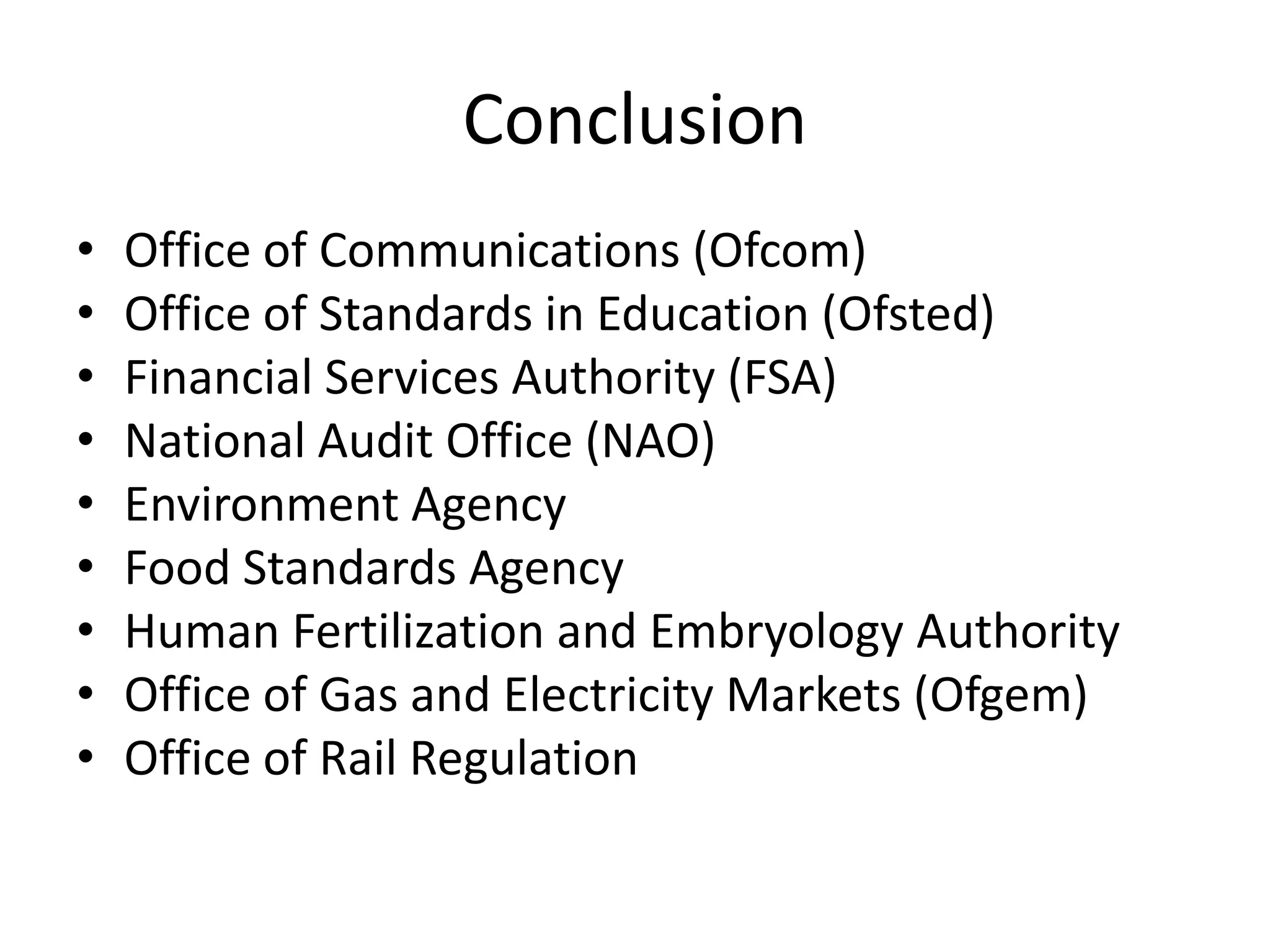
Conclusion
•   Office of Communications (Ofcom)
•   Office of Standards in Education (Ofsted)
•   Financial Services Authority (FSA)
•   National Audit Office (NAO)
•   Environment Agency
•   Food Standards Agency
•   Human Fertilization and Embryology Authority
•   Office of Gas and Electricity Markets (Ofgem)
•   Office of Rail Regulation
Conclusion
• A final thought about regulation...

• Quis custodiet ipos custodies?

• Who regulates the regulatory bodies, or the
  organisations that co-ordinate self-regulation?

Regulation in the public private interface

  • 1.
    Regulation in thePublic Private Interface
  • 2.
    Overview I. Introduction II. What is regulation? III. Why regulate? IV. Self-regulation V. Regulation of risk VI. Conclusion
  • 3.
    Introduction • Many peopleare under the impression that the UK has a deregulated economy • This perception is inaccurate • The UK has a regulated free market economy
  • 4.
    Introduction • There aremany forms of regulation in both the public and private sectors • Where the public and private sectors meet, there is a clash between different forms of regulation – Regulation by the State – Self-regulation
  • 5.
    What is Regulation? Traditionalregulation is about the government or government agencies enforcing rules, with penalties for non-compliance P. May (2007); “Regulatory Regimes and Accountability” Regulation & Governance vol. 1, pp. 8-26
  • 6.
    What is Regulation? Regulationis about “sustained and focused attempts to change the behavior [sic] of others in order to address a collective problem or attain an identified end or ends, usually through a combination of rules or norms and some means for their implementation and enforcement, which can be legal or non-legal.” J. Black (2008); “Constructing and contesting legitimacy and accountability in polycentric regulatory regimes” Regulation & Governance vol. 2, p. 139
  • 7.
    What is Regulation? •Note that this regulation is not necessarily carried out by the State • Much regulation is carried out by professional bodies and private organisations – They regulate the behaviour of their members
  • 8.
    What is Regulation? From an economic or business perspective, regulators can decide: – who can enter a market – what prices can be charged – by how much prices can increase – service standards This is not necessarily carried out by the State
  • 9.
    Why regulate? According tothe National Audit Office: “The purpose of regulation is to protect the public and the environment and provide a level playing field for business.” NAO (2008); “Regulatory quality: How regulators are implementing the Hampton vision”
  • 10.
    Why regulate? • Regulationis in place to protect consumers • This could be implemented by the State, or through self-regulation • Thus, it could be self-imposed upon particular businesses or groups of organisations to set minimum standards – These standards could be about product safety, standards of service delivery, membership requirements, etc.
  • 11.
    Self-regulation • This isseen as the preferred form of regulation by the private sector • It is perceived to be more effective, less burdensome, and more flexible • It is also seen to be more responsive
  • 12.
    Self-regulation Self-regulation “involves theregulation of the conduct of individual organizations, by themselves. Regulatory rules are self- specified, conduct is self-monitored and the rules are self-enforced.” Bartle & Vass (2007); “Self-Regulation within the Regulatory State” Public Administration vol. 85- 4, p.888
  • 13.
    Self-regulation • Can self-regulationbe trusted? • Think about the Financial Services Authority and the regulation of the banks – The FSA is staffed by current and former members of the banking sector!
  • 14.
    Regulation of Risk “Theidea of risk based regulation is to target both proactive and reactive strategies in accordance with the risks a firm poses to the regulators’ objectives.” Baldwin & Black (2008); “Really Responsive Regulation” The Modern Law Review vol. 71-1, p.66
  • 15.
    Regulation of Risk •Think of different industries in the public-private interface e.g. nuclear industry, education, bio-medical science • What risks might be posed? It is easy to think about foreseeable risks. What about the unforeseen risks? • How do the different bodies prepare for such risks?
  • 16.
    Conclusion • Regulation isa significant factor in the operations of both public and private sector organisations • There are many regulatory bodies, as well as organisations that perform regulatory functions
  • 17.
    Conclusion • Office of Communications (Ofcom) • Office of Standards in Education (Ofsted) • Financial Services Authority (FSA) • National Audit Office (NAO) • Environment Agency • Food Standards Agency • Human Fertilization and Embryology Authority • Office of Gas and Electricity Markets (Ofgem) • Office of Rail Regulation
  • 18.
    Conclusion • A finalthought about regulation... • Quis custodiet ipos custodies? • Who regulates the regulatory bodies, or the organisations that co-ordinate self-regulation?