Regulating human control over autonomous systems
Mikolaj Firlej
Faculty of Law, University of Oxford, Oxford, UK
Araz Taeihagh
Lee Kuan Yew School of Public Policy, National University of Singapore, Singapore
Abstract
In recent years, many sectors have experienced significant progress in automation, associated with the growing advances in
artificial intelligence and machine learning. There are already automated robotic weapons, which are able to evaluate and
engage with targets on their own, and there are already autonomous vehicles that do not need a human driver. It is argued
that the use of increasingly autonomous systems (AS) should be guided by the policy of human control, according to which
humans should execute a certain significant level of judgment over AS. While in the military sector there is a fear that AS
could mean that humans lose control over life and death decisions, in the transportation domain, on the contrary, there is a
strongly held view that autonomy could bring significant operational benefits by removing the need for a human driver. This
article explores the notion of human control in the United States in the two domains of defense and transportation. The
operationalization of emerging policies of human control results in the typology of direct and indirect human controls
exercised over the use of AS. The typology helps to steer the debate away from the linguistic complexities of the term “auton-
omy.” It identifies instead where human factors are undergoing important changes and ultimately informs about more detailed
rules and standards formulation, which differ across domains, applications, and sectors.
Keywords: artificial intelligence, autonomous system, autonomous vehicle, autonomous weapon, governance, regulation.
1. Introduction
The development of unmanned vehicles and their increasing use in both commercial and military operations1
has spotlighted the amount of effort that has been deployed toward greater autonomy in recent years. Yet despite
significant progress in automation, the conceptual apparatus to address the effects of these developments remains
rudimentary (Brundage et al. 2018).2
In academic studies, the prevailing temptation has been to integrate the
effects of new technologies into familiar doctrines, specifically by focusing on whether any particular innovation
complies with the general principles of law.3
Existing research on law and technology examines predominantly
the questions of why actors follow particular rules and how to conceptualize varying degrees of compliance.4
Lit-
tle attention has been given to the assessment of how general policies are operationalized in practice by either
administrative rules or practices.5
Such studies may not only problematize the content of a policy but also provide
insights into what areas require more detailed attention from rule-makers and standardization agencies.6
This article focuses specifically on the notion of human control, a public policy,7
according to which humans
should execute a certain significant level of judgment or control over highly automated or autonomous weapons
(AWs).8
Arguably the first official reference to “human control” was introduced relatively recently (2012) by the
US government in the policy on AWs (Directive 3000.09; DoD 2012).9
The US Department of Defense (DoD)
directs that “autonomous weapon systems shall be designed to allow commanders and operators to exercise
appropriate levels of human judgment over the use of force.”10
Despite the growing interest in the role of human
judgment over the use of autonomous systems (AS) in various industries, the US Department of Transportation
(DoT) has recently issued a key document (AV 3.0) which no longer assumes human control as necessary to AS,
Correspondence: Araz Taeihagh, Lee Kuan Yew School of Public Policy, National University of Singapore, 469B Bukit Timah
Road, Li Ka Shing Building, Level 2, #02-10, Singapore 259771. Email: spparaz@nus.edu.sg and araz.taeihagh@new.oxon.org
Accepted for publication 17 June 2020.
© 2020 The Authors. Regulation & Governance Published by John Wiley & Sons Australia, Ltd
This is an open access article under the terms of the Creative Commons Attribution License, which permits use, distribution and reproduction in any medium, provided
the original work is properly cited.
Regulation & Governance (2020) doi:10.1111/rego.12344
and thus supports the path towards full automation.11
While AV 3.0 is not a formal policy of DoT, the document
provides a framework for the integration of Autonomous Vehicles (AVs) into the US transportation system and
essentially serves as de facto US policy on AVs. However, many states still argue that a human must retain con-
trol over AVs and such a policy should guide a work of developers and manufacturers.12
Selected states have
introduced legislation with an explicit reference to the notion of human control, for instance, in the form of
safety drivers.13
This article explores the notion of human control over AS in the United States in the domain of defense and
transportation. It explores emerging policy and regulatory approaches that offer more insight into the content of
this vague notion. It presents a conceptual typology of human control wherein two main types are distinguished:
(i) direct control, which is a level of specification on how dependent AS are to be on the human, for example,
whether a human operator can override machine decision; and (ii) indirect control, which is a level of trust one
can have in the performance of AS. This framework helps to pinpoint where human factors are undergoing
important changes and informs about more nuanced rules and standards formulation, which differ across
domains, applications, and sectors.
The remainder of this article is as follows: Section 2 deals primarily with methodological considerations. It sit-
uates our research focus on the operationalization of human control in the wider problem of “autonomy” of sys-
tems. Further, it presents the top-down model of policy analysis, the notion of operationalization, and why a
comparative study offers relevant insights into our research question. It justifies our assessment of general policy
first, before exploring more specific rules applicable to both the transportation and defense industries. Sections 3
and 4 apply the methodological framework to the programs and rules of the US government with respect to AWs
and AVs, respectively. These two sections explore how the requirement of human control is defined by US gov-
ernment policy and examine various administrative measures that have been adopted by the military and by vari-
ous states’ administrations in the case of AWs and AVs, respectively, that demonstrate the content of this notion.
Section 5 compares how the notion of human control is defined in the two domains and argues that the focus on
operationalization of human control may better inform emerging governance approaches toward ASs, before the
article concludes in Section 6.
2. Methodology
This section highlights the research methodology of this study. Section 2.1 presents the objective of our research
by focusing on human factors, rather than the notion of autonomy and Section 2.2 explains how we conducted
the operationalization studies through the comparative lens.
2.1. Research objective: focus on human factors not autonomy
This article focuses on the operationalization of human control in the domain of defense and transportation in
order to provide insights into the typology of human control as such. We argue that the typology of human con-
trol helps to provide more clarity in the current debate on the future of human agency as the use of AS increases.
It can also inform the work on the governance of AS by shifting the focus from the regulation of the vague notion
of autonomy toward more detailed rules and standards applicable to the changing role of human factors.
The current debate on the future of AWs and AVs is often hindered by a lack of consensus over the definition
of basic terms, particularly the definition of AS. The scope and characteristics of autonomy are uncertain. It is a
challenge to agree on a definition of “autonomy” even when the concept is applied to humans.14
These problems
are further exacerbated when applied to machines, primarily due to uncertainty as to whether the concept of per-
sonal autonomy can be extended to other entities, and, if not, what is qualitatively different in the notion of per-
sonal autonomy that renders it incommensurable or incomparable with that of machines.15
In the literature, AS are often differentiated from automated and automatic ones.16
The term “automatic” is
usually associated with simple, mechanical responses to environmental input. The term “automated” refers to
more complex, rule-based systems, while the term “autonomous” is reserved for machines that execute some kind
of self-learning abilities.17
However, in practice, many machines fall somewhere within a spectrum of auton-
omy.18
One way of evaluating a machine’s level of autonomy is by measuring its level of dependence on humans
© 2020 The Authors. Regulation & Governance Published by John Wiley & Sons Australia, Ltd2
M. Firlej, and A. Taeihagh Regulating Human Control over Autonomous Systems
while executing the Observe, Orient, Decide, and Act (OODA) loop.19
The greater the machine’s ability to
observe, orient, decide, and act on its own, the greater its autonomy. However, three factors influence the degree
to which a machine is considered to be automatic, automated, or autonomous: (i) the frequency of operator inter-
action that the machine requires to function; (ii) the machine’s ability to execute tasks despite environmental
uncertainty; and (iii) the machine’s level of responsiveness regarding various operational decisions required for
the machine to complete its mission.20
Practical examples of the spectrum of autonomy include the Society of
Automotive Engineers (SAE) Levels of Autonomy in AVs21
or Sheridan’s 10-level rankings.22
Both illustrate the
absence of a clear division between automatic, automated, and AS.23
Moreover, a machine’s autonomy can vary at each stage of the OODA, thus a more comprehensive ranking
should take this fact into account.24
Some machines represent a combination of various types of functions, each
with a different level of autonomy. In the context of weapon systems, there are at least four functions to a
weapons system: trigger, targeting, navigation, and mobility.25
Some weapons, such as precision-guided muni-
tions, have autonomous mobility, triggering, and in some cases navigation, while the targeting is not autonomous.
Weapons such as the Samsung SGR-1 Sentry Gun, on the other hand, have an autonomous targeting function
through motion detectors, although their navigation, mobility, and triggering functions are not autonomous.26
In short, there is little agreement over how to define AWs or AVs through a vague notion of “autonomy.”
The confusion pervades discussions about when an advanced technological system is “autonomous,” and what
the implications of autonomy in the use of such systems are. The technology is developing rapidly while the intel-
lectual apparatus to analyze the effects of these innovations is still at the nascent stage, particularly from a regula-
tory perspective.27
The current state hinders further intellectual progress to move beyond definitional terms to
discussion about where specifically a potential regulatory intervention is needed, that is, whether there should be
more regulatory emphasis at the level of system design, or at the level of operation by humans.
This article aims to steer the debate away from the linguistic complexities of the term “autonomy” and
focuses instead on pinpointing where the human factor is undergoing important changes and therefore may
require particular attention from the relevant stakeholders. Furthermore, the presentation of human control in
the form of a typology allows the mapping of a plethora of already existing concepts into a single format.
2.2. The exploration of human control through the lenses of operationalization studies
The article focuses on defense and transportation because they represent, at least based on official statements,
contrasting approaches to the role of the human in the use of AS. While DoD is committed toward greater auto-
mation, they have explicitly included a reference on human control of AWs.28
Recent guidelines from DoT, in
contrast, do not assume the requirement of a human driver in the context of the growing automation of ground
vehicles.29
These contrasting perspectives may indicate different regulatory measures applicable to the role of humans in
the use of AS. Moreover, both AWs and AVs have recently received a fair amount of media attention. The cur-
rent debate on AWs is largely framed by a fear that AWs represent or could represent a new, dangerous category
of weapons, fundamentally distinct from other weapons, and therefore could represent new challenges for inter-
national and domestic legal regimes. Recently, such voices have been raised by the world’s leading robotics and
artificial intelligence (AI) pioneers who called on the UN to ban the development and use of “killer robots,” as
they referred to them. Moreover, the majority of countries have explicitly distanced themselves from the develop-
ment and use of such weapons.30
The current debate on AVs is dominated (though not univocally) by a hope
that AVs can meaningfully improve people’s well-being.31
These rather radical positions usually ignore the wider
changes in human–machine interactions related to the use of AS. In this article, we flesh out how the role of
human factors is described and what might be the applicable regulatory measures.
The article first explores how the notion of human control is defined in the US policies applicable to AWs
and AVs, and then focuses on the analysis of various regulatory measures that have been adopted to specify the
content of this notion. The assessment follows a top-down model of analysis that begins with the study of policy
objectives and then looks at more detailed rules and procedures.32
Such top-down models of policy analysis are
often criticized in implementation studies, as they emphasize the ability of decision makers to produce unequivo-
cal policy objectives, and to control the operationalization and implementation stages.33
Critics suggest alternative
© 2020 The Authors. Regulation & Governance Published by John Wiley & Sons Australia, Ltd 3
Regulating Human Control over Autonomous Systems M. Firlej, and A. Taeihagh
models of analysis, such as (i) bottom-up approaches that see lower-level bureaucrats as the main actors in the
creation of policies, or (ii) hybrid approaches that try to overcome the divide between the two.34
This article,
however, employs a top-down approach because it studies the process of operationalization of a policy, rather
than its implementation.35
The study of operationalization of policies is different from the study of policy imple-
mentation.36
These terms are often confused in the literature. Policy implementation is the translation of public
policy into practical outputs. Implementation focuses on the delivery of a wide array of services for the parties
impacted by the particular policy. Service delivery usually is defined as any contact with the public administration
during which customers seek or provide data, handle their affairs, or fulfill their duties. Usually, however, public
policies, enacted or not as law, are too general or abstract to enable an effective service delivery. This is where the
operationalization comes to play. Policies need to be made operational to enable service delivery. This is why pol-
icies often require the development of formal, more detailed rules by bureaucratic institutions. “Organisations
and agencies are created to translate laws into operational rules,” as argued by Dye.37
The operationalization
therefore is not a synonymous of a policy implementation, and this carries certain methodological implications
regarding empirical material. Policy implementation analysis requires the exploration of both formal rules and
social practices that lead to the delivery of a policy. These practices are referred to as “outputs,” that is, the
actions that the government actually performs. The study of policy operationalization is not, however, concerned
with policy outcomes (“Outcomes” refers to the results that are caused by those outputs), whether for instance
one particular policy is more effective than another. Rather, it is concerned with the exploration of how policy
objectives are defined and construed by bureaucratic institutions, how administrators understand particular
terms, where they put emphasis on, and what matters to them.
The objective of this study is precisely to investigate various measures employed by both DoD and DoT in
order to extract more insights about the concept of human control. Whether operationalization studies should
involve the service delivery and impact assessment of a policy depends on research objectives. Our goal is to
investigate various measures employed by the US government in order to extract more general insight into the
notion of human control as such. Thus, empirical accounts of social practices are not decisive. Rather, at this
stage—where we present a typology of various dimensions of human control, not the effectiveness of one or
another measure—we are primarily concerned with how government understands this notion of human control.
Thus, a top-down approach is preferable for the operationalization analysis, as it starts with the assumption that
policy objectives are set by central policymakers and specified in more depth by lower administration.
The main difficulty in the study of operationalization lies in delineating the boundaries of policy analysis and
the boundaries of specification of a given policy.38
Public policies are principled guides formulated by the govern-
ment to achieve intended outcomes. The process of operationalization is about translating general policies into
more specific rules specifying what needs to be done and how in order to achieve intended outcomes. Thus, the
operationalization of a policy usually includes the combination of legislative and executive action, but predomi-
nantly it is the domain of regulatory law, that is, law promulgated by the federal, state, and local administrative
agencies.39
Public policies, on the contrary, are not particularly detailed for two main reasons: they are intended
to be flexible enough to apply to various changing market and political circumstances; and some matters are too
technical for policy-makers, so they are necessarily delegated to more specialized branches of administration.
Therefore, the exploration of a policy refers to the main public documents which outline the US government’s
broad objectives regarding human control in defense (Directive 3000.09) and transportation (AV 3.0). The analy-
sis of these documents is supplemented by other relevant high-level plans that relate to US objectives regarding
AWs and AVs and that were presented respectively by DoD and DoT.40
The exploration of specific rules that
operationalize the notion of human control in defense is based on rules adopted by the US Army with respect to
the development of new weapons, as well as targeting and engagement procedures. Specifically, we refer to the
Enclosures to the Directive on AWs,41
US targeting rules in the Army Techniques Publication,42
the DoD Joint
Capabilities Integration and Development System (JCIDS) documentation,43
selected publications of the Defense
Science Board,44
and US weapons review rules. In the transportation domain, we present an analysis of selected
state legislation, as transportation specific rules are predominately set by state, rather than federal legislature.45
Our analysis is based on publicly available documents obtained from 2012 and 2018, from the adoption of the
Directive on AWs and the first state legislative efforts to regulate AVs (both in 2012) to the publication of the
DoD National Defense Strategy and DoT AV 3.0.
© 2020 The Authors. Regulation & Governance Published by John Wiley & Sons Australia, Ltd4
M. Firlej, and A. Taeihagh Regulating Human Control over Autonomous Systems
The limitations of this study are primarily related to the limitations of our sources. We relied only on publicly
available documents. In particular, some military rules, such as the Rules of Engagement (ROE), are classified
and may contain additional information regarding the specific operational tasks of human operators.46
Moreover,
further studies on empirical accounts of how various agents respond to operational rules could provide additional
insights into the typology of human control over AS and further inform the debate about the governance of AS.
3. Human control in AWs
This section presents a case study of US regulatory measures applicable to the notion of human control over
AWs. Section 3.1 explores how the notion of human control is defined by the US government, while Section 3.2
focuses on the analysis of various measures that have been adopted by the US administration, which demonstrate
the content of this notion.
3.1. The notion of human control in AWs
Robotic systems with greater autonomy have been highlighted as a key component of the US military by all major
documents outlining US defense and security priorities.47
In the United States, the research, development, and
deployment of AWs are specified by the DoD Directive 3000.09, Autonomy in Weapon Systems (2012). The DoD
directive establishes national policy on AWs.48
The directive specifies that AWs are those which, upon automa-
tion, can select and engage targets without human intervention.49
The directive allows the development and full
use of AWs to apply nonlethal, nonkinetic forces, such as electronic attack against material targets. However, in
special cases, AWs can be used more broadly, and the directive does not apply to all parts of the US government
or to cyberspace systems for cyberspace operations.50
The directive states that AWs and semi-AWs should be designed to allow commanders and operators to exer-
cise “appropriate levels of human judgment over the use of force.”51
Interestingly, the United States does not
explicitly refer here to the norm of human control, as they argue that the notion of control can be misleading and
too restrictive. It may imply a form of direct control in the sense that AWs would be mere tools dependent on
constant human input.52
The directive, on the contrary, concentrates primarily on the stage of weapon’s design.
The directive states that AWs will need to go through rigorous hardware and software verification and validation
(V&V) and realistic system developmental and operational test and evaluation (T&E), while training, doctrine,
and tactics, techniques, and procedures (TTPs) are being established. These measures, according to policymakers,
will ensure that AWs will function properly. The division between human judgment at the level of design versus
direct control has also been emphasized by a US delegation to the Group of Governmental Experts on AWs:
(…) an operator might be able to exercise meaningful control over every aspect of a weapon system, but if
the operator is only reflexively pressing a button to approve strikes recommended by the weapon system, the
operator would be exercising little, if any, judgment over the use of force. On the other hand, judgment can be
implemented through the use of automation.53
However, the directive in fact expands the notion of human judgment beyond the design stage in a situation
where a weapon is unable to complete engagements consistently with operator intentions. In such cases, a
weapon should seek additional human operator input before continuing the engagement or terminate engage-
ments. We have here a classical reference to direct control.
Thus, one might argue that two dimensions of human control emerge. The first type is control-by-design.
While the directive provides various procedures to ensure “the appropriate level of human judgment,” it does not
specify what this “appropriate level” constitutes. Next section will explore this issue in the light of operational
rules adopted by the US military administration. The second type of control is related to the ability of a human
to directly exercise control by terminating an AW’s engagement. This “finger on the button” control presents a
different dimension of control, even though prior design may determine it. It is different because a designed
mechanics of control is determined ex-ante engagement, while a “finger on the button” is the ability to exercise
control ex-post engagement, that is, in a realm of warfare during a real-time operation.
This difference has two main consequences for operational rules. First, regulation of human control-by-design
is primarily concerned with the notion of trust, that is, whether actions by an artifact or designed object can be
© 2020 The Authors. Regulation & Governance Published by John Wiley & Sons Australia, Ltd 5
Regulating Human Control over Autonomous Systems M. Firlej, and A. Taeihagh
deemed trustworthy. Trust is critical for a fighter in a hostile environment. As the Defense Science Board (DSB)
found, trust in AS is “core to the DoD’s success in broader adoption of autonomy.”54
Trust in the context of
AWs is often defined by the reliability and predictability of a system.55
It is characterized by a pattern of behavior
observed by the trustor and the belief that the recipient of trust (the AS) will respond in a particular way.56
As
pointed out by Roff, this type of trust persists in the absence of any detailed knowledge or understanding of the
“inner workings” of the machine’s design, structure, or past history.57
An operational consequence in the context
of AWs is that there must be certain rules that ensure a significant level of reliability and predictability in such
weapons in relation to human interface. Second, regulation of human control in the form of “finger on the but-
ton” is primarily concerned with an emergency of last resort. It is an insurance policy, in case something goes
wrong. In academic literature, this type of human control is known as “human-on-the-loop” and refers to the
ability of a human to override a machine’s action.58
It differs from “human-in-the-loop,” which refers to those
machines that can select targets and deliver force only with a human command, and also from “human-out-the-
loop,” that is, robots that are capable of selecting targets and delivering force without any human input or
interaction.
While the distinction is clear, difficulties arise in practice. Consider the following scenario. Weapon A can act
autonomously. A human has been involved initially in framing the selection and engagement with target, but ulti-
mately the decision on a specific target is delegated to a weapon. After the initial selection, a human cannot over-
ride a machine’s decision. This is an example of “human-out-the-loop.” Weapon B can also act autonomously.
Similarly, a human has been involved initially in framing the selection and engagement with the target but
ultimately the decision on a specific target is delegated to a weapon. After the initial selection, the human does
have the ability to override a machine’s decision; however, she has a very restricted time in which to veto engage-
ment. Should Weapon B be considered to be controlled by a human? A challenge here is to present the condi-
tions in which a human is actually able to exercise her right (or duty) to override a weapon’s decision to engage.
This is not just a technical question. Consider, for instance, a scenario in which Weapon B is used in operation
against an adversary with an AW. In a dynamic and unstructured environment, Weapon B was not accurately
responsive and engaged beyond the initial selection of targets. However, an adversary does not have any limita-
tion when it comes to the termination of engagement other than the final destruction of the opponent. The ques-
tion is what legal, ethical, and technical criteria should a human operator consider in such situations when
exercising her right (or duty) to override a machine engagement? Hence, an operational consequence in the con-
text of AWs is that there must be certain guidelines as to the circumstances in which a human can override a
weapon’s engagement.
3.2. Operationalization of human control over AWs
This section focuses on the analysis of various measures that have been adopted by the US military administra-
tion that demonstrate the content of the notion of human control. As discussed in the previous section, there are
two formulations of such notion:
1 Human control-by-design, formulated in the directive as: “The system design incorporates the necessary
capabilities to allow commanders and operators to exercise appropriate levels of human judgment in the
use of force.”59
2 Human control as a “finger on the button,” formulated in the directive as: “The system is designed to com-
plete engagements in a timeframe consistent with commander and operator intentions and, if unable to do
so, to terminate engagements or seek additional human operator input before continuing the
engagement.”60
The operational consequences of human control-by-design focus on ensuring a significant level of reliability
and predictability in such weapons in relation to human interface. The directive stipulates that before fielding,
each weapon should be a subject of legal review and – in addition – AWs will need to go through rigorous hard-
ware and software V&V and realistic system developmental and operational T&E, while training, doctrine, and
TTPs will have to be established. Therefore, two types of general procedures shall be used to gain the necessary
trust at the level of design: (i) legal review and (ii) technical evaluation procedures.
© 2020 The Authors. Regulation & Governance Published by John Wiley & Sons Australia, Ltd6
M. Firlej, and A. Taeihagh Regulating Human Control over Autonomous Systems
The weapons review was established in Article 36 of the 1977 Additional Protocol 1 to the Geneva Conven-
tions [Protocol 1]. While the United States is not officially a party to Protocol 1, they have established a national
weapons review, and they consider the review obligation to be customary in international law.61
Although overall
responsibility for conducting legal reviews lies with the DoD, all of the military services have a department
responsible for conducting legal reviews. In order to ensure alignment across US military services, military law-
yers work with the DoD’s Law of War Working Group. The most important element of weapons review is a com-
pliance test with laws of armed conflict. It is widely accepted that the assessments must consider: (i) Is the
weapon, means, or method of warfare prohibited by a specific treaty or customary law provision? (ii) Is the
weapon, means, or method of warfare inherently of a nature to cause superfluous injury or unnecessary suffering
in its regular or intended use? (iii) Is the weapon, means, or method of warfare inherently of a nature to be indis-
criminate, in its normal or intended use?62
Depending on the response to these questions, the authority con-
ducting the review could place restrictions, approve with conditions or make recommendations on the use of new
weapons, which could be integrated into the ROE and practical training. In the case that a new weapon does not
fulfill all requirements posed by weapons review, the reviewer may state corrective actions identified during the
process that should be followed in order to ensure that a subsequent review process would allow the envisioned
weapon to pass the legal review. During this stage, the reviewer considers whether legal restrictions on the use of
the weapon apply or whether practical training or ROE measures specific to a particular weapon system are nec-
essary. In academic literature, there is no agreement on whether currently existing AWs meet these requirements,
but many authors argue that existing AWs are not necessarily unlawful per se as they do not automatically violate
any principle of international armed conflict.63
However, it is very likely that such weapons might be used in an
unlawful manner, depending on circumstances. It is particularly unlikely, especially given current technological
developments, that AWs will be able to conduct sensitive, context-dependent, and standard-based assessments of
proportionality and military necessity.64
The above issue, however, could not be addressed without a thorough
examination of the empirical evidence and specific technical considerations.65
Therefore, a weapon system’s
V&V, T&E, and TTPs will inform the substantive legal review significantly.
In 2011, the United States published a report in which it stated that growing automated functionality would
“introduce unexpected levels of risk” and challenge current T&E and V&V capabilities.66
A second roadmap
(2013) discusses testing in much greater detail and articulates standards of testing.67
In this document, ‘trust’
refers explicitly to the satisfaction that an AS will operate in an expected or predictable manner. Current T&E
and V&V capabilities, effectively institutionalized in the DoD JCIDS, are based on the safety assurance concept.
According to this concept, the primary objective of the JCIDS process is to ensure that the capabilities required
by joint warfare68
are identified, along with their associated operational performance criteria, in order to success-
fully execute the missions assigned. It means that before any new capability can enter the development process
related to reviewing and validating its requirements, the originating sponsor organization (a weapon manufac-
turer) is obliged first to identify the AWs system capability requirements related to its functions, roles, mission
integration, and operations. It must then determine if the pursuit of such capability presents an unacceptable level
of risk relative to potential operational benefits.69
Obligatory assessments and reviews are captured in the Capa-
bility Development Document, which addresses system safety in accordance with current DoD guidance. How-
ever, AWs present a number of challenges with regard to existing T&E practices.70
Currently, the majority of
systems are continuously monitored by humans who can detect deviations from desired performance and correct
the behavior of the system. AI, on the contrary, enables increasing cognitization of machines, which not only
makes them faster or smarter than humans, but increases the unpredictability of their actions due to self-learning
and emergent coordination capabilities. Ensuring that such a system will respond appropriately to all possible
inputs will exceed the capability of conventional testing.71
Self-learning systems exhibit different behaviors, as
they incorporate data about their tasks from a variety of sources in real time and learn to provide better results
partly based on their own experience. Therefore, such software cannot be exhaustively tested. While the commer-
cial sector offers certain guidelines when it comes to evaluating and qualifying such systems, a lack of specific
standards for continuous V&V for AWs does not provide sufficient reassurance when it comes to the reliability
and predictability of such weapons in relation to human interface. This statement is supported by the Unmanned
Systems Integrated Roadmap FY2013–2038, which finds that “existing ranges and test facilities have been adequate
© 2020 The Authors. Regulation & Governance Published by John Wiley & Sons Australia, Ltd 7
Regulating Human Control over Autonomous Systems M. Firlej, and A. Taeihagh
to test systems with very limited autonomous capabilities.”72
Similarly, the Summer Study on Autonomy con-
cludes that current conventional testing capabilities are “inadequate for testing software that learns and adapts.”73
Moreover, Section 2 of Enclosure 3 of the directive states that the undersecretaries of defense for policy and
acquisition, technology, and logistics may request a Deputy Secretary of Defense waiver for T&E and V&V
requirements, with the exception of the requirement for a legal review, in cases of urgent military operational
need.74
It means that only weapon review is effectively a binding requirement that informs on operational trust
at the level of design.
The operational consequence of human control as a “finger on the button” is that there must exist certain
guidelines under which a human can override a weapon’s engagement. As the directive states, a human operator
can override a weapon when the system does not complete engagements in a timeframe consistent with operator
intentions. However, there are no specific guidelines with respect to how a human should execute this function.
One may argue that the human operator is a highly experienced agent, so she would be able to understand the
system’s limitations. The empirical research on human-machine interface suggests, however, that humans often
over- or under-estimate a machine’s capabilities.75
Moreover, humans suffer from “automation bias,” where they accept a machine’s decision even though it is
not correct.76
Automated or autonomous decision-making may have also detrimental effects on the human ability
to perform the same tasks as the machines. The increasing delegation of tasks to machines may lead to a degrada-
tion in skill levels, which might become a problem, particularly in safety critical applications.77
Therefore, the
increasing reliance on autonomous capabilities will require changes in existing command-and-control concepts in
order to ensure a greater level of trust. Irrespective of these deficiencies, Section 2 of Enclosure 3 of the directive
also provides an opportunity to waive the requirement of human control as a “finger on the button” under the
same circumstances as a waiver for T&E and V&V requirements, that is, in cases of “urgent military operational
need.”78
While it is understandable that all of DoD’s needs cannot be met by the same acquisition processes,
there is a clear recommendation from DSB that “rapid acquisition processes” must be based on proven technol-
ogy and robust manufacturing processes. Otherwise, attempting to squeeze new technology developments into an
urgent timeframe creates significant risks, particularly when it comes to the operation of self-learning systems.
The directive does not define “urgent military operational need,” which makes the phrase vulnerable to broad
interpretation, whereas DSB found that current approaches to implementing rapid responses to urgent needs
have not been sustainable.79
Many academics argue today that AWs should be guided by human control or that a human should somehow
retain control over AWs. Our research shows that US policy indeed includes a requirement for human control
over AWs as a guiding principle. The operationalization of human control reveals its two dimensions: human
control-by-design and human control as a “finger on the button.” It is, however, unclear under what conditions a
human can override a weapon when the system does not complete engagements in a timeframe consistent with
operator intentions. Both types of human control are required during the operation of such weapons, but in the
context of urgent military need AWs may only satisfy the requirement for control-by-design. While there are
many specific requirements for weapons design, effectively, only weapon review is a binding requirement that
informs on operational trust at the level of design. Table 1 provides a summary of the operationalization of
human control over AWs.
4. Human control in AVs
This section presents a case study of US regulatory measures applicable to the notion of human control over
AVs. Section 4.1 explores how the notion of human control is defined in the US policy, while Section 4.2 focuses
on the analysis of measures that have been adopted by selected states, which demonstrate the content of this
notion.
4.1. The notion of human control in AVs
The US government has not established an explicit federal policy on AVs.80
It has been the deliberate choice of
federal policy-makers to issue only voluntary guidance to states called Preparing for the Future of Transportation:
© 2020 The Authors. Regulation & Governance Published by John Wiley & Sons Australia, Ltd8
M. Firlej, and A. Taeihagh Regulating Human Control over Autonomous Systems
Automated Vehicles 3.0 (AV 3.0).81
AV 3.0 provides a framework for the safe integration of AVs into the US sur-
face transportation system and supplements the previous Automated Driving Systems: A Vision for Safety 2.0
(ADS 2.0). The DoT does not generally rule out support for the full automation of all aspects of the dynamic
driving task as long as AVs are developed according to performance-oriented, consensus-based, and voluntary
safety standards.82
A key objective of AV 3.0 is to relax assumptions in existing regulations related to the pres-
ence of a human.
Given that the AS rather than the human driver carries out the dynamic driving tasks for an AV, it is unclear
which entity may be considered the “driver” or to be “controlling” the vehicle.83
The guidelines seek to address
these ambiguities, stating that definitions of “drive” and “operator” will be adapted to allow for these entities to
refer to both a human as well as an automated system.84
By doing so, federal vehicle regulations will “no longer
assume” that a driver is human or that a human would always be present onboard a vehicle during its opera-
tions.85
Specifically, the DoT suggests new rulemaking for AVs, which would include more flexible standards for
AVs.86
The DoT expressed their commitment to promote the adoption of automated driving system (ADS)-equipped
vehicles that represent Levels 3–5 of vehicle automation, as defined by the SAE.87
The majority of ADS-equipped
vehicles are at a Level 2, which requires a human driver to keep their hands on the steering wheel. Some car
manufacturing companies are working toward Level 3 vehicles that allow drivers to take their hands off the
steering wheel and feet off the pedals but return control to the driver when the car requests it. Other manufac-
turers have considered moving straight from Level 2 to Level 4, where an ADS performs all aspects of the DDT
even if a human driver does not respond. Level 5 represents full automation. In the remaining part of this article,
we refer to AVs as vehicles at Levels 3–5 as defined by SAE. This is consistent with the AV 3.0 guidance that
refers to AVs separately from human-driven vehicles.88
While AVs are advancing rapidly, the technology is still not yet fully reliable, due to existing limitations that
could increase the risk of collision if a human driver is unable to regain control in a timely manner. Fatal acci-
dents have already occurred.89
While most autopilots are still at Level 2 and are considered as a driver-assistance
tool, not a driver replacement, their technological limitations are significantly affecting performance while creat-
ing an illusion of confidence for many drivers.90
Effective handover of control to the human driver is thus essen-
tial to mitigate the safety risks resulting from unpredictable technological failures, at least during the transition
from manual to fully automated AVs.91
However, the conditions under which humans should regain control over
AVs and vice versa, as well as exactly how the AV system should “prompt” its human passengers to take over
control, are still unclear.92
The design of the human–machine interface is critical as it shapes the ways in which
the AV system prompts the human driver to regain control and thereby, the human’s performance in responding
during handover scenarios.93
Further, the reduced level of human control over the decision-making of the vehi-
cle’s raises questions regarding whether and how AVs should be programmed in advance to avoid causing harm
or damage, particularly during unavoidable accidents.94
Table 1 Human control over AWs
Type of
control
Engagement
role
Intervention
role
Key requirements
Human control as
"Finger on the
Button”
Human in
the loop
Human Human (i) The active presence of a human operator,
(ii) system’s responsiveness to complete tasks in a
timeframe consistent with operator and commander
intentions
Human on
the loop
System Human (i) The presence of a human operator; (ii) a manual
override feature that allows an operator to assume
control of the AS at any time
Human control by
design
Design
control as
default
System System or
human
(i) Relevant software V&V, T&E, and TTPs,
(ii) compliance with relevant law, BUT in the case of
"urgent military need” only weapon review applies
© 2020 The Authors. Regulation & Governance Published by John Wiley & Sons Australia, Ltd 9
Regulating Human Control over Autonomous Systems M. Firlej, and A. Taeihagh
The US federal guidelines published by the DoT seek to address these risks, considering various dimensions
of human engagement in the context of AVs. The first notion of human control is “hands on the wheel,” which
relates to the ability of a human to take over the DDT. This form of control differs from a situation where a
human driver is responsible for the entire DDT, in other words when a human is actively driving a car. Several
existing National Highway Traffic Safety Administration (NHTSA) safety standards for motor vehicles assume
that a human occupant will be able to control the vehicle, and many standards incorporate performance require-
ments and test procedures geared towards ensuring safe operation by a human driver.95
However, both DoT and
the NHTSA consider the possibility of setting exceptions to certain standards (relevant only when human drivers
are present) for ADS-equipped vehicles.96
In the next section, we explore how selected states consider this notion
of human control, by examining whether they require a human driver to be present, and if so, under what
conditions.
The second notion of human control over AVs is a form of control-by-design, which mirrors the case of
AWs. In the context of AVs, two sub-categories of this concept emerged. Firstly, control-by-design relates to the
reliability and predictability of a system’s design. AV 3.0 guidelines recommend a number of measures that con-
centrate on hardware and software V&V to build confidence in the use of AVs and mitigate safety risks. AV 3.0
specifies the following conditions:
U.S. DoT envisions that entities testing and eventually deploying ADS technologies will employ a mixture of
industry best practices, consensus standards, and voluntary guidance to manage safety risks along the different
stages of technology development.97
Interestingly, instead of specifying any requirements for AVs, the DoT aims to promote discussion around
various visions for ensuring safety and managing AVs safety risks, and the AV 3.0 guidelines refer to a variety of
measures at different stages of development. However, unlike the design requirement of AWs discussed earlier,
AV 3.0 is not oriented towards an ultimate goal whereby the system design should incorporate the necessary
capabilities to allow the human operator or driver to exercise appropriate levels of human judgment in the use of
an AV. While safety drivers are still expected to be in the loop, particularly to ensure safety during road testing,
and identify new scenarios of interest, they mainly serve as a secondary risk mitigation strategy and will not be
primarily relied upon to ensure safety in the future, when AVs will mainly operate without human drivers.
The second subcategory of control-by-design relates to the ethical principles that AS follow in situations
where ethical judgment is required, such as unavoidable accidents. The AV 3.0 guidelines recommend additional
software assessments during situations of handling failure, crash-imminent scenarios, and edge cases, but do not
specify how such systems should behave during unavoidable accidents. While this debate is still in its nascent
stages, developers will have to decide which ethical principles should be used to inform the AV’s decision-making
during such incidents. For instance, whether the AV should adopt more a consequentialist or a deontological
approach remains an open question.
In the next section, we explore the operational consequences of both notions of human control – control in
the form of “hands on the wheel” and control-by-design – in the context of AVs. Under federal law, no state or
local government may enforce a law on the safety performance of a motor vehicle or motor vehicle equipment
that differs in any way from the federal standard. However, in the current situation – in the absence of law –
states have adopted various measures to ensure the safe use of AVs. Thus, the next section does not refer specifi-
cally to one state, but rather compares the various approaches of selected state legislatures.
4.2. Operationalization of human control over AVs
This section focuses on the analysis of various measures that have been adopted by states, which reveal the con-
tent of a human control notion. As discussed in the previous section, there are two formulations of this
requirement:
1 Human control in the form of “hands on the wheel” as the manual ability to intervene and take control of
DDT. This requirement is formulated in AV 3.0 primarily through the requirement for a “safety driver”
during the testing phase.
2 Human control-by-design that considers the predictability and reliability of a system as well as the ethical
principles that shape the AV’s response during situations that require ethical judgments. AV 3.0
© 2020 The Authors. Regulation & Governance Published by John Wiley & Sons Australia, Ltd10
M. Firlej, and A. Taeihagh Regulating Human Control over Autonomous Systems
recommends testing and evaluating AVs by adopting a mixture of industry best practices, consensus stan-
dards, and voluntary guidance, but it does not specifically refer to any ethical principles.
The notion of human control as the manual ability to intervene is operationalized through the requirements
with respect to the presence of human driver and the conditions under which a human driver is required. Based
on the review of state legislations, there are currently four main approaches:
a States that are silent as to whether a human driver is required. Examples include New Jersey, New Hamp-
shire, and Montana, among others.98
The majority of these states, however, actively discuss the adoption of
AVs in the near future.
b States, such as Illinois,99
Connecticut,100
and Washington D.C.,101
that formally require a human driver to
be prepared to take control of the AV. AVs may operate on a public roadway provided that the vehicles
have a manual override feature allowing a driver to assume control at any time and have a driver seated in
the control seat of the vehicle who is prepared to take control of the AV during operation. Human drivers
are required to have a valid driver’s license. However, none of these states specify how many and which of
the vehicle’s tasks must actually be undertaken by the driver and under what conditions.
c States that do not require the presence of a human driver in the vehicle but require remote human control
of the AV. California State has recently passed a law according to which car manufacturing companies are
required to link their cars to remote operators. They are responsible for monitoring multiple cars and tak-
ing over their controls, if needed.102
Specifically, they must establish continuous monitoring of the vehicle
and two-way communication links, descriptions of how the manufacturer will monitor the communication
link, and explanations of how all AVs will be monitored. The manufacturers are allowed to hire third-party
companies to handle remote operation, but some of them have already developed their own remote-driving
technologies.103
d States that do not require the presence of a human driver in the vehicle. Florida has recently amended their
regulations to allow operation of AVs on public roads and to eliminate requirements for a human driver in
the vehicle.104
Other states in this position include Michigan, Tennessee, Arizona, and Georgia.105
States that do not require the presence of a human driver stipulate various specific requirements to mitigate
safety risks. Three main requirements are usually considered by state legislators:
a Design-related requirements—there are usually two sub-categories of this requirement. First, the human
driver need not necessarily be present in the vehicle, as long as the vehicle is capable of achieving a mini-
mal risk condition, particularly in the context of malfunctioning.106
California requires vehicles to have
steering wheels and brake pedals. If automakers want to test cars without such controls, they will need to
receive a waiver from the NHTSA.107
Moreover, Tennessee and California require AVs to have “Automatic
crash notification technology,” a wireless communications and vehicle location technology to determine the
need for emergency response in the event of a vehicle accident.108
They also require a data-recording sys-
tem that is capable of recording the ADS’s status and other vehicle attributes, including speed, direction,
and location, during a specified time period before an accident, as determined by the car manufacturer.109
Furthermore, car manufacturers are required to meet applicable industry standards and information pri-
vacy laws (Lim and Taeihagh, 2018). Second, the vehicle should be capable of operating in compliance with
the applicable traffic and motor vehicle safety laws and regulations of the state that govern the performance
of the dynamic driving.110
b A permit requirement – a majority of states, such as Florida, California, and Nevada, require car manufac-
turers to obtain a permit to operate AVs on public roads.111
Currently, the only exception is Arizona.112
c A driver’s license requirement—some states such as Tennessee, Massachusetts,113
and California require
the AV’s operator to possess a valid driver license, while states such as North Carolina specify that a
driver’s license is not required for an AV operator, but they require an adult to accompany a child under
12 years in the vehicle.114
While some states specify many design requirements, there is a lack of reference to the idea that design
should incorporate the necessary capabilities to allow human operators to exercise appropriate levels of human
© 2020 The Authors. Regulation & Governance Published by John Wiley & Sons Australia, Ltd 11
Regulating Human Control over Autonomous Systems M. Firlej, and A. Taeihagh
judgment in the use of the cars, as such a design requirement is applied to AWs. Instead, various design-specific
requirements are in place to mitigate safety risks, while advancements in driverless technology increasingly elimi-
nate any kind of human input. As an example, in Arizona and California automakers are already able to manu-
facture and operate cars without a steering wheel, brake pedal, or accelerator.115
These innovations are supported
by the DoT, which is committed to the wider development of AVs by taking a soft approach to regulatory
requirements. The DoT proposed self-driving rules that focus only on a set of guidelines calling for automakers
and technology companies to voluntarily report on their testing and safety of AVs to the NHTSA before public
deployment.
Moreover, they exempt AV developers from meeting many existing transport safety rules, including the
requirement that a human operator should be inside the vehicle and that vehicles have safety features such
as a steering wheel, brakes and mirror that are functional at all times. Whether the engineering process will
be oriented towards ensuring a certain level of human oversight, similar to the case of remote control in
California, is uncertain. The DoT, like individual states, does not provide any detailed requirements relating
to software and hardware V&V processes. There are no requirements for a minimum “vision test” for the
AV system to assess whether the AV is able to properly identify its surroundings, including other cars,
pedestrians, and traffic signs, and respond appropriately. However, validation is critical to guarantee the
safety and reliability of the system’s performance. While there is an international safety standard for con-
ventional cars (ISO-26262), its use is not currently mandated by the US government. If accepted, a frame-
work such as ISO-26262 might develop into the standard engineering process requirement to validate,
verify and ultimately approve the operations and safety of AVs. However, ISO-26262 only addresses func-
tional safety, such as hardware and software developed to minimize risks caused by a functional failure but
does not address design flaws in algorithms. This standard is referred to as The Safety of The Intended
Functionality and is included in SO/PAS 21448. Currently, there are no requirements for transparency in
the design of algorithms underlying the AV system, which is crucial to identify the causes of crashes or
system malfunctions and the appropriate solutions to these problems. A problem widely known as “opac-
ity,” which characterizes many machine learning (ML) systems (Surden and Williams, 2016), is a major
challenge in determining aspects of an AV’s decision process that contributed to a crash.116
Such data anal-
ysis practices exist in commercial aviation.117
Whether safety is ensured within the scope of existing stan-
dards or is supported otherwise, it is essential for independent third-party assessors to review existing
safety procedures to ensure that vehicles are as safe as they need to be for use on public roads,118
which
are also not yet required by states’ existing regulations. In addition, there is a lack of AV-specific ethical
guidelines available to AV developers for informing an AV’s responses during inevitable crash situations.119
Regulators’ reluctance to specify more requirements for automakers can be attributed to concerns over sti-
fling innovation at the current nascent stage of AV development and the lack of consensus around the
methods that should be used to validate AI and ML systems.120
Many academics today argue that AVs should be guided by human control or that a human should retain
some degree of control over AVs. Our research shows that while federal US policy considers various dimensions
of human control over AVs (manual control, design control’s default, and control by “ethical code”), it no longer
assumes that such control is necessary as the full AS replaces the role of the human driver in conducting the
DDTs. Operationalization of these dimensions of human control by states reveal that states are primarily inter-
ested in safety of AS, rather than retaining elements of human control. Human control in the form of the human
driver’s physical presence is seen primarily as a safety backup of a rather temporary nature. Moreover, control-
by-design of the AV system does not require capabilities to allow human operators to exercise appropriate levels
of human judgment over the vehicle’s operation. Lastly, California was the first state to introduce a combination
of manual and design-type control in the form of remote control. Remote control represents a manual type of
control because it satisfies the “human-on-the-loop” condition, which refers to the ability of a human to override
a machine’s action. Remote control also imposes specific design requirements, such as two-way communication
links and technical explanations on the ways in which the AV will be monitored. The governance model adopted
in California is therefore similar to the one applied to AWs in the US: it captures the requirements of predictabil-
ity and reliability of a system (design) with an insurance policy in the form of human control as a last resort
(manual). Table 2 shows the summary of the operationalization of human control over AVs.
© 2020 The Authors. Regulation & Governance Published by John Wiley & Sons Australia, Ltd12
M. Firlej, and A. Taeihagh Regulating Human Control over Autonomous Systems
5. Discussion: typology of human control and implications for the governance of AS
The operationalization of human control in the domain of defense and transportation provide insights into the
typology of human control. The typology of human control helps to provide clarity in the current debate on the
future of human agency as the use of AS increases. It steers the debate away from the linguistic complexities of
the term “autonomy” and focuses instead on pinpointing where the human factor is undergoing important
changes and therefore may require particular attention from the relevant stakeholders. Further, the presentation
of human control in the form of a typology allows the mapping of a plethora of already existing concepts into a
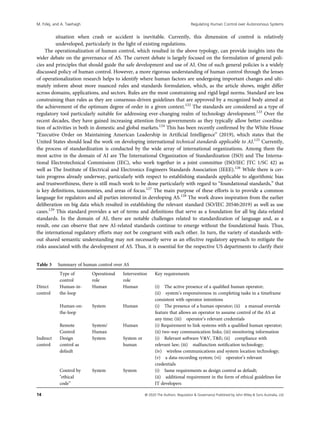
single format (Table 3). Below, based on the analysis in Sections 3 and 4, we provide a classification of human
control over AS:
1 Direct control consists of two types:
a Human-in-the-loop control is characterized by constant and uninterrupted physical control over the sys-
tem. A human is always actively engaged with a system and consequently influences its outcome. In
transportation, an example would be a human driver who drives a vehicle.
b Human-on-the-loop control is characterized by the ability of a human to override or intervene in the
action of a system. It is usually considered as a measure of last resort. In the context of transportation,
we referred to this notion as control in the form of “hands on the wheel” in the military as a “finger on
the button” type of control.
A remote control is a specific type of direct control, which can be used as either a human-in-the-loop or
human-on-the-loop type of control, depending on technical specification.121
This type of control refers to the
operation of a device from a distance, usually wirelessly. In transportation, such control is required for AVs in
California in the form of human-on-the-loop control, while in the military, there are unmanned aerial vehicles
which are remotely controlled and can represent either the human-in-the-loop or human-on-the-loop type of
control.
2 Indirect control or control-by-design consists of two dimensions:
a The necessary capabilities to allow human operators to exercise appropriate levels of human judgment in
the use of the system. This requirement usually refers to the ability of a system to be both predictable
and reliable, and specifically relates to the software and hardware V&V process.
b The necessary ethical guidance that AS follow in situations of inevitable accidents. This dimension of
control is particularly human because it involves deliberate choice as to the moral guidance of AS in a
Table 2 Human control over AVs
Type of
control
Driving
role
Intervention
role
Key requirements
Human control as
"Hands on the
Wheel”
Human in
the loop
Human Human (i) The active presence of a human driver with a driver’s
license
Human on
the loop
System Human (i) The presence of a safety driver; (ii) vehicles have a
manual override feature that allows a driver to assume
control of the AVs at any time; (iii) a valid driver’s license
Remote
control
System/
Human
Human (i) AV companies are required to link their cars to remote
operators; (ii) remote operators with a driver’s license;
(iii) Two-way communication links; and (iv) monitoring
information
Human control-by-
design
Design
control as
default
System System or
human
(i) Relevant software V & V and T & E; (ii) compliance
with relevant law; (iii) automatic crash notification,
technology; (iv) wireless communication; and vehicle
location technology; (v) a data recording system; (vi) A
permit to operate AVs; and (vii) a valid driver’s license
Control by
"ethical
code”
System System (i) Same requirements as per design control as default;
(ii) additional requirement in the form of ethical
guidelines for IT developers
© 2020 The Authors. Regulation & Governance Published by John Wiley & Sons Australia, Ltd 13
Regulating Human Control over Autonomous Systems M. Firlej, and A. Taeihagh
situation when crash or accident is inevitable. Currently, this dimension of control is relatively
undeveloped, particularly in the light of existing regulations.
The operationalization of human control, which resulted in the above typology, can provide insights into the
wider debate on the governance of AS. The current debate is largely focused on the formulation of general poli-
cies and principles that should guide the safe development and use of AI. One of such general policies is a widely
discussed policy of human control. However, a more rigorous understanding of human control through the lenses
of operationalization research helps to identify where human factors are undergoing important changes and ulti-
mately inform about more nuanced rules and standards formulation, which, as the article shows, might differ
across domains, applications, and sectors. Rules are the most constraining and rigid legal norms. Standard are less
constraining than rules as they are consensus-driven guidelines that are approved by a recognized body aimed at
the achievement of the optimum degree of order in a given context.122
The standards are considered as a type of
regulatory tool particularly suitable for addressing ever-changing realm of technology development.123
Over the
recent decades, they have gained increasing attention from governments as they typically allow better coordina-
tion of activities in both in domestic and global markets.124
This has been recently confirmed by the White House
“Executive Order on Maintaining American Leadership in Artificial Intelligence” (2019), which states that the
United States should lead the work on developing international technical standards applicable to AI.125
Currently,
the process of standardization is conducted by the wide array of international organizations. Among them the
most active in the domain of AI are The International Organization of Standardization (ISO) and The Interna-
tional Electrotechnical Commission (IEC), who work together in a joint committee (ISO/IEC JTC 1/SC 42) as
well as The Institute of Electrical and Electronics Engineers Standards Association (IEEE).126
While there is cer-
tain progress already underway, particularly with respect to establishing standards applicable to algorithmic bias
and trustworthiness, there is still much work to be done particularly with regard to “foundational standards,” that
is key definitions, taxonomies, and areas of focus.127
The main purpose of these efforts is to provide a common
language for regulators and all parties interested in developing AS.128
The work draws inspiration from the earlier
deliberation on big data which resulted in establishing the relevant standard (SO/IEC 20546:2019) as well as use
cases.129
This standard provides a set of terms and definitions that serve as a foundation for all big data-related
standards. In the domain of AI, there are notable challenges related to standardization of language and, as a
result, one can observe that new AI-related standards continue to emerge without the foundational basis. Thus,
the international regulatory efforts may not be congruent with each other. In turn, the variety of standards with-
out shared semantic understanding may not necessarily serve as an effective regulatory approach to mitigate the
risks associated with the development of AS. Thus, it is essential for the respective US departments to clarify their
Table 3 Summary of human control over AS
Type of
control
Operational
role
Intervention
role
Key requirements
Direct
control
Human-in-
the-loop
Human Human (i) The active presence of a qualified human operator;
(ii) system’s responsiveness in completing tasks in a timeframe
consistent with operator intentions
Human-on-
the-loop
System Human (i) The presence of a human operator; (ii) a manual override
feature that allows an operator to assume control of the AS at
any time; (iii) operator’s relevant credentials
Remote
Control
System/
Human
Human (i) Requirement to link systems with a qualified human operator;
(ii) two-way communication links; (iii) monitoring information
Indirect
control
Design
control as
default
System System or
human
(i) Relevant software V&V, T&E; (ii) compliance with
relevant law; (iii) malfunction notification technology;
(iv) wireless communications and system location technology;
(v) a data-recording system; (vi) operator’s relevant
credentials
Control by
"ethical
code”
System System (i) Same requirements as design control as default;
(ii) additional requirement in the form of ethical guidelines for
IT developers
© 2020 The Authors. Regulation & Governance Published by John Wiley & Sons Australia, Ltd14
M. Firlej, and A. Taeihagh Regulating Human Control over Autonomous Systems
position towards such standards and accelerate the work where standardization is absent or in the nascent stage
of development.
This article postulates to steer public and regulatory debate away from the linguistic complexities of the term
“autonomy” and focus instead on the areas where the human factor is undergoing important changes. This is
where the standardization is required. Based on our research, it is important to differentiate between direct
human control, which is concerned with certain degree of manual human intervention over the use of a system,
and indirect control, which stipulates the design requirements of a system. The analysis of the transportation and
defense sectors illustrates that both dimensions of control should be considered but one has to be mindful that
each have different requirements. Standardization related to indirect control has to deal with procedures for mea-
suring, testing, and certifying a machine’s system abilities, particularly in the context of failure.130
Furthermore, it
has to consider the development of ethics certification programme for AI systems, specifically in relation to trans-
parency, accountability and algorithmic bias.131
Standardization related to direct control should have a different
focus. It has to consider the requirements for human operators or supervisors of AI systems in various applica-
tion domains, interoperability features, such as the specification of manual override function and associated best
practices, as well as the standards of communication technologies. This area of analysis has received, so far, less
consideration from main standard setting organizations that focus on AI. While it is understandable that regula-
tors focus primarily on the software engineering processes of AI systems, our research shows that direct human
control is still relevant even though its role is shifting more to human on-the-loop or remote control. In the con-
text of AS, the “direct” element of human control is less conceived as a separate entity, but rather as an integral
element of the socio-technical system. It means that direct human control works necessarily in conjunction with
default control features. Thus, interoperability standard is particularly important. The potential standardization
here can be divided into both technical and non-technical dimensions. Technical interoperability includes com-
munications, electronic, application and database interoperability, while non-technical interoperability includes
human-machine integration, as well as operational and process interoperability. This area of work requires fur-
ther attention from regulatory bodies should one follow the dichotomy of control exemplified by the DoD and
DoT experience with the requirement of human control.
6. Concluding remarks
In the current literature on AS there is an oft-repeated argument that humans should retain control over AS. Our
research shows that the notion of human control is far from univocal. Various dimensions of human control and
domain-specific requirements are necessary to ensure certain desirable levels of such control. There are at least
two meaningful types of human control: (i) direct control related to the physical ability of a human to decide on
the course action of a system; and (ii) indirect control which is stipulated at the level of design and relates to
trust-building measures.
In defense, human control have two main dimensions: control in the form of a human finger on the button,
and control-by-design. However, in some circumstances, the requirement of human control has been limited to
control-by-design and defined in a constrained way that gives little confidence as to whether the requirement for
an “appropriate level of human control” can actually be satisfied. In transportation, there are also two types of
human control (manual control and control-by-design) with more explicit appreciation given to the ethical
requirements at the level of design. However, the majority of states define requirements regarding manual control
only. While the requirement for manual control is seen as a major obstacle towards the wider implementation of
AVs, states such as California have adopted regulations which maintain elements of both direct and indirect con-
trol in the form of remote control and accompanying design requirements.
The typology of human control shed lights into the discussion on governance of AS more broadly by focusing
on more detailed rules and standards applicable to the changing role of human factors. The standardization is
considered as a particularly relevant regulatory tool to address ever-changing dynamics of technology develop-
ment. Based on our findings, standardization related to indirect control has to focus on the one hand with mea-
suring, testing, and certifying a machine’s system abilities, particularly in the context of failure (control as a
design default). On the other hand, it has to develop ethics certification programme, specifically in relation to
transparency, accountability and algorithmic bias (control by ethical code).132
Standardization related to direct
© 2020 The Authors. Regulation & Governance Published by John Wiley & Sons Australia, Ltd 15
Regulating Human Control over Autonomous Systems M. Firlej, and A. Taeihagh
control has to consider the requirements for human operators or supervisors of AI systems in various application
domains, such as the specification of manual override function and associated best practices, as well as the stan-
dards of communication technologies. A particular issue that requires attention is the problem of non-technical
interoperability, that is the integration of direct human control with default control features specified at the level
of design.
Acknowledgments
Araz Taeihagh is grateful for the support provided by the Lee Kuan Yew School of Public Policy, National Uni-
versity of Singapore.
Endnotes
1
Bureau of the Investigative Journalism, “Drone Warfare” [Last accessed 28 August 2019.] Available from URL: http://
www.thebureauinvestigates.com/category/projects/drones/.
2
Only recently, more attention has been paid to the ways in which artificial intelligence (AI) can be used maliciously and
how it could affect various actors. See M Brundage et al. (2018).
3
See, among others, Anderson and Waxman (2013), Lewis (2015), and Schmitt (2013).
4
In legal theory, concepts such as “norms,” “rules,” or “principles” have various, often conflicting, meanings. While appre-
ciating a rich legal scholarship, this article does not intend to unpack these concepts, as this task is not seen as necessary
to the present study. The only caveat is that rules are considered in this study as more concrete specifications of a general
norm of human control.
5
See, in the context of autonomous weapons, Ekelhof (2018) and Roorda (2015).
6
See Gordon (1980) and Dean (2010).
7
In this article, we use the words “policies” and “principles” as synonymous, although in the literature various authors
emphasized the difference between these two concepts (see Dworkin 1977). Moreover, some organization such as Interna-
tional Committee of the Red Cross (ICRC) argues that “human control” should be even considered as a legal norm (see
Chengeta 2018; ICRC 2018).
8
The problem of what level of human judgment is indeed “significant” and what terminology should be used to describe
the level of human judgment is debated in the literature. Similarly, neither is there agreement on what the term “auton-
omy” actually means in the context of weapons, nor clear delineation between “autonomous,” “semi-autonomous,”
“human-supervised,” “automated,” and “automatic” weapons.
9
DoD, Directive 3000.09 Autonomy in Weapon Systems (2012).
10
DoD, Directive 3000.09 Autonomy in Weapon Systems (2012).
11
DoT, Preparing for the Future of Transportation: Automated Vehicles 3.0 (2018).
12
Nunes et al. (2019).
13
See Illinois State HB 791/2017, Connecticut SB 260/2017, or Washington D.C. DC B 19-0931/2012; see more on the
National Conference of State Legislatures (NCSL) database. [Last accessed 28 August 2019.] Available from URL: https://
www.ncsl.org/research/transportation/autonomous-vehicles-self-driving-vehicles-enacted-legislation.aspx.
14
Fischer (1982).
15
See the discussion on two models of autonomous targeting in Leveringhaus (2016).
16
Scharre and Horowitz (2015).
17
Scharre and Horowitz (2015).
18
Thomas (2015).
19
Marra and McNeil (2013).
20
Marra and McNeil (2013).
21
Taeihagh and Lim (2019).
22
Parasuraman et al. (2000).
23
Similarly see Air Force Research Lab 11-level autonomy ranking. See Sholes (2007).
© 2020 The Authors. Regulation & Governance Published by John Wiley & Sons Australia, Ltd16
M. Firlej, and A. Taeihagh Regulating Human Control over Autonomous Systems
24
An example of this is the Air Force Research Lab 11-level autonomy spectrum, which considers autonomy across various
stages of machine action.
25
Roff (2015).
26
Roff (2015).
27
Howlett et al., this issue, and Erdelyi and Goldsmith (2018).
28
DoD (n 9).
29
DoT (n 11).
30
UN, Background on Lethal Autonomous Weapon Systems [Last accessed on 28 August 2019.] Available from URL: https://
www.un.org/disarmament/geneva/ccw/background-on-lethal-autonomous-weapons-systems.
31
DoT (n 11).
32
T Dye, Top Down Policymaking (CQ Press 2000).
33
Pülzl and Treib (2007).
34
Pülzl and Treib (2007).
35
Implementation of a policy relates to the actual effects of a given policy, which may only to certain extent reflect intended
objectives. Here, a bottom-up or hybrid approach is more justified, as studies show that social outcomes do not always
sufficiently relate to original policy plans (Pülzl & Treib 2007).
36
For the study of policy operationalization, see Kerwin and Furlong (2011).
37
Dye (2016).
38
See Lewallen, this issue, for an in-depth examination of challenges of delineating boundaries and spill-over effects of
emerging technologies.
39
In the United States, the Administrative Procedure Act (1946) is the federal statute that governs the way in which admin-
istrative agencies of the federal government may propose and establish regulations.
40
DoD (n 9), The White House, National Security Strategy (2017, 2015, 2010), DoD, National Defense Strategy (2018);
DoD, National Military Strategy (2015, 2011); DoD, Defense Strategic Guidelines (2012), DoD, The Quadrennial Defense
Reviews (QDR 2014, 2010), DoD, Unmanned Systems Integrated Roadmap FY2013–2036 (2014) and FY2011–2036
(2011), DoT (n 11), DoT, NHTSA Automated Driving Systems: A Vision for Safety 2.0 (Report) (2017), SAE, SAE J 3016-
2018: Taxonomy and Definitions for Terms Related to Driving Automation Systems for On-Road Motor Vehicles (2018).
NHTSA, Federal Automated Vehicles Policy, 2016.
41
DoT (n 11).
42
DoD Department of the Army, Army Techniques Publication 3–60 (2015).
43
DoD JCIDS, Manual for the Operation of the Joint Capabilities Integration and Development Systems (2015).
44
Defense Science Board (DSB), Summer Study on Autonomy (Report) (2016).
45
NCSL (n 13).
46
ROE are directives to military forces that define the circumstances, conditions, degree, and the manner in which force, or
actions, which might be construed as provocative, may be applied. See DoD CJCSI, 3121.01B Standing Rules of Engage-
ment/Standing Rules for the Use of Force for US Forces (2005).
47
DoD, National Security Strategy (2017) 20; DoD, National Defense Strategy (2018) 3,7.
48
DoD (n 9) 1.a.
49
DoD (n 9) 1.a. PART II Definitions.
50
DoD (n 9) 1.a. 4.c. (1), 4.c. (3), 4.d.
51
DoD (n 9) 1.a. 4.a.
52
See Government of the United States, Human-Machine Interaction in the Development, Deployment and Use of Emerging
Technologies in the Area of Lethal Autonomous Weapons Systems (Statement CCW/GGE.2/2018/WP.4) (2018). For further
context see Article 36, Killer Robots: UK Government Policy on Fully Autonomous Weapons (2013) [Last accessed on 28
August 2019.] Available from URL: http://www.article36.org/wp-content/uploads/2013/04/Policy_Paper1.pdf.
53
Government of the United States (n 52).
54
DSB (n 44).
55
Roff and Danks (2018).
56
Roff and Danks (2018).
© 2020 The Authors. Regulation & Governance Published by John Wiley & Sons Australia, Ltd 17
Regulating Human Control over Autonomous Systems M. Firlej, and A. Taeihagh
57
Roff and Danks (2018).
58
DoD, Unmanned Systems Integrated Roadmap FY2011–2036 (2011); see also Leveringhaus (2016).
59
DoD (n 9) 4.a.
60
DoD 1.a (2).
61
The United States already had a legal review mechanism in 1974 before Additional Protocol I to the Geneva Conventions
came into force, which in Article 36 requires legal review of new weapons. See WH Parks, Conventional Weapons and
Weapons Reviews (2005) Year Book of International Humanitarian Law.
62
See ICRC (2006) and Boothby (2016).
63
See M Schmitt (n 3); J Lewis (n 3).
64
See van den Boogaard (2015).
65
Farrant and Ford (2017).
66
DoD (n 58).
67
DoD, Unmanned Systems Integrated Roadmap FY2013–2036 (2014).
68
Joint warfare is a military doctrine, which places priority on the integration of the various service branches of a state’s
armed forces into one unified command.
69
DoD (n 42).
70
J Farrant and C Ford (n 65) 412–415.
71
DSB (n 44).
72
DoD (n 67).
73
DSB (n 44).
74
DoD (n 9) 2.
75
See N Sharkey, “Staying in the loop” in Nehal Bhuta et al. (eds) Autonomous Weapon Systems (CUP 2016) 23–38.
76
See N Sharkey (n 75); Cummings (2004).
77
Haslbeck and Hoermann (2016).
78
DoD (n 9) 2.
79
DSB (n 44).
80
DoT, NHTSA (n 40).
81
DoT (n 11).
82
DoT (n 11).
83
Collingwood (2017).
84
DoT (n 11).
85
DoT (n 11).
86
DoT (n 11).
87
SAE (n 40).
88
DoT (n 11).
89
N Boudette, Tesla Self-Driving System Cleared in Deadly Crash. [Last accessed 28 August 2019.] Available from URL:
https://www.nytimes.com/2017/01/19/business/tesla-model-s-autopilot-fatal-crash.html.
90
J Davis, Dreaming of Driverless: What’s the Difference Between Level 2 and Level 5 Autonomy? (2018). [Last accessed 28
August 2019.] Available from URL: https://blogs.nvidia.com/blog/2018/01/25/whats-difference-level-2-level-5-autonomy.
91
Cunningham and Regan (2017).
92
Narayanan (2019).
93
SA Beiker, Legal aspects of autonomous driving (2012) Santa Clara L. Rev. 1145.
94
Hübner and White (2018).
95
DoT (n 11) 49–63.
96
DoT, NHTSA (n 40).
97
DoT (n 11).
98
NCSL (n 13).
99
State of Illinois, Executive Order 2018–13 (2018).
© 2020 The Authors. Regulation & Governance Published by John Wiley & Sons Australia, Ltd18
M. Firlej, and A. Taeihagh Regulating Human Control over Autonomous Systems
100
State of Connecticut, SB 260 (2017).
101
District of Columbia, DC B 19–0931 Autonomous Vehicle Act (2012).
102
State of California, Order Testing of Autonomous Vehicles (2018). [Last accessed 28 August 2019] Available from URL:
https://www.dmv.ca.gov/portal/wcm/connect/a6ea01e0-072f-4f93-aa6c-e12b844443cc/DriverlessAV_Adopted_
Regulatory_Text.pdf?MOD=AJPERES&CVID=.
103
M Harris, Waymo Filings Give New Details on Its Driverless Taxis (2018) IEEE Spectrum.
104
State of Florida, HB 7027 (2016).
105
NCSL (n 13).
106
See, for instance, State of Tennessee (2017) [Last accessed 28 August 2019.] Available from URL: http://wapp.capitol.tn.
gov/apps/Billinfo/default.aspx?BillNumber=SB0151&ga=11; State of California (n 102), State of Arizona, Executive Order
2018-04 Advancing Autonomous Vehicle Testing and Operating; Prioritizing Public Safety (2018).
107
State of California (n 102).
108
State of Tennessee (n 106), State of California (n 102).
109
State of California (n 102).
110
State of California (n 102).
111
NCSL (n 13).
112
State of Arizona (n 106).
113
AV Working Group, ‘Report of the Massachusetts Autonomous Vehicles Working Group’ (Report) (2018).
114
State of North Carolina, HB 469 (2017).
115
State of California (n 102); State of Arizona (n 106); State of Arizona, Executive Order 2015–09 Self-Driving Vehicle
Testing and Piloting in the State of Arizona; Self-Driving Vehicle Oversight Committee (2015).
116
Lim and Taeihag (2019).
117
International Civil Aviation Organisation, The Convention of International Civil Aviation Annex 6 (2010) 3.3.
118
K Fogarty, Who Will Regulate Autonomous Vehicles Best? (2018) [Last accessed 26 February 2019] Available from URL:
https://semiengineering.com/who-will-regulate-autonomous-vehicles-best/.
119
D Hübner and L White (n 94).
120
P Koopman and M Wagner, Challenges in Autonomous Vehicle Testing and Validation (2016) SAE World Congress.
121
G Schaub Jr. and JW Kristoffersen, In, On, or Out of the Loop? Denmark and Autonomous Weapon Systems (2017)
(Report).
122
See ISO/IEC 2004.
123
See also Brass and Sowell, this issue for standard setting in the context addressing risks of technology development chal-
lenges in the context of connected devices and internet of things.
124
N Brunsson, and B Jacobsson, A World of Standards (OUP 2000).
125
The White House, ‘Executive Order on Maintaining American Leadership in Artificial Intelligence’ (Executive
Order) (2019).
126
P Cihon, ‘Standards for AI Governance: International Standards to Enable Global Coordination in AI Research & Devel-
opment’ (Report) (2019) 19.
127
Foundational Standards: Concepts and terminology SC 42 WD 22989 and Framework for Artificial Intelligence Systems
Using Machine Learning SC 42 WD 23053. [Last accessed 28 August 2019.] Available from URL: https://www.iso.org/
standard/74296.html.
128
Foundational Standards: Concepts and terminology SC 42 WD 22989 and Framework for Artificial Intelligence Systems
Using Machine Learning SC 42 WD 23053. [Last accessed 28 August 2019.] Available from URL: https://www.iso.org/
standard/74296.html.
129
See ISO/IEC TR 20547-2:2018 Information technology – Big data reference architecture – Part 2: Use cases and derived
requirements.
130
The applicable standard, which is still under development, is Fail-safe design for AI systems (IEEE P7009).
131
IEEE SA recently launched the development of an Ethics Certification Program for Autonomous and Intelligent Systems
(ECPAIS). See also ISO/IEC 24027: Bias in AI systems and AI aided decision making and ISO/IEC 24028: Overview of
trustworthiness in Artificial Intelligence. Although outside the scope of this article, it is worth noting that a number of
useful principles about how to use AL and ML in public sector decision-making, including how to audit algorithms, have
© 2020 The Authors. Regulation & Governance Published by John Wiley & Sons Australia, Ltd 19
Regulating Human Control over Autonomous Systems M. Firlej, and A. Taeihagh
been put forward, among others, by the UK National Endowment for Science, Technology and the Arts. See T. Snow,
‘Three key principles to help public sector organisations make the most of AI tools’ (Report) (2019).
132
IEEE SA recently launched the development of an Ethics Certification Program for Autonomous and Intelligent Systems
(ECPAIS). See also ISO/IEC 24027: Bias in AI systems and AI aided decision making and ISO/IEC 24028: Overview of
trustworthiness in Artificial Intelligence.
References
Anderson K, Waxman M (2013) Law and Ethics for Autonomous Weapon Systems: Why a Ban Won’t Work and How the
Laws of War Can. AUWCLRP 11, 2–3.
Boothby W (2016) Weapons and the Law of Armed Conflict, 2nd edn, pp. 342–349. Oxford: OUP.
M Brundage et al., ‘The Malicious Use of Artificial Intelligence: Forecasting, Prevention, and Mitigation (Report) (2018).
T Chengeta, ‘What Level of Human Control Over Autonomous Systems is Required by International Law?’ (2018) Blog of the
European Journal of International Law.
L Collingwood, ‘Privacy implications and liability issues of autonomous vehicles’ (2017) Information & Communications
Technology Law 32–45.
ML Cummings, ‘Automation Bias in Intelligent Time Critical Decisions Support Systems’ (2004) American Institute of Aero-
nautics and Astronautics, AIAA 3rd Intelligent Systems Conference.
ML Cunningham and MA Regan, ‘Driver distraction and inattention in the realm of automated driving’ (2017) IET Intelligent
Transport Systems 407–413.
Dean M. Hoboken: Wiley-Blackwell; (2010) Governmentality. Power and Rule in Modern Society. The Wiley-Blackwell Ency-
clopedia of Social Theory, 2nd edn.
DoD, Directive 3000.09 Autonomy in Weapon Systems (2012)
Dworkin R. London: Duckworth; (1977). Taking Rights Seriously.
Dye T (2016) Understanding Public Policy, 15th edn. Boston: Pearson.
Ekelhof M (2018) Lifting the Fog of Targeting: “Autonomous Weapons” and Human Control through the Lens of Military
Targeting. NWCR 71(3), 61–95.
Erdelyi OJ, Goldsmith J (2018) Regulating Artificial Intelligence: Proposal for a Global Solution. AIES ’18: Proceedings of the
2018 AAAI/ACM Conference on AI, Ethics, and Society, New York, NY: Association for Computing Machinery.
Farrant J, Ford C (2017) Autonomous Weapons and Weapon Reviews: The UK Second International Weapon Review Forum,
Vol. 93, pp. 389–422. Newport, Rhode Island: ILS.
Fischer J (1982) Responsibility and Control. Journal of Philosophy 79, 24–40.
Gordon C (ed) (1980) Power/Knowledge: Selected Interviews & Other Writings 1972–1977 by Michel Foucault. Pantheon Books,
New York.
Haslbeck A, Hoermann HJ (2016) Flying the Needles: Flight Deck Automation Erodes Fine-Motor Flying Skills Among Air-
line Pilots. Human Factors 58(4), 533–545.
D Hübner and L White, ‘Crash Algorithms for Autonomous Cars: How the Trolley Problem can Move us Beyond Harm
Minimisation?’ (2018) Ethical Theory and Moral Practice 685–698.
ICRC, ‘A Guide to the Legal Review of New Weapons, Means and Methods of Warfare: Measures to Implement Article 36 of
Additional Protocol I of 1977.’ International Committee of the Red Cross; (2006).
ICRC, Statement on the Convention on Certain Conventional Weapons (CCW) Group of Governmental Experts on Lethal
Autonomous Weapons Systems ICRCGeneva 9–13 April 2018.
Kerwin C, Furlong S (2011) Rulemaking: How Government Agencies Write Law and Make Policy, 4th edn. Washington, D.C.:
CQ Press.
Leveringhaus A (2016) Ethics and Autonomous Weapons, Vol. 53. London New York, NY: Palgrave Macmillan.
Lewis J (2015) The Case for Regulating Fully Autonomous Weapons. YLJ 124(4), 1309–1326.
Lim HSM, Taeihagh A (2018) Autonomous vehicles for smart and sustainable cities: An in-depth exploration of privacy and
cybersecurity implications. Energies 11(5), 1062.
Lim H, Taeihagh A (2019) Algorithmic Decision-Making in AVs: Understanding Ethical and Technical Concerns for Smart
Cities. Sustainability 11(20), 5791.
Marra WC, McNeil SK (2013) Understanding “the Loop” Regulating the Next Generation of War Machines. Harvard Journal
of Law and Public Policy 36(3), 1139–1186.
A Narayanan, ‘When Is It Right and Good for an Intelligent Autonomous Vehicle to Take Over Control (and Hand It Back)?’
(2019) [Last accessed 28 August 2019.] Available from URL: https://arxiv.org/pdf/1901.08221.pdf.
Nunes A, Reimer B, Caughlin JF (2019) People Must Retain Control Over Autonomous Vehicles. Nature 556(7700), 169–171.
R Parasuraman et al., ‘A Model for Types and Levels of Human Interaction with Automation’ (2000) 30 IEEE Transactions on
Systems, Man, and Cybernetics Part A Systems and Humans. 30(3), 286–297.
Pülzl H, Treib O (2007) Implementing Public Policy. In: Fischer F, Miller GJ, Sidney MS (eds) Handbook of Public Policy
Analysis. New York, NY: CRC Press.
H Roff, Autonomous or “Semi” Autonomous Weapons? A Distinction Without Difference, Huffington Post (2015) [Last
accessed 28 August 2019] Available from URL: https://www.huffingtonpost.com/heather-roff/autonomous-or-
semiautono_b_6487268.html.
© 2020 The Authors. Regulation & Governance Published by John Wiley & Sons Australia, Ltd20
M. Firlej, and A. Taeihagh Regulating Human Control over Autonomous Systems
Roff H, Danks D (2018) Trust but Verify: The Difficulty of Trusting Autonomous Weapons Systems. Journal of Military Ethics
17(1), 2–20.
Roorda M (2015) NATO’s Targeting Process: Ensuring Human Control Over and Lawful Use of “Autonomous” Weapons. In:
Scharre P, Williams A (eds) Autonomous Systems. Issues for Defence Policymakers, pp. 152–168. Norfolk, VA: NATO HQ
SACT.
Scharre P, Horowitz M (2015) An Introduction to Autonomy in Weapon Systems. Center for a New American Security.
Schmitt M (2013) Autonomous Weapon Systems and International Law: A Reply to the Critics. Harvard National Security
Journal 4(231), 1–37.
Surden, H., & Williams, M. A. (2016) Technological opacity, predictability, and self-driving cars. Cardozo L. Rev., 38, 121.
E Sholes, Evolution of a UAV Autonomy Classification Taxonomy (2007) IEEE Aerospace Conference
Taeihagh A, Lim H (2019) Governing autonomous vehicles: emerging responses for safety, liability, privacy, cybersecurity, and
industry risks. Transport reviews 39(1), 103–128.
Thomas B (2015) Autonomous Weapon Systems: The Anatomy of Autonomy and the Legality of Lethality. Houston Journal
of International Law 37, 235–238.
van den Boogaard J (2015) Proportionality and Autonomous Weapons Systems. Journal of International Humanitarian Legal
Studies 6(2), 247–283.
© 2020 The Authors. Regulation & Governance Published by John Wiley & Sons Australia, Ltd 21
Regulating Human Control over Autonomous Systems M. Firlej, and A. Taeihagh

Regulating human control over autonomous systems

  • 1.
    Regulating human controlover autonomous systems Mikolaj Firlej Faculty of Law, University of Oxford, Oxford, UK Araz Taeihagh Lee Kuan Yew School of Public Policy, National University of Singapore, Singapore Abstract In recent years, many sectors have experienced significant progress in automation, associated with the growing advances in artificial intelligence and machine learning. There are already automated robotic weapons, which are able to evaluate and engage with targets on their own, and there are already autonomous vehicles that do not need a human driver. It is argued that the use of increasingly autonomous systems (AS) should be guided by the policy of human control, according to which humans should execute a certain significant level of judgment over AS. While in the military sector there is a fear that AS could mean that humans lose control over life and death decisions, in the transportation domain, on the contrary, there is a strongly held view that autonomy could bring significant operational benefits by removing the need for a human driver. This article explores the notion of human control in the United States in the two domains of defense and transportation. The operationalization of emerging policies of human control results in the typology of direct and indirect human controls exercised over the use of AS. The typology helps to steer the debate away from the linguistic complexities of the term “auton- omy.” It identifies instead where human factors are undergoing important changes and ultimately informs about more detailed rules and standards formulation, which differ across domains, applications, and sectors. Keywords: artificial intelligence, autonomous system, autonomous vehicle, autonomous weapon, governance, regulation. 1. Introduction The development of unmanned vehicles and their increasing use in both commercial and military operations1 has spotlighted the amount of effort that has been deployed toward greater autonomy in recent years. Yet despite significant progress in automation, the conceptual apparatus to address the effects of these developments remains rudimentary (Brundage et al. 2018).2 In academic studies, the prevailing temptation has been to integrate the effects of new technologies into familiar doctrines, specifically by focusing on whether any particular innovation complies with the general principles of law.3 Existing research on law and technology examines predominantly the questions of why actors follow particular rules and how to conceptualize varying degrees of compliance.4 Lit- tle attention has been given to the assessment of how general policies are operationalized in practice by either administrative rules or practices.5 Such studies may not only problematize the content of a policy but also provide insights into what areas require more detailed attention from rule-makers and standardization agencies.6 This article focuses specifically on the notion of human control, a public policy,7 according to which humans should execute a certain significant level of judgment or control over highly automated or autonomous weapons (AWs).8 Arguably the first official reference to “human control” was introduced relatively recently (2012) by the US government in the policy on AWs (Directive 3000.09; DoD 2012).9 The US Department of Defense (DoD) directs that “autonomous weapon systems shall be designed to allow commanders and operators to exercise appropriate levels of human judgment over the use of force.”10 Despite the growing interest in the role of human judgment over the use of autonomous systems (AS) in various industries, the US Department of Transportation (DoT) has recently issued a key document (AV 3.0) which no longer assumes human control as necessary to AS, Correspondence: Araz Taeihagh, Lee Kuan Yew School of Public Policy, National University of Singapore, 469B Bukit Timah Road, Li Ka Shing Building, Level 2, #02-10, Singapore 259771. Email: spparaz@nus.edu.sg and araz.taeihagh@new.oxon.org Accepted for publication 17 June 2020. © 2020 The Authors. Regulation & Governance Published by John Wiley & Sons Australia, Ltd This is an open access article under the terms of the Creative Commons Attribution License, which permits use, distribution and reproduction in any medium, provided the original work is properly cited. Regulation & Governance (2020) doi:10.1111/rego.12344
  • 2.
    and thus supportsthe path towards full automation.11 While AV 3.0 is not a formal policy of DoT, the document provides a framework for the integration of Autonomous Vehicles (AVs) into the US transportation system and essentially serves as de facto US policy on AVs. However, many states still argue that a human must retain con- trol over AVs and such a policy should guide a work of developers and manufacturers.12 Selected states have introduced legislation with an explicit reference to the notion of human control, for instance, in the form of safety drivers.13 This article explores the notion of human control over AS in the United States in the domain of defense and transportation. It explores emerging policy and regulatory approaches that offer more insight into the content of this vague notion. It presents a conceptual typology of human control wherein two main types are distinguished: (i) direct control, which is a level of specification on how dependent AS are to be on the human, for example, whether a human operator can override machine decision; and (ii) indirect control, which is a level of trust one can have in the performance of AS. This framework helps to pinpoint where human factors are undergoing important changes and informs about more nuanced rules and standards formulation, which differ across domains, applications, and sectors. The remainder of this article is as follows: Section 2 deals primarily with methodological considerations. It sit- uates our research focus on the operationalization of human control in the wider problem of “autonomy” of sys- tems. Further, it presents the top-down model of policy analysis, the notion of operationalization, and why a comparative study offers relevant insights into our research question. It justifies our assessment of general policy first, before exploring more specific rules applicable to both the transportation and defense industries. Sections 3 and 4 apply the methodological framework to the programs and rules of the US government with respect to AWs and AVs, respectively. These two sections explore how the requirement of human control is defined by US gov- ernment policy and examine various administrative measures that have been adopted by the military and by vari- ous states’ administrations in the case of AWs and AVs, respectively, that demonstrate the content of this notion. Section 5 compares how the notion of human control is defined in the two domains and argues that the focus on operationalization of human control may better inform emerging governance approaches toward ASs, before the article concludes in Section 6. 2. Methodology This section highlights the research methodology of this study. Section 2.1 presents the objective of our research by focusing on human factors, rather than the notion of autonomy and Section 2.2 explains how we conducted the operationalization studies through the comparative lens. 2.1. Research objective: focus on human factors not autonomy This article focuses on the operationalization of human control in the domain of defense and transportation in order to provide insights into the typology of human control as such. We argue that the typology of human con- trol helps to provide more clarity in the current debate on the future of human agency as the use of AS increases. It can also inform the work on the governance of AS by shifting the focus from the regulation of the vague notion of autonomy toward more detailed rules and standards applicable to the changing role of human factors. The current debate on the future of AWs and AVs is often hindered by a lack of consensus over the definition of basic terms, particularly the definition of AS. The scope and characteristics of autonomy are uncertain. It is a challenge to agree on a definition of “autonomy” even when the concept is applied to humans.14 These problems are further exacerbated when applied to machines, primarily due to uncertainty as to whether the concept of per- sonal autonomy can be extended to other entities, and, if not, what is qualitatively different in the notion of per- sonal autonomy that renders it incommensurable or incomparable with that of machines.15 In the literature, AS are often differentiated from automated and automatic ones.16 The term “automatic” is usually associated with simple, mechanical responses to environmental input. The term “automated” refers to more complex, rule-based systems, while the term “autonomous” is reserved for machines that execute some kind of self-learning abilities.17 However, in practice, many machines fall somewhere within a spectrum of auton- omy.18 One way of evaluating a machine’s level of autonomy is by measuring its level of dependence on humans © 2020 The Authors. Regulation & Governance Published by John Wiley & Sons Australia, Ltd2 M. Firlej, and A. Taeihagh Regulating Human Control over Autonomous Systems
  • 3.
    while executing theObserve, Orient, Decide, and Act (OODA) loop.19 The greater the machine’s ability to observe, orient, decide, and act on its own, the greater its autonomy. However, three factors influence the degree to which a machine is considered to be automatic, automated, or autonomous: (i) the frequency of operator inter- action that the machine requires to function; (ii) the machine’s ability to execute tasks despite environmental uncertainty; and (iii) the machine’s level of responsiveness regarding various operational decisions required for the machine to complete its mission.20 Practical examples of the spectrum of autonomy include the Society of Automotive Engineers (SAE) Levels of Autonomy in AVs21 or Sheridan’s 10-level rankings.22 Both illustrate the absence of a clear division between automatic, automated, and AS.23 Moreover, a machine’s autonomy can vary at each stage of the OODA, thus a more comprehensive ranking should take this fact into account.24 Some machines represent a combination of various types of functions, each with a different level of autonomy. In the context of weapon systems, there are at least four functions to a weapons system: trigger, targeting, navigation, and mobility.25 Some weapons, such as precision-guided muni- tions, have autonomous mobility, triggering, and in some cases navigation, while the targeting is not autonomous. Weapons such as the Samsung SGR-1 Sentry Gun, on the other hand, have an autonomous targeting function through motion detectors, although their navigation, mobility, and triggering functions are not autonomous.26 In short, there is little agreement over how to define AWs or AVs through a vague notion of “autonomy.” The confusion pervades discussions about when an advanced technological system is “autonomous,” and what the implications of autonomy in the use of such systems are. The technology is developing rapidly while the intel- lectual apparatus to analyze the effects of these innovations is still at the nascent stage, particularly from a regula- tory perspective.27 The current state hinders further intellectual progress to move beyond definitional terms to discussion about where specifically a potential regulatory intervention is needed, that is, whether there should be more regulatory emphasis at the level of system design, or at the level of operation by humans. This article aims to steer the debate away from the linguistic complexities of the term “autonomy” and focuses instead on pinpointing where the human factor is undergoing important changes and therefore may require particular attention from the relevant stakeholders. Furthermore, the presentation of human control in the form of a typology allows the mapping of a plethora of already existing concepts into a single format. 2.2. The exploration of human control through the lenses of operationalization studies The article focuses on defense and transportation because they represent, at least based on official statements, contrasting approaches to the role of the human in the use of AS. While DoD is committed toward greater auto- mation, they have explicitly included a reference on human control of AWs.28 Recent guidelines from DoT, in contrast, do not assume the requirement of a human driver in the context of the growing automation of ground vehicles.29 These contrasting perspectives may indicate different regulatory measures applicable to the role of humans in the use of AS. Moreover, both AWs and AVs have recently received a fair amount of media attention. The cur- rent debate on AWs is largely framed by a fear that AWs represent or could represent a new, dangerous category of weapons, fundamentally distinct from other weapons, and therefore could represent new challenges for inter- national and domestic legal regimes. Recently, such voices have been raised by the world’s leading robotics and artificial intelligence (AI) pioneers who called on the UN to ban the development and use of “killer robots,” as they referred to them. Moreover, the majority of countries have explicitly distanced themselves from the develop- ment and use of such weapons.30 The current debate on AVs is dominated (though not univocally) by a hope that AVs can meaningfully improve people’s well-being.31 These rather radical positions usually ignore the wider changes in human–machine interactions related to the use of AS. In this article, we flesh out how the role of human factors is described and what might be the applicable regulatory measures. The article first explores how the notion of human control is defined in the US policies applicable to AWs and AVs, and then focuses on the analysis of various regulatory measures that have been adopted to specify the content of this notion. The assessment follows a top-down model of analysis that begins with the study of policy objectives and then looks at more detailed rules and procedures.32 Such top-down models of policy analysis are often criticized in implementation studies, as they emphasize the ability of decision makers to produce unequivo- cal policy objectives, and to control the operationalization and implementation stages.33 Critics suggest alternative © 2020 The Authors. Regulation & Governance Published by John Wiley & Sons Australia, Ltd 3 Regulating Human Control over Autonomous Systems M. Firlej, and A. Taeihagh
  • 4.
    models of analysis,such as (i) bottom-up approaches that see lower-level bureaucrats as the main actors in the creation of policies, or (ii) hybrid approaches that try to overcome the divide between the two.34 This article, however, employs a top-down approach because it studies the process of operationalization of a policy, rather than its implementation.35 The study of operationalization of policies is different from the study of policy imple- mentation.36 These terms are often confused in the literature. Policy implementation is the translation of public policy into practical outputs. Implementation focuses on the delivery of a wide array of services for the parties impacted by the particular policy. Service delivery usually is defined as any contact with the public administration during which customers seek or provide data, handle their affairs, or fulfill their duties. Usually, however, public policies, enacted or not as law, are too general or abstract to enable an effective service delivery. This is where the operationalization comes to play. Policies need to be made operational to enable service delivery. This is why pol- icies often require the development of formal, more detailed rules by bureaucratic institutions. “Organisations and agencies are created to translate laws into operational rules,” as argued by Dye.37 The operationalization therefore is not a synonymous of a policy implementation, and this carries certain methodological implications regarding empirical material. Policy implementation analysis requires the exploration of both formal rules and social practices that lead to the delivery of a policy. These practices are referred to as “outputs,” that is, the actions that the government actually performs. The study of policy operationalization is not, however, concerned with policy outcomes (“Outcomes” refers to the results that are caused by those outputs), whether for instance one particular policy is more effective than another. Rather, it is concerned with the exploration of how policy objectives are defined and construed by bureaucratic institutions, how administrators understand particular terms, where they put emphasis on, and what matters to them. The objective of this study is precisely to investigate various measures employed by both DoD and DoT in order to extract more insights about the concept of human control. Whether operationalization studies should involve the service delivery and impact assessment of a policy depends on research objectives. Our goal is to investigate various measures employed by the US government in order to extract more general insight into the notion of human control as such. Thus, empirical accounts of social practices are not decisive. Rather, at this stage—where we present a typology of various dimensions of human control, not the effectiveness of one or another measure—we are primarily concerned with how government understands this notion of human control. Thus, a top-down approach is preferable for the operationalization analysis, as it starts with the assumption that policy objectives are set by central policymakers and specified in more depth by lower administration. The main difficulty in the study of operationalization lies in delineating the boundaries of policy analysis and the boundaries of specification of a given policy.38 Public policies are principled guides formulated by the govern- ment to achieve intended outcomes. The process of operationalization is about translating general policies into more specific rules specifying what needs to be done and how in order to achieve intended outcomes. Thus, the operationalization of a policy usually includes the combination of legislative and executive action, but predomi- nantly it is the domain of regulatory law, that is, law promulgated by the federal, state, and local administrative agencies.39 Public policies, on the contrary, are not particularly detailed for two main reasons: they are intended to be flexible enough to apply to various changing market and political circumstances; and some matters are too technical for policy-makers, so they are necessarily delegated to more specialized branches of administration. Therefore, the exploration of a policy refers to the main public documents which outline the US government’s broad objectives regarding human control in defense (Directive 3000.09) and transportation (AV 3.0). The analy- sis of these documents is supplemented by other relevant high-level plans that relate to US objectives regarding AWs and AVs and that were presented respectively by DoD and DoT.40 The exploration of specific rules that operationalize the notion of human control in defense is based on rules adopted by the US Army with respect to the development of new weapons, as well as targeting and engagement procedures. Specifically, we refer to the Enclosures to the Directive on AWs,41 US targeting rules in the Army Techniques Publication,42 the DoD Joint Capabilities Integration and Development System (JCIDS) documentation,43 selected publications of the Defense Science Board,44 and US weapons review rules. In the transportation domain, we present an analysis of selected state legislation, as transportation specific rules are predominately set by state, rather than federal legislature.45 Our analysis is based on publicly available documents obtained from 2012 and 2018, from the adoption of the Directive on AWs and the first state legislative efforts to regulate AVs (both in 2012) to the publication of the DoD National Defense Strategy and DoT AV 3.0. © 2020 The Authors. Regulation & Governance Published by John Wiley & Sons Australia, Ltd4 M. Firlej, and A. Taeihagh Regulating Human Control over Autonomous Systems
  • 5.
    The limitations ofthis study are primarily related to the limitations of our sources. We relied only on publicly available documents. In particular, some military rules, such as the Rules of Engagement (ROE), are classified and may contain additional information regarding the specific operational tasks of human operators.46 Moreover, further studies on empirical accounts of how various agents respond to operational rules could provide additional insights into the typology of human control over AS and further inform the debate about the governance of AS. 3. Human control in AWs This section presents a case study of US regulatory measures applicable to the notion of human control over AWs. Section 3.1 explores how the notion of human control is defined by the US government, while Section 3.2 focuses on the analysis of various measures that have been adopted by the US administration, which demonstrate the content of this notion. 3.1. The notion of human control in AWs Robotic systems with greater autonomy have been highlighted as a key component of the US military by all major documents outlining US defense and security priorities.47 In the United States, the research, development, and deployment of AWs are specified by the DoD Directive 3000.09, Autonomy in Weapon Systems (2012). The DoD directive establishes national policy on AWs.48 The directive specifies that AWs are those which, upon automa- tion, can select and engage targets without human intervention.49 The directive allows the development and full use of AWs to apply nonlethal, nonkinetic forces, such as electronic attack against material targets. However, in special cases, AWs can be used more broadly, and the directive does not apply to all parts of the US government or to cyberspace systems for cyberspace operations.50 The directive states that AWs and semi-AWs should be designed to allow commanders and operators to exer- cise “appropriate levels of human judgment over the use of force.”51 Interestingly, the United States does not explicitly refer here to the norm of human control, as they argue that the notion of control can be misleading and too restrictive. It may imply a form of direct control in the sense that AWs would be mere tools dependent on constant human input.52 The directive, on the contrary, concentrates primarily on the stage of weapon’s design. The directive states that AWs will need to go through rigorous hardware and software verification and validation (V&V) and realistic system developmental and operational test and evaluation (T&E), while training, doctrine, and tactics, techniques, and procedures (TTPs) are being established. These measures, according to policymakers, will ensure that AWs will function properly. The division between human judgment at the level of design versus direct control has also been emphasized by a US delegation to the Group of Governmental Experts on AWs: (…) an operator might be able to exercise meaningful control over every aspect of a weapon system, but if the operator is only reflexively pressing a button to approve strikes recommended by the weapon system, the operator would be exercising little, if any, judgment over the use of force. On the other hand, judgment can be implemented through the use of automation.53 However, the directive in fact expands the notion of human judgment beyond the design stage in a situation where a weapon is unable to complete engagements consistently with operator intentions. In such cases, a weapon should seek additional human operator input before continuing the engagement or terminate engage- ments. We have here a classical reference to direct control. Thus, one might argue that two dimensions of human control emerge. The first type is control-by-design. While the directive provides various procedures to ensure “the appropriate level of human judgment,” it does not specify what this “appropriate level” constitutes. Next section will explore this issue in the light of operational rules adopted by the US military administration. The second type of control is related to the ability of a human to directly exercise control by terminating an AW’s engagement. This “finger on the button” control presents a different dimension of control, even though prior design may determine it. It is different because a designed mechanics of control is determined ex-ante engagement, while a “finger on the button” is the ability to exercise control ex-post engagement, that is, in a realm of warfare during a real-time operation. This difference has two main consequences for operational rules. First, regulation of human control-by-design is primarily concerned with the notion of trust, that is, whether actions by an artifact or designed object can be © 2020 The Authors. Regulation & Governance Published by John Wiley & Sons Australia, Ltd 5 Regulating Human Control over Autonomous Systems M. Firlej, and A. Taeihagh
  • 6.
    deemed trustworthy. Trustis critical for a fighter in a hostile environment. As the Defense Science Board (DSB) found, trust in AS is “core to the DoD’s success in broader adoption of autonomy.”54 Trust in the context of AWs is often defined by the reliability and predictability of a system.55 It is characterized by a pattern of behavior observed by the trustor and the belief that the recipient of trust (the AS) will respond in a particular way.56 As pointed out by Roff, this type of trust persists in the absence of any detailed knowledge or understanding of the “inner workings” of the machine’s design, structure, or past history.57 An operational consequence in the context of AWs is that there must be certain rules that ensure a significant level of reliability and predictability in such weapons in relation to human interface. Second, regulation of human control in the form of “finger on the but- ton” is primarily concerned with an emergency of last resort. It is an insurance policy, in case something goes wrong. In academic literature, this type of human control is known as “human-on-the-loop” and refers to the ability of a human to override a machine’s action.58 It differs from “human-in-the-loop,” which refers to those machines that can select targets and deliver force only with a human command, and also from “human-out-the- loop,” that is, robots that are capable of selecting targets and delivering force without any human input or interaction. While the distinction is clear, difficulties arise in practice. Consider the following scenario. Weapon A can act autonomously. A human has been involved initially in framing the selection and engagement with target, but ulti- mately the decision on a specific target is delegated to a weapon. After the initial selection, a human cannot over- ride a machine’s decision. This is an example of “human-out-the-loop.” Weapon B can also act autonomously. Similarly, a human has been involved initially in framing the selection and engagement with the target but ultimately the decision on a specific target is delegated to a weapon. After the initial selection, the human does have the ability to override a machine’s decision; however, she has a very restricted time in which to veto engage- ment. Should Weapon B be considered to be controlled by a human? A challenge here is to present the condi- tions in which a human is actually able to exercise her right (or duty) to override a weapon’s decision to engage. This is not just a technical question. Consider, for instance, a scenario in which Weapon B is used in operation against an adversary with an AW. In a dynamic and unstructured environment, Weapon B was not accurately responsive and engaged beyond the initial selection of targets. However, an adversary does not have any limita- tion when it comes to the termination of engagement other than the final destruction of the opponent. The ques- tion is what legal, ethical, and technical criteria should a human operator consider in such situations when exercising her right (or duty) to override a machine engagement? Hence, an operational consequence in the con- text of AWs is that there must be certain guidelines as to the circumstances in which a human can override a weapon’s engagement. 3.2. Operationalization of human control over AWs This section focuses on the analysis of various measures that have been adopted by the US military administra- tion that demonstrate the content of the notion of human control. As discussed in the previous section, there are two formulations of such notion: 1 Human control-by-design, formulated in the directive as: “The system design incorporates the necessary capabilities to allow commanders and operators to exercise appropriate levels of human judgment in the use of force.”59 2 Human control as a “finger on the button,” formulated in the directive as: “The system is designed to com- plete engagements in a timeframe consistent with commander and operator intentions and, if unable to do so, to terminate engagements or seek additional human operator input before continuing the engagement.”60 The operational consequences of human control-by-design focus on ensuring a significant level of reliability and predictability in such weapons in relation to human interface. The directive stipulates that before fielding, each weapon should be a subject of legal review and – in addition – AWs will need to go through rigorous hard- ware and software V&V and realistic system developmental and operational T&E, while training, doctrine, and TTPs will have to be established. Therefore, two types of general procedures shall be used to gain the necessary trust at the level of design: (i) legal review and (ii) technical evaluation procedures. © 2020 The Authors. Regulation & Governance Published by John Wiley & Sons Australia, Ltd6 M. Firlej, and A. Taeihagh Regulating Human Control over Autonomous Systems
  • 7.
    The weapons reviewwas established in Article 36 of the 1977 Additional Protocol 1 to the Geneva Conven- tions [Protocol 1]. While the United States is not officially a party to Protocol 1, they have established a national weapons review, and they consider the review obligation to be customary in international law.61 Although overall responsibility for conducting legal reviews lies with the DoD, all of the military services have a department responsible for conducting legal reviews. In order to ensure alignment across US military services, military law- yers work with the DoD’s Law of War Working Group. The most important element of weapons review is a com- pliance test with laws of armed conflict. It is widely accepted that the assessments must consider: (i) Is the weapon, means, or method of warfare prohibited by a specific treaty or customary law provision? (ii) Is the weapon, means, or method of warfare inherently of a nature to cause superfluous injury or unnecessary suffering in its regular or intended use? (iii) Is the weapon, means, or method of warfare inherently of a nature to be indis- criminate, in its normal or intended use?62 Depending on the response to these questions, the authority con- ducting the review could place restrictions, approve with conditions or make recommendations on the use of new weapons, which could be integrated into the ROE and practical training. In the case that a new weapon does not fulfill all requirements posed by weapons review, the reviewer may state corrective actions identified during the process that should be followed in order to ensure that a subsequent review process would allow the envisioned weapon to pass the legal review. During this stage, the reviewer considers whether legal restrictions on the use of the weapon apply or whether practical training or ROE measures specific to a particular weapon system are nec- essary. In academic literature, there is no agreement on whether currently existing AWs meet these requirements, but many authors argue that existing AWs are not necessarily unlawful per se as they do not automatically violate any principle of international armed conflict.63 However, it is very likely that such weapons might be used in an unlawful manner, depending on circumstances. It is particularly unlikely, especially given current technological developments, that AWs will be able to conduct sensitive, context-dependent, and standard-based assessments of proportionality and military necessity.64 The above issue, however, could not be addressed without a thorough examination of the empirical evidence and specific technical considerations.65 Therefore, a weapon system’s V&V, T&E, and TTPs will inform the substantive legal review significantly. In 2011, the United States published a report in which it stated that growing automated functionality would “introduce unexpected levels of risk” and challenge current T&E and V&V capabilities.66 A second roadmap (2013) discusses testing in much greater detail and articulates standards of testing.67 In this document, ‘trust’ refers explicitly to the satisfaction that an AS will operate in an expected or predictable manner. Current T&E and V&V capabilities, effectively institutionalized in the DoD JCIDS, are based on the safety assurance concept. According to this concept, the primary objective of the JCIDS process is to ensure that the capabilities required by joint warfare68 are identified, along with their associated operational performance criteria, in order to success- fully execute the missions assigned. It means that before any new capability can enter the development process related to reviewing and validating its requirements, the originating sponsor organization (a weapon manufac- turer) is obliged first to identify the AWs system capability requirements related to its functions, roles, mission integration, and operations. It must then determine if the pursuit of such capability presents an unacceptable level of risk relative to potential operational benefits.69 Obligatory assessments and reviews are captured in the Capa- bility Development Document, which addresses system safety in accordance with current DoD guidance. How- ever, AWs present a number of challenges with regard to existing T&E practices.70 Currently, the majority of systems are continuously monitored by humans who can detect deviations from desired performance and correct the behavior of the system. AI, on the contrary, enables increasing cognitization of machines, which not only makes them faster or smarter than humans, but increases the unpredictability of their actions due to self-learning and emergent coordination capabilities. Ensuring that such a system will respond appropriately to all possible inputs will exceed the capability of conventional testing.71 Self-learning systems exhibit different behaviors, as they incorporate data about their tasks from a variety of sources in real time and learn to provide better results partly based on their own experience. Therefore, such software cannot be exhaustively tested. While the commer- cial sector offers certain guidelines when it comes to evaluating and qualifying such systems, a lack of specific standards for continuous V&V for AWs does not provide sufficient reassurance when it comes to the reliability and predictability of such weapons in relation to human interface. This statement is supported by the Unmanned Systems Integrated Roadmap FY2013–2038, which finds that “existing ranges and test facilities have been adequate © 2020 The Authors. Regulation & Governance Published by John Wiley & Sons Australia, Ltd 7 Regulating Human Control over Autonomous Systems M. Firlej, and A. Taeihagh
  • 8.
    to test systemswith very limited autonomous capabilities.”72 Similarly, the Summer Study on Autonomy con- cludes that current conventional testing capabilities are “inadequate for testing software that learns and adapts.”73 Moreover, Section 2 of Enclosure 3 of the directive states that the undersecretaries of defense for policy and acquisition, technology, and logistics may request a Deputy Secretary of Defense waiver for T&E and V&V requirements, with the exception of the requirement for a legal review, in cases of urgent military operational need.74 It means that only weapon review is effectively a binding requirement that informs on operational trust at the level of design. The operational consequence of human control as a “finger on the button” is that there must exist certain guidelines under which a human can override a weapon’s engagement. As the directive states, a human operator can override a weapon when the system does not complete engagements in a timeframe consistent with operator intentions. However, there are no specific guidelines with respect to how a human should execute this function. One may argue that the human operator is a highly experienced agent, so she would be able to understand the system’s limitations. The empirical research on human-machine interface suggests, however, that humans often over- or under-estimate a machine’s capabilities.75 Moreover, humans suffer from “automation bias,” where they accept a machine’s decision even though it is not correct.76 Automated or autonomous decision-making may have also detrimental effects on the human ability to perform the same tasks as the machines. The increasing delegation of tasks to machines may lead to a degrada- tion in skill levels, which might become a problem, particularly in safety critical applications.77 Therefore, the increasing reliance on autonomous capabilities will require changes in existing command-and-control concepts in order to ensure a greater level of trust. Irrespective of these deficiencies, Section 2 of Enclosure 3 of the directive also provides an opportunity to waive the requirement of human control as a “finger on the button” under the same circumstances as a waiver for T&E and V&V requirements, that is, in cases of “urgent military operational need.”78 While it is understandable that all of DoD’s needs cannot be met by the same acquisition processes, there is a clear recommendation from DSB that “rapid acquisition processes” must be based on proven technol- ogy and robust manufacturing processes. Otherwise, attempting to squeeze new technology developments into an urgent timeframe creates significant risks, particularly when it comes to the operation of self-learning systems. The directive does not define “urgent military operational need,” which makes the phrase vulnerable to broad interpretation, whereas DSB found that current approaches to implementing rapid responses to urgent needs have not been sustainable.79 Many academics argue today that AWs should be guided by human control or that a human should somehow retain control over AWs. Our research shows that US policy indeed includes a requirement for human control over AWs as a guiding principle. The operationalization of human control reveals its two dimensions: human control-by-design and human control as a “finger on the button.” It is, however, unclear under what conditions a human can override a weapon when the system does not complete engagements in a timeframe consistent with operator intentions. Both types of human control are required during the operation of such weapons, but in the context of urgent military need AWs may only satisfy the requirement for control-by-design. While there are many specific requirements for weapons design, effectively, only weapon review is a binding requirement that informs on operational trust at the level of design. Table 1 provides a summary of the operationalization of human control over AWs. 4. Human control in AVs This section presents a case study of US regulatory measures applicable to the notion of human control over AVs. Section 4.1 explores how the notion of human control is defined in the US policy, while Section 4.2 focuses on the analysis of measures that have been adopted by selected states, which demonstrate the content of this notion. 4.1. The notion of human control in AVs The US government has not established an explicit federal policy on AVs.80 It has been the deliberate choice of federal policy-makers to issue only voluntary guidance to states called Preparing for the Future of Transportation: © 2020 The Authors. Regulation & Governance Published by John Wiley & Sons Australia, Ltd8 M. Firlej, and A. Taeihagh Regulating Human Control over Autonomous Systems
  • 9.
    Automated Vehicles 3.0(AV 3.0).81 AV 3.0 provides a framework for the safe integration of AVs into the US sur- face transportation system and supplements the previous Automated Driving Systems: A Vision for Safety 2.0 (ADS 2.0). The DoT does not generally rule out support for the full automation of all aspects of the dynamic driving task as long as AVs are developed according to performance-oriented, consensus-based, and voluntary safety standards.82 A key objective of AV 3.0 is to relax assumptions in existing regulations related to the pres- ence of a human. Given that the AS rather than the human driver carries out the dynamic driving tasks for an AV, it is unclear which entity may be considered the “driver” or to be “controlling” the vehicle.83 The guidelines seek to address these ambiguities, stating that definitions of “drive” and “operator” will be adapted to allow for these entities to refer to both a human as well as an automated system.84 By doing so, federal vehicle regulations will “no longer assume” that a driver is human or that a human would always be present onboard a vehicle during its opera- tions.85 Specifically, the DoT suggests new rulemaking for AVs, which would include more flexible standards for AVs.86 The DoT expressed their commitment to promote the adoption of automated driving system (ADS)-equipped vehicles that represent Levels 3–5 of vehicle automation, as defined by the SAE.87 The majority of ADS-equipped vehicles are at a Level 2, which requires a human driver to keep their hands on the steering wheel. Some car manufacturing companies are working toward Level 3 vehicles that allow drivers to take their hands off the steering wheel and feet off the pedals but return control to the driver when the car requests it. Other manufac- turers have considered moving straight from Level 2 to Level 4, where an ADS performs all aspects of the DDT even if a human driver does not respond. Level 5 represents full automation. In the remaining part of this article, we refer to AVs as vehicles at Levels 3–5 as defined by SAE. This is consistent with the AV 3.0 guidance that refers to AVs separately from human-driven vehicles.88 While AVs are advancing rapidly, the technology is still not yet fully reliable, due to existing limitations that could increase the risk of collision if a human driver is unable to regain control in a timely manner. Fatal acci- dents have already occurred.89 While most autopilots are still at Level 2 and are considered as a driver-assistance tool, not a driver replacement, their technological limitations are significantly affecting performance while creat- ing an illusion of confidence for many drivers.90 Effective handover of control to the human driver is thus essen- tial to mitigate the safety risks resulting from unpredictable technological failures, at least during the transition from manual to fully automated AVs.91 However, the conditions under which humans should regain control over AVs and vice versa, as well as exactly how the AV system should “prompt” its human passengers to take over control, are still unclear.92 The design of the human–machine interface is critical as it shapes the ways in which the AV system prompts the human driver to regain control and thereby, the human’s performance in responding during handover scenarios.93 Further, the reduced level of human control over the decision-making of the vehi- cle’s raises questions regarding whether and how AVs should be programmed in advance to avoid causing harm or damage, particularly during unavoidable accidents.94 Table 1 Human control over AWs Type of control Engagement role Intervention role Key requirements Human control as "Finger on the Button” Human in the loop Human Human (i) The active presence of a human operator, (ii) system’s responsiveness to complete tasks in a timeframe consistent with operator and commander intentions Human on the loop System Human (i) The presence of a human operator; (ii) a manual override feature that allows an operator to assume control of the AS at any time Human control by design Design control as default System System or human (i) Relevant software V&V, T&E, and TTPs, (ii) compliance with relevant law, BUT in the case of "urgent military need” only weapon review applies © 2020 The Authors. Regulation & Governance Published by John Wiley & Sons Australia, Ltd 9 Regulating Human Control over Autonomous Systems M. Firlej, and A. Taeihagh
  • 10.
    The US federalguidelines published by the DoT seek to address these risks, considering various dimensions of human engagement in the context of AVs. The first notion of human control is “hands on the wheel,” which relates to the ability of a human to take over the DDT. This form of control differs from a situation where a human driver is responsible for the entire DDT, in other words when a human is actively driving a car. Several existing National Highway Traffic Safety Administration (NHTSA) safety standards for motor vehicles assume that a human occupant will be able to control the vehicle, and many standards incorporate performance require- ments and test procedures geared towards ensuring safe operation by a human driver.95 However, both DoT and the NHTSA consider the possibility of setting exceptions to certain standards (relevant only when human drivers are present) for ADS-equipped vehicles.96 In the next section, we explore how selected states consider this notion of human control, by examining whether they require a human driver to be present, and if so, under what conditions. The second notion of human control over AVs is a form of control-by-design, which mirrors the case of AWs. In the context of AVs, two sub-categories of this concept emerged. Firstly, control-by-design relates to the reliability and predictability of a system’s design. AV 3.0 guidelines recommend a number of measures that con- centrate on hardware and software V&V to build confidence in the use of AVs and mitigate safety risks. AV 3.0 specifies the following conditions: U.S. DoT envisions that entities testing and eventually deploying ADS technologies will employ a mixture of industry best practices, consensus standards, and voluntary guidance to manage safety risks along the different stages of technology development.97 Interestingly, instead of specifying any requirements for AVs, the DoT aims to promote discussion around various visions for ensuring safety and managing AVs safety risks, and the AV 3.0 guidelines refer to a variety of measures at different stages of development. However, unlike the design requirement of AWs discussed earlier, AV 3.0 is not oriented towards an ultimate goal whereby the system design should incorporate the necessary capabilities to allow the human operator or driver to exercise appropriate levels of human judgment in the use of an AV. While safety drivers are still expected to be in the loop, particularly to ensure safety during road testing, and identify new scenarios of interest, they mainly serve as a secondary risk mitigation strategy and will not be primarily relied upon to ensure safety in the future, when AVs will mainly operate without human drivers. The second subcategory of control-by-design relates to the ethical principles that AS follow in situations where ethical judgment is required, such as unavoidable accidents. The AV 3.0 guidelines recommend additional software assessments during situations of handling failure, crash-imminent scenarios, and edge cases, but do not specify how such systems should behave during unavoidable accidents. While this debate is still in its nascent stages, developers will have to decide which ethical principles should be used to inform the AV’s decision-making during such incidents. For instance, whether the AV should adopt more a consequentialist or a deontological approach remains an open question. In the next section, we explore the operational consequences of both notions of human control – control in the form of “hands on the wheel” and control-by-design – in the context of AVs. Under federal law, no state or local government may enforce a law on the safety performance of a motor vehicle or motor vehicle equipment that differs in any way from the federal standard. However, in the current situation – in the absence of law – states have adopted various measures to ensure the safe use of AVs. Thus, the next section does not refer specifi- cally to one state, but rather compares the various approaches of selected state legislatures. 4.2. Operationalization of human control over AVs This section focuses on the analysis of various measures that have been adopted by states, which reveal the con- tent of a human control notion. As discussed in the previous section, there are two formulations of this requirement: 1 Human control in the form of “hands on the wheel” as the manual ability to intervene and take control of DDT. This requirement is formulated in AV 3.0 primarily through the requirement for a “safety driver” during the testing phase. 2 Human control-by-design that considers the predictability and reliability of a system as well as the ethical principles that shape the AV’s response during situations that require ethical judgments. AV 3.0 © 2020 The Authors. Regulation & Governance Published by John Wiley & Sons Australia, Ltd10 M. Firlej, and A. Taeihagh Regulating Human Control over Autonomous Systems
  • 11.
    recommends testing andevaluating AVs by adopting a mixture of industry best practices, consensus stan- dards, and voluntary guidance, but it does not specifically refer to any ethical principles. The notion of human control as the manual ability to intervene is operationalized through the requirements with respect to the presence of human driver and the conditions under which a human driver is required. Based on the review of state legislations, there are currently four main approaches: a States that are silent as to whether a human driver is required. Examples include New Jersey, New Hamp- shire, and Montana, among others.98 The majority of these states, however, actively discuss the adoption of AVs in the near future. b States, such as Illinois,99 Connecticut,100 and Washington D.C.,101 that formally require a human driver to be prepared to take control of the AV. AVs may operate on a public roadway provided that the vehicles have a manual override feature allowing a driver to assume control at any time and have a driver seated in the control seat of the vehicle who is prepared to take control of the AV during operation. Human drivers are required to have a valid driver’s license. However, none of these states specify how many and which of the vehicle’s tasks must actually be undertaken by the driver and under what conditions. c States that do not require the presence of a human driver in the vehicle but require remote human control of the AV. California State has recently passed a law according to which car manufacturing companies are required to link their cars to remote operators. They are responsible for monitoring multiple cars and tak- ing over their controls, if needed.102 Specifically, they must establish continuous monitoring of the vehicle and two-way communication links, descriptions of how the manufacturer will monitor the communication link, and explanations of how all AVs will be monitored. The manufacturers are allowed to hire third-party companies to handle remote operation, but some of them have already developed their own remote-driving technologies.103 d States that do not require the presence of a human driver in the vehicle. Florida has recently amended their regulations to allow operation of AVs on public roads and to eliminate requirements for a human driver in the vehicle.104 Other states in this position include Michigan, Tennessee, Arizona, and Georgia.105 States that do not require the presence of a human driver stipulate various specific requirements to mitigate safety risks. Three main requirements are usually considered by state legislators: a Design-related requirements—there are usually two sub-categories of this requirement. First, the human driver need not necessarily be present in the vehicle, as long as the vehicle is capable of achieving a mini- mal risk condition, particularly in the context of malfunctioning.106 California requires vehicles to have steering wheels and brake pedals. If automakers want to test cars without such controls, they will need to receive a waiver from the NHTSA.107 Moreover, Tennessee and California require AVs to have “Automatic crash notification technology,” a wireless communications and vehicle location technology to determine the need for emergency response in the event of a vehicle accident.108 They also require a data-recording sys- tem that is capable of recording the ADS’s status and other vehicle attributes, including speed, direction, and location, during a specified time period before an accident, as determined by the car manufacturer.109 Furthermore, car manufacturers are required to meet applicable industry standards and information pri- vacy laws (Lim and Taeihagh, 2018). Second, the vehicle should be capable of operating in compliance with the applicable traffic and motor vehicle safety laws and regulations of the state that govern the performance of the dynamic driving.110 b A permit requirement – a majority of states, such as Florida, California, and Nevada, require car manufac- turers to obtain a permit to operate AVs on public roads.111 Currently, the only exception is Arizona.112 c A driver’s license requirement—some states such as Tennessee, Massachusetts,113 and California require the AV’s operator to possess a valid driver license, while states such as North Carolina specify that a driver’s license is not required for an AV operator, but they require an adult to accompany a child under 12 years in the vehicle.114 While some states specify many design requirements, there is a lack of reference to the idea that design should incorporate the necessary capabilities to allow human operators to exercise appropriate levels of human © 2020 The Authors. Regulation & Governance Published by John Wiley & Sons Australia, Ltd 11 Regulating Human Control over Autonomous Systems M. Firlej, and A. Taeihagh
  • 12.
    judgment in theuse of the cars, as such a design requirement is applied to AWs. Instead, various design-specific requirements are in place to mitigate safety risks, while advancements in driverless technology increasingly elimi- nate any kind of human input. As an example, in Arizona and California automakers are already able to manu- facture and operate cars without a steering wheel, brake pedal, or accelerator.115 These innovations are supported by the DoT, which is committed to the wider development of AVs by taking a soft approach to regulatory requirements. The DoT proposed self-driving rules that focus only on a set of guidelines calling for automakers and technology companies to voluntarily report on their testing and safety of AVs to the NHTSA before public deployment. Moreover, they exempt AV developers from meeting many existing transport safety rules, including the requirement that a human operator should be inside the vehicle and that vehicles have safety features such as a steering wheel, brakes and mirror that are functional at all times. Whether the engineering process will be oriented towards ensuring a certain level of human oversight, similar to the case of remote control in California, is uncertain. The DoT, like individual states, does not provide any detailed requirements relating to software and hardware V&V processes. There are no requirements for a minimum “vision test” for the AV system to assess whether the AV is able to properly identify its surroundings, including other cars, pedestrians, and traffic signs, and respond appropriately. However, validation is critical to guarantee the safety and reliability of the system’s performance. While there is an international safety standard for con- ventional cars (ISO-26262), its use is not currently mandated by the US government. If accepted, a frame- work such as ISO-26262 might develop into the standard engineering process requirement to validate, verify and ultimately approve the operations and safety of AVs. However, ISO-26262 only addresses func- tional safety, such as hardware and software developed to minimize risks caused by a functional failure but does not address design flaws in algorithms. This standard is referred to as The Safety of The Intended Functionality and is included in SO/PAS 21448. Currently, there are no requirements for transparency in the design of algorithms underlying the AV system, which is crucial to identify the causes of crashes or system malfunctions and the appropriate solutions to these problems. A problem widely known as “opac- ity,” which characterizes many machine learning (ML) systems (Surden and Williams, 2016), is a major challenge in determining aspects of an AV’s decision process that contributed to a crash.116 Such data anal- ysis practices exist in commercial aviation.117 Whether safety is ensured within the scope of existing stan- dards or is supported otherwise, it is essential for independent third-party assessors to review existing safety procedures to ensure that vehicles are as safe as they need to be for use on public roads,118 which are also not yet required by states’ existing regulations. In addition, there is a lack of AV-specific ethical guidelines available to AV developers for informing an AV’s responses during inevitable crash situations.119 Regulators’ reluctance to specify more requirements for automakers can be attributed to concerns over sti- fling innovation at the current nascent stage of AV development and the lack of consensus around the methods that should be used to validate AI and ML systems.120 Many academics today argue that AVs should be guided by human control or that a human should retain some degree of control over AVs. Our research shows that while federal US policy considers various dimensions of human control over AVs (manual control, design control’s default, and control by “ethical code”), it no longer assumes that such control is necessary as the full AS replaces the role of the human driver in conducting the DDTs. Operationalization of these dimensions of human control by states reveal that states are primarily inter- ested in safety of AS, rather than retaining elements of human control. Human control in the form of the human driver’s physical presence is seen primarily as a safety backup of a rather temporary nature. Moreover, control- by-design of the AV system does not require capabilities to allow human operators to exercise appropriate levels of human judgment over the vehicle’s operation. Lastly, California was the first state to introduce a combination of manual and design-type control in the form of remote control. Remote control represents a manual type of control because it satisfies the “human-on-the-loop” condition, which refers to the ability of a human to override a machine’s action. Remote control also imposes specific design requirements, such as two-way communication links and technical explanations on the ways in which the AV will be monitored. The governance model adopted in California is therefore similar to the one applied to AWs in the US: it captures the requirements of predictabil- ity and reliability of a system (design) with an insurance policy in the form of human control as a last resort (manual). Table 2 shows the summary of the operationalization of human control over AVs. © 2020 The Authors. Regulation & Governance Published by John Wiley & Sons Australia, Ltd12 M. Firlej, and A. Taeihagh Regulating Human Control over Autonomous Systems
  • 13.
    5. Discussion: typologyof human control and implications for the governance of AS The operationalization of human control in the domain of defense and transportation provide insights into the typology of human control. The typology of human control helps to provide clarity in the current debate on the future of human agency as the use of AS increases. It steers the debate away from the linguistic complexities of the term “autonomy” and focuses instead on pinpointing where the human factor is undergoing important changes and therefore may require particular attention from the relevant stakeholders. Further, the presentation of human control in the form of a typology allows the mapping of a plethora of already existing concepts into a single format (Table 3). Below, based on the analysis in Sections 3 and 4, we provide a classification of human control over AS: 1 Direct control consists of two types: a Human-in-the-loop control is characterized by constant and uninterrupted physical control over the sys- tem. A human is always actively engaged with a system and consequently influences its outcome. In transportation, an example would be a human driver who drives a vehicle. b Human-on-the-loop control is characterized by the ability of a human to override or intervene in the action of a system. It is usually considered as a measure of last resort. In the context of transportation, we referred to this notion as control in the form of “hands on the wheel” in the military as a “finger on the button” type of control. A remote control is a specific type of direct control, which can be used as either a human-in-the-loop or human-on-the-loop type of control, depending on technical specification.121 This type of control refers to the operation of a device from a distance, usually wirelessly. In transportation, such control is required for AVs in California in the form of human-on-the-loop control, while in the military, there are unmanned aerial vehicles which are remotely controlled and can represent either the human-in-the-loop or human-on-the-loop type of control. 2 Indirect control or control-by-design consists of two dimensions: a The necessary capabilities to allow human operators to exercise appropriate levels of human judgment in the use of the system. This requirement usually refers to the ability of a system to be both predictable and reliable, and specifically relates to the software and hardware V&V process. b The necessary ethical guidance that AS follow in situations of inevitable accidents. This dimension of control is particularly human because it involves deliberate choice as to the moral guidance of AS in a Table 2 Human control over AVs Type of control Driving role Intervention role Key requirements Human control as "Hands on the Wheel” Human in the loop Human Human (i) The active presence of a human driver with a driver’s license Human on the loop System Human (i) The presence of a safety driver; (ii) vehicles have a manual override feature that allows a driver to assume control of the AVs at any time; (iii) a valid driver’s license Remote control System/ Human Human (i) AV companies are required to link their cars to remote operators; (ii) remote operators with a driver’s license; (iii) Two-way communication links; and (iv) monitoring information Human control-by- design Design control as default System System or human (i) Relevant software V & V and T & E; (ii) compliance with relevant law; (iii) automatic crash notification, technology; (iv) wireless communication; and vehicle location technology; (v) a data recording system; (vi) A permit to operate AVs; and (vii) a valid driver’s license Control by "ethical code” System System (i) Same requirements as per design control as default; (ii) additional requirement in the form of ethical guidelines for IT developers © 2020 The Authors. Regulation & Governance Published by John Wiley & Sons Australia, Ltd 13 Regulating Human Control over Autonomous Systems M. Firlej, and A. Taeihagh
  • 14.
    situation when crashor accident is inevitable. Currently, this dimension of control is relatively undeveloped, particularly in the light of existing regulations. The operationalization of human control, which resulted in the above typology, can provide insights into the wider debate on the governance of AS. The current debate is largely focused on the formulation of general poli- cies and principles that should guide the safe development and use of AI. One of such general policies is a widely discussed policy of human control. However, a more rigorous understanding of human control through the lenses of operationalization research helps to identify where human factors are undergoing important changes and ulti- mately inform about more nuanced rules and standards formulation, which, as the article shows, might differ across domains, applications, and sectors. Rules are the most constraining and rigid legal norms. Standard are less constraining than rules as they are consensus-driven guidelines that are approved by a recognized body aimed at the achievement of the optimum degree of order in a given context.122 The standards are considered as a type of regulatory tool particularly suitable for addressing ever-changing realm of technology development.123 Over the recent decades, they have gained increasing attention from governments as they typically allow better coordina- tion of activities in both in domestic and global markets.124 This has been recently confirmed by the White House “Executive Order on Maintaining American Leadership in Artificial Intelligence” (2019), which states that the United States should lead the work on developing international technical standards applicable to AI.125 Currently, the process of standardization is conducted by the wide array of international organizations. Among them the most active in the domain of AI are The International Organization of Standardization (ISO) and The Interna- tional Electrotechnical Commission (IEC), who work together in a joint committee (ISO/IEC JTC 1/SC 42) as well as The Institute of Electrical and Electronics Engineers Standards Association (IEEE).126 While there is cer- tain progress already underway, particularly with respect to establishing standards applicable to algorithmic bias and trustworthiness, there is still much work to be done particularly with regard to “foundational standards,” that is key definitions, taxonomies, and areas of focus.127 The main purpose of these efforts is to provide a common language for regulators and all parties interested in developing AS.128 The work draws inspiration from the earlier deliberation on big data which resulted in establishing the relevant standard (SO/IEC 20546:2019) as well as use cases.129 This standard provides a set of terms and definitions that serve as a foundation for all big data-related standards. In the domain of AI, there are notable challenges related to standardization of language and, as a result, one can observe that new AI-related standards continue to emerge without the foundational basis. Thus, the international regulatory efforts may not be congruent with each other. In turn, the variety of standards with- out shared semantic understanding may not necessarily serve as an effective regulatory approach to mitigate the risks associated with the development of AS. Thus, it is essential for the respective US departments to clarify their Table 3 Summary of human control over AS Type of control Operational role Intervention role Key requirements Direct control Human-in- the-loop Human Human (i) The active presence of a qualified human operator; (ii) system’s responsiveness in completing tasks in a timeframe consistent with operator intentions Human-on- the-loop System Human (i) The presence of a human operator; (ii) a manual override feature that allows an operator to assume control of the AS at any time; (iii) operator’s relevant credentials Remote Control System/ Human Human (i) Requirement to link systems with a qualified human operator; (ii) two-way communication links; (iii) monitoring information Indirect control Design control as default System System or human (i) Relevant software V&V, T&E; (ii) compliance with relevant law; (iii) malfunction notification technology; (iv) wireless communications and system location technology; (v) a data-recording system; (vi) operator’s relevant credentials Control by "ethical code” System System (i) Same requirements as design control as default; (ii) additional requirement in the form of ethical guidelines for IT developers © 2020 The Authors. Regulation & Governance Published by John Wiley & Sons Australia, Ltd14 M. Firlej, and A. Taeihagh Regulating Human Control over Autonomous Systems
  • 15.
    position towards suchstandards and accelerate the work where standardization is absent or in the nascent stage of development. This article postulates to steer public and regulatory debate away from the linguistic complexities of the term “autonomy” and focus instead on the areas where the human factor is undergoing important changes. This is where the standardization is required. Based on our research, it is important to differentiate between direct human control, which is concerned with certain degree of manual human intervention over the use of a system, and indirect control, which stipulates the design requirements of a system. The analysis of the transportation and defense sectors illustrates that both dimensions of control should be considered but one has to be mindful that each have different requirements. Standardization related to indirect control has to deal with procedures for mea- suring, testing, and certifying a machine’s system abilities, particularly in the context of failure.130 Furthermore, it has to consider the development of ethics certification programme for AI systems, specifically in relation to trans- parency, accountability and algorithmic bias.131 Standardization related to direct control should have a different focus. It has to consider the requirements for human operators or supervisors of AI systems in various applica- tion domains, interoperability features, such as the specification of manual override function and associated best practices, as well as the standards of communication technologies. This area of analysis has received, so far, less consideration from main standard setting organizations that focus on AI. While it is understandable that regula- tors focus primarily on the software engineering processes of AI systems, our research shows that direct human control is still relevant even though its role is shifting more to human on-the-loop or remote control. In the con- text of AS, the “direct” element of human control is less conceived as a separate entity, but rather as an integral element of the socio-technical system. It means that direct human control works necessarily in conjunction with default control features. Thus, interoperability standard is particularly important. The potential standardization here can be divided into both technical and non-technical dimensions. Technical interoperability includes com- munications, electronic, application and database interoperability, while non-technical interoperability includes human-machine integration, as well as operational and process interoperability. This area of work requires fur- ther attention from regulatory bodies should one follow the dichotomy of control exemplified by the DoD and DoT experience with the requirement of human control. 6. Concluding remarks In the current literature on AS there is an oft-repeated argument that humans should retain control over AS. Our research shows that the notion of human control is far from univocal. Various dimensions of human control and domain-specific requirements are necessary to ensure certain desirable levels of such control. There are at least two meaningful types of human control: (i) direct control related to the physical ability of a human to decide on the course action of a system; and (ii) indirect control which is stipulated at the level of design and relates to trust-building measures. In defense, human control have two main dimensions: control in the form of a human finger on the button, and control-by-design. However, in some circumstances, the requirement of human control has been limited to control-by-design and defined in a constrained way that gives little confidence as to whether the requirement for an “appropriate level of human control” can actually be satisfied. In transportation, there are also two types of human control (manual control and control-by-design) with more explicit appreciation given to the ethical requirements at the level of design. However, the majority of states define requirements regarding manual control only. While the requirement for manual control is seen as a major obstacle towards the wider implementation of AVs, states such as California have adopted regulations which maintain elements of both direct and indirect con- trol in the form of remote control and accompanying design requirements. The typology of human control shed lights into the discussion on governance of AS more broadly by focusing on more detailed rules and standards applicable to the changing role of human factors. The standardization is considered as a particularly relevant regulatory tool to address ever-changing dynamics of technology develop- ment. Based on our findings, standardization related to indirect control has to focus on the one hand with mea- suring, testing, and certifying a machine’s system abilities, particularly in the context of failure (control as a design default). On the other hand, it has to develop ethics certification programme, specifically in relation to transparency, accountability and algorithmic bias (control by ethical code).132 Standardization related to direct © 2020 The Authors. Regulation & Governance Published by John Wiley & Sons Australia, Ltd 15 Regulating Human Control over Autonomous Systems M. Firlej, and A. Taeihagh
  • 16.
    control has toconsider the requirements for human operators or supervisors of AI systems in various application domains, such as the specification of manual override function and associated best practices, as well as the stan- dards of communication technologies. A particular issue that requires attention is the problem of non-technical interoperability, that is the integration of direct human control with default control features specified at the level of design. Acknowledgments Araz Taeihagh is grateful for the support provided by the Lee Kuan Yew School of Public Policy, National Uni- versity of Singapore. Endnotes 1 Bureau of the Investigative Journalism, “Drone Warfare” [Last accessed 28 August 2019.] Available from URL: http:// www.thebureauinvestigates.com/category/projects/drones/. 2 Only recently, more attention has been paid to the ways in which artificial intelligence (AI) can be used maliciously and how it could affect various actors. See M Brundage et al. (2018). 3 See, among others, Anderson and Waxman (2013), Lewis (2015), and Schmitt (2013). 4 In legal theory, concepts such as “norms,” “rules,” or “principles” have various, often conflicting, meanings. While appre- ciating a rich legal scholarship, this article does not intend to unpack these concepts, as this task is not seen as necessary to the present study. The only caveat is that rules are considered in this study as more concrete specifications of a general norm of human control. 5 See, in the context of autonomous weapons, Ekelhof (2018) and Roorda (2015). 6 See Gordon (1980) and Dean (2010). 7 In this article, we use the words “policies” and “principles” as synonymous, although in the literature various authors emphasized the difference between these two concepts (see Dworkin 1977). Moreover, some organization such as Interna- tional Committee of the Red Cross (ICRC) argues that “human control” should be even considered as a legal norm (see Chengeta 2018; ICRC 2018). 8 The problem of what level of human judgment is indeed “significant” and what terminology should be used to describe the level of human judgment is debated in the literature. Similarly, neither is there agreement on what the term “auton- omy” actually means in the context of weapons, nor clear delineation between “autonomous,” “semi-autonomous,” “human-supervised,” “automated,” and “automatic” weapons. 9 DoD, Directive 3000.09 Autonomy in Weapon Systems (2012). 10 DoD, Directive 3000.09 Autonomy in Weapon Systems (2012). 11 DoT, Preparing for the Future of Transportation: Automated Vehicles 3.0 (2018). 12 Nunes et al. (2019). 13 See Illinois State HB 791/2017, Connecticut SB 260/2017, or Washington D.C. DC B 19-0931/2012; see more on the National Conference of State Legislatures (NCSL) database. [Last accessed 28 August 2019.] Available from URL: https:// www.ncsl.org/research/transportation/autonomous-vehicles-self-driving-vehicles-enacted-legislation.aspx. 14 Fischer (1982). 15 See the discussion on two models of autonomous targeting in Leveringhaus (2016). 16 Scharre and Horowitz (2015). 17 Scharre and Horowitz (2015). 18 Thomas (2015). 19 Marra and McNeil (2013). 20 Marra and McNeil (2013). 21 Taeihagh and Lim (2019). 22 Parasuraman et al. (2000). 23 Similarly see Air Force Research Lab 11-level autonomy ranking. See Sholes (2007). © 2020 The Authors. Regulation & Governance Published by John Wiley & Sons Australia, Ltd16 M. Firlej, and A. Taeihagh Regulating Human Control over Autonomous Systems
  • 17.
    24 An example ofthis is the Air Force Research Lab 11-level autonomy spectrum, which considers autonomy across various stages of machine action. 25 Roff (2015). 26 Roff (2015). 27 Howlett et al., this issue, and Erdelyi and Goldsmith (2018). 28 DoD (n 9). 29 DoT (n 11). 30 UN, Background on Lethal Autonomous Weapon Systems [Last accessed on 28 August 2019.] Available from URL: https:// www.un.org/disarmament/geneva/ccw/background-on-lethal-autonomous-weapons-systems. 31 DoT (n 11). 32 T Dye, Top Down Policymaking (CQ Press 2000). 33 Pülzl and Treib (2007). 34 Pülzl and Treib (2007). 35 Implementation of a policy relates to the actual effects of a given policy, which may only to certain extent reflect intended objectives. Here, a bottom-up or hybrid approach is more justified, as studies show that social outcomes do not always sufficiently relate to original policy plans (Pülzl & Treib 2007). 36 For the study of policy operationalization, see Kerwin and Furlong (2011). 37 Dye (2016). 38 See Lewallen, this issue, for an in-depth examination of challenges of delineating boundaries and spill-over effects of emerging technologies. 39 In the United States, the Administrative Procedure Act (1946) is the federal statute that governs the way in which admin- istrative agencies of the federal government may propose and establish regulations. 40 DoD (n 9), The White House, National Security Strategy (2017, 2015, 2010), DoD, National Defense Strategy (2018); DoD, National Military Strategy (2015, 2011); DoD, Defense Strategic Guidelines (2012), DoD, The Quadrennial Defense Reviews (QDR 2014, 2010), DoD, Unmanned Systems Integrated Roadmap FY2013–2036 (2014) and FY2011–2036 (2011), DoT (n 11), DoT, NHTSA Automated Driving Systems: A Vision for Safety 2.0 (Report) (2017), SAE, SAE J 3016- 2018: Taxonomy and Definitions for Terms Related to Driving Automation Systems for On-Road Motor Vehicles (2018). NHTSA, Federal Automated Vehicles Policy, 2016. 41 DoT (n 11). 42 DoD Department of the Army, Army Techniques Publication 3–60 (2015). 43 DoD JCIDS, Manual for the Operation of the Joint Capabilities Integration and Development Systems (2015). 44 Defense Science Board (DSB), Summer Study on Autonomy (Report) (2016). 45 NCSL (n 13). 46 ROE are directives to military forces that define the circumstances, conditions, degree, and the manner in which force, or actions, which might be construed as provocative, may be applied. See DoD CJCSI, 3121.01B Standing Rules of Engage- ment/Standing Rules for the Use of Force for US Forces (2005). 47 DoD, National Security Strategy (2017) 20; DoD, National Defense Strategy (2018) 3,7. 48 DoD (n 9) 1.a. 49 DoD (n 9) 1.a. PART II Definitions. 50 DoD (n 9) 1.a. 4.c. (1), 4.c. (3), 4.d. 51 DoD (n 9) 1.a. 4.a. 52 See Government of the United States, Human-Machine Interaction in the Development, Deployment and Use of Emerging Technologies in the Area of Lethal Autonomous Weapons Systems (Statement CCW/GGE.2/2018/WP.4) (2018). For further context see Article 36, Killer Robots: UK Government Policy on Fully Autonomous Weapons (2013) [Last accessed on 28 August 2019.] Available from URL: http://www.article36.org/wp-content/uploads/2013/04/Policy_Paper1.pdf. 53 Government of the United States (n 52). 54 DSB (n 44). 55 Roff and Danks (2018). 56 Roff and Danks (2018). © 2020 The Authors. Regulation & Governance Published by John Wiley & Sons Australia, Ltd 17 Regulating Human Control over Autonomous Systems M. Firlej, and A. Taeihagh
  • 18.
    57 Roff and Danks(2018). 58 DoD, Unmanned Systems Integrated Roadmap FY2011–2036 (2011); see also Leveringhaus (2016). 59 DoD (n 9) 4.a. 60 DoD 1.a (2). 61 The United States already had a legal review mechanism in 1974 before Additional Protocol I to the Geneva Conventions came into force, which in Article 36 requires legal review of new weapons. See WH Parks, Conventional Weapons and Weapons Reviews (2005) Year Book of International Humanitarian Law. 62 See ICRC (2006) and Boothby (2016). 63 See M Schmitt (n 3); J Lewis (n 3). 64 See van den Boogaard (2015). 65 Farrant and Ford (2017). 66 DoD (n 58). 67 DoD, Unmanned Systems Integrated Roadmap FY2013–2036 (2014). 68 Joint warfare is a military doctrine, which places priority on the integration of the various service branches of a state’s armed forces into one unified command. 69 DoD (n 42). 70 J Farrant and C Ford (n 65) 412–415. 71 DSB (n 44). 72 DoD (n 67). 73 DSB (n 44). 74 DoD (n 9) 2. 75 See N Sharkey, “Staying in the loop” in Nehal Bhuta et al. (eds) Autonomous Weapon Systems (CUP 2016) 23–38. 76 See N Sharkey (n 75); Cummings (2004). 77 Haslbeck and Hoermann (2016). 78 DoD (n 9) 2. 79 DSB (n 44). 80 DoT, NHTSA (n 40). 81 DoT (n 11). 82 DoT (n 11). 83 Collingwood (2017). 84 DoT (n 11). 85 DoT (n 11). 86 DoT (n 11). 87 SAE (n 40). 88 DoT (n 11). 89 N Boudette, Tesla Self-Driving System Cleared in Deadly Crash. [Last accessed 28 August 2019.] Available from URL: https://www.nytimes.com/2017/01/19/business/tesla-model-s-autopilot-fatal-crash.html. 90 J Davis, Dreaming of Driverless: What’s the Difference Between Level 2 and Level 5 Autonomy? (2018). [Last accessed 28 August 2019.] Available from URL: https://blogs.nvidia.com/blog/2018/01/25/whats-difference-level-2-level-5-autonomy. 91 Cunningham and Regan (2017). 92 Narayanan (2019). 93 SA Beiker, Legal aspects of autonomous driving (2012) Santa Clara L. Rev. 1145. 94 Hübner and White (2018). 95 DoT (n 11) 49–63. 96 DoT, NHTSA (n 40). 97 DoT (n 11). 98 NCSL (n 13). 99 State of Illinois, Executive Order 2018–13 (2018). © 2020 The Authors. Regulation & Governance Published by John Wiley & Sons Australia, Ltd18 M. Firlej, and A. Taeihagh Regulating Human Control over Autonomous Systems
  • 19.
    100 State of Connecticut,SB 260 (2017). 101 District of Columbia, DC B 19–0931 Autonomous Vehicle Act (2012). 102 State of California, Order Testing of Autonomous Vehicles (2018). [Last accessed 28 August 2019] Available from URL: https://www.dmv.ca.gov/portal/wcm/connect/a6ea01e0-072f-4f93-aa6c-e12b844443cc/DriverlessAV_Adopted_ Regulatory_Text.pdf?MOD=AJPERES&CVID=. 103 M Harris, Waymo Filings Give New Details on Its Driverless Taxis (2018) IEEE Spectrum. 104 State of Florida, HB 7027 (2016). 105 NCSL (n 13). 106 See, for instance, State of Tennessee (2017) [Last accessed 28 August 2019.] Available from URL: http://wapp.capitol.tn. gov/apps/Billinfo/default.aspx?BillNumber=SB0151&ga=11; State of California (n 102), State of Arizona, Executive Order 2018-04 Advancing Autonomous Vehicle Testing and Operating; Prioritizing Public Safety (2018). 107 State of California (n 102). 108 State of Tennessee (n 106), State of California (n 102). 109 State of California (n 102). 110 State of California (n 102). 111 NCSL (n 13). 112 State of Arizona (n 106). 113 AV Working Group, ‘Report of the Massachusetts Autonomous Vehicles Working Group’ (Report) (2018). 114 State of North Carolina, HB 469 (2017). 115 State of California (n 102); State of Arizona (n 106); State of Arizona, Executive Order 2015–09 Self-Driving Vehicle Testing and Piloting in the State of Arizona; Self-Driving Vehicle Oversight Committee (2015). 116 Lim and Taeihag (2019). 117 International Civil Aviation Organisation, The Convention of International Civil Aviation Annex 6 (2010) 3.3. 118 K Fogarty, Who Will Regulate Autonomous Vehicles Best? (2018) [Last accessed 26 February 2019] Available from URL: https://semiengineering.com/who-will-regulate-autonomous-vehicles-best/. 119 D Hübner and L White (n 94). 120 P Koopman and M Wagner, Challenges in Autonomous Vehicle Testing and Validation (2016) SAE World Congress. 121 G Schaub Jr. and JW Kristoffersen, In, On, or Out of the Loop? Denmark and Autonomous Weapon Systems (2017) (Report). 122 See ISO/IEC 2004. 123 See also Brass and Sowell, this issue for standard setting in the context addressing risks of technology development chal- lenges in the context of connected devices and internet of things. 124 N Brunsson, and B Jacobsson, A World of Standards (OUP 2000). 125 The White House, ‘Executive Order on Maintaining American Leadership in Artificial Intelligence’ (Executive Order) (2019). 126 P Cihon, ‘Standards for AI Governance: International Standards to Enable Global Coordination in AI Research & Devel- opment’ (Report) (2019) 19. 127 Foundational Standards: Concepts and terminology SC 42 WD 22989 and Framework for Artificial Intelligence Systems Using Machine Learning SC 42 WD 23053. [Last accessed 28 August 2019.] Available from URL: https://www.iso.org/ standard/74296.html. 128 Foundational Standards: Concepts and terminology SC 42 WD 22989 and Framework for Artificial Intelligence Systems Using Machine Learning SC 42 WD 23053. [Last accessed 28 August 2019.] Available from URL: https://www.iso.org/ standard/74296.html. 129 See ISO/IEC TR 20547-2:2018 Information technology – Big data reference architecture – Part 2: Use cases and derived requirements. 130 The applicable standard, which is still under development, is Fail-safe design for AI systems (IEEE P7009). 131 IEEE SA recently launched the development of an Ethics Certification Program for Autonomous and Intelligent Systems (ECPAIS). See also ISO/IEC 24027: Bias in AI systems and AI aided decision making and ISO/IEC 24028: Overview of trustworthiness in Artificial Intelligence. Although outside the scope of this article, it is worth noting that a number of useful principles about how to use AL and ML in public sector decision-making, including how to audit algorithms, have © 2020 The Authors. Regulation & Governance Published by John Wiley & Sons Australia, Ltd 19 Regulating Human Control over Autonomous Systems M. Firlej, and A. Taeihagh
  • 20.
    been put forward,among others, by the UK National Endowment for Science, Technology and the Arts. See T. Snow, ‘Three key principles to help public sector organisations make the most of AI tools’ (Report) (2019). 132 IEEE SA recently launched the development of an Ethics Certification Program for Autonomous and Intelligent Systems (ECPAIS). See also ISO/IEC 24027: Bias in AI systems and AI aided decision making and ISO/IEC 24028: Overview of trustworthiness in Artificial Intelligence. References Anderson K, Waxman M (2013) Law and Ethics for Autonomous Weapon Systems: Why a Ban Won’t Work and How the Laws of War Can. AUWCLRP 11, 2–3. Boothby W (2016) Weapons and the Law of Armed Conflict, 2nd edn, pp. 342–349. Oxford: OUP. M Brundage et al., ‘The Malicious Use of Artificial Intelligence: Forecasting, Prevention, and Mitigation (Report) (2018). T Chengeta, ‘What Level of Human Control Over Autonomous Systems is Required by International Law?’ (2018) Blog of the European Journal of International Law. L Collingwood, ‘Privacy implications and liability issues of autonomous vehicles’ (2017) Information & Communications Technology Law 32–45. ML Cummings, ‘Automation Bias in Intelligent Time Critical Decisions Support Systems’ (2004) American Institute of Aero- nautics and Astronautics, AIAA 3rd Intelligent Systems Conference. ML Cunningham and MA Regan, ‘Driver distraction and inattention in the realm of automated driving’ (2017) IET Intelligent Transport Systems 407–413. Dean M. Hoboken: Wiley-Blackwell; (2010) Governmentality. Power and Rule in Modern Society. The Wiley-Blackwell Ency- clopedia of Social Theory, 2nd edn. DoD, Directive 3000.09 Autonomy in Weapon Systems (2012) Dworkin R. London: Duckworth; (1977). Taking Rights Seriously. Dye T (2016) Understanding Public Policy, 15th edn. Boston: Pearson. Ekelhof M (2018) Lifting the Fog of Targeting: “Autonomous Weapons” and Human Control through the Lens of Military Targeting. NWCR 71(3), 61–95. Erdelyi OJ, Goldsmith J (2018) Regulating Artificial Intelligence: Proposal for a Global Solution. AIES ’18: Proceedings of the 2018 AAAI/ACM Conference on AI, Ethics, and Society, New York, NY: Association for Computing Machinery. Farrant J, Ford C (2017) Autonomous Weapons and Weapon Reviews: The UK Second International Weapon Review Forum, Vol. 93, pp. 389–422. Newport, Rhode Island: ILS. Fischer J (1982) Responsibility and Control. Journal of Philosophy 79, 24–40. Gordon C (ed) (1980) Power/Knowledge: Selected Interviews & Other Writings 1972–1977 by Michel Foucault. Pantheon Books, New York. Haslbeck A, Hoermann HJ (2016) Flying the Needles: Flight Deck Automation Erodes Fine-Motor Flying Skills Among Air- line Pilots. Human Factors 58(4), 533–545. D Hübner and L White, ‘Crash Algorithms for Autonomous Cars: How the Trolley Problem can Move us Beyond Harm Minimisation?’ (2018) Ethical Theory and Moral Practice 685–698. ICRC, ‘A Guide to the Legal Review of New Weapons, Means and Methods of Warfare: Measures to Implement Article 36 of Additional Protocol I of 1977.’ International Committee of the Red Cross; (2006). ICRC, Statement on the Convention on Certain Conventional Weapons (CCW) Group of Governmental Experts on Lethal Autonomous Weapons Systems ICRCGeneva 9–13 April 2018. Kerwin C, Furlong S (2011) Rulemaking: How Government Agencies Write Law and Make Policy, 4th edn. Washington, D.C.: CQ Press. Leveringhaus A (2016) Ethics and Autonomous Weapons, Vol. 53. London New York, NY: Palgrave Macmillan. Lewis J (2015) The Case for Regulating Fully Autonomous Weapons. YLJ 124(4), 1309–1326. Lim HSM, Taeihagh A (2018) Autonomous vehicles for smart and sustainable cities: An in-depth exploration of privacy and cybersecurity implications. Energies 11(5), 1062. Lim H, Taeihagh A (2019) Algorithmic Decision-Making in AVs: Understanding Ethical and Technical Concerns for Smart Cities. Sustainability 11(20), 5791. Marra WC, McNeil SK (2013) Understanding “the Loop” Regulating the Next Generation of War Machines. Harvard Journal of Law and Public Policy 36(3), 1139–1186. A Narayanan, ‘When Is It Right and Good for an Intelligent Autonomous Vehicle to Take Over Control (and Hand It Back)?’ (2019) [Last accessed 28 August 2019.] Available from URL: https://arxiv.org/pdf/1901.08221.pdf. Nunes A, Reimer B, Caughlin JF (2019) People Must Retain Control Over Autonomous Vehicles. Nature 556(7700), 169–171. R Parasuraman et al., ‘A Model for Types and Levels of Human Interaction with Automation’ (2000) 30 IEEE Transactions on Systems, Man, and Cybernetics Part A Systems and Humans. 30(3), 286–297. Pülzl H, Treib O (2007) Implementing Public Policy. In: Fischer F, Miller GJ, Sidney MS (eds) Handbook of Public Policy Analysis. New York, NY: CRC Press. H Roff, Autonomous or “Semi” Autonomous Weapons? A Distinction Without Difference, Huffington Post (2015) [Last accessed 28 August 2019] Available from URL: https://www.huffingtonpost.com/heather-roff/autonomous-or- semiautono_b_6487268.html. © 2020 The Authors. Regulation & Governance Published by John Wiley & Sons Australia, Ltd20 M. Firlej, and A. Taeihagh Regulating Human Control over Autonomous Systems
  • 21.
    Roff H, DanksD (2018) Trust but Verify: The Difficulty of Trusting Autonomous Weapons Systems. Journal of Military Ethics 17(1), 2–20. Roorda M (2015) NATO’s Targeting Process: Ensuring Human Control Over and Lawful Use of “Autonomous” Weapons. In: Scharre P, Williams A (eds) Autonomous Systems. Issues for Defence Policymakers, pp. 152–168. Norfolk, VA: NATO HQ SACT. Scharre P, Horowitz M (2015) An Introduction to Autonomy in Weapon Systems. Center for a New American Security. Schmitt M (2013) Autonomous Weapon Systems and International Law: A Reply to the Critics. Harvard National Security Journal 4(231), 1–37. Surden, H., & Williams, M. A. (2016) Technological opacity, predictability, and self-driving cars. Cardozo L. Rev., 38, 121. E Sholes, Evolution of a UAV Autonomy Classification Taxonomy (2007) IEEE Aerospace Conference Taeihagh A, Lim H (2019) Governing autonomous vehicles: emerging responses for safety, liability, privacy, cybersecurity, and industry risks. Transport reviews 39(1), 103–128. Thomas B (2015) Autonomous Weapon Systems: The Anatomy of Autonomy and the Legality of Lethality. Houston Journal of International Law 37, 235–238. van den Boogaard J (2015) Proportionality and Autonomous Weapons Systems. Journal of International Humanitarian Legal Studies 6(2), 247–283. © 2020 The Authors. Regulation & Governance Published by John Wiley & Sons Australia, Ltd 21 Regulating Human Control over Autonomous Systems M. Firlej, and A. Taeihagh