Presidency of the Republic of Brazil 
Secretariat of Civil Aviation 
Regional Aviation Programs in Brazil 
Airport Infrastructure and Subsidies to Airlines 
Gustavo Pacheco Fortes Fleury 
Air Services Policy Manager 
BOGOTA, November 10th, 2014
1. Overview of Air Transport in Brazil 
2. “Programa de Investimentos em Logística: Aeroportos” 
(Logistics Investment Program: Airports) 
3. “Programa de Desenvolvimento da Aviação Regional” 
(Regional Aviation Development Program) 
4. Further Issues
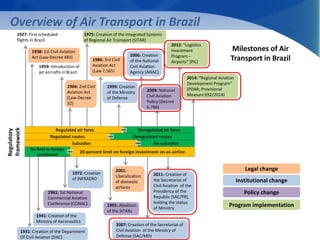
Milestones of Air 
Transport in Brazil 
Legal change 
Institutional change 
Overview of Air Transport in Brazil 
1975: Creation of the Integrated Systems 
of Regional Air Transport (SITAR) 
1986: 3rd Civil 
Aviation Act 
(Law 7,565) 
1972: Creation 
of INFRAERO 
1961: 1st National 
Commercial Aviation 
Conference (CONAC) 
1941: Creation of the 
Ministry of Aeronautics 
1931: Creation of the Department 
Of Civil Aviation (DAC) 
2006: Creation 
of the National 
Civil Aviation 
Agency (ANAC) 
2001 
2004 
2001: 
Liberalization 
of domestic 
airfares 
1991 
1991: Abolition 
of the SITARs 
2012: “Logistics 
Investment 
Program – 
Airports” (PIL) 
2011: Creation of 
the Secretariat of 
Civil Aviation of the 
Presidency of the 
Republic (SAC/PR), 
holding the status 
of Ministry 
2007: Creation of the Secretariat of 
Civil Aviation of the Ministry of 
Defense (SAC/MD) 
1927: First scheduled 
flights in Brazil 
1938: 1st Civil Aviation 
Act (Law-Decree 483) 
1959: Introduction of 
jet aircrafts in Brazil 
1966: 2nd Civil 
Aviation Act 
(Law-Decree 
32) 
1999: Creation 
of the Ministry 
of Defense 
2009: National 
Civil Aviation 
Policy (Decree 
6,780) 
2014: “Regional Aviation 
Development Program” 
(PDAR; Provisional 
Measure 652/2014) 
Regulated air fares Deregulated air fares 
Regulated routes Deregulated routes 
Subsidies No subsidies 
No limit to foreign 
investment 
20-percent limit on foreign investment on an airline 
1966 
Policy change 
Program implementation 
Regulatory 
framework
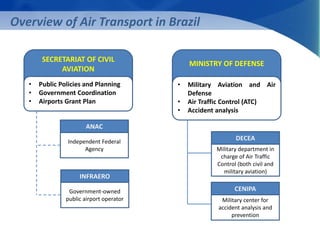
SECRETARIAT OF CIVIL 
AVIATION 
• Public Policies and Planning 
• Government Coordination 
• Airports Grant Plan 
MINISTRY OF DEFENSE 
• Military Aviation and Air 
Defense 
• Air Traffic Control (ATC) 
• Accident analysis 
ANAC 
Independent Federal 
Agency 
INFRAERO 
Government-owned 
public airport operator 
DECEA 
Military department in 
charge of Air Traffic 
Control (both civil and 
military aviation) 
CENIPA 
Military center for 
accident analysis and 
prevention 
Overview of Air Transport in Brazil
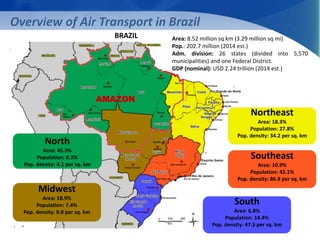
Overview of Air Transport in Brazil 
North 
Area: 45.3% 
Population: 8.3% 
Pop. density: 4.1 per sq. km 
Midwest 
Area: 18.9% 
Population: 7.4% 
Pop. density: 8.8 per sq. km 
BRAZIL Area: 8.52 million sq km (3.29 million sq mi) 
Pop.: 202.7 million (2014 est.) 
Adm. division: 26 states (divided into 5,570 
municipalities) and one Federal District. 
GDP (nominal): USD 2.24 trillion (2014 est.) 
AMAZON 
Northeast 
Area: 18.3% 
Population: 27.8% 
Pop. density: 34.2 per sq. km 
Southeast 
Area: 10.9% 
Population: 42.1% 
Pop. density: 86.9 per sq. km 
South 
Area: 6.8% 
Population: 14.4% 
Pop. density: 47.5 per sq. km
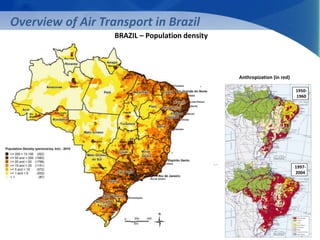
Overview of Air Transport in Brazil 
BRAZIL – Population density 
Anthropization (in red) 
1950- 
1960 
1997- 
2004
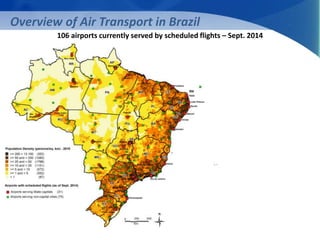
Overview of Air Transport in Brazil 
106 airports currently served by scheduled flights – Sept. 2014
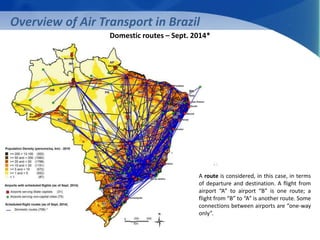
Overview of Air Transport in Brazil 
Domestic routes – Sept. 2014* 
A route is considered, in this case, in terms 
of departure and destination. A flight from 
airport “A” to airport “B” is one route; a 
flight from “B” to “A” is another route. Some 
connections between airports are “one-way 
only”.
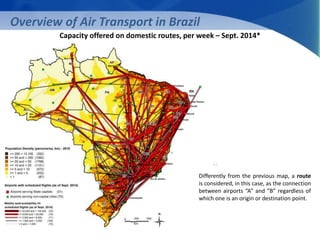
Overview of Air Transport in Brazil 
Capacity offered on domestic routes, per week – Sept. 2014* 
Differently from the previous map, a route 
is considered, in this case, as the connection 
between airports “A” and “B” regardless of 
which one is an origin or destination point.
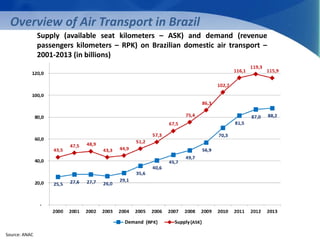
Overview of Air Transport in Brazil 
Source: ANAC 
Supply (available seat kilometers – ASK) and demand (revenue 
passengers kilometers – RPK) on Brazilian domestic air transport – 
2001-2013 (in billions) 
Demand Supply
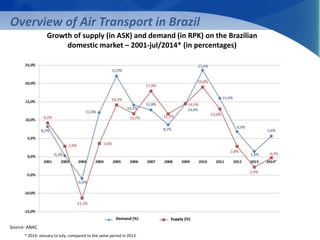
Overview of Air Transport in Brazil 
Growth of supply (in ASK) and demand (in RPK) on the Brazilian 
domestic market – 2001-jul/2014* (in percentages) 
Source: ANAC 
Demand (%) Supply (%) 
* 2014: January to July, compared to the same period in 2013.
Overview of Air Transport in Brazil 
Monthly average load-factor on domestic routes – Jan/2000 to Jul/2014 (%) 
Source: ANAC Load-factor (%) Linear trend (%)
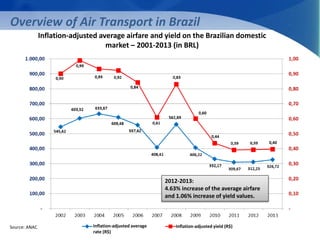
Overview of Air Transport in Brazil 
Inflation-adjusted average airfare and yield on the Brazilian domestic 
market – 2001-2013 (in BRL) 
2012-2013: 
4.63% increase of the average airfare 
and 1.06% increase of yield values. 
Inflation-adjusted average 
rate (R$) 
Inflation-Source: ANAC adjusted yield (R$)
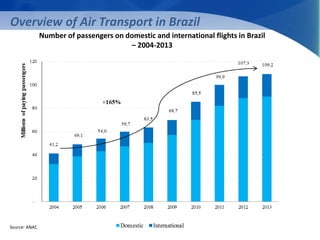
Overview of Air Transport in Brazil 
Number of passengers on domestic and international flights in Brazil 
– 2004-2013 
Source: ANAC
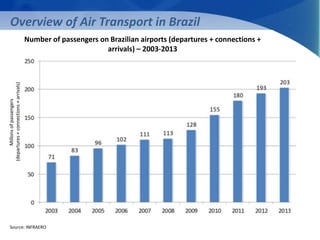
Overview of Air Transport in Brazil 
Millons of passengers 
(departures + connections + arrivals) 
Number of passengers on Brazilian airports (departures + connections + 
arrivals) – 2003-2013 
Source: INFRAERO
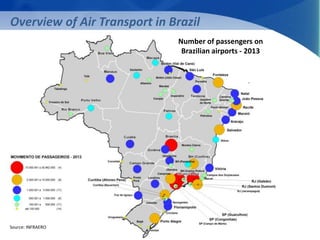
Overview of Air Transport in Brazil 
Number of passengers on 
Brazilian airports - 2013 
Source: INFRAERO
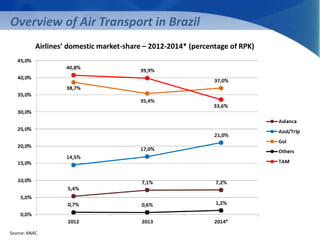
Overview of Air Transport in Brazil 
Airlines’ domestic market-share – 2012-2014* (percentage of RPK) 
Source: ANAC
Indicator of market concentration (Herfindhal-Hirschman Index - HHI) for 
the Brazilian domestic market – 2000-Sept/2014 
2004 
• VASP’s bankruptcy 
• VARIG’s crisis, with 
diminishing fleet (bankrupt in 
2006) 
2008 
• Azul enters the market; 
• Webjet is sold to CVC (Brazil’s 
biggest tourism operator) and 
increases its fleet from 3 to 11 
aircrafts; 
• Trip sells 20% of its shares to 
Skywest Airlines. 
2012: 
• Gol acquires Webjet; 
• Azul acquires Trip; 
• HHI would be 0,299 if those 
mergers had not happened. 
Overview of Air Transport in Brazil
Airports served by scheduled 
flights in 1999 
192 airports served by scheduled 
flights throughout 1999, with a peak 
of 183 airports in February 1999. 
Overview of Air Transport in Brazil 
Airports serving State capitals (31) 
Regional airports (161)
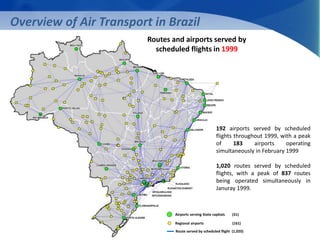
Routes and airports served by 
scheduled flights in 1999 
192 airports served by scheduled 
flights throughout 1999, with a peak 
of 183 airports operating 
simultaneously in February 1999 
1,020 routes served by scheduled 
flights, with a peak of 837 routes 
being operated simultaneously in 
Januray 1999. 
Overview of Air Transport in Brazil 
Airports serving State capitals (31) 
Regional airports (161) 
Route served by scheduled flight (1,020)
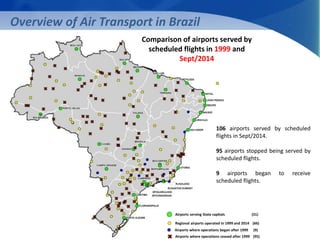
Comparison of airports served by 
scheduled flights in 1999 and 
106 airports served by scheduled 
flights in Sept/2014. 
95 airports stopped being served by 
scheduled flights. 
9 airports began to receive 
scheduled flights. 
Overview of Air Transport in Brazil 
Sept/2014 
Airports serving State capitals (31) 
Regional airports operated in 1999 and 2014 (66) 
Airports where operations began after 1999 (9) 
Airports where operations ceased after 1999 (95)
Airports served by scheduled 
flights in Sept/2014 
106 airports served by scheduled 
flights in Sept/2014. 
Overview of Air Transport in Brazil 
Airports serving State capitals (31) 
Regional airports operated in 1999 and 2014 (66) 
Airports where operations began after 1999 (9)
106 airports served by scheduled 
flights in Sept/2014. 
706 routes served by scheduled 
flights in Sept/2014. 
Overview of Air Transport in Brazil 
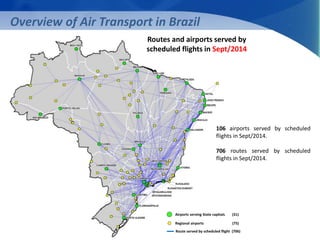
Routes and airports served by 
scheduled flights in Sept/2014 
Airports serving State capitals (31) 
Regional airports (75) 
Route served by scheduled flight (706)
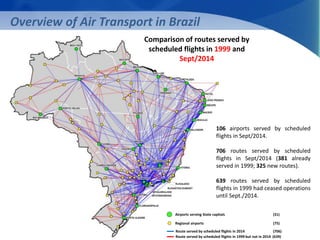
106 airports served by scheduled 
flights in Sept/2014. 
706 routes served by scheduled 
flights in Sept/2014 (381 already 
served in 1999; 325 new routes). 
639 routes served by scheduled 
flights in 1999 had ceased operations 
until Sept./2014. 
Overview of Air Transport in Brazil 
Comparison of routes served by 
scheduled flights in 1999 and 
Sept/2014 
Airports serving State capitals (31) 
Regional airports (75) 
Route served by scheduled flights in 2014 (706) 
Route served by scheduled flights in 1999 but not in 2014 (639)
Overview of Air Transport in Brazil 
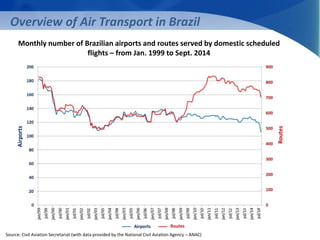
Monthly number of Brazilian airports and routes served by domestic scheduled 
flights – from Jan. 1999 to Sept. 2014 
Airports 
Source: Civil Aviation Secretariat (with data provided by the National Civil Aviation Agency – ANAC) 
Routes 
Airports Routes
Overview of Air Transport in Brazil 
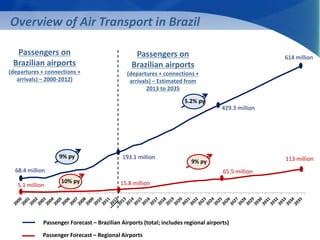
Passengers on 
Brazilian airports 
(departures + connections + 
arrivals) – 2000-2012) 
68.4 million 
5.1 million 
193.1 million 
15.8 million 
429.3 million 
65.5 million 
614 million 
Passenger Forecast – Brazilian Airports (total; includes regional airports) 
Passenger Forecast – Regional Airports 
5.2% py 
9% py 
9% py 
10% py 
Passengers on 
Brazilian airports 
(departures + connections + 
arrivals) – Estimated from 
2013 to 2035 
113 million
1. Overview of Air Transport in Brazil 
2. “Programa de Investimentos em Logística: 
Aeroportos” (Logistics Investment Program: Airports) 
3. “Programa de Desenvolvimento da Aviação Regional” 
(Regional Aviation Development Program) 
4. Further issues
Logistics Investment Program - Airports 
PROGRAMA DE INVESTIMENTOS EM LOGÍSTICA: AEROPORTOS 
(PIL-Aeroportos) 
Logistics Investment Program 
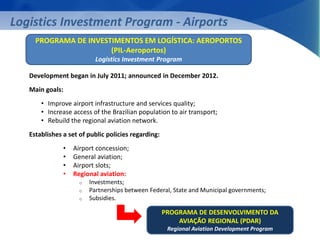
Development began in July 2011; announced in December 2012. 
Main goals: 
• Improve airport infrastructure and services quality; 
• Increase access of the Brazilian population to air transport; 
• Rebuild the regional aviation network. 
Establishes a set of public policies regarding: 
• Airport concession; 
• General aviation; 
• Airport slots; 
• Regional aviation: 
o Investments; 
o Partnerships between Federal, State and Municipal governments; 
o Subsidies. 
PROGRAMA DE DESENVOLVIMENTO DA 
AVIAÇÃO REGIONAL (PDAR) 
Regional Aviation Development Program
Logistics Investment Program - Airports 
PROGRAMA DE INVESTIMENTO EM LOGÍSTICA: AEROPORTOS 
(PIL-Aeroportos) 
Logistics Investment Program 
BACKGROUND 
The creation of the Secretariat of Civil Aviation – SAC, in March 2011, as a Special 
Secretariat of the Presidency of the Republic – thus holding the status of Ministry –, 
and of the Fundo Nacional de Aviação Civil – FNAC (National Fund for Civil Aviation) 
was a turning point for the development and implementation of the Política 
Nacional de Aviação Civil – PNAC (National Civil Aviation Policy), approved by 
Decree n. 6,780 of Feb. 18th, 2009. It provided the adequate institutional framework 
and financial resources to invest in air transport. 
Development of the PIL-Aeroportos program began in July 2011. It was triggered by 
recurring complaints that airlines could not adequately serve some destinations – 
particularly in the Amazon region – due to innapropriate airport infrastructure. The 
basic question that was posed was 
Which airports should receive investments on infrastructure?
Logistics Investment Program - Airports 
PROGRAMA DE INVESTIMENTOS EM LOGÍSTICA: AEROPORTOS 
(PIL-Aeroportos) 
Logistics Investment Program 
Which airports should receive investments in infrastructure? 
During the 2nd semester of 2011, a preliminary study was undertaken by SAC to 
select airports that could possibly receive investments in order to provide adequate 
infrastructure for scheduled flights. The following variables were considered: 
• Availability of scheduled air services; 
• Distance to an airport where scheduled air services were provided; 
• Access to other modes of transport (roads, railways and waterways); 
• Tourism destination; 
• Urban hierarchy (“Região de Influência das Cidades - REGIC”, a study by the 
IBGE – Brazilian Institute of Geography and Statistic); 
• Demographic statistics; 
• Municipal GDP (Gross Domestic Product). 
The first draft was completed by the end of 2011 and deemed appropriate to be 
presented and discussed with other organizations (inside and outside the Federal 
Government).
Logistics Investment Program - Airports 
PROGRAMA DE INVESTIMENTOS EM LOGÍSTICA: AEROPORTOS 
(PIL-Aeroportos) 
Logistics Investment Program 
Throughout 2012, SAC presented and discussed the selection of airports with the 
following organizations: 
• 26 State Governments and the Government of the Federal District; 
• National Congress (Senate and House of Representatives); 
• Ministry of Tourism – MTur; 
• Ministry of Defense/Command of Aeronautics – MD/COMAER; 
• Ministry of Planning, Budget and Management – MPOG; 
• Ministry of Finance – MF; 
• National Civil Aviation Agency – ANAC; 
• Planning and Logistics Enterprise – EPL; 
• Civil House of the Presidency of the Republic – CC/PR; 
• Brazilian Federal Court of Accounts – TCU; 
• Airline associations (National Airlines Syndicate –SNEA; Brazilian Regional 
Airlines Association – ABETAR) 
• Embraer.
Logistics Investment Program - Airports 
PROGRAMA DE INVESTIMENTOS EM LOGÍSTICA: AEROPORTOS 
(PIL-Aeroportos) 
Logistics Investment Program 
It was particularly important to discuss with State Governments the list of airports 
that would receive investments, not only to make it compatible with their social and 
economic planning but because 631 of the 719 public aerodromes/airports are 
operated by States or Municipalities (directly or indirectly). SAC invited officials from 
each State government to present a list of airports of their respective State (other 
States’ airports were not presented), after which they were granted enough time to 
evaluate and submit suggestions. 
Airlines also submitted a list of airports they expected to serve. 
In general, the list presented by SAC matched both the States’ and the airlines’ 
planning and few changes were needed. This process, although time-consuming, 
provided the PIL-Aeroportos with a greater degree of legitimacy.
Logistics Investment Program - Airports 
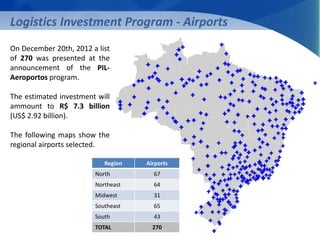
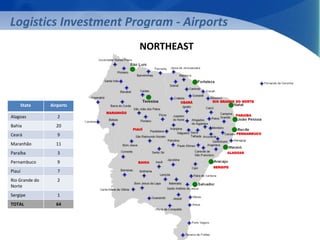
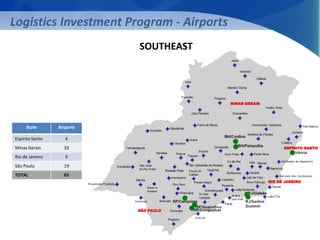
On December 20th, 2012 a list 
of 270 was presented at the 
announcement of the PIL-Aeroportos 
Region Airports 
North 67 
Northeast 64 
Midwest 31 
Southeast 65 
South 43 
TOTAL 270 
program. 
The estimated investment will 
ammount to R$ 7.3 billion 
(US$ 2.92 billion). 
The following maps show the 
regional airports selected.
Logistics Investment Program - Airports 
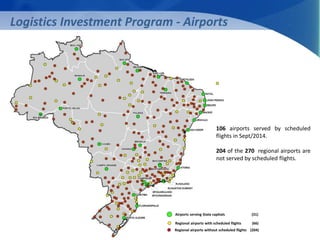
Set/2014 
106 airports served by scheduled 
flights in Sept/2014. 
204 of the 270 regional airports are 
not served by scheduled flights. 
Airports serving State capitals (31) 
Regional airports with scheduled flights (66) 
Regional airports without scheduled flights (204)
Logistics Investment Program - Airports 
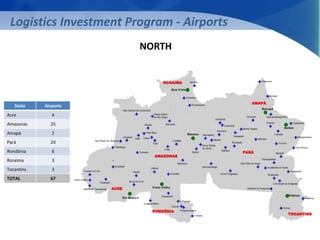
State Airports 
Acre 4 
Amazonas 25 
Amapá 2 
Pará 24 
Rondônia 6 
Roraima 3 
Tocantins 3 
TOTAL 67 
ACRE 
NORTH 
AMAZONAS 
PARÁ 
TOCANTINS 
RORAIMA 
AMAPÁ 
RONDÔNIA
Logistics Investment Program - Airports 
State Airports 
Alagoas 2 
Bahia 20 
Ceará 9 
Maranhão 11 
Paraíba 3 
Pernambuco 9 
Piauí 7 
Rio Grande do 
2 
Norte 
Sergipe 1 
TOTAL 64 
MARANHÃO 
RIO GRANDE DO NORTE 
PERNAMBUCO 
CEARÁ 
PIAUÍ 
BAHIA 
PARAÍBA 
ALAGOAS 
SERGIPE 
NORTHEAST
Logistics Investment Program - Airports 
State Airports 
Goiás 10 
Mato Grosso 13 
Mato Grosso do Sul 8 
TOTAL 64 
MATO GROSSO DO SUL 
GOIÁS 
MATO GROSSO 
DF 
MIDWEST
Logistics Investment Program - Airports 
State Airports 
Espírito Santo 4 
Minas Gerais 33 
Rio de Janeiro 9 
São Paulo 19 
TOTAL 65 
MINAS GERAIS 
ESPÍRITO SANTO 
RIO DE JANEIRO 
SOUTHEAST 
SÃO PAULO
Logistics Investment Program - Airports 
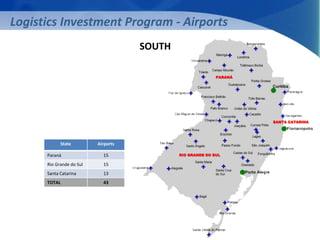
State Airports 
Paraná 15 
Rio Grande do Sul 15 
Santa Catarina 13 
TOTAL 43 
SANTA CATARINA 
PARANÁ 
RIO GRANDE DO SUL 
SOUTH
Logistics Investment Program - Airports 
PROGRAMA DE INVESTIMENTOS EM LOGÍSTICA: AEROPORTOS 
(PIL-Aeroportos) 
Logistics Investment Program 
After the announcement of the PIL-Aeroportos program, SAC pursued the following 
line of action: 
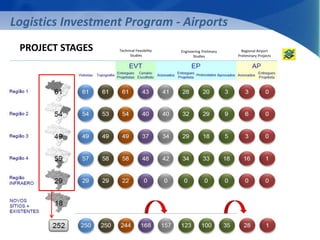
• Hire Banco do Brasil (BB) to manage the projects and investment. BB is in charge 
of delivering the Estudos de Viabilidade Técnica – EVT (“Technical Feasibility 
Studies”), the Estudos Preliminares de Engenharia – EP (“Engineering Preliminary 
Studies”) the Anteprojetos de Aeroporto Regional – AP (“Regional Airport 
Preliminary Projects”) to SAC. 
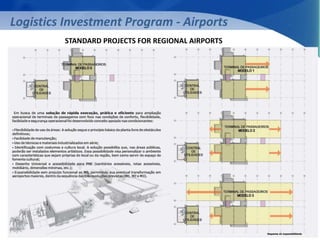
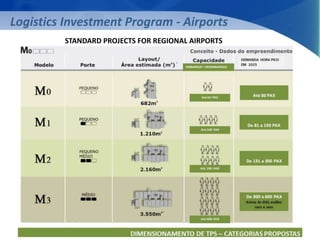
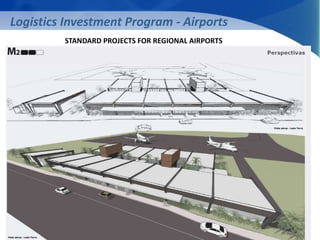
• Create standard projects for small, small-medium and medium airports: 
• Establish partnerships with local governments (State and Municipal) for the 
management and operation of regional airports: 
o Federal Government funds building and maintenance; 
o Investments are standardized by airport size; 
o Agreements with State and Municipal governments for maintenance 
and operation;
PROJECT STAGES Technical Feasibility 
Studies 
Engineering Prelimary 
Studies 
Regional Airport 
Preliminary Projects 
Logistics Investment Program - Airports
Logistics Investment Program - Airports 
STANDARD PROJECTS FOR REGIONAL AIRPORTS
Logistics Investment Program - Airports 
STANDARD PROJECTS FOR REGIONAL AIRPORTS
Logistics Investment Program - Airports 
STANDARD PROJECTS FOR REGIONAL AIRPORTS
Logistics Investment Program - Airports 
STANDARD PROJECTS FOR REGIONAL AIRPORTS
1. Overview of Air Transport in Brazil 
2. “Programa de Investimentos em Logística: Aeroportos” 
(Logistics Investment Program: Airports) 
3. “Programa de Desenvolvimento da Aviação Regional” 
(Regional Aviation Development Program) 
4. Further issues
Regional Aviation Development Program 
PROGRAMA DE DESENVOLVIMENTO DA AVIAÇÃO REGIONAL (PDAR) 
Regional Aviation Development Program 
BACKGROUND 
The proposal of subsidies to airlines as a way to increase the number of airports 
served by scheduled services was part of the Logistics Investment Program (PIL-Aeroportos) 
announced in Dec. 2012. Discussions concerning the primary aspects of a 
subsidy program were held concurrently to the selection of regional airports that 
were to receive investments in infrastructure, and involved mostly organizations that 
are part of the Federal Government. 
On January 2013, SAC put forth a Public Consultation (Consulta Pública nº 02/2013) 
detailing such proposal. Organizations and persons were granted one month to send 
their suggestions, all of which were to be analysed by SAC. A public hearing was held 
in Brasilia to receive suggestions by anyone attending. Most suggestions were made 
by airlines.
Regional Aviation Development Program 
PROGRAMA DE DESENVOLVIMENTO DA AVIAÇÃO REGIONAL (PDAR) 
Regional Aviation Development Program 
BACKGROUND 
The proposal presented reasons why a subsidy program was needed; its main goals; 
its scope; elegibility criteria; a formula for calculating the subsidy; the validity time 
frame; the expected results; government and airlines obligations; oversight and 
information provision; and penalties due to infringement of obligations. 
SAC initially proposed that the subsidy program would last for 2 years and could be 
continually renewed for the same period. Airlines would not be obligated to apply for 
subsidies, but in doing so would be required to provide information on a monthly 
basis. Evidences of wrongdoing by an airline would result in investigation and possibly 
the its exclusion of the program, as well as further legal actions defined by law.
Regional Aviation Development Program 
PROGRAMA DE DESENVOLVIMENTO DA AVIAÇÃO REGIONAL (PDAR) 
PUBLIC CONSULTATION N. 2/2013 
Public Consultation n. 02/2013 described the following goals for the subsidy 
program: 
1. Increase the Brazilian population’s access to the air transport network by 
reducing the average airfare; 
2. Integrate remote communities to the civil aviation national network in order 
to facilitate the transport of people and goods, such as food supplies and 
pharmaceuticals; 
3. Integrate regions with lower economic potential to medium- and large-sized 
urban centers; 
4. Facilitate the access to regions with tourism potential; 
5. Increase the number of passengers on already-existing routes; and 
6. Increase the number of routes and cities served by scheduled passenger 
flights 
Regional Aviation Development Program
Regional Aviation Development Program 
PROGRAMA DE DESENVOLVIMENTO DA AVIAÇÃO REGIONAL (PDAR) 
Regional Aviation Development Program 
PUBLIC CONSULTATION N. 2/2013 
Routes would be classified considering the number of passengers (departures + 
connections + arrivals) on either the departure or destination airport (or both). Low-density 
routes were to be defined as any route in which either one or both the departure 
or destination airport received less than 50,000 passengers on a certain year, whereas 
medium-density routes would be those on which these airports had more than 50,000 and 
less than 800,000 passengers. High-density routes would be those in which both the 
departure and destination airports had more than 800,000 passengers/year or those 
serving State capitals. Only low- and medium-density routes would subsidized. 
The proposal presented on Public Consultation n. 2/2013 is not binding. It serves as general 
guidelines that may be considered when drafting the final proposal for the creation of the 
subsidy program. 
More information on Public Consultation n. 2/2013 can be found at 
http://www.aviacaocivil.gov.br/acesso-a-informacao/arquivos-pdf/proposta-de-modelo-de-subsidios2013. 
pdf (Portuguese only)
Regional Aviation Development Program 
PROGRAMA DE DESENVOLVIMENTO DA AVIAÇÃO REGIONAL (PDAR) 
Regional Aviation Development Program 
PROVISIONAL MEASURE N. 652, OF JULY 25TH, 2014 
Following Public Consultation n. 2/2013, discussions were held between SAC and the 
Ministry of Finance (MF), the Ministry of Planning, Budget and Management 
(MPOG), and the Civil House of the Presidency of the Republic (CC/PR) as to what 
legal instrument would be used to provide the Federal Government with the 
possibility to grant subsidies to regional flights – a provisional measure (Medida 
Provisória) or a bill (Projeto de Lei) –, and to which aspects should be included and 
which ones should be detailed on a Presidential Decree. 
Opting between a provisional measure and a bill was a key issue during those 
debates. Although both eventually become a law once aproved by a majority on the 
Senate and the House of Representatives, there are substantial differences concerning 
the legislative process which they must go through.
Regional Aviation Development Program 
PROGRAMA DE DESENVOLVIMENTO DA AVIAÇÃO REGIONAL (PDAR) 
Regional Aviation Development Program 
PROVISIONAL MEASURE N. 652, OF JULY 25TH, 2014 
Main differences and similarities between provisional measures and bills: 
Medida Provisória (MP) Projeto de Lei (PL) 
May be presented only by the President in cases of great urgency 
and relevance. Can not legislate in matters as nationality, crime, 
political rights, budget, etc. 
May be presented by any member of Congress, by the President, 
by the Supreme Court (STF), and by the People (with 1% of the 
total voters’ signatures) and concern any topic. 
Comes into force on the date of its publication. Comes into force after being approved by Congress (on both the 
Senate and the House of Representatives), signed by the President, 
and published. 
Must be approved by a simple majority on each House of Congress. Must be approved by a simple majority on each House of Congress. 
Must be voted within 60 days (a 60 day extension is granted only 
once) or it looses its effectiveness. 
Does not need to be voted within a given time frame. 
Is analysed only in one especially-created Commision (Comissão 
Mista) formed by members of the Senate and of the House of 
Representatives. 
Is analysed by at least 3 different commisions on each House of 
Congress. 
Blocks all voting if – having been approved by the special comission 
– is not voted after 45 days of being submitted by the President. 
Does not block any voting if not voted.
Regional Aviation Development Program 
PROGRAMA DE DESENVOLVIMENTO DA AVIAÇÃO REGIONAL (PDAR) 
Regional Aviation Development Program 
PROVISIONAL MEASURE N. 652, OF JULY 25TH, 2014 
The draft proposal of Provisional Measure n. 652/2014 was subject to lenghty discussions 
involving mostly Government organizations throughout 2013 and 2014 – almost all of 
which were consulted when drafting the PIL-Aeroportos program (State governments were 
not involved this time). The final proposal was signed by the President in July 25th, 2014, 
thus coming into force when published on July 28th. One must note that it does not grant 
any right to subsidies before it is regulated by a Presidential Decree. The PM creates the 
Programa de Desenvolvimento da Aviação Regional (PDAR, Regional Aviation 
Development Program). 
The provisional measure was sent to Congress and must be approved by both Houses 
before November 24th, 2014, or it looses its effectiveness. Representatives and Senators 
proposed 85 amendments to the PM until August 5th. Due to general elections in Brazil in 
October 5th and 26th, Congressional activities were halted. On November 4th, the special 
commission resumed its activites and a public hearing was held in order to discuss the 
matter. SAC analysed the 85 amendments and submited this analysis to Congress.
Regional Aviation Development Program 
PROGRAMA DE DESENVOLVIMENTO DA AVIAÇÃO REGIONAL (PDAR) 
Regional Aviation Development Program 
PROVISIONAL MEASURE N. 652, OF JULY 25TH, 2014 
The comission invited the Minister of Civil Aviation (SAC); the Director-President of 
the National Civil Aviation Agency (ANAC); the President of INFRAERO; the Chief of 
the Operations Subdepartment of the Department of Air Traffic Control (DECEA); the 
President of the Brazilian Airlines Association (ABEAR); and the President of the 
National Syndicate of Aeronauts (SNA). A representative of regional airlines was 
present and was granted the right to speak. 
Following the public hearing, Federal Government officials and the members of the 
Comission discussed which aspects of the proposal and of the amendments should be 
included on the vote of the Comission’s “Relator”, a member designated to analyse 
the proposal. 
On November 5th, the Comission’s “Relator” issued his vote. Members of the 
Comission requested time to analyse it, and the following meeting is scheduled for 
November 11th.
Regional Aviation Development Program 
PROGRAMA DE DESENVOLVIMENTO DA AVIAÇÃO REGIONAL (PDAR) 
Regional Aviation Development Program 
PROVISIONAL MEASURE N. 652, OF JULY 25TH, 2014 
The Comission’s “Relator” rejected 11 amendments on the grounds of not being related to 
aviation at all. A total of 16 amendments were rejected for not being related to regional 
aviation, despite being related to aviation in general. 2 amendments were considered 
unconstitutional. 7 amendments were rejected because they concerned matters already 
allowed by law. This totals 36 amendments being rejected without further analysis, since 
they did not relate to the subsidy program. The remaining 49 amendments were further 
analysed by the “Relator” and 15 were totally or partially approved on his vote. He voted 
for the following changes on the proposal: 
• Establish a limit of 20% of the FNAC (Fundo Nacional de Aviação Civil) that can be used 
to provide subsidies to airlines. In 2015 that should ammount to R$ 840 million (or US$ 
336 million). 
• Have the definition of “regional airport” on the law, not on a Presidential Decree: up to 
600,000 passengers/year for airports located in regions other than the Amazon; up to 
800,000 passengers/year for airports located on the Amazon.
Regional Aviation Development Program 
PROGRAMA DE DESENVOLVIMENTO DA AVIAÇÃO REGIONAL (PDAR) 
Regional Aviation Development Program 
PROVISIONAL MEASURE N. 652, OF JULY 25TH, 2014 
The “Relator” also voted for the following changes on the proposal: 
• 50% of the subsidies must be granted to the operation of new routes. 
• Limit the subsidies to 50% of the available seats on na aircraft. That means if a 70-seat 
aircraft is loaded with 60 passengers, the calculus for the subsidy will consider only 35 
passengers. 
• Airlines receiving subsidies must not have debts related to airport and air navigation 
fees. 
• Establish a priority for flights on the Amazon. 
• Payments to airlines must be done on a regular basis. 
• SAC must publish an annual report with full information concerning the program. 
• The subsidy program is valid for 5 years, pending one extension for 5 more years if 
deemed necessary. 
• No taxes are to be levied on the subsidies.
Regional Aviation Development Program 
PROGRAMA DE DESENVOLVIMENTO DA AVIAÇÃO REGIONAL (PDAR) 
Regional Aviation Development Program 
FURTHER ACTIONS 
Congress must vote the Provisional Measure n. 652/2014 until November 24th, 
otherwise it will not be valid anymore. Once approved by Congress and signed by the 
President, a Presidential Decree regulating the new Law must be issued. 
Key aspects concerning the contents of the Decree are pending the approval of the 
Provisional Measure, and thus can not be confirmed at the present time. 
More information on legislative process of the the Provisional Measure n. 652/2014 
may be found at http://www.senado.gov.br/atividade/materia/detalhes.asp?p_cod_mate=118341 
(Portuguese only).
1. Overview of Air Transport in Brazil 
2. “Programa de Investimentos em Logística: Aeroportos” 
(Logistics Investment Program: Airports) 
3. “Programa de Desenvolvimento da Aviação Regional” 
(Regional Aviation Development Program) 
4. Further issues
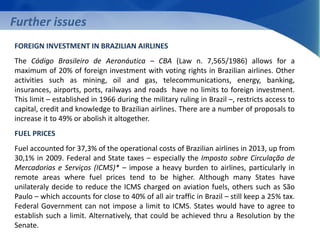
Further issues 
FOREIGN INVESTMENT IN BRAZILIAN AIRLINES 
The Código Brasileiro de Aeronáutica – CBA (Law n. 7,565/1986) allows for a 
maximum of 20% of foreign investment with voting rights in Brazilian airlines. Other 
activities such as mining, oil and gas, telecommunications, energy, banking, 
insurances, airports, ports, railways and roads have no limits to foreign investment. 
This limit – established in 1966 during the military ruling in Brazil –, restricts access to 
capital, credit and knowledge to Brazilian airlines. There are a number of proposals to 
increase it to 49% or abolish it altogether. 
FUEL PRICES 
Fuel accounted for 37,3% of the operational costs of Brazilian airlines in 2013, up from 
30,1% in 2009. Federal and State taxes – especially the Imposto sobre Circulação de 
Mercadorias e Serviços (ICMS)* – impose a heavy burden to airlines, particularly in 
remote areas where fuel prices tend to be higher. Although many States have 
unilateraly decide to reduce the ICMS charged on aviation fuels, others such as São 
Paulo – which accounts for close to 40% of all air traffic in Brazil – still keep a 25% tax. 
Federal Government can not impose a limit to ICMS. States would have to agree to 
establish such a limit. Alternatively, that could be achieved thru a Resolution by the 
Senate.
Links 
Public Organizations: 
• Secretaria de Aviação Civil (SAC)/Secretariat of Civil Aviation – http://www.aviacaocivil.gov.br 
• Presidência da República (PR)/Presidency of the Reopublic – http://www.planalto.gov.br 
• Câmara dos Deputados/House of Representatives – http://www.camara.gov.br 
• Senado Federal/Senate – http://www.senado.gov.br 
• Agência Nacional de Aviação Civil (ANAC)/National Civil Aviation Agency – http://www.anac.gov.br 
• Empresa Brasileira de Infraestrutura Aeroportuária (Infraero) – http://www.infraero.gov.br 
• Empresa de Planejamento e Logística (EPL)/Planning and Logistics Enterprise – http://www.epl.gov.br 
• Ministério do Turismo (MTur)/Ministry of Tourism – http://www.turismo.gov.br 
• Ministério da Fazenda (MF)/Ministry of Finance – http://www.fazenda.gov.br 
• Ministério da Defesa (MD)/Ministry of Defense – http://www.defesa.gov.br 
• Tribunal de Contas da União (TCU)/Federal Court of Accounts – http://www.tcu.gov.br 
• Departamento de Controle do Espaço Aéreo (DECEA)/Department of Air Traffic Control – 
http://www.decea.gov.br 
Private Organizations: 
• Empresa Brasileira de Aeronáutica S.A. (Embraer) – http://www.embraer.com.br 
• Associação Brasileira das Empresas Aéreas (ABEAR)/Brazilian Airlines Association – http://www.abear.com.br 
• Sindicato Nacional das Empresas Aéreas (SNEA)/National Airlines Syndicate – http://www.snea.com.br 
Throughout 
airports
¡Gracias! 
Thank you! 
Obrigado! 
Gustavo Pacheco Fortes Fleury 
Air Services Policy Manager 
Secretariat of Civil Aviation of the Presidency of the Republic 
Secretariat of Civil Aviation Regulatory Policy 
Department of Air Services Policy 
+55 (61) 3311-7371 
gustavo.fleury@aviacaocivil.gov.br 
Setor Comercial Sul-B (SBS-B), Quadra 9, Lote C, 6th floor, 70308-200 
Brasília, DF, Brazil

Regional Aviation Programs in Brazil - 2014

  • 1.
    Presidency of theRepublic of Brazil Secretariat of Civil Aviation Regional Aviation Programs in Brazil Airport Infrastructure and Subsidies to Airlines Gustavo Pacheco Fortes Fleury Air Services Policy Manager BOGOTA, November 10th, 2014
  • 2.
    1. Overview ofAir Transport in Brazil 2. “Programa de Investimentos em Logística: Aeroportos” (Logistics Investment Program: Airports) 3. “Programa de Desenvolvimento da Aviação Regional” (Regional Aviation Development Program) 4. Further Issues
  • 3.
    Milestones of Air Transport in Brazil Legal change Institutional change Overview of Air Transport in Brazil 1975: Creation of the Integrated Systems of Regional Air Transport (SITAR) 1986: 3rd Civil Aviation Act (Law 7,565) 1972: Creation of INFRAERO 1961: 1st National Commercial Aviation Conference (CONAC) 1941: Creation of the Ministry of Aeronautics 1931: Creation of the Department Of Civil Aviation (DAC) 2006: Creation of the National Civil Aviation Agency (ANAC) 2001 2004 2001: Liberalization of domestic airfares 1991 1991: Abolition of the SITARs 2012: “Logistics Investment Program – Airports” (PIL) 2011: Creation of the Secretariat of Civil Aviation of the Presidency of the Republic (SAC/PR), holding the status of Ministry 2007: Creation of the Secretariat of Civil Aviation of the Ministry of Defense (SAC/MD) 1927: First scheduled flights in Brazil 1938: 1st Civil Aviation Act (Law-Decree 483) 1959: Introduction of jet aircrafts in Brazil 1966: 2nd Civil Aviation Act (Law-Decree 32) 1999: Creation of the Ministry of Defense 2009: National Civil Aviation Policy (Decree 6,780) 2014: “Regional Aviation Development Program” (PDAR; Provisional Measure 652/2014) Regulated air fares Deregulated air fares Regulated routes Deregulated routes Subsidies No subsidies No limit to foreign investment 20-percent limit on foreign investment on an airline 1966 Policy change Program implementation Regulatory framework
  • 4.
    SECRETARIAT OF CIVIL AVIATION • Public Policies and Planning • Government Coordination • Airports Grant Plan MINISTRY OF DEFENSE • Military Aviation and Air Defense • Air Traffic Control (ATC) • Accident analysis ANAC Independent Federal Agency INFRAERO Government-owned public airport operator DECEA Military department in charge of Air Traffic Control (both civil and military aviation) CENIPA Military center for accident analysis and prevention Overview of Air Transport in Brazil
  • 5.
    Overview of AirTransport in Brazil North Area: 45.3% Population: 8.3% Pop. density: 4.1 per sq. km Midwest Area: 18.9% Population: 7.4% Pop. density: 8.8 per sq. km BRAZIL Area: 8.52 million sq km (3.29 million sq mi) Pop.: 202.7 million (2014 est.) Adm. division: 26 states (divided into 5,570 municipalities) and one Federal District. GDP (nominal): USD 2.24 trillion (2014 est.) AMAZON Northeast Area: 18.3% Population: 27.8% Pop. density: 34.2 per sq. km Southeast Area: 10.9% Population: 42.1% Pop. density: 86.9 per sq. km South Area: 6.8% Population: 14.4% Pop. density: 47.5 per sq. km
  • 6.
    Overview of AirTransport in Brazil BRAZIL – Population density Anthropization (in red) 1950- 1960 1997- 2004
  • 7.
    Overview of AirTransport in Brazil 106 airports currently served by scheduled flights – Sept. 2014
  • 8.
    Overview of AirTransport in Brazil Domestic routes – Sept. 2014* A route is considered, in this case, in terms of departure and destination. A flight from airport “A” to airport “B” is one route; a flight from “B” to “A” is another route. Some connections between airports are “one-way only”.
  • 9.
    Overview of AirTransport in Brazil Capacity offered on domestic routes, per week – Sept. 2014* Differently from the previous map, a route is considered, in this case, as the connection between airports “A” and “B” regardless of which one is an origin or destination point.
  • 10.
    Overview of AirTransport in Brazil Source: ANAC Supply (available seat kilometers – ASK) and demand (revenue passengers kilometers – RPK) on Brazilian domestic air transport – 2001-2013 (in billions) Demand Supply
  • 11.
    Overview of AirTransport in Brazil Growth of supply (in ASK) and demand (in RPK) on the Brazilian domestic market – 2001-jul/2014* (in percentages) Source: ANAC Demand (%) Supply (%) * 2014: January to July, compared to the same period in 2013.
  • 12.
    Overview of AirTransport in Brazil Monthly average load-factor on domestic routes – Jan/2000 to Jul/2014 (%) Source: ANAC Load-factor (%) Linear trend (%)
  • 13.
    Overview of AirTransport in Brazil Inflation-adjusted average airfare and yield on the Brazilian domestic market – 2001-2013 (in BRL) 2012-2013: 4.63% increase of the average airfare and 1.06% increase of yield values. Inflation-adjusted average rate (R$) Inflation-Source: ANAC adjusted yield (R$)
  • 14.
    Overview of AirTransport in Brazil Number of passengers on domestic and international flights in Brazil – 2004-2013 Source: ANAC
  • 15.
    Overview of AirTransport in Brazil Millons of passengers (departures + connections + arrivals) Number of passengers on Brazilian airports (departures + connections + arrivals) – 2003-2013 Source: INFRAERO
  • 16.
    Overview of AirTransport in Brazil Number of passengers on Brazilian airports - 2013 Source: INFRAERO
  • 17.
    Overview of AirTransport in Brazil Airlines’ domestic market-share – 2012-2014* (percentage of RPK) Source: ANAC
  • 18.
    Indicator of marketconcentration (Herfindhal-Hirschman Index - HHI) for the Brazilian domestic market – 2000-Sept/2014 2004 • VASP’s bankruptcy • VARIG’s crisis, with diminishing fleet (bankrupt in 2006) 2008 • Azul enters the market; • Webjet is sold to CVC (Brazil’s biggest tourism operator) and increases its fleet from 3 to 11 aircrafts; • Trip sells 20% of its shares to Skywest Airlines. 2012: • Gol acquires Webjet; • Azul acquires Trip; • HHI would be 0,299 if those mergers had not happened. Overview of Air Transport in Brazil
  • 19.
    Airports served byscheduled flights in 1999 192 airports served by scheduled flights throughout 1999, with a peak of 183 airports in February 1999. Overview of Air Transport in Brazil Airports serving State capitals (31) Regional airports (161)
  • 20.
    Routes and airportsserved by scheduled flights in 1999 192 airports served by scheduled flights throughout 1999, with a peak of 183 airports operating simultaneously in February 1999 1,020 routes served by scheduled flights, with a peak of 837 routes being operated simultaneously in Januray 1999. Overview of Air Transport in Brazil Airports serving State capitals (31) Regional airports (161) Route served by scheduled flight (1,020)
  • 21.
    Comparison of airportsserved by scheduled flights in 1999 and 106 airports served by scheduled flights in Sept/2014. 95 airports stopped being served by scheduled flights. 9 airports began to receive scheduled flights. Overview of Air Transport in Brazil Sept/2014 Airports serving State capitals (31) Regional airports operated in 1999 and 2014 (66) Airports where operations began after 1999 (9) Airports where operations ceased after 1999 (95)
  • 22.
    Airports served byscheduled flights in Sept/2014 106 airports served by scheduled flights in Sept/2014. Overview of Air Transport in Brazil Airports serving State capitals (31) Regional airports operated in 1999 and 2014 (66) Airports where operations began after 1999 (9)
  • 23.
    106 airports servedby scheduled flights in Sept/2014. 706 routes served by scheduled flights in Sept/2014. Overview of Air Transport in Brazil Routes and airports served by scheduled flights in Sept/2014 Airports serving State capitals (31) Regional airports (75) Route served by scheduled flight (706)
  • 24.
    106 airports servedby scheduled flights in Sept/2014. 706 routes served by scheduled flights in Sept/2014 (381 already served in 1999; 325 new routes). 639 routes served by scheduled flights in 1999 had ceased operations until Sept./2014. Overview of Air Transport in Brazil Comparison of routes served by scheduled flights in 1999 and Sept/2014 Airports serving State capitals (31) Regional airports (75) Route served by scheduled flights in 2014 (706) Route served by scheduled flights in 1999 but not in 2014 (639)
  • 25.
    Overview of AirTransport in Brazil Monthly number of Brazilian airports and routes served by domestic scheduled flights – from Jan. 1999 to Sept. 2014 Airports Source: Civil Aviation Secretariat (with data provided by the National Civil Aviation Agency – ANAC) Routes Airports Routes
  • 26.
    Overview of AirTransport in Brazil Passengers on Brazilian airports (departures + connections + arrivals) – 2000-2012) 68.4 million 5.1 million 193.1 million 15.8 million 429.3 million 65.5 million 614 million Passenger Forecast – Brazilian Airports (total; includes regional airports) Passenger Forecast – Regional Airports 5.2% py 9% py 9% py 10% py Passengers on Brazilian airports (departures + connections + arrivals) – Estimated from 2013 to 2035 113 million
  • 27.
    1. Overview ofAir Transport in Brazil 2. “Programa de Investimentos em Logística: Aeroportos” (Logistics Investment Program: Airports) 3. “Programa de Desenvolvimento da Aviação Regional” (Regional Aviation Development Program) 4. Further issues
  • 28.
    Logistics Investment Program- Airports PROGRAMA DE INVESTIMENTOS EM LOGÍSTICA: AEROPORTOS (PIL-Aeroportos) Logistics Investment Program Development began in July 2011; announced in December 2012. Main goals: • Improve airport infrastructure and services quality; • Increase access of the Brazilian population to air transport; • Rebuild the regional aviation network. Establishes a set of public policies regarding: • Airport concession; • General aviation; • Airport slots; • Regional aviation: o Investments; o Partnerships between Federal, State and Municipal governments; o Subsidies. PROGRAMA DE DESENVOLVIMENTO DA AVIAÇÃO REGIONAL (PDAR) Regional Aviation Development Program
  • 29.
    Logistics Investment Program- Airports PROGRAMA DE INVESTIMENTO EM LOGÍSTICA: AEROPORTOS (PIL-Aeroportos) Logistics Investment Program BACKGROUND The creation of the Secretariat of Civil Aviation – SAC, in March 2011, as a Special Secretariat of the Presidency of the Republic – thus holding the status of Ministry –, and of the Fundo Nacional de Aviação Civil – FNAC (National Fund for Civil Aviation) was a turning point for the development and implementation of the Política Nacional de Aviação Civil – PNAC (National Civil Aviation Policy), approved by Decree n. 6,780 of Feb. 18th, 2009. It provided the adequate institutional framework and financial resources to invest in air transport. Development of the PIL-Aeroportos program began in July 2011. It was triggered by recurring complaints that airlines could not adequately serve some destinations – particularly in the Amazon region – due to innapropriate airport infrastructure. The basic question that was posed was Which airports should receive investments on infrastructure?
  • 30.
    Logistics Investment Program- Airports PROGRAMA DE INVESTIMENTOS EM LOGÍSTICA: AEROPORTOS (PIL-Aeroportos) Logistics Investment Program Which airports should receive investments in infrastructure? During the 2nd semester of 2011, a preliminary study was undertaken by SAC to select airports that could possibly receive investments in order to provide adequate infrastructure for scheduled flights. The following variables were considered: • Availability of scheduled air services; • Distance to an airport where scheduled air services were provided; • Access to other modes of transport (roads, railways and waterways); • Tourism destination; • Urban hierarchy (“Região de Influência das Cidades - REGIC”, a study by the IBGE – Brazilian Institute of Geography and Statistic); • Demographic statistics; • Municipal GDP (Gross Domestic Product). The first draft was completed by the end of 2011 and deemed appropriate to be presented and discussed with other organizations (inside and outside the Federal Government).
  • 31.
    Logistics Investment Program- Airports PROGRAMA DE INVESTIMENTOS EM LOGÍSTICA: AEROPORTOS (PIL-Aeroportos) Logistics Investment Program Throughout 2012, SAC presented and discussed the selection of airports with the following organizations: • 26 State Governments and the Government of the Federal District; • National Congress (Senate and House of Representatives); • Ministry of Tourism – MTur; • Ministry of Defense/Command of Aeronautics – MD/COMAER; • Ministry of Planning, Budget and Management – MPOG; • Ministry of Finance – MF; • National Civil Aviation Agency – ANAC; • Planning and Logistics Enterprise – EPL; • Civil House of the Presidency of the Republic – CC/PR; • Brazilian Federal Court of Accounts – TCU; • Airline associations (National Airlines Syndicate –SNEA; Brazilian Regional Airlines Association – ABETAR) • Embraer.
  • 32.
    Logistics Investment Program- Airports PROGRAMA DE INVESTIMENTOS EM LOGÍSTICA: AEROPORTOS (PIL-Aeroportos) Logistics Investment Program It was particularly important to discuss with State Governments the list of airports that would receive investments, not only to make it compatible with their social and economic planning but because 631 of the 719 public aerodromes/airports are operated by States or Municipalities (directly or indirectly). SAC invited officials from each State government to present a list of airports of their respective State (other States’ airports were not presented), after which they were granted enough time to evaluate and submit suggestions. Airlines also submitted a list of airports they expected to serve. In general, the list presented by SAC matched both the States’ and the airlines’ planning and few changes were needed. This process, although time-consuming, provided the PIL-Aeroportos with a greater degree of legitimacy.
  • 33.
    Logistics Investment Program- Airports On December 20th, 2012 a list of 270 was presented at the announcement of the PIL-Aeroportos Region Airports North 67 Northeast 64 Midwest 31 Southeast 65 South 43 TOTAL 270 program. The estimated investment will ammount to R$ 7.3 billion (US$ 2.92 billion). The following maps show the regional airports selected.
  • 34.
    Logistics Investment Program- Airports Set/2014 106 airports served by scheduled flights in Sept/2014. 204 of the 270 regional airports are not served by scheduled flights. Airports serving State capitals (31) Regional airports with scheduled flights (66) Regional airports without scheduled flights (204)
  • 35.
    Logistics Investment Program- Airports State Airports Acre 4 Amazonas 25 Amapá 2 Pará 24 Rondônia 6 Roraima 3 Tocantins 3 TOTAL 67 ACRE NORTH AMAZONAS PARÁ TOCANTINS RORAIMA AMAPÁ RONDÔNIA
  • 36.
    Logistics Investment Program- Airports State Airports Alagoas 2 Bahia 20 Ceará 9 Maranhão 11 Paraíba 3 Pernambuco 9 Piauí 7 Rio Grande do 2 Norte Sergipe 1 TOTAL 64 MARANHÃO RIO GRANDE DO NORTE PERNAMBUCO CEARÁ PIAUÍ BAHIA PARAÍBA ALAGOAS SERGIPE NORTHEAST
  • 37.
    Logistics Investment Program- Airports State Airports Goiás 10 Mato Grosso 13 Mato Grosso do Sul 8 TOTAL 64 MATO GROSSO DO SUL GOIÁS MATO GROSSO DF MIDWEST
  • 38.
    Logistics Investment Program- Airports State Airports Espírito Santo 4 Minas Gerais 33 Rio de Janeiro 9 São Paulo 19 TOTAL 65 MINAS GERAIS ESPÍRITO SANTO RIO DE JANEIRO SOUTHEAST SÃO PAULO
  • 39.
    Logistics Investment Program- Airports State Airports Paraná 15 Rio Grande do Sul 15 Santa Catarina 13 TOTAL 43 SANTA CATARINA PARANÁ RIO GRANDE DO SUL SOUTH
  • 40.
    Logistics Investment Program- Airports PROGRAMA DE INVESTIMENTOS EM LOGÍSTICA: AEROPORTOS (PIL-Aeroportos) Logistics Investment Program After the announcement of the PIL-Aeroportos program, SAC pursued the following line of action: • Hire Banco do Brasil (BB) to manage the projects and investment. BB is in charge of delivering the Estudos de Viabilidade Técnica – EVT (“Technical Feasibility Studies”), the Estudos Preliminares de Engenharia – EP (“Engineering Preliminary Studies”) the Anteprojetos de Aeroporto Regional – AP (“Regional Airport Preliminary Projects”) to SAC. • Create standard projects for small, small-medium and medium airports: • Establish partnerships with local governments (State and Municipal) for the management and operation of regional airports: o Federal Government funds building and maintenance; o Investments are standardized by airport size; o Agreements with State and Municipal governments for maintenance and operation;
  • 41.
    PROJECT STAGES TechnicalFeasibility Studies Engineering Prelimary Studies Regional Airport Preliminary Projects Logistics Investment Program - Airports
  • 42.
    Logistics Investment Program- Airports STANDARD PROJECTS FOR REGIONAL AIRPORTS
  • 43.
    Logistics Investment Program- Airports STANDARD PROJECTS FOR REGIONAL AIRPORTS
  • 44.
    Logistics Investment Program- Airports STANDARD PROJECTS FOR REGIONAL AIRPORTS
  • 45.
    Logistics Investment Program- Airports STANDARD PROJECTS FOR REGIONAL AIRPORTS
  • 46.
    1. Overview ofAir Transport in Brazil 2. “Programa de Investimentos em Logística: Aeroportos” (Logistics Investment Program: Airports) 3. “Programa de Desenvolvimento da Aviação Regional” (Regional Aviation Development Program) 4. Further issues
  • 47.
    Regional Aviation DevelopmentProgram PROGRAMA DE DESENVOLVIMENTO DA AVIAÇÃO REGIONAL (PDAR) Regional Aviation Development Program BACKGROUND The proposal of subsidies to airlines as a way to increase the number of airports served by scheduled services was part of the Logistics Investment Program (PIL-Aeroportos) announced in Dec. 2012. Discussions concerning the primary aspects of a subsidy program were held concurrently to the selection of regional airports that were to receive investments in infrastructure, and involved mostly organizations that are part of the Federal Government. On January 2013, SAC put forth a Public Consultation (Consulta Pública nº 02/2013) detailing such proposal. Organizations and persons were granted one month to send their suggestions, all of which were to be analysed by SAC. A public hearing was held in Brasilia to receive suggestions by anyone attending. Most suggestions were made by airlines.
  • 48.
    Regional Aviation DevelopmentProgram PROGRAMA DE DESENVOLVIMENTO DA AVIAÇÃO REGIONAL (PDAR) Regional Aviation Development Program BACKGROUND The proposal presented reasons why a subsidy program was needed; its main goals; its scope; elegibility criteria; a formula for calculating the subsidy; the validity time frame; the expected results; government and airlines obligations; oversight and information provision; and penalties due to infringement of obligations. SAC initially proposed that the subsidy program would last for 2 years and could be continually renewed for the same period. Airlines would not be obligated to apply for subsidies, but in doing so would be required to provide information on a monthly basis. Evidences of wrongdoing by an airline would result in investigation and possibly the its exclusion of the program, as well as further legal actions defined by law.
  • 49.
    Regional Aviation DevelopmentProgram PROGRAMA DE DESENVOLVIMENTO DA AVIAÇÃO REGIONAL (PDAR) PUBLIC CONSULTATION N. 2/2013 Public Consultation n. 02/2013 described the following goals for the subsidy program: 1. Increase the Brazilian population’s access to the air transport network by reducing the average airfare; 2. Integrate remote communities to the civil aviation national network in order to facilitate the transport of people and goods, such as food supplies and pharmaceuticals; 3. Integrate regions with lower economic potential to medium- and large-sized urban centers; 4. Facilitate the access to regions with tourism potential; 5. Increase the number of passengers on already-existing routes; and 6. Increase the number of routes and cities served by scheduled passenger flights Regional Aviation Development Program
  • 50.
    Regional Aviation DevelopmentProgram PROGRAMA DE DESENVOLVIMENTO DA AVIAÇÃO REGIONAL (PDAR) Regional Aviation Development Program PUBLIC CONSULTATION N. 2/2013 Routes would be classified considering the number of passengers (departures + connections + arrivals) on either the departure or destination airport (or both). Low-density routes were to be defined as any route in which either one or both the departure or destination airport received less than 50,000 passengers on a certain year, whereas medium-density routes would be those on which these airports had more than 50,000 and less than 800,000 passengers. High-density routes would be those in which both the departure and destination airports had more than 800,000 passengers/year or those serving State capitals. Only low- and medium-density routes would subsidized. The proposal presented on Public Consultation n. 2/2013 is not binding. It serves as general guidelines that may be considered when drafting the final proposal for the creation of the subsidy program. More information on Public Consultation n. 2/2013 can be found at http://www.aviacaocivil.gov.br/acesso-a-informacao/arquivos-pdf/proposta-de-modelo-de-subsidios2013. pdf (Portuguese only)
  • 51.
    Regional Aviation DevelopmentProgram PROGRAMA DE DESENVOLVIMENTO DA AVIAÇÃO REGIONAL (PDAR) Regional Aviation Development Program PROVISIONAL MEASURE N. 652, OF JULY 25TH, 2014 Following Public Consultation n. 2/2013, discussions were held between SAC and the Ministry of Finance (MF), the Ministry of Planning, Budget and Management (MPOG), and the Civil House of the Presidency of the Republic (CC/PR) as to what legal instrument would be used to provide the Federal Government with the possibility to grant subsidies to regional flights – a provisional measure (Medida Provisória) or a bill (Projeto de Lei) –, and to which aspects should be included and which ones should be detailed on a Presidential Decree. Opting between a provisional measure and a bill was a key issue during those debates. Although both eventually become a law once aproved by a majority on the Senate and the House of Representatives, there are substantial differences concerning the legislative process which they must go through.
  • 52.
    Regional Aviation DevelopmentProgram PROGRAMA DE DESENVOLVIMENTO DA AVIAÇÃO REGIONAL (PDAR) Regional Aviation Development Program PROVISIONAL MEASURE N. 652, OF JULY 25TH, 2014 Main differences and similarities between provisional measures and bills: Medida Provisória (MP) Projeto de Lei (PL) May be presented only by the President in cases of great urgency and relevance. Can not legislate in matters as nationality, crime, political rights, budget, etc. May be presented by any member of Congress, by the President, by the Supreme Court (STF), and by the People (with 1% of the total voters’ signatures) and concern any topic. Comes into force on the date of its publication. Comes into force after being approved by Congress (on both the Senate and the House of Representatives), signed by the President, and published. Must be approved by a simple majority on each House of Congress. Must be approved by a simple majority on each House of Congress. Must be voted within 60 days (a 60 day extension is granted only once) or it looses its effectiveness. Does not need to be voted within a given time frame. Is analysed only in one especially-created Commision (Comissão Mista) formed by members of the Senate and of the House of Representatives. Is analysed by at least 3 different commisions on each House of Congress. Blocks all voting if – having been approved by the special comission – is not voted after 45 days of being submitted by the President. Does not block any voting if not voted.
  • 53.
    Regional Aviation DevelopmentProgram PROGRAMA DE DESENVOLVIMENTO DA AVIAÇÃO REGIONAL (PDAR) Regional Aviation Development Program PROVISIONAL MEASURE N. 652, OF JULY 25TH, 2014 The draft proposal of Provisional Measure n. 652/2014 was subject to lenghty discussions involving mostly Government organizations throughout 2013 and 2014 – almost all of which were consulted when drafting the PIL-Aeroportos program (State governments were not involved this time). The final proposal was signed by the President in July 25th, 2014, thus coming into force when published on July 28th. One must note that it does not grant any right to subsidies before it is regulated by a Presidential Decree. The PM creates the Programa de Desenvolvimento da Aviação Regional (PDAR, Regional Aviation Development Program). The provisional measure was sent to Congress and must be approved by both Houses before November 24th, 2014, or it looses its effectiveness. Representatives and Senators proposed 85 amendments to the PM until August 5th. Due to general elections in Brazil in October 5th and 26th, Congressional activities were halted. On November 4th, the special commission resumed its activites and a public hearing was held in order to discuss the matter. SAC analysed the 85 amendments and submited this analysis to Congress.
  • 54.
    Regional Aviation DevelopmentProgram PROGRAMA DE DESENVOLVIMENTO DA AVIAÇÃO REGIONAL (PDAR) Regional Aviation Development Program PROVISIONAL MEASURE N. 652, OF JULY 25TH, 2014 The comission invited the Minister of Civil Aviation (SAC); the Director-President of the National Civil Aviation Agency (ANAC); the President of INFRAERO; the Chief of the Operations Subdepartment of the Department of Air Traffic Control (DECEA); the President of the Brazilian Airlines Association (ABEAR); and the President of the National Syndicate of Aeronauts (SNA). A representative of regional airlines was present and was granted the right to speak. Following the public hearing, Federal Government officials and the members of the Comission discussed which aspects of the proposal and of the amendments should be included on the vote of the Comission’s “Relator”, a member designated to analyse the proposal. On November 5th, the Comission’s “Relator” issued his vote. Members of the Comission requested time to analyse it, and the following meeting is scheduled for November 11th.
  • 55.
    Regional Aviation DevelopmentProgram PROGRAMA DE DESENVOLVIMENTO DA AVIAÇÃO REGIONAL (PDAR) Regional Aviation Development Program PROVISIONAL MEASURE N. 652, OF JULY 25TH, 2014 The Comission’s “Relator” rejected 11 amendments on the grounds of not being related to aviation at all. A total of 16 amendments were rejected for not being related to regional aviation, despite being related to aviation in general. 2 amendments were considered unconstitutional. 7 amendments were rejected because they concerned matters already allowed by law. This totals 36 amendments being rejected without further analysis, since they did not relate to the subsidy program. The remaining 49 amendments were further analysed by the “Relator” and 15 were totally or partially approved on his vote. He voted for the following changes on the proposal: • Establish a limit of 20% of the FNAC (Fundo Nacional de Aviação Civil) that can be used to provide subsidies to airlines. In 2015 that should ammount to R$ 840 million (or US$ 336 million). • Have the definition of “regional airport” on the law, not on a Presidential Decree: up to 600,000 passengers/year for airports located in regions other than the Amazon; up to 800,000 passengers/year for airports located on the Amazon.
  • 56.
    Regional Aviation DevelopmentProgram PROGRAMA DE DESENVOLVIMENTO DA AVIAÇÃO REGIONAL (PDAR) Regional Aviation Development Program PROVISIONAL MEASURE N. 652, OF JULY 25TH, 2014 The “Relator” also voted for the following changes on the proposal: • 50% of the subsidies must be granted to the operation of new routes. • Limit the subsidies to 50% of the available seats on na aircraft. That means if a 70-seat aircraft is loaded with 60 passengers, the calculus for the subsidy will consider only 35 passengers. • Airlines receiving subsidies must not have debts related to airport and air navigation fees. • Establish a priority for flights on the Amazon. • Payments to airlines must be done on a regular basis. • SAC must publish an annual report with full information concerning the program. • The subsidy program is valid for 5 years, pending one extension for 5 more years if deemed necessary. • No taxes are to be levied on the subsidies.
  • 57.
    Regional Aviation DevelopmentProgram PROGRAMA DE DESENVOLVIMENTO DA AVIAÇÃO REGIONAL (PDAR) Regional Aviation Development Program FURTHER ACTIONS Congress must vote the Provisional Measure n. 652/2014 until November 24th, otherwise it will not be valid anymore. Once approved by Congress and signed by the President, a Presidential Decree regulating the new Law must be issued. Key aspects concerning the contents of the Decree are pending the approval of the Provisional Measure, and thus can not be confirmed at the present time. More information on legislative process of the the Provisional Measure n. 652/2014 may be found at http://www.senado.gov.br/atividade/materia/detalhes.asp?p_cod_mate=118341 (Portuguese only).
  • 58.
    1. Overview ofAir Transport in Brazil 2. “Programa de Investimentos em Logística: Aeroportos” (Logistics Investment Program: Airports) 3. “Programa de Desenvolvimento da Aviação Regional” (Regional Aviation Development Program) 4. Further issues
  • 59.
    Further issues FOREIGNINVESTMENT IN BRAZILIAN AIRLINES The Código Brasileiro de Aeronáutica – CBA (Law n. 7,565/1986) allows for a maximum of 20% of foreign investment with voting rights in Brazilian airlines. Other activities such as mining, oil and gas, telecommunications, energy, banking, insurances, airports, ports, railways and roads have no limits to foreign investment. This limit – established in 1966 during the military ruling in Brazil –, restricts access to capital, credit and knowledge to Brazilian airlines. There are a number of proposals to increase it to 49% or abolish it altogether. FUEL PRICES Fuel accounted for 37,3% of the operational costs of Brazilian airlines in 2013, up from 30,1% in 2009. Federal and State taxes – especially the Imposto sobre Circulação de Mercadorias e Serviços (ICMS)* – impose a heavy burden to airlines, particularly in remote areas where fuel prices tend to be higher. Although many States have unilateraly decide to reduce the ICMS charged on aviation fuels, others such as São Paulo – which accounts for close to 40% of all air traffic in Brazil – still keep a 25% tax. Federal Government can not impose a limit to ICMS. States would have to agree to establish such a limit. Alternatively, that could be achieved thru a Resolution by the Senate.
  • 60.
    Links Public Organizations: • Secretaria de Aviação Civil (SAC)/Secretariat of Civil Aviation – http://www.aviacaocivil.gov.br • Presidência da República (PR)/Presidency of the Reopublic – http://www.planalto.gov.br • Câmara dos Deputados/House of Representatives – http://www.camara.gov.br • Senado Federal/Senate – http://www.senado.gov.br • Agência Nacional de Aviação Civil (ANAC)/National Civil Aviation Agency – http://www.anac.gov.br • Empresa Brasileira de Infraestrutura Aeroportuária (Infraero) – http://www.infraero.gov.br • Empresa de Planejamento e Logística (EPL)/Planning and Logistics Enterprise – http://www.epl.gov.br • Ministério do Turismo (MTur)/Ministry of Tourism – http://www.turismo.gov.br • Ministério da Fazenda (MF)/Ministry of Finance – http://www.fazenda.gov.br • Ministério da Defesa (MD)/Ministry of Defense – http://www.defesa.gov.br • Tribunal de Contas da União (TCU)/Federal Court of Accounts – http://www.tcu.gov.br • Departamento de Controle do Espaço Aéreo (DECEA)/Department of Air Traffic Control – http://www.decea.gov.br Private Organizations: • Empresa Brasileira de Aeronáutica S.A. (Embraer) – http://www.embraer.com.br • Associação Brasileira das Empresas Aéreas (ABEAR)/Brazilian Airlines Association – http://www.abear.com.br • Sindicato Nacional das Empresas Aéreas (SNEA)/National Airlines Syndicate – http://www.snea.com.br Throughout airports
  • 61.
    ¡Gracias! Thank you! Obrigado! Gustavo Pacheco Fortes Fleury Air Services Policy Manager Secretariat of Civil Aviation of the Presidency of the Republic Secretariat of Civil Aviation Regulatory Policy Department of Air Services Policy +55 (61) 3311-7371 gustavo.fleury@aviacaocivil.gov.br Setor Comercial Sul-B (SBS-B), Quadra 9, Lote C, 6th floor, 70308-200 Brasília, DF, Brazil