REFORMS IN
INDIAN
FINANCIAL
INSTRUMENTS
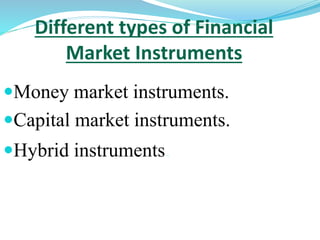
Different types of Financial
Market Instruments
Money market instruments.
Capital market instruments.
Hybrid instruments.
Money Market
The money market can be defined as a market for
short-term money and financial assets that are near
substitutes for money.
The term short-term means generally a period upto
one year and near substitutes to money is used to
denote any financial asset which can be quickly
converted into money with minimum transaction cost.
Money market instruments
1. Call/Notice Money
2. Inter-Bank Call Money Market
3. Treasury Bills
4. Commercial Papers
5. Repos
Call /Notice-Money Market
 Call/Notice money is the money borrowed or lent on
demand for a very short period. When money is borrowed
or lent for a day, it is known as Call (Overnight) Money.
 Intervening holidays and/or Sunday are excluded for this
purpose. Thus money, borrowed on a day and repaid on
the next working day, (irrespective of the number of
intervening holidays) is "Call Money".
 When money is borrowed or lent for more than a day and
up to 14 days, it is "Notice Money". No collateral security
is required to cover these transactions.
Inter-Bank Call Money Market
 A short-term money market, which allows for large
financial institutions, such as banks, mutual funds
and corporations to borrow and lend money
at interbank rates. The loans in the call money market
are very short, usually lasting no longer than a week
and are often used to help banks meet reserve
requirements.
Treasury Bills
 Treasury Bills are short term (up to one year)
borrowing instruments of the Government of
India which enable investors to park their short
term surplus funds while reducing their market
risk. They are auctioned by Reserve Bank of India
at regular intervals
 They are issued at a discount to the face value, and
on maturity the face value is paid to the holder. The
rate of discount and the corresponding issue price are
determined at each auction.
Commercial Paper
Commercial paper is a money market security issued
(sold) by large corporations to obtain funds to meet
short-term debt obligations and is backed only by an
issuing bank or company promise to pay the face
amount on the maturity date specified on the note.
Since it is not backed by collateral, only firms with
excellent credit ratings from a recognized credit rating
agency will be able to sell their commercial paper at a
reasonable price.
Repo & Reverse Repo Rate
 Repo (Repurchase ) Rate :-
This is a type of collateral lending by RBI. Here,
banks sells securities (gov. securities) to RBI with
a repurchase agreement (meaning banks will buy back
those securities at future date with extra interest).
The rate charged by RBI is known as Repo rate.
 Reverse Repo Rate :-
Reverse repo rate is the rate at which the central bank of
a country (Reserve Bank of India in case of India)
borrows money from commercial banks within the
country. It is a monetary policy instrument which can be
used to control the money supply in the country
Capital Market Instruments
The capital market generally consists of
the following long term period i.e., more than
one year period, financial instruments; In the
equity segment Equity shares, preference
shares, convertible preference shares, non-
convertible preference shares etc and in the
debt segment debentures, zero coupon bonds,
deep discount bonds etc.
An equity share, commonly referred to as
ordinary share also represents the form of
fractional or part ownership in which a shareholder,
as a fractional owner, undertakes the maximum
entrepreneurial risk associated with a business
venture. The holders of such shares are members of
the company and have voting rights
Preference shares are shares which are preferred
over common or equity shares in payment of
surplus or dividend i.e preference shareholders are
the first to get dividends in case the company
decides to pay out dividends. Owners of preference
shares gets fixed dividend. However, in the event of
liquidation of the company they are paid after
bond holders and creditors, but before equity
holders.
A debenture is one of the capital market
instruments which is used to raise medium or
long term funds from public. A debenture is
essentially a debt instrument that acknowledges a
loan to the company and is executed under the
common seal of the company.
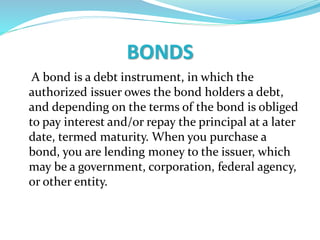
BONDS
A bond is a debt instrument, in which the
authorized issuer owes the bond holders a debt,
and depending on the terms of the bond is obliged
to pay interest and/or repay the principal at a later
date, termed maturity. When you purchase a
bond, you are lending money to the issuer, which
may be a government, corporation, federal agency,
or other entity.
Hybrid Instruments
Hybrid instruments have both the features of
equity and debenture. This kind of instruments is
called as hybrid instruments. Examples are
convertible debentures, warrants etc.
This type of security is an issuance of debt that can be
converted to a company's common stock at any given
time. So, it is kind of like a call option.
reforms in financial instruments

reforms in financial instruments

  • 1.
  • 2.
    Different types ofFinancial Market Instruments Money market instruments. Capital market instruments. Hybrid instruments.
  • 3.
    Money Market The moneymarket can be defined as a market for short-term money and financial assets that are near substitutes for money. The term short-term means generally a period upto one year and near substitutes to money is used to denote any financial asset which can be quickly converted into money with minimum transaction cost.
  • 4.
    Money market instruments 1.Call/Notice Money 2. Inter-Bank Call Money Market 3. Treasury Bills 4. Commercial Papers 5. Repos
  • 5.
    Call /Notice-Money Market Call/Notice money is the money borrowed or lent on demand for a very short period. When money is borrowed or lent for a day, it is known as Call (Overnight) Money.  Intervening holidays and/or Sunday are excluded for this purpose. Thus money, borrowed on a day and repaid on the next working day, (irrespective of the number of intervening holidays) is "Call Money".  When money is borrowed or lent for more than a day and up to 14 days, it is "Notice Money". No collateral security is required to cover these transactions.
  • 6.
    Inter-Bank Call MoneyMarket  A short-term money market, which allows for large financial institutions, such as banks, mutual funds and corporations to borrow and lend money at interbank rates. The loans in the call money market are very short, usually lasting no longer than a week and are often used to help banks meet reserve requirements.
  • 7.
    Treasury Bills  TreasuryBills are short term (up to one year) borrowing instruments of the Government of India which enable investors to park their short term surplus funds while reducing their market risk. They are auctioned by Reserve Bank of India at regular intervals  They are issued at a discount to the face value, and on maturity the face value is paid to the holder. The rate of discount and the corresponding issue price are determined at each auction.
  • 8.
    Commercial Paper Commercial paperis a money market security issued (sold) by large corporations to obtain funds to meet short-term debt obligations and is backed only by an issuing bank or company promise to pay the face amount on the maturity date specified on the note. Since it is not backed by collateral, only firms with excellent credit ratings from a recognized credit rating agency will be able to sell their commercial paper at a reasonable price.
  • 9.
    Repo & ReverseRepo Rate  Repo (Repurchase ) Rate :- This is a type of collateral lending by RBI. Here, banks sells securities (gov. securities) to RBI with a repurchase agreement (meaning banks will buy back those securities at future date with extra interest). The rate charged by RBI is known as Repo rate.  Reverse Repo Rate :- Reverse repo rate is the rate at which the central bank of a country (Reserve Bank of India in case of India) borrows money from commercial banks within the country. It is a monetary policy instrument which can be used to control the money supply in the country
  • 10.
    Capital Market Instruments Thecapital market generally consists of the following long term period i.e., more than one year period, financial instruments; In the equity segment Equity shares, preference shares, convertible preference shares, non- convertible preference shares etc and in the debt segment debentures, zero coupon bonds, deep discount bonds etc.
  • 12.
    An equity share,commonly referred to as ordinary share also represents the form of fractional or part ownership in which a shareholder, as a fractional owner, undertakes the maximum entrepreneurial risk associated with a business venture. The holders of such shares are members of the company and have voting rights
  • 13.
    Preference shares areshares which are preferred over common or equity shares in payment of surplus or dividend i.e preference shareholders are the first to get dividends in case the company decides to pay out dividends. Owners of preference shares gets fixed dividend. However, in the event of liquidation of the company they are paid after bond holders and creditors, but before equity holders.
  • 14.
    A debenture isone of the capital market instruments which is used to raise medium or long term funds from public. A debenture is essentially a debt instrument that acknowledges a loan to the company and is executed under the common seal of the company.
  • 15.
    BONDS A bond isa debt instrument, in which the authorized issuer owes the bond holders a debt, and depending on the terms of the bond is obliged to pay interest and/or repay the principal at a later date, termed maturity. When you purchase a bond, you are lending money to the issuer, which may be a government, corporation, federal agency, or other entity.
  • 16.
    Hybrid Instruments Hybrid instrumentshave both the features of equity and debenture. This kind of instruments is called as hybrid instruments. Examples are convertible debentures, warrants etc. This type of security is an issuance of debt that can be converted to a company's common stock at any given time. So, it is kind of like a call option.