Yanti Andriyani
Dr. Rashina Hoda
Prof. Robert Amor
1
@YA_Andriyani
2
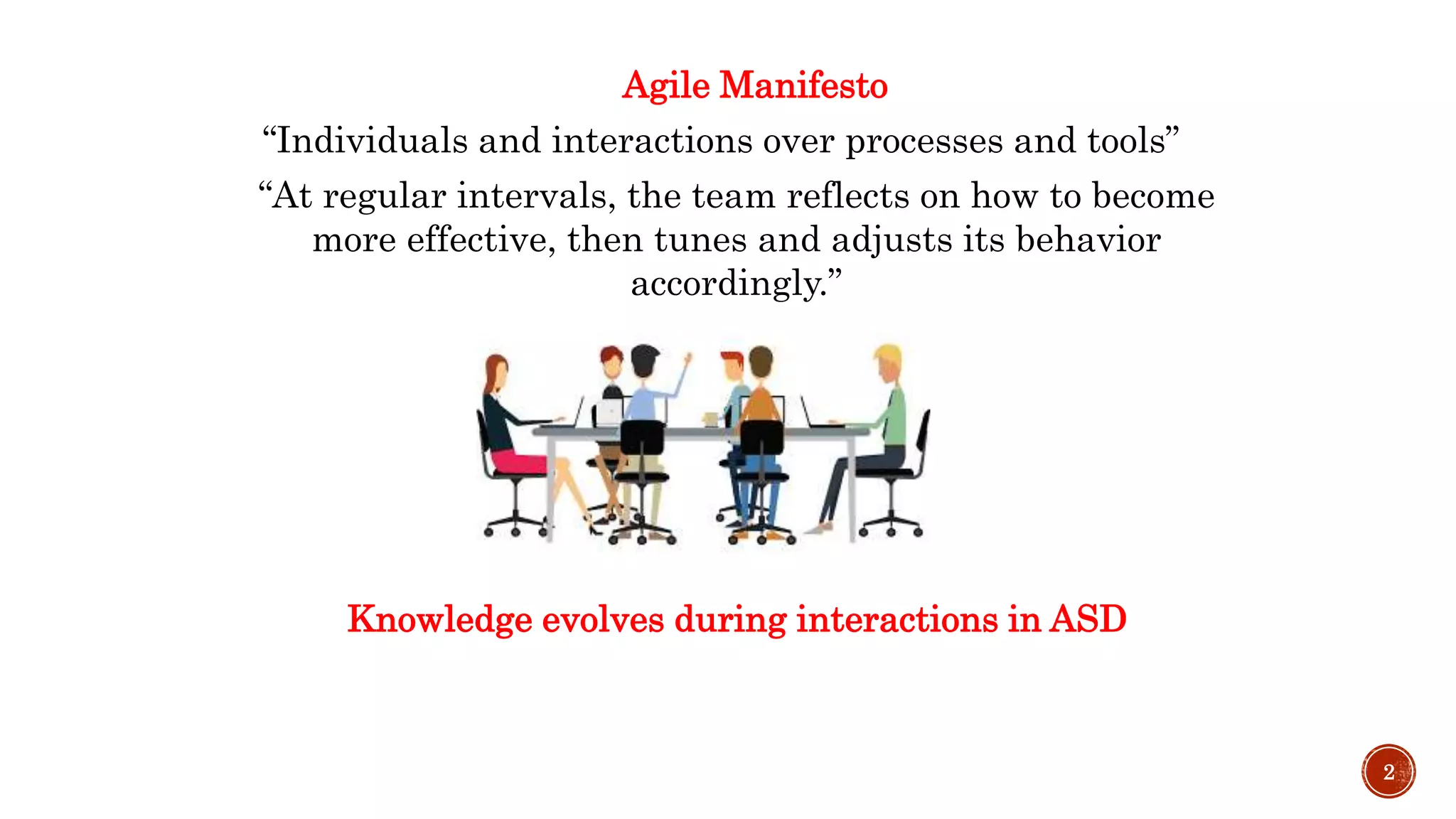
“Individuals and interactions over processes and tools”
“At regular intervals, the team reflects on how to become
more effective, then tunes and adjusts its behavior
accordingly.”
Agile Manifesto
Knowledge evolves during interactions in ASD
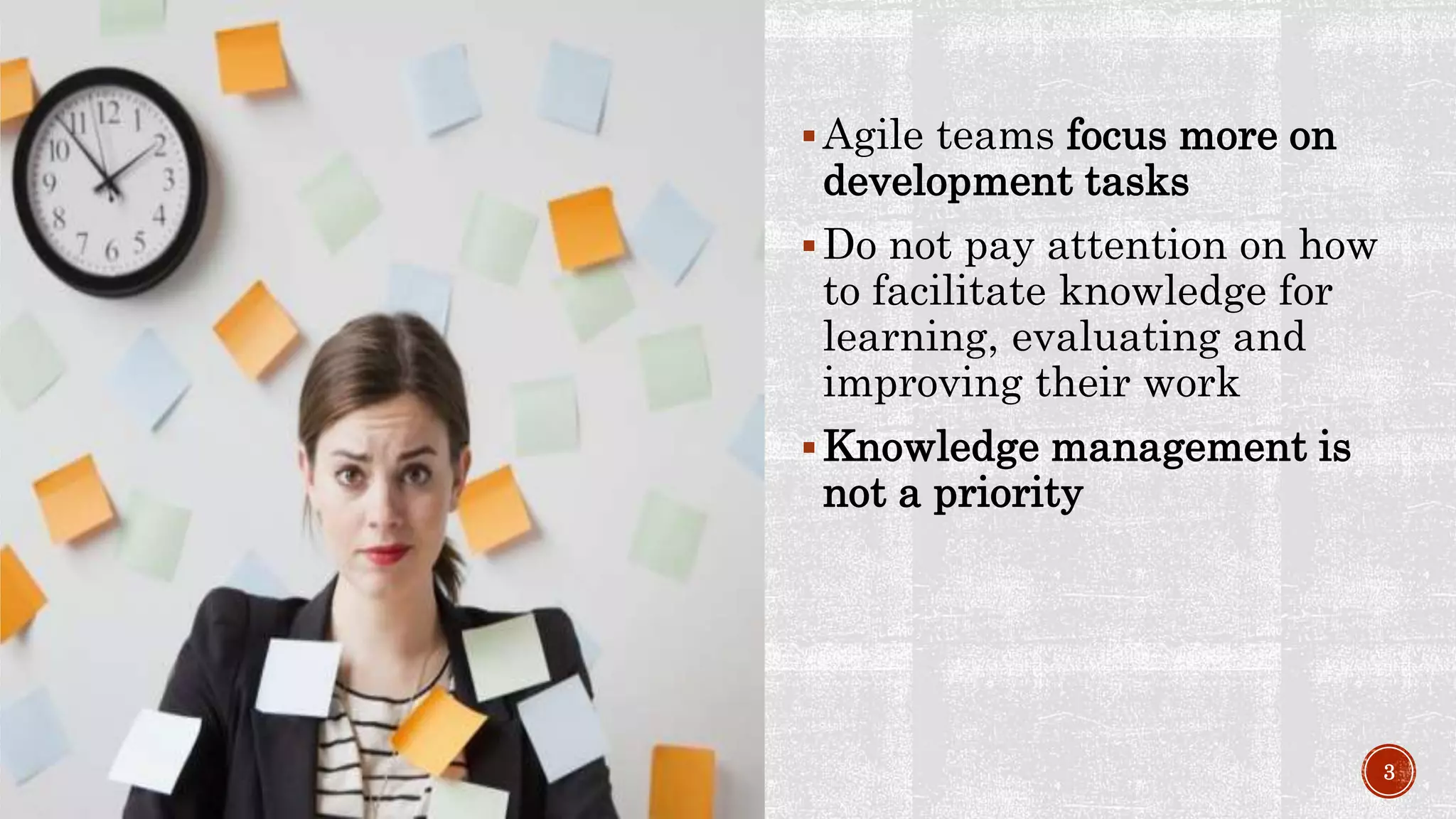
Agile teams focus more on
development tasks
Do not pay attention on how
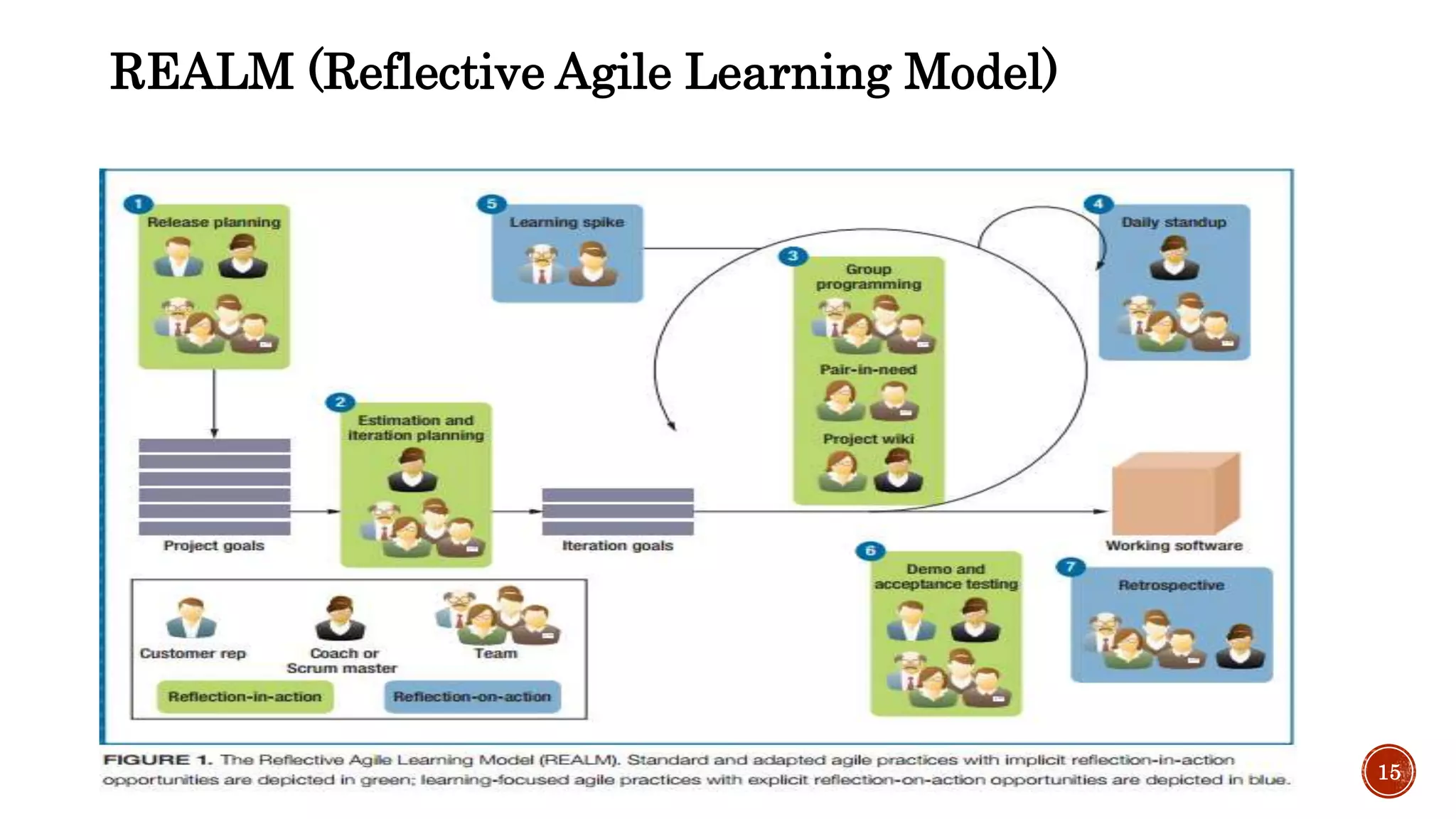
to facilitate knowledge for
learning, evaluating and
improving their work
Knowledge management is
not a priority
3
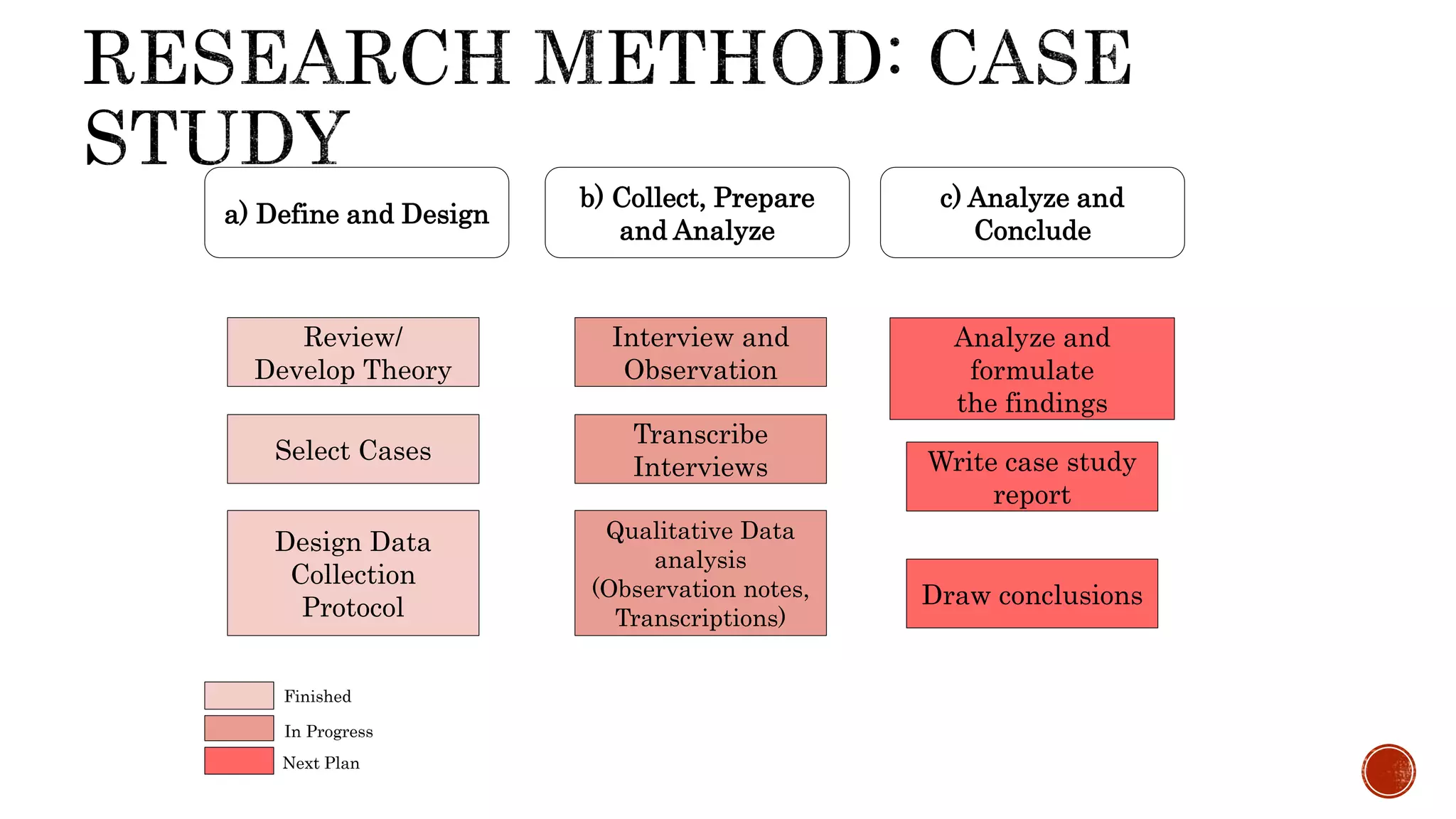
a) Define and Design
c) Analyze and
Conclude
b) Collect, Prepare
and Analyze
Review/
Develop Theory
Select Cases
Design Data
Collection
Protocol
Interview and
Observation
Transcribe
Interviews
Qualitative Data
analysis
(Observation notes,
Transcriptions)
Analyze and
formulate
the findings
Write case study
report
Draw conclusions
Finished
In Progress
Next Plan
4
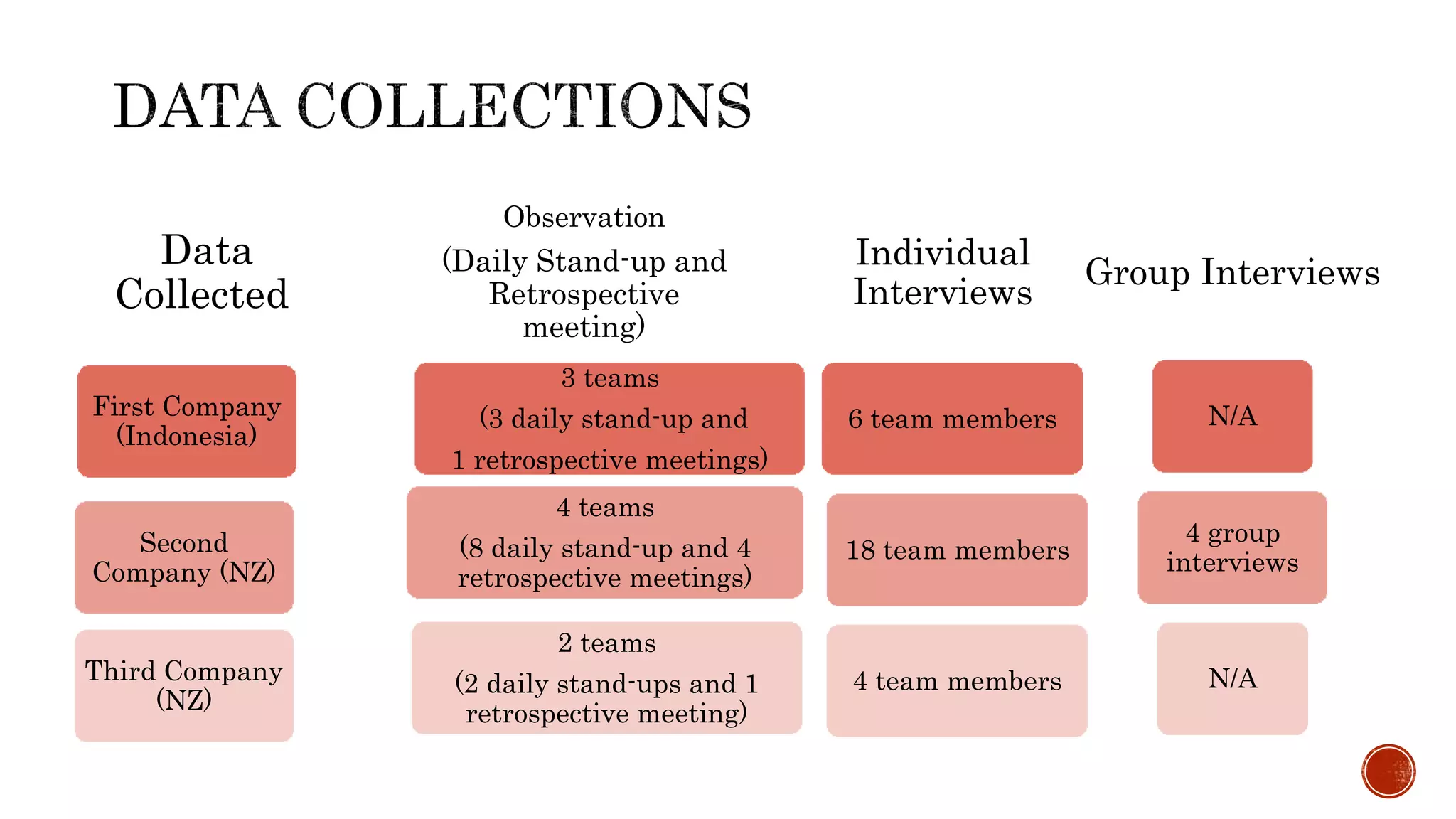
Data
Collected
First Company
(Indonesia)
Second
Company (NZ)
Third Company
(NZ)
Observation
(Daily Stand-up and
Retrospective
meeting)
3 teams
(3 daily stand-up and
1 retrospective meetings)
4 teams
(8 daily stand-up and 4
retrospective meetings)
2 teams
(2 daily stand-ups and 1
retrospective meeting)
Individual
Interviews
6 team members
18 team members
4 team members
Group Interviews
N/A
4 group
interviews
N/A
5
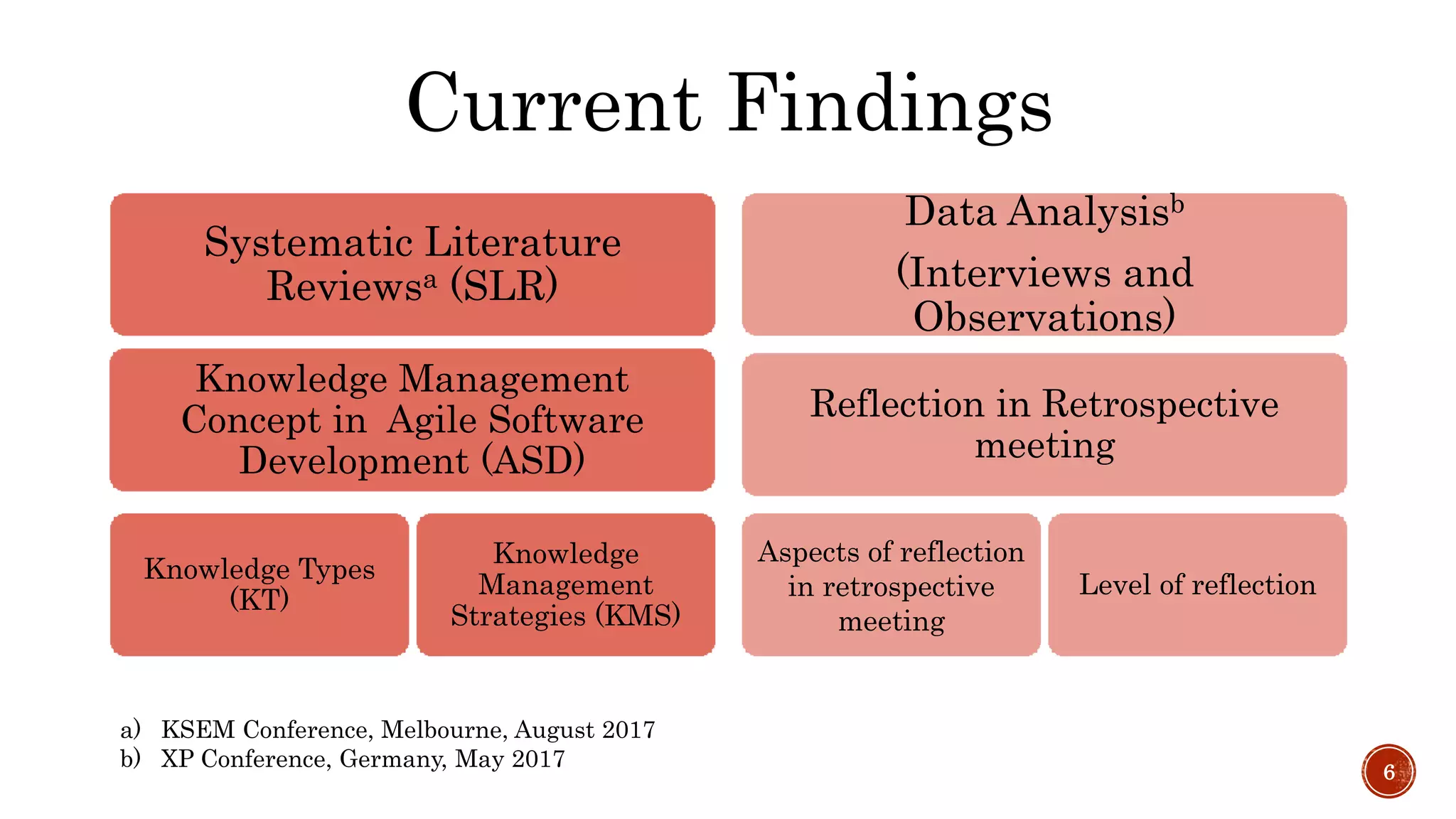
Current Findings
Systematic Literature
Reviewsa (SLR)
Knowledge Management
Concept in Agile Software
Development (ASD)
Knowledge Types
(KT)
Knowledge
Management
Strategies (KMS)
Data Analysisb
(Interviews and
Observations)
Reflection in Retrospective
meeting
Aspects of reflection
in retrospective
meeting
Level of reflection
a) KSEM Conference, Melbourne, August 2017
b) XP Conference, Germany, May 2017
6
[7] Ebert, C., & De Man, J. (2008). Effectively utilizing project, product and process knowledge. Information and
Software Technology , 50.6, 579-594.
7
Knowledge Types [7]
Product
Knowledge
Product features
Design
Requirements
Project
Knowledge
Timeline
Progress
Impediments
Estimation
Process
Knowledge
System flows
Coding flows
Synchronize
teamwork
Improvement
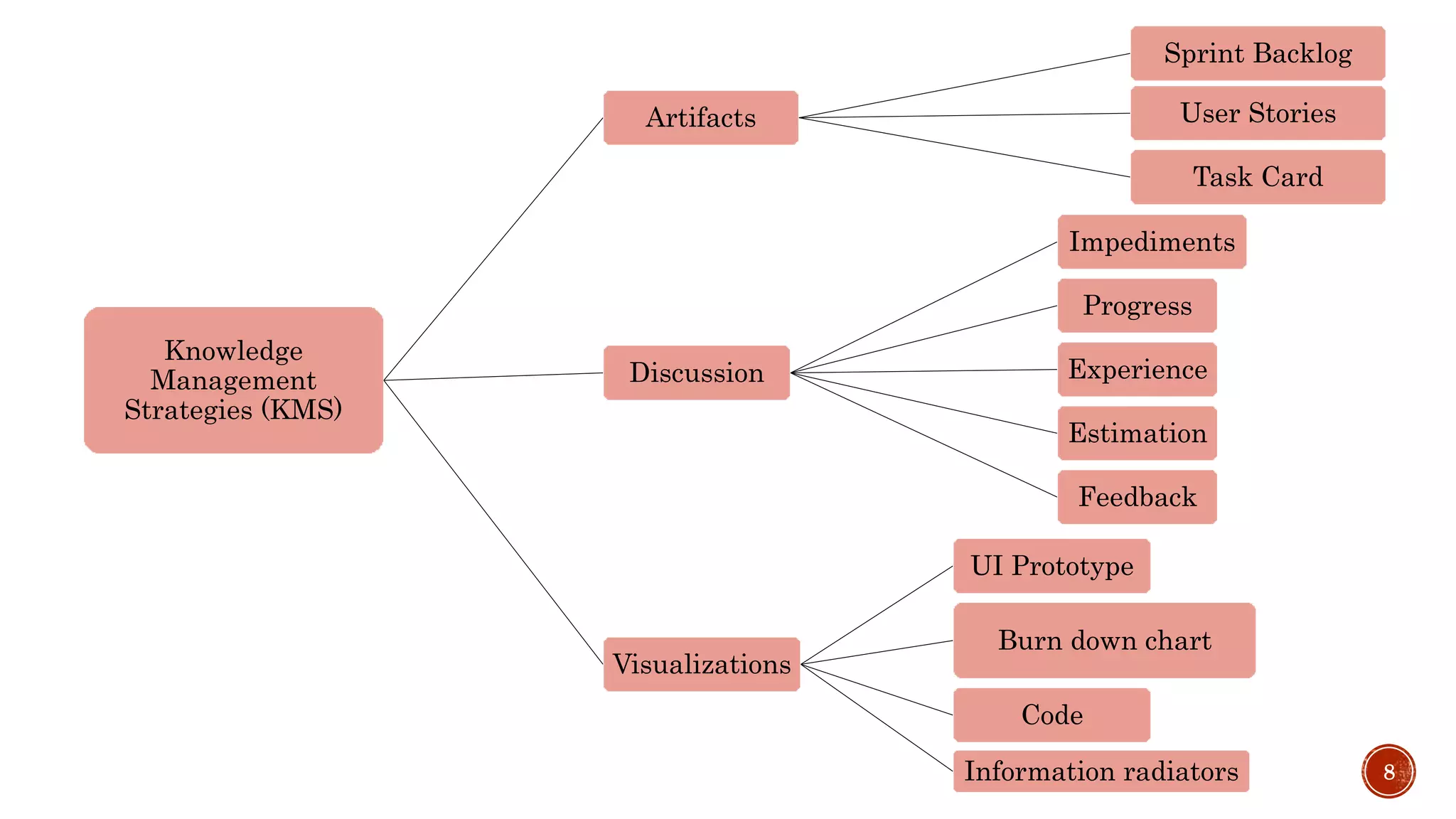
Knowledge
Management
Strategies (KMS)
Artifacts
Sprint Backlog
User Stories
Task Card
Discussion
Impediments
Progress
Experience
Estimation
Feedback
Visualizations
UI Prototype
Burn down chart
Code
Information radiators 8
9
9
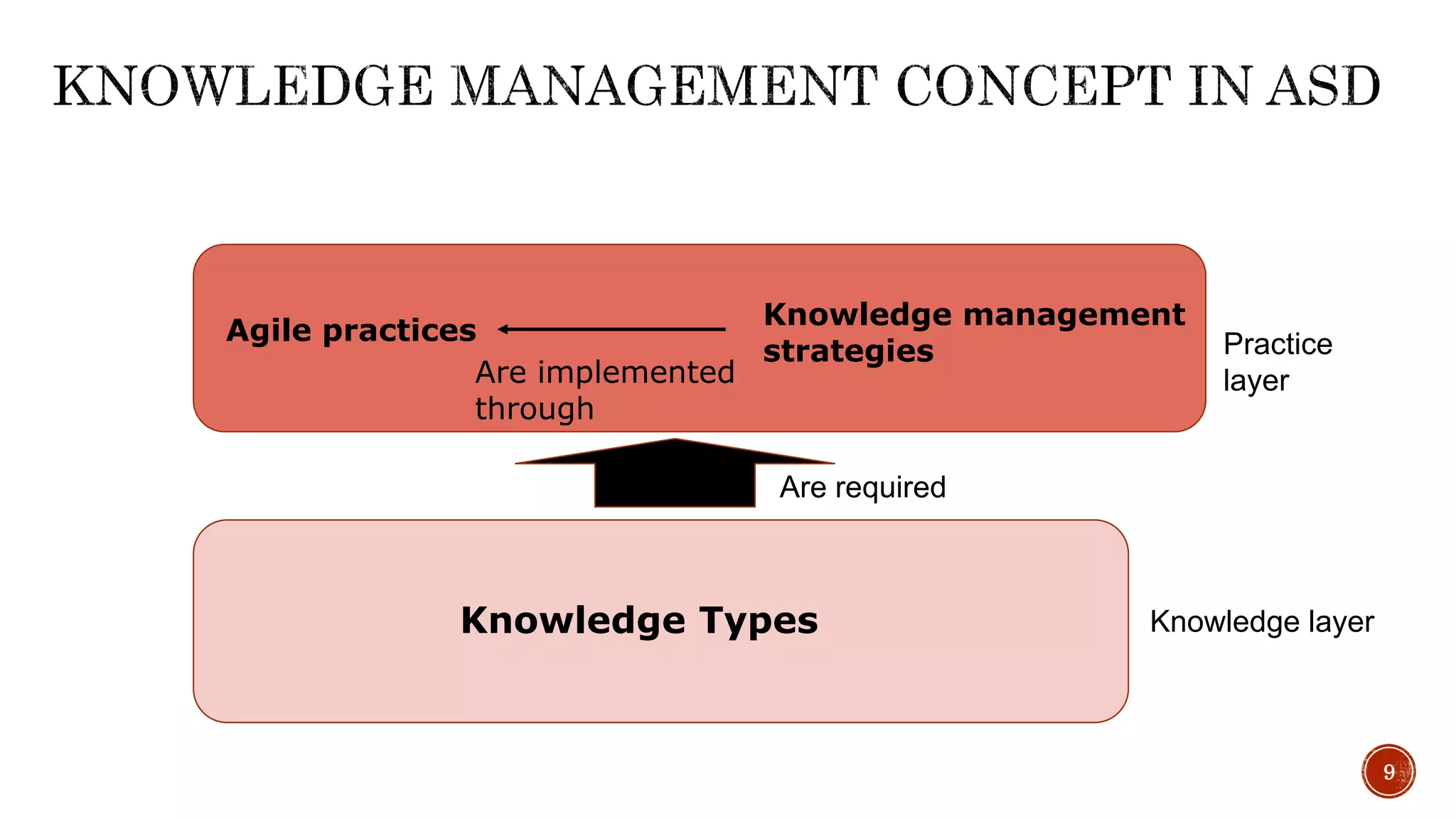
Knowledge Types
Agile practices
Knowledge management
strategies
Are implemented
through
Knowledge layer
Practice
layer
Are required
10
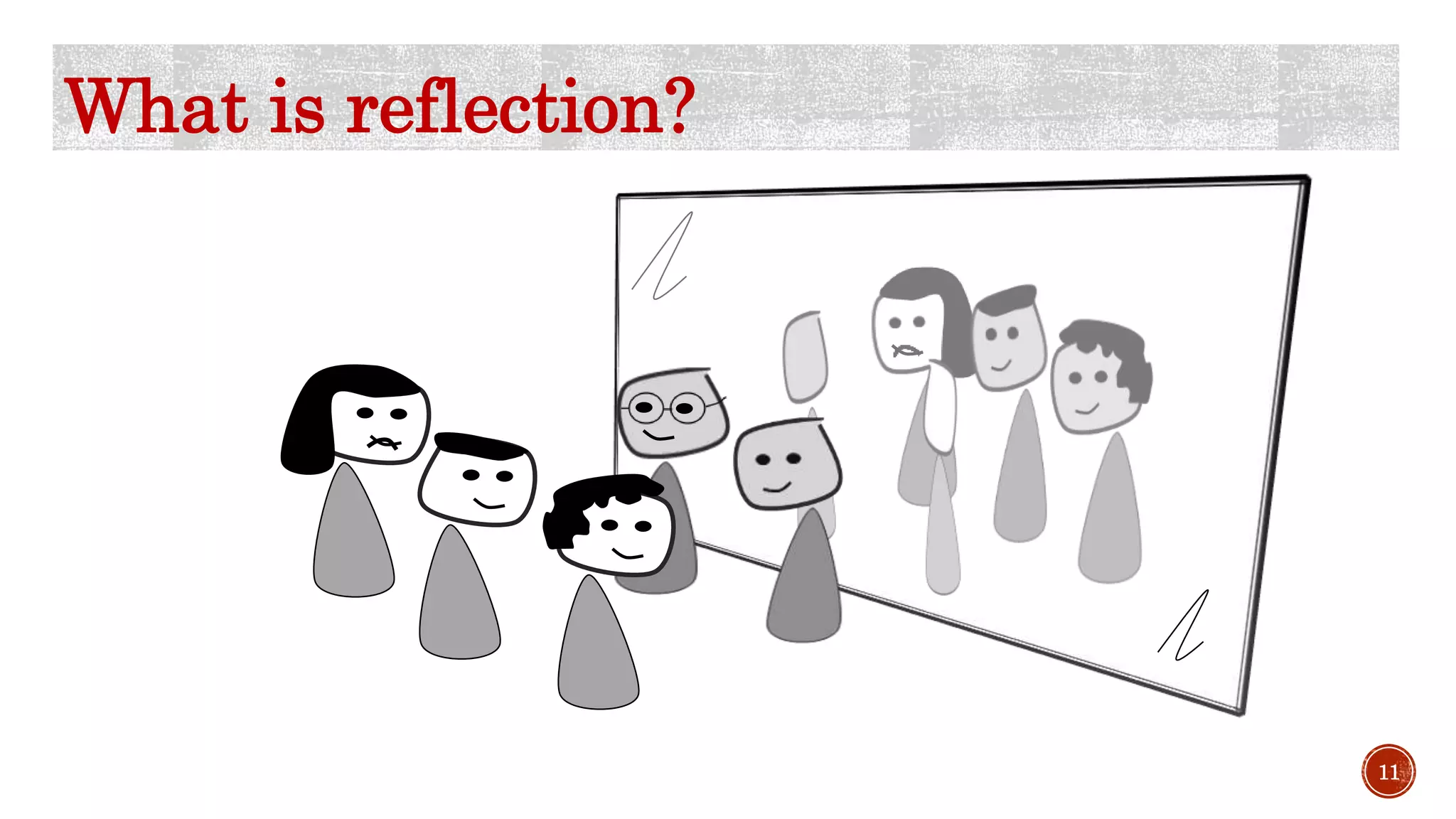
What is reflection?
11
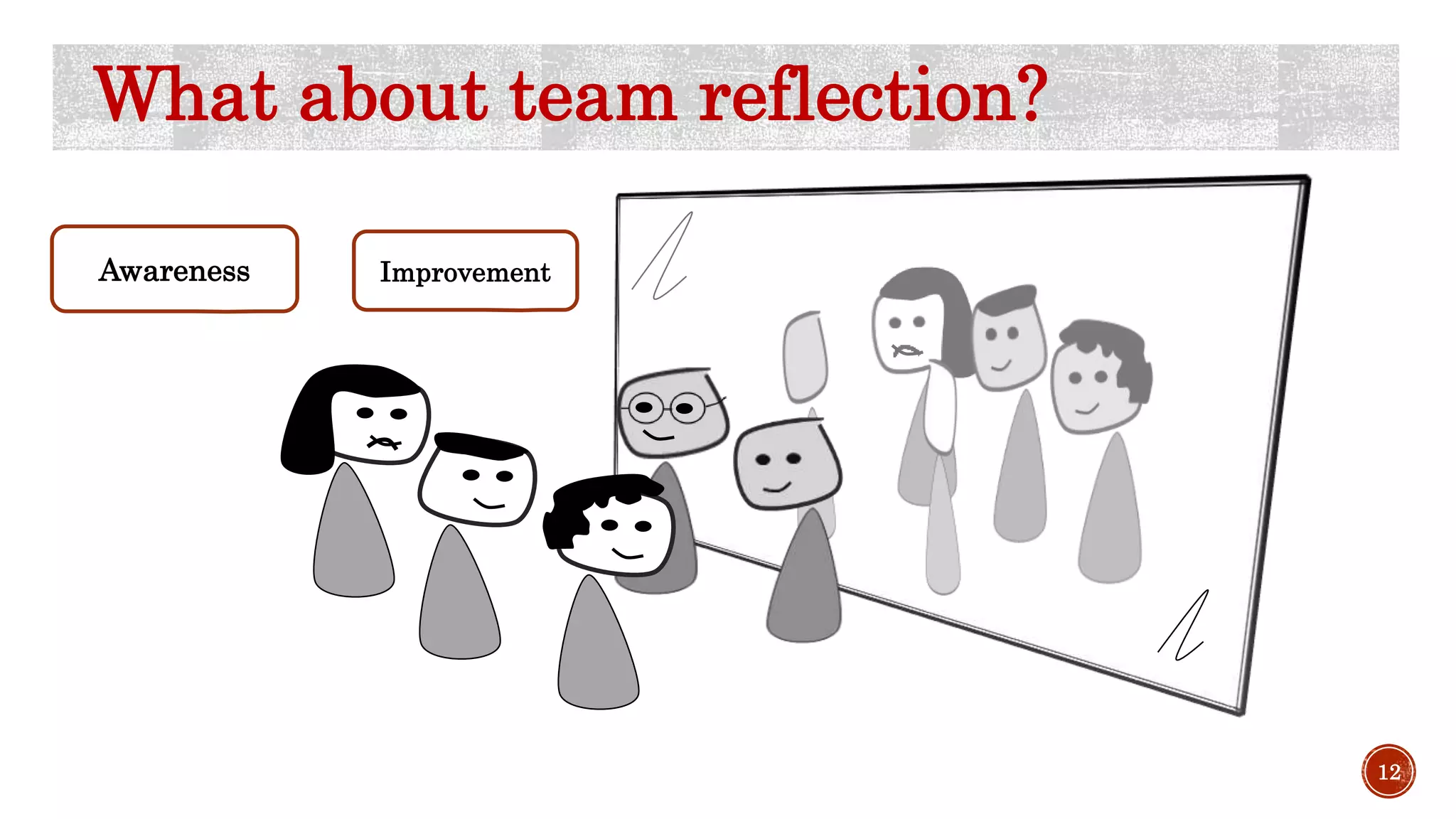
What about team reflection?
Awareness Improvement
12
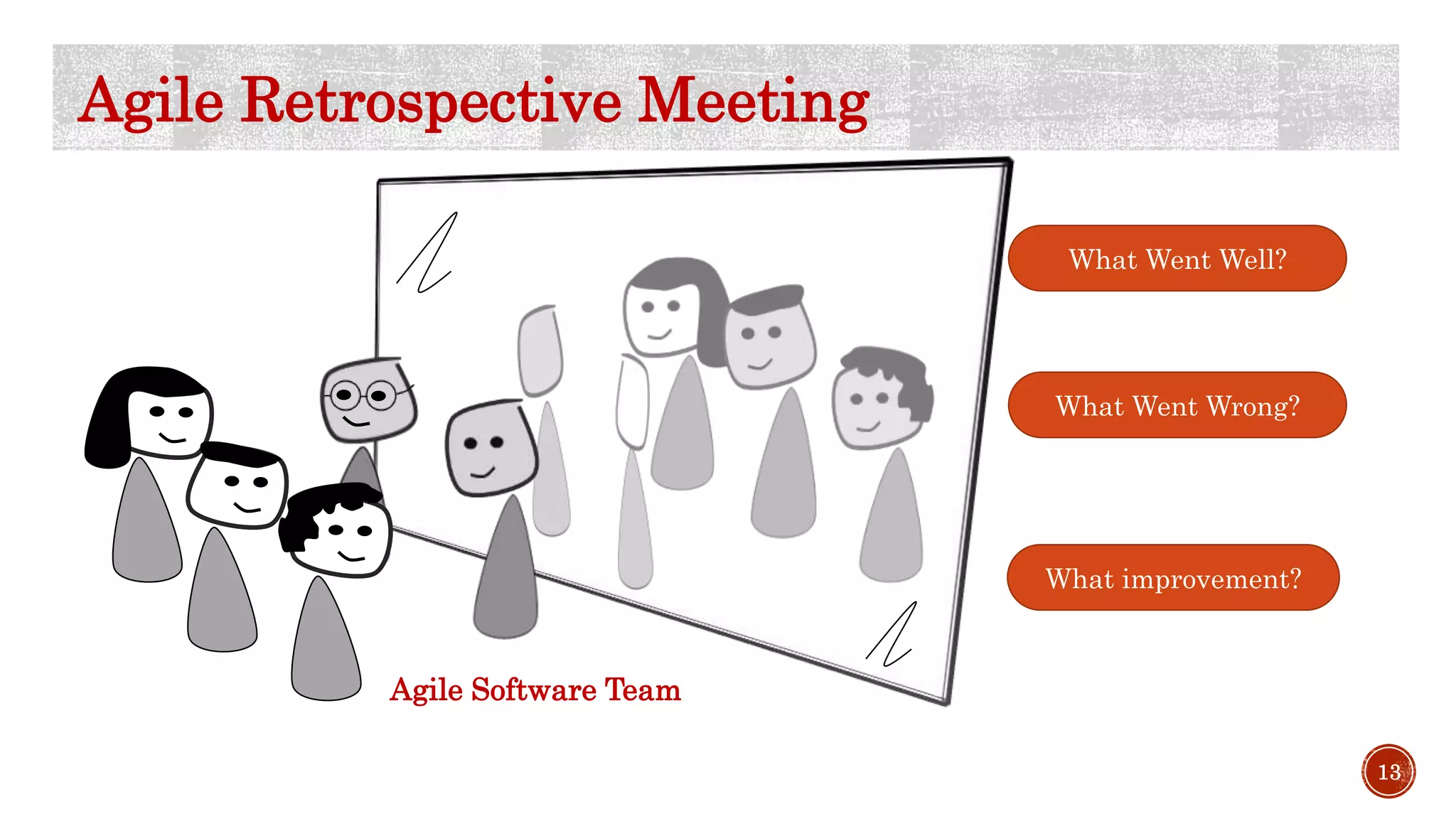
Agile Retrospective Meeting
Agile Software Team
What Went Well?
What Went Wrong?
What improvement?
13
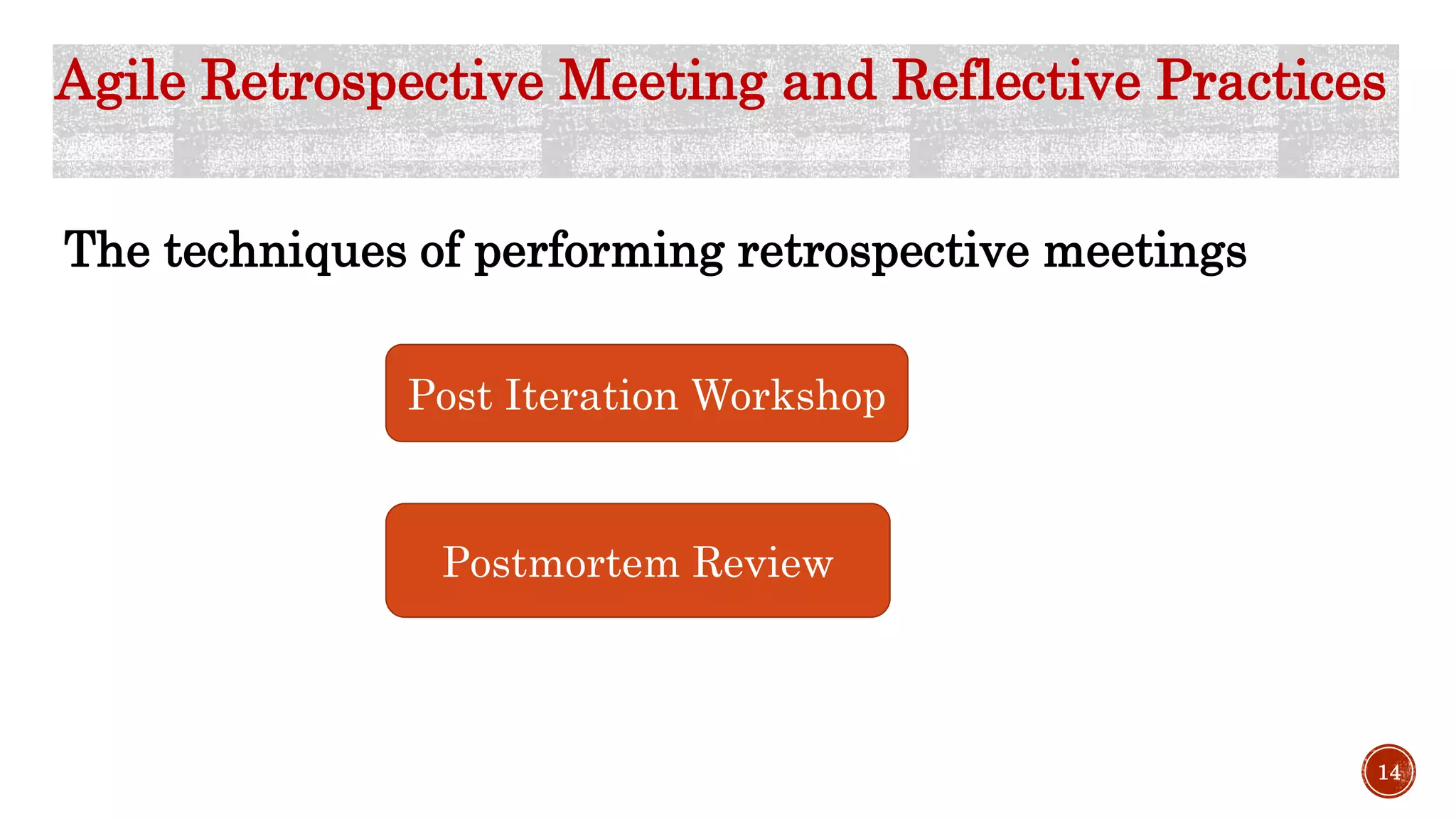
Agile Retrospective Meeting and Reflective Practices
The techniques of performing retrospective meetings
Post Iteration Workshop
Postmortem Review
14
15
REALM (Reflective Agile Learning Model)
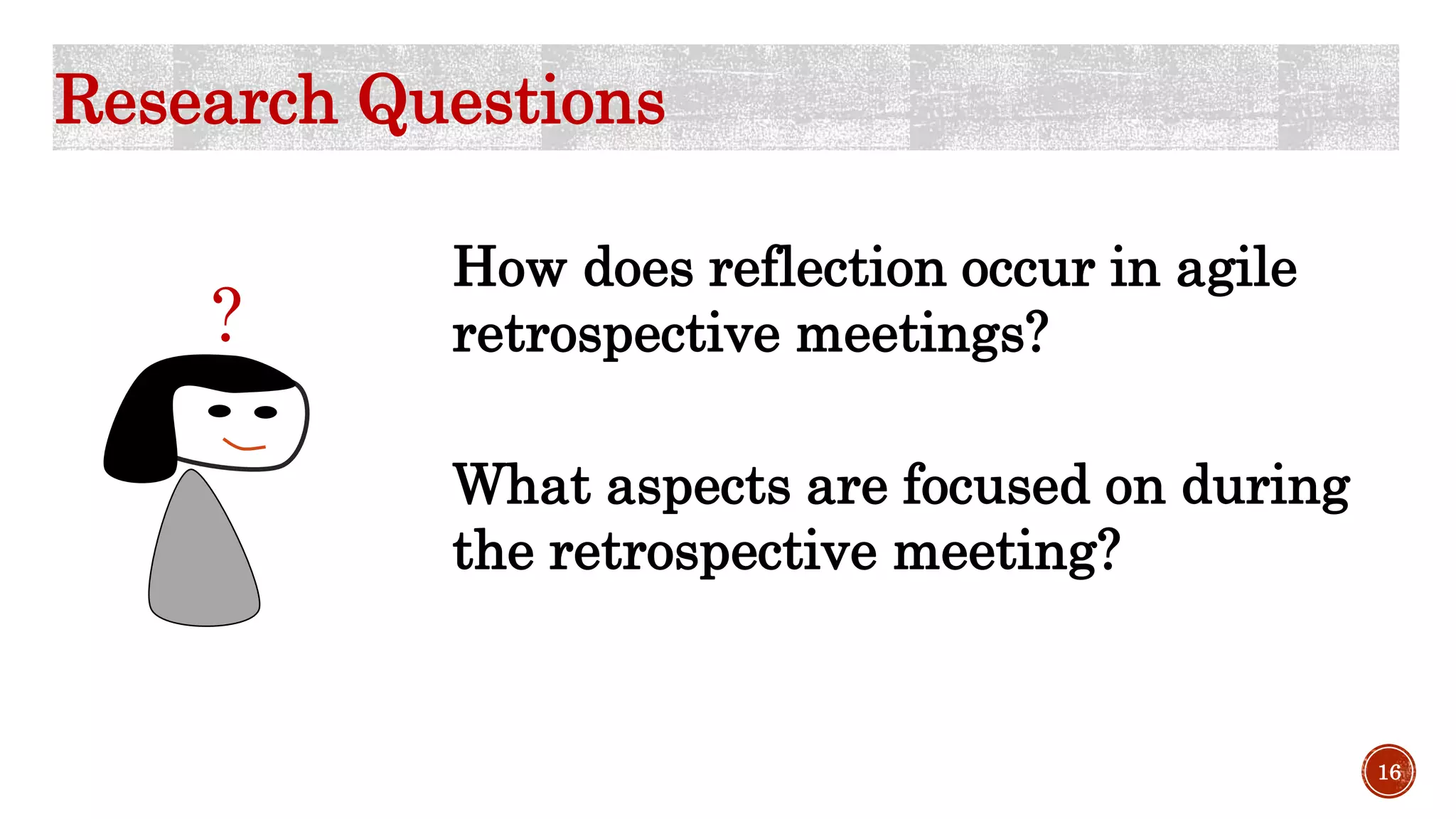
How does reflection occur in agile
retrospective meetings?
What aspects are focused on during
the retrospective meeting?
Research Questions
?
16
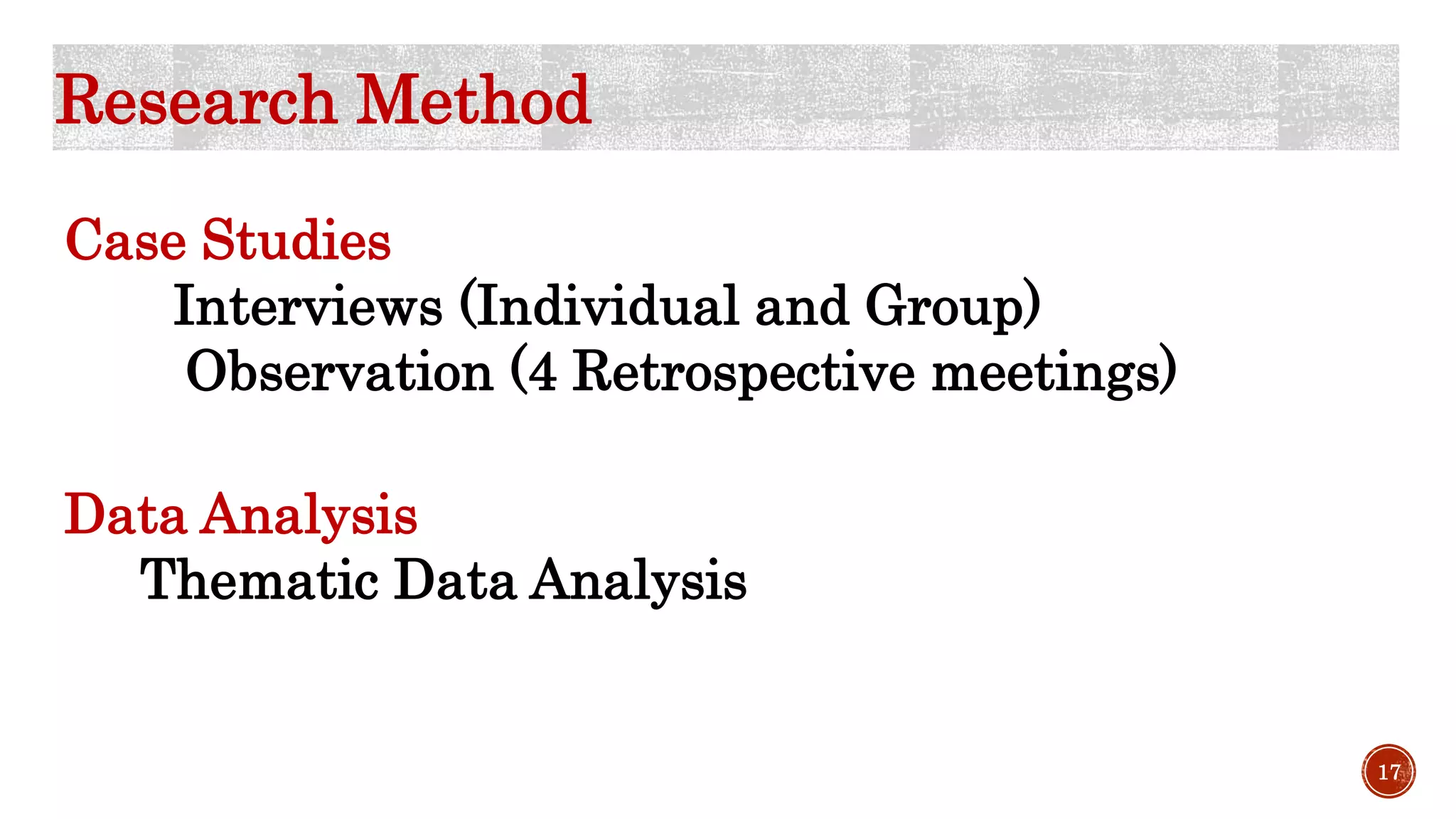
Research Method
Case Studies
Interviews (Individual and Group)
Observation (4 Retrospective meetings)
Data Analysis
Thematic Data Analysis
17
18
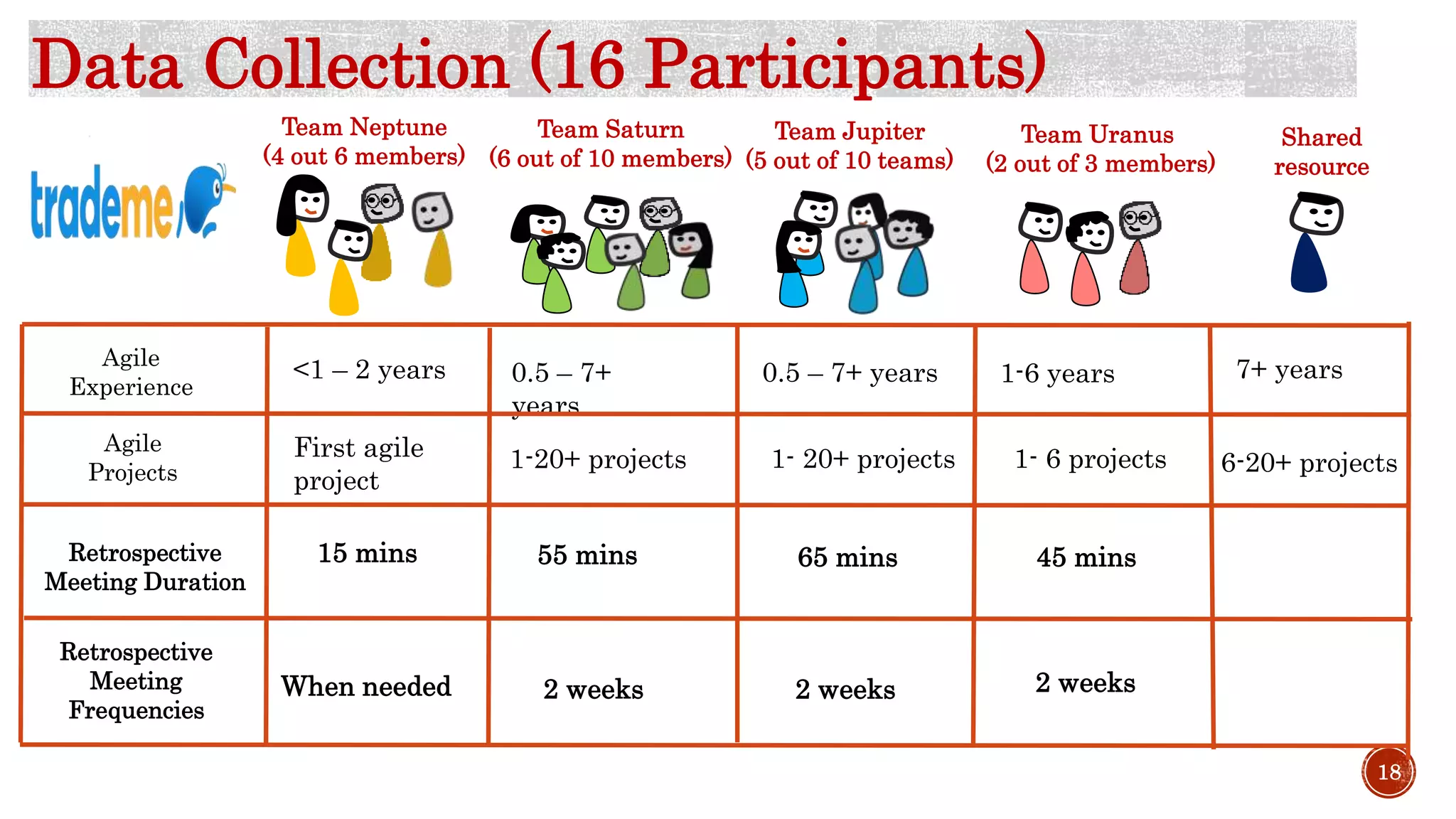
Data Collection (16 Participants)
Team Neptune
(4 out 6 members)
Team Jupiter
(5 out of 10 teams)
Team Saturn
(6 out of 10 members)
Team Uranus
(2 out of 3 members)
Shared
resource
<1 – 2 years 0.5 – 7+
years
0.5 – 7+ years 1-6 years 7+ yearsAgile
Experience
Agile
Projects
Retrospective
Meeting Duration
Retrospective
Meeting
Frequencies
First agile
project
1-20+ projects 1- 20+ projects 1- 6 projects 6-20+ projects
15 mins
When needed
55 mins 65 mins 45 mins
2 weeks 2 weeks 2 weeks
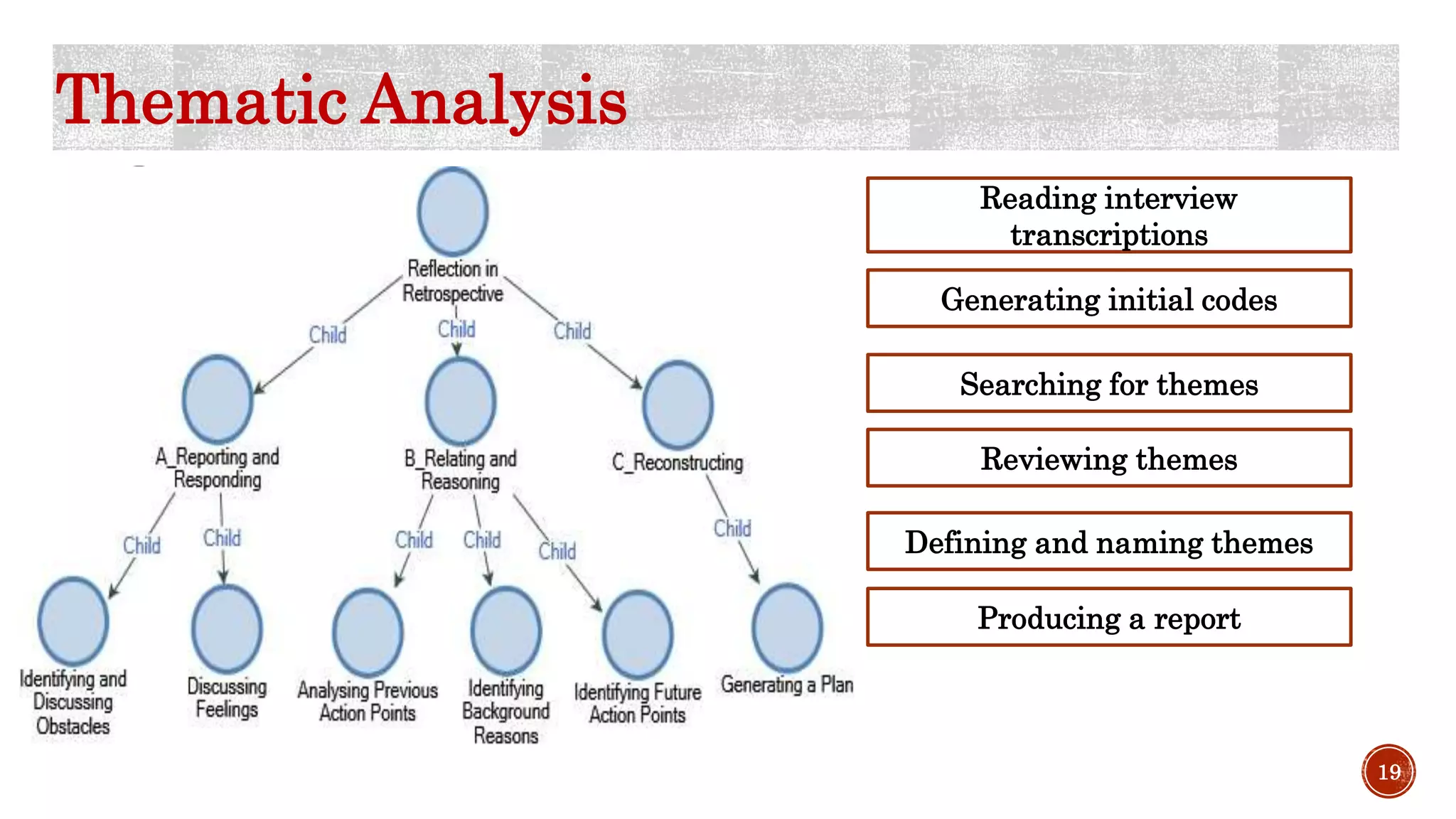
Thematic Analysis
19
Reading interview
transcriptions
Generating initial codes
---
---
-
…quite a few people were in the same situation,...”
Shared
Feelings
Searching for themes
Reviewing themes
Shared
Obstacles
(dependencies)
Generated
Action Points
Defining and naming themes
Producing a report
“I scored myself really low, I said I wasn’t very happy.
“…we have to do something within two
days and that’s kind of an interdependent
thing; like until you do it I won’t be able to
do it. “
“We usually write something down; it will be like a
series of four or five bullet points that we then try to
look at the following week. “
SharingOutcomes Reporting and
Responding
Reconstructing
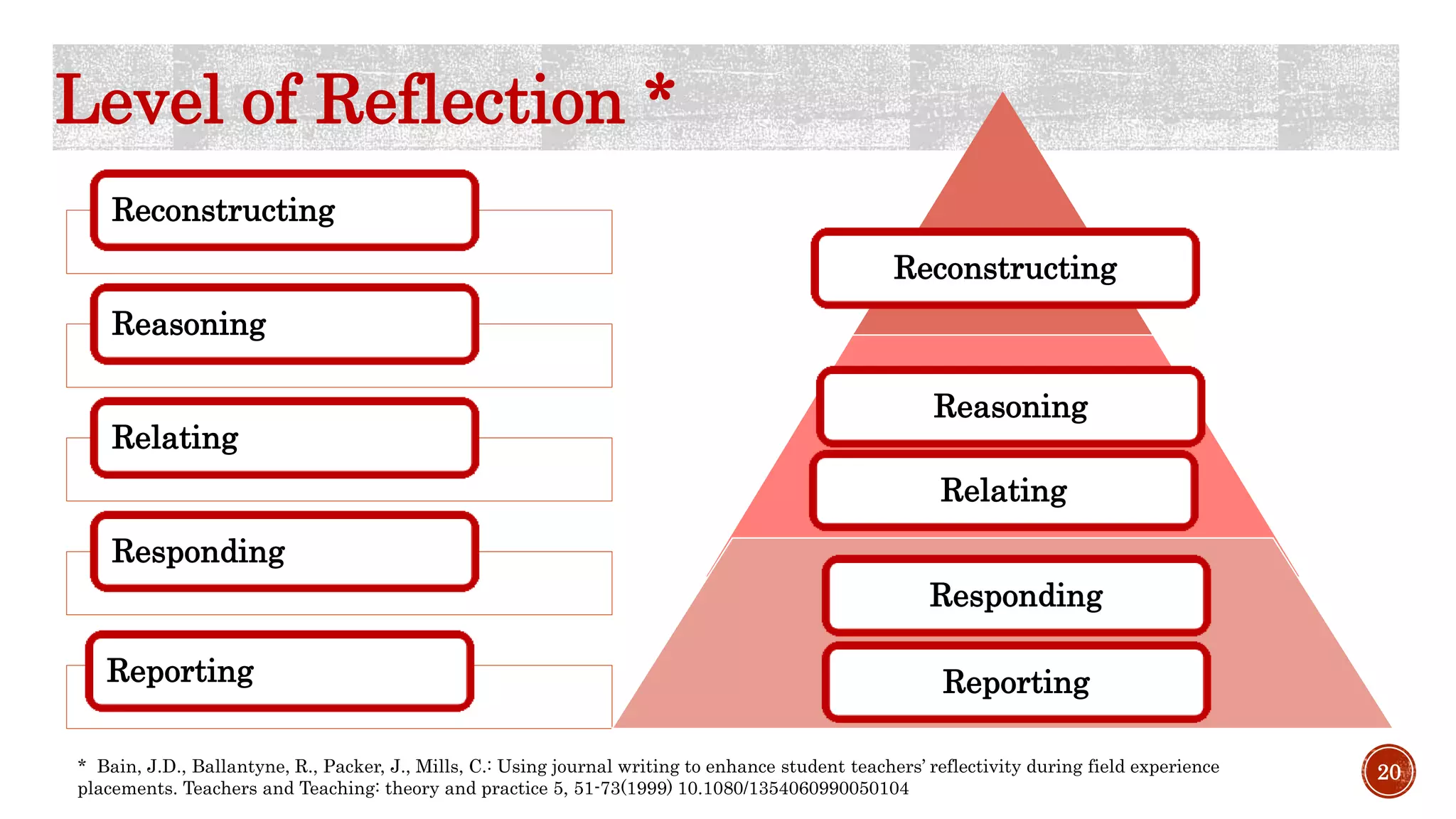
Level of Reflection *
20
Responding
Reporting
Relating
Reasoning
Reconstructing
* Bain, J.D., Ballantyne, R., Packer, J., Mills, C.: Using journal writing to enhance student teachers’ reflectivity during field experience
placements. Teachers and Teaching: theory and practice 5, 51-73(1999) 10.1080/1354060990050104
Reconstructing
Reasoning
Relating
Responding
Reporting
Dependencies related to
the aspects that hindered the team
from making progress
“If it's delayed at the first point, if something is wrong at
the first point the next person feels it. So, if one brings it
up [in the retrospective] and if it's a true concern you will
have support because it does affect people.”
P16 - Test Chapter Lead
(Across All Teams)
Identifying and Discussing
Obstacles
21
Reporting & Responding
Relating
&
Reasoning
Reconstructing
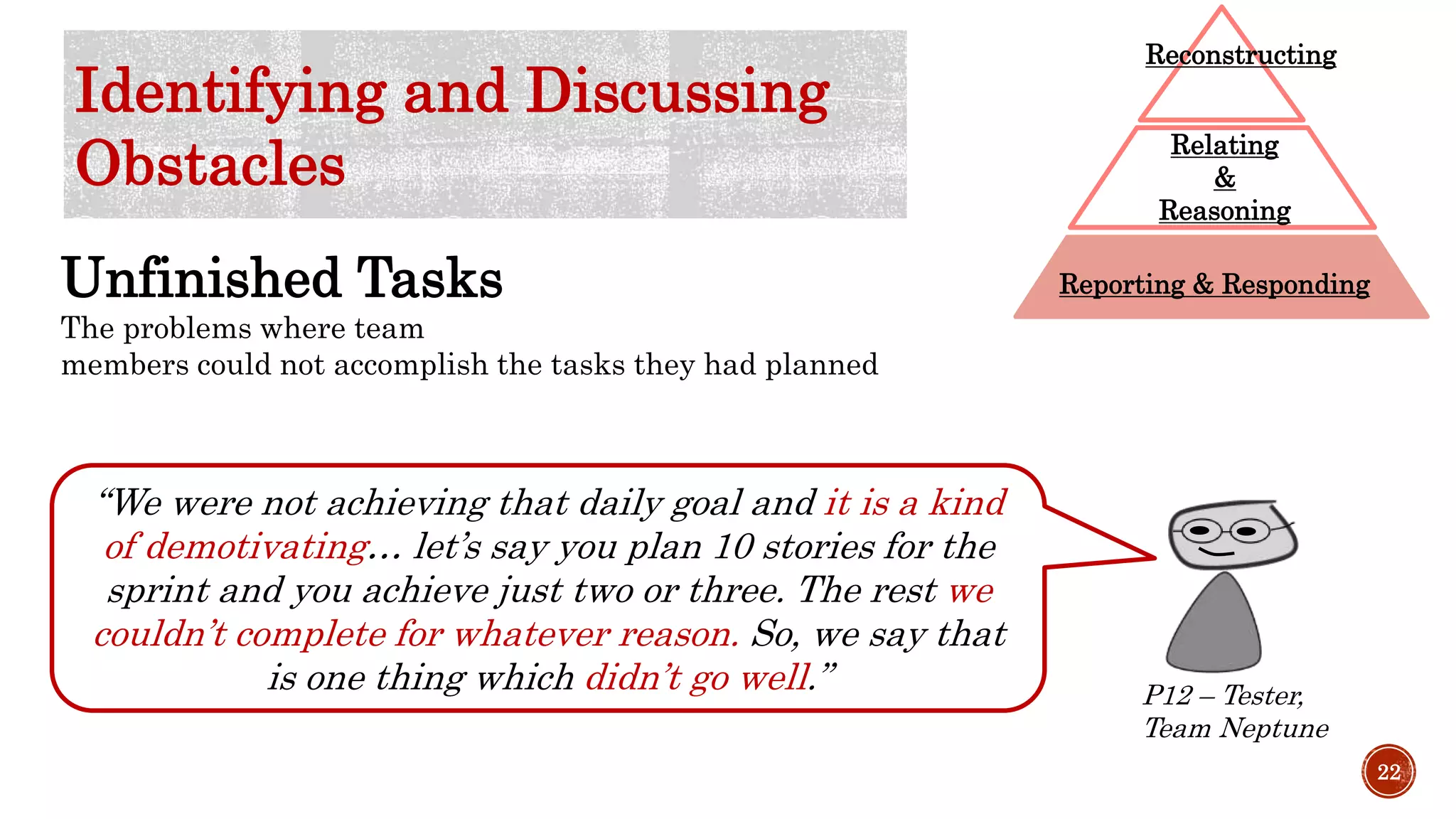
Unfinished Tasks
The problems where team
members could not accomplish the tasks they had planned
“We were not achieving that daily goal and it is a kind
of demotivating… let’s say you plan 10 stories for the
sprint and you achieve just two or three. The rest we
couldn’t complete for whatever reason. So, we say that
is one thing which didn’t go well.” P12 – Tester,
Team Neptune
22
Identifying and Discussing
Obstacles
Reporting & Responding
Relating
&
Reasoning
Reconstructing
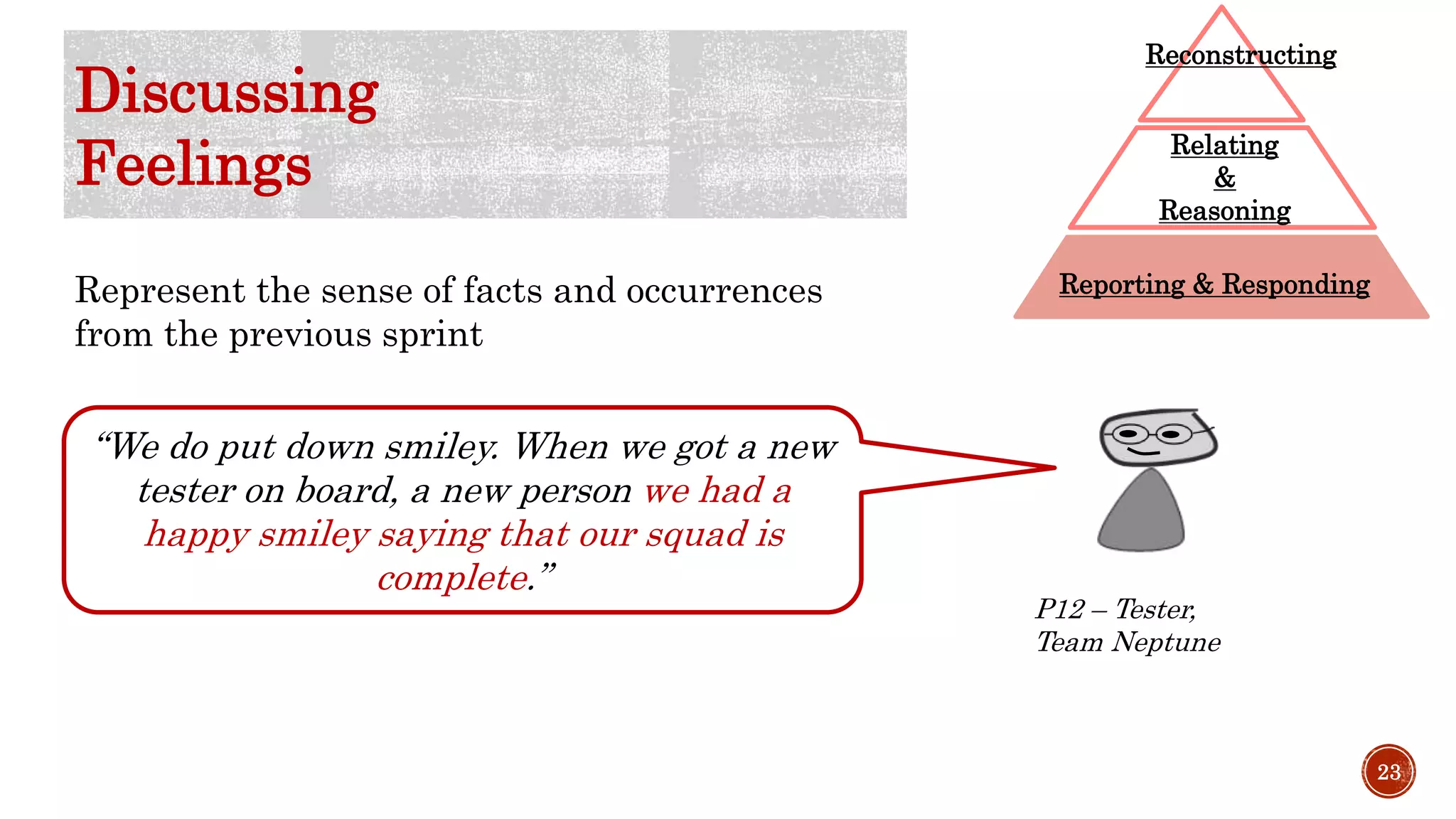
“We do put down smiley. When we got a new
tester on board, a new person we had a
happy smiley saying that our squad is
complete.”
P12 – Tester,
Team Neptune
23
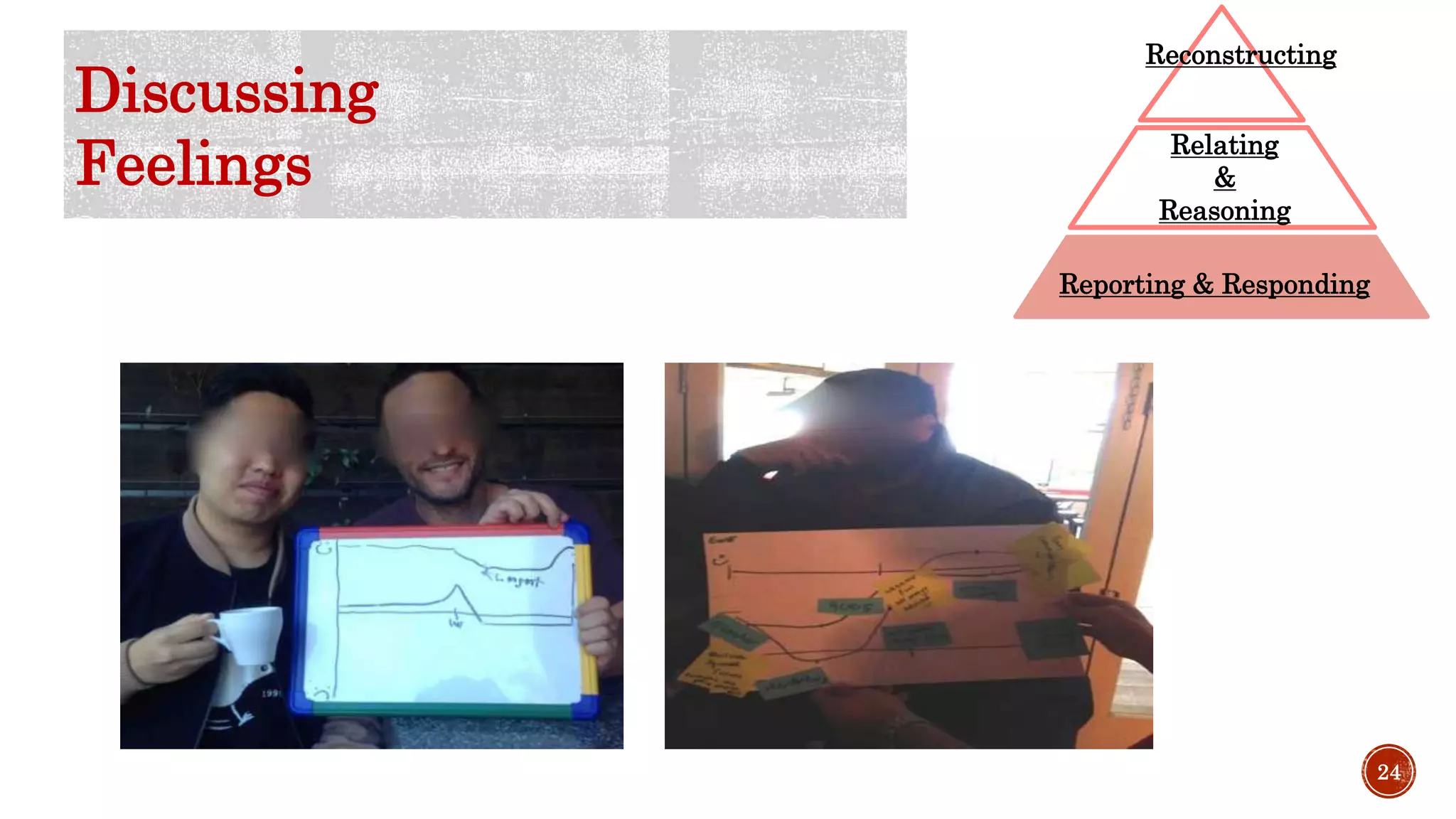
Discussing
Feelings
Reporting & Responding
Relating
&
Reasoning
Reconstructing
Represent the sense of facts and occurrences
from the previous sprint
24
Discussing
Feelings
Reporting & Responding
Relating
&
Reasoning
Reconstructing
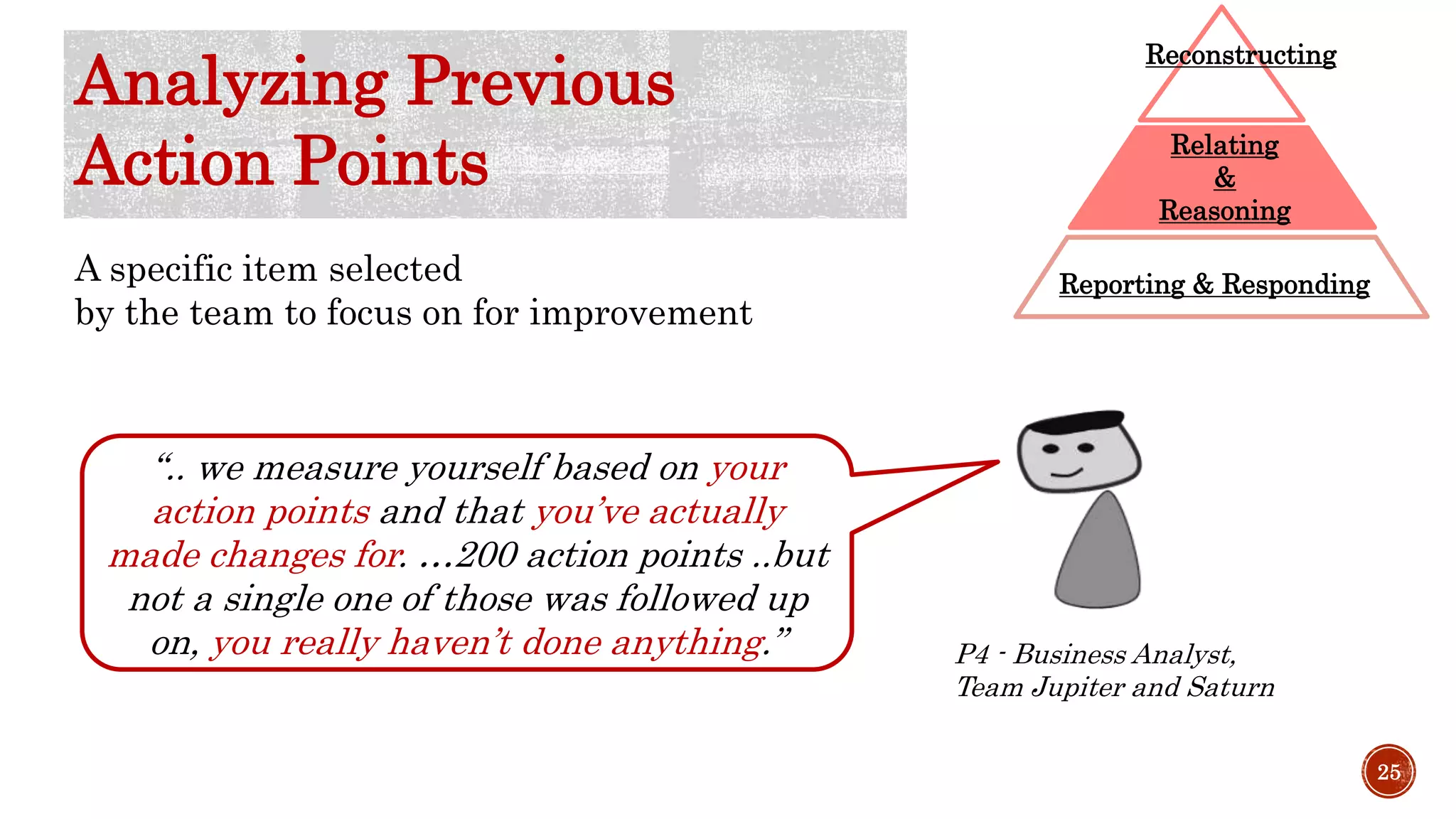
“.. we measure yourself based on your
action points and that you’ve actually
made changes for. …200 action points ..but
not a single one of those was followed up
on, you really haven’t done anything.” P4 - Business Analyst,
Team Jupiter and Saturn
25
Reporting & Responding
Relating
&
Reasoning
Reconstructing
Analyzing Previous
Action Points
A specific item selected
by the team to focus on for improvement
“I think we addressed like the major issues are
causing the squad stuck at the moment and
things like test environment and [..] dealing
with an external dependency like platform
team in [city name]”
P4 - Business Analyst,
Team Jupiter and Saturn
26
Identifying
Background Reasons
Reporting & Responding
Relating
&
Reasoning
Reconstructing
Why??
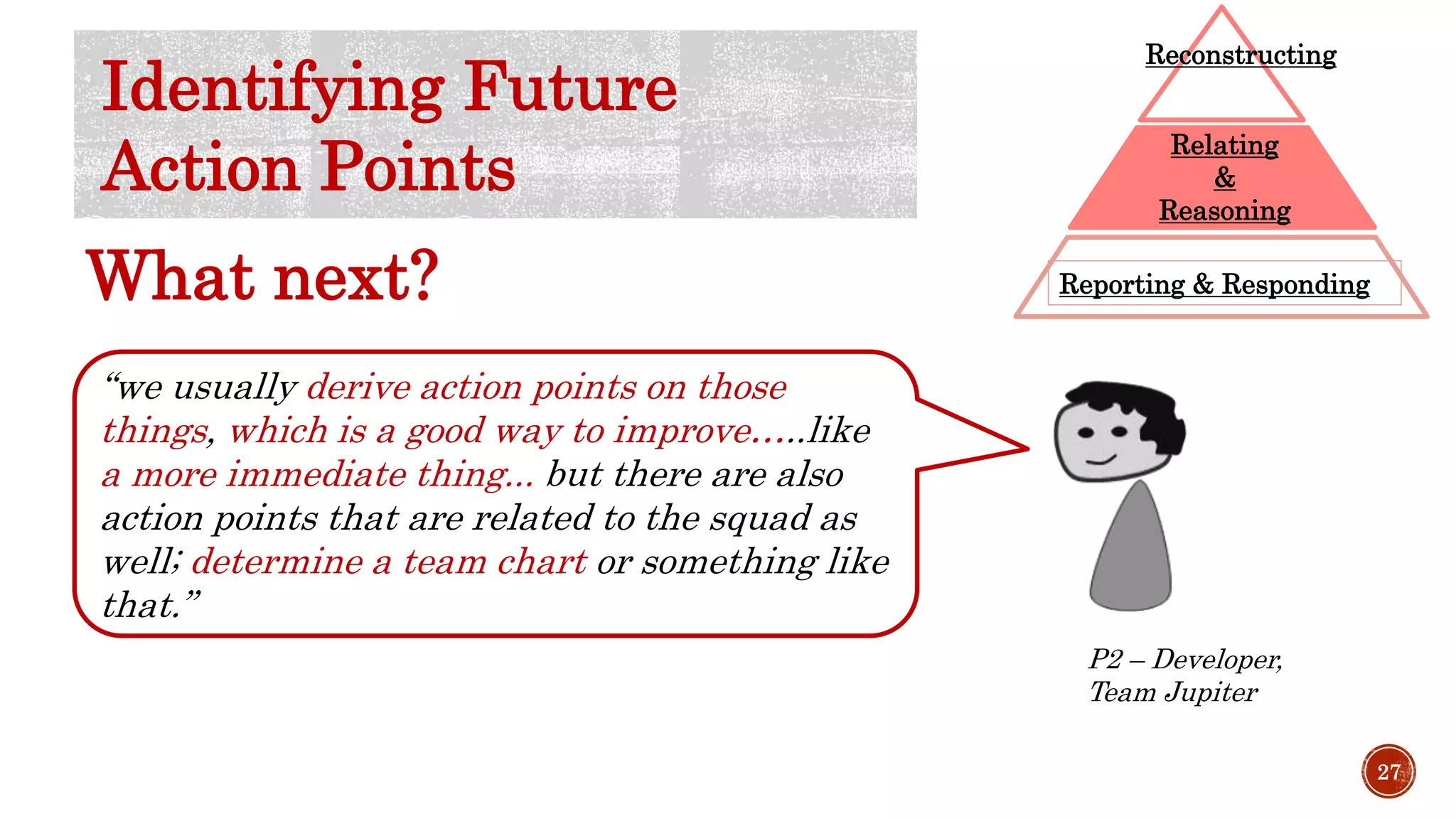
“we usually derive action points on those
things, which is a good way to improve…..like
a more immediate thing... but there are also
action points that are related to the squad as
well; determine a team chart or something like
that.”
P2 – Developer,
Team Jupiter
27
Reporting & Responding
Relating
&
Reasoning
Reconstructing
Identifying Future
Action Points
What next?
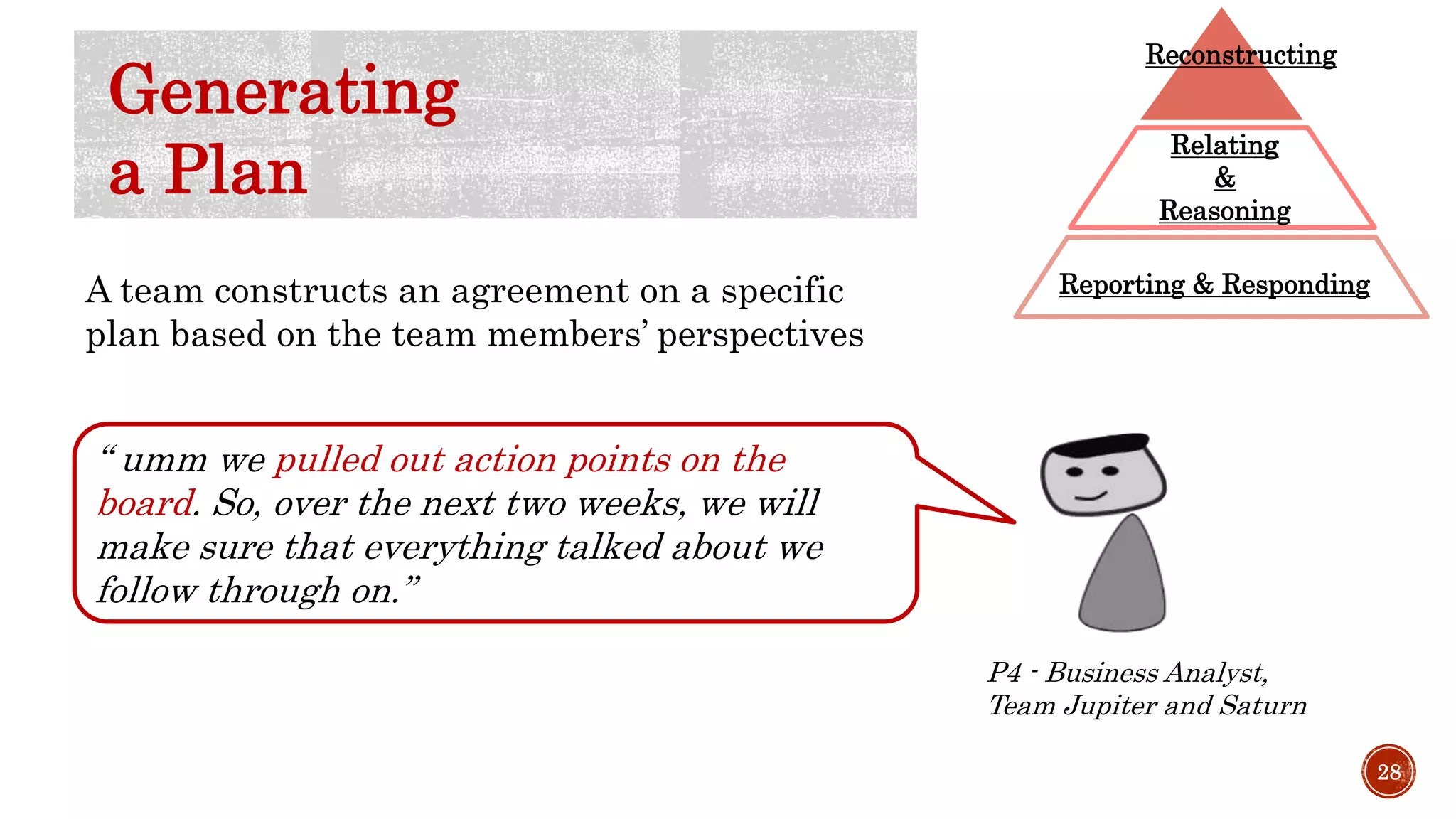
“ umm we pulled out action points on the
board. So, over the next two weeks, we will
make sure that everything talked about we
follow through on.”
P4 - Business Analyst,
Team Jupiter and Saturn
28
Reporting & Responding
Relating
&
Reasoning
Reconstructing
Generating
a Plan
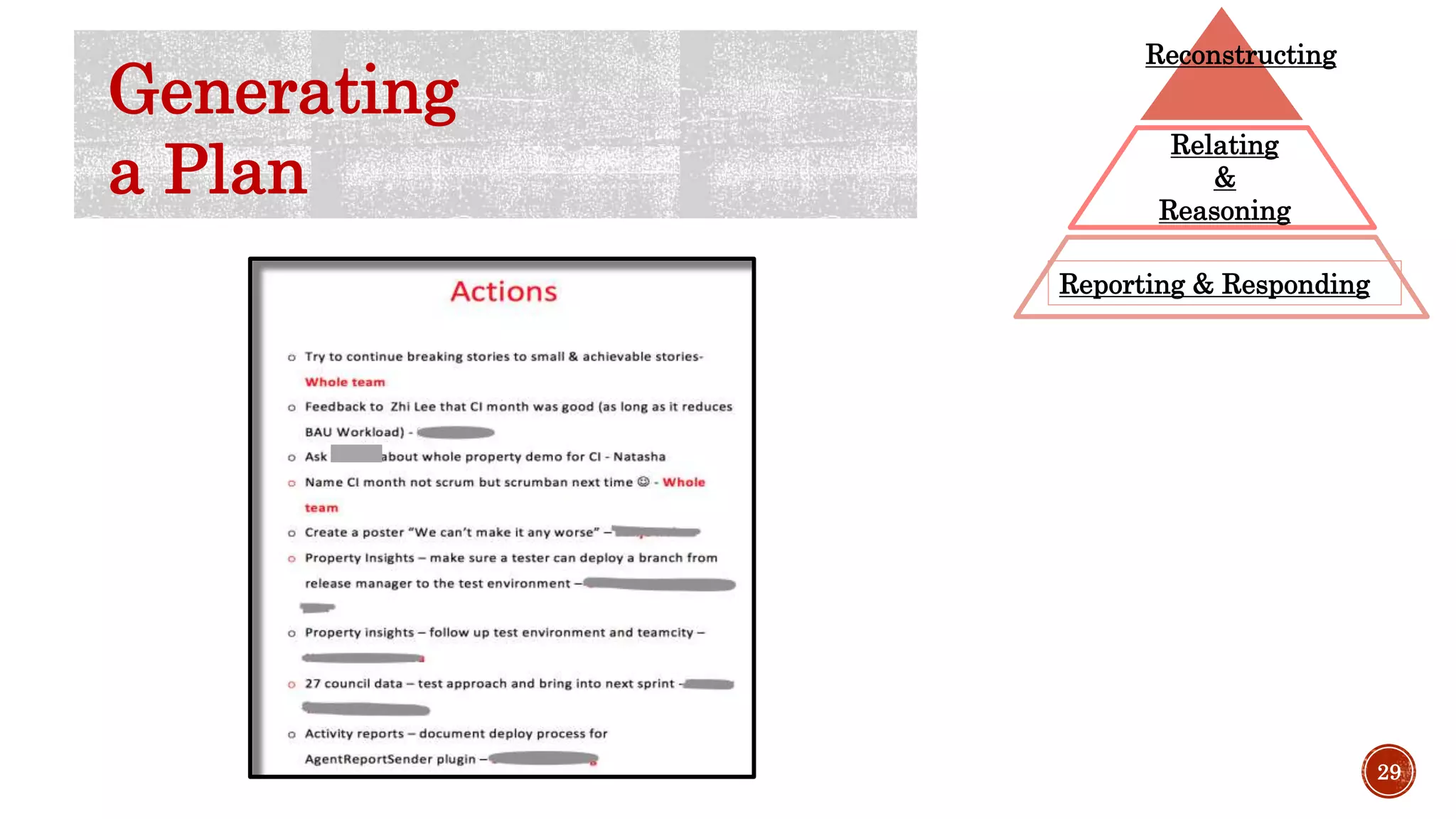
A team constructs an agreement on a specific
plan based on the team members’ perspectives
29
Reporting & Responding
Relating
&
Reasoning
Reconstructing
Generating
a Plan
30
Level of Reflection Build on Each Other
Team Saturn
Team Uranus
Team Jupiter
Identifying and Discussing Obstacles
Discussing Feelings
Analyzing Previous Action Points
Identifying Background Reasons
Identifying Future Action Points
Generating a Plan
Reporting and Responding
Relating and Reasoning
Reconstructing
Level of Reflection Build on Each Other
Team Neptune
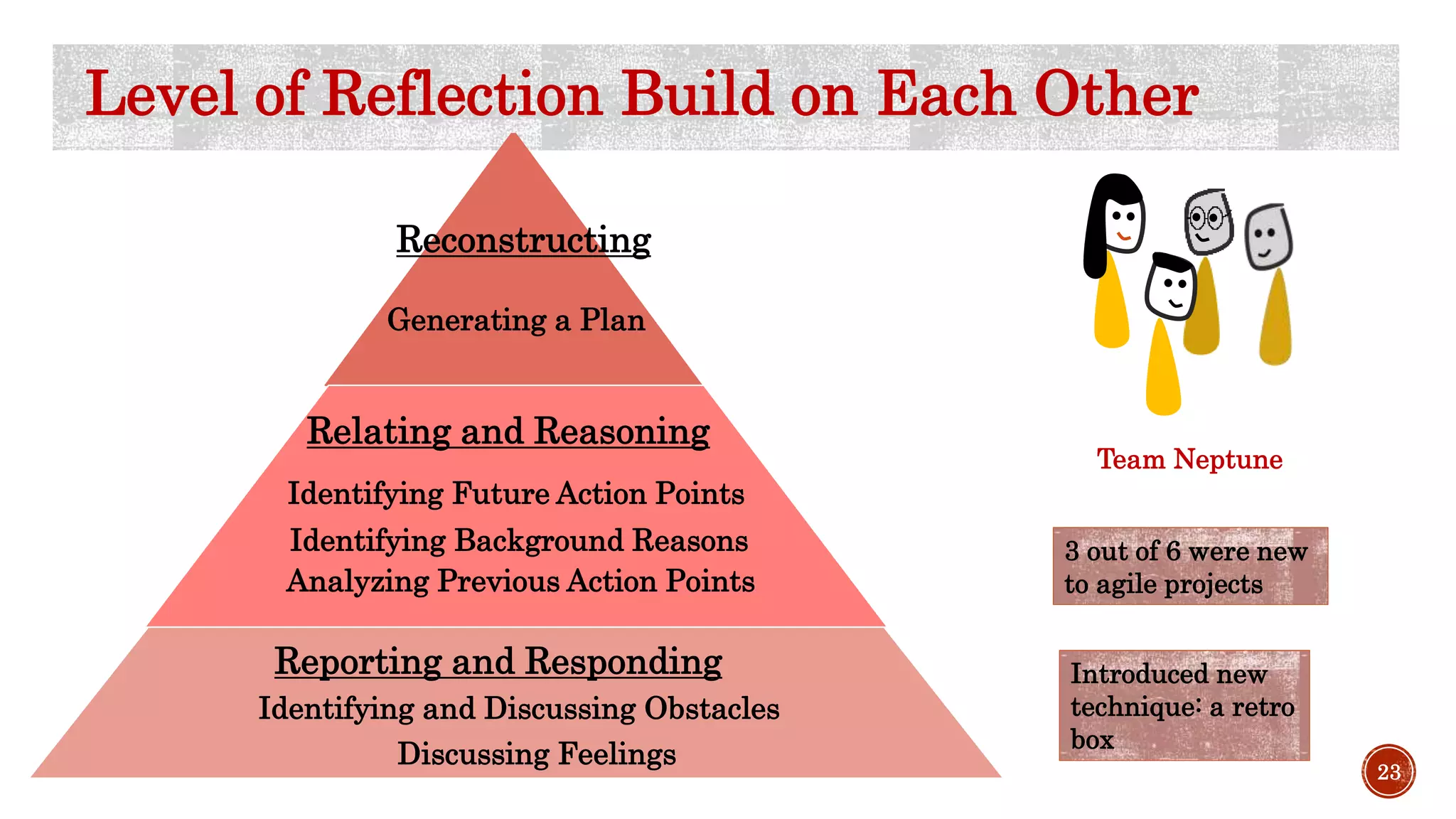
3 out of 6 were new
to agile projects
Introduced new
technique: a retro
box
Identifying and Discussing Obstacles
Discussing Feelings
Analyzing Previous Action Points
Identifying Background Reasons
Identifying Future Action Points
Generating a Plan
Reporting and Responding
Relating and Reasoning
Reconstructing
23
32
Level of Reflection Build on Each Other
Identifying and Discussing Obstacles
Discussing Feelings
Analyzing Previous Action Points
Identifying Background Reasons
Identifying Future Action Points
Generating a Plan
Reporting and Responding
Relating and Reasoning
Reconstructing
33
Implications
The benefits of retrospective
meeting
Continuous Improvement
A framework
reflection in agile retrospective
34
Identifying and Discussing Obstacles
Discussing Feelings
Analyzing Previous Action Points
Identifying Background Reasons
Identifying Future Action Points
Generating a Plan
Reporting and Responding
Relating and Reasoning
Reconstructing
Gather Data
Generate Insight
Generate What to do
Implications
Set the stage
Close the retrospective
meeting
35
Identifying and Discussing Obstacles
Discussing Feelings
Analyzing Previous Action Points
Identifying Background Reasons
Identifying Future Action Points
Generating a Plan
Reporting and Responding
Relating and Reasoning
Reconstructing
Gather Data
Generate Insight
Generate What to do
Implications
Set the stage
Close the retrospective
meeting
36
Implications
A framework
reflection in agile retrospective
Explore more on other agile practices
Explore more on different team contexts
37
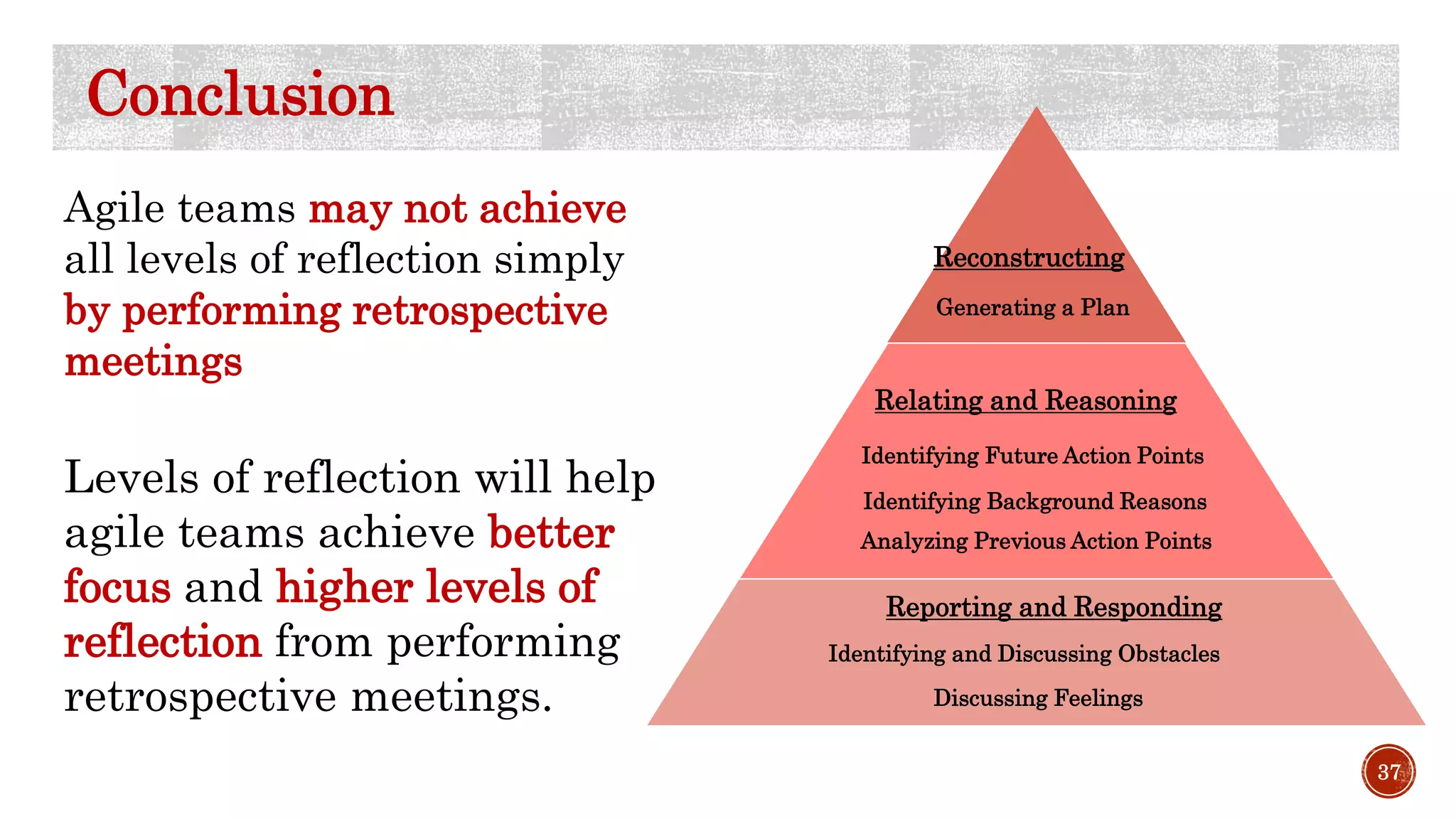
Conclusion
Agile teams may not achieve
all levels of reflection simply
by performing retrospective
meetings
Levels of reflection will help
agile teams achieve better
focus and higher levels of
reflection from performing
retrospective meetings.
Identifying and Discussing Obstacles
Discussing Feelings
Analyzing Previous Action Points
Identifying Background Reasons
Identifying Future Action Points
Generating a Plan
Reporting and Responding
Relating and Reasoning
Reconstructing
39
Thank You
@YA_Andriyani
yand610@aucklanduni.ac.nz

Reflection in Agile Retrospective (Agile Indonesia Conference)

  • 1.
    Yanti Andriyani Dr. RashinaHoda Prof. Robert Amor 1 @YA_Andriyani
  • 2.
    2 “Individuals and interactionsover processes and tools” “At regular intervals, the team reflects on how to become more effective, then tunes and adjusts its behavior accordingly.” Agile Manifesto Knowledge evolves during interactions in ASD
  • 3.
    Agile teams focusmore on development tasks Do not pay attention on how to facilitate knowledge for learning, evaluating and improving their work Knowledge management is not a priority 3
  • 4.
    a) Define andDesign c) Analyze and Conclude b) Collect, Prepare and Analyze Review/ Develop Theory Select Cases Design Data Collection Protocol Interview and Observation Transcribe Interviews Qualitative Data analysis (Observation notes, Transcriptions) Analyze and formulate the findings Write case study report Draw conclusions Finished In Progress Next Plan 4
  • 5.
    Data Collected First Company (Indonesia) Second Company (NZ) ThirdCompany (NZ) Observation (Daily Stand-up and Retrospective meeting) 3 teams (3 daily stand-up and 1 retrospective meetings) 4 teams (8 daily stand-up and 4 retrospective meetings) 2 teams (2 daily stand-ups and 1 retrospective meeting) Individual Interviews 6 team members 18 team members 4 team members Group Interviews N/A 4 group interviews N/A 5
  • 6.
    Current Findings Systematic Literature Reviewsa(SLR) Knowledge Management Concept in Agile Software Development (ASD) Knowledge Types (KT) Knowledge Management Strategies (KMS) Data Analysisb (Interviews and Observations) Reflection in Retrospective meeting Aspects of reflection in retrospective meeting Level of reflection a) KSEM Conference, Melbourne, August 2017 b) XP Conference, Germany, May 2017 6
  • 7.
    [7] Ebert, C.,& De Man, J. (2008). Effectively utilizing project, product and process knowledge. Information and Software Technology , 50.6, 579-594. 7 Knowledge Types [7] Product Knowledge Product features Design Requirements Project Knowledge Timeline Progress Impediments Estimation Process Knowledge System flows Coding flows Synchronize teamwork Improvement
  • 8.
    Knowledge Management Strategies (KMS) Artifacts Sprint Backlog UserStories Task Card Discussion Impediments Progress Experience Estimation Feedback Visualizations UI Prototype Burn down chart Code Information radiators 8
  • 9.
    9 9 Knowledge Types Agile practices Knowledgemanagement strategies Are implemented through Knowledge layer Practice layer Are required
  • 10.
  • 11.
  • 12.
    What about teamreflection? Awareness Improvement 12
  • 13.
    Agile Retrospective Meeting AgileSoftware Team What Went Well? What Went Wrong? What improvement? 13
  • 14.
    Agile Retrospective Meetingand Reflective Practices The techniques of performing retrospective meetings Post Iteration Workshop Postmortem Review 14
  • 15.
  • 16.
    How does reflectionoccur in agile retrospective meetings? What aspects are focused on during the retrospective meeting? Research Questions ? 16
  • 17.
    Research Method Case Studies Interviews(Individual and Group) Observation (4 Retrospective meetings) Data Analysis Thematic Data Analysis 17
  • 18.
    18 Data Collection (16Participants) Team Neptune (4 out 6 members) Team Jupiter (5 out of 10 teams) Team Saturn (6 out of 10 members) Team Uranus (2 out of 3 members) Shared resource <1 – 2 years 0.5 – 7+ years 0.5 – 7+ years 1-6 years 7+ yearsAgile Experience Agile Projects Retrospective Meeting Duration Retrospective Meeting Frequencies First agile project 1-20+ projects 1- 20+ projects 1- 6 projects 6-20+ projects 15 mins When needed 55 mins 65 mins 45 mins 2 weeks 2 weeks 2 weeks
  • 19.
    Thematic Analysis 19 Reading interview transcriptions Generatinginitial codes --- --- - …quite a few people were in the same situation,...” Shared Feelings Searching for themes Reviewing themes Shared Obstacles (dependencies) Generated Action Points Defining and naming themes Producing a report “I scored myself really low, I said I wasn’t very happy. “…we have to do something within two days and that’s kind of an interdependent thing; like until you do it I won’t be able to do it. “ “We usually write something down; it will be like a series of four or five bullet points that we then try to look at the following week. “ SharingOutcomes Reporting and Responding Reconstructing
  • 20.
    Level of Reflection* 20 Responding Reporting Relating Reasoning Reconstructing * Bain, J.D., Ballantyne, R., Packer, J., Mills, C.: Using journal writing to enhance student teachers’ reflectivity during field experience placements. Teachers and Teaching: theory and practice 5, 51-73(1999) 10.1080/1354060990050104 Reconstructing Reasoning Relating Responding Reporting
  • 21.
    Dependencies related to theaspects that hindered the team from making progress “If it's delayed at the first point, if something is wrong at the first point the next person feels it. So, if one brings it up [in the retrospective] and if it's a true concern you will have support because it does affect people.” P16 - Test Chapter Lead (Across All Teams) Identifying and Discussing Obstacles 21 Reporting & Responding Relating & Reasoning Reconstructing
  • 22.
    Unfinished Tasks The problemswhere team members could not accomplish the tasks they had planned “We were not achieving that daily goal and it is a kind of demotivating… let’s say you plan 10 stories for the sprint and you achieve just two or three. The rest we couldn’t complete for whatever reason. So, we say that is one thing which didn’t go well.” P12 – Tester, Team Neptune 22 Identifying and Discussing Obstacles Reporting & Responding Relating & Reasoning Reconstructing
  • 23.
    “We do putdown smiley. When we got a new tester on board, a new person we had a happy smiley saying that our squad is complete.” P12 – Tester, Team Neptune 23 Discussing Feelings Reporting & Responding Relating & Reasoning Reconstructing Represent the sense of facts and occurrences from the previous sprint
  • 24.
  • 25.
    “.. we measureyourself based on your action points and that you’ve actually made changes for. …200 action points ..but not a single one of those was followed up on, you really haven’t done anything.” P4 - Business Analyst, Team Jupiter and Saturn 25 Reporting & Responding Relating & Reasoning Reconstructing Analyzing Previous Action Points A specific item selected by the team to focus on for improvement
  • 26.
    “I think weaddressed like the major issues are causing the squad stuck at the moment and things like test environment and [..] dealing with an external dependency like platform team in [city name]” P4 - Business Analyst, Team Jupiter and Saturn 26 Identifying Background Reasons Reporting & Responding Relating & Reasoning Reconstructing Why??
  • 27.
    “we usually deriveaction points on those things, which is a good way to improve…..like a more immediate thing... but there are also action points that are related to the squad as well; determine a team chart or something like that.” P2 – Developer, Team Jupiter 27 Reporting & Responding Relating & Reasoning Reconstructing Identifying Future Action Points What next?
  • 28.
    “ umm wepulled out action points on the board. So, over the next two weeks, we will make sure that everything talked about we follow through on.” P4 - Business Analyst, Team Jupiter and Saturn 28 Reporting & Responding Relating & Reasoning Reconstructing Generating a Plan A team constructs an agreement on a specific plan based on the team members’ perspectives
  • 29.
  • 30.
    30 Level of ReflectionBuild on Each Other Team Saturn Team Uranus Team Jupiter Identifying and Discussing Obstacles Discussing Feelings Analyzing Previous Action Points Identifying Background Reasons Identifying Future Action Points Generating a Plan Reporting and Responding Relating and Reasoning Reconstructing
  • 31.
    Level of ReflectionBuild on Each Other Team Neptune 3 out of 6 were new to agile projects Introduced new technique: a retro box Identifying and Discussing Obstacles Discussing Feelings Analyzing Previous Action Points Identifying Background Reasons Identifying Future Action Points Generating a Plan Reporting and Responding Relating and Reasoning Reconstructing 23
  • 32.
    32 Level of ReflectionBuild on Each Other Identifying and Discussing Obstacles Discussing Feelings Analyzing Previous Action Points Identifying Background Reasons Identifying Future Action Points Generating a Plan Reporting and Responding Relating and Reasoning Reconstructing
  • 33.
    33 Implications The benefits ofretrospective meeting Continuous Improvement A framework reflection in agile retrospective
  • 34.
    34 Identifying and DiscussingObstacles Discussing Feelings Analyzing Previous Action Points Identifying Background Reasons Identifying Future Action Points Generating a Plan Reporting and Responding Relating and Reasoning Reconstructing Gather Data Generate Insight Generate What to do Implications Set the stage Close the retrospective meeting
  • 35.
    35 Identifying and DiscussingObstacles Discussing Feelings Analyzing Previous Action Points Identifying Background Reasons Identifying Future Action Points Generating a Plan Reporting and Responding Relating and Reasoning Reconstructing Gather Data Generate Insight Generate What to do Implications Set the stage Close the retrospective meeting
  • 36.
    36 Implications A framework reflection inagile retrospective Explore more on other agile practices Explore more on different team contexts
  • 37.
    37 Conclusion Agile teams maynot achieve all levels of reflection simply by performing retrospective meetings Levels of reflection will help agile teams achieve better focus and higher levels of reflection from performing retrospective meetings. Identifying and Discussing Obstacles Discussing Feelings Analyzing Previous Action Points Identifying Background Reasons Identifying Future Action Points Generating a Plan Reporting and Responding Relating and Reasoning Reconstructing
  • 38.

Editor's Notes

  • #2 Good afternoon , Thank you for coming everyone. My name is Yanti Andriyani, I am from the University of Auckland. Today, I would like to present my research, which entitled: REFLECTION IN AGILE RETROSPECTIVE MEETINGS.
  • #11 Good afternoon , Thank you for coming everyone. My name is Yanti Andriyani, I am from the University of Auckland. Today, I would like to present my research, which entitled: REFLECTION IN AGILE RETROSPECTIVE MEETINGS.
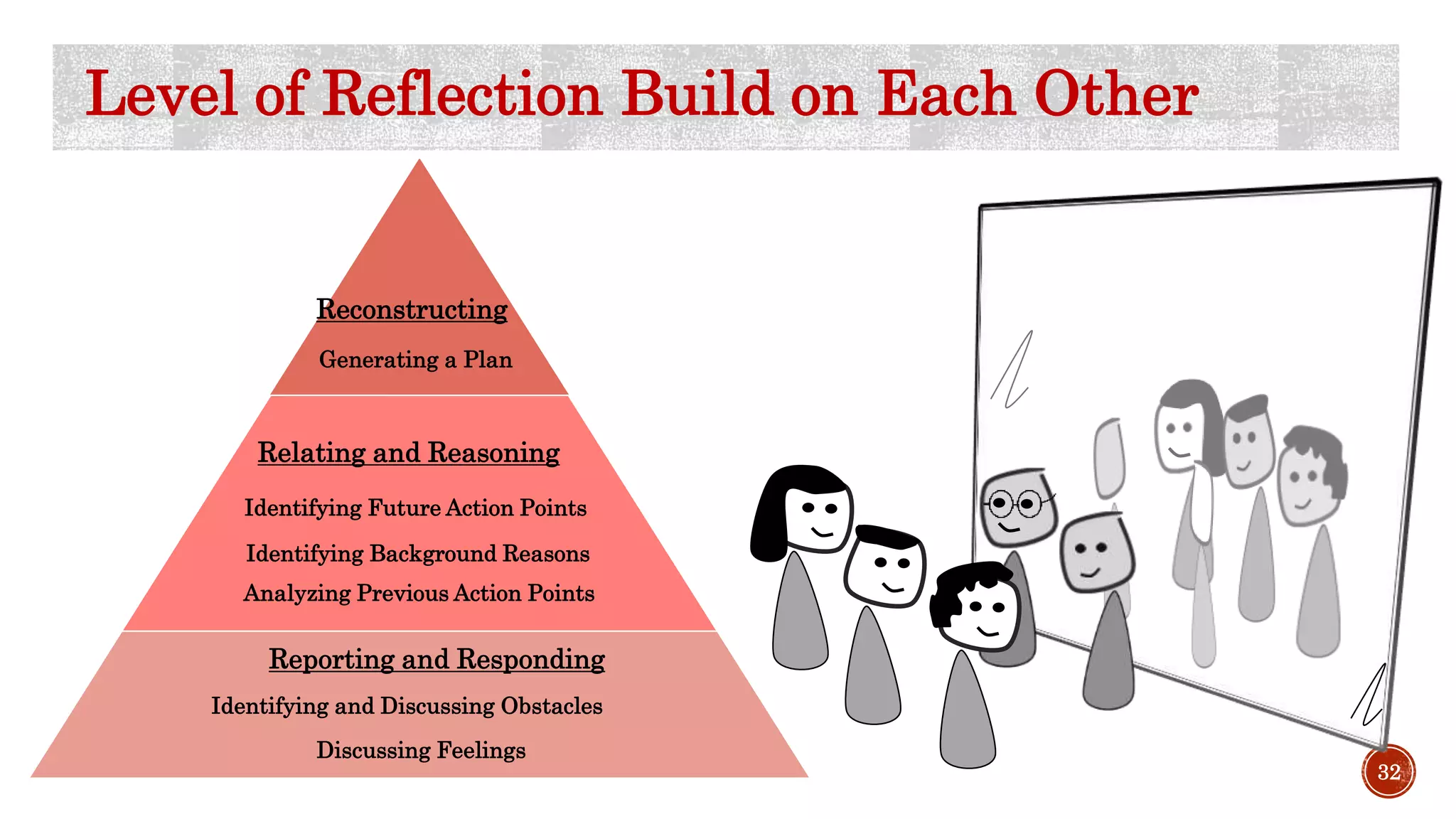
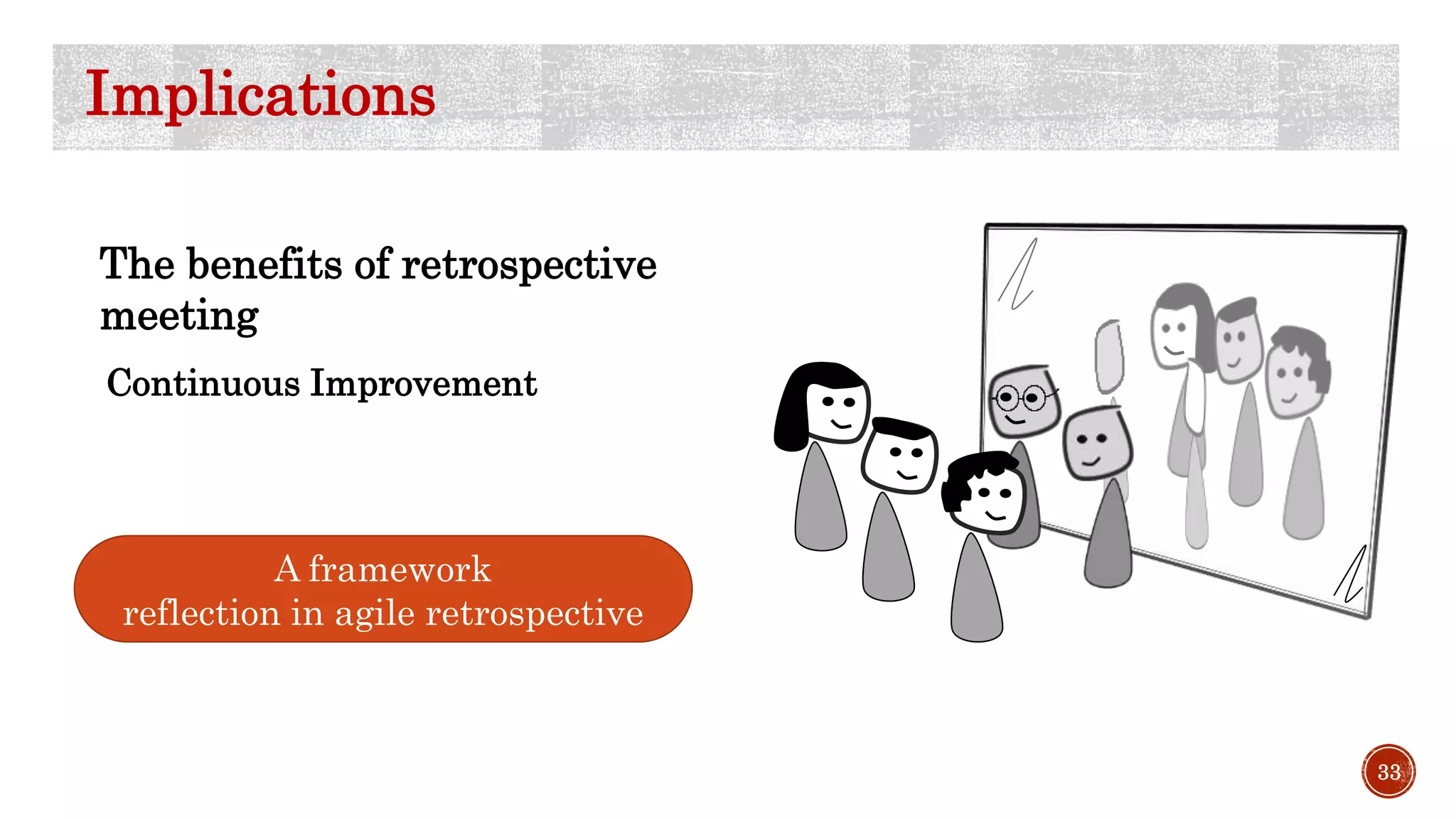
  • #12 Before I explain further about my research, I would like to give a simple analogy about reflection. MIRROR, mirror is a medium where you can see your reflection. We are able to see things about ourselves and be able to get some idea of what we look like. We can see our physical appearance in order to know how good we are or how bad we are. For example, when you see your hair is messy and look upset, what will you do?? Probably you start to think brush your hair, use lipstick in order to make you fresher.  What about team reflection? Do you need mirror as well? How do you know your te am members feel bad or happy? Does your team aware with that? How to improve that situation? This analogy tries to highlight REFLECTION is about increase or develop AWARENESS in order to IMPROVE. NEXT…
  • #13 Before I explain further about my research, I would like to give a simple analogy about reflection. MIRROR, mirror is a medium where you can see your reflection. We are able to see things about ourselves and be able to get some idea of what we look like. We can see our physical appearance in order to know how good we are or how bad we are. For example, when you see your hair is messy and look upset, what will you do?? Probably you start to think brush your hair, use lipstick in order to make you fresher.  What about team reflection? Do you need mirror as well? How do you know your te am members feel bad or happy? Does your team aware with that? How to improve that situation? This analogy tries to highlight REFLECTION is about increase or develop AWARENESS in order to IMPROVE. NEXT…
  • #14  Retrospective meeting is a meeting that facilitates agile software teams to reflect team situation in order to gain continuous improvement. They commonly perform the meeting by discussing three main points, such as WHAT WENT WELL, WHAT WENT WRONG and WHAT SHOULD BE IMPROVED. The way to perform this meeting also vary, such as using Lego, card, journey lines etc. The games purposes to make this meeting less informal, makes the team comfortable with the meeting and improve team relationship.
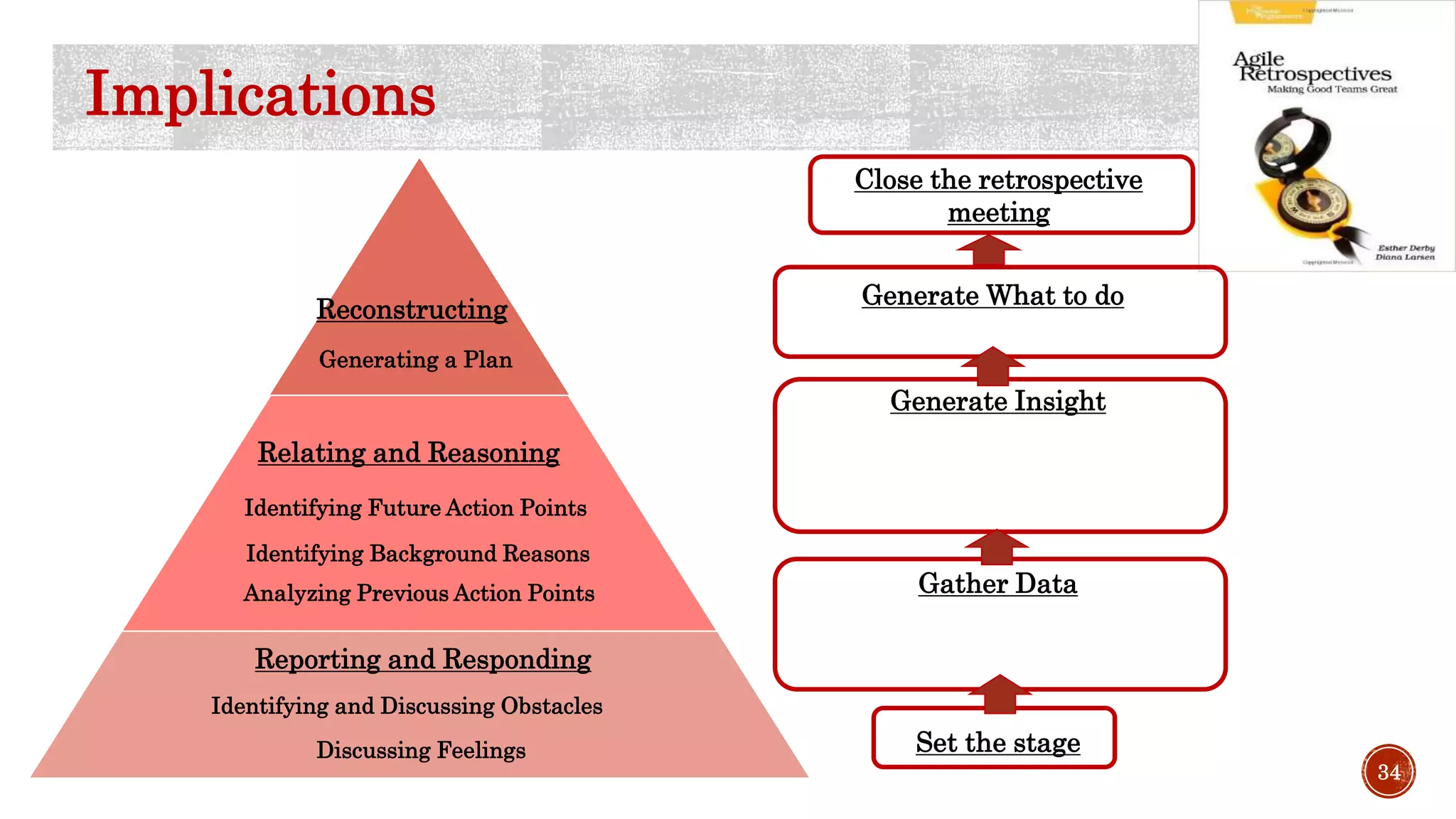
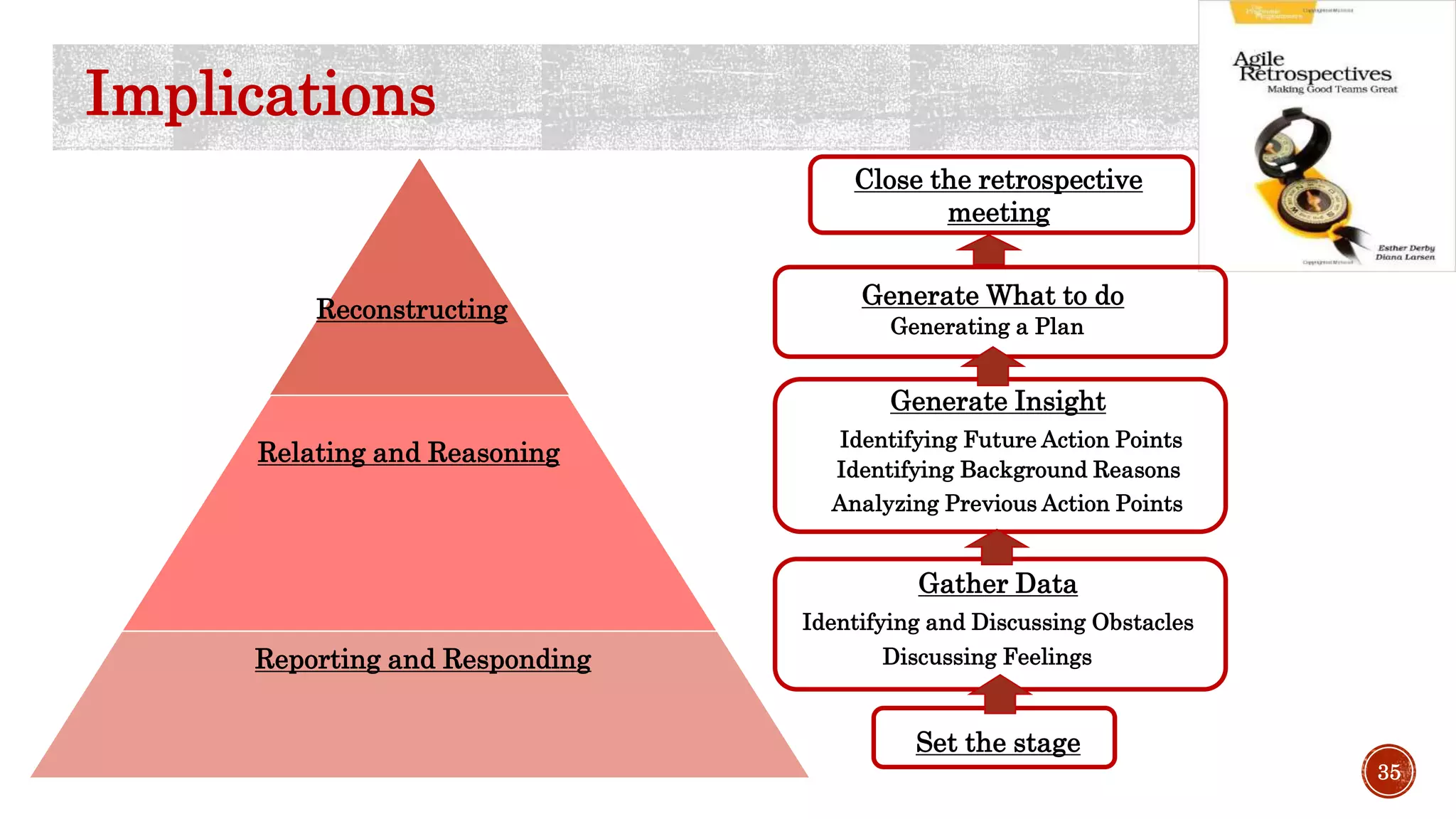
  • #15 As explained in the existing research in agile retrospective meeting. The research focuses more on the techniques how to perform retrospective meeting. Based on Ester Derby and Diana Larsen book, there are 5 steps conducting agile retrospective meeting. Setting the stage to begin the meeting, gathering data-> asking reviews from all team members, generating insight-> get ideas from team members and deciding what area or issues that need to be focused on, then close the meeting. Another technique, such post iteration workshop and post mortem review is a reflection workshop which involves collecting issues and generating tasks and decisions by using root causes analysis From the REFLECTION research area, there is a study that include retrospective meeting as part of agile reflective practices. Retrospective meeting is categorised as reflection-on action, which focuses on the evaluation after the process. What I can see from the existing research are: The investigation in retrospective meeting only focuses on the technique There is a need to investigate further what exactly happen in the retrospective meeting, how team reflect
  • #17 Thus, we tried to define several research questions: How does reflection occur in agile retrospective meetings? What aspects are focused on during the retrospective meeting?
  • #18 To answer the research questions, this research conducted by implementing the Case Study research method. During one of the Auckland Agile meetups, we received interest in participation from an agile team lead working at the largest online auction company in New Zealand, Trade Me. Trade Me had been practicing agile software development for over three years and provided access to four teams. Its headquarters are located in Wellington and the regional offices are in Auckland and Christchurch. For confidentiality purposes, the teams are named Jupiter, Saturn, Uranus, and Neptune. Face-to-face individual and one group interview (of six team members) were conducted to gain comprehensive explanations, which would help derive the real concerns from both individual and team perspectives. We conducted one-on-one interviews with all participants (P1-P16), where the duration of individual interviews varied from 35 to 50 minutes. Observations were conducted during the retrospective meetings of all the teams and of their general workplace. The observations aimed to capture the details of the retrospective meeting (i.e. time spent, attendees, and discussion involved) and to help validate the findings from the interviews.
  • #19 <1 - 2
  • #20 Sixteen interviews were transcribed and imported into NVivo software to facilitate coding and thematic analysis. Generating initial codes involved code identification by analyzing interesting features of a sentence, which were highlighted and added as a node in NVivo representing a new code, such as identifying and discussing obstacles and discussing feelings. Searching for themes involved comparing data with different codes to see whether they have similar meanings or aspects. Parent themes were classified based on five (grouped into three) levels of reflection, where each code was classified based on the definition of each level.
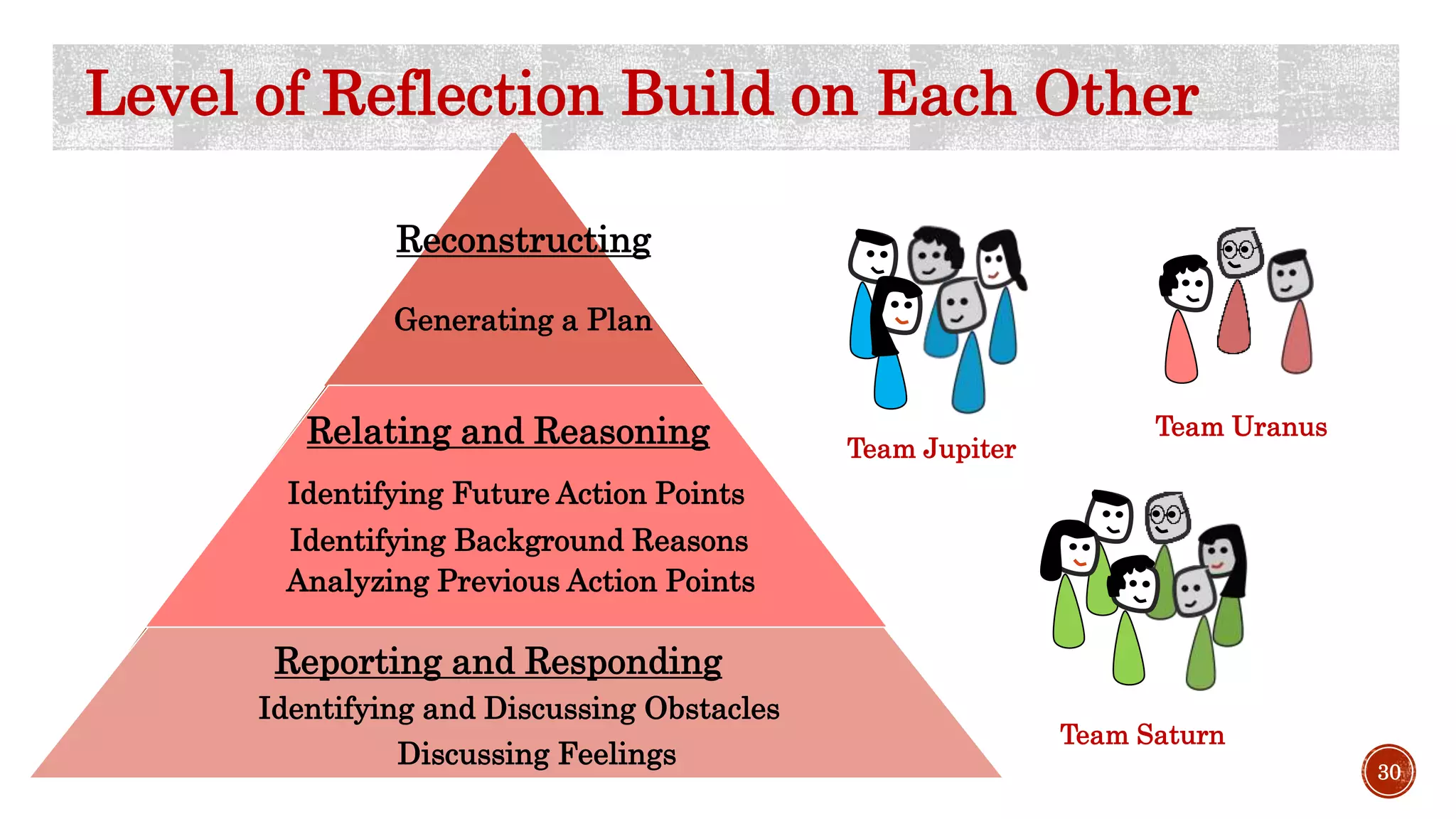
  • #21 reporting and responding : share brief descriptions of their experience, their feelings about events, facts or problems that they encountered. Level 3 is relating and involves: share experience with personal meaning. Understanding at this level occurs when learners try to highlight good points (e.g. their ability, successful work) and negative points (e.g. mistakes, failure) to learn and identify areas of improvement. Level 4 is reasoningn where learners explore the information shared as well as background knowledge related to the occurrences. Level 5 is reconstructing which signifies a high level of learning where learners generate the general framework of thinking, which is specified in a plan or action for responding to similar obstacles in the future. Our study refers to levels of reflection proposed by Bain et al. [12] and adjusts the levels into three main levels, i.e. reporting and responding, relating and reasoning and reconstructing, based on our observations of the agile retrospectives in practice. Reporting and responding are grouped together as the first level as these levels closely related to reviews sharing and discussions at the beginning of the retrospective meeting. Relating and responding are grouped as the second level as agile teams participate in a further discussion after they reported and responded to the reviews. The third level, the reconstructing level is embodied when agile teams discuss to formulate a plan as an improvement for the next sprint.
  • #22 Identifying and Discussing Obstacles. Obstacles reported in the retrospective meetings related to the aspects that hindered the team from making progress. During the retrospective meeting, agile teams gathered all the problems that occurred in the previous sprint, which would be useful for the teams to highlight areas of improvement. By sharing problems about dependencies team members became aware of the other team members’ tasks and how they related to their own tasks. By being aware of this issue the team could think about ways to solve the dependency problems.
  • #23 Unfinished tasks. Unfinished tasks were mentioned by three participants as an obstacle reported in retrospective meetings. An unfinished task was a problem where team members could not accomplish the tasks they had planned or considered the team to be making slow progress. Surfacing this obstacle was helpful for teams to understand how much more effort was required to finish the tasks, what tasks were challenging and why the tasks were difficult to finish.
  • #24 The feelings shared by team members represented the sense of facts and occurrences from the previous sprint, such as when they were feeling down or happy. There was an example of positive feelings shared, which had a positive impact on the team’s productivity, where their work can be distributed well
  • #25 The feelings shared by team members represented the sense of facts and occurrences from the previous sprint, such as when they were feeling down or happy. There was an example of positive feelings shared, which had a positive impact on the team’s productivity, where their work can be distributed well
  • #26 Relating and reasoning can be seen when agile teams compile the obstacles and the feelings shared (from the previous reporting and responding level) and investigate the relationship between those aspects. An ‘action point’ refers to a specific item selected by the team to focus on for improvement. In analyzing previous action points, agile teams referred to the action points agreed upon by the team in the previous retrospective and evaluated the actual effort made by the team on that specific point.
  • #27 Identifying Background Reasons. The background reasons of the existing issues were identified when teams were not actively progressing, they would explore the reasons why and what blockers were related to this problem. By identifying the background reasons, teams would understand what aspects needed to be improved.
  • #28 Identifying future action points happened when the teams analyzed previous action points and identified the background issues, which followed by identifying areas of improvement and asking ideas and agreement from the teams. From the discussion, the teams gained the understanding of the existing issues which lead to the thoughts of what areas need to improve and how to improve. Identifying future action points, the teams discussed areas of improvement, which were focused on the process improvement.
  • #29 The Reconstructing level of reflection seems to happen when a team constructs an agreement on a specific plan based on the team members’ perspectives. There were three out of the four teams (Jupiter, Saturn, Uranus) that seemed to engage in the reconstructing level as they performed further discussions and finalized by generating action points. In reconstructing, teams generated plans decided from their discussion in the retrospective meeting. Action points are an explicit outcome of the retrospective meeting. It is useful to remind all team members about the goal for the next sprint, who will responsible, and what are the associated deadlines.
  • #30 The Reconstructing level of reflection seems to happen when a team constructs an agreement on a specific plan based on the team members’ perspectives. There were three out of the four teams (Jupiter, Saturn, Uranus) that seemed to engage in the reconstructing level as they performed further discussions and finalized by generating action points. In reconstructing, teams generated plans decided from their discussion in the retrospective meeting. Action points are an explicit outcome of the retrospective meeting. It is useful to remind all team members about the goal for the next sprint, who will responsible, and what are the associated deadlines.
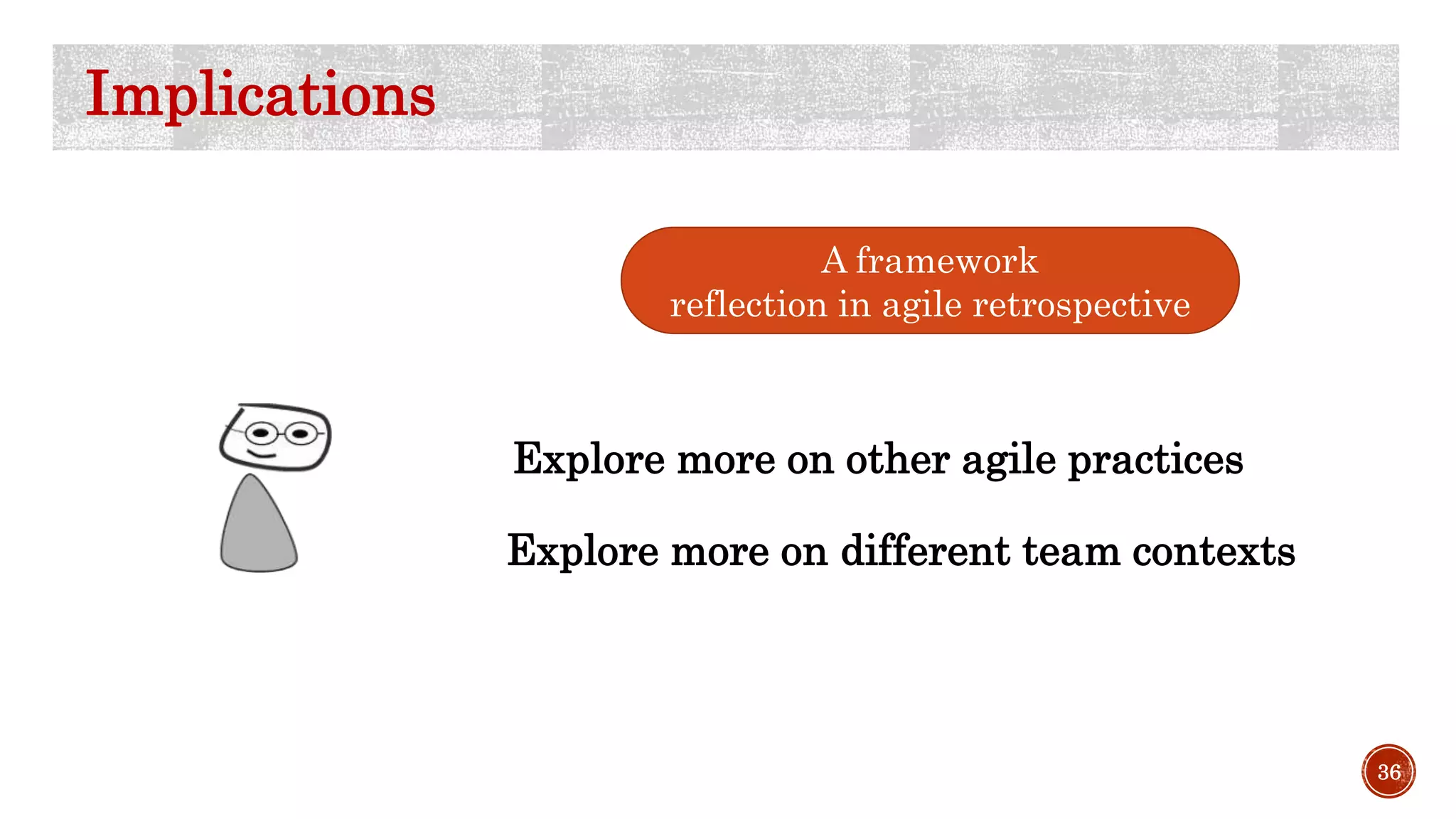
  • #34 Agile Practitioners: By being aware of the different levels of reflection meant to be achieved in each retrospective step, teams can consciously strive to achieve the most out of their retrospective meetings. In particular, they can see that only reporting and responding and relating and reasoning levels are not enough rather reconstructing to generate action points and following up on those points in future meetings is critical to harnessing retrospective meetings to achieve continuous improvement. Reseacher:Using the framework presented in the previous section, researchers can study agile teams’ reflective practice in terms of levels of reflection both in retrospective meetings and other practices that involve reflection (e.g. daily standup, pair programming [7]). Future studies can explore new aspects or topics covered in each level and further explore how the levels build upon each other in different team contexts.
  • #35 Agile Practitioners: By being aware of the different levels of reflection meant to be achieved in each retrospective step, teams can consciously strive to achieve the most out of their retrospective meetings. In particular, they can see that only reporting and responding and relating and reasoning levels are not enough rather reconstructing to generate action points and following up on those points in future meetings is critical to harnessing retrospective meetings to achieve continuous improvement. Reseacher:Using the framework presented in the previous section, researchers can study agile teams’ reflective practice in terms of levels of reflection both in retrospective meetings and other practices that involve reflection (e.g. daily standup, pair programming [7]). Future studies can explore new aspects or topics covered in each level and further explore how the levels build upon each other in different team contexts.
  • #36 Agile Practitioners: By being aware of the different levels of reflection meant to be achieved in each retrospective step, teams can consciously strive to achieve the most out of their retrospective meetings. In particular, they can see that only reporting and responding and relating and reasoning levels are not enough rather reconstructing to generate action points and following up on those points in future meetings is critical to harnessing retrospective meetings to achieve continuous improvement. Reseacher:Using the framework presented in the previous section, researchers can study agile teams’ reflective practice in terms of levels of reflection both in retrospective meetings and other practices that involve reflection (e.g. daily standup, pair programming [7]). Future studies can explore new aspects or topics covered in each level and further explore how the levels build upon each other in different team contexts.
  • #37 Agile Practitioners: By being aware of the different levels of reflection meant to be achieved in each retrospective step, teams can consciously strive to achieve the most out of their retrospective meetings. In particular, they can see that only reporting and responding and relating and reasoning levels are not enough rather reconstructing to generate action points and following up on those points in future meetings is critical to harnessing retrospective meetings to achieve continuous improvement. Reseacher:Using the framework presented in the previous section, researchers can study agile teams’ reflective practice in terms of levels of reflection both in retrospective meetings and other practices that involve reflection (e.g. daily standup, pair programming [7]). Future studies can explore new aspects or topics covered in each level and further explore how the levels build upon each other in different team contexts.