Stevenson/Whitmore: Strategies for Engineering Communication 1 of 35
Referencing Conventions
 Give credit to others for ideas and words
 Important feature of scholarship
 Vary from one field to another
 Require attention to detail
 Involves citations and reference lists
Stevenson/Whitmore: Strategies for Engineering Communication 2 of 35
Acknowledgements
 Use for general contributions to a document
 Keep the acknowledgement short and direct
Example: “I would like to thank John Smith for contributing
his expertise in the area of hydraulic erosion to
this report.”
Stevenson/Whitmore: Strategies for Engineering Communication 3 of 35
Footnotes
 Use smaller font (8 or 9 point) to distinguish it from the
text.
 Use 1.5 to 2 inch horizontal line to separate footnote from
text.
 If more than 2 or 3 footnotes, number them; if only a few
notes, use symbols such as * or †.
 Avoid footnotes if using footers; if you must use them,
leave 1/2 to 1 inch blank space between footnote and
footer.
 If possible, avoid more than one footnote per page.
Stevenson/Whitmore: Strategies for Engineering Communication 4 of 35
Citations
 Citations provide just enough information for a reader to
find the source of an idea or quotation in a reference list.
 Two common types of citations: Numbers or Author/Date
 Using numbers saves space, but provides little
information
Designing a robust controller requires a nominal
model of the controlled plant [1].
[10, 11, 12] propose alternative models.
Stevenson/Whitmore: Strategies for Engineering Communication 5 of 35
Author/Date Citations
 Author/date system acknowledges authors’ ideas and
words by last name(s) and year of publication.
 This information is useful to someone who knows the
literature in the field.
Recent research (Black & Johnston 2002) supports
this explanation.
One expert claims that such groups “can be the
forward-thinking, value-oriented, leading bodies we
claim them to be” (Carver 1997).
Stevenson/Whitmore: Strategies for Engineering Communication 6 of 35
Citing Sources
 Two or more publications by same author(s) in same
year
• (Chan 1999a; 1999b)
• Use these letters after dates in reference list.
 More than one author
• Two authors: (Santos and Martin 2001)
• Three authors: (Smith, Trinh, and Matsui 2001) for
first reference. (Smith et al. 2001) for subsequent
references
• Four or more authors, et al. for all references:
(McManus et al. 1998)
Stevenson/Whitmore: Strategies for Engineering Communication 7 of 35
Citing Sources
More Than One Source Cited
 Separate sources with semi-colons
(Vincent 1998; Wong 2000; Young and Rawicz 2001)
 If more than one source by the same author, give name
once and then just dates
(Carver 1986; 1992, 1995, 2000)
Stevenson/Whitmore: Strategies for Engineering Communication 8 of 35
Citing Sources
Author Unknown
 Substitute association, corporation, government agency,
or other group.
 If group name is in sentence, omit from citation.
(NRC 1999)
These estimates are based on data provided by the
National Research Council (1999).
Stevenson/Whitmore: Strategies for Engineering Communication 9 of 35
Citing Sources
Additional Information
 To help readers find information, include volume, page,
section, equation numbers, etc.
 Separate this additional information from the date with a
comma
(Singh 2001, 55) to refer to a single page
(Jones 2002, 63-65) to refer to more than one page
(Xu 1999, sec 11.5) to refer to a relevant section
(Peterson 2000, eq. 10) to refer to an equation
Stevenson/Whitmore: Strategies for Engineering Communication 10 of 35
Citing Sources
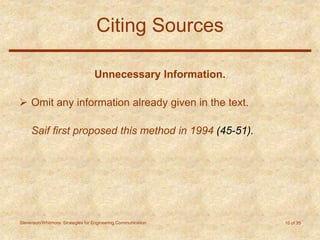
Unnecessary Information.
 Omit any information already given in the text.
Saif first proposed this method in 1994 (45-51).
Stevenson/Whitmore: Strategies for Engineering Communication 11 of 35
Citing Sources
Unconventional Sources
 For interviews, personal letters, mail or e-mail
exchanges, provide full name and nature and date of
communication.
(John Brown, letter to the author, July 2000)
(Bill Smith, telephone interview, 10 Sept 1999)
(Susan Eaglets, e-mail exchange, Aug-Sept 1998)
(Aaron Bates, e-mail to the author, 4 Nov 2000)
Stevenson/Whitmore: Strategies for Engineering Communication 12 of 35
Citing Sources
On-line Sources
 Provide author/date, author, short title, or name of
organization much as for text-based sources.
 Only use URL as the citation if the item is not in your
reference list and the site is stable.
 If not including item in reference list, provide enough
information for a reader to locate the information.
(XYZ Inc., Thermistor Price List, accessed 22 May 1999
<http://www.xyz.nz/~thermistors/pricelist/>
Stevenson/Whitmore: Strategies for Engineering Communication 13 of 35
Placing Citations in Sentences
 Whenever possible, place citations at the ends of
sentences or before a punctuation mark.
 Take care that citations are placed to clarify the points
they support.
Which of the following sentences is unclear?
Researchers (Lightfoot and Jackson 1998) have
reported findings that support this alternative
explanation.
Researchers have reported findings that support this
alternative explanation (Lightfoot and Jackson 1998).
Stevenson/Whitmore: Strategies for Engineering Communication 14 of 35
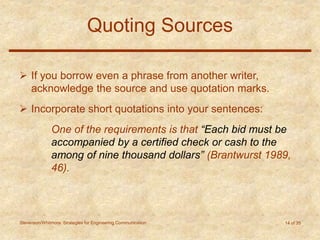
Quoting Sources
 If you borrow even a phrase from another writer,
acknowledge the source and use quotation marks.
 Incorporate short quotations into your sentences:
One of the requirements is that “Each bid must be
accompanied by a certified check or cash to the
among of nine thousand dollars” (Brantwurst 1989,
46).
Stevenson/Whitmore: Strategies for Engineering Communication 15 of 35
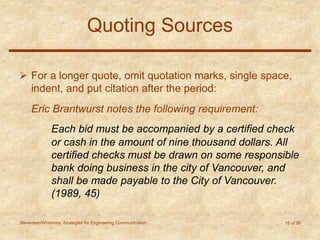
Quoting Sources
 For a longer quote, omit quotation marks, single space,
indent, and put citation after the period:
Eric Brantwurst notes the following requirement:
Each bid must be accompanied by a certified check
or cash in the amount of nine thousand dollars. All
certified checks must be drawn on some responsible
bank doing business in the city of Vancouver, and
shall be made payable to the City of Vancouver.
(1989, 45)
Stevenson/Whitmore: Strategies for Engineering Communication 16 of 35
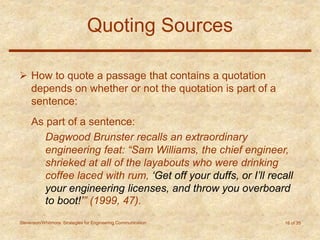
Quoting Sources
 How to quote a passage that contains a quotation
depends on whether or not the quotation is part of a
sentence:
As part of a sentence:
Dagwood Brunster recalls an extraordinary
engineering feat: “Sam Williams, the chief engineer,
shrieked at all of the layabouts who were drinking
coffee laced with rum, ‘Get off your duffs, or I’ll recall
your engineering licenses, and throw you overboard
to boot!’” (1999, 47).
Stevenson/Whitmore: Strategies for Engineering Communication 17 of 35
Quoting Sources
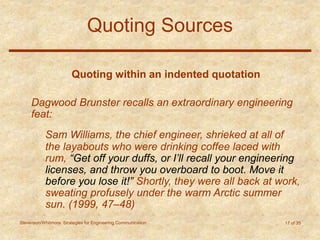
Quoting within an indented quotation
Dagwood Brunster recalls an extraordinary engineering
feat:
Sam Williams, the chief engineer, shrieked at all of
the layabouts who were drinking coffee laced with
rum, “Get off your duffs, or I’ll recall your engineering
licenses, and throw you overboard to boot. Move it
before you lose it!” Shortly, they were all back at work,
sweating profusely under the warm Arctic summer
sun. (1999, 47–48)
Stevenson/Whitmore: Strategies for Engineering Communication 18 of 35
Quoting Sources
 Sometimes you need to make changes to quotations so
they match the grammar of your sentence.
 Indicate changes by placing them in square brackets.
As Humphrey’s explains, “Major investors [were]
pleased with [the President’s] successor.”
 On rare occasions, you may want to note an error in a
quotation by using [sic].
Before you use this convention, assess its affect [sic]
on your readers.
Stevenson/Whitmore: Strategies for Engineering Communication 19 of 35
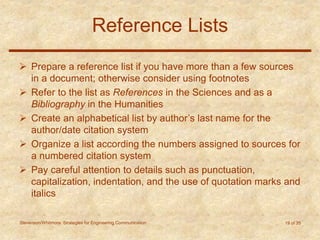
Reference Lists
 Prepare a reference list if you have more than a few sources
in a document; otherwise consider using footnotes
 Refer to the list as References in the Sciences and as a
Bibliography in the Humanities
 Create an alphabetical list by author’s last name for the
author/date citation system
 Organize a list according the numbers assigned to sources for
a numbered citation system
 Pay careful attention to details such as punctuation,
capitalization, indentation, and the use of quotation marks and
italics
Stevenson/Whitmore: Strategies for Engineering Communication 20 of 35
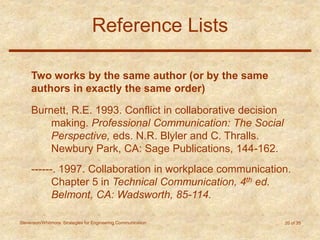
Reference Lists
Two works by the same author (or by the same
authors in exactly the same order)
Burnett, R.E. 1993. Conflict in collaborative decision
making. Professional Communication: The Social
Perspective, eds. N.R. Blyler and C. Thralls.
Newbury Park, CA: Sage Publications, 144-162.
------. 1997. Collaboration in workplace communication.
Chapter 5 in Technical Communication, 4th ed.
Belmont, CA: Wadsworth, 85-114.
Stevenson/Whitmore: Strategies for Engineering Communication 21 of 35
Reference Lists
Journal articles
Harney, M. 2000. Is technical writing an engineering
discipline? IEEE Trans. Prof. Commun. 43:2, 210-
212.
Markus, L. 1994. Electronic mail as the medium of
managerial choice. Organization Sci. 5:4, 504.
Stevenson/Whitmore: Strategies for Engineering Communication 22 of 35
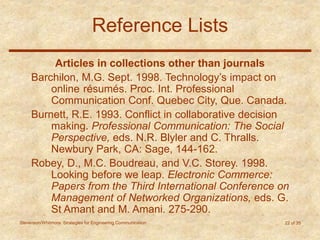
Reference Lists
Articles in collections other than journals
Barchilon, M.G. Sept. 1998. Technology’s impact on
online résumés. Proc. Int. Professional
Communication Conf. Quebec City, Que. Canada.
Burnett, R.E. 1993. Conflict in collaborative decision
making. Professional Communication: The Social
Perspective, eds. N.R. Blyler and C. Thralls.
Newbury Park, CA: Sage, 144-162.
Robey, D., M.C. Boudreau, and V.C. Storey. 1998.
Looking before we leap. Electronic Commerce:
Papers from the Third International Conference on
Management of Networked Organizations, eds. G.
St Amant and M. Amani. 275-290.
Stevenson/Whitmore: Strategies for Engineering Communication 23 of 35
Reference Lists
Unpublished conference papers
Divsalar, D. and J.K. Omura. June 1979. Performance of
mismatched Viterbi receiver on satellite channels.
Presented at Int. Conf. Commun., Boston MA.
Stevenson/Whitmore: Strategies for Engineering Communication 24 of 35
Reference Lists
Unpublished theses or dissertations
Newland, P.A. 1990. Understanding Designers’
Knowledge Acquisition Processes: A Potential for
Enhancing Information Transfer. PhD dissertation.
Portsmouth Univ., Portsmouth, UK.
Stevenson/Whitmore: Strategies for Engineering Communication 25 of 35
Reference Lists
Books
Austin, J.L. 1975. How to Do Things with Words, 2nd ed.,
J.O. Urmson and M. Sbisá editors. Cambridge MA:
Harvard University Press.
Berners-Lee, T. and M. Fischetti. 1999. Weaving the
Web: The Original Design and Ultimate Destiny of
the World Wide Web by Its Inventor. New York:
Harper Collins.
Stevenson/Whitmore: Strategies for Engineering Communication 26 of 35
Reference Lists
On-line sources
 Conventions still evolving
 Include as much of same information as for text-based
source as possible
 Include date you accessed site and the URL
Stevenson/Whitmore: Strategies for Engineering Communication 27 of 35
Reference Lists
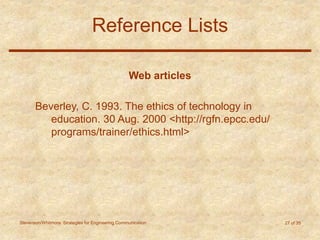
Web articles
Beverley, C. 1993. The ethics of technology in
education. 30 Aug. 2000 <http://rgfn.epcc.edu/
programs/trainer/ethics.html>
Stevenson/Whitmore: Strategies for Engineering Communication 28 of 35
Reference Lists
Published articles accessed on the web
Whitbeck.C. Fall 1996. Problems and cases: New
directions in ethics 1980-1996. 30 Aug. 2000
<http://www.onlineethics.org/essays/education/
index.html>.
Stevenson/Whitmore: Strategies for Engineering Communication 29 of 35
Reference Lists
On-line publications
Greenleaf, G. June 1996. A proposed privacy code for
Asia-Pacific cyberlaw. Journal of Computer-
Mediated Communication, ed. A.W. Branscomb. 2:1.
30 Aug 2000 <http://www.ascusc.org.vol2/issue1>.
Stevenson/Whitmore: Strategies for Engineering Communication 30 of 35
Reference Lists
On-line discussion groups
Adamowski, T. Writer’s resource. IEEE PCS Online
Discussion Forum. 14 Dec. 1999 <http//ieeepcs.org/
wwwboard/>,
Stevenson/Whitmore: Strategies for Engineering Communication 31 of 35
Sample Reference List
Stevenson/Whitmore: Strategies for Engineering Communication 32 of 35
Variations
 Referencing conventions vary among disciplines, fields,
publications, and companies
Wise, Penelope. “Money Today: Two Cents for a Dollar.”
No Profit Review 2 (1987): 123-42.
Wise. P. Money Today: Two cents for a dollar. No Profit
Rev. 2: 123-42.
Wise. P. 1987. Money today. No Profit Rev. 2: 123-42.
Wise, P. 1987. No Profit Rev. 2: 123-42.
Stevenson/Whitmore: Strategies for Engineering Communication 33 of 35
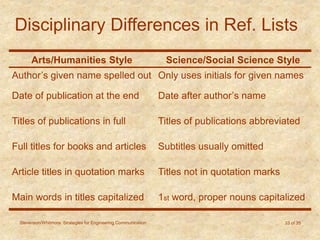
Disciplinary Differences in Ref. Lists
Arts/Humanities Style Science/Social Science Style
Author’s given name spelled out Only uses initials for given names
Date of publication at the end Date after author’s name
Titles of publications in full Titles of publications abbreviated
Full titles for books and articles Subtitles usually omitted
Article titles in quotation marks Titles not in quotation marks
Main words in titles capitalized 1st word, proper nouns capitalized
Stevenson/Whitmore: Strategies for Engineering Communication 34 of 35
IEEE Style
[1] B. Oakley, II, “HyperCard courseware for introduction to
circuit analysis,” in Proc. ASEE Annu. Meet., 1991, pp.
496-500.
[2] Microsoft Video for Windows, Microsoft Corp. 232-100-
901, 1994.
[3] K.L. Conway, “Putting technology in its place: the
classroom,” Institute for Academic Technology, Spring
1991, p. 5.
[4] P.R. Keller and M.M. Keller, Visual Cues, Los Alamitos,
CA, IEEE Computer Society Press, 1993.
Stevenson/Whitmore: Strategies for Engineering Communication 35 of 35
ASEE Style
1. Tonso, K.L. “Becoming Engineers While Working
Collaboratively: Knowledge and Gender in a Non-
Traditional Engineering Course,” part of Margaret
Eisenhart’s Final Report to the Spencer Foundation
entitled “The Construction of Scientific Knowledge
Outside School,” 1993.
2. Lunsford, A. Ede L., “Why Write . . . Together: A
Research Update,” Rhetoric Review, 5, 1986, pp. 71-76.
3. “Learning Together Makes a Difference,” The
Teaching Professor, June/July 1995, p. 5.

referencing.ppt

  • 1.
    Stevenson/Whitmore: Strategies forEngineering Communication 1 of 35 Referencing Conventions  Give credit to others for ideas and words  Important feature of scholarship  Vary from one field to another  Require attention to detail  Involves citations and reference lists
  • 2.
    Stevenson/Whitmore: Strategies forEngineering Communication 2 of 35 Acknowledgements  Use for general contributions to a document  Keep the acknowledgement short and direct Example: “I would like to thank John Smith for contributing his expertise in the area of hydraulic erosion to this report.”
  • 3.
    Stevenson/Whitmore: Strategies forEngineering Communication 3 of 35 Footnotes  Use smaller font (8 or 9 point) to distinguish it from the text.  Use 1.5 to 2 inch horizontal line to separate footnote from text.  If more than 2 or 3 footnotes, number them; if only a few notes, use symbols such as * or †.  Avoid footnotes if using footers; if you must use them, leave 1/2 to 1 inch blank space between footnote and footer.  If possible, avoid more than one footnote per page.
  • 4.
    Stevenson/Whitmore: Strategies forEngineering Communication 4 of 35 Citations  Citations provide just enough information for a reader to find the source of an idea or quotation in a reference list.  Two common types of citations: Numbers or Author/Date  Using numbers saves space, but provides little information Designing a robust controller requires a nominal model of the controlled plant [1]. [10, 11, 12] propose alternative models.
  • 5.
    Stevenson/Whitmore: Strategies forEngineering Communication 5 of 35 Author/Date Citations  Author/date system acknowledges authors’ ideas and words by last name(s) and year of publication.  This information is useful to someone who knows the literature in the field. Recent research (Black & Johnston 2002) supports this explanation. One expert claims that such groups “can be the forward-thinking, value-oriented, leading bodies we claim them to be” (Carver 1997).
  • 6.
    Stevenson/Whitmore: Strategies forEngineering Communication 6 of 35 Citing Sources  Two or more publications by same author(s) in same year • (Chan 1999a; 1999b) • Use these letters after dates in reference list.  More than one author • Two authors: (Santos and Martin 2001) • Three authors: (Smith, Trinh, and Matsui 2001) for first reference. (Smith et al. 2001) for subsequent references • Four or more authors, et al. for all references: (McManus et al. 1998)
  • 7.
    Stevenson/Whitmore: Strategies forEngineering Communication 7 of 35 Citing Sources More Than One Source Cited  Separate sources with semi-colons (Vincent 1998; Wong 2000; Young and Rawicz 2001)  If more than one source by the same author, give name once and then just dates (Carver 1986; 1992, 1995, 2000)
  • 8.
    Stevenson/Whitmore: Strategies forEngineering Communication 8 of 35 Citing Sources Author Unknown  Substitute association, corporation, government agency, or other group.  If group name is in sentence, omit from citation. (NRC 1999) These estimates are based on data provided by the National Research Council (1999).
  • 9.
    Stevenson/Whitmore: Strategies forEngineering Communication 9 of 35 Citing Sources Additional Information  To help readers find information, include volume, page, section, equation numbers, etc.  Separate this additional information from the date with a comma (Singh 2001, 55) to refer to a single page (Jones 2002, 63-65) to refer to more than one page (Xu 1999, sec 11.5) to refer to a relevant section (Peterson 2000, eq. 10) to refer to an equation
  • 10.
    Stevenson/Whitmore: Strategies forEngineering Communication 10 of 35 Citing Sources Unnecessary Information.  Omit any information already given in the text. Saif first proposed this method in 1994 (45-51).
  • 11.
    Stevenson/Whitmore: Strategies forEngineering Communication 11 of 35 Citing Sources Unconventional Sources  For interviews, personal letters, mail or e-mail exchanges, provide full name and nature and date of communication. (John Brown, letter to the author, July 2000) (Bill Smith, telephone interview, 10 Sept 1999) (Susan Eaglets, e-mail exchange, Aug-Sept 1998) (Aaron Bates, e-mail to the author, 4 Nov 2000)
  • 12.
    Stevenson/Whitmore: Strategies forEngineering Communication 12 of 35 Citing Sources On-line Sources  Provide author/date, author, short title, or name of organization much as for text-based sources.  Only use URL as the citation if the item is not in your reference list and the site is stable.  If not including item in reference list, provide enough information for a reader to locate the information. (XYZ Inc., Thermistor Price List, accessed 22 May 1999 <http://www.xyz.nz/~thermistors/pricelist/>
  • 13.
    Stevenson/Whitmore: Strategies forEngineering Communication 13 of 35 Placing Citations in Sentences  Whenever possible, place citations at the ends of sentences or before a punctuation mark.  Take care that citations are placed to clarify the points they support. Which of the following sentences is unclear? Researchers (Lightfoot and Jackson 1998) have reported findings that support this alternative explanation. Researchers have reported findings that support this alternative explanation (Lightfoot and Jackson 1998).
  • 14.
    Stevenson/Whitmore: Strategies forEngineering Communication 14 of 35 Quoting Sources  If you borrow even a phrase from another writer, acknowledge the source and use quotation marks.  Incorporate short quotations into your sentences: One of the requirements is that “Each bid must be accompanied by a certified check or cash to the among of nine thousand dollars” (Brantwurst 1989, 46).
  • 15.
    Stevenson/Whitmore: Strategies forEngineering Communication 15 of 35 Quoting Sources  For a longer quote, omit quotation marks, single space, indent, and put citation after the period: Eric Brantwurst notes the following requirement: Each bid must be accompanied by a certified check or cash in the amount of nine thousand dollars. All certified checks must be drawn on some responsible bank doing business in the city of Vancouver, and shall be made payable to the City of Vancouver. (1989, 45)
  • 16.
    Stevenson/Whitmore: Strategies forEngineering Communication 16 of 35 Quoting Sources  How to quote a passage that contains a quotation depends on whether or not the quotation is part of a sentence: As part of a sentence: Dagwood Brunster recalls an extraordinary engineering feat: “Sam Williams, the chief engineer, shrieked at all of the layabouts who were drinking coffee laced with rum, ‘Get off your duffs, or I’ll recall your engineering licenses, and throw you overboard to boot!’” (1999, 47).
  • 17.
    Stevenson/Whitmore: Strategies forEngineering Communication 17 of 35 Quoting Sources Quoting within an indented quotation Dagwood Brunster recalls an extraordinary engineering feat: Sam Williams, the chief engineer, shrieked at all of the layabouts who were drinking coffee laced with rum, “Get off your duffs, or I’ll recall your engineering licenses, and throw you overboard to boot. Move it before you lose it!” Shortly, they were all back at work, sweating profusely under the warm Arctic summer sun. (1999, 47–48)
  • 18.
    Stevenson/Whitmore: Strategies forEngineering Communication 18 of 35 Quoting Sources  Sometimes you need to make changes to quotations so they match the grammar of your sentence.  Indicate changes by placing them in square brackets. As Humphrey’s explains, “Major investors [were] pleased with [the President’s] successor.”  On rare occasions, you may want to note an error in a quotation by using [sic]. Before you use this convention, assess its affect [sic] on your readers.
  • 19.
    Stevenson/Whitmore: Strategies forEngineering Communication 19 of 35 Reference Lists  Prepare a reference list if you have more than a few sources in a document; otherwise consider using footnotes  Refer to the list as References in the Sciences and as a Bibliography in the Humanities  Create an alphabetical list by author’s last name for the author/date citation system  Organize a list according the numbers assigned to sources for a numbered citation system  Pay careful attention to details such as punctuation, capitalization, indentation, and the use of quotation marks and italics
  • 20.
    Stevenson/Whitmore: Strategies forEngineering Communication 20 of 35 Reference Lists Two works by the same author (or by the same authors in exactly the same order) Burnett, R.E. 1993. Conflict in collaborative decision making. Professional Communication: The Social Perspective, eds. N.R. Blyler and C. Thralls. Newbury Park, CA: Sage Publications, 144-162. ------. 1997. Collaboration in workplace communication. Chapter 5 in Technical Communication, 4th ed. Belmont, CA: Wadsworth, 85-114.
  • 21.
    Stevenson/Whitmore: Strategies forEngineering Communication 21 of 35 Reference Lists Journal articles Harney, M. 2000. Is technical writing an engineering discipline? IEEE Trans. Prof. Commun. 43:2, 210- 212. Markus, L. 1994. Electronic mail as the medium of managerial choice. Organization Sci. 5:4, 504.
  • 22.
    Stevenson/Whitmore: Strategies forEngineering Communication 22 of 35 Reference Lists Articles in collections other than journals Barchilon, M.G. Sept. 1998. Technology’s impact on online résumés. Proc. Int. Professional Communication Conf. Quebec City, Que. Canada. Burnett, R.E. 1993. Conflict in collaborative decision making. Professional Communication: The Social Perspective, eds. N.R. Blyler and C. Thralls. Newbury Park, CA: Sage, 144-162. Robey, D., M.C. Boudreau, and V.C. Storey. 1998. Looking before we leap. Electronic Commerce: Papers from the Third International Conference on Management of Networked Organizations, eds. G. St Amant and M. Amani. 275-290.
  • 23.
    Stevenson/Whitmore: Strategies forEngineering Communication 23 of 35 Reference Lists Unpublished conference papers Divsalar, D. and J.K. Omura. June 1979. Performance of mismatched Viterbi receiver on satellite channels. Presented at Int. Conf. Commun., Boston MA.
  • 24.
    Stevenson/Whitmore: Strategies forEngineering Communication 24 of 35 Reference Lists Unpublished theses or dissertations Newland, P.A. 1990. Understanding Designers’ Knowledge Acquisition Processes: A Potential for Enhancing Information Transfer. PhD dissertation. Portsmouth Univ., Portsmouth, UK.
  • 25.
    Stevenson/Whitmore: Strategies forEngineering Communication 25 of 35 Reference Lists Books Austin, J.L. 1975. How to Do Things with Words, 2nd ed., J.O. Urmson and M. Sbisá editors. Cambridge MA: Harvard University Press. Berners-Lee, T. and M. Fischetti. 1999. Weaving the Web: The Original Design and Ultimate Destiny of the World Wide Web by Its Inventor. New York: Harper Collins.
  • 26.
    Stevenson/Whitmore: Strategies forEngineering Communication 26 of 35 Reference Lists On-line sources  Conventions still evolving  Include as much of same information as for text-based source as possible  Include date you accessed site and the URL
  • 27.
    Stevenson/Whitmore: Strategies forEngineering Communication 27 of 35 Reference Lists Web articles Beverley, C. 1993. The ethics of technology in education. 30 Aug. 2000 <http://rgfn.epcc.edu/ programs/trainer/ethics.html>
  • 28.
    Stevenson/Whitmore: Strategies forEngineering Communication 28 of 35 Reference Lists Published articles accessed on the web Whitbeck.C. Fall 1996. Problems and cases: New directions in ethics 1980-1996. 30 Aug. 2000 <http://www.onlineethics.org/essays/education/ index.html>.
  • 29.
    Stevenson/Whitmore: Strategies forEngineering Communication 29 of 35 Reference Lists On-line publications Greenleaf, G. June 1996. A proposed privacy code for Asia-Pacific cyberlaw. Journal of Computer- Mediated Communication, ed. A.W. Branscomb. 2:1. 30 Aug 2000 <http://www.ascusc.org.vol2/issue1>.
  • 30.
    Stevenson/Whitmore: Strategies forEngineering Communication 30 of 35 Reference Lists On-line discussion groups Adamowski, T. Writer’s resource. IEEE PCS Online Discussion Forum. 14 Dec. 1999 <http//ieeepcs.org/ wwwboard/>,
  • 31.
    Stevenson/Whitmore: Strategies forEngineering Communication 31 of 35 Sample Reference List
  • 32.
    Stevenson/Whitmore: Strategies forEngineering Communication 32 of 35 Variations  Referencing conventions vary among disciplines, fields, publications, and companies Wise, Penelope. “Money Today: Two Cents for a Dollar.” No Profit Review 2 (1987): 123-42. Wise. P. Money Today: Two cents for a dollar. No Profit Rev. 2: 123-42. Wise. P. 1987. Money today. No Profit Rev. 2: 123-42. Wise, P. 1987. No Profit Rev. 2: 123-42.
  • 33.
    Stevenson/Whitmore: Strategies forEngineering Communication 33 of 35 Disciplinary Differences in Ref. Lists Arts/Humanities Style Science/Social Science Style Author’s given name spelled out Only uses initials for given names Date of publication at the end Date after author’s name Titles of publications in full Titles of publications abbreviated Full titles for books and articles Subtitles usually omitted Article titles in quotation marks Titles not in quotation marks Main words in titles capitalized 1st word, proper nouns capitalized
  • 34.
    Stevenson/Whitmore: Strategies forEngineering Communication 34 of 35 IEEE Style [1] B. Oakley, II, “HyperCard courseware for introduction to circuit analysis,” in Proc. ASEE Annu. Meet., 1991, pp. 496-500. [2] Microsoft Video for Windows, Microsoft Corp. 232-100- 901, 1994. [3] K.L. Conway, “Putting technology in its place: the classroom,” Institute for Academic Technology, Spring 1991, p. 5. [4] P.R. Keller and M.M. Keller, Visual Cues, Los Alamitos, CA, IEEE Computer Society Press, 1993.
  • 35.
    Stevenson/Whitmore: Strategies forEngineering Communication 35 of 35 ASEE Style 1. Tonso, K.L. “Becoming Engineers While Working Collaboratively: Knowledge and Gender in a Non- Traditional Engineering Course,” part of Margaret Eisenhart’s Final Report to the Spencer Foundation entitled “The Construction of Scientific Knowledge Outside School,” 1993. 2. Lunsford, A. Ede L., “Why Write . . . Together: A Research Update,” Rhetoric Review, 5, 1986, pp. 71-76. 3. “Learning Together Makes a Difference,” The Teaching Professor, June/July 1995, p. 5.