The ChurchStructures and Membership;The Catholic MembershipGroup III9/21/2010page1 of 20
Structures andMembershipChristian FaithfulHierarchical Constitution of the ChurchEpiscopal College and its Head, the PopeLaityThe Consecrated Life9/21/20102
9/21/2010page3 of 20
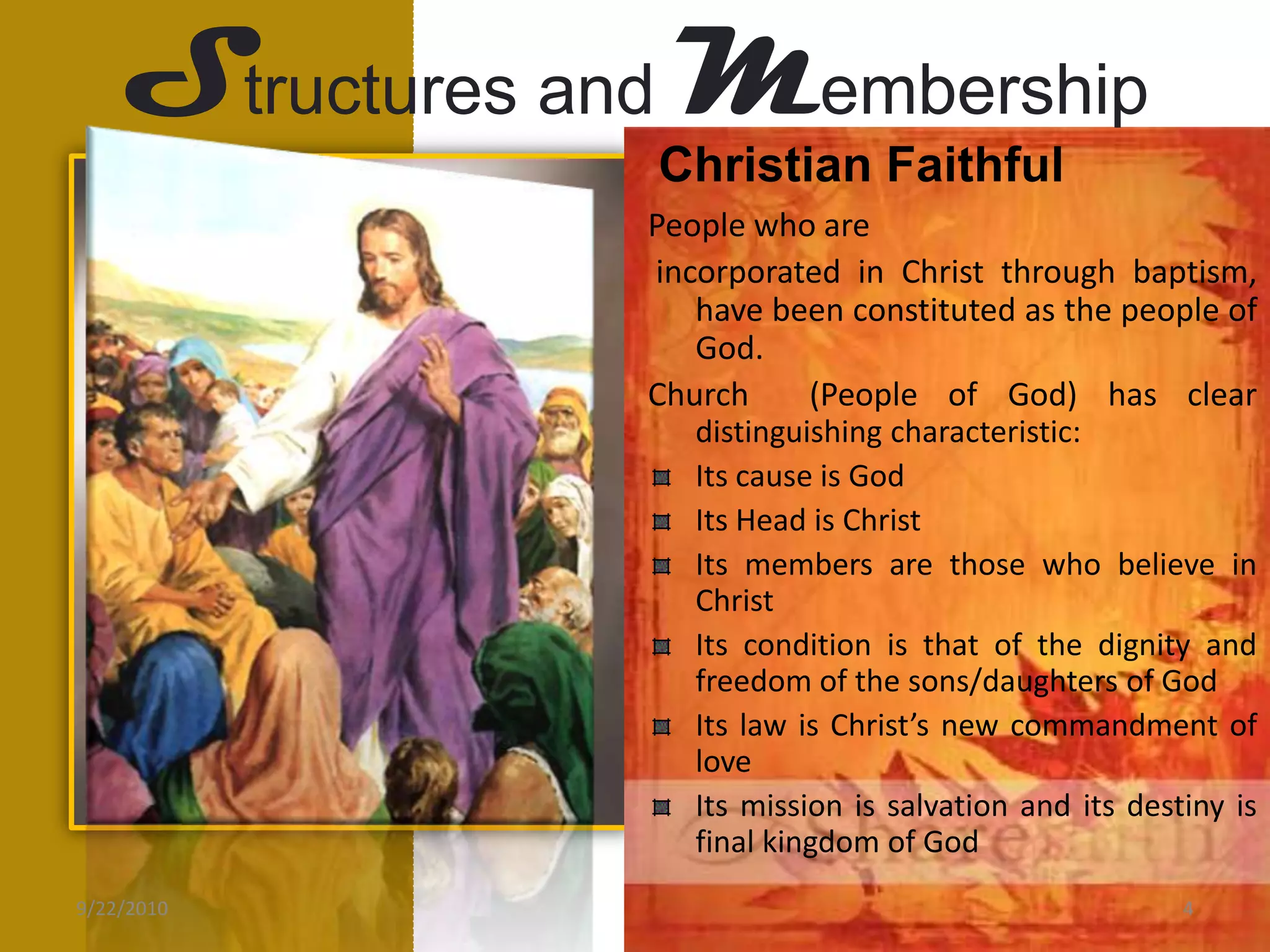
Structures andMembershipChristian FaithfulPeople who are incorporated in Christ through baptism, have been constituted as the people of God.Church  (People of God) has clear distinguishing characteristic:Its cause is GodIts Head is Christ Its members are those who believe in ChristIts condition is that of the dignity and freedom of the sons/daughters of GodIts law is Christ’s new commandment of loveIts mission is salvation and its destiny is final kingdom of God9/21/20104
Structures andMembershipHierarchical Constitution of the ChurchPopeCardinalateEpiscopatePriestDeaconslaity'All the faithful, from the Pope to the child who has just been baptized share in one and the same grace.'[7] Nonetheless, when it is affirmed that the Church is a hierarchical society we are in substance saying that in spite of the 'radical or fundamental equality' which is to be found among the People of God, the Church has structures, features and differentiations by virtue of which she is a society in which there is a 'functional inequality.'[8] That is to say: not all the faithful have the same function or mission. For this reason Pope St. Pius X could say that 'the Church is essentially an unequal society, that is, a society composed of two types of people: shepherds and sheep.Christ is Himself of the source of ministry in the ChurchHe instituted the ChurchHe his authority and mission, orientation and goala system of persons or things arranged in a graded order the way in which a thing is composed or made up;9/21/20105
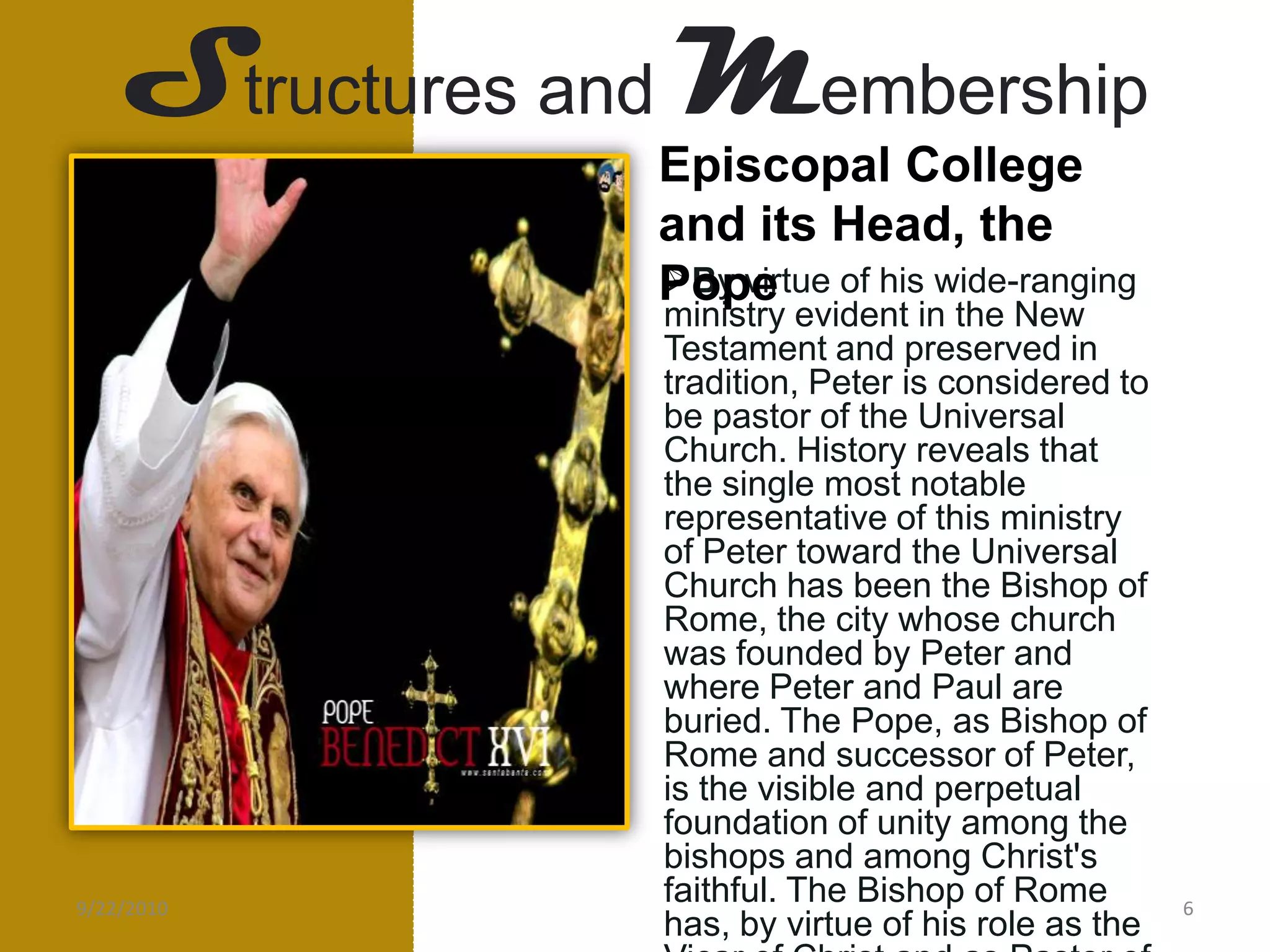
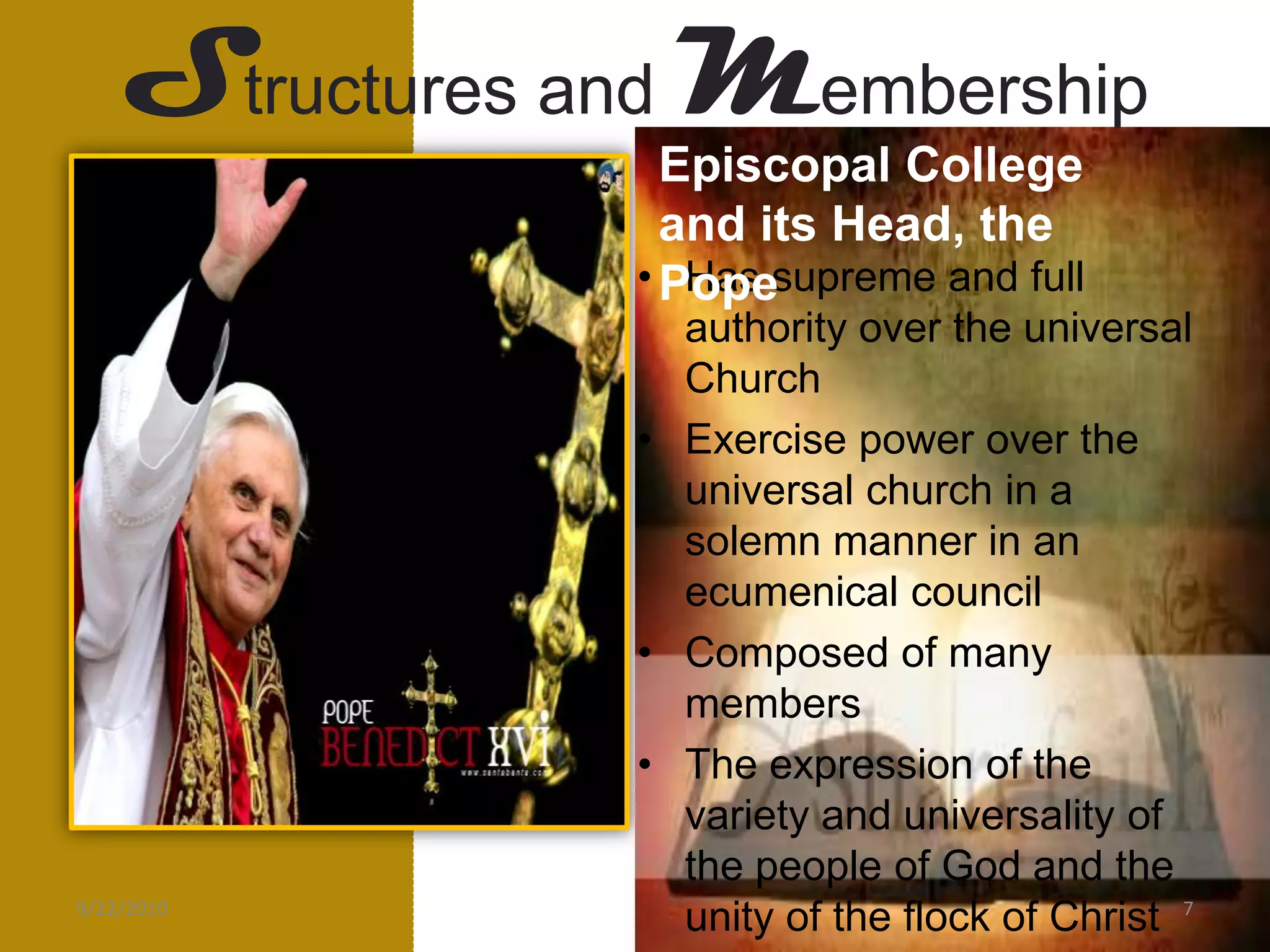
Structures andMembershipEpiscopal College and its Head, the PopeBy virtue of his wide-ranging ministry evident in the New Testament and preserved in tradition, Peter is considered to be pastor of the Universal Church. History reveals that the single most notable representative of this ministry of Peter toward the Universal Church has been the Bishop of Rome, the city whose church was founded by Peter and where Peter and Paul are buried. The Pope, as Bishop of Rome and successor of Peter, is the visible and perpetual foundation of unity among the bishops and among Christ's faithful. The Bishop of Rome has, by virtue of his role as the Vicar of Christ and as Pastor of the entire Church, a full, supreme and universal authority. The college of bishops, when united to the Pope, has a similar authority. 9/21/20106
Structures andMembershipEpiscopal College and its Head, the PopeHas supreme and full authority over the universal ChurchExercise power over the universal church in a solemn manner in an ecumenical councilComposed of many members The expression of the variety and universality of the people of God and the unity of the flock of ChristPETER- the “rock” of the church
`Key of His Church
Shepherd of the whole flock
POPE- vicar of Christ9/21/20107
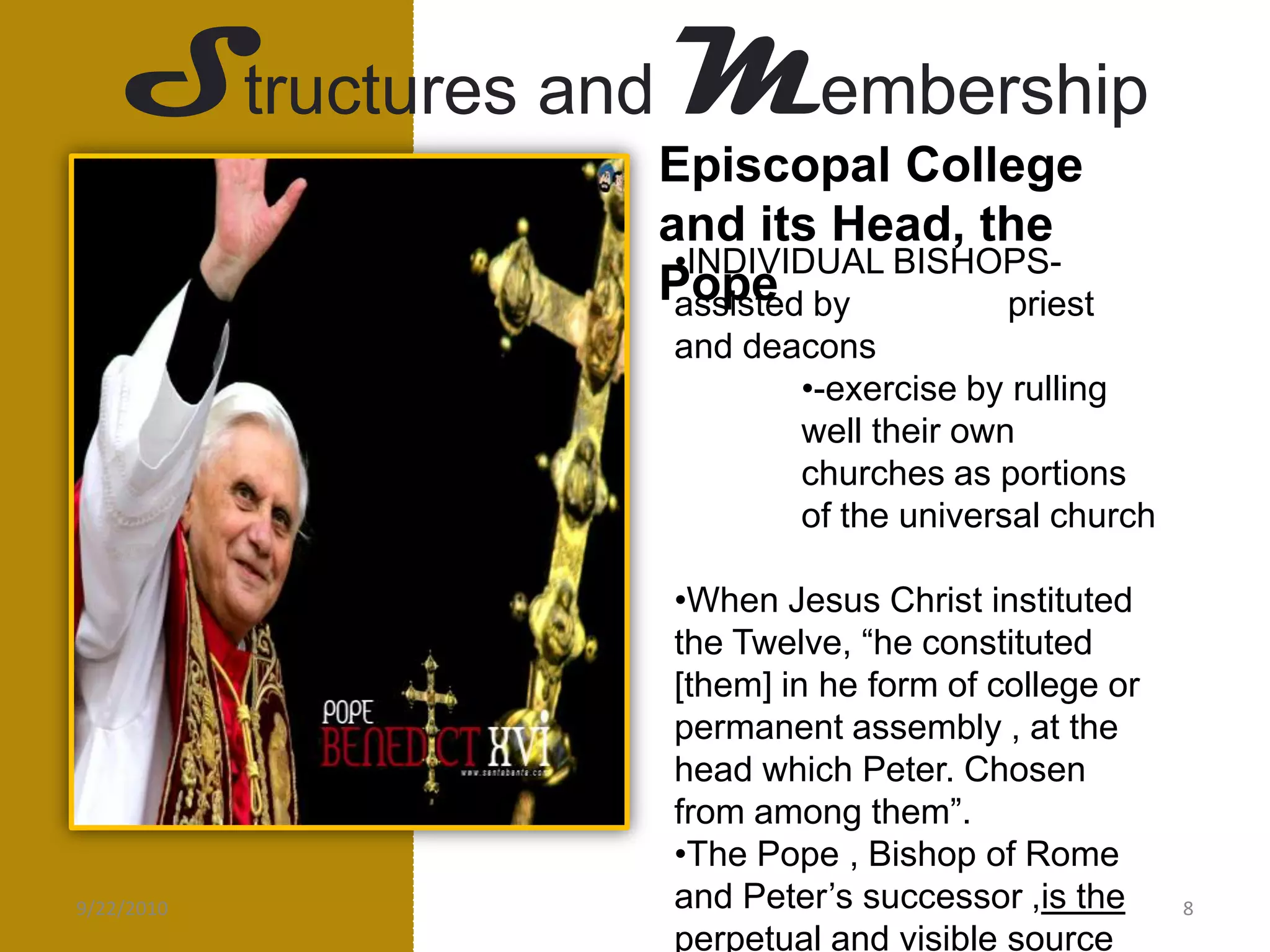
Structures andMembershipEpiscopal College and its Head, the PopeINDIVIDUAL BISHOPS-assisted by 		priest and deacons
-exercise by rulling well their own churches as portions of the universal church
When Jesus Christ instituted the Twelve, “he constituted [them] in he form of college or permanent assembly , at the head which Peter. Chosen from among them”.
The Pope , Bishop of Rome and Peter’s successor ,is the perpetual and visible source and foundation of the unity both of bishops and the whole company of the faithful. 9/21/20108
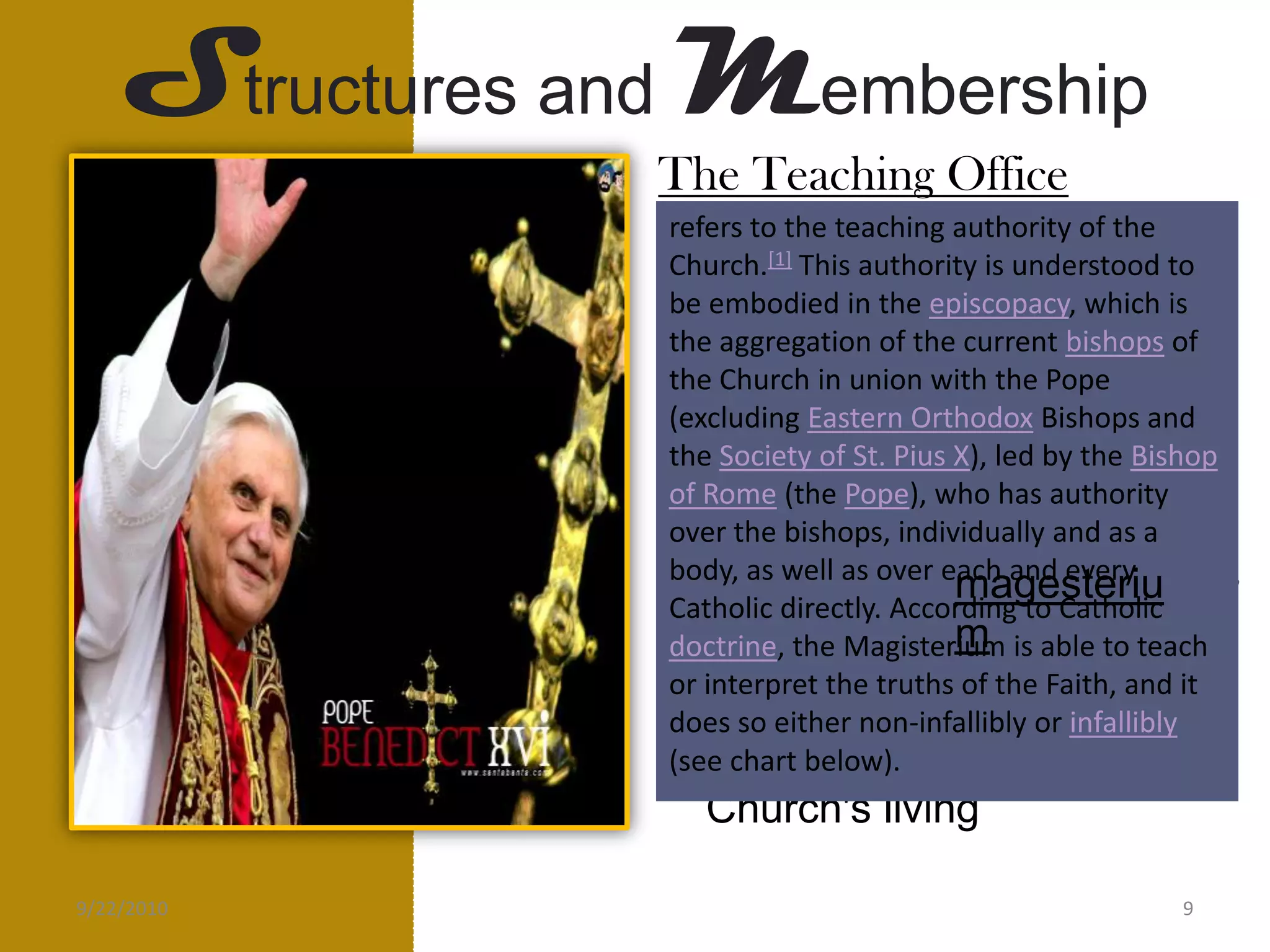
Structures andMembershipThe Teaching OfficeBishops, with priest as co workersto preach the Gospel of God to all 			     men (in keeping the                 		Lord’s command)Authentic teachers of the apostolic faithful	By a “supernatural sense of faith,” the people of God under the guidance of the     Church's livingrefers to the teaching authority of the Church.[1] This authority is understood to be embodied in the episcopacy, which is the aggregation of the current bishops of the Church in union with the Pope (excluding Eastern Orthodox Bishops and the Society of St. Pius X), led by the Bishop of Rome (the Pope), who has authority over the bishops, individually and as a body, as well as over each and every Catholic directly. According to Catholic doctrine, the Magisterium is able to teach or interpret the truths of the Faith, and it does so either non-infallibly or infallibly (see chart below).magesterium9/21/20109
Structures andMembershipThe Teaching OfficePastoral duty-the people of God abides in the truths liberates9/21/201010
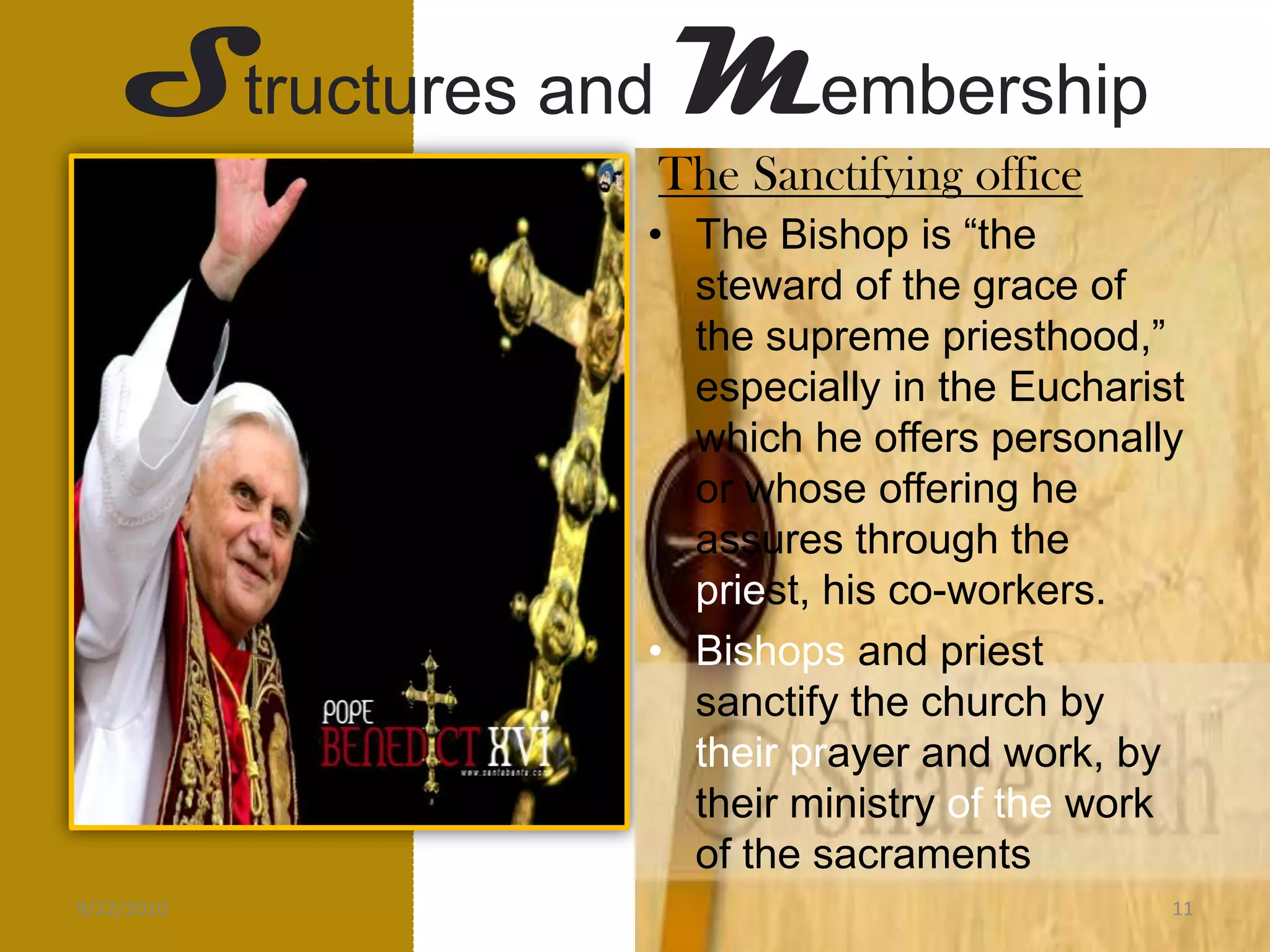
Structures andMembershipThe Sanctifying officeThe Bishop is “the steward of the grace of the supreme priesthood,” especially in the Eucharist which he offers personally or whose offering he assures through the priest, his co-workers.Bishops and priest sanctify the church by theirprayer and work, by their ministry of the work of the sacraments9/21/201011
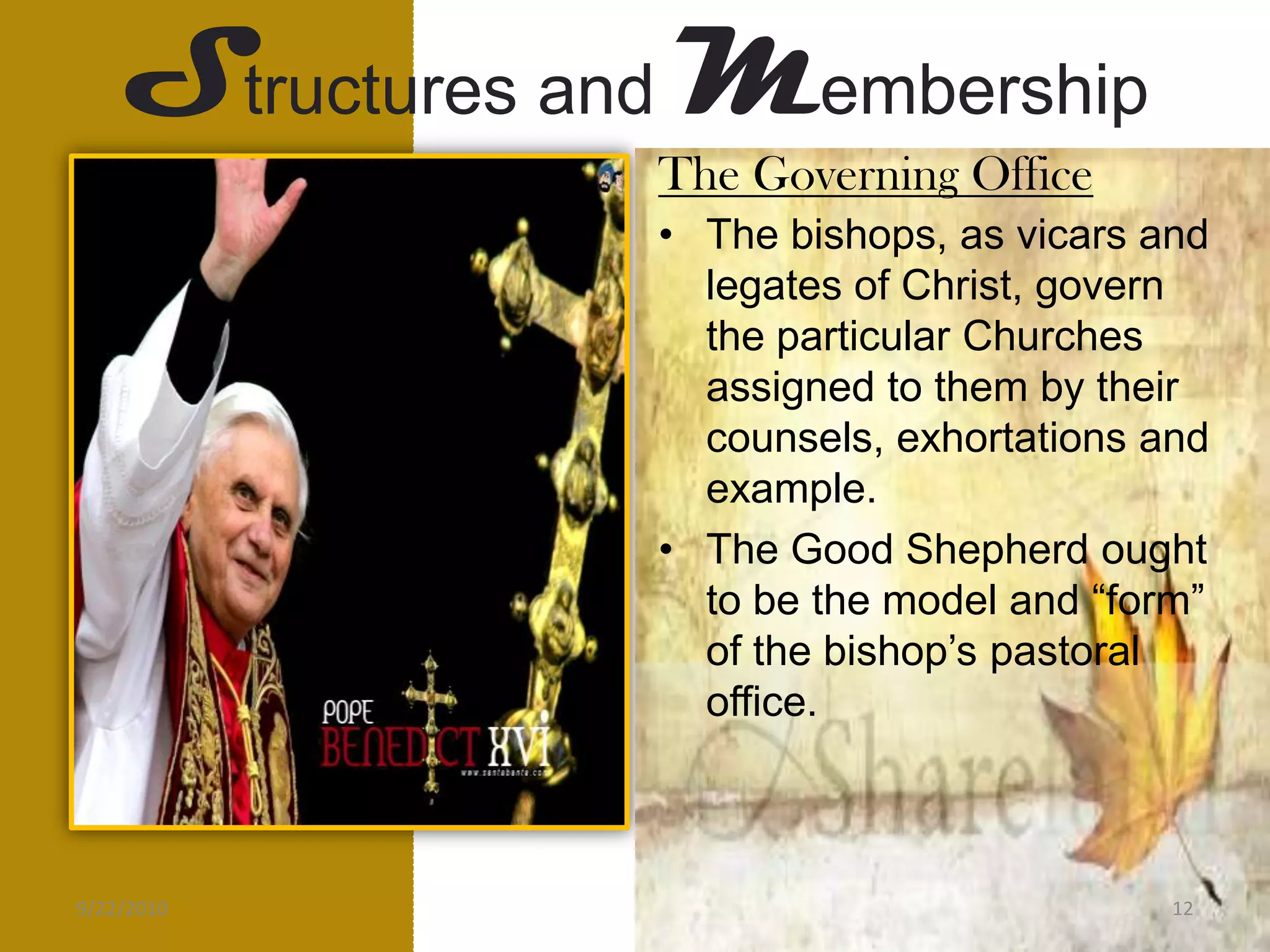
Structures andMembershipThe Governing OfficeThe bishops, as vicars and legates of Christ, govern the particular Churches assigned to them by their counsels, exhortations and example.The Good Shepherd ought to be the model and “form” of the bishop’s pastoral office.9/21/201012
Structures andMembershipThe InfallibilityTrough the Spirit, Christ bestowed on his Church, in particular on the college of Bishops teaching in communion with Peter’s successors, the gift infallibility. 9/21/201013

Reed

  • 1.
    The ChurchStructures andMembership;The Catholic MembershipGroup III9/21/2010page1 of 20
  • 2.
    Structures andMembershipChristian FaithfulHierarchicalConstitution of the ChurchEpiscopal College and its Head, the PopeLaityThe Consecrated Life9/21/20102
  • 3.
  • 4.
    Structures andMembershipChristian FaithfulPeoplewho are incorporated in Christ through baptism, have been constituted as the people of God.Church (People of God) has clear distinguishing characteristic:Its cause is GodIts Head is Christ Its members are those who believe in ChristIts condition is that of the dignity and freedom of the sons/daughters of GodIts law is Christ’s new commandment of loveIts mission is salvation and its destiny is final kingdom of God9/21/20104
  • 5.
    Structures andMembershipHierarchical Constitutionof the ChurchPopeCardinalateEpiscopatePriestDeaconslaity'All the faithful, from the Pope to the child who has just been baptized share in one and the same grace.'[7] Nonetheless, when it is affirmed that the Church is a hierarchical society we are in substance saying that in spite of the 'radical or fundamental equality' which is to be found among the People of God, the Church has structures, features and differentiations by virtue of which she is a society in which there is a 'functional inequality.'[8] That is to say: not all the faithful have the same function or mission. For this reason Pope St. Pius X could say that 'the Church is essentially an unequal society, that is, a society composed of two types of people: shepherds and sheep.Christ is Himself of the source of ministry in the ChurchHe instituted the ChurchHe his authority and mission, orientation and goala system of persons or things arranged in a graded order the way in which a thing is composed or made up;9/21/20105
  • 6.
    Structures andMembershipEpiscopal Collegeand its Head, the PopeBy virtue of his wide-ranging ministry evident in the New Testament and preserved in tradition, Peter is considered to be pastor of the Universal Church. History reveals that the single most notable representative of this ministry of Peter toward the Universal Church has been the Bishop of Rome, the city whose church was founded by Peter and where Peter and Paul are buried. The Pope, as Bishop of Rome and successor of Peter, is the visible and perpetual foundation of unity among the bishops and among Christ's faithful. The Bishop of Rome has, by virtue of his role as the Vicar of Christ and as Pastor of the entire Church, a full, supreme and universal authority. The college of bishops, when united to the Pope, has a similar authority. 9/21/20106
  • 7.
    Structures andMembershipEpiscopal Collegeand its Head, the PopeHas supreme and full authority over the universal ChurchExercise power over the universal church in a solemn manner in an ecumenical councilComposed of many members The expression of the variety and universality of the people of God and the unity of the flock of ChristPETER- the “rock” of the church
  • 8.
  • 9.
    Shepherd of thewhole flock
  • 10.
    POPE- vicar ofChrist9/21/20107
  • 11.
    Structures andMembershipEpiscopal Collegeand its Head, the PopeINDIVIDUAL BISHOPS-assisted by priest and deacons
  • 12.
    -exercise by rullingwell their own churches as portions of the universal church
  • 13.
    When Jesus Christinstituted the Twelve, “he constituted [them] in he form of college or permanent assembly , at the head which Peter. Chosen from among them”.
  • 14.
    The Pope ,Bishop of Rome and Peter’s successor ,is the perpetual and visible source and foundation of the unity both of bishops and the whole company of the faithful. 9/21/20108
  • 15.
    Structures andMembershipThe TeachingOfficeBishops, with priest as co workersto preach the Gospel of God to all men (in keeping the Lord’s command)Authentic teachers of the apostolic faithful By a “supernatural sense of faith,” the people of God under the guidance of the Church's livingrefers to the teaching authority of the Church.[1] This authority is understood to be embodied in the episcopacy, which is the aggregation of the current bishops of the Church in union with the Pope (excluding Eastern Orthodox Bishops and the Society of St. Pius X), led by the Bishop of Rome (the Pope), who has authority over the bishops, individually and as a body, as well as over each and every Catholic directly. According to Catholic doctrine, the Magisterium is able to teach or interpret the truths of the Faith, and it does so either non-infallibly or infallibly (see chart below).magesterium9/21/20109
  • 16.
    Structures andMembershipThe TeachingOfficePastoral duty-the people of God abides in the truths liberates9/21/201010
  • 17.
    Structures andMembershipThe SanctifyingofficeThe Bishop is “the steward of the grace of the supreme priesthood,” especially in the Eucharist which he offers personally or whose offering he assures through the priest, his co-workers.Bishops and priest sanctify the church by theirprayer and work, by their ministry of the work of the sacraments9/21/201011
  • 18.
    Structures andMembershipThe GoverningOfficeThe bishops, as vicars and legates of Christ, govern the particular Churches assigned to them by their counsels, exhortations and example.The Good Shepherd ought to be the model and “form” of the bishop’s pastoral office.9/21/201012
  • 19.
    Structures andMembershipThe InfallibilityTroughthe Spirit, Christ bestowed on his Church, in particular on the college of Bishops teaching in communion with Peter’s successors, the gift infallibility. 9/21/201013
  • 20.
    Structures andMembershipLaityThe term “laity” is here understood to mean all the faithful except those in Holy Orders and those who belong to a religious state approved by the church.the body of the faithful, outside of the ranks of the clergy9/21/201014
  • 21.
    Structures andMembershipLaityThey arethose members of the church who are not in Holy Orders nor in the religious state; they form the greater bulk of ecclesiastical societyThey work in their own way to evangelize and sanctify the worldRole of Laity share in the priestly, prophetic and royal office of Christ and therefore have their own share in the mission of the whole people of God in the Church and in the world
  • 22.
    Exercise the apostolatein fact by their activity directed to evangelization and sanctifying 9/21/201015
  • 23.
    Structures andMembershipLaityLay ApostolateThe ministries of the lay faithful are founded in the Sacrament of Baptism and Confirmation..in the Sacrament of Matrimony.9/21/201016
  • 24.
    Structures andMembershipThe ConsecratedLifeThose faithful who bind themselves to Christ in a state of life consecrated to Godreferred to as the "Religious Life", denotes a stable form of Christian living by those faithful who feel called to follow Jesus Christ in a more exacting way recognized by the Church9/21/201017
  • 25.
    The Catholic UnityGodhas willed to make men holy and save them, not merely as an individuals without any bonds, but by making them into a single people, a people which acknowledges Him in truth and serves Him in holinessAll men are called to His Catholic unity which prefigures and promotes universal peace. And in different ways to it belong, or are related: the Catholic faithful, others who believe in Christ, and finally all man kind, called BY God’s grace to salvation . We are to consider the Nature of CATHOLIC UNITY, as comprehended constitutionally in the idea of the Christian Church.Catholic –a member of a Catholic church, esp. of the Roman Catholic Church. universalChristian -a person who believes in Jesus Christ; adherent of Christianity. 9/21/201018
  • 26.
    Eph. IV. 4-6.–Thereis one body and one Spirit, even as ye are called in one hope of your calling; one Lord, one faith, one baptism; one God and Father of all, who is above all, and through all, and in you all.9/21/201019

Editor's Notes

  • #2 Please leave us a 5 star rating on Microsoft’s Template site if you enjoy this template! Welcome to Super Easy Templates: This is an 8 x 11 PowerPoint presentation that consists of one design slide or title page. We provide easy-to-use and customize templates for home and business use. Most of our templates are for PowerPoint 2007 and Word 2007. If you are interested in additional templates, visit our website: www.supereasytemplates.com. We specialize in creating and designing positive, multi-cultural presentations, posters, postcards, and other media for home and business use! If you require technical support on this specific presentation, email us: support@supereasytemplates.com. Also, check the Microsoft forums for specialized assistance. Although we try to respond to all support requests, please realize that this is a free service and we cannot guarantee a timely response. All questions and answers are usually posted on our FAQ pages.