Exploring Flexible Working
and Family Friendly Rights
David Poddington, Partner
Tom Draper, Associate
Kelly Gibson, Legal Executive
Rebecca Hutchinson, Trainee Legal Executive
22 September 2016
“ the material for this seminar has been prepared solely for the benefit of delegates on this seminar. It should not be relied upon
for giving advice and Taylor&Emmet LLP accept no responsibility for loss or consequential losses incurred as a result of
reliance on this material”.
Programme
Family friendly rights and flexible working: the what and the
why?
How to handle flexible working requests
Indirect discrimination
Homeworking pitfalls
Experiences of shared parental leave
Maternity leave and redundancy
New developments
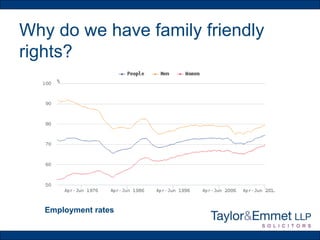
Why do we have family friendly
rights?
Employment rates
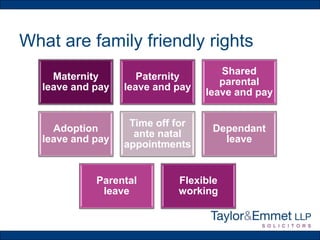
What are family friendly rights
Maternity
leave and pay
Paternity
leave and pay
Shared
parental
leave and pay
Adoption
leave and pay
Time off for
ante natal
appointments
Dependant
leave
Parental
leave
Flexible
working
What is flexible working?
Updated Regulations came into force in June 2014
Now all employees with over 26 weeks’ service can request
to work flexibly for any reason
One request permitted every 12 months
Results in permanent change to terms and conditions
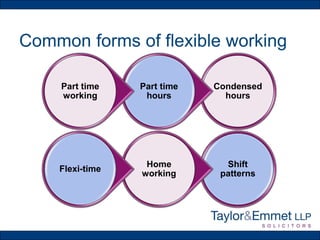
Common forms of flexible working
Condensed
hours
Part time
hours
Part time
working
Shift
patterns
Home
working
Flexi-time
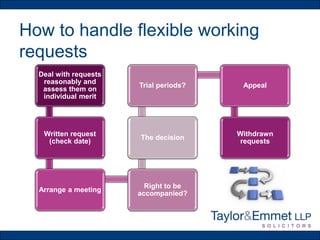
How to handle flexible working
requests
Deal with requests
reasonably and
assess them on
individual merit
Written request
(check date)
Arrange a meeting
Right to be
accompanied?
The decision
Trial periods? Appeal
Withdrawn
requests
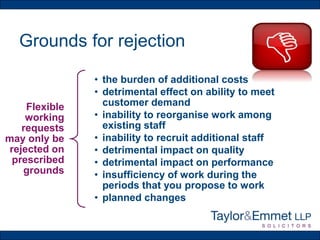
Grounds for rejection
Flexible
working
requests
may only be
rejected on
prescribed
grounds
• the burden of additional costs
• detrimental effect on ability to meet
customer demand
• inability to reorganise work among
existing staff
• inability to recruit additional staff
• detrimental impact on quality
• detrimental impact on performance
• insufficiency of work during the
periods that you propose to work
• planned changes
Flexible working v business needs
An employee in a call centre
requests to change his working
hours from 9-5 to 7-3 to enable him
to pick his children up from school.
However, the phone lines do not
become busy until after 9am so
there is insufficient work for the
employee to do and no alternative
duties he can undertake. It is likely
that his request could therefore
reasonably be refused due to
insufficiency of work.
Two management employees apply
for a post as a proposed job-share,
but both wish to work three days
per week.
The business cannot afford the
increased payroll cost, and
proposes that both employees work
2.5 days. However, the employees
will not compromise and therefore it
is likely their request can be
reasonably refused on costs
grounds.
Completing requests
What criteria might you consider?
First come, first served?
Practical discussions with the employees
Setting precedents?
Indirect discrimination
What is
discrimination
• Rejecting flexible working requests could have
negative disproportionate impact on groups with
certain protected characteristics (sex or disability)
• Under the Equality Act 2010, indirect discrimination
occurs where A applies to B an apparently neutral
provision, criterion or practice (PCP) that A would
apply equally to others, but which puts or would put
those who share B’s protected characteristic at a
particular disadvantage. If the PCP cannot be
objectively justified, discrimination will occur
Example:
A woman with less than 26 weeks' continuous service wishes to work part-time
due to her childcare arrangements. She makes a request for part-time working
without following your Flexible Working Policy. This employee may have an
indirect sex discrimination claim if her request is rejected
Claims for breach of flexible working
regulations
Remedies for breach of statutory scheme:
• An order for reconsideration of the request (the date of the
tribunal's order will be treated as the date of the request)
• An award of compensation to be paid by the employer to the
employee, of such amount as the tribunal considers just and
equitable, up to 8 weeks’ pay
Discrimination claims – injury to feelings
Constructive dismissal claims
Case Study
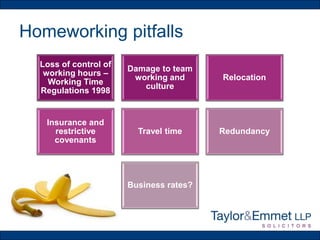
Homeworking pitfalls
Loss of control of
working hours –
Working Time
Regulations 1998
Damage to team
working and
culture
Relocation
Insurance and
restrictive
covenants
Travel time Redundancy
Business rates?
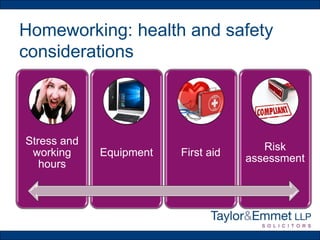
Homeworking: health and safety
considerations
Stress and
working
hours
Equipment First aid
Risk
assessment
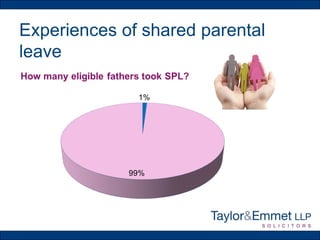
Experiences of shared parental
leave
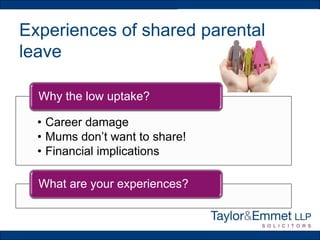
Experiences of shared parental
leave
• Career damage
• Mums don’t want to share!
• Financial implications
Why the low uptake?
What are your experiences?
Maternity leave protections
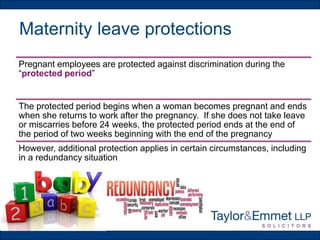
Pregnant employees are protected against discrimination during the
“protected period”
The protected period begins when a woman becomes pregnant and ends
when she returns to work after the pregnancy. If she does not take leave
or miscarries before 24 weeks, the protected period ends at the end of
the period of two weeks beginning with the end of the pregnancy
However, additional protection applies in certain circumstances, including
in a redundancy situation
Maternity leave and dismissal
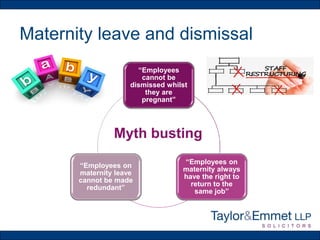
“Employees
cannot be
dismissed whilst
they are
pregnant”
“Employees on
maternity always
have the right to
return to the
same job”
“Employees on
maternity leave
cannot be made
redundant”
Myth busting
Maternity leave and
redundancy
Right to be automatically placed into suitable alternative
role in preference to any other employee (male or female)
Fairly apply selection criteria (if appropriate)
Consult with any employee on maternity leave
New developments
Shared Grandparental Leave
Childcare vouchers
Gender pay gap reporting
30 hours free childcare per week for working parents
Enhanced maternity rights?
Brexit…
Any questions
Exploring Flexible Working &
Family Friendly Rights
• Employment Law Advice
• HR Training
• T&E Complete – all inclusive employment protection package
• Corporate Finance
• Commercial Law advice
• Commercial Litigation
• Commercial Property
• Property Litigation
• Debt Recovery
• Social Housing

Exploring flexible working family friendly rights

  • 1.
    Exploring Flexible Working andFamily Friendly Rights David Poddington, Partner Tom Draper, Associate Kelly Gibson, Legal Executive Rebecca Hutchinson, Trainee Legal Executive 22 September 2016 “ the material for this seminar has been prepared solely for the benefit of delegates on this seminar. It should not be relied upon for giving advice and Taylor&Emmet LLP accept no responsibility for loss or consequential losses incurred as a result of reliance on this material”.
  • 2.
    Programme Family friendly rightsand flexible working: the what and the why? How to handle flexible working requests Indirect discrimination Homeworking pitfalls Experiences of shared parental leave Maternity leave and redundancy New developments
  • 3.
    Why do wehave family friendly rights? Employment rates
  • 4.
    What are familyfriendly rights Maternity leave and pay Paternity leave and pay Shared parental leave and pay Adoption leave and pay Time off for ante natal appointments Dependant leave Parental leave Flexible working
  • 5.
    What is flexibleworking? Updated Regulations came into force in June 2014 Now all employees with over 26 weeks’ service can request to work flexibly for any reason One request permitted every 12 months Results in permanent change to terms and conditions
  • 6.
    Common forms offlexible working Condensed hours Part time hours Part time working Shift patterns Home working Flexi-time
  • 7.
    How to handleflexible working requests Deal with requests reasonably and assess them on individual merit Written request (check date) Arrange a meeting Right to be accompanied? The decision Trial periods? Appeal Withdrawn requests
  • 8.
    Grounds for rejection Flexible working requests mayonly be rejected on prescribed grounds • the burden of additional costs • detrimental effect on ability to meet customer demand • inability to reorganise work among existing staff • inability to recruit additional staff • detrimental impact on quality • detrimental impact on performance • insufficiency of work during the periods that you propose to work • planned changes
  • 9.
    Flexible working vbusiness needs An employee in a call centre requests to change his working hours from 9-5 to 7-3 to enable him to pick his children up from school. However, the phone lines do not become busy until after 9am so there is insufficient work for the employee to do and no alternative duties he can undertake. It is likely that his request could therefore reasonably be refused due to insufficiency of work. Two management employees apply for a post as a proposed job-share, but both wish to work three days per week. The business cannot afford the increased payroll cost, and proposes that both employees work 2.5 days. However, the employees will not compromise and therefore it is likely their request can be reasonably refused on costs grounds.
  • 10.
    Completing requests What criteriamight you consider? First come, first served? Practical discussions with the employees Setting precedents?
  • 11.
    Indirect discrimination What is discrimination •Rejecting flexible working requests could have negative disproportionate impact on groups with certain protected characteristics (sex or disability) • Under the Equality Act 2010, indirect discrimination occurs where A applies to B an apparently neutral provision, criterion or practice (PCP) that A would apply equally to others, but which puts or would put those who share B’s protected characteristic at a particular disadvantage. If the PCP cannot be objectively justified, discrimination will occur Example: A woman with less than 26 weeks' continuous service wishes to work part-time due to her childcare arrangements. She makes a request for part-time working without following your Flexible Working Policy. This employee may have an indirect sex discrimination claim if her request is rejected
  • 12.
    Claims for breachof flexible working regulations Remedies for breach of statutory scheme: • An order for reconsideration of the request (the date of the tribunal's order will be treated as the date of the request) • An award of compensation to be paid by the employer to the employee, of such amount as the tribunal considers just and equitable, up to 8 weeks’ pay Discrimination claims – injury to feelings Constructive dismissal claims
  • 13.
  • 14.
    Homeworking pitfalls Loss ofcontrol of working hours – Working Time Regulations 1998 Damage to team working and culture Relocation Insurance and restrictive covenants Travel time Redundancy Business rates?
  • 15.
    Homeworking: health andsafety considerations Stress and working hours Equipment First aid Risk assessment
  • 16.
    Experiences of sharedparental leave
  • 17.
    Experiences of sharedparental leave • Career damage • Mums don’t want to share! • Financial implications Why the low uptake? What are your experiences?
  • 18.
    Maternity leave protections Pregnantemployees are protected against discrimination during the “protected period” The protected period begins when a woman becomes pregnant and ends when she returns to work after the pregnancy. If she does not take leave or miscarries before 24 weeks, the protected period ends at the end of the period of two weeks beginning with the end of the pregnancy However, additional protection applies in certain circumstances, including in a redundancy situation
  • 19.
    Maternity leave anddismissal “Employees cannot be dismissed whilst they are pregnant” “Employees on maternity always have the right to return to the same job” “Employees on maternity leave cannot be made redundant” Myth busting
  • 20.
    Maternity leave and redundancy Rightto be automatically placed into suitable alternative role in preference to any other employee (male or female) Fairly apply selection criteria (if appropriate) Consult with any employee on maternity leave
  • 21.
    New developments Shared GrandparentalLeave Childcare vouchers Gender pay gap reporting 30 hours free childcare per week for working parents Enhanced maternity rights? Brexit…
  • 22.
  • 23.
    Exploring Flexible Working& Family Friendly Rights • Employment Law Advice • HR Training • T&E Complete – all inclusive employment protection package • Corporate Finance • Commercial Law advice • Commercial Litigation • Commercial Property • Property Litigation • Debt Recovery • Social Housing