Recruitment, Training, Evaluation &
Compensation to a Pharmacist
Ms. N. K. Mujawar
M. Pharm (Pharmaceutics)
Assistant Professor,
Shri. Balasaheb Mane Shikshan Prasarak Mandal Ambaps
WOMENS COLLEGE OF PHARMACY, PETH-VADGAON, Kolhapur
Maharashtra.
Recruitment
Recruitment is the process of exploring the source of supply of the required
person and stimulating the prospective employees to apply for job in the
organization.
• The recruitment of pharmacist in Government Sector is done by State or
Central Government Agencies such as Service Selection Board (Ex SSC, MPSC
etc)
• In Private Sector like recruitment as salesman, store pharmacist, Company
jobs recruitment done by either by owner of store departmental head of
company or HR department
• An Advertisement can be given in the leading daily news papers, popular
magazines and professional journals.
• The detailed description of the post is given and interested candidate are
required to submit bio data, resume.
There are two types of Sources of recruitment:
1. Internal Sources:
-The recruitment is done among the personnel already on the pay roll of
an organization.
-Whenever any vacancy occurs, somebody from within organization is
upgraded, transferred, and promoted.
-Less costly, job securities but it often leads to inbreeding and
discourages new blood from entering an organization.
2.External Sources:
-Out side the organization.
-Includes young mostly inexperienced potential employees, trained
unemployed and retired experienced person.
Methods of Recruitment
1.Direct methods: Team is sent to college/universities which conducts
pharmacy course(degree/diploma).Recruitment done with co-
operation with placement cell of college.
2.Indirect methods: Advertisement is generally give in leading
newspaper, popular magazines and professional journals. Prescribed
proforma before last date.
3.Third party methods: Use of commercial or private employment
agencies, placement office of the institutions, recruiting firms and
management consulting firms.
• Selection
A well organized selection procedure has to be adopted to select suitable
candidates for various jobs. The following procedure generally adopted for
selection.
1. Scrutiny of Application
2. Preliminary Interview
3. Selection Test
4. Selection Interview
5. Physical Examination
6. Reference Check
7. Final Selection
8. Placement
1.Scrutiny of Application:
The application received up to due date are carefully scrutinized. The
incomplete application, and those candidates are not fulfil the require
eligibility are rejected.
2. Preliminary Interview:
The candidates are considered and eligible suitable on the basis of their
applications are called for preliminary interview. This is generally brief
interview.
3. Selection Test:
The selection test it may be written or oral test. The technical knowledge
and administrate capability can be judged from these test. Now a days
Psychological Test is carried out in this test.
The following tests are commonly used in the selection process: -
a. Intelligence Tests (Estimate IQ, mental alertness)
b. Aptitude Tests (measure capacity to learn skill, potential)
c. Trade Tests (Measure level of knowledge, and skill)
also called as Performance Test.
d. Personality Tests (Find out emotional balance, maturity etc.)
4. Selection Interview:
A face to face dialogue between the interviewer and candidate. It is a
most popular technique of selection.
The main purpose of selection interview is:
a) To find out the suitability of candidate,
b) To cross check the information reveled in the application and the test.,
c) To give the candidate accurate picture of his job and the enterprise
5. Physical Examination:
Physical Examination is of the candidate is conducted to ensure that he is
physically fit for the job. Those are suffering from any disease or disability he is
rejected.
6. Reference Check:
Usually the candidates are required to write in their application two importance
reference of persons who know the candidate.
7. Final Selection and placement:
The candidates who have been found suitable in all respects are appointed by
issuing appointment letter to them. Appointed on probation period a successful
completion of these period they are made permanent employee.
• Training
-Training is the scientific process of improving the knowledge and skill of
employee for doing a particular job.
-Training is an organized activity through which people learn, acquire, and
adopt new skills and knowledge regarding to job.
• Training should be cover following subjects:
1. Rules and policies of organization
2. Routine Work, Technical knowledge, Discussion regarding to current
trends
3. Dealing Trends with customers, Highlighting technique of new product.
4.The technical knowledge of selling products of the firm which are
given in its booklets, pamphlates,films and brouchers.
5.Discussion on the location of the various lines of merchandise in
the drug store, so that when a customer makes enquiries about the
required goods, the salesman should be in a position to show and
discuss it promptly.
6.The highlights of new products should be discussed whenever it
arrives in the drug store so that each salesman of the drug store
gets acquainted with it.
• Types of Training:
1. Induction Training
2. Promotional Training
3. Refresher Training
4. Job Training
5. Safety Training
1. Induction Training: It is refer to introducing the new employee to the
organization as well as existing staff.
2. Promotional Training: In many organizations, training is given to the
existing employees to meet the requirements of the higher post.
3. Refresher Training: The training is given to the employee in order to
update their knowledge with respect to the latest development in their
respective field.
PCI organized various workshops
4.Job Training: The training is given to the newly recruited employees.
The instructions are given by a supervisor to the new workers.
5.Safety Training: The training is given to the workers to handles the
dangerous machines and material in order to avoid any fatal accidents.
Method of Training
• Following two methods are used for training the employee...
A. On the job training
B. Off the job training
A.On the job training: It is a practical training given to the employees, so
that they can learn while working in the organization.
They are having following types of the training....
1. Coaching and Counselling:
2. Vestibule Training: give after selection.
3. Apprenticeship Training:
4. Job Rotation Training:
5. Under Study Training: Give to promoted employee
6. Special Project Training:
7. Committee Assignment:
8. Junior Board:
B. Off the Job Training
1.Lectures, Conferences and Seminars:
2.Special Course:
3.Case Study:
4.Role Playing:
5.Sensitivity Training:
6.Brain Storming:
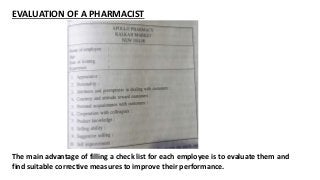
EVALUATION OF A PHARMACIST
The main advantage of filling a check list for each employee is to evaluate them and
find suitable corrective measures to improve their performance.
COMPENSATION TO THE PHARMACIST
Majority of the drug stores find it difficult to retain good employees.
Adequate compensation helps in retaining good employees and
encourage them to work whole heartedly.
-In order to maintain the interest of an employee in his job, the
compensation plan may cover the following points
1.Adequacy
2.Simplicity
3.Incentive
4.Proportionate award
5.Flexibility
6.Promotion
7.Uniform earning
Reference
1.Drug store & Business management by Mohammed Ali & Jyoti.
2.Drug Store and Business Management by R. M. Mheta.
Recruitment,Training,Evaluation & Compensation to a Pharmacist

Recruitment,Training,Evaluation & Compensation to a Pharmacist

  • 1.
    Recruitment, Training, Evaluation& Compensation to a Pharmacist Ms. N. K. Mujawar M. Pharm (Pharmaceutics) Assistant Professor, Shri. Balasaheb Mane Shikshan Prasarak Mandal Ambaps WOMENS COLLEGE OF PHARMACY, PETH-VADGAON, Kolhapur Maharashtra.
  • 2.
    Recruitment Recruitment is theprocess of exploring the source of supply of the required person and stimulating the prospective employees to apply for job in the organization. • The recruitment of pharmacist in Government Sector is done by State or Central Government Agencies such as Service Selection Board (Ex SSC, MPSC etc) • In Private Sector like recruitment as salesman, store pharmacist, Company jobs recruitment done by either by owner of store departmental head of company or HR department • An Advertisement can be given in the leading daily news papers, popular magazines and professional journals. • The detailed description of the post is given and interested candidate are required to submit bio data, resume.
  • 3.
    There are twotypes of Sources of recruitment: 1. Internal Sources: -The recruitment is done among the personnel already on the pay roll of an organization. -Whenever any vacancy occurs, somebody from within organization is upgraded, transferred, and promoted. -Less costly, job securities but it often leads to inbreeding and discourages new blood from entering an organization. 2.External Sources: -Out side the organization. -Includes young mostly inexperienced potential employees, trained unemployed and retired experienced person.
  • 4.
    Methods of Recruitment 1.Directmethods: Team is sent to college/universities which conducts pharmacy course(degree/diploma).Recruitment done with co- operation with placement cell of college. 2.Indirect methods: Advertisement is generally give in leading newspaper, popular magazines and professional journals. Prescribed proforma before last date. 3.Third party methods: Use of commercial or private employment agencies, placement office of the institutions, recruiting firms and management consulting firms.
  • 5.
    • Selection A wellorganized selection procedure has to be adopted to select suitable candidates for various jobs. The following procedure generally adopted for selection. 1. Scrutiny of Application 2. Preliminary Interview 3. Selection Test 4. Selection Interview 5. Physical Examination 6. Reference Check 7. Final Selection 8. Placement
  • 6.
    1.Scrutiny of Application: Theapplication received up to due date are carefully scrutinized. The incomplete application, and those candidates are not fulfil the require eligibility are rejected. 2. Preliminary Interview: The candidates are considered and eligible suitable on the basis of their applications are called for preliminary interview. This is generally brief interview. 3. Selection Test: The selection test it may be written or oral test. The technical knowledge and administrate capability can be judged from these test. Now a days Psychological Test is carried out in this test.
  • 7.
    The following testsare commonly used in the selection process: - a. Intelligence Tests (Estimate IQ, mental alertness) b. Aptitude Tests (measure capacity to learn skill, potential) c. Trade Tests (Measure level of knowledge, and skill) also called as Performance Test. d. Personality Tests (Find out emotional balance, maturity etc.)
  • 8.
    4. Selection Interview: Aface to face dialogue between the interviewer and candidate. It is a most popular technique of selection. The main purpose of selection interview is: a) To find out the suitability of candidate, b) To cross check the information reveled in the application and the test., c) To give the candidate accurate picture of his job and the enterprise
  • 9.
    5. Physical Examination: PhysicalExamination is of the candidate is conducted to ensure that he is physically fit for the job. Those are suffering from any disease or disability he is rejected. 6. Reference Check: Usually the candidates are required to write in their application two importance reference of persons who know the candidate. 7. Final Selection and placement: The candidates who have been found suitable in all respects are appointed by issuing appointment letter to them. Appointed on probation period a successful completion of these period they are made permanent employee.
  • 10.
    • Training -Training isthe scientific process of improving the knowledge and skill of employee for doing a particular job. -Training is an organized activity through which people learn, acquire, and adopt new skills and knowledge regarding to job. • Training should be cover following subjects: 1. Rules and policies of organization 2. Routine Work, Technical knowledge, Discussion regarding to current trends 3. Dealing Trends with customers, Highlighting technique of new product.
  • 11.
    4.The technical knowledgeof selling products of the firm which are given in its booklets, pamphlates,films and brouchers. 5.Discussion on the location of the various lines of merchandise in the drug store, so that when a customer makes enquiries about the required goods, the salesman should be in a position to show and discuss it promptly. 6.The highlights of new products should be discussed whenever it arrives in the drug store so that each salesman of the drug store gets acquainted with it.
  • 12.
    • Types ofTraining: 1. Induction Training 2. Promotional Training 3. Refresher Training 4. Job Training 5. Safety Training
  • 13.
    1. Induction Training:It is refer to introducing the new employee to the organization as well as existing staff. 2. Promotional Training: In many organizations, training is given to the existing employees to meet the requirements of the higher post. 3. Refresher Training: The training is given to the employee in order to update their knowledge with respect to the latest development in their respective field. PCI organized various workshops
  • 14.
    4.Job Training: Thetraining is given to the newly recruited employees. The instructions are given by a supervisor to the new workers. 5.Safety Training: The training is given to the workers to handles the dangerous machines and material in order to avoid any fatal accidents.
  • 15.
    Method of Training •Following two methods are used for training the employee... A. On the job training B. Off the job training
  • 16.
    A.On the jobtraining: It is a practical training given to the employees, so that they can learn while working in the organization. They are having following types of the training.... 1. Coaching and Counselling: 2. Vestibule Training: give after selection. 3. Apprenticeship Training: 4. Job Rotation Training: 5. Under Study Training: Give to promoted employee 6. Special Project Training: 7. Committee Assignment: 8. Junior Board:
  • 17.
    B. Off theJob Training 1.Lectures, Conferences and Seminars: 2.Special Course: 3.Case Study: 4.Role Playing: 5.Sensitivity Training: 6.Brain Storming:
  • 18.
    EVALUATION OF APHARMACIST The main advantage of filling a check list for each employee is to evaluate them and find suitable corrective measures to improve their performance.
  • 19.
    COMPENSATION TO THEPHARMACIST Majority of the drug stores find it difficult to retain good employees. Adequate compensation helps in retaining good employees and encourage them to work whole heartedly. -In order to maintain the interest of an employee in his job, the compensation plan may cover the following points 1.Adequacy 2.Simplicity 3.Incentive 4.Proportionate award 5.Flexibility 6.Promotion 7.Uniform earning
  • 20.
    Reference 1.Drug store &Business management by Mohammed Ali & Jyoti. 2.Drug Store and Business Management by R. M. Mheta.