Reconceptualising the relationship between
     ECE and CSE in the training field
      Insights from the Italian experience

                      Universität Hildesheim, 7th July 2012
Aim and scope of this presentation
• Exploring the relationship between ECE and CSE in the Italian
  case: origin, development and underlying assumptions of
  educational continuity (Lazzari & Balduzzi, forthcoming)
Moss, P. (Forthcoming) Early Childhood and Compulsory
  Education: Reconceptualising the relationship. London:
  Routledge.
• Analysing how the relationship between ECE and CSE affected
  teachers’ professional preparation at tertiary level
• Discussing contemporary issues: challenges and possibilities
Outlining conceptual categories for re-thinking the relationship
between elementary and primary education fields in the
framework of context-specific conditions
Early Childhood and Compulsory Education:
 Reconceptualising the Relationship
• Contesting Early Childhood Series, November 2012
  (London: Routledge) Editor: Peter Moss
• Contributors: John Bennett, Margaret Carr, Gunilla Dahlberg,
  Hildegard Gobeyn, Peder Haug, Sharon Lynn Kagan, Peter Moss,
  Nadine De Stercke and Michel Vandenbroeck
• Arianna Lazzari and Lucia Balduzzi (University of Bologna)
- Exploring the approach of educational continuity (continuità
  educativa) as an alternative to the ‘school readiness’ approach
- Analysis framed by an historical and socio-cultural perspective
  with a specific pedagogical focus
- Sources: policy documents, pedagogical literature, curricular
  guidelines and documentary sources
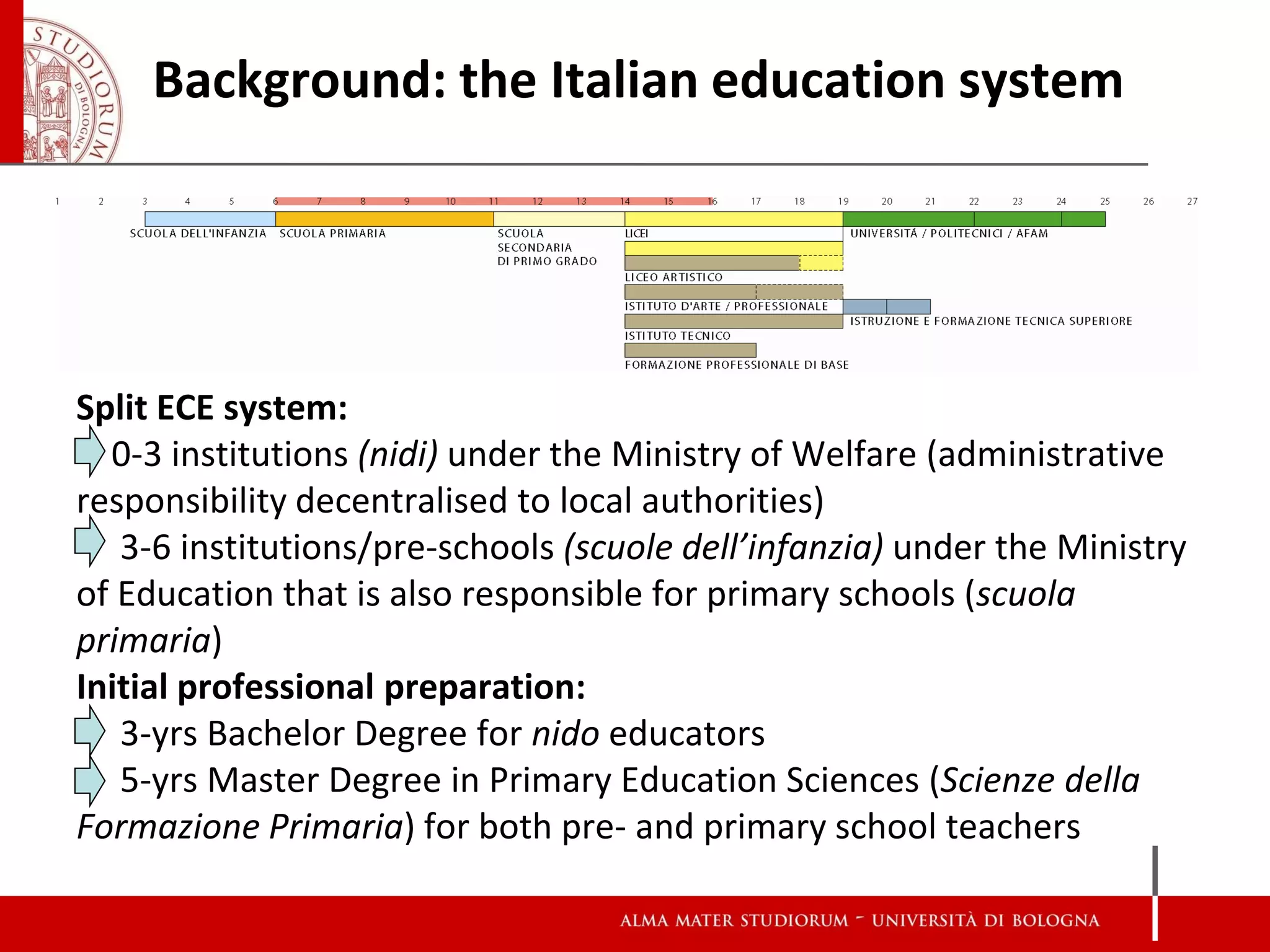
Background: the Italian education system


Split ECE system:
  0-3 institutions (nidi) under the Ministry of Welfare (administrative
responsibility decentralised to local authorities)
   3-6 institutions/pre-schools (scuole dell’infanzia) under the Ministry
of Education that is also responsible for primary schools (scuola
primaria)
Initial professional preparation:
   3-yrs Bachelor Degree for nido educators
   5-yrs Master Degree in Primary Education Sciences (Scienze della
Formazione Primaria) for both pre- and primary school teachers
The perspective of educational continuity

Traditionally, a certain attention has been dedicated to the
relationship between pre- and primary school, despite the
fragmented structure of the overall education system.

          • Radical roots and local experimentalism: political and
1960-70     social premises of educational continuity

          • The pedagogical debate on educational continuity and
1980-90     institutionalisation of continuity practices

          • Teacher’s professionalisation across the fields of pre-
1990-00     and primary education
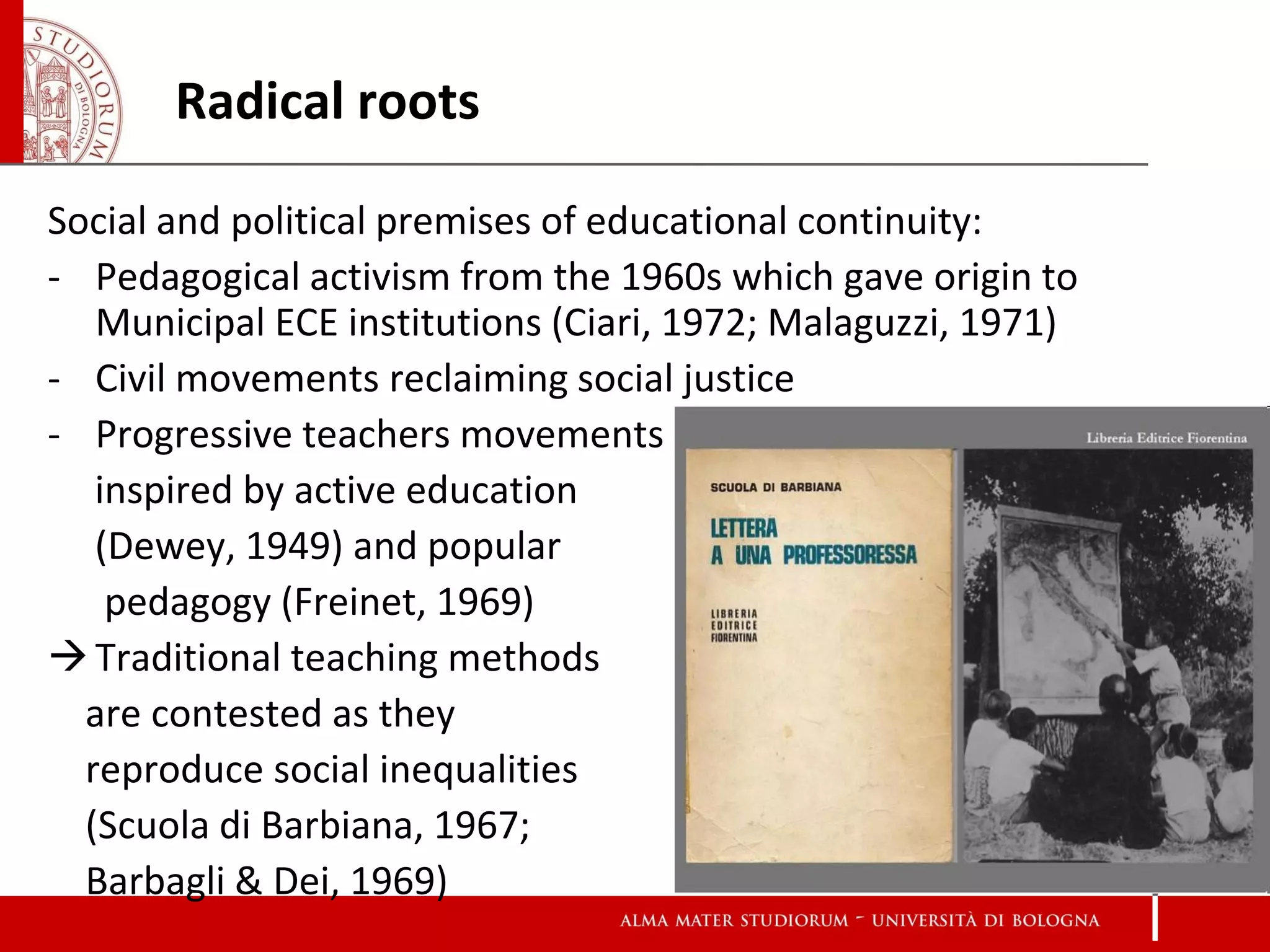
Radical roots

Social and political premises of educational continuity:
- Pedagogical activism from the 1960s which gave origin to
   Municipal ECE institutions (Ciari, 1972; Malaguzzi, 1971)
- Civil movements reclaiming social justice
- Progressive teachers movements
   inspired by active education
   (Dewey, 1949) and popular
    pedagogy (Freinet, 1969)
 Traditional teaching methods
  are contested as they
  reproduce social inequalities
  (Scuola di Barbiana, 1967;
  Barbagli & Dei, 1969)
‘Engaging with children from low social classes
and engaging in politics are part of the same
commitment. It is not possible to be
committed to children who are affected by
unfair laws and not to advocate for better
laws.’ (Scuola di Barbiana, 1967; p. 93)
Local experimentalism: ECE as a driving force
                shaping a new paradigm
  The experimentation of the integrated day in primary school (tempo
   pieno) shaped a new understanding of compulsory school education:
 - education as emancipatory experience for social and cultural
   transformation VS conservative practice reproducing inequalities
 - image of the child: competent human being , citizen bearer of rights
 - holistic approach to children’s development, which is nurtured
   through the exploration of many symbolic languages
 - learning understood as a process of co-construction that takes place
   in social interaction > project work methodology
- schools understood as democratic communities(social management)
- teachers as facilitators, providing children with diversified learning
   opportunities according to their specific needs VS standardised
   teacher instructions
The pedagogical debate on
                   educational continuity
   The approach of educational continuity was further elaborated
   following the findings of psychological studies (Bateson, 1972;
   Bronfenbrenner, 1979; Bruner, 1981; Rogoff & Lave, 1984) :
   - children’s learning is shaped by the relational and cultural
   environment in which educational practices take place
  - children’s development encompasses both inter-personal and
   intrapersonal variations
             Implication for practices:
- Children’s development should be sustained along a continuum by
   taking into account their diversified needs and potentialities
- teachers’ reflectivity has a crucial role to play in this regard
    An inter-disciplinary approach to educational sciences is needed
   in order to deal with complex phenomena taking place on everyday
   basis within school settings
‘It is therefore unfair to demand
psychology to draw a well defined
picture of children’s development
articulated in […] chronologically
precise phases so that schooling could
be appropriately organised: it is
precisely the notion of
“appropriateness” to be misleading […].
Perhaps what is wished to be found in
scientific knowledge is the
legitimisation of political and
educational choices that are de facto
the result of historical and social
processes.’
(Pontecorvo, 1986; p. 49)
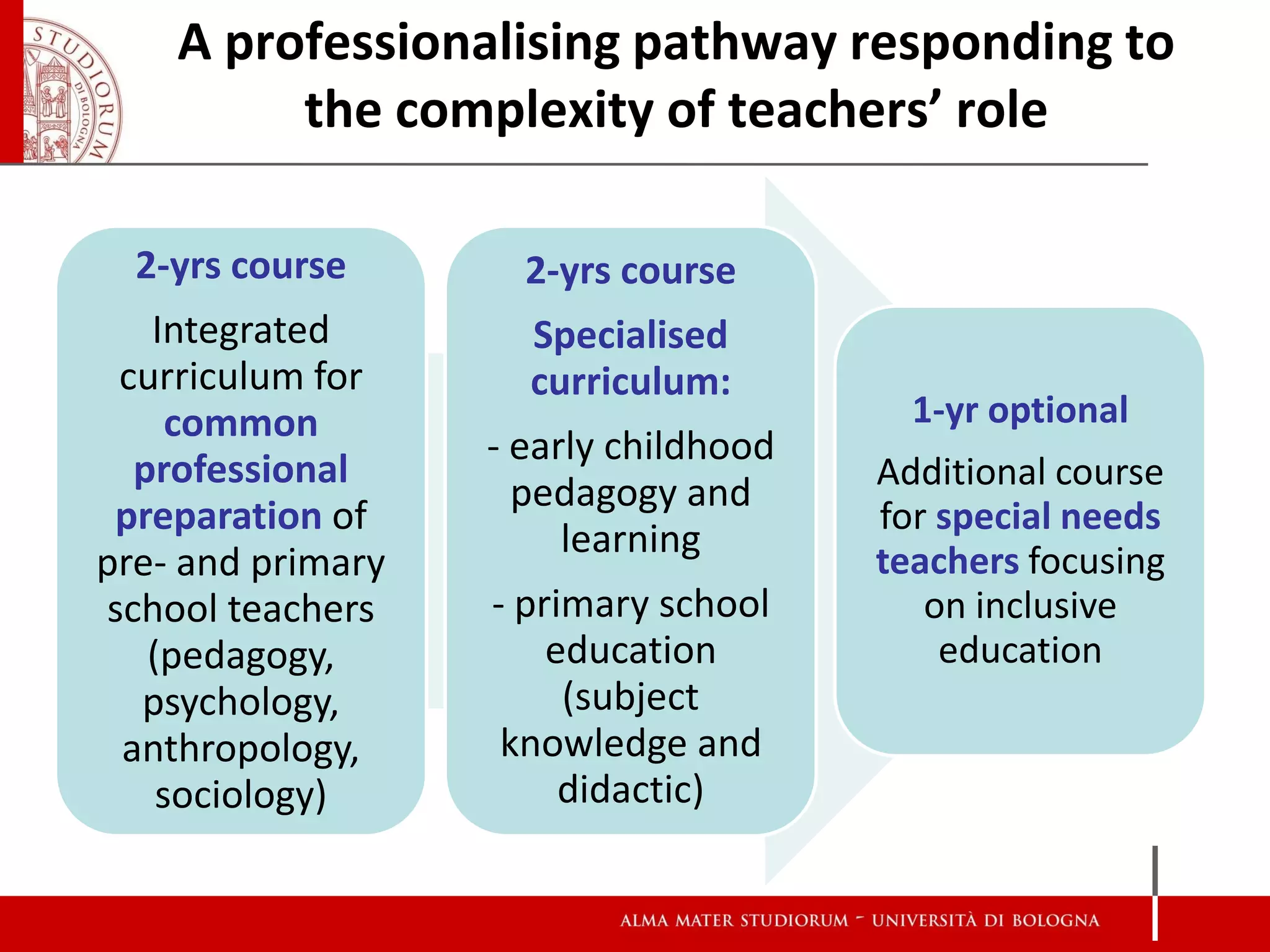
A professionalising pathway responding to
         the complexity of teachers’ role

  2-yrs course       2-yrs course
   Integrated        Specialised
 curriculum for      curriculum:
     common                              1-yr optional
                   - early childhood
  professional                         Additional course
                     pedagogy and
 preparation of                        for special needs
                        learning
pre- and primary                       teachers focusing
school teachers    - primary school       on inclusive
   (pedagogy,          education           education
  psychology,           (subject
 anthropology,      knowledge and
    sociology)          didactic)
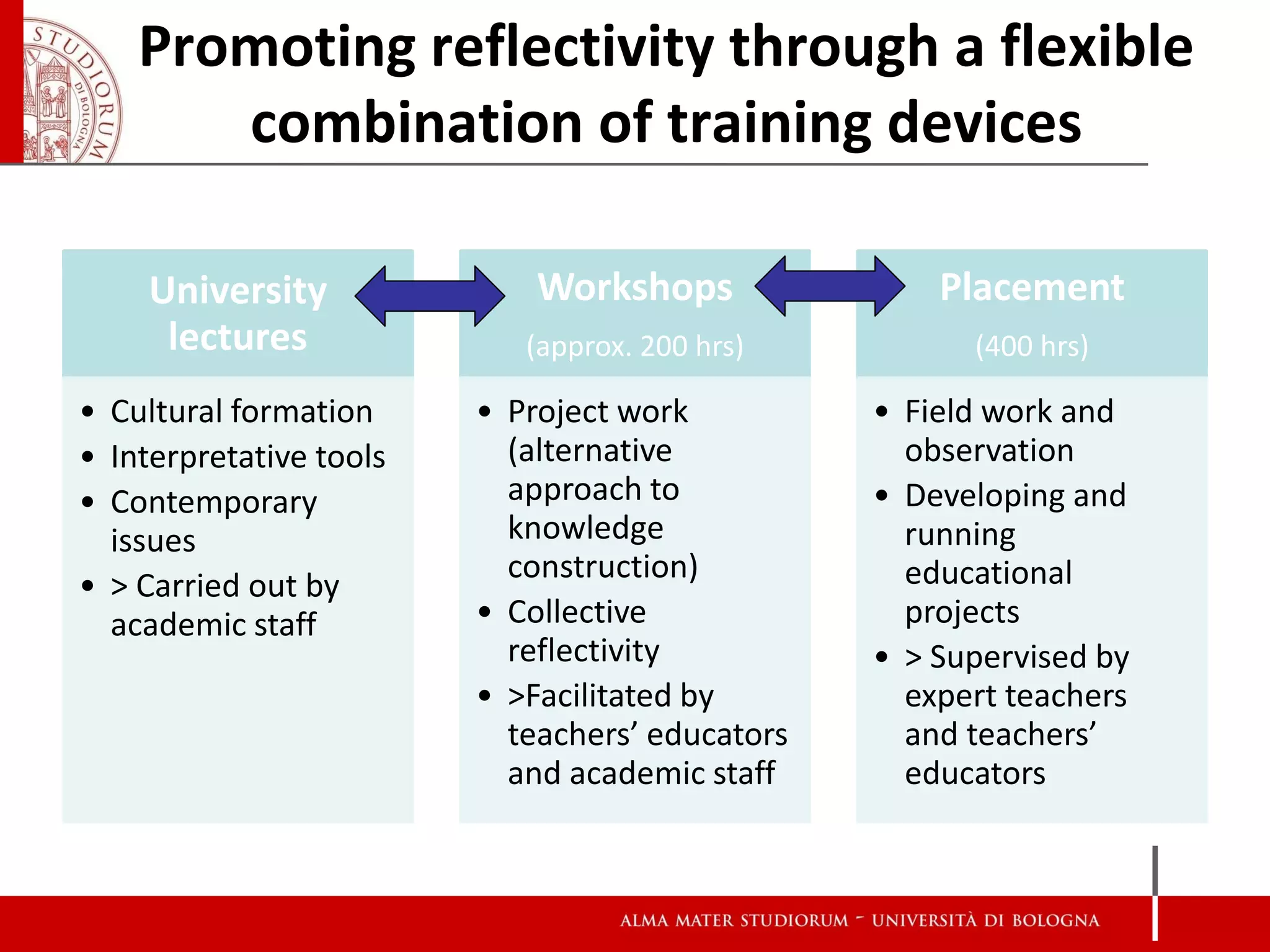
Promoting reflectivity through a flexible
       combination of training devices

     University              Workshops               Placement
      lectures              (approx. 200 hrs)          (400 hrs)

• Cultural formation     • Project work          • Field work and
• Interpretative tools     (alternative            observation
• Contemporary             approach to           • Developing and
  issues                   knowledge               running
                           construction)           educational
• > Carried out by
  academic staff         • Collective              projects
                           reflectivity          • > Supervised by
                         • >Facilitated by         expert teachers
                           teachers’ educators     and teachers’
                           and academic staff      educators
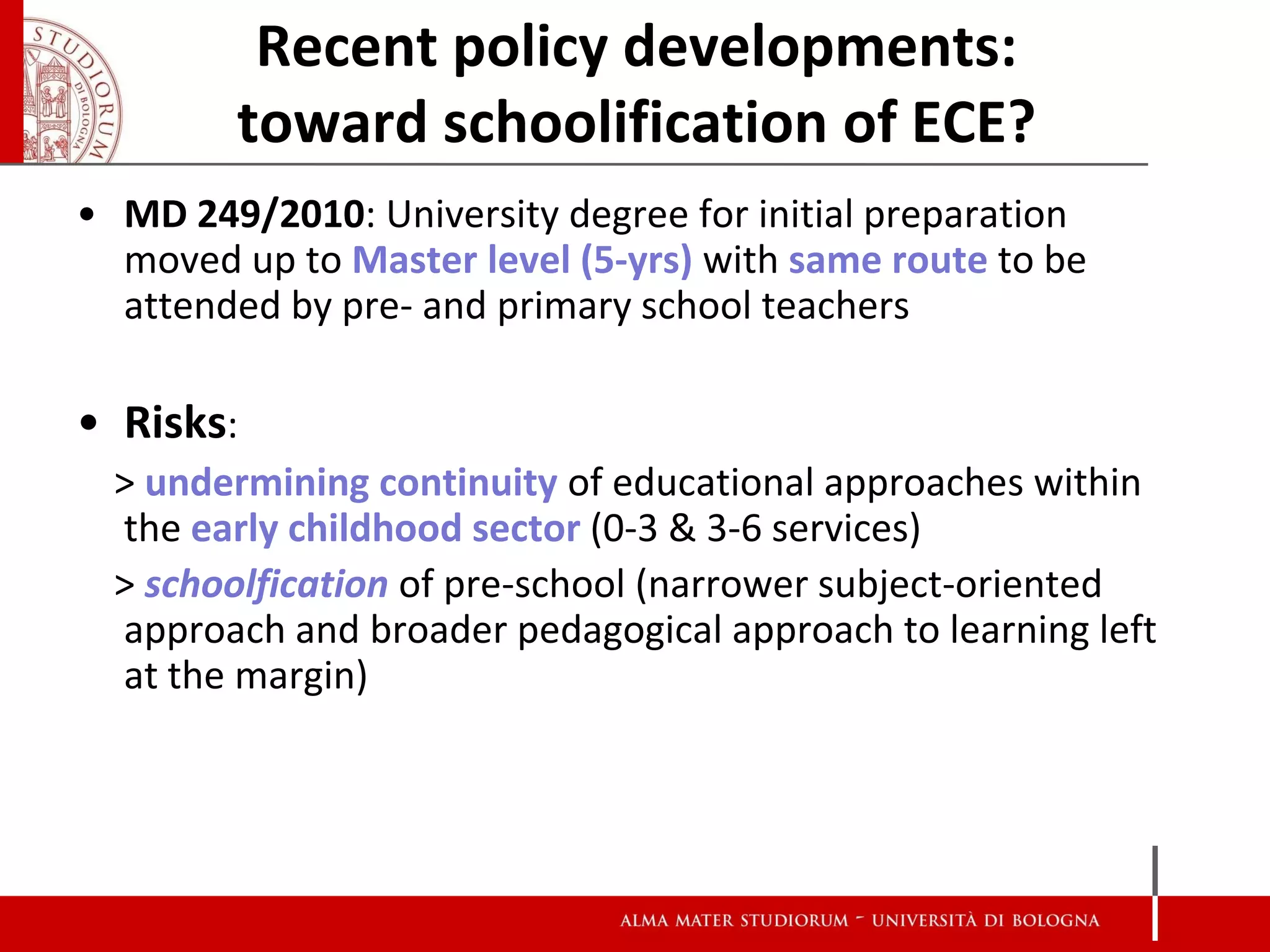
Recent policy developments:
        toward schoolification of ECE?
• MD 249/2010: University degree for initial preparation
  moved up to Master level (5-yrs) with same route to be
  attended by pre- and primary school teachers

• Risks:
  > undermining continuity of educational approaches within
  the early childhood sector (0-3 & 3-6 services)
  > schoolfication of pre-school (narrower subject-oriented
  approach and broader pedagogical approach to learning left
  at the margin)
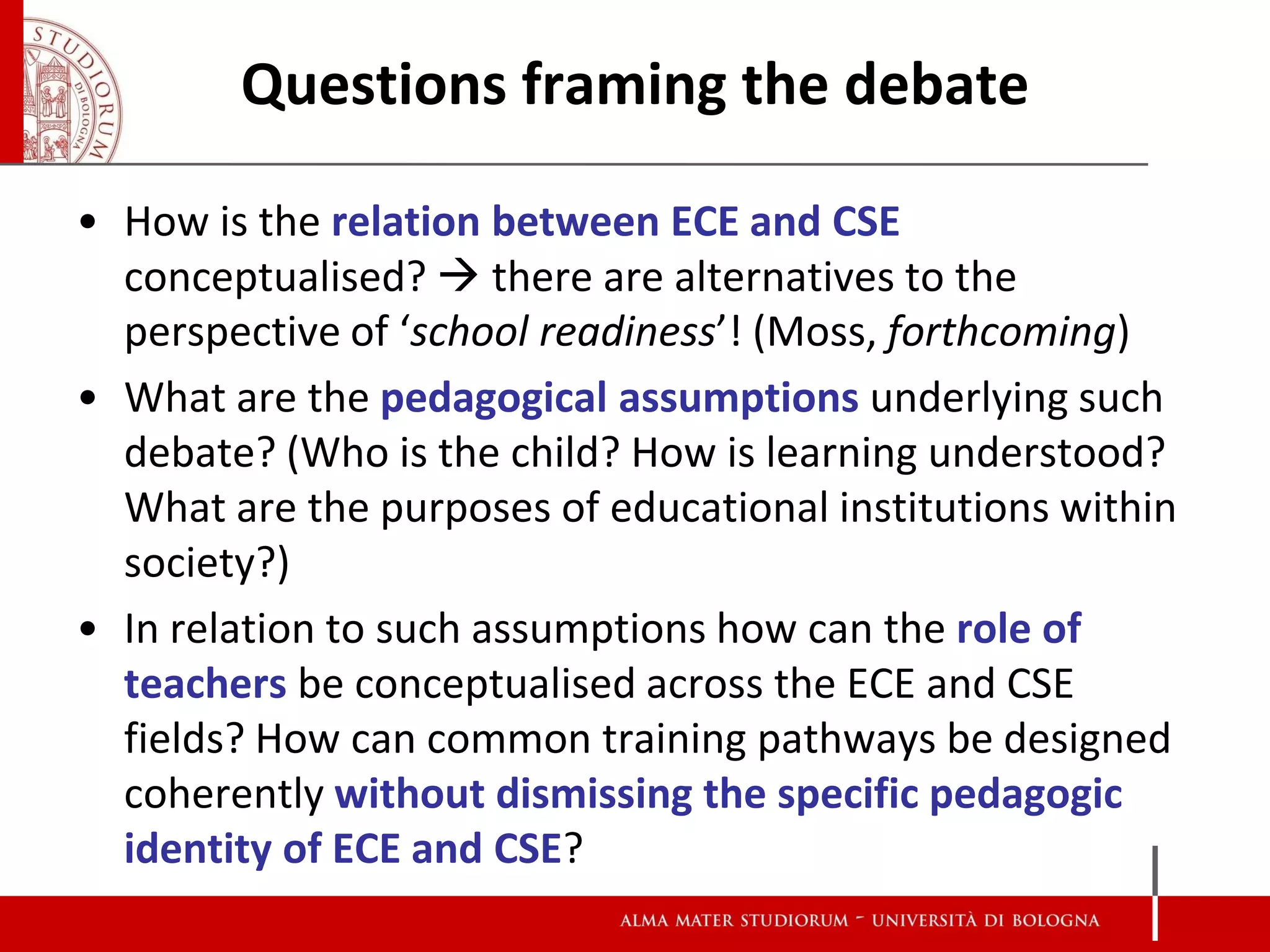
Questions framing the debate

• How is the relation between ECE and CSE
  conceptualised?  there are alternatives to the
  perspective of ‘school readiness’! (Moss, forthcoming)
• What are the pedagogical assumptions underlying such
  debate? (Who is the child? How is learning understood?
  What are the purposes of educational institutions within
  society?)
• In relation to such assumptions how can the role of
  teachers be conceptualised across the ECE and CSE
  fields? How can common training pathways be designed
  coherently without dismissing the specific pedagogic
  identity of ECE and CSE?
Arianna Lazzari
Dipartimento di Scienze dell’Educazione
       arianna.lazzari2@unibo.it

            www.unibo.it

Reconceptualising the relationship between ECE and CSE in the training field

  • 1.
    Reconceptualising the relationshipbetween ECE and CSE in the training field Insights from the Italian experience Universität Hildesheim, 7th July 2012
  • 2.
    Aim and scopeof this presentation • Exploring the relationship between ECE and CSE in the Italian case: origin, development and underlying assumptions of educational continuity (Lazzari & Balduzzi, forthcoming) Moss, P. (Forthcoming) Early Childhood and Compulsory Education: Reconceptualising the relationship. London: Routledge. • Analysing how the relationship between ECE and CSE affected teachers’ professional preparation at tertiary level • Discussing contemporary issues: challenges and possibilities Outlining conceptual categories for re-thinking the relationship between elementary and primary education fields in the framework of context-specific conditions
  • 3.
    Early Childhood andCompulsory Education: Reconceptualising the Relationship • Contesting Early Childhood Series, November 2012 (London: Routledge) Editor: Peter Moss • Contributors: John Bennett, Margaret Carr, Gunilla Dahlberg, Hildegard Gobeyn, Peder Haug, Sharon Lynn Kagan, Peter Moss, Nadine De Stercke and Michel Vandenbroeck • Arianna Lazzari and Lucia Balduzzi (University of Bologna) - Exploring the approach of educational continuity (continuità educativa) as an alternative to the ‘school readiness’ approach - Analysis framed by an historical and socio-cultural perspective with a specific pedagogical focus - Sources: policy documents, pedagogical literature, curricular guidelines and documentary sources
  • 4.
    Background: the Italianeducation system Split ECE system: 0-3 institutions (nidi) under the Ministry of Welfare (administrative responsibility decentralised to local authorities) 3-6 institutions/pre-schools (scuole dell’infanzia) under the Ministry of Education that is also responsible for primary schools (scuola primaria) Initial professional preparation: 3-yrs Bachelor Degree for nido educators 5-yrs Master Degree in Primary Education Sciences (Scienze della Formazione Primaria) for both pre- and primary school teachers
  • 5.
    The perspective ofeducational continuity Traditionally, a certain attention has been dedicated to the relationship between pre- and primary school, despite the fragmented structure of the overall education system. • Radical roots and local experimentalism: political and 1960-70 social premises of educational continuity • The pedagogical debate on educational continuity and 1980-90 institutionalisation of continuity practices • Teacher’s professionalisation across the fields of pre- 1990-00 and primary education
  • 6.
    Radical roots Social andpolitical premises of educational continuity: - Pedagogical activism from the 1960s which gave origin to Municipal ECE institutions (Ciari, 1972; Malaguzzi, 1971) - Civil movements reclaiming social justice - Progressive teachers movements inspired by active education (Dewey, 1949) and popular pedagogy (Freinet, 1969)  Traditional teaching methods are contested as they reproduce social inequalities (Scuola di Barbiana, 1967; Barbagli & Dei, 1969)
  • 7.
    ‘Engaging with childrenfrom low social classes and engaging in politics are part of the same commitment. It is not possible to be committed to children who are affected by unfair laws and not to advocate for better laws.’ (Scuola di Barbiana, 1967; p. 93)
  • 8.
    Local experimentalism: ECEas a driving force shaping a new paradigm The experimentation of the integrated day in primary school (tempo pieno) shaped a new understanding of compulsory school education: - education as emancipatory experience for social and cultural transformation VS conservative practice reproducing inequalities - image of the child: competent human being , citizen bearer of rights - holistic approach to children’s development, which is nurtured through the exploration of many symbolic languages - learning understood as a process of co-construction that takes place in social interaction > project work methodology - schools understood as democratic communities(social management) - teachers as facilitators, providing children with diversified learning opportunities according to their specific needs VS standardised teacher instructions
  • 9.
    The pedagogical debateon educational continuity The approach of educational continuity was further elaborated following the findings of psychological studies (Bateson, 1972; Bronfenbrenner, 1979; Bruner, 1981; Rogoff & Lave, 1984) : - children’s learning is shaped by the relational and cultural environment in which educational practices take place - children’s development encompasses both inter-personal and intrapersonal variations Implication for practices: - Children’s development should be sustained along a continuum by taking into account their diversified needs and potentialities - teachers’ reflectivity has a crucial role to play in this regard  An inter-disciplinary approach to educational sciences is needed in order to deal with complex phenomena taking place on everyday basis within school settings
  • 10.
    ‘It is thereforeunfair to demand psychology to draw a well defined picture of children’s development articulated in […] chronologically precise phases so that schooling could be appropriately organised: it is precisely the notion of “appropriateness” to be misleading […]. Perhaps what is wished to be found in scientific knowledge is the legitimisation of political and educational choices that are de facto the result of historical and social processes.’ (Pontecorvo, 1986; p. 49)
  • 11.
    A professionalising pathwayresponding to the complexity of teachers’ role 2-yrs course 2-yrs course Integrated Specialised curriculum for curriculum: common 1-yr optional - early childhood professional Additional course pedagogy and preparation of for special needs learning pre- and primary teachers focusing school teachers - primary school on inclusive (pedagogy, education education psychology, (subject anthropology, knowledge and sociology) didactic)
  • 12.
    Promoting reflectivity througha flexible combination of training devices University Workshops Placement lectures (approx. 200 hrs) (400 hrs) • Cultural formation • Project work • Field work and • Interpretative tools (alternative observation • Contemporary approach to • Developing and issues knowledge running construction) educational • > Carried out by academic staff • Collective projects reflectivity • > Supervised by • >Facilitated by expert teachers teachers’ educators and teachers’ and academic staff educators
  • 13.
    Recent policy developments: toward schoolification of ECE? • MD 249/2010: University degree for initial preparation moved up to Master level (5-yrs) with same route to be attended by pre- and primary school teachers • Risks: > undermining continuity of educational approaches within the early childhood sector (0-3 & 3-6 services) > schoolfication of pre-school (narrower subject-oriented approach and broader pedagogical approach to learning left at the margin)
  • 14.
    Questions framing thedebate • How is the relation between ECE and CSE conceptualised?  there are alternatives to the perspective of ‘school readiness’! (Moss, forthcoming) • What are the pedagogical assumptions underlying such debate? (Who is the child? How is learning understood? What are the purposes of educational institutions within society?) • In relation to such assumptions how can the role of teachers be conceptualised across the ECE and CSE fields? How can common training pathways be designed coherently without dismissing the specific pedagogic identity of ECE and CSE?
  • 15.
    Arianna Lazzari Dipartimento diScienze dell’Educazione arianna.lazzari2@unibo.it www.unibo.it