[Type the company name] | Error! No text of specified style in document. 0
Foreign Exchange Laws Update
By: CA. Sudha G. Bhushan
www.taxpertpro.com
www.taxpertpro.com || info@taxpertpro.com || 09769134554
Foreign Portfolio Investor - Investment under Portfolio Investment
Scheme, Government and Corporate debt
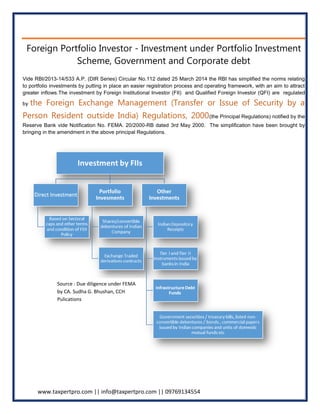
Vide RBI/2013-14/533 A.P. (DIR Series) Circular No.112 dated 25 March 2014 the RBI has simplified the norms relating
to portfolio investments by putting in place an easier registration process and operating framework, with an aim to attract
greater inflows.The investment by Foreign Institutional Investor (FII) and Qualified Foreign Investor (QFI) are regulated
by the Foreign Exchange Management (Transfer or Issue of Security by a
Person Resident outside India) Regulations, 2000(the Principal Regulations) notified by the
Reserve Bank vide Notification No. FEMA. 20/2000-RB dated 3rd May 2000. The simplification have been brought by
bringing in the amendment in the above principal Regulations.
Source : Due diligence under FEMA
by CA. Sudha G. Bhushan, CCH
Pulications
www.taxpertpro.com || info@taxpertpro.com || 09769134554
The new framework shall be called ‘Foreign Portfolio
Investment’ scheme.
Salient features of the new scheme are:
The portfolio investor registered in accordance with SEBI guidelines shall be called ‘Registered Foreign Portfolio Investor
(RFPI)’. The existing portfolio investor class, namely, Foreign Institutional Investor (FII) and Qualified Foreign Investor
(QFI) registered with SEBI shall be subsumed under RFPI;
RFPI may purchase and sell shares and convertible debentures of Indian company through registered broker on
recognised stock exchanges in India as well as purchases shares and convertible debentures which are offered to public
in terms of relevant SEBI guidelines/ regulations.
o RFPI may sell shares or convertible debentures so acquired
a. in open offer in accordance with the SEBI
(Substantial Acquisition of Shares and
Takeovers) Regulations, 2011; or
b. in an open offer in accordance with the
SEBI (Delisting of Equity shares) Regulations,
2009; or
c. through buyback of shares by a listed Indian
company in accordance with the SEBI (Buy-
back of securities) Regulations, 1998
o RFPI may also acquire shares or convertible
debentures
a. in any bid for, or acquisition of, securities in
response to an offer for disinvestment of shares made by the Central Government or any State Government; or
b. in any transaction in securities pursuant to an agreement entered into with merchant banker in the process of market
making or subscribing to unsubscribed portion of the issue in accordance with Chapter XB of the Securities and Exchange
Board of India (Issue of Capital and Disclosure Requirements) Regulations, 2009.
Bank Accounts : RFPI shall be eligible to open a Special Non-Resident Rupee (SNRR) account and a foreign currency
account with Authorised Dealer bank and to transfer sums from foreign currency account to SNRR account at the
prevailing market rate for making genuine investments in securities. The Authorised Dealer bank may transfer repatriable
proceeds (after payment of applicable taxes) from SNRR account to foreign currency account ;
RFPI shall be eligible to invest in government securities and corporate debt subject to limits specified by the RBI and
SEBI from time to time;
The investment by RFPI will be made subject to the SEBI (FPI) Regulations 2014, modified by SEBI/Government of India
from time to time;
The individual and aggregate investment
limits for the RFPIs shall be below 10% (per
cent) or 24% (per cent) respectively of the
total paid-up equity capital or 10% (per
cent) or 24% (per cent) respectively of the
paid-up value of each series of convertible
debentures issued by an Indian company.
Further, where there is composite sectoral
cap under FDI policy, these limits for RFPI
investment shall also be within such
overall FDI sectoral caps
www.taxpertpro.com || info@taxpertpro.com || 09769134554
RFPI shall be permitted to trade in all exchange traded derivative contracts on the stock exchanges in India subject to the
position limits as specified by SEBI from time to time;
RFPI may offer cash or foreign sovereign securities with AAA rating or corporate bonds or domestic Government
Securities, as collateral to the recognized Stock Exchanges for their transactions in the cash as well as derivative
segment of the market.
Present FIIs and QFIs : Any foreign institutional investor who holds a valid certificate of registration from SEBI shall be
deemed to be a registered foreign portfolio investor (RFPI) till the expiry of the block of three years for which fees have
been paid as per the Securities and Exchange Board of India (Foreign Institutional Investors) Regulations, 1995. A QFI
may continue to buy, sell or otherwise deal in securities subject to the SEBI (FPI) Regulations, 2014 for a period of one
year from the date of commencement of these regulations, or until he obtains a certificate of registration as foreign
portfolio investor, whichever is earlier.All investments made by that FII/QFI in accordance with the regulations prior to
registration as RFPI shall continue to be valid and taken into account for computation of aggregate limit.
Reporting: RFPI shall report the transaction to RBI as being reported by FII in LEC Form as per extant practice.
=====================================================================================
Taxpert Professionals is a conglomeration of multi-diverged professionals known
for providing concentrated services in relation to taxation and corporate laws
advisory in a seamless manner. Taxpert professionals believe in the creation of
value through advising and assisting the business. The pool of professionals from
different spectrum like tax, accountancy, legal, costing, management facilitate the
conversion of knowledge into beneficial transaction.
CA. Sudha G. Bhushan is a Chartered Accountant and Company Secretary. She is known to be expert in FEMA,
International Tax and FDI policy. She has authored quite a few books on the subject.

Fema u pdate march

  • 1.
    [Type the companyname] | Error! No text of specified style in document. 0 Foreign Exchange Laws Update By: CA. Sudha G. Bhushan www.taxpertpro.com
  • 2.
    www.taxpertpro.com || info@taxpertpro.com|| 09769134554 Foreign Portfolio Investor - Investment under Portfolio Investment Scheme, Government and Corporate debt Vide RBI/2013-14/533 A.P. (DIR Series) Circular No.112 dated 25 March 2014 the RBI has simplified the norms relating to portfolio investments by putting in place an easier registration process and operating framework, with an aim to attract greater inflows.The investment by Foreign Institutional Investor (FII) and Qualified Foreign Investor (QFI) are regulated by the Foreign Exchange Management (Transfer or Issue of Security by a Person Resident outside India) Regulations, 2000(the Principal Regulations) notified by the Reserve Bank vide Notification No. FEMA. 20/2000-RB dated 3rd May 2000. The simplification have been brought by bringing in the amendment in the above principal Regulations. Source : Due diligence under FEMA by CA. Sudha G. Bhushan, CCH Pulications
  • 3.
    www.taxpertpro.com || info@taxpertpro.com|| 09769134554 The new framework shall be called ‘Foreign Portfolio Investment’ scheme. Salient features of the new scheme are: The portfolio investor registered in accordance with SEBI guidelines shall be called ‘Registered Foreign Portfolio Investor (RFPI)’. The existing portfolio investor class, namely, Foreign Institutional Investor (FII) and Qualified Foreign Investor (QFI) registered with SEBI shall be subsumed under RFPI; RFPI may purchase and sell shares and convertible debentures of Indian company through registered broker on recognised stock exchanges in India as well as purchases shares and convertible debentures which are offered to public in terms of relevant SEBI guidelines/ regulations. o RFPI may sell shares or convertible debentures so acquired a. in open offer in accordance with the SEBI (Substantial Acquisition of Shares and Takeovers) Regulations, 2011; or b. in an open offer in accordance with the SEBI (Delisting of Equity shares) Regulations, 2009; or c. through buyback of shares by a listed Indian company in accordance with the SEBI (Buy- back of securities) Regulations, 1998 o RFPI may also acquire shares or convertible debentures a. in any bid for, or acquisition of, securities in response to an offer for disinvestment of shares made by the Central Government or any State Government; or b. in any transaction in securities pursuant to an agreement entered into with merchant banker in the process of market making or subscribing to unsubscribed portion of the issue in accordance with Chapter XB of the Securities and Exchange Board of India (Issue of Capital and Disclosure Requirements) Regulations, 2009. Bank Accounts : RFPI shall be eligible to open a Special Non-Resident Rupee (SNRR) account and a foreign currency account with Authorised Dealer bank and to transfer sums from foreign currency account to SNRR account at the prevailing market rate for making genuine investments in securities. The Authorised Dealer bank may transfer repatriable proceeds (after payment of applicable taxes) from SNRR account to foreign currency account ; RFPI shall be eligible to invest in government securities and corporate debt subject to limits specified by the RBI and SEBI from time to time; The investment by RFPI will be made subject to the SEBI (FPI) Regulations 2014, modified by SEBI/Government of India from time to time; The individual and aggregate investment limits for the RFPIs shall be below 10% (per cent) or 24% (per cent) respectively of the total paid-up equity capital or 10% (per cent) or 24% (per cent) respectively of the paid-up value of each series of convertible debentures issued by an Indian company. Further, where there is composite sectoral cap under FDI policy, these limits for RFPI investment shall also be within such overall FDI sectoral caps
  • 4.
    www.taxpertpro.com || info@taxpertpro.com|| 09769134554 RFPI shall be permitted to trade in all exchange traded derivative contracts on the stock exchanges in India subject to the position limits as specified by SEBI from time to time; RFPI may offer cash or foreign sovereign securities with AAA rating or corporate bonds or domestic Government Securities, as collateral to the recognized Stock Exchanges for their transactions in the cash as well as derivative segment of the market. Present FIIs and QFIs : Any foreign institutional investor who holds a valid certificate of registration from SEBI shall be deemed to be a registered foreign portfolio investor (RFPI) till the expiry of the block of three years for which fees have been paid as per the Securities and Exchange Board of India (Foreign Institutional Investors) Regulations, 1995. A QFI may continue to buy, sell or otherwise deal in securities subject to the SEBI (FPI) Regulations, 2014 for a period of one year from the date of commencement of these regulations, or until he obtains a certificate of registration as foreign portfolio investor, whichever is earlier.All investments made by that FII/QFI in accordance with the regulations prior to registration as RFPI shall continue to be valid and taken into account for computation of aggregate limit. Reporting: RFPI shall report the transaction to RBI as being reported by FII in LEC Form as per extant practice. ===================================================================================== Taxpert Professionals is a conglomeration of multi-diverged professionals known for providing concentrated services in relation to taxation and corporate laws advisory in a seamless manner. Taxpert professionals believe in the creation of value through advising and assisting the business. The pool of professionals from different spectrum like tax, accountancy, legal, costing, management facilitate the conversion of knowledge into beneficial transaction. CA. Sudha G. Bhushan is a Chartered Accountant and Company Secretary. She is known to be expert in FEMA, International Tax and FDI policy. She has authored quite a few books on the subject.