
Real-time Analytics: The Path to Intelligent Retailing Infographic
•
1 like•5,502 views

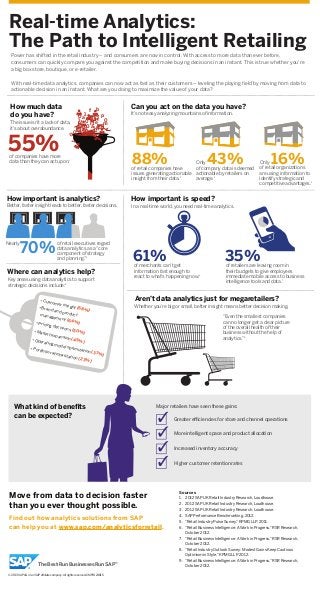
http://spr.ly/AA_Retail - Power has shifted in the retail industry – and consumers are now in control. With access to more data than ever before, consumers can quickly compare you against the competition and make buying decisions in an instant. This is true whether you’re a big box store, boutique, or e-retailer.
Recommended

Recommended
More Related Content
Viewers also liked
Viewers also liked (10)
More from SAP Analytics
More from SAP Analytics (20)
Recently uploaded
Recently uploaded (20)
Real-time Analytics: The Path to Intelligent Retailing Infographic
- 1. Real-time Analytics: The Path to Intelligent Retailing Power has shifted in the retail industry – and consumers are now in control. With access to more data than ever before, consumers can quickly compare you against the competition and make buying decisions in an instant. This is true whether you’re a big box store, boutique, or e-retailer. With real-time data analytics, companies can now act as fast as their customers – leveling the playing field by moving from data to actionable decision in an instant. What are you doing to maximize the value of your data? How much data do you have? Can you act on the data you have? 55% The issue isn’t a lack of data, it’s about overabundance. It’s not easy analyzing mountains of information. How important is analytics? Better, faster insight leads to better, faster decisions. of companies have more data than they can act upon.1 88%of retail companies have issues generating actionable insight from their data.2 43%of company data is deemed actionable by retailers on average.3 16%of retail organizations are using information to identify strategic and competitive advantages.4 70% of retail executives regard data analytics as a “core component of strategy and planning.”5 Nearly Only Only Where can analytics help? Key areas using data analytics to support strategic decisions include:8 Aren’t data analytics just for megaretailers? Whether you’re big or small, better insight means better decision making. How important is speed? In a real-time world, you need real-time analytics. 61%of merchants can’t get information fast enough to react to what’s happening now.6 35%of retailers are leaving room in their budgets to give employees immediate mobile access to business intelligence tools and data.7 “Even the smallest companies can no longer get a clear picture of the overall health of their business without the help of analytics.”9 • Customer insight (68%) • Brand and productmanagement (64%)• Pricing decisions (50%)• Market expansion (45%)• Operating model optimization (37%) • Portfolio rationalization (23%) 1 01 1 0 1 1 1 0 0 0 1 p s s f b a 0 0 0 1 f a d m h o 0 0 01 e 1 f a d m o a What kind of benefits can be expected? Major retailers have seen these gains: Greater efficiencies for store and channel operations More intelligent space and product allocation Increased inventory accuracy Higher customer retention rates Move from data to decision faster than you ever thought possible. Find out how analytics solutions from SAP can help you at www.sap.com/analyticsforretail. Sources 1. 2012 SAP UK Retail Industry Research, Loudhouse. 2. 2012 SAP UK Retail Industry Research, Loudhouse. 3. 2012 SAP UK Retail Industry Research, Loudhouse. 4. SAP Performance Benchmarking, 2012. 5. “Retail Industry Pulse Survey,” KPMG LLP, 2011. 6. “Retail Business Intelligence: A Work in Progress,” RSR Research, October 2012. 7. “Retail Business Intelligence: A Work in Progress,” RSR Research, October 2012. 8. “Retail Industry Outlook Survey: Modest Gains Keep Cautious Optimism in Style,” KPMG LLP, 2012. 9. “Retail Business Intelligence: A Work in Progress,” RSR Research, October 2012. © 2013 SAP AG or an SAP affiliate company. All rights reserved. CMPID 24816 The Best-Run Businesses Run SAP™