NAME –SUNO NAGIM & PIE
ROLL NO-3.14&2.18
READING AND
REFLECTING
ON TEXTS
SECTION A
NPE 1986
NCF2005
NPE 1986
 The national policy of education (NPE) is a policy
formulated by the government of India to promote
education amongst India people.
 The policy cover elementary education to colleges in
both rural and urban India.
 The first NPE was promulgated in 1968 by the
government of prime minister Indira Gandhi and
second by prime minister Rajiv Gandhi in 1986.
REFLECTION ON AIMS OF
EDUCATION
 Providing Life long education.
 Development Manpower
 Education for all.
 Equalization of education
 Providing National System of education.
 Cultivating moral and ethical values.
 Stressing on all round development of child.
 International co-operation and peacefulness.
REFLECTION WITH RESPECT TO
PEDAGOGY
 Common core curriculum.
 Interactive teaching.
 Common structure of education.
 Readjustments in the curriculum.
 Child centered and activity basedapproach.
 Enhancement for employability.
 Teachers with greater accountability.
 Synthesis between technology and culture.
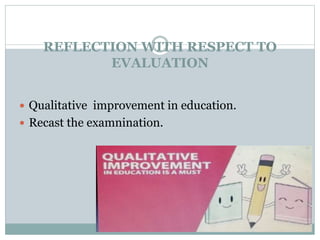
REFLECTION WITH RESPECT TO
EVALUATION
 Qualitative improvement in education.
 Recast the examnination.
CONCLUSION
 The present system of education is merely to
literate the person as desite having institutional
and understructure challenges. The school to
achieve purpose of education.
NCF-2005
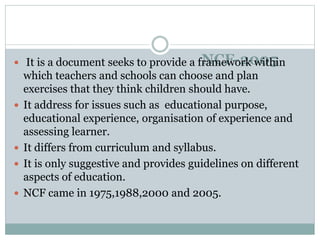
 It is a document seeks to provide a framework within
which teachers and schools can choose and plan
exercises that they think children should have.
 It address for issues such as educational purpose,
educational experience, organisation of experience and
assessing learner.
 It differs from curriculum and syllabus.
 It is only suggestive and provides guidelines on different
aspects of education.
 NCF came in 1975,1988,2000 and 2005.
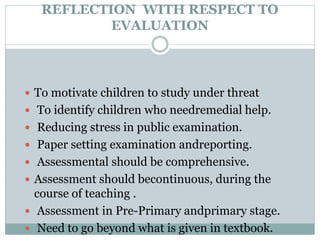
REFLECTION WITH RESPECT TO
EVALUATION
 To motivate children to study under threat
 To identify children who needremedial help.
 Reducing stress in public examination.
 Paper setting examination andreporting.
 Assessmental should be comprehensive.
 Assessment should becontinuous, during the
course of teaching .
 Assessment in Pre-Primary andprimary stage.
 Need to go beyond what is given in textbook.
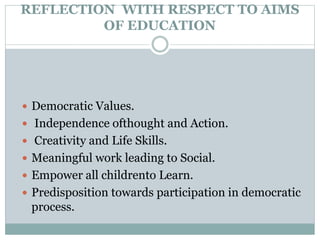
REFLECTION WITH RESPECT TO AIMS
OF EDUCATION
 Democratic Values.
 Independence ofthought and Action.
 Creativity and Life Skills.
 Meaningful work leading to Social.
 Empower all childrento Learn.
 Predisposition towards participation in democratic
process.
REFLECTION WITH RESPECT TO
PEDAGOGY
 • Child centered pedagogy.
 Based on real life experience.
 Based on Psychologicalprincipals.
 Active engagement ofstudents.
 Shift from role method.
 Teaching for understanding.
 Learning how to learn.
 Linking learning with work.
CONCLUSION
A curriculum framework is an organised plan or set of
standards or learning outcomes that defines the
content to be leaned in terms of clear definable
standards of what the student know and be able to
do a curriculum is prescriptive and is based on a
more general syllabus which merely specifies what
topics must be understood and to what level to
achieve a particular grade or standard formal
education.
READING AND REFLECTING ON CORE
ELEMENTS W.R.T GENDER ,
ENVIRONMENT AND HEALTH
GENDER,HEALTH& ENVIRONMENT
 Ideal textbook represents gender , health and
environmental issues fairly.
 Because it is through texts gender equality can be
promoted.
 Health issues awareness can be promoted by
discussion in detail.
 Awarness about environment can be created by texts
Reading of
8th class
text book of
science
Content of book
 Chapter 1 Crop Production and Management
 Chapter 2 Microorganisms: Friend and Foe
 Chapter 3 Synthetic Fibers and Plastics
 Chapter 4 Materials: Metals and Non-Metals
 Chapter 5 Coal and Petroleum
 Chapter 6 Combustion and Flame
 Chapter 7 Conservation of Plants and Animals
 Chapter 8 Cell – Structure and Functions
 Chapter 9 Reproduction in Animals
 Chapter 10 Reaching the Age of Adolescence
 Chapter 11 Force and Pressure
 Chapter 12 Friction
 Chapter 13 Sound
 Chapter 14 Chemical Effects of Electric Current
 Chapter 15 Some Natural Phenomena
 Chapter 16 Light
 Chapter 17 Stars and the Solar System
 Chapter 18 Pollution of Air and Water
Reflection of
8th class text book
of science
W.r.t Gender , environment and health
GENDER
 In many chapter gender related issues are discussed
like in chapters 1,2,3,6,11,12,13,15,16,17. In many
chapters boys pictures are shown more than girls
they show gender inequality, there are many
chapters which do not aware about the gender
equality.
 For eg – In chapter 1 the agriculture works are
shown doing only by men not women Like
traditional method of sowing,moat ,the plough etc
ENVIRONMENT
 In many chapters environment related issues are
discussed. There are many chapters which aware
about the environment issue and their cause ,
prevention etc. Chapters
1,2,3,4,5,6,7,12,13,14,15,16,17 Environment related
topics are discussed.
 For example they discussed about the pollution,
lightning, earthquake,disposal of factories waste etc.
HEALTH
 In many chapters health related issues are discussed
,for example they tell us how drugs harm the body
and effect health ,they aware us about the AIDS
which caused by virues, they also explain excessive
noise in the surrounding may cause many health
related problems lack of sleep, hypertension ,blood
pressure , anxiety etc and many more topics are
discussed in this book which aware us about health
related problems and their causes, they also explain
their preventions.
Reading of
8th class
text book of
Maths
CONTENT
 Chapter 1 Rational Numbers
 Chapter 2 Linear Equations in One Variable
 Chapter 3 Understanding Quadrilaterals
 Chapter 4 Practical Geometry
 Chapter 5 Data Handling
 Chapter 6 Squares and Square Roots
 Chapter 7 Cubes and Cube Roots
 Chapter 8 Comparing Quantities
 Chapter 9 Algebraic Expressions and Identities
 Chapter 10 Visualising Solid Shapes
 Chapter 11 Mensuration
 Chapter 12 Exponents and Powers
 Chapter 13 Direct and Inverse Proportions
 Chapter 14 Factorisation
 Chapter 15 Introduction to Graphs
 Chapter 16 Playing with Numbers
Reflection of
8th class text book
of science
W.r.t Gender , environment and health
GENDER
 In many chapter gender related issues are
discussed like in chapters 2,5,6,7,8,9,11,13,14,15,16
 . In many chapters boys pictures are shown more
than girls they show gender inequality, there are
many chapters which do not aware about the
gender equality.
HEALTH
 In some chapter gender related issues are
discussed like in chapters 8,12,15.
Some health related issues questions are
there .
ENVIRONMENT
In some chapter environment related in
topics are discussed like in chapters
2,5,6,8,11,12,13,15.
CONCLUSION
 Both the textbooks of science and maths of class 8th
does not properly highlight the gender ,health and
environment issues .
There is need for some changes in the textbooks so
as provide good learning pattern to the students.

READING AND REFLECTING ON TEXTS .pptx

  • 1.
    NAME –SUNO NAGIM& PIE ROLL NO-3.14&2.18 READING AND REFLECTING ON TEXTS
  • 2.
  • 4.
    NPE 1986  Thenational policy of education (NPE) is a policy formulated by the government of India to promote education amongst India people.  The policy cover elementary education to colleges in both rural and urban India.  The first NPE was promulgated in 1968 by the government of prime minister Indira Gandhi and second by prime minister Rajiv Gandhi in 1986.
  • 5.
    REFLECTION ON AIMSOF EDUCATION  Providing Life long education.  Development Manpower  Education for all.  Equalization of education  Providing National System of education.  Cultivating moral and ethical values.  Stressing on all round development of child.  International co-operation and peacefulness.
  • 6.
    REFLECTION WITH RESPECTTO PEDAGOGY  Common core curriculum.  Interactive teaching.  Common structure of education.  Readjustments in the curriculum.  Child centered and activity basedapproach.  Enhancement for employability.  Teachers with greater accountability.  Synthesis between technology and culture.
  • 7.
    REFLECTION WITH RESPECTTO EVALUATION  Qualitative improvement in education.  Recast the examnination.
  • 8.
    CONCLUSION  The presentsystem of education is merely to literate the person as desite having institutional and understructure challenges. The school to achieve purpose of education.
  • 10.
    NCF-2005  It isa document seeks to provide a framework within which teachers and schools can choose and plan exercises that they think children should have.  It address for issues such as educational purpose, educational experience, organisation of experience and assessing learner.  It differs from curriculum and syllabus.  It is only suggestive and provides guidelines on different aspects of education.  NCF came in 1975,1988,2000 and 2005.
  • 11.
    REFLECTION WITH RESPECTTO EVALUATION  To motivate children to study under threat  To identify children who needremedial help.  Reducing stress in public examination.  Paper setting examination andreporting.  Assessmental should be comprehensive.  Assessment should becontinuous, during the course of teaching .  Assessment in Pre-Primary andprimary stage.  Need to go beyond what is given in textbook.
  • 12.
    REFLECTION WITH RESPECTTO AIMS OF EDUCATION  Democratic Values.  Independence ofthought and Action.  Creativity and Life Skills.  Meaningful work leading to Social.  Empower all childrento Learn.  Predisposition towards participation in democratic process.
  • 13.
    REFLECTION WITH RESPECTTO PEDAGOGY  • Child centered pedagogy.  Based on real life experience.  Based on Psychologicalprincipals.  Active engagement ofstudents.  Shift from role method.  Teaching for understanding.  Learning how to learn.  Linking learning with work.
  • 14.
    CONCLUSION A curriculum frameworkis an organised plan or set of standards or learning outcomes that defines the content to be leaned in terms of clear definable standards of what the student know and be able to do a curriculum is prescriptive and is based on a more general syllabus which merely specifies what topics must be understood and to what level to achieve a particular grade or standard formal education.
  • 15.
    READING AND REFLECTINGON CORE ELEMENTS W.R.T GENDER , ENVIRONMENT AND HEALTH
  • 16.
    GENDER,HEALTH& ENVIRONMENT  Idealtextbook represents gender , health and environmental issues fairly.  Because it is through texts gender equality can be promoted.  Health issues awareness can be promoted by discussion in detail.  Awarness about environment can be created by texts
  • 17.
  • 18.
    Content of book Chapter 1 Crop Production and Management  Chapter 2 Microorganisms: Friend and Foe  Chapter 3 Synthetic Fibers and Plastics  Chapter 4 Materials: Metals and Non-Metals  Chapter 5 Coal and Petroleum  Chapter 6 Combustion and Flame  Chapter 7 Conservation of Plants and Animals  Chapter 8 Cell – Structure and Functions
  • 19.
     Chapter 9Reproduction in Animals  Chapter 10 Reaching the Age of Adolescence  Chapter 11 Force and Pressure  Chapter 12 Friction  Chapter 13 Sound  Chapter 14 Chemical Effects of Electric Current  Chapter 15 Some Natural Phenomena  Chapter 16 Light  Chapter 17 Stars and the Solar System  Chapter 18 Pollution of Air and Water
  • 20.
    Reflection of 8th classtext book of science W.r.t Gender , environment and health
  • 21.
    GENDER  In manychapter gender related issues are discussed like in chapters 1,2,3,6,11,12,13,15,16,17. In many chapters boys pictures are shown more than girls they show gender inequality, there are many chapters which do not aware about the gender equality.  For eg – In chapter 1 the agriculture works are shown doing only by men not women Like traditional method of sowing,moat ,the plough etc
  • 22.
    ENVIRONMENT  In manychapters environment related issues are discussed. There are many chapters which aware about the environment issue and their cause , prevention etc. Chapters 1,2,3,4,5,6,7,12,13,14,15,16,17 Environment related topics are discussed.  For example they discussed about the pollution, lightning, earthquake,disposal of factories waste etc.
  • 23.
    HEALTH  In manychapters health related issues are discussed ,for example they tell us how drugs harm the body and effect health ,they aware us about the AIDS which caused by virues, they also explain excessive noise in the surrounding may cause many health related problems lack of sleep, hypertension ,blood pressure , anxiety etc and many more topics are discussed in this book which aware us about health related problems and their causes, they also explain their preventions.
  • 24.
  • 25.
    CONTENT  Chapter 1Rational Numbers  Chapter 2 Linear Equations in One Variable  Chapter 3 Understanding Quadrilaterals  Chapter 4 Practical Geometry  Chapter 5 Data Handling  Chapter 6 Squares and Square Roots  Chapter 7 Cubes and Cube Roots  Chapter 8 Comparing Quantities
  • 26.
     Chapter 9Algebraic Expressions and Identities  Chapter 10 Visualising Solid Shapes  Chapter 11 Mensuration  Chapter 12 Exponents and Powers  Chapter 13 Direct and Inverse Proportions  Chapter 14 Factorisation  Chapter 15 Introduction to Graphs  Chapter 16 Playing with Numbers
  • 27.
    Reflection of 8th classtext book of science W.r.t Gender , environment and health
  • 28.
    GENDER  In manychapter gender related issues are discussed like in chapters 2,5,6,7,8,9,11,13,14,15,16  . In many chapters boys pictures are shown more than girls they show gender inequality, there are many chapters which do not aware about the gender equality.
  • 29.
    HEALTH  In somechapter gender related issues are discussed like in chapters 8,12,15. Some health related issues questions are there .
  • 30.
    ENVIRONMENT In some chapterenvironment related in topics are discussed like in chapters 2,5,6,8,11,12,13,15.
  • 31.
    CONCLUSION  Both thetextbooks of science and maths of class 8th does not properly highlight the gender ,health and environment issues . There is need for some changes in the textbooks so as provide good learning pattern to the students.