
React Hooks
Erez Cohen
UI Architect at Perfecto (Perforce)
@erezcohentlv
Background
☞ Introduced in React version 16.8.
☞ Hooks enable adding state and side effects to Functional
Components.
☞ Essentially replace the need for Class components.
In the eyes of the React Team:
☞ What a true component should be: "A function with state".
☞ The mindset: Call a function for rendering.
Background
Classes Components are not “real classes”:
😐 We shouldn't inherit a class component.
😐 We cannot do dynamic binding (Polymorphism).
😐 We do not use the “new” keyword.
😐 We do not move around instances like we do with objects.
😐 Members go into ”State”?!
😐 What are props? (params to a function? a constructor?)
From an interview with Dan Abramov
Motivation
😺 Functionality Reuse:
- Extract repeating code to a custom hook (including state and side effects).
- Simpler then HOC (Higher Order Components) and "Render Props".
😺 Smaller code, co-located:
- E.g. useEffect() may replace code that was previously spread over several
lifecycle methods.
😺 Functional components are less verbose.
Let’s look at
⚡️ useState
⚡️ useReducer
⚡️ useEffect
⚡️ useCallback
⚡️ useMemo
⚡️ useRef
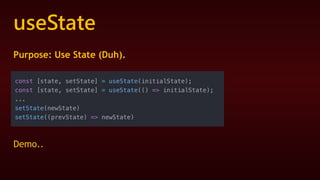
useState
Purpose: Use State (Duh).
Demo..
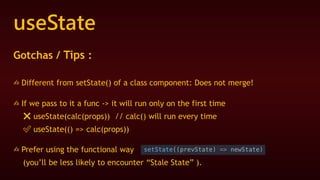
useState
Gotchas / Tips :
✍ Different from setState() of a class component: Does not merge!
✍ If we pass to it a func -> it will run only on the first time
❌ useState(calc(props)) // calc() will run every time
✅ useState(() => calc(props))
✍ Prefer using the functional way
(you’ll be less likely to encounter “Stale State” ).
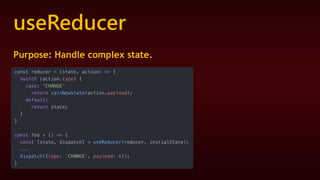
useReducer
Purpose: Handle complex state.
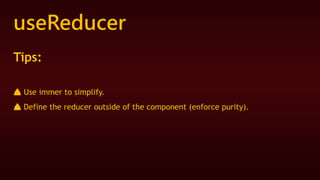
useReducer
Tips:
⛰ Use immer to simplify.
⛰ Define the reducer outside of the component (enforce purity).
useEffect
Purpose: Handle side effects (mostly).
How depArr affects behavior:
Nothing → Run after each render / Cleanup before every next render
[] → Run only after mount / Cleanup before unmount
[deps...] → Run only after dependencies change / Cleanup before next render
Demo..
Or (named):
useEffect:
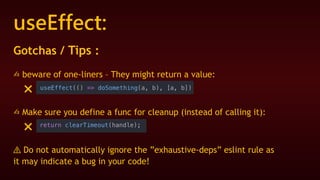
Gotchas / Tips :
✍ beware of one-liners – They might return a value:
❌
✍ Make sure you define a func for cleanup (instead of calling it):
❌
⚠️ Do not automatically ignore the ”exhaustive-deps” eslint rule as
it may indicate a bug in your code!
useEffect:
Gotchas / Tips:
✍ useEffect should only have “Stable References” as dependencies:
A stable ref is a reference which is constant. Examples:
✅ Consts we define outside the component (props too).
✅ The func returned from useState / useCallback().
✅ Variables we define with useRef().
❌ A const defined in a component → it is redefined on each run.
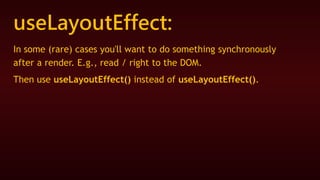
useLayoutEffect:
In some (rare) cases you'll want to do something synchronously
after a render. E.g., read / right to the DOM.
Then use useLayoutEffect() instead of useLayoutEffect().
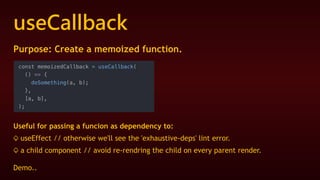
useCallback
Purpose: Create a memoized function.
Useful for passing a funcion as dependency to:
♤ useEffect // otherwise we'll see the 'exhaustive-deps' lint error.
♤ a child component // avoid re-rendring the child on every parent render.
Demo..
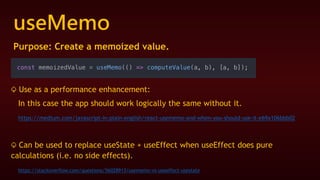
useMemo
Purpose: Create a memoized value.
♤ Use as a performance enhancement:
In this case the app should work logically the same without it.
https://medium.com/javascript-in-plain-english/react-usememo-and-when-you-should-use-it-e69a106bbb02
♤ Can be used to replace useState + useEffect when useEffect does pure
calculations (i.e. no side effects).
https://stackoverflow.com/questions/56028913/usememo-vs-useeffect-usestate
useRef
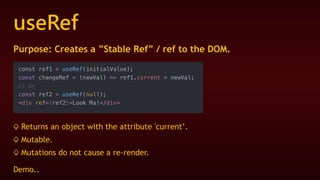
Purpose: Creates a ”Stable Ref” / ref to the DOM.
♤ Returns an object with the attribute 'current’.
♤ Mutable.
♤ Mutations do not cause a re-render.
Demo..
useRef
Usages examples:
♤ Refer to a DOM element (like createRef() in classes):
=> Detect clicks outside the element, find its size etc.
♤ Store a mutable value across the lifespan of the component
(like placing a value on “this” in a class).
=> Access a var from different funcs, keep previous state etc.
⚠️ Modify refs in event handlers and effects, not the
“render” (=the body of the component).
Hooks Rules!
📜 Do not place hooks behind conditions!
Make sure all are called every time the component “runs”.
Best practice: Place at the top of the component.
📜 Call hooks only from functional components or custom hooks!
* Enforced using the eslint-plugin-react-hooks rules.
Custom Hooks
🚀 Enable logic reusability between (and within) components.
🚀 Added bonus: Hooks created by the community:
→ Gists.
→ Npm packages.
* Same hooks rules apply.
* The name should start with “use” (otherwise we lose the linter’s help).
Demo..
Links
📃 The official Docs: https://reactjs.org/docs/hooks-intro.html
📃 Useful hooks (for copy+paste): https://github.com/gragland/usehooks
📃 Useful hooks (as npm packages): https://github.com/gragland/usehooks
📃 Huge collection of hooks related links:
https://github.com/rehooks/awesome-react-hooks
Fin
(for now)

React Hooks

  • 1.
    React Hooks Erez Cohen UIArchitect at Perfecto (Perforce) @erezcohentlv
  • 2.
    Background ☞ Introduced inReact version 16.8. ☞ Hooks enable adding state and side effects to Functional Components. ☞ Essentially replace the need for Class components. In the eyes of the React Team: ☞ What a true component should be: "A function with state". ☞ The mindset: Call a function for rendering.
  • 3.
    Background Classes Components arenot “real classes”: 😐 We shouldn't inherit a class component. 😐 We cannot do dynamic binding (Polymorphism). 😐 We do not use the “new” keyword. 😐 We do not move around instances like we do with objects. 😐 Members go into ”State”?! 😐 What are props? (params to a function? a constructor?) From an interview with Dan Abramov
  • 4.
    Motivation 😺 Functionality Reuse: -Extract repeating code to a custom hook (including state and side effects). - Simpler then HOC (Higher Order Components) and "Render Props". 😺 Smaller code, co-located: - E.g. useEffect() may replace code that was previously spread over several lifecycle methods. 😺 Functional components are less verbose.
  • 5.
    Let’s look at ⚡️useState ⚡️ useReducer ⚡️ useEffect ⚡️ useCallback ⚡️ useMemo ⚡️ useRef
  • 6.
  • 7.
    useState Gotchas / Tips: ✍ Different from setState() of a class component: Does not merge! ✍ If we pass to it a func -> it will run only on the first time ❌ useState(calc(props)) // calc() will run every time ✅ useState(() => calc(props)) ✍ Prefer using the functional way (you’ll be less likely to encounter “Stale State” ).
  • 8.
  • 9.
    useReducer Tips: ⛰ Use immerto simplify. ⛰ Define the reducer outside of the component (enforce purity).
  • 10.
    useEffect Purpose: Handle sideeffects (mostly). How depArr affects behavior: Nothing → Run after each render / Cleanup before every next render [] → Run only after mount / Cleanup before unmount [deps...] → Run only after dependencies change / Cleanup before next render Demo.. Or (named):
  • 11.
    useEffect: Gotchas / Tips: ✍ beware of one-liners – They might return a value: ❌ ✍ Make sure you define a func for cleanup (instead of calling it): ❌ ⚠️ Do not automatically ignore the ”exhaustive-deps” eslint rule as it may indicate a bug in your code!
  • 12.
    useEffect: Gotchas / Tips: ✍useEffect should only have “Stable References” as dependencies: A stable ref is a reference which is constant. Examples: ✅ Consts we define outside the component (props too). ✅ The func returned from useState / useCallback(). ✅ Variables we define with useRef(). ❌ A const defined in a component → it is redefined on each run.
  • 13.
    useLayoutEffect: In some (rare)cases you'll want to do something synchronously after a render. E.g., read / right to the DOM. Then use useLayoutEffect() instead of useLayoutEffect().
  • 14.
    useCallback Purpose: Create amemoized function. Useful for passing a funcion as dependency to: ♤ useEffect // otherwise we'll see the 'exhaustive-deps' lint error. ♤ a child component // avoid re-rendring the child on every parent render. Demo..
  • 15.
    useMemo Purpose: Create amemoized value. ♤ Use as a performance enhancement: In this case the app should work logically the same without it. https://medium.com/javascript-in-plain-english/react-usememo-and-when-you-should-use-it-e69a106bbb02 ♤ Can be used to replace useState + useEffect when useEffect does pure calculations (i.e. no side effects). https://stackoverflow.com/questions/56028913/usememo-vs-useeffect-usestate
  • 16.
    useRef Purpose: Creates a”Stable Ref” / ref to the DOM. ♤ Returns an object with the attribute 'current’. ♤ Mutable. ♤ Mutations do not cause a re-render. Demo..
  • 17.
    useRef Usages examples: ♤ Referto a DOM element (like createRef() in classes): => Detect clicks outside the element, find its size etc. ♤ Store a mutable value across the lifespan of the component (like placing a value on “this” in a class). => Access a var from different funcs, keep previous state etc. ⚠️ Modify refs in event handlers and effects, not the “render” (=the body of the component).
  • 18.
    Hooks Rules! 📜 Donot place hooks behind conditions! Make sure all are called every time the component “runs”. Best practice: Place at the top of the component. 📜 Call hooks only from functional components or custom hooks! * Enforced using the eslint-plugin-react-hooks rules.
  • 19.
    Custom Hooks 🚀 Enablelogic reusability between (and within) components. 🚀 Added bonus: Hooks created by the community: → Gists. → Npm packages. * Same hooks rules apply. * The name should start with “use” (otherwise we lose the linter’s help). Demo..
  • 20.
    Links 📃 The officialDocs: https://reactjs.org/docs/hooks-intro.html 📃 Useful hooks (for copy+paste): https://github.com/gragland/usehooks 📃 Useful hooks (as npm packages): https://github.com/gragland/usehooks 📃 Huge collection of hooks related links: https://github.com/rehooks/awesome-react-hooks
  • 21.