arvind.saini@outlook.com
Rajasthan Board 10 Maths Chapter 8 Height and
Distance Miscellaneous Exercise
Question 1.
The shadow of a vertical pillar is same the height of pillar, then angle of elevation of sun will be
:
(A) 45°
(B) 30°
(C) 60°
(D) 50°
Solution :
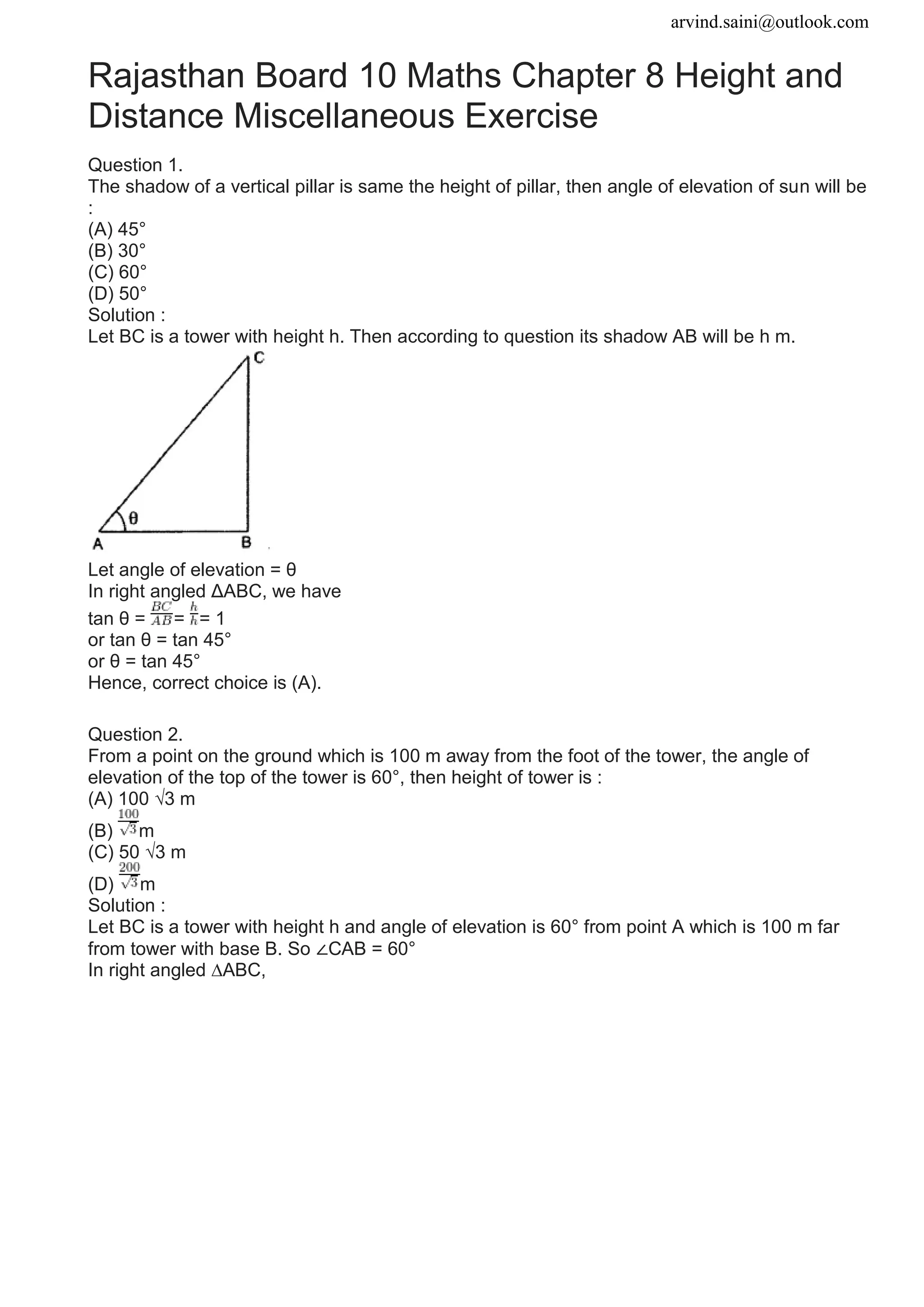
Let BC is a tower with height h. Then according to question its shadow AB will be h m.
Let angle of elevation = θ
In right angled ΔABC, we have
tan θ = = = 1
or tan θ = tan 45°
or θ = tan 45°
Hence, correct choice is (A).
Question 2.
From a point on the ground which is 100 m away from the foot of the tower, the angle of
elevation of the top of the tower is 60°, then height of tower is :
(A) 100 √3 m
(B) m
(C) 50 √3 m
(D) m
Solution :
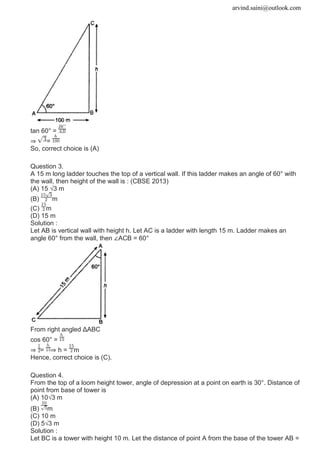
Let BC is a tower with height h and angle of elevation is 60° from point A which is 100 m far
from tower with base B. So ∠CAB = 60°
In right angled ∆ABC,
arvind.saini@outlook.com
tan 60° =
⇒ =
So, correct choice is (A)
Question 3.
A 15 m long ladder touches the top of a vertical wall. If this ladder makes an angle of 60° with
the wall, then height of the wall is : (CBSE 2013)
(A) 15 √3 m
(B) m
(C) m
(D) 15 m
Solution :
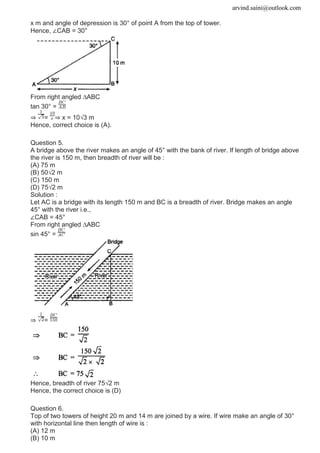
Let AB is vertical wall with height h. Let AC is a ladder with length 15 m. Ladder makes an
angle 60° from the wall, then ∠ACB = 60°
From right angled ΔABC
cos 60° =
⇒ = ⇒ h = m
Hence, correct choice is (C).
Question 4.
From the top of a loom height tower, angle of depression at a point on earth is 30°. Distance of
point from base of tower is
(A) 10√3 m
(B) m
(C) 10 m
(D) 5√3 m
Solution :
Let BC is a tower with height 10 m. Let the distance of point A from the base of the tower AB =
arvind.saini@outlook.com
x m and angle of depression is 30° of point A from the top of tower.
Hence, ∠CAB = 30°
From right angled ∆ABC
tan 30° =
⇒ = ⇒ x = 10√3 m
Hence, correct choice is (A).
Question 5.
A bridge above the river makes an angle of 45° with the bank of river. If length of bridge above
the river is 150 m, then breadth of river will be :
(A) 75 m
(B) 50√2 m
(C) 150 m
(D) 75√2 m
Solution :
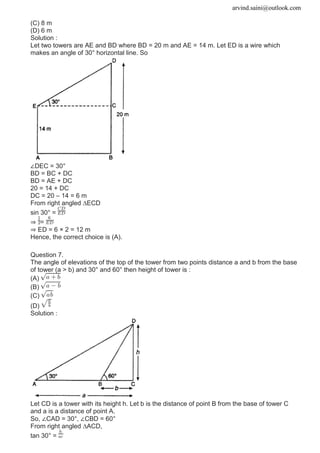
Let AC is a bridge with its length 150 m and BC is a breadth of river. Bridge makes an angle
45° with the river i.e.,
∠CAB = 45°
From right angled ∆ABC
sin 45° =
⇒ =
Hence, breadth of river 75√2 m
Hence, the correct choice is (D)
Question 6.
Top of two towers of height 20 m and 14 m are joined by a wire. If wire make an angle of 30°
with horizontal line then length of wire is :
(A) 12 m
(B) 10 m
arvind.saini@outlook.com
(C) 8 m
(D) 6 m
Solution :
Let two towers are AE and BD where BD = 20 m and AE = 14 m. Let ED is a wire which
makes an angle of 30° horizontal line. So
∠DEC = 30°
BD = BC + DC
BD = AE + DC
20 = 14 + DC
DC = 20 – 14 = 6 m
From right angled ∆ECD
sin 30° =
⇒ =
⇒ ED = 6 × 2 = 12 m
Hence, the correct choice is (A).
Question 7.
The angle of elevations of the top of the tower from two points distance a and b from the base
of tower (a > b) and 30° and 60° then height of tower is :
(A)
(B)
(C)
(D)
Solution :
Let CD is a tower with its height h. Let b is the distance of point B from the base of tower C
and a is a distance of point A.
So, ∠CAD = 30°, ∠CBD = 60°
From right angled ∆ACD,
tan 30° =
arvind.saini@outlook.com
⇒ =
⇒ h = …..(i)
From right angled ∆BCD,
tan 60° =
⇒ = …(ii)
⇒ h = √3b
From equation (i) and (ii),
h2
= ab
or h =
So, correct choice is (C).
Question 8.
From the top of a 25 m high pillar at the top of tower angle of elevation is same as the angle of
depression of foot of tower then height of tower is :
(A) 25 m
(B) 100 m
(C) 75 m
(D) 50 m
Solution :
Let AE is a pillar in the figure with height 25 m and BD is a tower. According to question at the
top of tower angle of elevation is same as the angle of depression of foot of tower.
So ∠CED = ∠CEB = ∠ABE = θ
and AE = BC = 2 m
From right angled ΔBAE
tan θ =
or AB = = 25 cotθ
From right angled ΔECD,
tan θ = =
tan θ =
or CD = 25 cot θ × tan θ
= 25 m [∵ tan θ cot θ = 1]
Hence, height of tower = BC + CD
= 25 + 25
= 50 m
So, correct choice is (D).
Question 9.
If ratio of length of a vertical rod and length of its shadow is 1 : √3, then angle of elevation of
sun is :
(A) 30°
arvind.saini@outlook.com
(B) 45°
(C) 60°
(D) 90°
Solution :
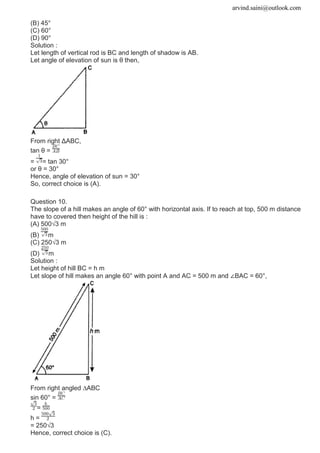
Let length of vertical rod is BC and length of shadow is AB.
Let angle of elevation of sun is θ then,
From right ΔABC,
tan θ =
= = tan 30°
or θ = 30°
Hence, angle of elevation of sun = 30°
So, correct choice is (A).
Question 10.
The slope of a hill makes an angle of 60° with horizontal axis. If to reach at top, 500 m distance
have to covered then height of the hill is :
(A) 500√3 m
(B) m
(C) 250√3 m
(D) m
Solution :
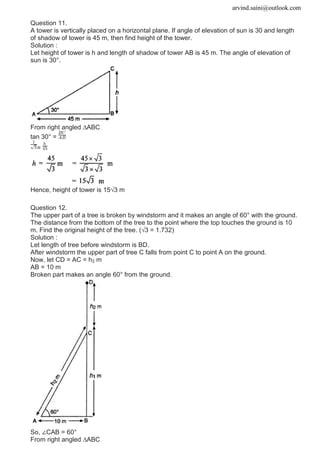
Let height of hill BC = h m
Let slope of hill makes an angle 60° with point A and AC = 500 m and ∠BAC = 60°,
From right angled ∆ABC
sin 60° =
=
h =
= 250√3
Hence, correct choice is (C).
arvind.saini@outlook.com
Question 11.
A tower is vertically placed on a horizontal plane. If angle of elevation of sun is 30 and length
of shadow of tower is 45 m, then find height of the tower.
Solution :
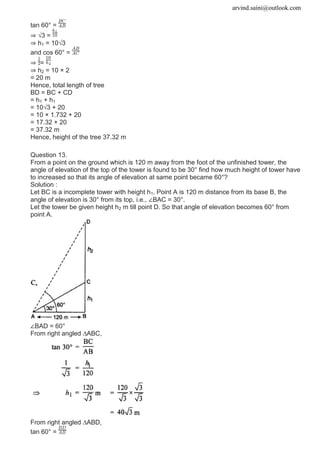
Let height of tower is h and length of shadow of tower AB is 45 m. The angle of elevation of
sun is 30°.
From right angled ∆ABC
tan 30° =
=
Hence, height of tower is 15√3 m
Question 12.
The upper part of a tree is broken by windstorm and it makes an angle of 60° with the ground.
The distance from the bottom of the tree to the point where the top touches the ground is 10
m. Find the original height of the tree. (√3 = 1.732)
Solution :
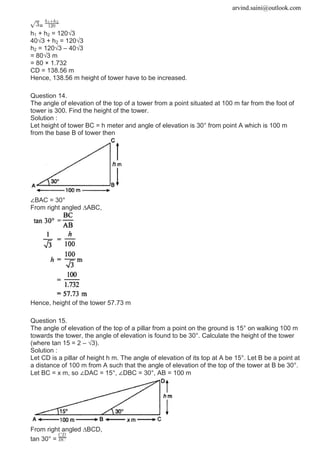
Let length of tree before windstorm is BD.
After windstorm the upper part of tree C falls from point C to point A on the ground.
Now, let CD = AC = h2 m
AB = 10 m
Broken part makes an angle 60° from the ground.
So, ∠CAB = 60°
From right angled ∆ABC
arvind.saini@outlook.com
tan 60° =
⇒ √3 =
⇒ h1 = 10√3
and cos 60° =
⇒ =
⇒ h2 = 10 × 2
= 20 m
Hence, total length of tree
BD = BC + CD
= h1 + h1
= 10√3 + 20
= 10 × 1.732 + 20
= 17.32 + 20
= 37.32 m
Hence, height of the tree 37.32 m
Question 13.
From a point on the ground which is 120 m away from the foot of the unfinished tower, the
angle of elevation of the top of the tower is found to be 30° find how much height of tower have
to increased so that its angle of elevation at same point became 60°?
Solution :
Let BC is a incomplete tower with height h1. Point A is 120 m distance from its base B, the
angle of elevation is 30° from its top, i.e., ∠BAC = 30°.
Let the tower be given height h2 m till point D. So that angle of elevation becomes 60° from
point A.
∠BAD = 60°
From right angled ∆ABC,
From right angled ∆ABD,
tan 60° =
arvind.saini@outlook.com
=
h1 + h2 = 120√3
40√3 + h2 = 120√3
h2 = 120√3 – 40√3
= 80√3 m
= 80 × 1.732
CD = 138.56 m
Hence, 138.56 m height of tower have to be increased.
Question 14.
The angle of elevation of the top of a tower from a point situated at 100 m far from the foot of
tower is 300. Find the height of the tower.
Solution :
Let height of tower BC = h meter and angle of elevation is 30° from point A which is 100 m
from the base B of tower then
∠BAC = 30°
From right angled ∆ABC,
Hence, height of the tower 57.73 m
Question 15.
The angle of elevation of the top of a pillar from a point on the ground is 15° on walking 100 m
towards the tower, the angle of elevation is found to be 30°. Calculate the height of the tower
(where tan 15 = 2 – √3).
Solution :
Let CD is a pillar of height h m. The angle of elevation of its top at A be 15°. Let B be a point at
a distance of 100 m from A such that the angle of elevation of the top of the tower at B be 30°.
Let BC = x m, so ∠DAC = 15°, ∠DBC = 30°, AB = 100 m
From right angled ∆BCD,
tan 30° =
arvind.saini@outlook.com
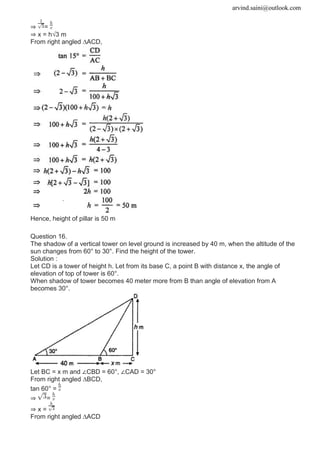
⇒ =
⇒ x = h√3 m
From right angled ∆ACD,
Hence, height of pillar is 50 m
Question 16.
The shadow of a vertical tower on level ground is increased by 40 m, when the altitude of the
sun changes from 60° to 30°. Find the height of the tower.
Solution :
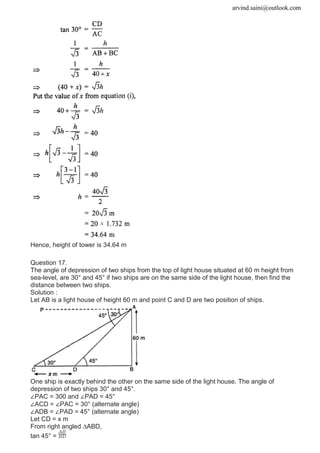
Let CD is a tower of height h. Let from its base C, a point B with distance x, the angle of
elevation of top of tower is 60°.
When shadow of tower becomes 40 meter more from B than angle of elevation from A
becomes 30°.
Let BC = x m and ∠CBD = 60°, ∠CAD = 30°
From right angled ∆BCD,
tan 60° =
⇒ =
⇒ x =
From right angled ∆ACD
arvind.saini@outlook.com
Hence, height of tower is 34.64 m
Question 17.
The angle of depression of two ships from the top of light house situated at 60 m height from
sea-level, are 30° and 45° if two ships are on the same side of the light house, then find the
distance between two ships.
Solution :
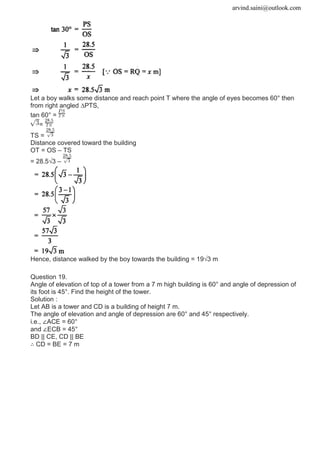
Let AB is a light house of height 60 m and point C and D are two position of ships.
One ship is exactly behind the other on the same side of the light house. The angle of
depression of two ships 30° and 45°.
∠PAC = 300 and ∠PAD = 45°
∠ACD = ∠PAC = 30° (alternate angle)
∠ADB = ∠PAD = 45° (alternate angle)
Let CD = x m
From right angled ∆ABD,
tan 45° =
arvind.saini@outlook.com
1 =
⇒ BD = 60 m …..(i)
From right angled ∆ABC,
[∵ From equation (i) BD = 60 m]
x + 60 = 60√3
x = 60√3 – 60
= 60(√3 – 1)
= 60 × (1.732 – 1)
= 60 × 0.732
= 43.92 m
Hence, distance between two ships = 43.92 m
Question 18.
A 1.5 m tall boy is standing at some distance away from a 30 m high building when he moves
towards the building then angle of elevation from his eye became 60° from 30°. Find how
much distance he covered towards the building?
Solution :
Let PQ be the building of height 30 m. A boy is standing at point R with distance x m from the
base of building Q with height QR = 1.5 m, then
OS || PQ and QR || SQ
∴ SQ = OR = 1.5 m
∴ PS = PQ = SQ
= 30 – 1.5 = 28.5 m
The angle of elevation from the eyes of the boy to the top of building is 30° and as the boy
walks towards the building the angle of elevation
becomes 60°.
∠PQS = 30° and ∠PTS = 60°
From tight angled ∆PSO,
arvind.saini@outlook.com
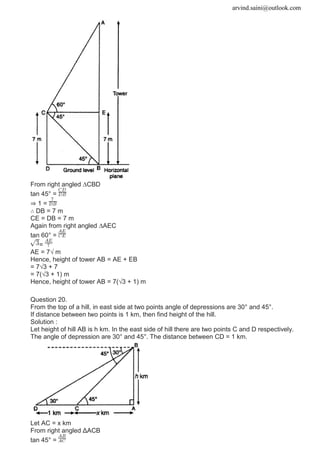
Let a boy walks some distance and reach point T where the angle of eyes becomes 60° then
from right angled ∆PTS,
tan 60° =
=
TS =
Distance covered toward the building
OT = OS – TS
= 28.5√3 –
Hence, distance walked by the boy towards the building = 19√3 m
Question 19.
Angle of elevation of top of a tower from a 7 m high building is 60° and angle of depression of
its foot is 45°. Find the height of the tower.
Solution :
Let AB is a tower and CD is a building of height 7 m.
The angle of elevation and angle of depression are 60° and 45° respectively.
i.e., ∠ACE = 60°
and ∠ECB = 45°
BD || CE, CD || BE
∴ CD = BE = 7 m
arvind.saini@outlook.com
From right angled ∆CBD
tan 45° =
⇒ 1 =
∴ DB = 7 m
CE = DB = 7 m
Again from right angled ∆AEC
tan 60° =
=
AE = 7√ m
Hence, height of tower AB = AE + EB
= 7√3 + 7
= 7(√3 + 1) m
Hence, height of tower AB = 7(√3 + 1) m
Question 20.
From the top of a hill, in east side at two points angle of depressions are 30° and 45°.
If distance between two points is 1 km, then find height of the hill.
Solution :
Let height of hill AB is h km. In the east side of hill there are two points C and D respectively.
The angle of depression are 30° and 45°. The distance between CD = 1 km.
Let AC = x km
From right angled ΔACB
tan 45° =
arvind.saini@outlook.com
⇒ 1 =
⇒ h = x
From right angled ΔDAB,
tan 30° =
⇒ =
⇒ √3h = x + 1
Put the value of x from equation (i) in equation (ii)
√3h = h + 1
√3h – h = 1
h(√3 – 1) = 1
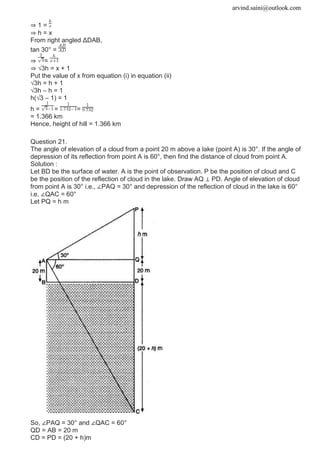
h = = =
= 1.366 km
Hence, height of hill = 1.366 km
Question 21.
The angle of elevation of a cloud from a point 20 m above a lake (point A) is 30°. If the angle of
depression of its reflection from point A is 60°, then find the distance of cloud from point A.
Solution :
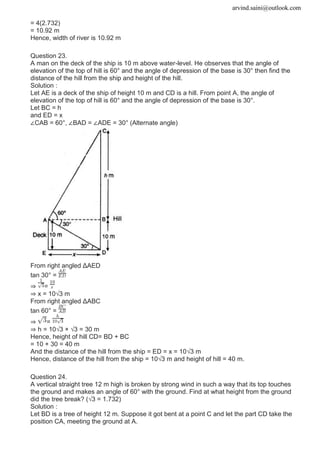
Let BD be the surface of water. A is the point of observation. P be the position of cloud and C
be the position of the reflection of cloud in the lake. Draw AQ ⊥ PD. Angle of elevation of cloud
from point A is 30° i.e., ∠PAQ = 30° and depression of the reflection of cloud in the lake is 60°
i.e, ∠QAC = 60°
Let PQ = h m
So, ∠PAQ = 30° and ∠QAC = 60°
QD = AB = 20 m
CD = PD = (20 + h)m
arvind.saini@outlook.com
QC = 20 + h + 20
= (40 + h) m
BD = AQ
From right angled ∆PAQ,
tan 30° =
⇒ =
⇒ AQ = h√3 m
From right angled ∆AQC,
tan 60° =
⇒ = [∵ From equation (i), AQ = h√3]
h√3 × √3 = 40 + h
⇒ 3h = 40 + h
⇒ 2h = 40
⇒ h = = 20 m
From right angled ∆PAQ
sin 30° =
⇒ =
⇒ =
⇒ AP = 20 × 2 = 40 m
Hence, distance of cloud from A = 40 m
Question 22.
From a point on a bridge across a river, the angles of depression of the banks on opposite side
of the river are 30° and 45°, respectively. If the bridge is at height of 4 m from the bank, find
the width of the river.
Solution :
Given : Height of bridge from river
AO = 4 m
BO = x, CO = y
From right angled ∆AOB
= tan 45°
⇒ = 1
⇒ x = 4 m ……(i)
Again from right angled ∆AOC,
= tan 30°
⇒ =
⇒ y = 4√3 m ……(ii)
From equation (i) and (ii)
Width of river = x + y
= 4√3 + 4
= 4(√3 + 1)
= 4(1.732 + 1)
arvind.saini@outlook.com
= 4(2.732)
= 10.92 m
Hence, width of river is 10.92 m
Question 23.
A man on the deck of the ship is 10 m above water-level. He observes that the angle of
elevation of the top of hill is 60° and the angle of depression of the base is 30° then find the
distance of the hill from the ship and height of the hill.
Solution :
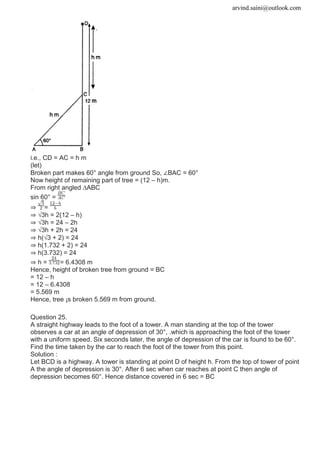
Let AE is a deck of the ship of height 10 m and CD is a hill. From point A, the angle of
elevation of the top of hill is 60° and the angle of depression of the base is 30°.
Let BC = h
and ED = x
∠CAB = 60°, ∠BAD = ∠ADE = 30° (Alternate angle)
From right angled ΔAED
tan 30° =
⇒ =
⇒ x = 10√3 m
From right angled ΔABC
tan 60° =
⇒ =
⇒ h = 10√3 × √3 = 30 m
Hence, height of hill CD= BD + BC
= 10 + 30 = 40 m
And the distance of the hill from the ship = ED = x = 10√3 m
Hence, distance of the hill from the ship = 10√3 m and height of hill = 40 m.
Question 24.
A vertical straight tree 12 m high is broken by strong wind in such a way that its top touches
the ground and makes an angle of 60° with the ground. Find at what height from the ground
did the tree break? (√3 = 1.732)
Solution :
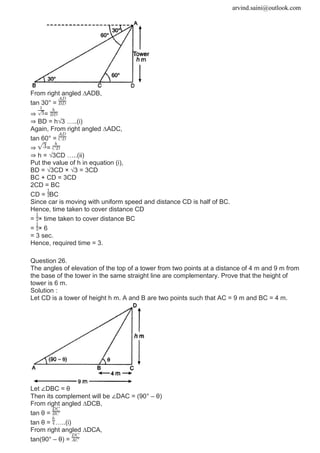
Let BD is a tree of height 12 m. Suppose it got bent at a point C and let the part CD take the
position CA, meeting the ground at A.
arvind.saini@outlook.com
i.e., CD = AC = h m
(let)
Broken part makes 60° angle from ground So, ∠BAC = 60°
Now height of remaining part of tree = (12 – h)m.
From right angled ∆ABC
sin 60° =
⇒ =
⇒ √3h = 2(12 – h)
⇒ √3h = 24 – 2h
⇒ √3h + 2h = 24
⇒ h(√3 + 2) = 24
⇒ h(1.732 + 2) = 24
⇒ h(3.732) = 24
⇒ h = = 6.4308 m
Hence, height of broken tree from ground = BC
= 12 – h
= 12 – 6.4308
= 5.569 m
Hence, tree ¡s broken 5.569 m from ground.
Question 25.
A straight highway leads to the foot of a tower. A man standing at the top of the tower
observes a car at an angle of depression of 30°, .which is approaching the foot of the tower
with a uniform speed. Six seconds later, the angle of depression of the car is found to be 60°.
Find the time taken by the car to reach the foot of the tower from this point.
Solution :
Let BCD is a highway. A tower is standing at point D of height h. From the top of tower of point
A the angle of depression is 30°. After 6 sec when car reaches at point C then angle of
depression becomes 60°. Hence distance covered in 6 sec = BC
arvind.saini@outlook.com
From right angled ∆ADB,
tan 30° =
⇒ =
⇒ BD = h√3 …..(i)
Again, From right angled ∆ADC,
tan 60° =
⇒ =
⇒ h = √3CD …..(ii)
Put the value of h in equation (i),
BD = √3CD × √3 = 3CD
BC + CD = 3CD
2CD = BC
CD = BC
Since car is moving with uniform speed and distance CD is half of BC.
Hence, time taken to cover distance CD
= × time taken to cover distance BC
= × 6
= 3 sec.
Hence, required time = 3.
Question 26.
The angles of elevation of the top of a tower from two points at a distance of 4 m and 9 m from
the base of the tower in the same straight line are complementary. Prove that the height of
tower is 6 m.
Solution :
Let CD is a tower of height h m. A and B are two points such that AC = 9 m and BC = 4 m.
Let ∠DBC = θ
Then its complement will be ∠DAC = (90° – θ)
From right angled ∆DCB,
tan θ =
tan θ = …..(i)
From right angled ∆DCA,
tan(90° – θ) =
arvind.saini@outlook.com
cot θ =
⇒ = …..(i)
multiply equation (i) and (ii),
tan θ × = ×
or 1 =
⇒ h2
= 36
⇒ h = 6 m
Hence, height of tower = 6 m
Question 27.
A tower and a building on the opposite side of road are situated. The angles depression from
the top of tower at the roof and base of building are 45° and 60° respectively. If height of
building Is 12 m then find the height of the tower. (√3 = 1.732)
Solution :
Let AB is a building of height 12 m. CE is a tower. Let ED = h m
The angles of depression from point E of top of tower at the roof and base on building are 45°
and 60° respectively. Now
∠XEA = ∠EAD = 45° (Alternate angle)
∠XEB = ∠EBC = 60° (Alternate angle)
Let BC = x and ED = h m
AB = CD = 12 m
From right angled ΔEAD,
tan 45° =
l =
⇒ h = x …(i)
From right angled ΔEBC,
tan 60° =
√3 = = (Put the value of x from equation (i))
⇒ √3h = h + 12
⇒ √3h – h = 12
⇒ h[1.732 – 1] = 12
⇒ h =
= 16.393 m
Hence, height of tower = EC = CD + ED
= 12 + 16.393
= 28.393 m
arvind.saini@outlook.com
Question 28.
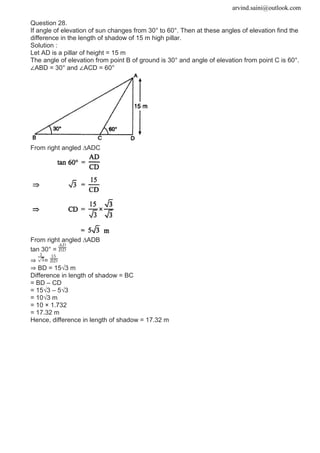
If angle of elevation of sun changes from 30° to 60°. Then at these angles of elevation find the
difference in the length of shadow of 15 m high pillar.
Solution :
Let AD is a pillar of height = 15 m
The angle of elevation from point B of ground is 30° and angle of elevation from point C is 60°.
∠ABD = 30° and ∠ACD = 60°
From right angled ∆ADC
From right angled ∆ADB
tan 30° =
⇒ =
⇒ BD = 15√3 m
Difference in length of shadow = BC
= BD – CD
= 15√3 – 5√3
= 10√3 m
= 10 × 1.732
= 17.32 m
Hence, difference in length of shadow = 17.32 m

Rbse solutions for class 10 maths chapter 8 height and distance

  • 1.
    arvind.saini@outlook.com Rajasthan Board 10Maths Chapter 8 Height and Distance Miscellaneous Exercise Question 1. The shadow of a vertical pillar is same the height of pillar, then angle of elevation of sun will be : (A) 45° (B) 30° (C) 60° (D) 50° Solution : Let BC is a tower with height h. Then according to question its shadow AB will be h m. Let angle of elevation = θ In right angled ΔABC, we have tan θ = = = 1 or tan θ = tan 45° or θ = tan 45° Hence, correct choice is (A). Question 2. From a point on the ground which is 100 m away from the foot of the tower, the angle of elevation of the top of the tower is 60°, then height of tower is : (A) 100 √3 m (B) m (C) 50 √3 m (D) m Solution : Let BC is a tower with height h and angle of elevation is 60° from point A which is 100 m far from tower with base B. So ∠CAB = 60° In right angled ∆ABC,
  • 2.
    arvind.saini@outlook.com tan 60° = ⇒= So, correct choice is (A) Question 3. A 15 m long ladder touches the top of a vertical wall. If this ladder makes an angle of 60° with the wall, then height of the wall is : (CBSE 2013) (A) 15 √3 m (B) m (C) m (D) 15 m Solution : Let AB is vertical wall with height h. Let AC is a ladder with length 15 m. Ladder makes an angle 60° from the wall, then ∠ACB = 60° From right angled ΔABC cos 60° = ⇒ = ⇒ h = m Hence, correct choice is (C). Question 4. From the top of a loom height tower, angle of depression at a point on earth is 30°. Distance of point from base of tower is (A) 10√3 m (B) m (C) 10 m (D) 5√3 m Solution : Let BC is a tower with height 10 m. Let the distance of point A from the base of the tower AB =
  • 3.
    arvind.saini@outlook.com x m andangle of depression is 30° of point A from the top of tower. Hence, ∠CAB = 30° From right angled ∆ABC tan 30° = ⇒ = ⇒ x = 10√3 m Hence, correct choice is (A). Question 5. A bridge above the river makes an angle of 45° with the bank of river. If length of bridge above the river is 150 m, then breadth of river will be : (A) 75 m (B) 50√2 m (C) 150 m (D) 75√2 m Solution : Let AC is a bridge with its length 150 m and BC is a breadth of river. Bridge makes an angle 45° with the river i.e., ∠CAB = 45° From right angled ∆ABC sin 45° = ⇒ = Hence, breadth of river 75√2 m Hence, the correct choice is (D) Question 6. Top of two towers of height 20 m and 14 m are joined by a wire. If wire make an angle of 30° with horizontal line then length of wire is : (A) 12 m (B) 10 m
  • 4.
    arvind.saini@outlook.com (C) 8 m (D)6 m Solution : Let two towers are AE and BD where BD = 20 m and AE = 14 m. Let ED is a wire which makes an angle of 30° horizontal line. So ∠DEC = 30° BD = BC + DC BD = AE + DC 20 = 14 + DC DC = 20 – 14 = 6 m From right angled ∆ECD sin 30° = ⇒ = ⇒ ED = 6 × 2 = 12 m Hence, the correct choice is (A). Question 7. The angle of elevations of the top of the tower from two points distance a and b from the base of tower (a > b) and 30° and 60° then height of tower is : (A) (B) (C) (D) Solution : Let CD is a tower with its height h. Let b is the distance of point B from the base of tower C and a is a distance of point A. So, ∠CAD = 30°, ∠CBD = 60° From right angled ∆ACD, tan 30° =
  • 5.
    arvind.saini@outlook.com ⇒ = ⇒ h= …..(i) From right angled ∆BCD, tan 60° = ⇒ = …(ii) ⇒ h = √3b From equation (i) and (ii), h2 = ab or h = So, correct choice is (C). Question 8. From the top of a 25 m high pillar at the top of tower angle of elevation is same as the angle of depression of foot of tower then height of tower is : (A) 25 m (B) 100 m (C) 75 m (D) 50 m Solution : Let AE is a pillar in the figure with height 25 m and BD is a tower. According to question at the top of tower angle of elevation is same as the angle of depression of foot of tower. So ∠CED = ∠CEB = ∠ABE = θ and AE = BC = 2 m From right angled ΔBAE tan θ = or AB = = 25 cotθ From right angled ΔECD, tan θ = = tan θ = or CD = 25 cot θ × tan θ = 25 m [∵ tan θ cot θ = 1] Hence, height of tower = BC + CD = 25 + 25 = 50 m So, correct choice is (D). Question 9. If ratio of length of a vertical rod and length of its shadow is 1 : √3, then angle of elevation of sun is : (A) 30°
  • 6.
    arvind.saini@outlook.com (B) 45° (C) 60° (D)90° Solution : Let length of vertical rod is BC and length of shadow is AB. Let angle of elevation of sun is θ then, From right ΔABC, tan θ = = = tan 30° or θ = 30° Hence, angle of elevation of sun = 30° So, correct choice is (A). Question 10. The slope of a hill makes an angle of 60° with horizontal axis. If to reach at top, 500 m distance have to covered then height of the hill is : (A) 500√3 m (B) m (C) 250√3 m (D) m Solution : Let height of hill BC = h m Let slope of hill makes an angle 60° with point A and AC = 500 m and ∠BAC = 60°, From right angled ∆ABC sin 60° = = h = = 250√3 Hence, correct choice is (C).
  • 7.
    arvind.saini@outlook.com Question 11. A toweris vertically placed on a horizontal plane. If angle of elevation of sun is 30 and length of shadow of tower is 45 m, then find height of the tower. Solution : Let height of tower is h and length of shadow of tower AB is 45 m. The angle of elevation of sun is 30°. From right angled ∆ABC tan 30° = = Hence, height of tower is 15√3 m Question 12. The upper part of a tree is broken by windstorm and it makes an angle of 60° with the ground. The distance from the bottom of the tree to the point where the top touches the ground is 10 m. Find the original height of the tree. (√3 = 1.732) Solution : Let length of tree before windstorm is BD. After windstorm the upper part of tree C falls from point C to point A on the ground. Now, let CD = AC = h2 m AB = 10 m Broken part makes an angle 60° from the ground. So, ∠CAB = 60° From right angled ∆ABC
  • 8.
    arvind.saini@outlook.com tan 60° = ⇒√3 = ⇒ h1 = 10√3 and cos 60° = ⇒ = ⇒ h2 = 10 × 2 = 20 m Hence, total length of tree BD = BC + CD = h1 + h1 = 10√3 + 20 = 10 × 1.732 + 20 = 17.32 + 20 = 37.32 m Hence, height of the tree 37.32 m Question 13. From a point on the ground which is 120 m away from the foot of the unfinished tower, the angle of elevation of the top of the tower is found to be 30° find how much height of tower have to increased so that its angle of elevation at same point became 60°? Solution : Let BC is a incomplete tower with height h1. Point A is 120 m distance from its base B, the angle of elevation is 30° from its top, i.e., ∠BAC = 30°. Let the tower be given height h2 m till point D. So that angle of elevation becomes 60° from point A. ∠BAD = 60° From right angled ∆ABC, From right angled ∆ABD, tan 60° =
  • 9.
    arvind.saini@outlook.com = h1 + h2= 120√3 40√3 + h2 = 120√3 h2 = 120√3 – 40√3 = 80√3 m = 80 × 1.732 CD = 138.56 m Hence, 138.56 m height of tower have to be increased. Question 14. The angle of elevation of the top of a tower from a point situated at 100 m far from the foot of tower is 300. Find the height of the tower. Solution : Let height of tower BC = h meter and angle of elevation is 30° from point A which is 100 m from the base B of tower then ∠BAC = 30° From right angled ∆ABC, Hence, height of the tower 57.73 m Question 15. The angle of elevation of the top of a pillar from a point on the ground is 15° on walking 100 m towards the tower, the angle of elevation is found to be 30°. Calculate the height of the tower (where tan 15 = 2 – √3). Solution : Let CD is a pillar of height h m. The angle of elevation of its top at A be 15°. Let B be a point at a distance of 100 m from A such that the angle of elevation of the top of the tower at B be 30°. Let BC = x m, so ∠DAC = 15°, ∠DBC = 30°, AB = 100 m From right angled ∆BCD, tan 30° =
  • 10.
    arvind.saini@outlook.com ⇒ = ⇒ x= h√3 m From right angled ∆ACD, Hence, height of pillar is 50 m Question 16. The shadow of a vertical tower on level ground is increased by 40 m, when the altitude of the sun changes from 60° to 30°. Find the height of the tower. Solution : Let CD is a tower of height h. Let from its base C, a point B with distance x, the angle of elevation of top of tower is 60°. When shadow of tower becomes 40 meter more from B than angle of elevation from A becomes 30°. Let BC = x m and ∠CBD = 60°, ∠CAD = 30° From right angled ∆BCD, tan 60° = ⇒ = ⇒ x = From right angled ∆ACD
  • 11.
    arvind.saini@outlook.com Hence, height oftower is 34.64 m Question 17. The angle of depression of two ships from the top of light house situated at 60 m height from sea-level, are 30° and 45° if two ships are on the same side of the light house, then find the distance between two ships. Solution : Let AB is a light house of height 60 m and point C and D are two position of ships. One ship is exactly behind the other on the same side of the light house. The angle of depression of two ships 30° and 45°. ∠PAC = 300 and ∠PAD = 45° ∠ACD = ∠PAC = 30° (alternate angle) ∠ADB = ∠PAD = 45° (alternate angle) Let CD = x m From right angled ∆ABD, tan 45° =
  • 12.
    arvind.saini@outlook.com 1 = ⇒ BD= 60 m …..(i) From right angled ∆ABC, [∵ From equation (i) BD = 60 m] x + 60 = 60√3 x = 60√3 – 60 = 60(√3 – 1) = 60 × (1.732 – 1) = 60 × 0.732 = 43.92 m Hence, distance between two ships = 43.92 m Question 18. A 1.5 m tall boy is standing at some distance away from a 30 m high building when he moves towards the building then angle of elevation from his eye became 60° from 30°. Find how much distance he covered towards the building? Solution : Let PQ be the building of height 30 m. A boy is standing at point R with distance x m from the base of building Q with height QR = 1.5 m, then OS || PQ and QR || SQ ∴ SQ = OR = 1.5 m ∴ PS = PQ = SQ = 30 – 1.5 = 28.5 m The angle of elevation from the eyes of the boy to the top of building is 30° and as the boy walks towards the building the angle of elevation becomes 60°. ∠PQS = 30° and ∠PTS = 60° From tight angled ∆PSO,
  • 13.
    arvind.saini@outlook.com Let a boywalks some distance and reach point T where the angle of eyes becomes 60° then from right angled ∆PTS, tan 60° = = TS = Distance covered toward the building OT = OS – TS = 28.5√3 – Hence, distance walked by the boy towards the building = 19√3 m Question 19. Angle of elevation of top of a tower from a 7 m high building is 60° and angle of depression of its foot is 45°. Find the height of the tower. Solution : Let AB is a tower and CD is a building of height 7 m. The angle of elevation and angle of depression are 60° and 45° respectively. i.e., ∠ACE = 60° and ∠ECB = 45° BD || CE, CD || BE ∴ CD = BE = 7 m
  • 14.
    arvind.saini@outlook.com From right angled∆CBD tan 45° = ⇒ 1 = ∴ DB = 7 m CE = DB = 7 m Again from right angled ∆AEC tan 60° = = AE = 7√ m Hence, height of tower AB = AE + EB = 7√3 + 7 = 7(√3 + 1) m Hence, height of tower AB = 7(√3 + 1) m Question 20. From the top of a hill, in east side at two points angle of depressions are 30° and 45°. If distance between two points is 1 km, then find height of the hill. Solution : Let height of hill AB is h km. In the east side of hill there are two points C and D respectively. The angle of depression are 30° and 45°. The distance between CD = 1 km. Let AC = x km From right angled ΔACB tan 45° =
  • 15.
    arvind.saini@outlook.com ⇒ 1 = ⇒h = x From right angled ΔDAB, tan 30° = ⇒ = ⇒ √3h = x + 1 Put the value of x from equation (i) in equation (ii) √3h = h + 1 √3h – h = 1 h(√3 – 1) = 1 h = = = = 1.366 km Hence, height of hill = 1.366 km Question 21. The angle of elevation of a cloud from a point 20 m above a lake (point A) is 30°. If the angle of depression of its reflection from point A is 60°, then find the distance of cloud from point A. Solution : Let BD be the surface of water. A is the point of observation. P be the position of cloud and C be the position of the reflection of cloud in the lake. Draw AQ ⊥ PD. Angle of elevation of cloud from point A is 30° i.e., ∠PAQ = 30° and depression of the reflection of cloud in the lake is 60° i.e, ∠QAC = 60° Let PQ = h m So, ∠PAQ = 30° and ∠QAC = 60° QD = AB = 20 m CD = PD = (20 + h)m
  • 16.
    arvind.saini@outlook.com QC = 20+ h + 20 = (40 + h) m BD = AQ From right angled ∆PAQ, tan 30° = ⇒ = ⇒ AQ = h√3 m From right angled ∆AQC, tan 60° = ⇒ = [∵ From equation (i), AQ = h√3] h√3 × √3 = 40 + h ⇒ 3h = 40 + h ⇒ 2h = 40 ⇒ h = = 20 m From right angled ∆PAQ sin 30° = ⇒ = ⇒ = ⇒ AP = 20 × 2 = 40 m Hence, distance of cloud from A = 40 m Question 22. From a point on a bridge across a river, the angles of depression of the banks on opposite side of the river are 30° and 45°, respectively. If the bridge is at height of 4 m from the bank, find the width of the river. Solution : Given : Height of bridge from river AO = 4 m BO = x, CO = y From right angled ∆AOB = tan 45° ⇒ = 1 ⇒ x = 4 m ……(i) Again from right angled ∆AOC, = tan 30° ⇒ = ⇒ y = 4√3 m ……(ii) From equation (i) and (ii) Width of river = x + y = 4√3 + 4 = 4(√3 + 1) = 4(1.732 + 1)
  • 17.
    arvind.saini@outlook.com = 4(2.732) = 10.92m Hence, width of river is 10.92 m Question 23. A man on the deck of the ship is 10 m above water-level. He observes that the angle of elevation of the top of hill is 60° and the angle of depression of the base is 30° then find the distance of the hill from the ship and height of the hill. Solution : Let AE is a deck of the ship of height 10 m and CD is a hill. From point A, the angle of elevation of the top of hill is 60° and the angle of depression of the base is 30°. Let BC = h and ED = x ∠CAB = 60°, ∠BAD = ∠ADE = 30° (Alternate angle) From right angled ΔAED tan 30° = ⇒ = ⇒ x = 10√3 m From right angled ΔABC tan 60° = ⇒ = ⇒ h = 10√3 × √3 = 30 m Hence, height of hill CD= BD + BC = 10 + 30 = 40 m And the distance of the hill from the ship = ED = x = 10√3 m Hence, distance of the hill from the ship = 10√3 m and height of hill = 40 m. Question 24. A vertical straight tree 12 m high is broken by strong wind in such a way that its top touches the ground and makes an angle of 60° with the ground. Find at what height from the ground did the tree break? (√3 = 1.732) Solution : Let BD is a tree of height 12 m. Suppose it got bent at a point C and let the part CD take the position CA, meeting the ground at A.
  • 18.
    arvind.saini@outlook.com i.e., CD =AC = h m (let) Broken part makes 60° angle from ground So, ∠BAC = 60° Now height of remaining part of tree = (12 – h)m. From right angled ∆ABC sin 60° = ⇒ = ⇒ √3h = 2(12 – h) ⇒ √3h = 24 – 2h ⇒ √3h + 2h = 24 ⇒ h(√3 + 2) = 24 ⇒ h(1.732 + 2) = 24 ⇒ h(3.732) = 24 ⇒ h = = 6.4308 m Hence, height of broken tree from ground = BC = 12 – h = 12 – 6.4308 = 5.569 m Hence, tree ¡s broken 5.569 m from ground. Question 25. A straight highway leads to the foot of a tower. A man standing at the top of the tower observes a car at an angle of depression of 30°, .which is approaching the foot of the tower with a uniform speed. Six seconds later, the angle of depression of the car is found to be 60°. Find the time taken by the car to reach the foot of the tower from this point. Solution : Let BCD is a highway. A tower is standing at point D of height h. From the top of tower of point A the angle of depression is 30°. After 6 sec when car reaches at point C then angle of depression becomes 60°. Hence distance covered in 6 sec = BC
  • 19.
    arvind.saini@outlook.com From right angled∆ADB, tan 30° = ⇒ = ⇒ BD = h√3 …..(i) Again, From right angled ∆ADC, tan 60° = ⇒ = ⇒ h = √3CD …..(ii) Put the value of h in equation (i), BD = √3CD × √3 = 3CD BC + CD = 3CD 2CD = BC CD = BC Since car is moving with uniform speed and distance CD is half of BC. Hence, time taken to cover distance CD = × time taken to cover distance BC = × 6 = 3 sec. Hence, required time = 3. Question 26. The angles of elevation of the top of a tower from two points at a distance of 4 m and 9 m from the base of the tower in the same straight line are complementary. Prove that the height of tower is 6 m. Solution : Let CD is a tower of height h m. A and B are two points such that AC = 9 m and BC = 4 m. Let ∠DBC = θ Then its complement will be ∠DAC = (90° – θ) From right angled ∆DCB, tan θ = tan θ = …..(i) From right angled ∆DCA, tan(90° – θ) =
  • 20.
    arvind.saini@outlook.com cot θ = ⇒= …..(i) multiply equation (i) and (ii), tan θ × = × or 1 = ⇒ h2 = 36 ⇒ h = 6 m Hence, height of tower = 6 m Question 27. A tower and a building on the opposite side of road are situated. The angles depression from the top of tower at the roof and base of building are 45° and 60° respectively. If height of building Is 12 m then find the height of the tower. (√3 = 1.732) Solution : Let AB is a building of height 12 m. CE is a tower. Let ED = h m The angles of depression from point E of top of tower at the roof and base on building are 45° and 60° respectively. Now ∠XEA = ∠EAD = 45° (Alternate angle) ∠XEB = ∠EBC = 60° (Alternate angle) Let BC = x and ED = h m AB = CD = 12 m From right angled ΔEAD, tan 45° = l = ⇒ h = x …(i) From right angled ΔEBC, tan 60° = √3 = = (Put the value of x from equation (i)) ⇒ √3h = h + 12 ⇒ √3h – h = 12 ⇒ h[1.732 – 1] = 12 ⇒ h = = 16.393 m Hence, height of tower = EC = CD + ED = 12 + 16.393 = 28.393 m
  • 21.
    arvind.saini@outlook.com Question 28. If angleof elevation of sun changes from 30° to 60°. Then at these angles of elevation find the difference in the length of shadow of 15 m high pillar. Solution : Let AD is a pillar of height = 15 m The angle of elevation from point B of ground is 30° and angle of elevation from point C is 60°. ∠ABD = 30° and ∠ACD = 60° From right angled ∆ADC From right angled ∆ADB tan 30° = ⇒ = ⇒ BD = 15√3 m Difference in length of shadow = BC = BD – CD = 15√3 – 5√3 = 10√3 m = 10 × 1.732 = 17.32 m Hence, difference in length of shadow = 17.32 m