NAME: M.AHSAN BASHIR
ROLL NO: 652493
Introduction
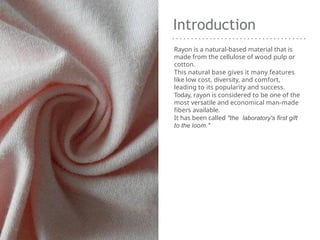
Rayon is a natural-based material that is
made from the cellulose of wood pulp or
cotton.
This natural base gives it many features
like low cost, diversity, and comfort,
leading to its popularity and success.
Today, rayon is considered to be one of the
most versatile and economical man-made
fibers available.
It has been called "the laboratory's first gift
to the loom."
Microscopic Structure
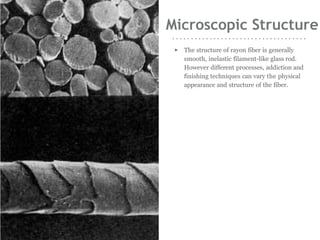
➤ The structure of rayon fiber is generally
smooth, inelastic filament-like glass rod.
However different processes, addiction and
finishing techniques can vary the physical
appearance and structure of the fiber.
CHEMICAL STRUCTURE
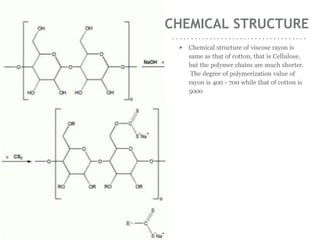
➤ Chemical structure of viscose rayon is
same as that of cotton, that is Cellulose,
but the polymer chains are much shorter.
The degree of polymerization value of
rayon is 400 - 700 while that of cotton is
5000
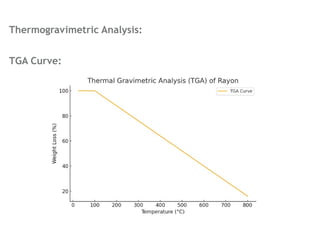
Thermogravimetric Analysis:
TGA Curve:
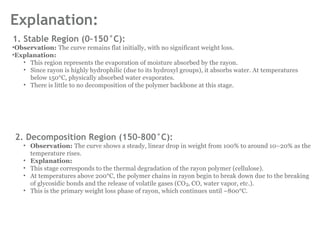
Explanation:
1. Stable Region (0–150°C):
•Observation: The curve remains flat initially, with no significant weight loss.
•Explanation:
• This region represents the evaporation of moisture absorbed by the rayon.
• Since rayon is highly hydrophilic (due to its hydroxyl groups), it absorbs water. At temperatures
below 150°C, physically absorbed water evaporates.
• There is little to no decomposition of the polymer backbone at this stage.
2. Decomposition Region (150–800°C):
• Observation: The curve shows a steady, linear drop in weight from 100% to around 10–20% as the
temperature rises.
• Explanation:
• This stage corresponds to the thermal degradation of the rayon polymer (cellulose).
• At temperatures above 200°C, the polymer chains in rayon begin to break down due to the breaking
of glycosidic bonds and the release of volatile gases (CO , CO, water vapor, etc.).
₂
• This is the primary weight loss phase of rayon, which continues until ~800°C.
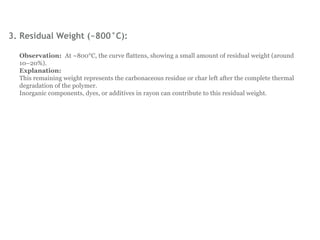
3. Residual Weight (~800°C):
Observation: At ~800°C, the curve flattens, showing a small amount of residual weight (around
10–20%).
Explanation:
This remaining weight represents the carbonaceous residue or char left after the complete thermal
degradation of the polymer.
Inorganic components, dyes, or additives in rayon can contribute to this residual weight.
.
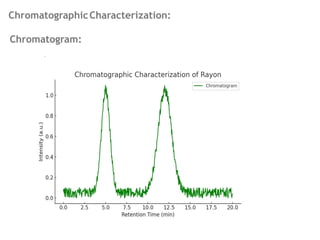
ChromatographicCharacterization:
Chromatogram:
Retention Time:
• The peaks appear around 5 minutes and 12.5 minutes.
• Each retention time corresponds to a specific component of the rayon polymer or additives present
in the sample.
• Shorter retention time (5 min) indicates a component with lower affinity for the stationary phase
(likely a smaller, polar molecule).
• Longer retention time (12.5 min) suggests a component with a higher affinity or interaction with
the stationary phase.
Peak Shape and Height:
• The two peaks are sharp and symmetrical, which indicates good separation and resolution of
components.
• Peak height represents the concentration or intensity of the components detected. Higher peaks
suggest that the corresponding component is present in greater quantities.
Baseline Noise:
The baseline has slight noise between 0 and 20 minutes, which may be due to instrument
sensitivity or minor impurities.
FTIR Spectrum for Rayon Characterization:
FTIR Spectrum:
Explanation:
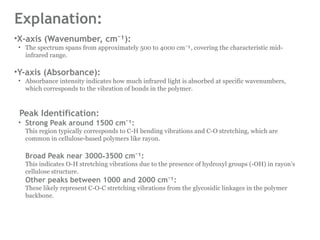
•X-axis (Wavenumber, cm ¹):
⁻
• The spectrum spans from approximately 500 to 4000 cm ¹, covering the characteristic mid-
⁻
infrared range.
•Y-axis (Absorbance):
• Absorbance intensity indicates how much infrared light is absorbed at specific wavenumbers,
which corresponds to the vibration of bonds in the polymer.
Peak Identification:
• Strong Peak around 1500 cm ¹:
⁻
This region typically corresponds to C-H bending vibrations and C-O stretching, which are
common in cellulose-based polymers like rayon.
Broad Peak near 3000–3500 cm ¹:
⁻
This indicates O-H stretching vibrations due to the presence of hydroxyl groups (-OH) in rayon's
cellulose structure.
Other peaks between 1000 and 2000 cm ¹:
⁻
These likely represent C-O-C stretching vibrations from the glycosidic linkages in the polymer
backbone.
PROPERTIES
• Rayon is a versatile fiber
•Rayon is very soft, cool comfortable and very good absorbent property but could
not be able to protect body heat and used in humid steamy climatic conditions.
• Rayon fibre has the same comfort property as natural fibres.
• Rayon can replicate the feel and texture of silk, cotton, linen and wool.
• Rayon can easily be dyed in variety of colors
• Rayon has very lower elastic recovery of any fibre.
• Usual rayon fibres recommended care for dry cleaning purpose only.
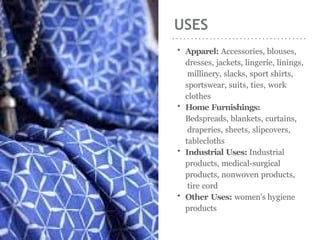
USES
• Apparel: Accessories, blouses,
dresses, jackets, lingerie, linings,
millinery, slacks, sport shirts,
sportswear, suits, ties, work
clothes
• Home Furnishings:
Bedspreads, blankets, curtains,
draperies, sheets, slipcovers,
tablecloths
• Industrial Uses: Industrial
products, medical-surgical
products, nonwoven products,
tire cord
• Other Uses: women's hygiene
products

..//RAYON POLYMER POLYMER CHEMISTRY pptx

  • 1.
  • 2.
    Introduction Rayon is anatural-based material that is made from the cellulose of wood pulp or cotton. This natural base gives it many features like low cost, diversity, and comfort, leading to its popularity and success. Today, rayon is considered to be one of the most versatile and economical man-made fibers available. It has been called "the laboratory's first gift to the loom."
  • 3.
    Microscopic Structure ➤ Thestructure of rayon fiber is generally smooth, inelastic filament-like glass rod. However different processes, addiction and finishing techniques can vary the physical appearance and structure of the fiber.
  • 4.
    CHEMICAL STRUCTURE ➤ Chemicalstructure of viscose rayon is same as that of cotton, that is Cellulose, but the polymer chains are much shorter. The degree of polymerization value of rayon is 400 - 700 while that of cotton is 5000
  • 5.
  • 6.
    Explanation: 1. Stable Region(0–150°C): •Observation: The curve remains flat initially, with no significant weight loss. •Explanation: • This region represents the evaporation of moisture absorbed by the rayon. • Since rayon is highly hydrophilic (due to its hydroxyl groups), it absorbs water. At temperatures below 150°C, physically absorbed water evaporates. • There is little to no decomposition of the polymer backbone at this stage. 2. Decomposition Region (150–800°C): • Observation: The curve shows a steady, linear drop in weight from 100% to around 10–20% as the temperature rises. • Explanation: • This stage corresponds to the thermal degradation of the rayon polymer (cellulose). • At temperatures above 200°C, the polymer chains in rayon begin to break down due to the breaking of glycosidic bonds and the release of volatile gases (CO , CO, water vapor, etc.). ₂ • This is the primary weight loss phase of rayon, which continues until ~800°C.
  • 7.
    3. Residual Weight(~800°C): Observation: At ~800°C, the curve flattens, showing a small amount of residual weight (around 10–20%). Explanation: This remaining weight represents the carbonaceous residue or char left after the complete thermal degradation of the polymer. Inorganic components, dyes, or additives in rayon can contribute to this residual weight.
  • 8.
  • 9.
    Retention Time: • Thepeaks appear around 5 minutes and 12.5 minutes. • Each retention time corresponds to a specific component of the rayon polymer or additives present in the sample. • Shorter retention time (5 min) indicates a component with lower affinity for the stationary phase (likely a smaller, polar molecule). • Longer retention time (12.5 min) suggests a component with a higher affinity or interaction with the stationary phase. Peak Shape and Height: • The two peaks are sharp and symmetrical, which indicates good separation and resolution of components. • Peak height represents the concentration or intensity of the components detected. Higher peaks suggest that the corresponding component is present in greater quantities. Baseline Noise: The baseline has slight noise between 0 and 20 minutes, which may be due to instrument sensitivity or minor impurities.
  • 10.
    FTIR Spectrum forRayon Characterization: FTIR Spectrum:
  • 11.
    Explanation: •X-axis (Wavenumber, cm¹): ⁻ • The spectrum spans from approximately 500 to 4000 cm ¹, covering the characteristic mid- ⁻ infrared range. •Y-axis (Absorbance): • Absorbance intensity indicates how much infrared light is absorbed at specific wavenumbers, which corresponds to the vibration of bonds in the polymer. Peak Identification: • Strong Peak around 1500 cm ¹: ⁻ This region typically corresponds to C-H bending vibrations and C-O stretching, which are common in cellulose-based polymers like rayon. Broad Peak near 3000–3500 cm ¹: ⁻ This indicates O-H stretching vibrations due to the presence of hydroxyl groups (-OH) in rayon's cellulose structure. Other peaks between 1000 and 2000 cm ¹: ⁻ These likely represent C-O-C stretching vibrations from the glycosidic linkages in the polymer backbone.
  • 12.
    PROPERTIES • Rayon isa versatile fiber •Rayon is very soft, cool comfortable and very good absorbent property but could not be able to protect body heat and used in humid steamy climatic conditions. • Rayon fibre has the same comfort property as natural fibres. • Rayon can replicate the feel and texture of silk, cotton, linen and wool. • Rayon can easily be dyed in variety of colors • Rayon has very lower elastic recovery of any fibre. • Usual rayon fibres recommended care for dry cleaning purpose only.
  • 13.
    USES • Apparel: Accessories,blouses, dresses, jackets, lingerie, linings, millinery, slacks, sport shirts, sportswear, suits, ties, work clothes • Home Furnishings: Bedspreads, blankets, curtains, draperies, sheets, slipcovers, tablecloths • Industrial Uses: Industrial products, medical-surgical products, nonwoven products, tire cord • Other Uses: women's hygiene products