Ratio Analysis
Basic Theory
By Dr. Paritosh Dube
Content
• Objectives of Presentation.
• Meaning of Ratio
• Forms of Expression
• Meaning of Ratio Analysis
• Advantages
• Limitations
• Precaution & Guidelines of Ratios
• Users of Ratios
• Source of Information
• Classifications of Ratios.
Objective of Presentation
• To create an understanding about the nature of Ratios.
• To create an understanding about the advantages and limitations of Ratio Analysis
tool.
• To inform about the various precautions and guidelines to be followed while using
ratio analysis tool
• To provide information regarding various Users of the ratio analysis tool.
• To learn about the Source from where information for ratios can be gathered.
• To briefly discuss the classification of Ratios.
What is a Ratio?
•Relationship in quantitative terms,
between figures which have cause and
effect relationships or which are
connected to one another in one way or
another
Forms of Expression
• Absolute Figure
a. Division Form:- when two numbers are divided by each number. For
example 5/10=.50
b. Proportion Form using Colon :- when two numbers are placed in
relation to each other. for example 5:10
• Percentage Form:- when two numbers are divided by each other and the
result is multiplied by 100. For example (3/6)*100=50%
What is Ratio Analysis
• RATIOS ANALYSIS IS A COMPARISON OF TWO NUMBERS.
• THE NUMBERS RELATE TO FINANCIAL ASPECT OF THE
BUSINESS.
• THE OBJECTIVE IS TO GAIN INSIGHT INTO PERFORMANCE
OF THE BUSINESS
Advantages
• Helps in Decision Making such as Make or Buy decision, Increasing Production
Capacity
• Helps in forecasting and Planning for the future
• Helps in Easy Communication of Performance
• Helps in better coordination among various departments.
• Helps in establishing control by establishing standards and identifying Deviations.
• Helps prospective shareholders to assess business profitability
Advantages
• Helps lenders and creditors to assess creditworthiness of the business.
• Helps employees to assess the business from increment and bonus point of
view
• Helps the government to assess the financial viability of various sectors and
frame suitable policies for overall development of the economy.
• Helps the tax authority to assess the true profit of the business concern and
determine the level of tax chargeable from the company
Limitations
• Limited use of Single Ratio
• Lack of adequate standards
• Ratios of past may not truly represent future performance.
• Subject to change of accounting procedure.
• Personal Bias of researcher
• Window dressing
Limitations
• Comparison becomes difficult as both Industry and Companies differ on
account of number of various variables such as their size ,accounting
procedures etc.
• Subject to price level changes
• It is only a tool and not an End in itself.
• It depends on financial statements for its usefulness.
Precautions & Guidelines
• Trained Analyst
• Objective of The Analysis.
• Selection of Proper Ratios
• Use of Suitable Standards
• Accuracy of the Financial Statements.
• Ratios should only serve as a tool and decision should be taken after due
deliberations
Users of The Ratio Analysis
• Shareholders/Investors
• Prospective Investors
• Management of the company.
• Employees of the Company.
• Competitors
• Lenders & Creditors
• Government/Policy Makers
• Taxation Authority
• Society
• Researchers
Where does the Information for Ratio Analysis
come from ?
•Income
Statement
•Balance
Sheet
Classification
Statement Functional
Statement Ratios
Income statement
• Net Profit Ratio
• Gross Profit Ratio
• Operating Profit
Ratio
Balance Sheet
• Debt Equity Ratio
• Current Asset
Ratio
• Acid Test Ratio
Mixed Statement
• Return on Capital
Employed Ratio.
• Fixed Asset to
turnover ratio
• Earning per share
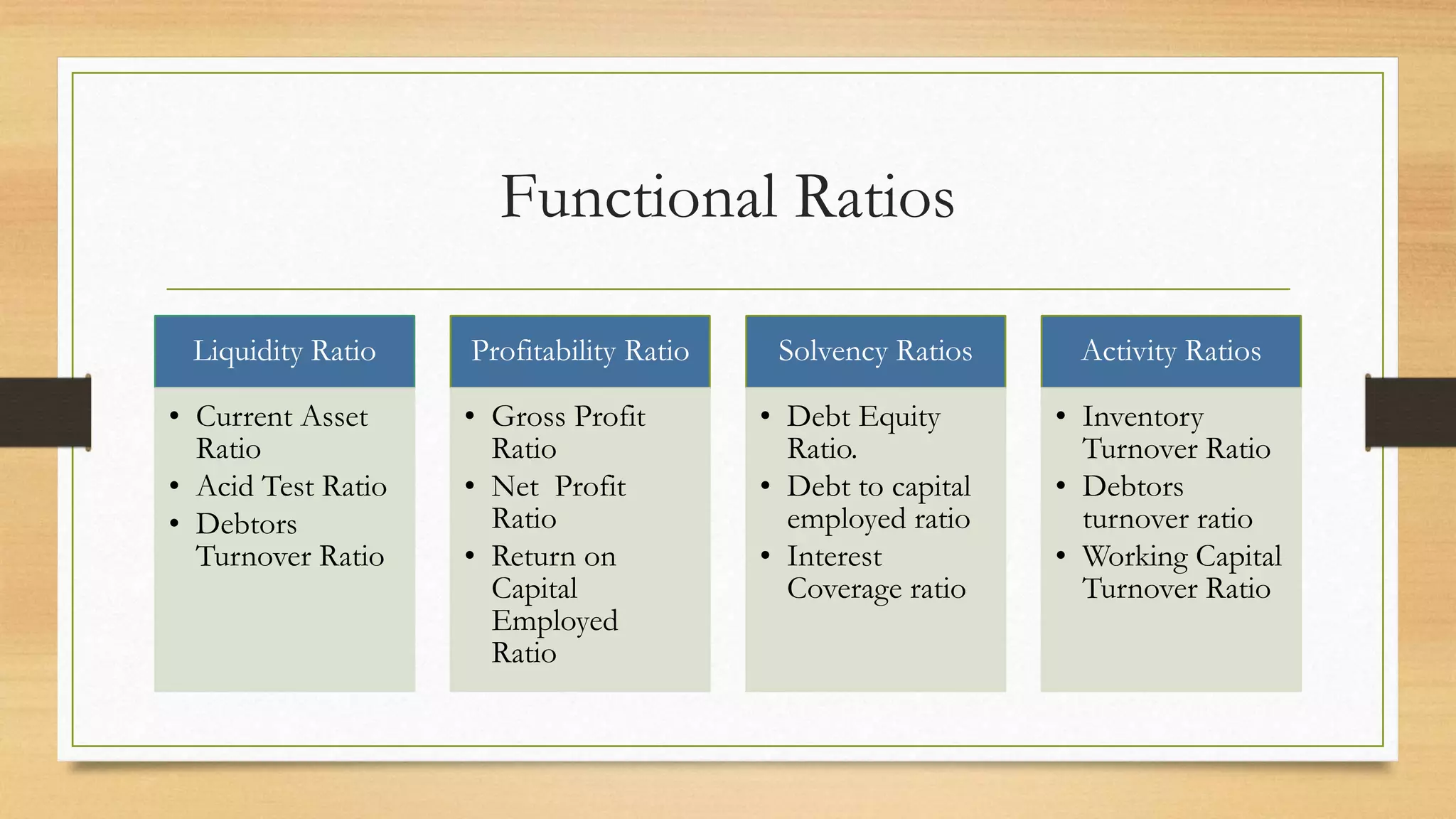
Functional Ratios
Liquidity Ratio
• Current Asset
Ratio
• Acid Test Ratio
• Debtors
Turnover Ratio
Profitability Ratio
• Gross Profit
Ratio
• Net Profit
Ratio
• Return on
Capital
Employed
Ratio
Solvency Ratios
• Debt Equity
Ratio.
• Debt to capital
employed ratio
• Interest
Coverage ratio
Activity Ratios
• Inventory
Turnover Ratio
• Debtors
turnover ratio
• Working Capital
Turnover Ratio
Thank You

Ratio analysis

  • 1.
  • 2.
    Content • Objectives ofPresentation. • Meaning of Ratio • Forms of Expression • Meaning of Ratio Analysis • Advantages • Limitations • Precaution & Guidelines of Ratios • Users of Ratios • Source of Information • Classifications of Ratios.
  • 3.
    Objective of Presentation •To create an understanding about the nature of Ratios. • To create an understanding about the advantages and limitations of Ratio Analysis tool. • To inform about the various precautions and guidelines to be followed while using ratio analysis tool • To provide information regarding various Users of the ratio analysis tool. • To learn about the Source from where information for ratios can be gathered. • To briefly discuss the classification of Ratios.
  • 4.
    What is aRatio? •Relationship in quantitative terms, between figures which have cause and effect relationships or which are connected to one another in one way or another
  • 5.
    Forms of Expression •Absolute Figure a. Division Form:- when two numbers are divided by each number. For example 5/10=.50 b. Proportion Form using Colon :- when two numbers are placed in relation to each other. for example 5:10 • Percentage Form:- when two numbers are divided by each other and the result is multiplied by 100. For example (3/6)*100=50%
  • 6.
    What is RatioAnalysis • RATIOS ANALYSIS IS A COMPARISON OF TWO NUMBERS. • THE NUMBERS RELATE TO FINANCIAL ASPECT OF THE BUSINESS. • THE OBJECTIVE IS TO GAIN INSIGHT INTO PERFORMANCE OF THE BUSINESS
  • 7.
    Advantages • Helps inDecision Making such as Make or Buy decision, Increasing Production Capacity • Helps in forecasting and Planning for the future • Helps in Easy Communication of Performance • Helps in better coordination among various departments. • Helps in establishing control by establishing standards and identifying Deviations. • Helps prospective shareholders to assess business profitability
  • 8.
    Advantages • Helps lendersand creditors to assess creditworthiness of the business. • Helps employees to assess the business from increment and bonus point of view • Helps the government to assess the financial viability of various sectors and frame suitable policies for overall development of the economy. • Helps the tax authority to assess the true profit of the business concern and determine the level of tax chargeable from the company
  • 9.
    Limitations • Limited useof Single Ratio • Lack of adequate standards • Ratios of past may not truly represent future performance. • Subject to change of accounting procedure. • Personal Bias of researcher • Window dressing
  • 10.
    Limitations • Comparison becomesdifficult as both Industry and Companies differ on account of number of various variables such as their size ,accounting procedures etc. • Subject to price level changes • It is only a tool and not an End in itself. • It depends on financial statements for its usefulness.
  • 11.
    Precautions & Guidelines •Trained Analyst • Objective of The Analysis. • Selection of Proper Ratios • Use of Suitable Standards • Accuracy of the Financial Statements. • Ratios should only serve as a tool and decision should be taken after due deliberations
  • 12.
    Users of TheRatio Analysis • Shareholders/Investors • Prospective Investors • Management of the company. • Employees of the Company. • Competitors • Lenders & Creditors • Government/Policy Makers • Taxation Authority • Society • Researchers
  • 13.
    Where does theInformation for Ratio Analysis come from ? •Income Statement •Balance Sheet
  • 14.
  • 15.
    Statement Ratios Income statement •Net Profit Ratio • Gross Profit Ratio • Operating Profit Ratio Balance Sheet • Debt Equity Ratio • Current Asset Ratio • Acid Test Ratio Mixed Statement • Return on Capital Employed Ratio. • Fixed Asset to turnover ratio • Earning per share
  • 16.
    Functional Ratios Liquidity Ratio •Current Asset Ratio • Acid Test Ratio • Debtors Turnover Ratio Profitability Ratio • Gross Profit Ratio • Net Profit Ratio • Return on Capital Employed Ratio Solvency Ratios • Debt Equity Ratio. • Debt to capital employed ratio • Interest Coverage ratio Activity Ratios • Inventory Turnover Ratio • Debtors turnover ratio • Working Capital Turnover Ratio
  • 17.