BetterBallotIN.org
UPGRADE TO RANKED CHOICE VOTING
Every
Vote
Counts
Michaela Spangenburg, Psy.D.
Non-partisan non-profit corporation powered by Hoosiers.
We are here to educate and empower Hoosiers.
We are here to strengthen democracy in Indiana.
Every
Vote
Counts
Why Rank Choice Voting?
A Personal Perspective
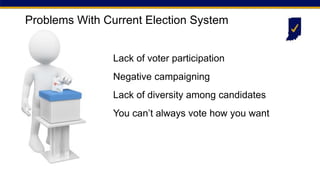
Lack of voter participation
Problems With Current Election System
Negative campaigning
Lack of diversity among candidates
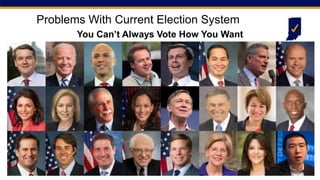
You can’t always vote how you want
Problems With Current Election System
You Can’t Always Vote How You Want
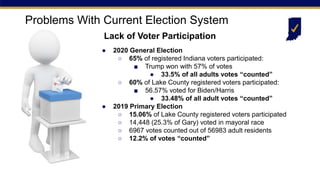
● 2020 General Election
○ 65% of registered Indiana voters participated:
■ Trump won with 57% of votes
● 33.5% of all adults votes “counted”
○ 60% of Lake County registered voters participated:
■ 56.57% voted for Biden/Harris
● 33.48% of all adult votes “counted”
● 2019 Primary Election
○ 15.06% of Lake County registered voters participated
○ 14,448 (25.3% of Gary) voted in mayoral race
○ 6967 votes counted out of 56983 adult residents
○ 12.2% of votes “counted”
Problems With Current Election System
Lack of Voter Participation
Core Values of Modern Democracy
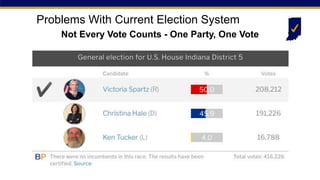
 Instead of one person one vote,
we have
one party one vote.
 Instead of every vote counts,
we have not every vote counts.
 Instead of majority rule,
we have plurality wins.
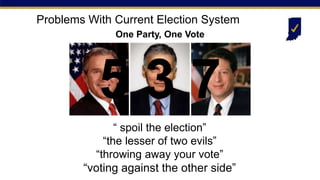
“ spoil the election”
“the lesser of two evils”
“throwing away your vote”
“voting against the other side”
Problems With Current Election System
One Party, One Vote
5 3 7
39% 61%
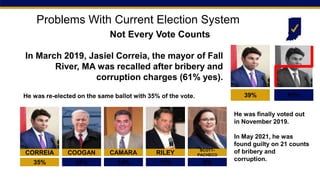
In March 2019, Jasiel Correia, the mayor of Fall
River, MA was recalled after bribery and
corruption charges (61% yes).
Problems With Current Election System
Not Every Vote Counts
He was re-elected on the same ballot with 35% of the vote.
He was finally voted out
in November 2019.
In May 2021, he was
found guilty on 21 counts
of bribery and
corruption.
34%
35%
CORREIA COOGAN CAMARA RILEY
SCOTT-
PACHECO
14% 11% 6%
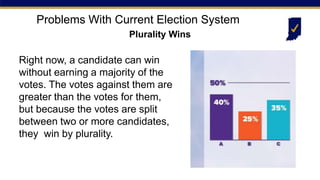
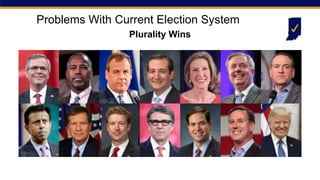
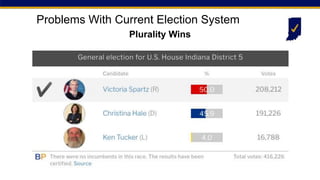
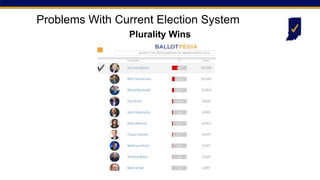
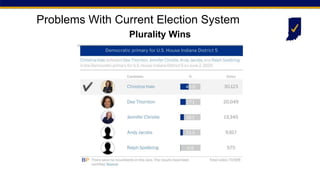
Right now, a candidate can win
without earning a majority of the
votes. The votes against them are
greater than the votes for them,
but because the votes are split
between two or more candidates,
they win by plurality.
Problems With Current Election System
Plurality Wins
Problems With Current Election System
Plurality Wins
Problems With Current Election System
Plurality Wins
Problems With Current Election System
Plurality Wins
Problems With Current Election System
Plurality Wins
Problems With Current Election System
Not Every Vote Counts - One Party, One Vote
The Solution: Upgrading to Rank Choice Voting
What is Rank Choice Voting?
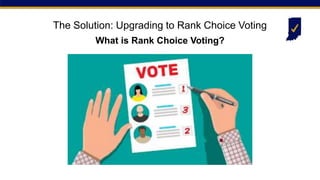
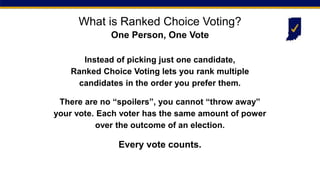
Instead of picking just one candidate,
Ranked Choice Voting lets you rank multiple
candidates in the order you prefer them.
There are no “spoilers”, you cannot “throw away”
your vote. Each voter has the same amount of power
over the outcome of an election.
Every vote counts.
What is Ranked Choice Voting?
One Person, One Vote
What is Ranked Choice Voting?
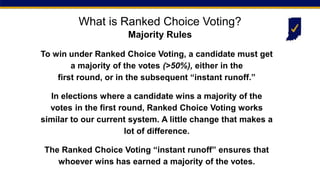
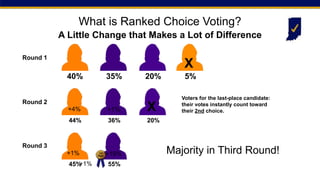
To win under Ranked Choice Voting, a candidate must get
a majority of the votes (>50%), either in the
first round, or in the subsequent “instant runoff.”
In elections where a candidate wins a majority of the
votes in the first round, Ranked Choice Voting works
similar to our current system. A little change that makes a
lot of difference.
The Ranked Choice Voting “instant runoff” ensures that
whoever wins has earned a majority of the votes.
Majority Rules
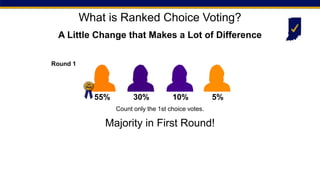
Count only the 1st choice votes.
Round 1
10% 5%
55% 30%
What is Ranked Choice Voting?
Majority in First Round!
A Little Change that Makes a Lot of Difference
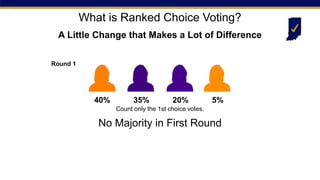
Count only the 1st choice votes.
Round 1
No Majority in First Round
20% 5%
40% 35%
What is Ranked Choice Voting?
A Little Change that Makes a Lot of Difference
Round 1
Round 2
Voters for the last-place candidate:
their votes instantly count toward
their 2nd choice.
X
20% 5%
40% 35%
20%
44% 36%
Round 3
45% 55%
X
+1%
+1%
+19% Majority in Third Round!
What is Ranked Choice Voting?
A Little Change that Makes a Lot of Difference
+4% +1%
+1%
What is Ranked Choice Voting?
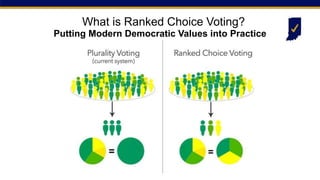
Putting Modern Democratic Values into Practice
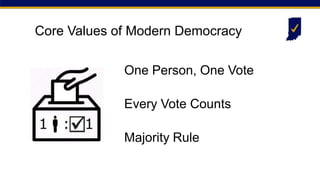
Core Values of Modern Democracy
One Person, One Vote
Every Vote Counts
Majority Rule
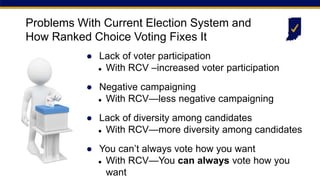
● Lack of voter participation
 With RCV –increased voter participation
● Negative campaigning
 With RCV—less negative campaigning
● Lack of diversity among candidates
 With RCV—more diversity among candidates
● You can’t always vote how you want
 With RCV—You can always vote how you
want
Problems With Current Election System and
How Ranked Choice Voting Fixes It
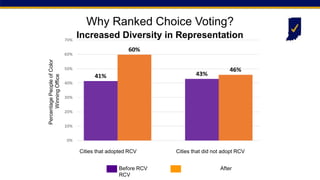
Cities that adopted RCV Cities that did not adopt RCV
Before RCV After
RCV
Percentage
People
of
Color
Winning
Office
Why Ranked Choice Voting?
Increased Diversity in Representation
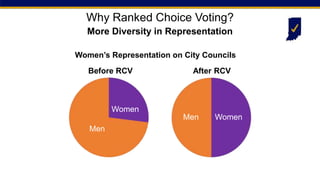
Men
Women
Men Women
Women’s Representation on City Councils
After RCV
Before RCV
Why Ranked Choice Voting?
More Diversity in Representation
Why Ranked Choice Voting?
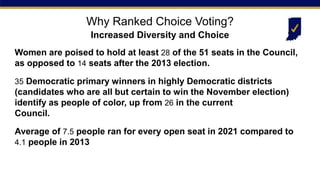
Increased Diversity and Choice
Women are poised to hold at least 28 of the 51 seats in the Council,
as opposed to 14 seats after the 2013 election.
35 Democratic primary winners in highly Democratic districts
(candidates who are all but certain to win the November election)
identify as people of color, up from 26 in the current
Council.
Average of 7.5 people ran for every open seat in 2021 compared to
4.1 people in 2013
Why Ranked Choice Voting?
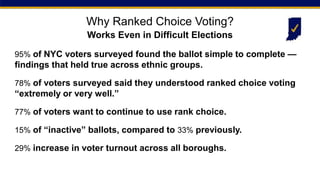
Works Even in Difficult Elections
95% of NYC voters surveyed found the ballot simple to complete —
findings that held true across ethnic groups.
78% of voters surveyed said they understood ranked choice voting
“extremely or very well.”
77% of voters want to continue to use rank choice.
15% of “inactive” ballots, compared to 33% previously.
29% increase in voter turnout across all boroughs.
Drafted in October 2016, an expansive new study by University of Missouri-St.
Louis Professor, David Kimball, and Ph.D. candidate, Joseph Anthony,
examines the impact of ranked choice voting (RCV) on voter turnout in 26
American cities across 79 elections.
Kimball and Anthony’s study shows that the adoption of RCV:
● is associated with a 10-point increase in voter turnout compared to primary
and runoff elections.
● is not associated with any change in turnout in the General Election.
● is not associated with any change in the number of residual votes (overvotes
and undervotes).
● did not exacerbate inequities in voter turnout and residual votes in
Minneapolis.
Read the FairVote brief | Read the full study
Why Ranked Choice Voting?
Increased Voter Participation
Why Ranked Choice Voting?
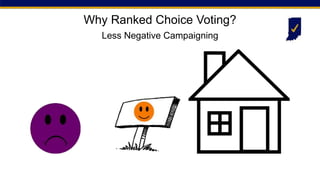
Less Negative Campaigning
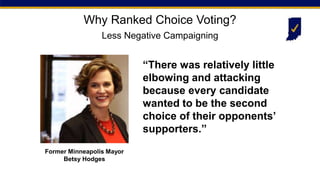
“There was relatively little
elbowing and attacking
because every candidate
wanted to be the second
choice of their opponents’
supporters.”
Former Minneapolis Mayor
Betsy Hodges
Why Ranked Choice Voting?
Less Negative Campaigning
Why Ranked Choice Voting?
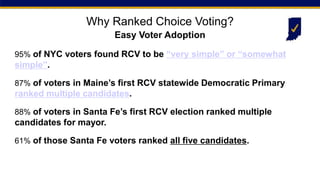
Easy Voter Adoption
95% of NYC voters found RCV to be “very simple” or “somewhat
simple”.
87% of voters in Maine’s first RCV statewide Democratic Primary
ranked multiple candidates.
88% of voters in Santa Fe’s first RCV election ranked multiple
candidates for mayor.
61% of those Santa Fe voters ranked all five candidates.
RCV is a real, practical solution.
Eliminates spoilers and vote-splitting.
Encourages more people to run.
Curbs negative campaigning.
Gives voters more voice and more choice.
Will transform politics in Indiana.
Why Upgrade to Ranked Choice Voting?
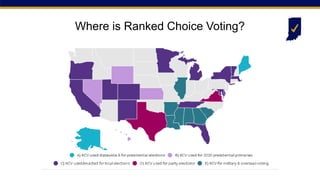
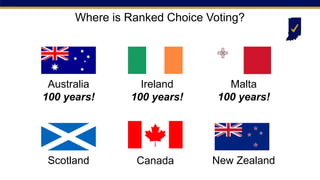
Where is Ranked Choice Voting?
Ireland
100 years!
Australia
100 years!
Canada New Zealand
Scotland
Malta
100 years!
Where is Ranked Choice Voting?
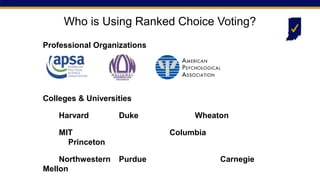
Professional Organizations
Who is Using Ranked Choice Voting?
Colleges & Universities
Harvard Duke Wheaton
MIT Columbia
Princeton
Northwestern Purdue Carnegie
Mellon
Questions?
Visit BetterBallotIN.org to get involved!
Every
Vote
Counts

Ranked Choice Voting

  • 1.
    BetterBallotIN.org UPGRADE TO RANKEDCHOICE VOTING Every Vote Counts Michaela Spangenburg, Psy.D.
  • 2.
    Non-partisan non-profit corporationpowered by Hoosiers. We are here to educate and empower Hoosiers. We are here to strengthen democracy in Indiana. Every Vote Counts
  • 3.
    Why Rank ChoiceVoting? A Personal Perspective
  • 4.
    Lack of voterparticipation Problems With Current Election System Negative campaigning Lack of diversity among candidates You can’t always vote how you want
  • 5.
    Problems With CurrentElection System You Can’t Always Vote How You Want
  • 6.
    ● 2020 GeneralElection ○ 65% of registered Indiana voters participated: ■ Trump won with 57% of votes ● 33.5% of all adults votes “counted” ○ 60% of Lake County registered voters participated: ■ 56.57% voted for Biden/Harris ● 33.48% of all adult votes “counted” ● 2019 Primary Election ○ 15.06% of Lake County registered voters participated ○ 14,448 (25.3% of Gary) voted in mayoral race ○ 6967 votes counted out of 56983 adult residents ○ 12.2% of votes “counted” Problems With Current Election System Lack of Voter Participation
  • 7.
    Core Values ofModern Democracy  Instead of one person one vote, we have one party one vote.  Instead of every vote counts, we have not every vote counts.  Instead of majority rule, we have plurality wins.
  • 8.
    “ spoil theelection” “the lesser of two evils” “throwing away your vote” “voting against the other side” Problems With Current Election System One Party, One Vote 5 3 7
  • 9.
    39% 61% In March2019, Jasiel Correia, the mayor of Fall River, MA was recalled after bribery and corruption charges (61% yes). Problems With Current Election System Not Every Vote Counts He was re-elected on the same ballot with 35% of the vote. He was finally voted out in November 2019. In May 2021, he was found guilty on 21 counts of bribery and corruption. 34% 35% CORREIA COOGAN CAMARA RILEY SCOTT- PACHECO 14% 11% 6%
  • 10.
    Right now, acandidate can win without earning a majority of the votes. The votes against them are greater than the votes for them, but because the votes are split between two or more candidates, they win by plurality. Problems With Current Election System Problems With Current Election System Plurality Wins
  • 11.
    Problems With CurrentElection System Plurality Wins
  • 12.
    Problems With CurrentElection System Plurality Wins
  • 13.
    Problems With CurrentElection System Plurality Wins
  • 14.
    Problems With CurrentElection System Plurality Wins
  • 15.
    Problems With CurrentElection System Not Every Vote Counts - One Party, One Vote
  • 16.
    The Solution: Upgradingto Rank Choice Voting What is Rank Choice Voting?
  • 17.
    Instead of pickingjust one candidate, Ranked Choice Voting lets you rank multiple candidates in the order you prefer them. There are no “spoilers”, you cannot “throw away” your vote. Each voter has the same amount of power over the outcome of an election. Every vote counts. What is Ranked Choice Voting? One Person, One Vote
  • 18.
    What is RankedChoice Voting? To win under Ranked Choice Voting, a candidate must get a majority of the votes (>50%), either in the first round, or in the subsequent “instant runoff.” In elections where a candidate wins a majority of the votes in the first round, Ranked Choice Voting works similar to our current system. A little change that makes a lot of difference. The Ranked Choice Voting “instant runoff” ensures that whoever wins has earned a majority of the votes. Majority Rules
  • 19.
    Count only the1st choice votes. Round 1 10% 5% 55% 30% What is Ranked Choice Voting? Majority in First Round! A Little Change that Makes a Lot of Difference
  • 20.
    Count only the1st choice votes. Round 1 No Majority in First Round 20% 5% 40% 35% What is Ranked Choice Voting? A Little Change that Makes a Lot of Difference
  • 21.
    Round 1 Round 2 Votersfor the last-place candidate: their votes instantly count toward their 2nd choice. X 20% 5% 40% 35% 20% 44% 36% Round 3 45% 55% X +1% +1% +19% Majority in Third Round! What is Ranked Choice Voting? A Little Change that Makes a Lot of Difference +4% +1% +1%
  • 22.
    What is RankedChoice Voting? Putting Modern Democratic Values into Practice
  • 23.
    Core Values ofModern Democracy One Person, One Vote Every Vote Counts Majority Rule
  • 24.
    ● Lack ofvoter participation  With RCV –increased voter participation ● Negative campaigning  With RCV—less negative campaigning ● Lack of diversity among candidates  With RCV—more diversity among candidates ● You can’t always vote how you want  With RCV—You can always vote how you want Problems With Current Election System and How Ranked Choice Voting Fixes It
  • 25.
    Cities that adoptedRCV Cities that did not adopt RCV Before RCV After RCV Percentage People of Color Winning Office Why Ranked Choice Voting? Increased Diversity in Representation
  • 26.
    Men Women Men Women Women’s Representationon City Councils After RCV Before RCV Why Ranked Choice Voting? More Diversity in Representation
  • 27.
    Why Ranked ChoiceVoting? Increased Diversity and Choice Women are poised to hold at least 28 of the 51 seats in the Council, as opposed to 14 seats after the 2013 election. 35 Democratic primary winners in highly Democratic districts (candidates who are all but certain to win the November election) identify as people of color, up from 26 in the current Council. Average of 7.5 people ran for every open seat in 2021 compared to 4.1 people in 2013
  • 28.
    Why Ranked ChoiceVoting? Works Even in Difficult Elections 95% of NYC voters surveyed found the ballot simple to complete — findings that held true across ethnic groups. 78% of voters surveyed said they understood ranked choice voting “extremely or very well.” 77% of voters want to continue to use rank choice. 15% of “inactive” ballots, compared to 33% previously. 29% increase in voter turnout across all boroughs.
  • 29.
    Drafted in October2016, an expansive new study by University of Missouri-St. Louis Professor, David Kimball, and Ph.D. candidate, Joseph Anthony, examines the impact of ranked choice voting (RCV) on voter turnout in 26 American cities across 79 elections. Kimball and Anthony’s study shows that the adoption of RCV: ● is associated with a 10-point increase in voter turnout compared to primary and runoff elections. ● is not associated with any change in turnout in the General Election. ● is not associated with any change in the number of residual votes (overvotes and undervotes). ● did not exacerbate inequities in voter turnout and residual votes in Minneapolis. Read the FairVote brief | Read the full study Why Ranked Choice Voting? Increased Voter Participation
  • 30.
    Why Ranked ChoiceVoting? Less Negative Campaigning
  • 31.
    “There was relativelylittle elbowing and attacking because every candidate wanted to be the second choice of their opponents’ supporters.” Former Minneapolis Mayor Betsy Hodges Why Ranked Choice Voting? Less Negative Campaigning
  • 32.
    Why Ranked ChoiceVoting? Easy Voter Adoption 95% of NYC voters found RCV to be “very simple” or “somewhat simple”. 87% of voters in Maine’s first RCV statewide Democratic Primary ranked multiple candidates. 88% of voters in Santa Fe’s first RCV election ranked multiple candidates for mayor. 61% of those Santa Fe voters ranked all five candidates.
  • 33.
    RCV is areal, practical solution. Eliminates spoilers and vote-splitting. Encourages more people to run. Curbs negative campaigning. Gives voters more voice and more choice. Will transform politics in Indiana. Why Upgrade to Ranked Choice Voting?
  • 34.
    Where is RankedChoice Voting?
  • 35.
    Ireland 100 years! Australia 100 years! CanadaNew Zealand Scotland Malta 100 years! Where is Ranked Choice Voting?
  • 36.
    Professional Organizations Who isUsing Ranked Choice Voting? Colleges & Universities Harvard Duke Wheaton MIT Columbia Princeton Northwestern Purdue Carnegie Mellon
  • 37.
    Questions? Visit BetterBallotIN.org toget involved! Every Vote Counts