Rancher 2.X
First Step before Deep Dive
LINE Corporation, Verda2 Yuki Nishiwaki
Who you are?
Name:
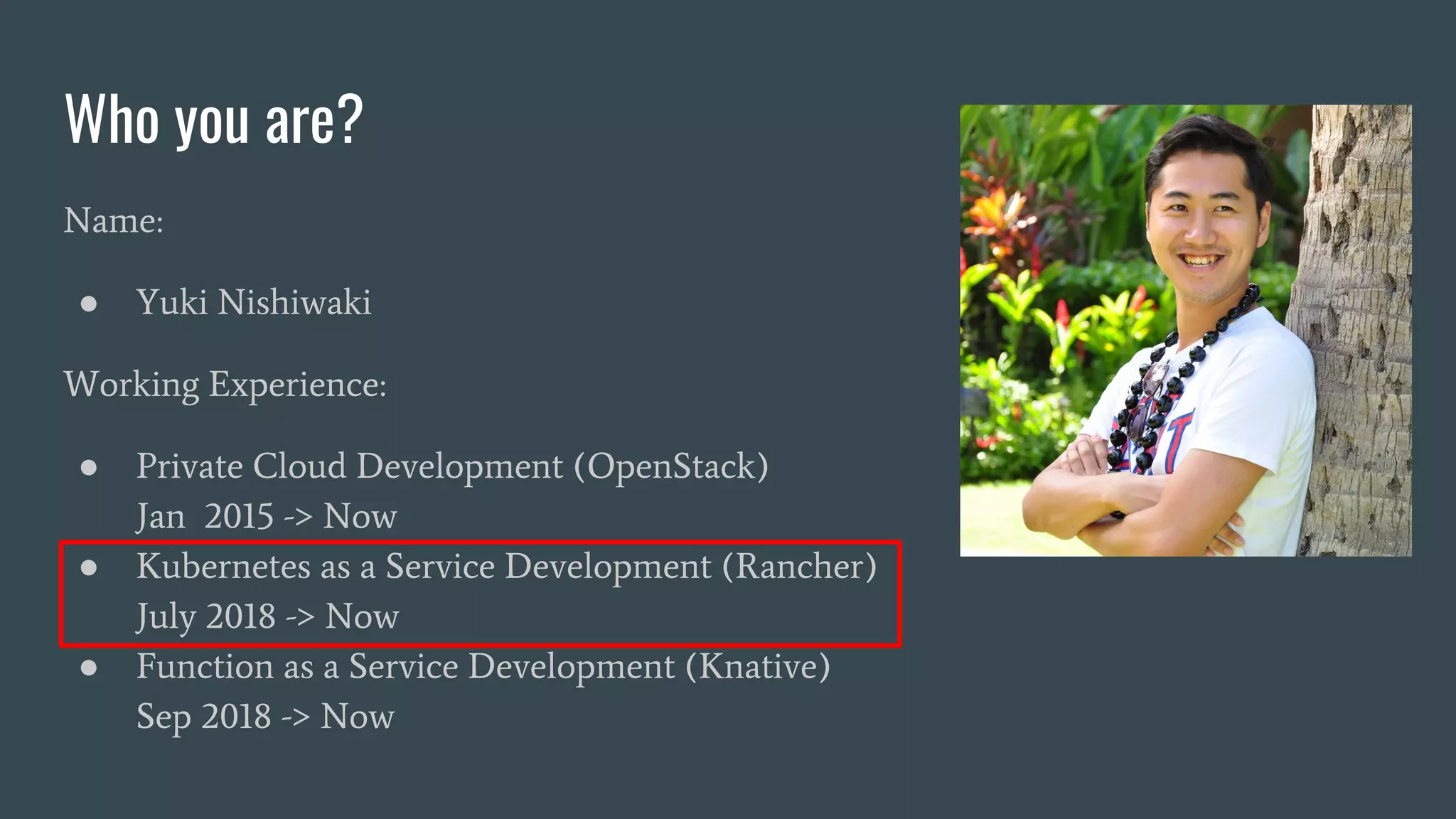
● Yuki Nishiwaki
Working Experience:
● Private Cloud Development (OpenStack)
Jan 2015 -> Now
● Kubernetes as a Service Development (Rancher)
July 2018 -> Now
● Function as a Service Development (Knative)
Sep 2018 -> Now
Rancher and Me
● User and Developer
● Have contributed few patches to rancher 2.X related projects
○ rancher/types
■ https://github.com/rancher/types/pull/525
○ rancher/machine
■ https://github.com/rancher/machine/pull/12
○ rancher/norman
■ https://github.com/rancher/norman/pull/201
■ https://github.com/rancher/norman/pull/202
■ https://github.com/rancher/norman/pull/203
○ rancher/rancher
■ https://github.com/rancher/rancher/pull/15909
■ https://github.com/rancher/rancher/pull/15991
■ https://github.com/rancher/rancher/pull/16044
Not so many contributions yet
Today’s scope
● We have only 20-30 min
● Rancher have bunch of features. It will take half of day if I talk all parts
● Try to explain whole picture
● Check following article for more detail
○ https://www.slideshare.net/linecorp/lets-unbox-rancher-20-v200
○ https://github.com/ukinau/rancher-analyse
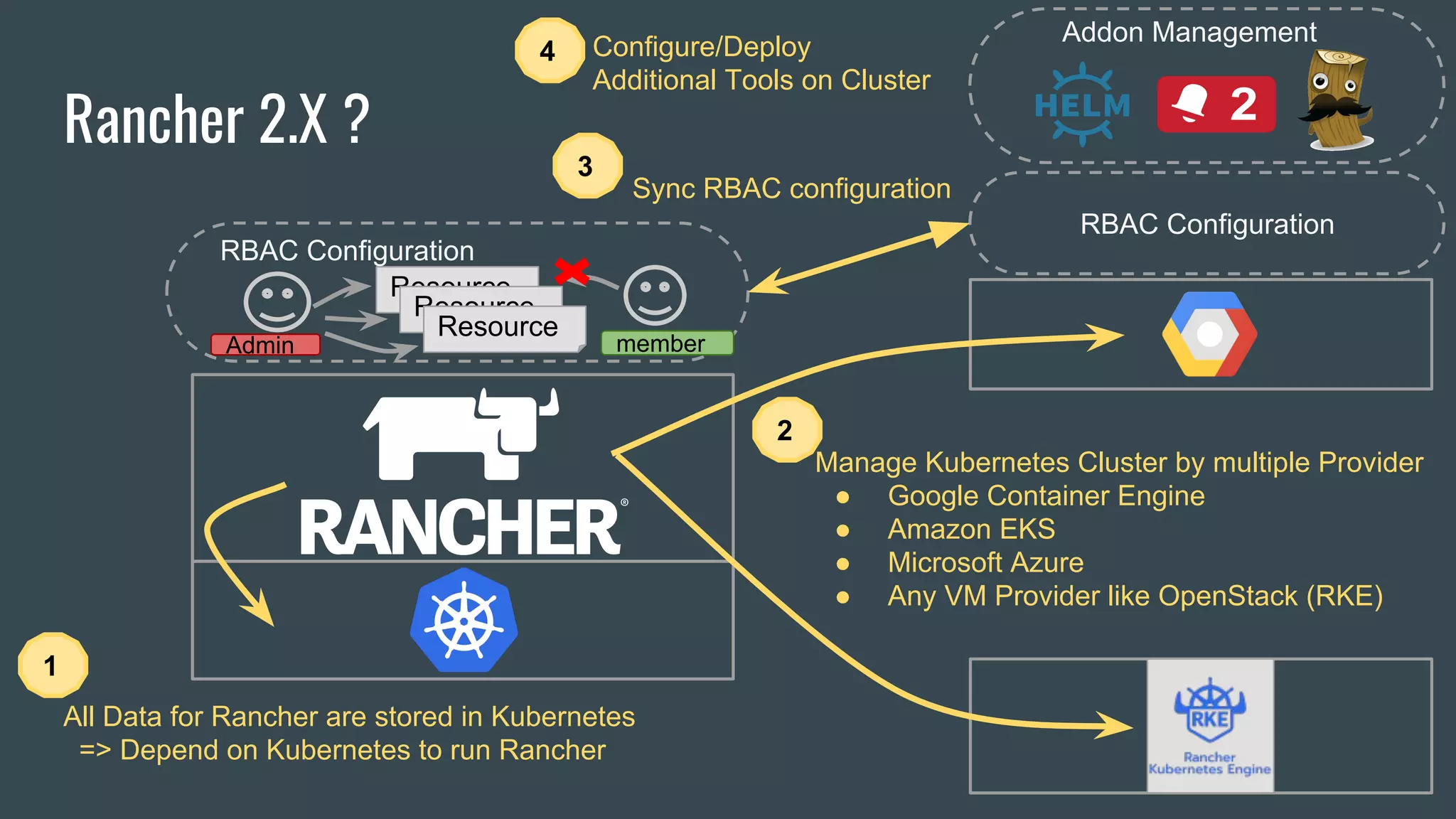
Rancher 2.X ?
All Data for Rancher are stored in Kubernetes
=> Depend on Kubernetes to run Rancher
1
Manage Kubernetes Cluster by multiple Provider
● Google Container Engine
● Amazon EKS
● Microsoft Azure
● Any VM Provider like OpenStack (RKE)
2
RBAC Configuration
Configure/Deploy
Additional Tools on Cluster
Addon Management
4
Resource
Resource
Resource
Admin member
RBAC Configuration
3
Sync RBAC configuration
Rancher 2.X
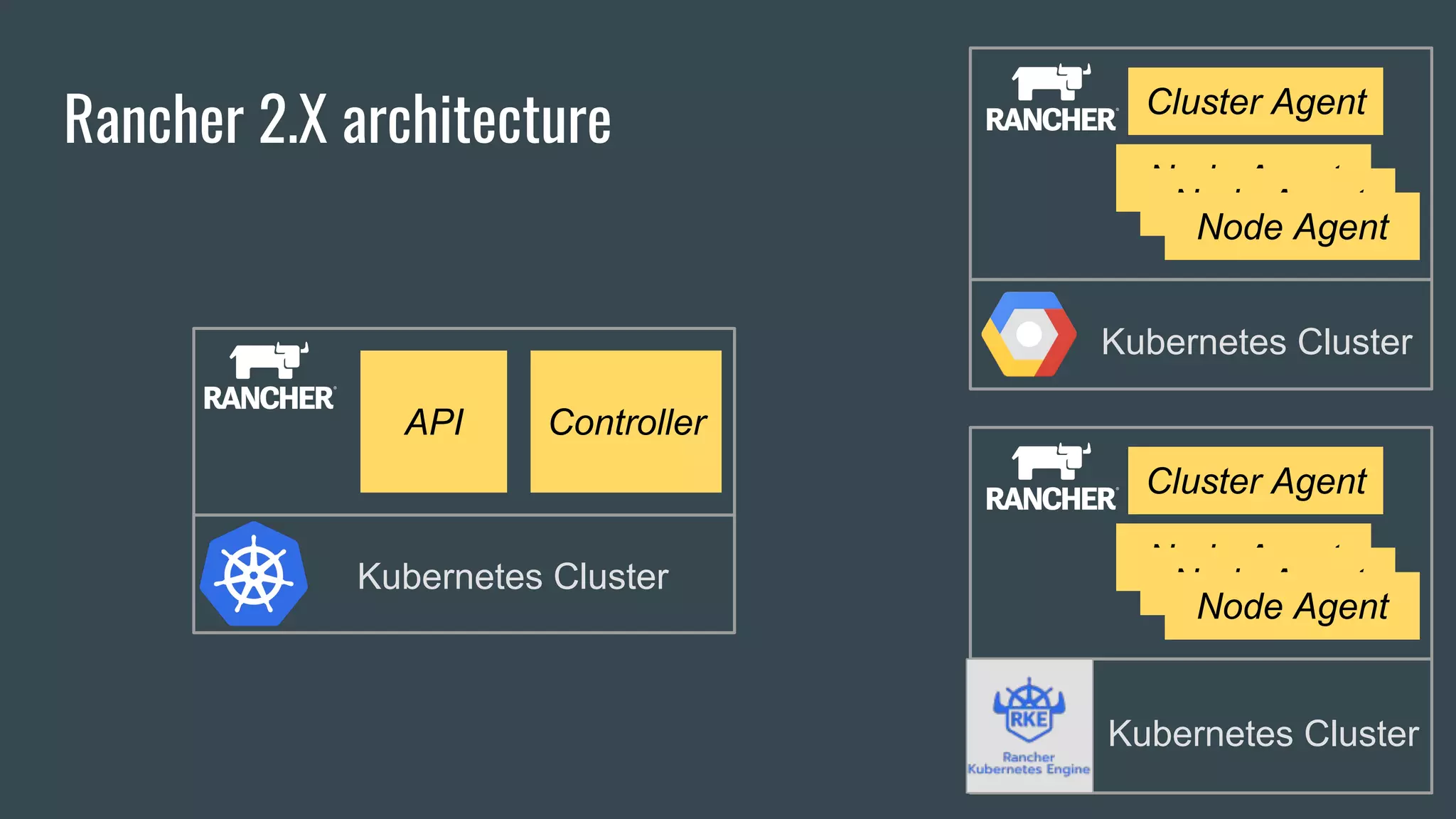
Rancher 2.X architecture
API Controller
Cluster Agent
Node Agent
Node Agent
Node Agent
Cluster Agent
Node Agent
Node Agent
Node Agent
Kubernetes Cluster
Kubernetes Cluster
Kubernetes Cluster
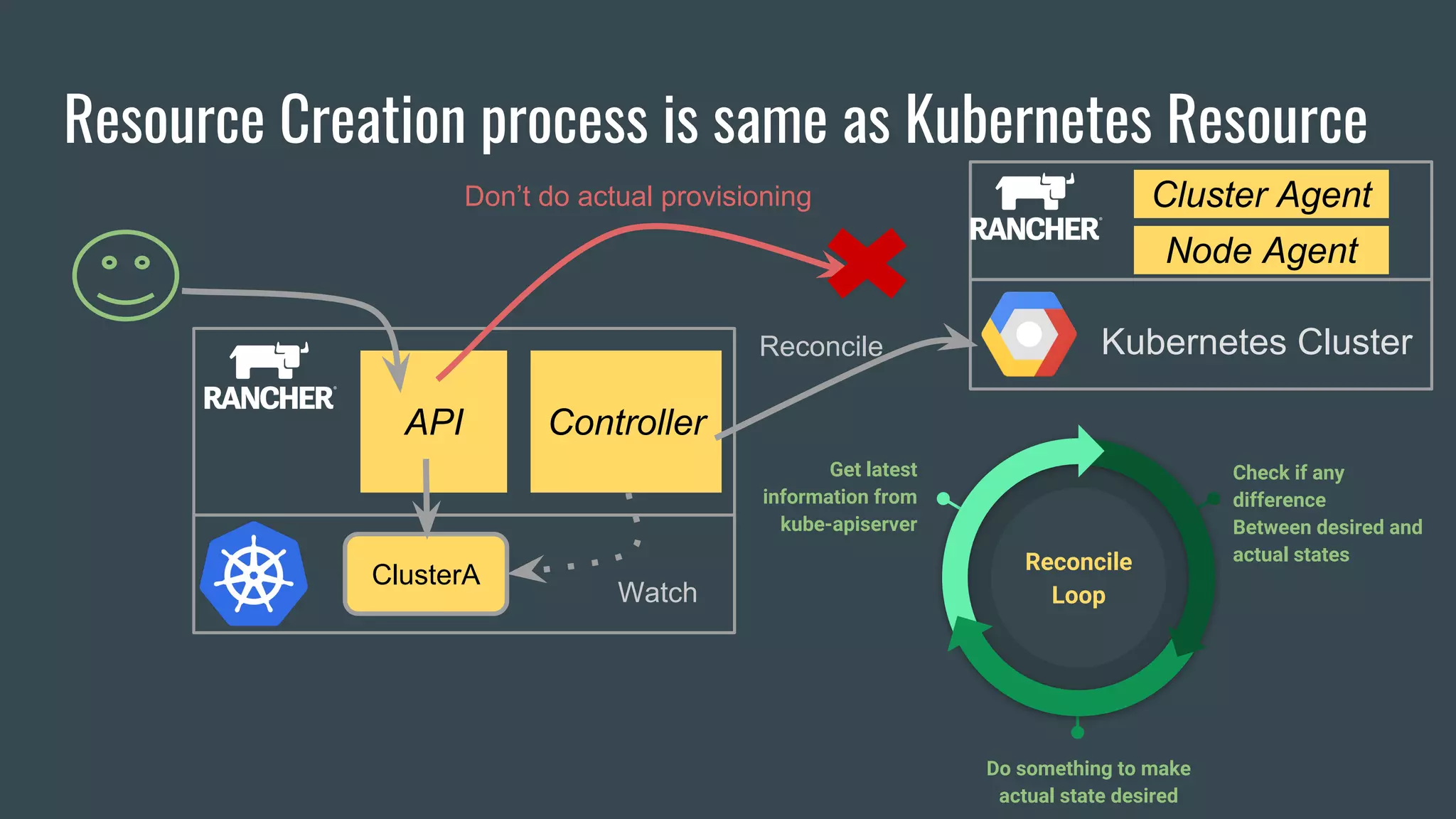
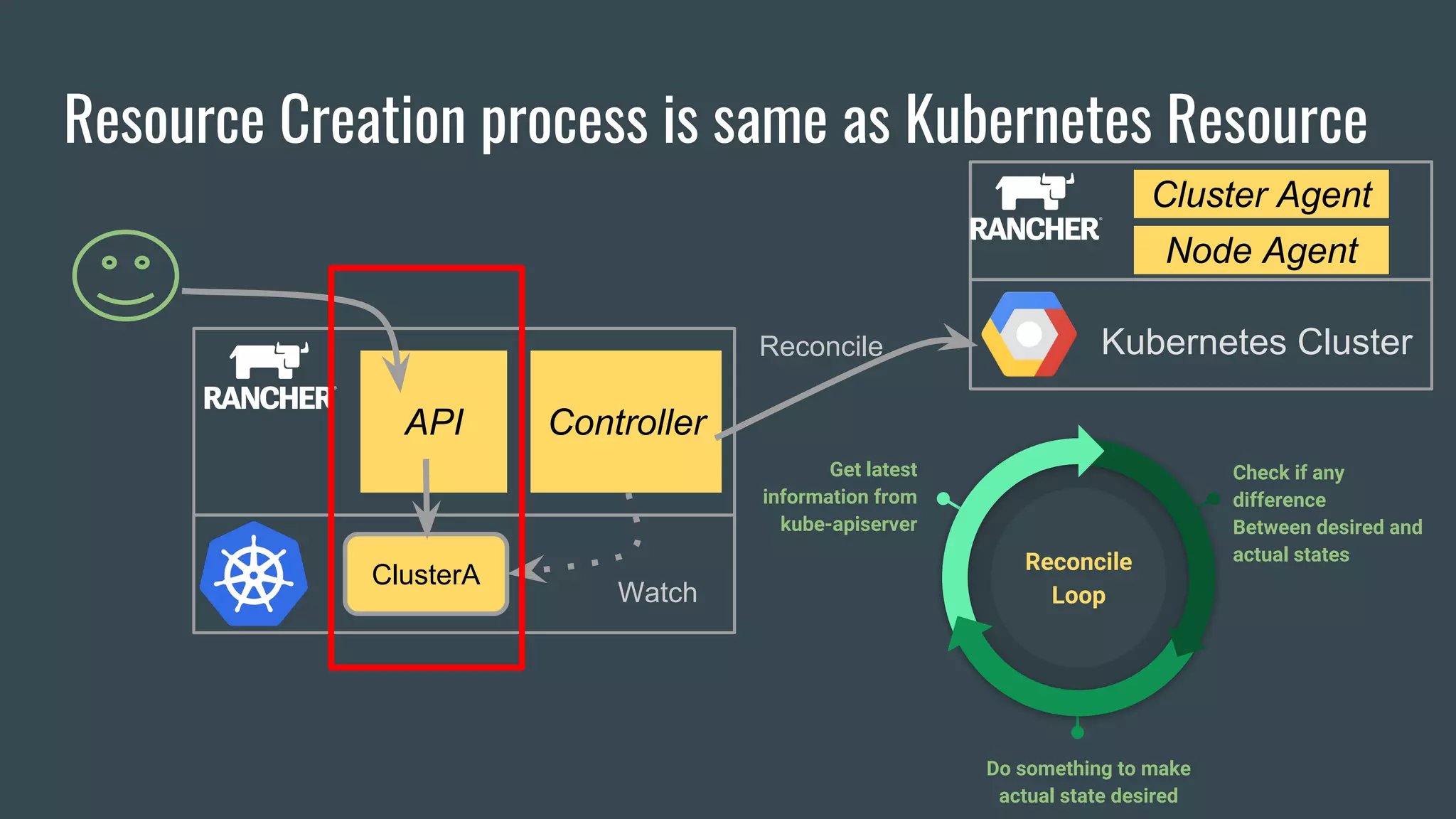
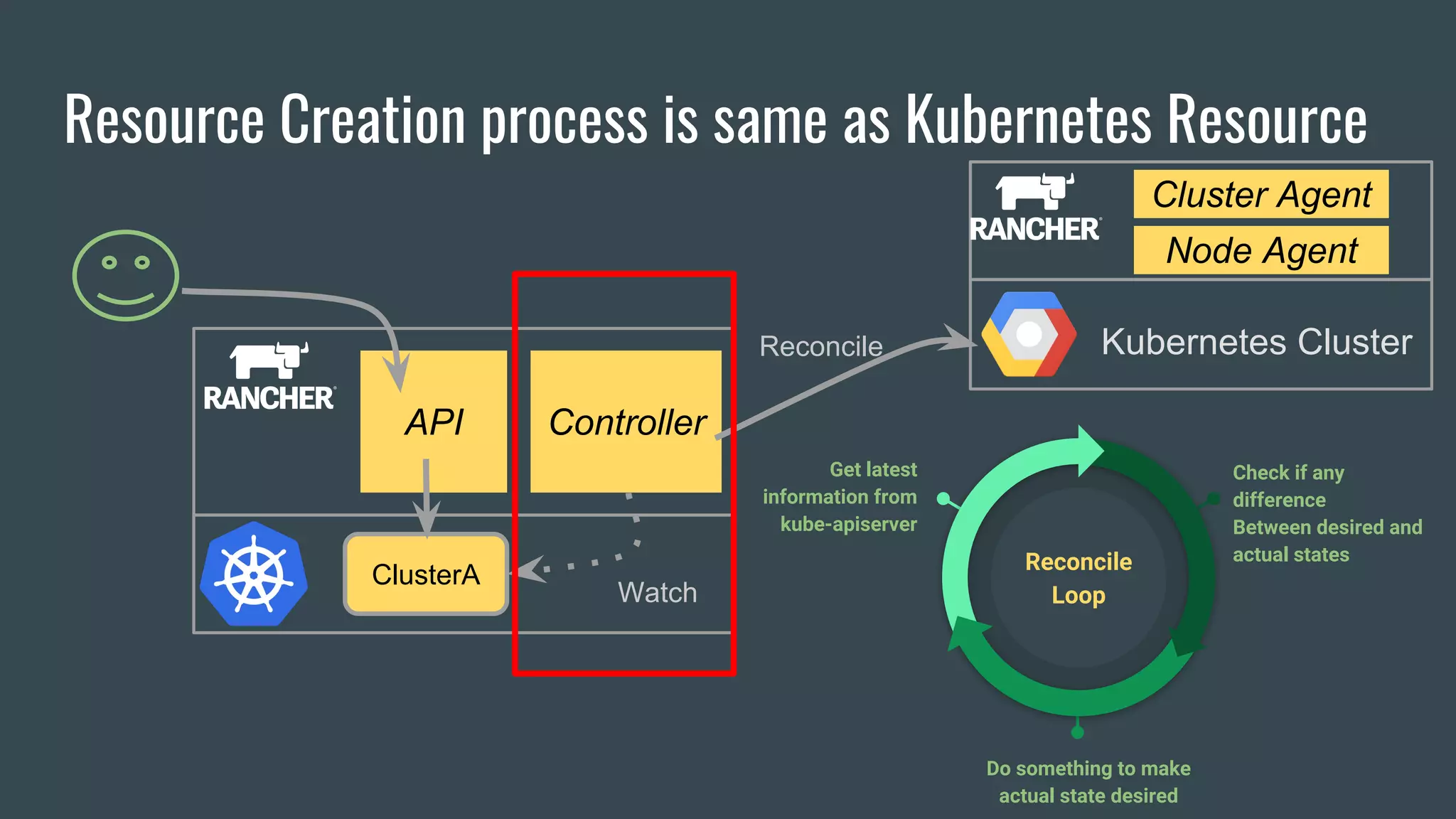
Resource Creation process is same as Kubernetes Resource
API Controller
ClusterA
Watch
Kubernetes ClusterReconcile
Get latest
information from
kube-apiserver
Check if any
difference
Between desired and
actual states
Do something to make
actual state desired
Reconcile
Loop
Cluster Agent
Node Agent
Don’t do actual provisioning
Resource Creation process is same as Kubernetes Resource
API Controller
ClusterA
Watch
Kubernetes ClusterReconcile
Get latest
information from
kube-apiserver
Check if any
difference
Between desired and
actual states
Do something to make
actual state desired
Reconcile
Loop
Cluster Agent
Node Agent
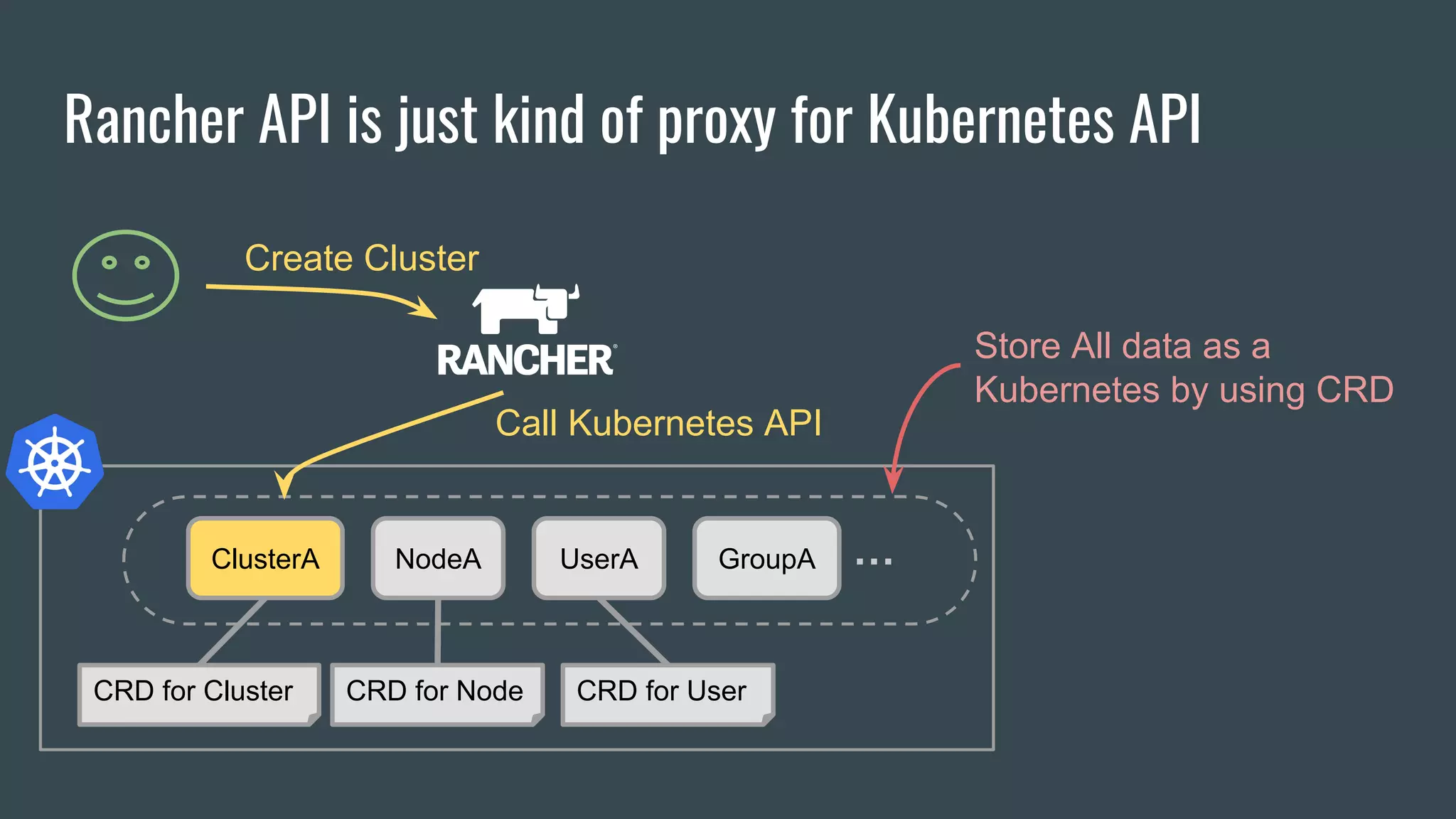
Rancher API is just kind of proxy for Kubernetes API
ClusterA NodeA UserA GroupA ・・・
Create Cluster
Store All data as a
Kubernetes by using CRD
CRD for Cluster CRD for Node CRD for User
Call Kubernetes API
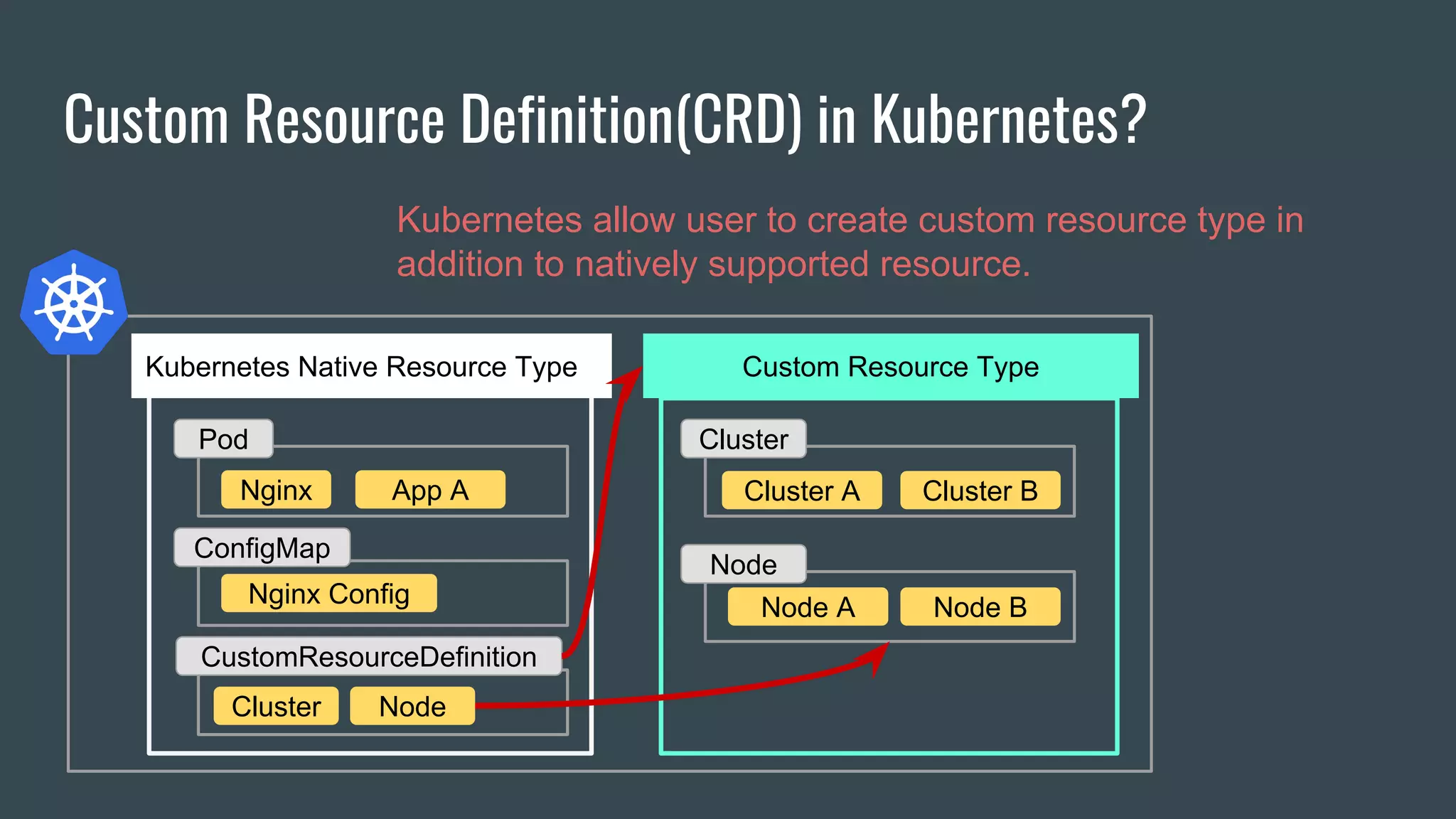
Custom Resource Definition(CRD) in Kubernetes?
Kubernetes Native Resource Type Custom Resource Type
CustomResourceDefinition
ConfigMap
Pod
Nginx App A
Nginx Config
Cluster Node
Cluster
Node
Cluster A Cluster B
Node A Node B
Kubernetes allow user to create custom resource type in
addition to natively supported resource.
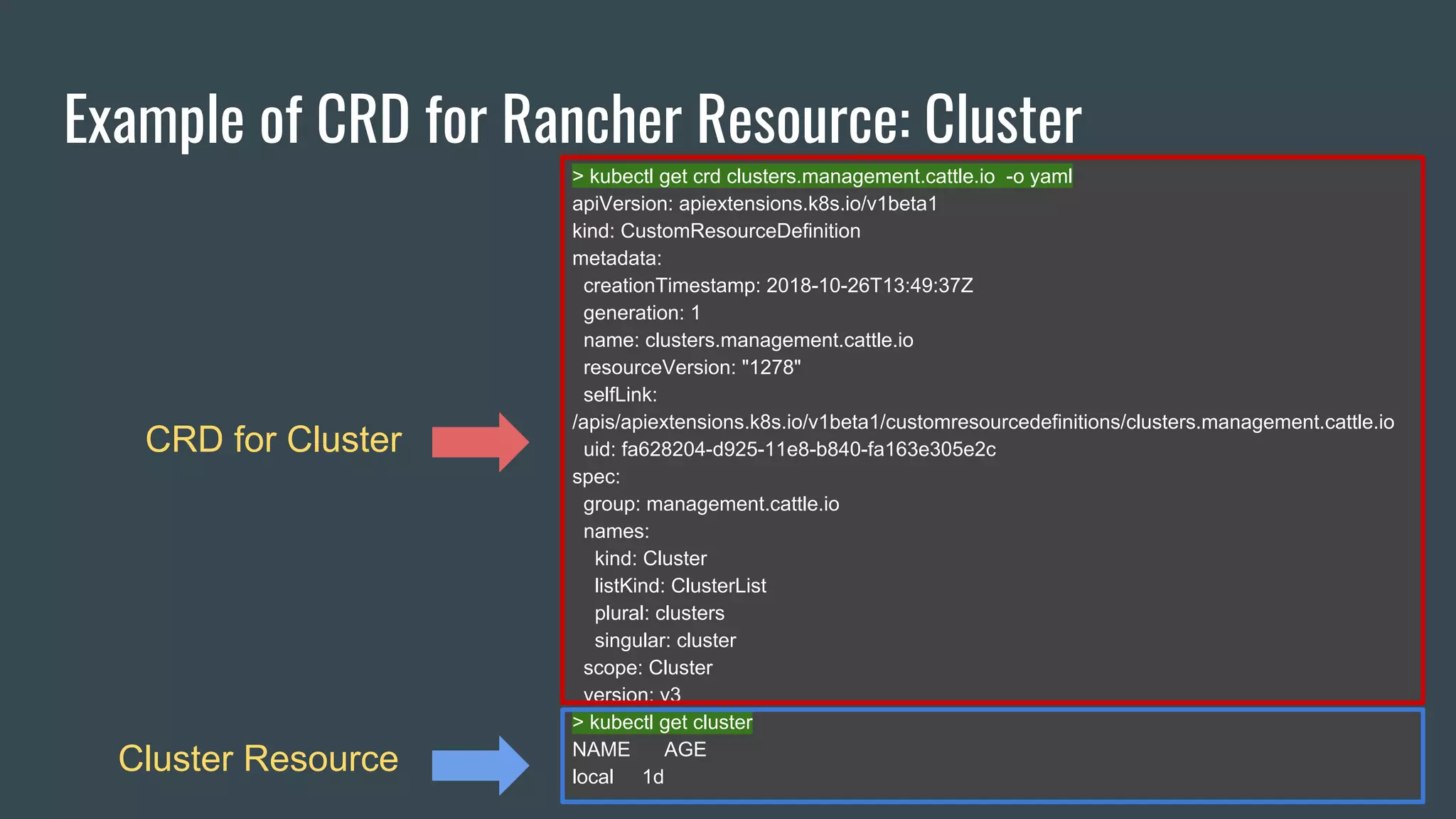
> kubectl get crd clusters.management.cattle.io -o yaml
apiVersion: apiextensions.k8s.io/v1beta1
kind: CustomResourceDefinition
metadata:
creationTimestamp: 2018-10-26T13:49:37Z
generation: 1
name: clusters.management.cattle.io
resourceVersion: "1278"
selfLink:
/apis/apiextensions.k8s.io/v1beta1/customresourcedefinitions/clusters.management.cattle.io
uid: fa628204-d925-11e8-b840-fa163e305e2c
spec:
group: management.cattle.io
names:
kind: Cluster
listKind: ClusterList
plural: clusters
singular: cluster
scope: Cluster
version: v3
> kubectl get cluster
NAME AGE
local 1d
Example of CRD for Rancher Resource: Cluster
CRD for Cluster
Cluster Resource
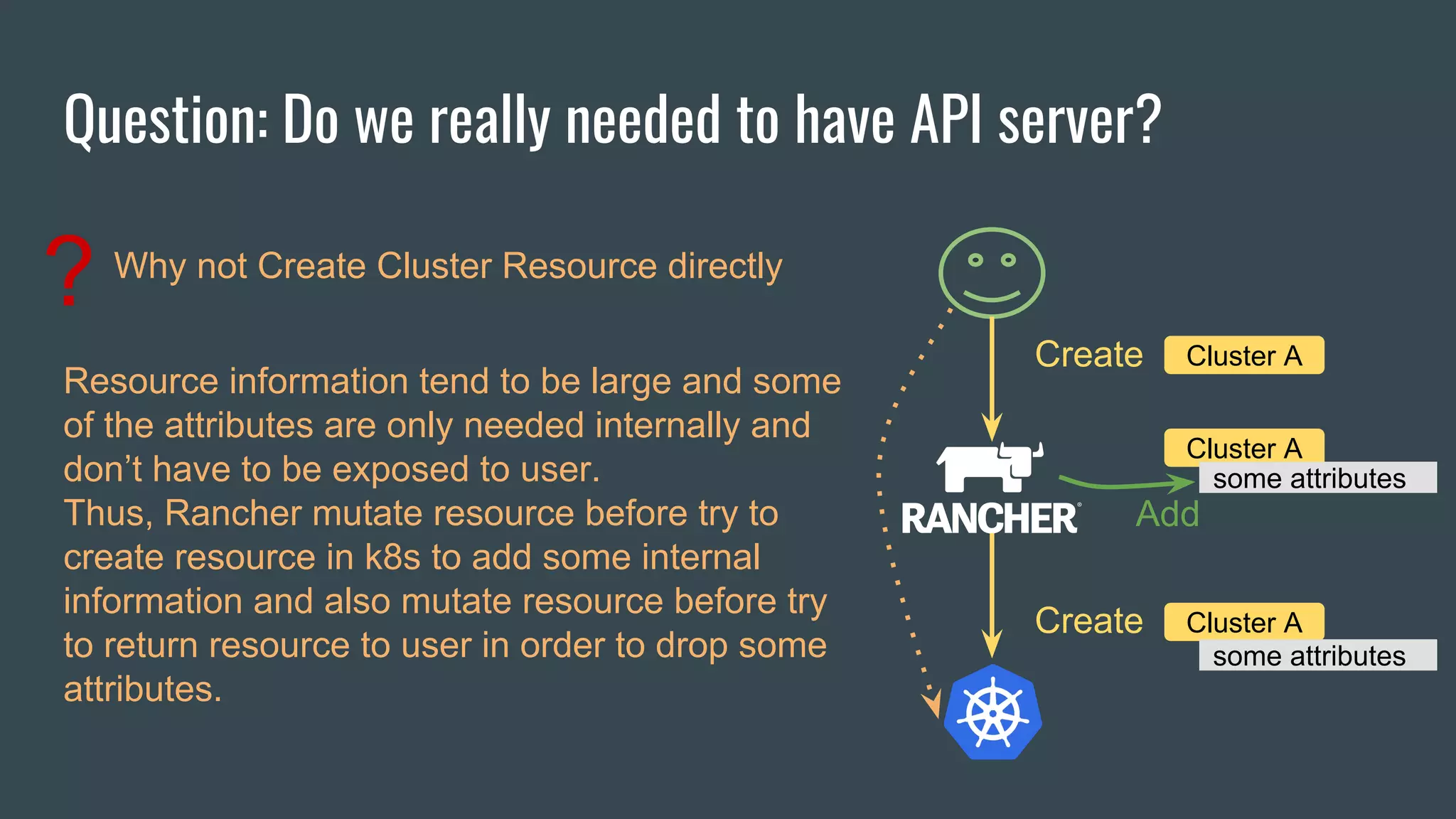
Question: Do we really needed to have API server?
Create
Create
Why not Create Cluster Resource directly
?
Resource information tend to be large and some
of the attributes are only needed internally and
don’t have to be exposed to user.
Thus, Rancher mutate resource before try to
create resource in k8s to add some internal
information and also mutate resource before try
to return resource to user in order to drop some
attributes.
Cluster A
Cluster A
Cluster A
some attributes
some attributes
Add
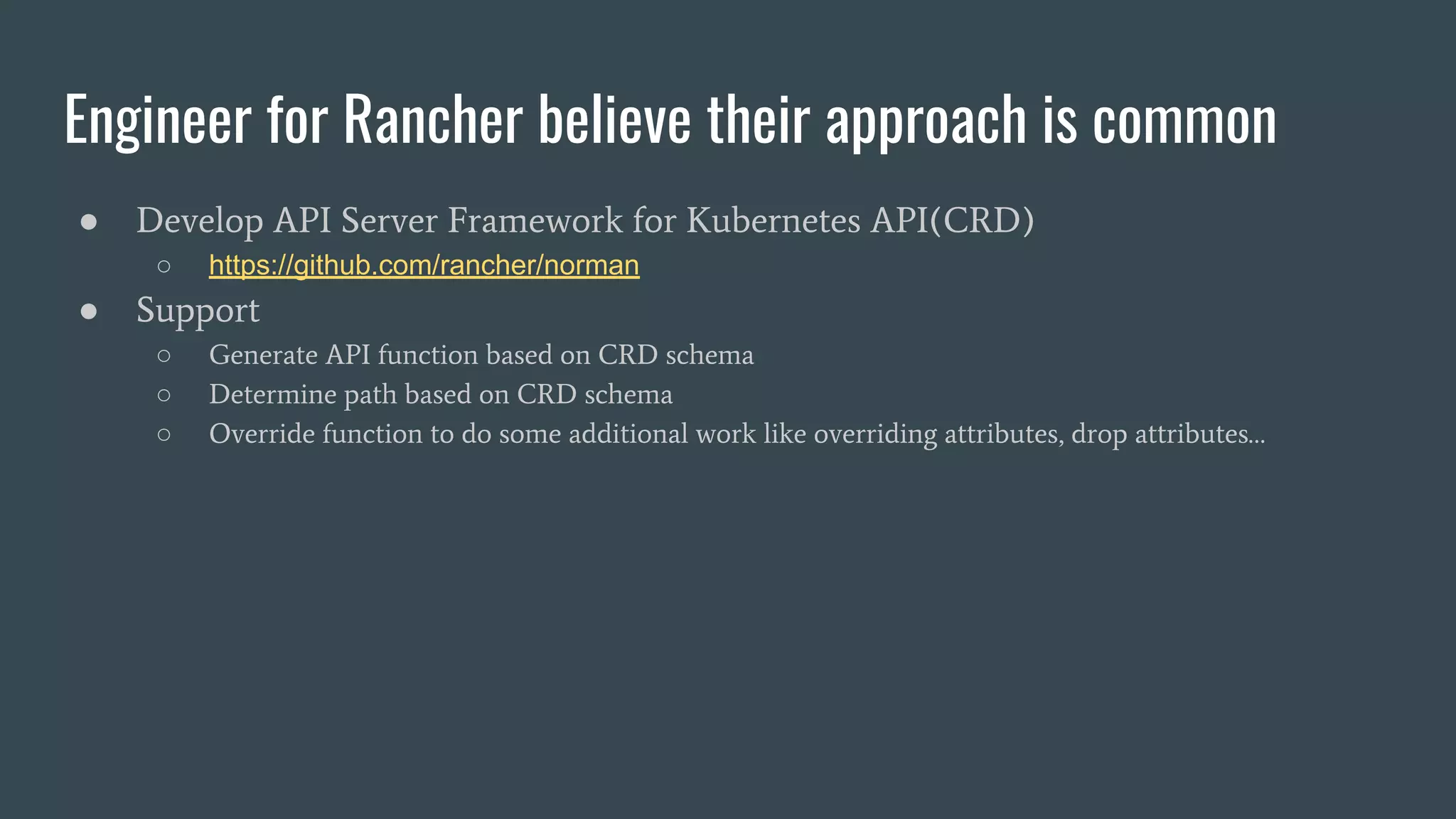
Engineer for Rancher believe their approach is common
● Develop API Server Framework for Kubernetes API(CRD)
○ https://github.com/rancher/norman
● Support
○ Generate API function based on CRD schema
○ Determine path based on CRD schema
○ Override function to do some additional work like overriding attributes, drop attributes…
Resource Creation process is same as Kubernetes Resource
API Controller
ClusterA
Watch
Kubernetes ClusterReconcile
Get latest
information from
kube-apiserver
Check if any
difference
Between desired and
actual states
Do something to make
actual state desired
Reconcile
Loop
Cluster Agent
Node Agent
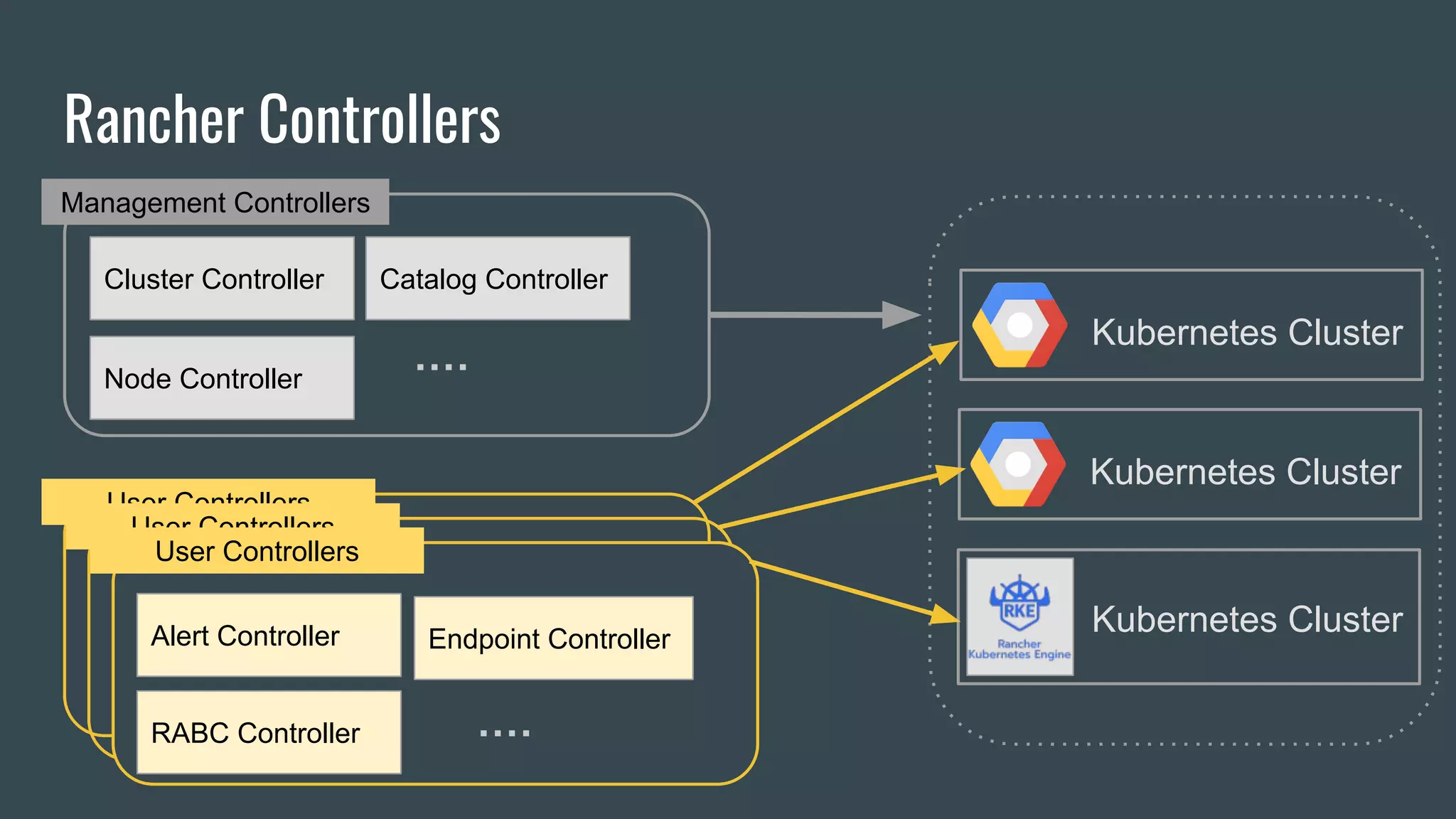
Rancher Controllers
Management Controllers
Kubernetes Cluster
Kubernetes Cluster
Kubernetes Cluster
User Controllers
User Controllers
User Controllers
Cluster Controller
Node Controller
Catalog Controller
・・・・
Alert Controller
RABC Controller
Endpoint Controller
・・・・
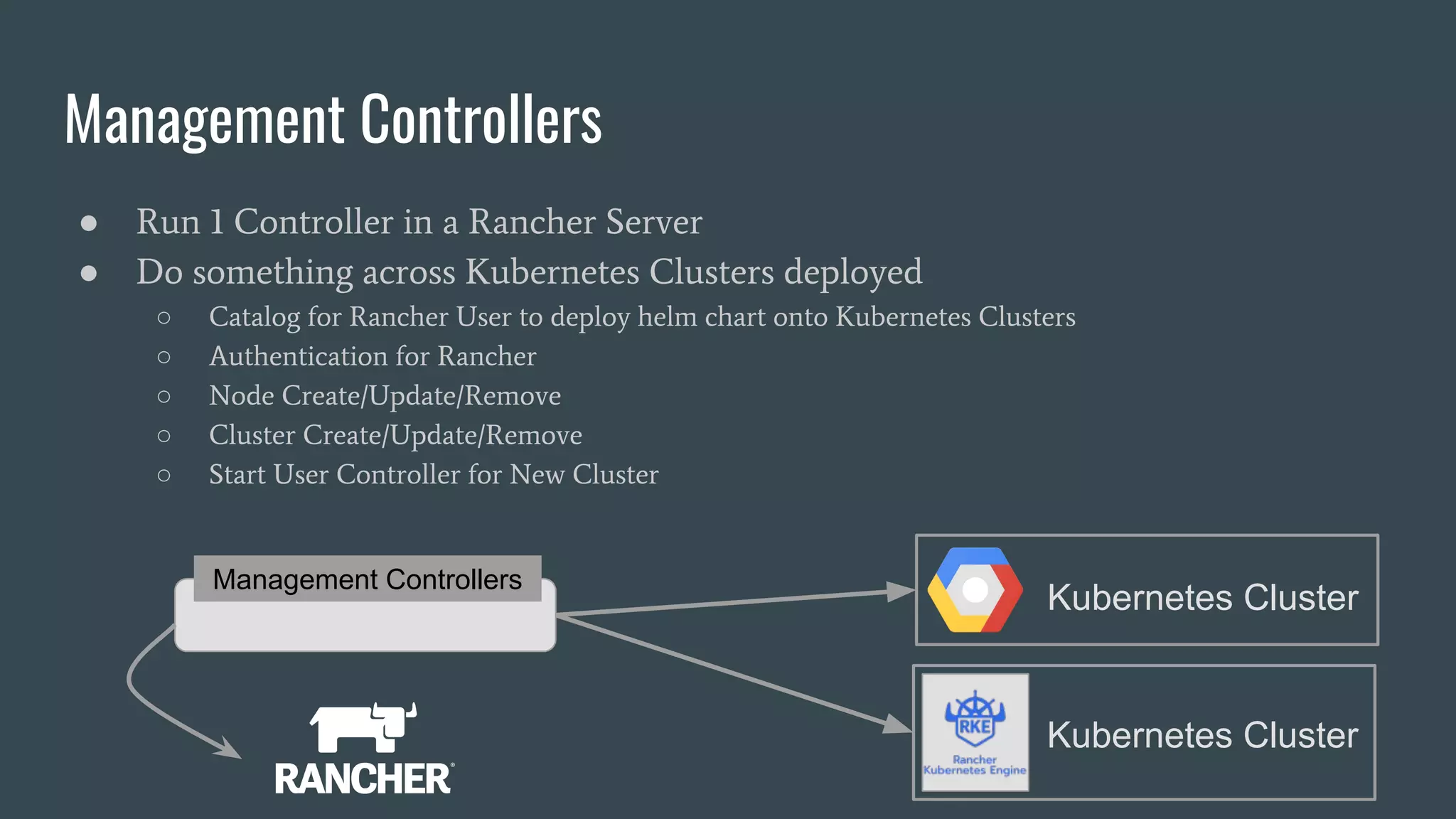
● Run 1 Controller in a Rancher Server
● Do something across Kubernetes Clusters deployed
○ Catalog for Rancher User to deploy helm chart onto Kubernetes Clusters
○ Authentication for Rancher
○ Node Create/Update/Remove
○ Cluster Create/Update/Remove
○ Start User Controller for New Cluster
Management Controllers
Kubernetes Cluster
Kubernetes Cluster
User Controllers
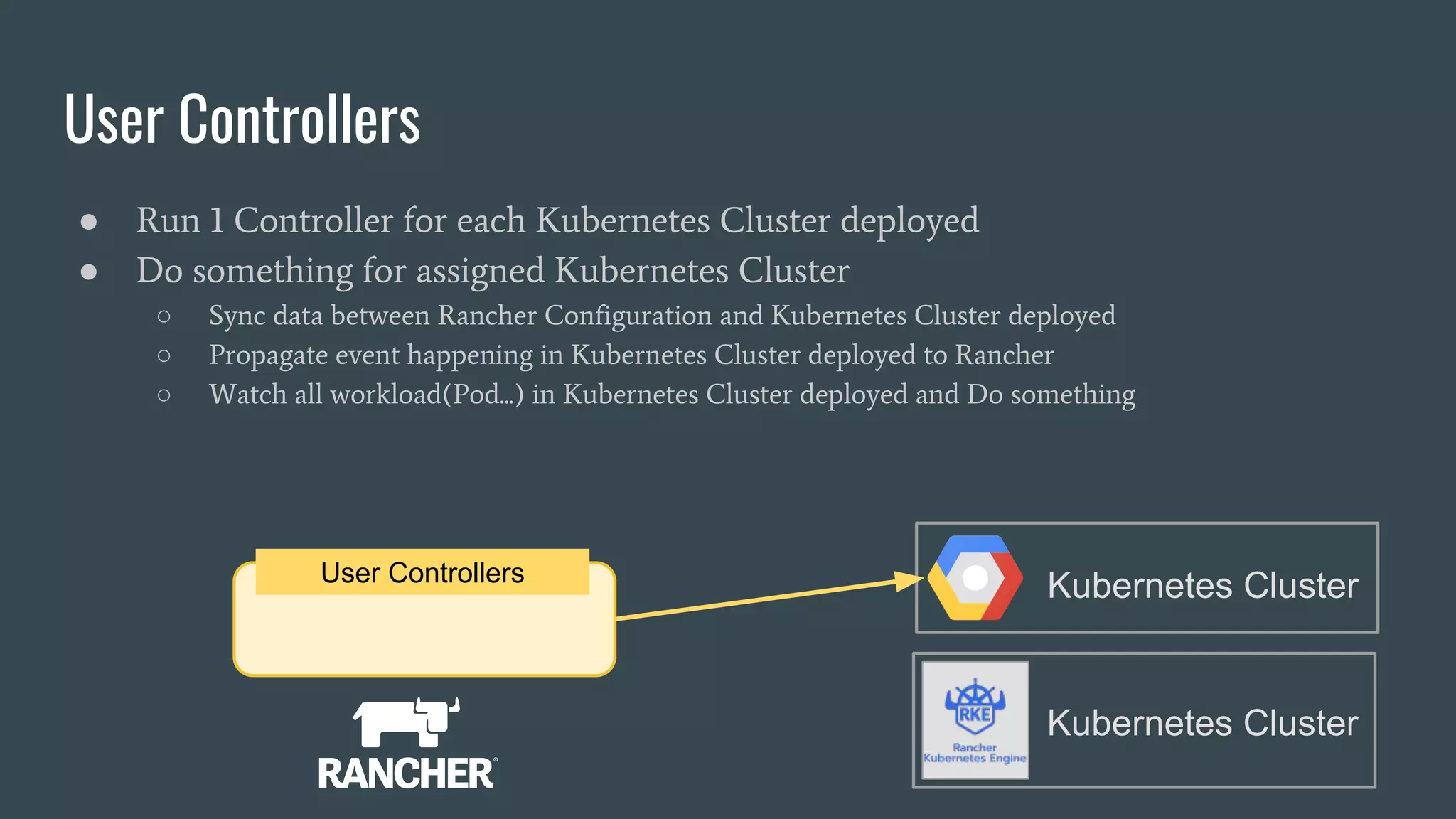
● Run 1 Controller for each Kubernetes Cluster deployed
● Do something for assigned Kubernetes Cluster
○ Sync data between Rancher Configuration and Kubernetes Cluster deployed
○ Propagate event happening in Kubernetes Cluster deployed to Rancher
○ Watch all workload(Pod...) in Kubernetes Cluster deployed and Do something
User Controllers
Kubernetes Cluster
Kubernetes Cluster
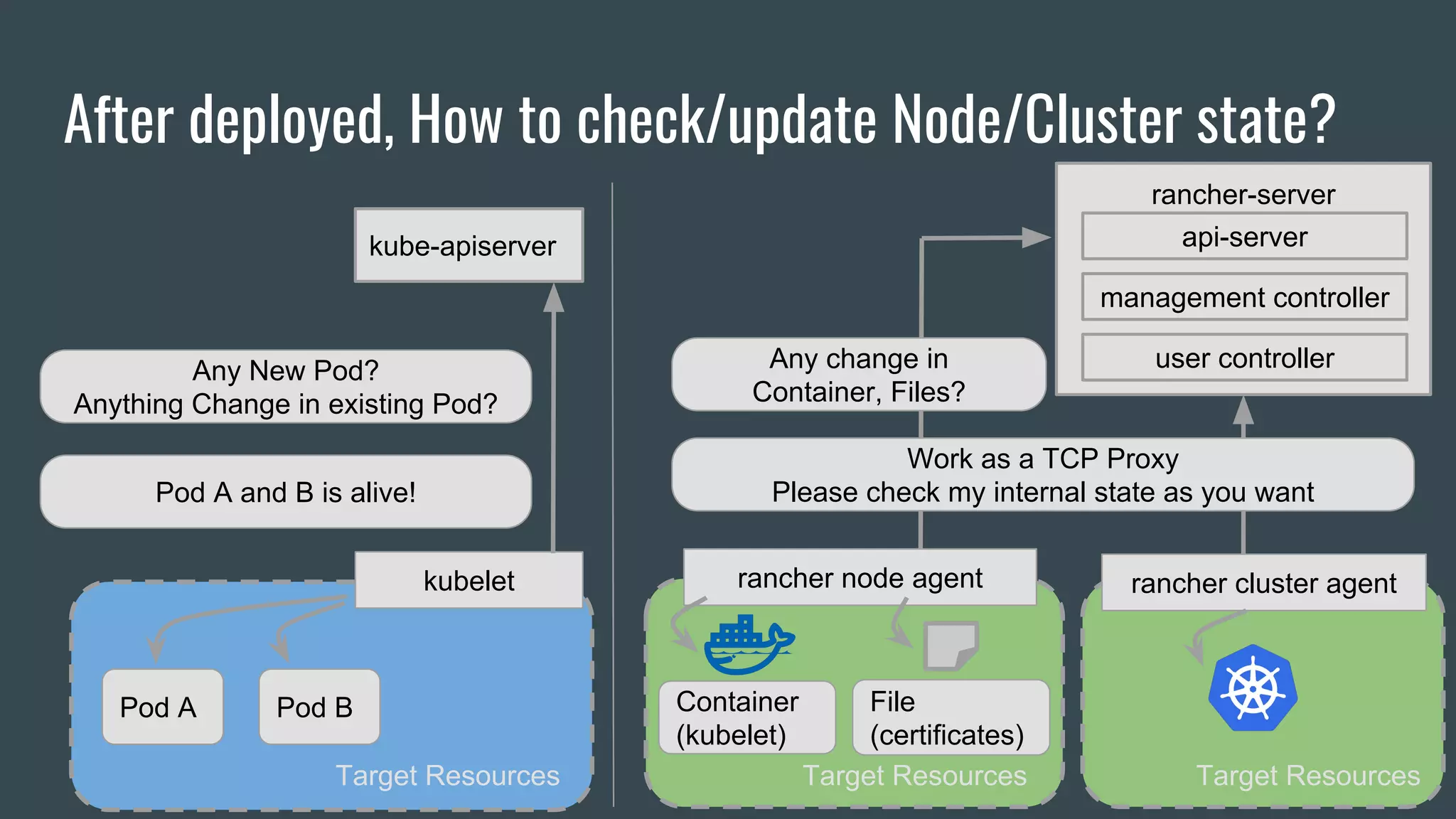
After deployed, How to check/update Node/Cluster state?
kube-apiserver
rancher-server
management controller
user controller
kubelet
Pod A Pod B
Target Resources
Any New Pod?
Anything Change in existing Pod?
Pod A and B is alive!
rancher cluster agent
Target ResourcesTarget Resources
Container
(kubelet)
File
(certificates)
Any change in
Container, Files?
Work as a TCP Proxy
Please check my internal state as you want
rancher node agent
api-server
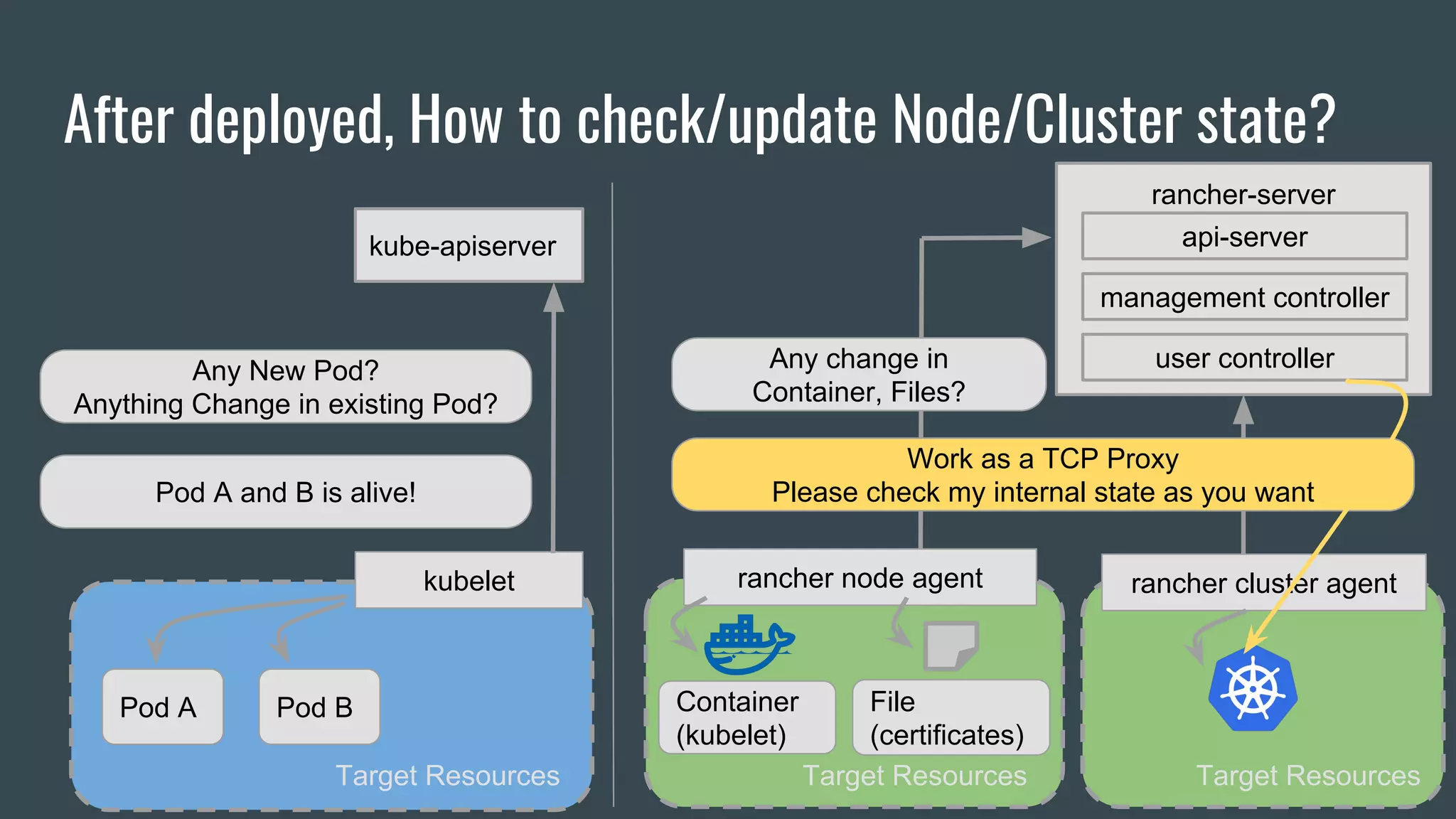
After deployed, How to check/update Node/Cluster state?
kube-apiserver
rancher-server
management controller
user controller
kubelet
Pod A Pod B
Target Resources
Any New Pod?
Anything Change in existing Pod?
Pod A and B is alive!
rancher cluster agent
Target ResourcesTarget Resources
Container
(kubelet)
File
(certificates)
Any change in
Container, Files?
Work as a TCP Proxy
Please check my internal state as you want
rancher node agent
api-server
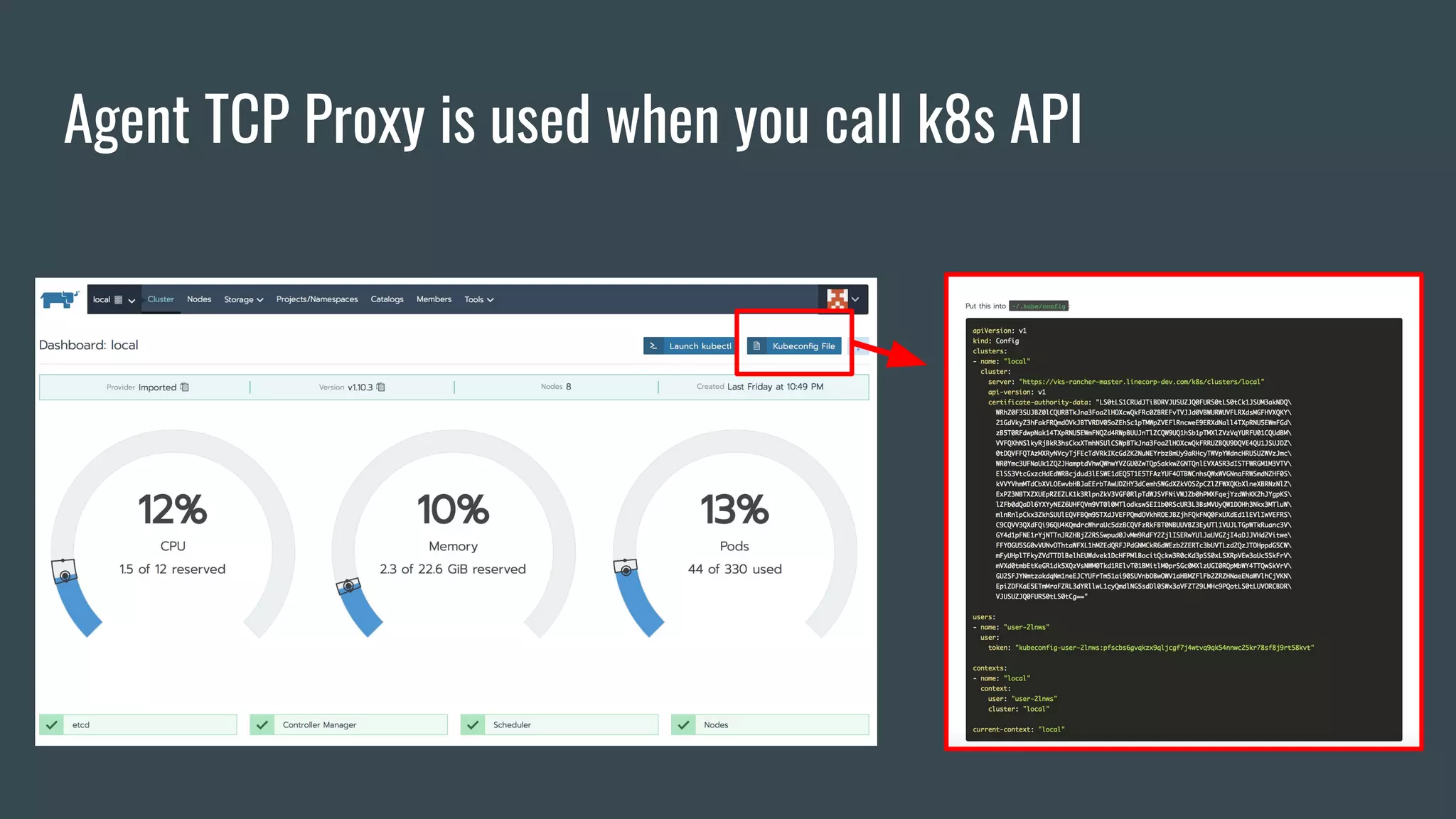
Agent TCP Proxy is used when you call k8s API
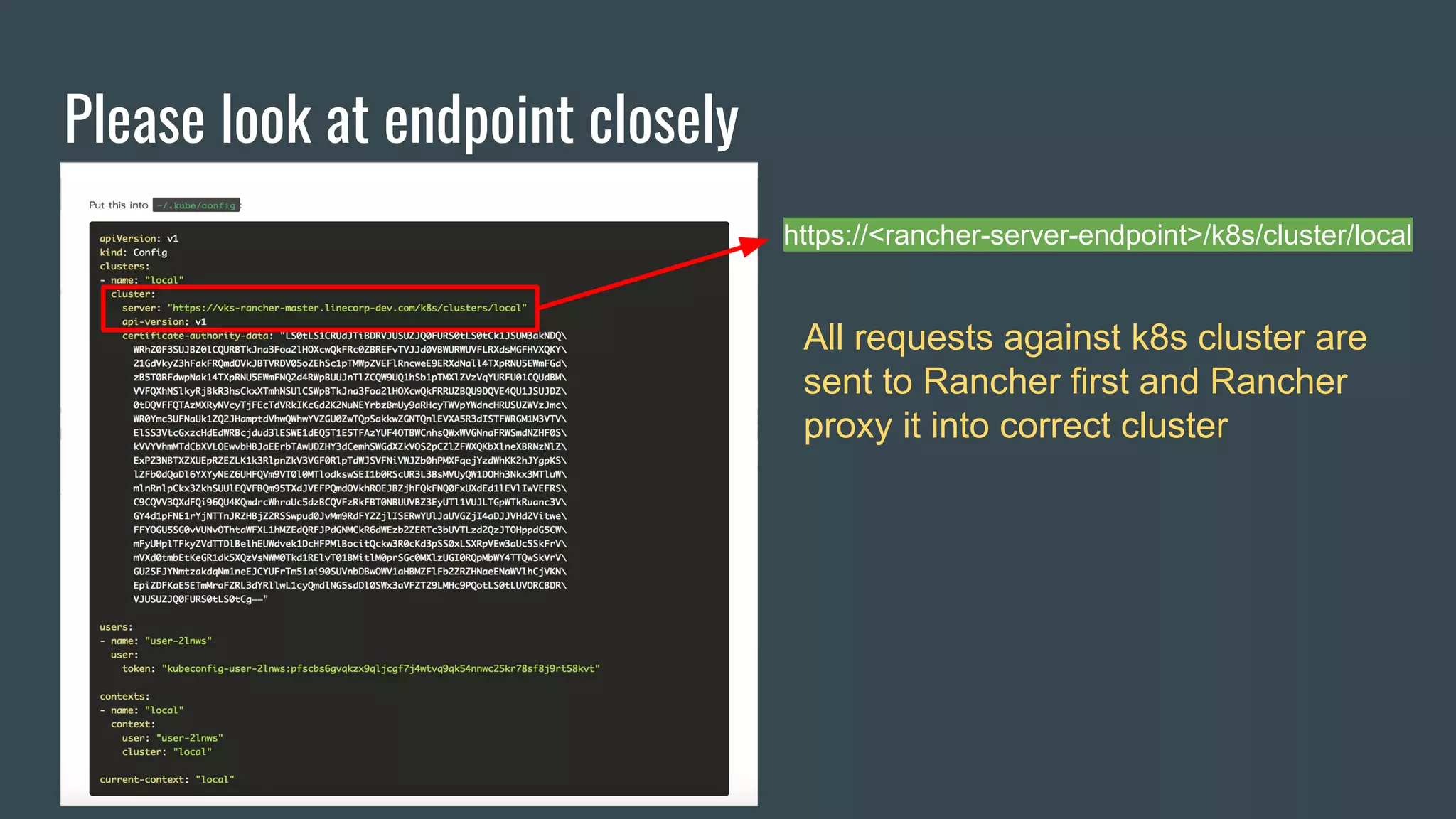
Please look at endpoint closely
https://<rancher-server-endpoint>/k8s/cluster/local
All requests against k8s cluster are
sent to Rancher first and Rancher
proxy it into correct cluster
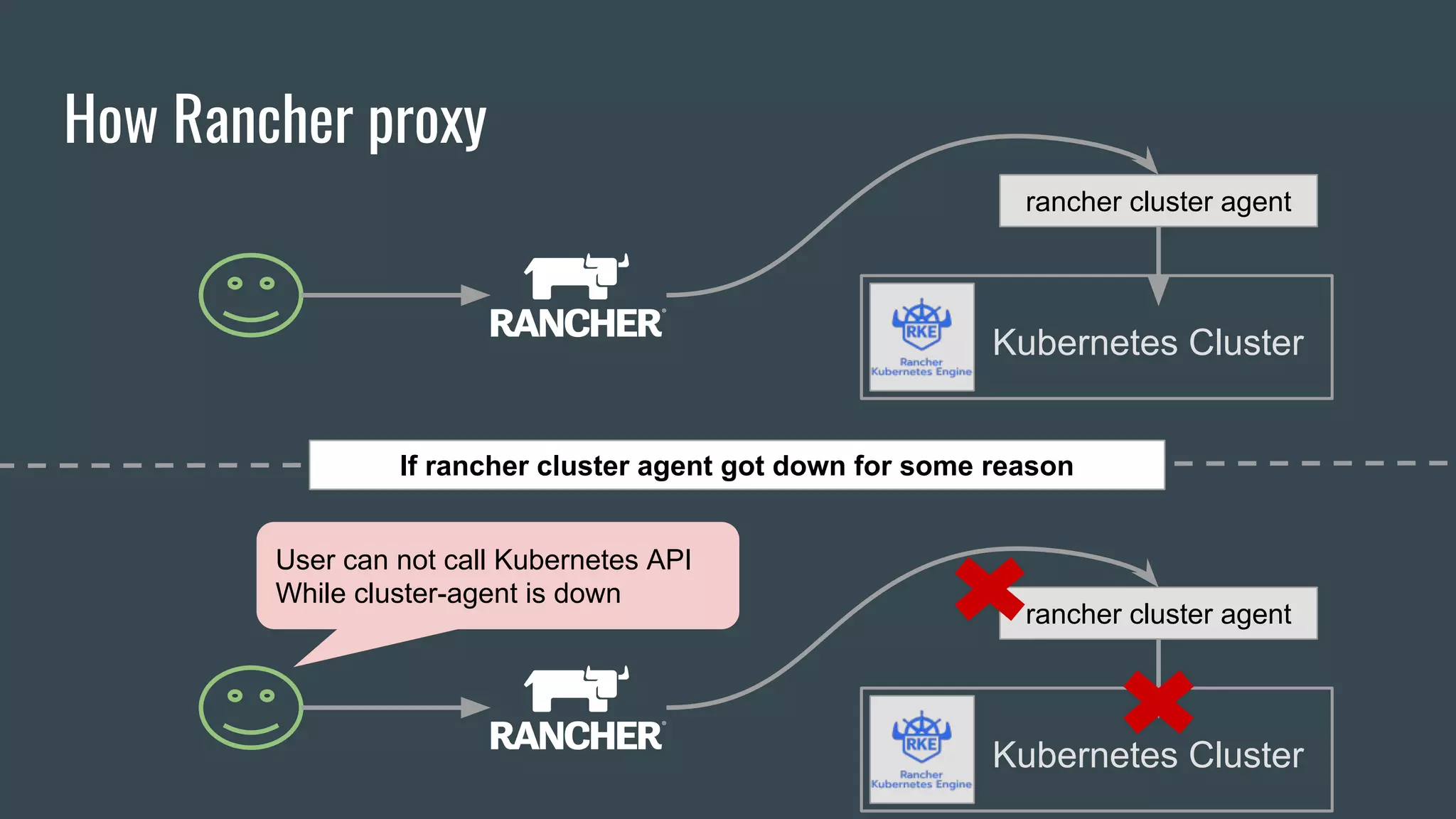
How Rancher proxy
Kubernetes Cluster
rancher cluster agent
Kubernetes Cluster
rancher cluster agent
User can not call Kubernetes API
While cluster-agent is down
If rancher cluster agent got down for some reason
Rancher 2.X Updates
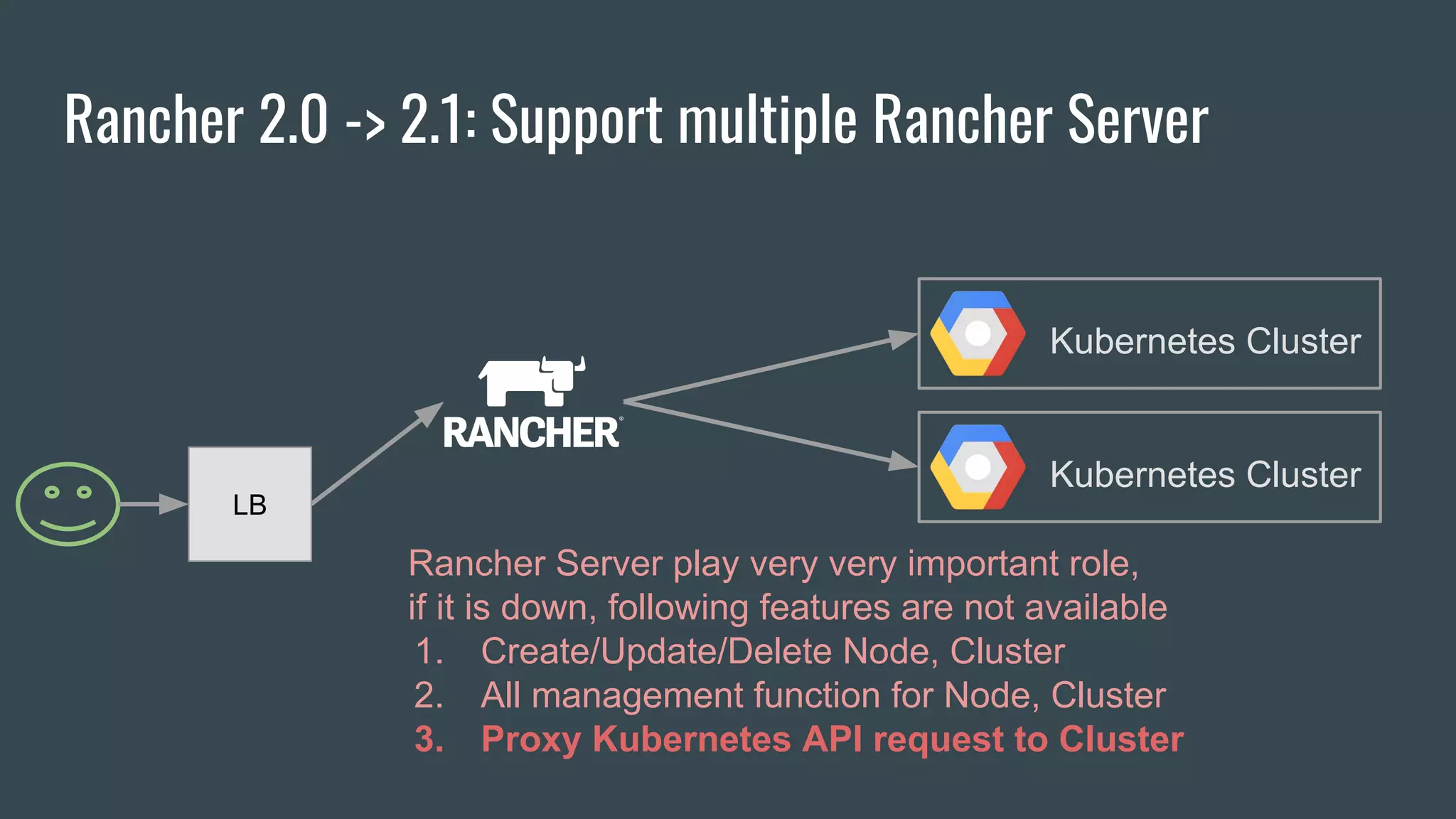
Rancher 2.0 -> 2.1: Support multiple Rancher Server
Kubernetes Cluster
Kubernetes Cluster
LB
Rancher Server play very very important role,
if it is down, following features are not available
1. Create/Update/Delete Node, Cluster
2. All management function for Node, Cluster
3. Proxy Kubernetes API request to Cluster
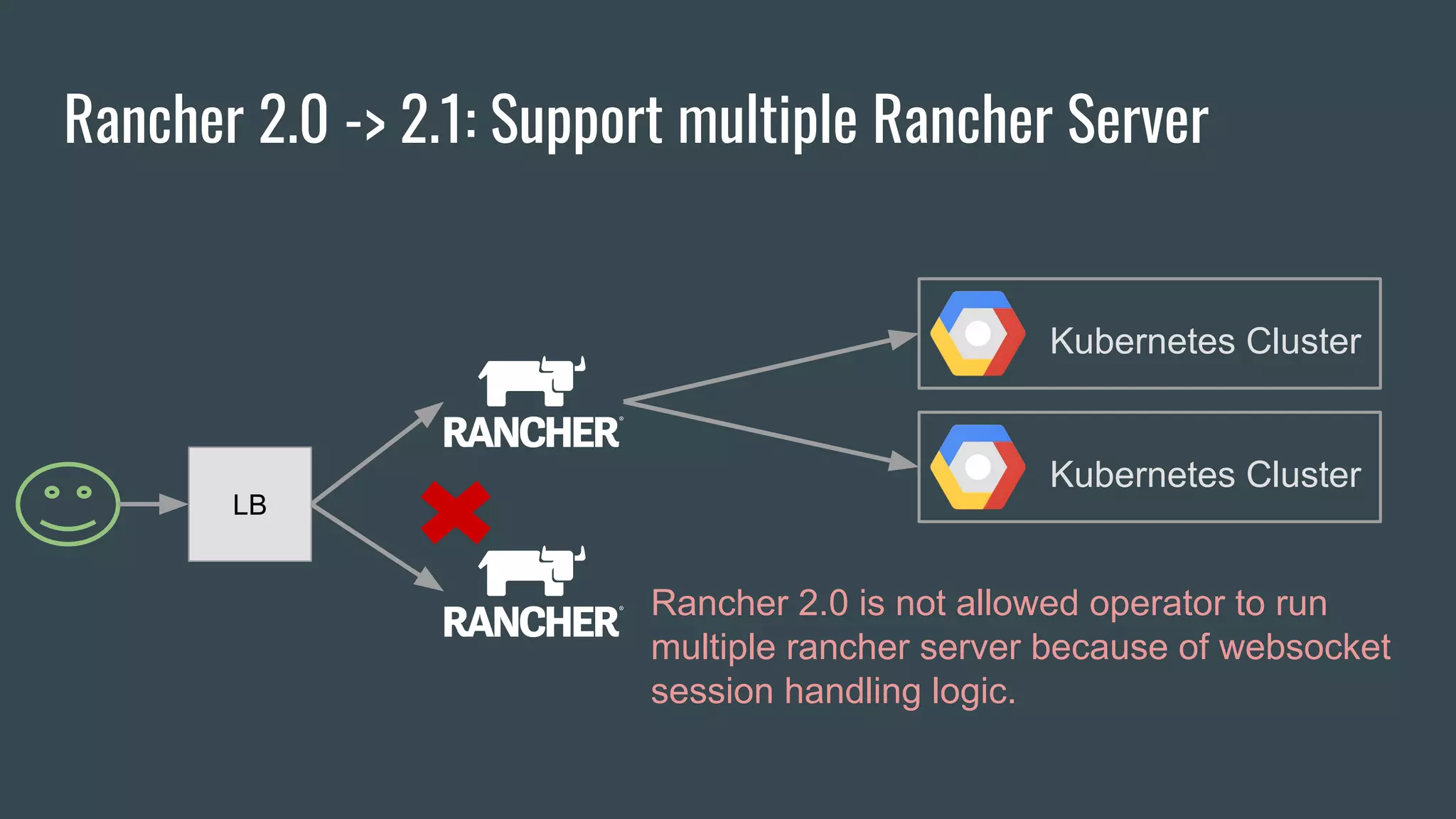
Rancher 2.0 -> 2.1: Support multiple Rancher Server
Kubernetes Cluster
Kubernetes Cluster
LB
Rancher 2.0 is not allowed operator to run
multiple rancher server because of websocket
session handling logic.
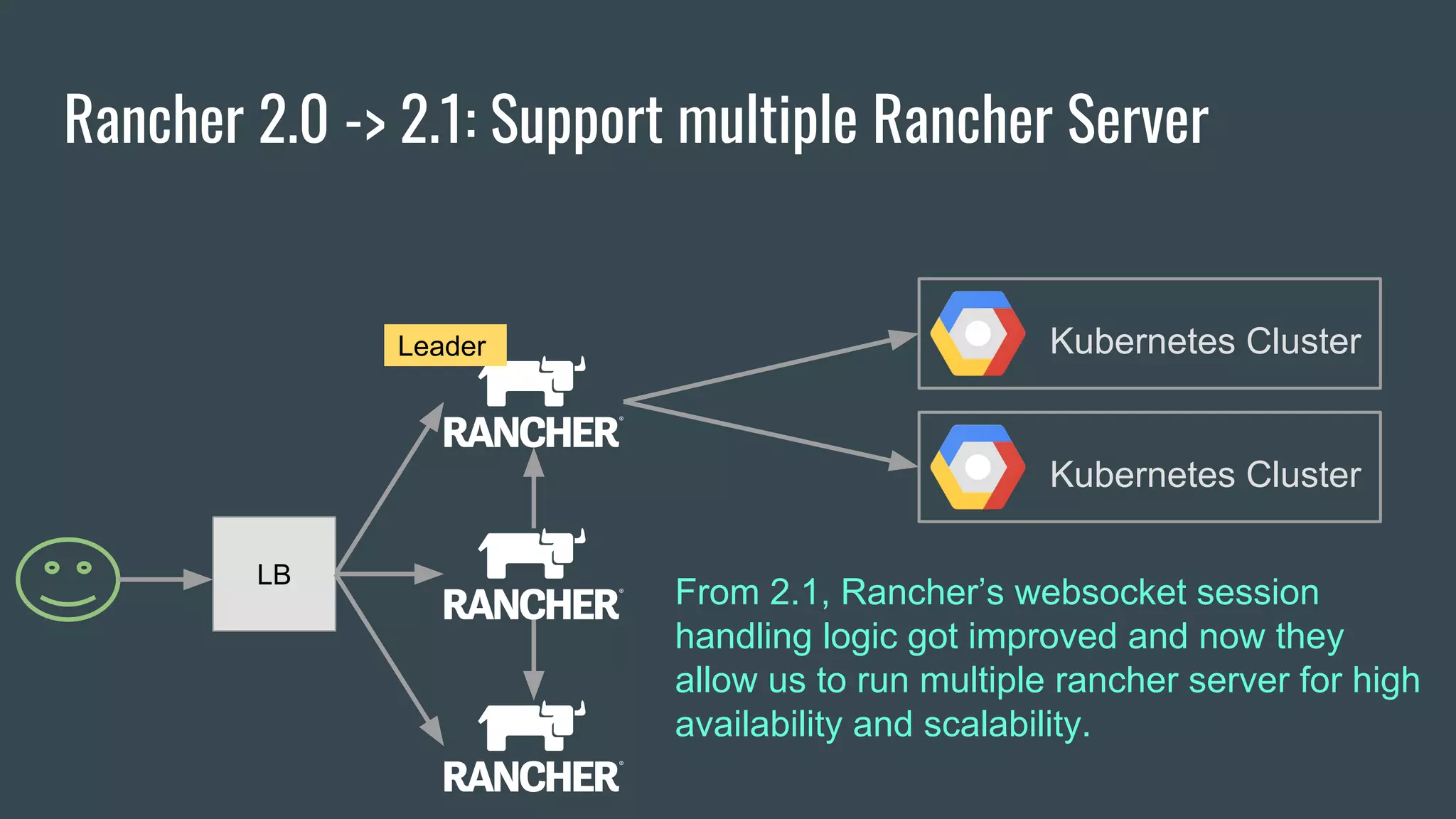
Rancher 2.0 -> 2.1: Support multiple Rancher Server
Kubernetes Cluster
Kubernetes Cluster
LB
Leader
From 2.1, Rancher’s websocket session
handling logic got improved and now they
allow us to run multiple rancher server for high
availability and scalability.
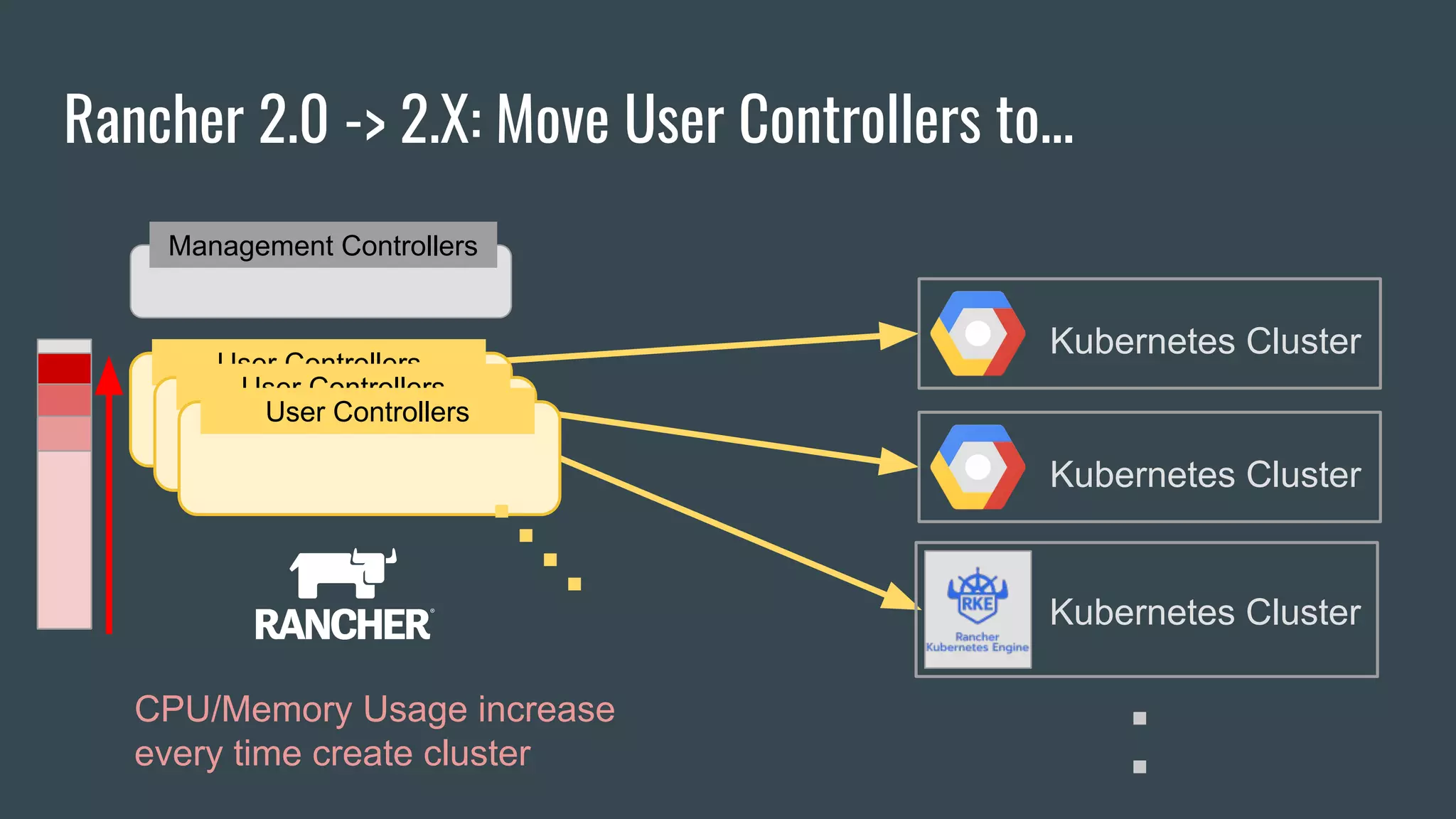
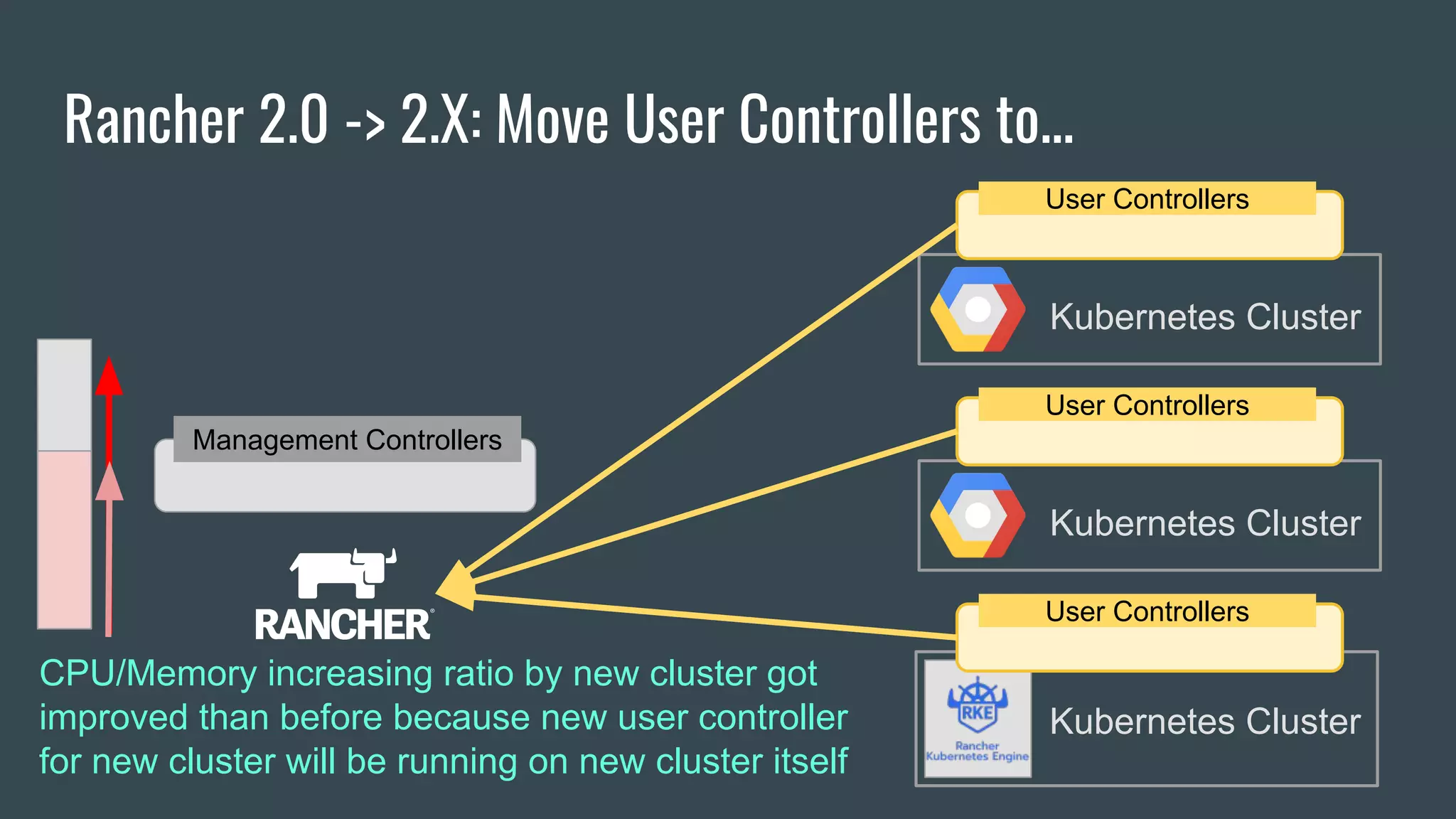
Rancher 2.0 -> 2.X: Move User Controllers to...
User Controllers
User Controllers
User Controllers
Kubernetes Cluster
Kubernetes Cluster
Kubernetes Cluster
CPU/Memory Usage increase
every time create cluster
・・・・
・
・
Management Controllers
Rancher 2.0 -> 2.X: Move User Controllers to...
Kubernetes Cluster
Kubernetes Cluster
Kubernetes Cluster
User Controllers
User Controllers
User Controllers
Management Controllers
CPU/Memory increasing ratio by new cluster got
improved than before because new user controller
for new cluster will be running on new cluster itself

Rancher 2.x first step before deep dive

  • 1.
    Rancher 2.X First Stepbefore Deep Dive LINE Corporation, Verda2 Yuki Nishiwaki
  • 2.
    Who you are? Name: ●Yuki Nishiwaki Working Experience: ● Private Cloud Development (OpenStack) Jan 2015 -> Now ● Kubernetes as a Service Development (Rancher) July 2018 -> Now ● Function as a Service Development (Knative) Sep 2018 -> Now
  • 3.
    Rancher and Me ●User and Developer ● Have contributed few patches to rancher 2.X related projects ○ rancher/types ■ https://github.com/rancher/types/pull/525 ○ rancher/machine ■ https://github.com/rancher/machine/pull/12 ○ rancher/norman ■ https://github.com/rancher/norman/pull/201 ■ https://github.com/rancher/norman/pull/202 ■ https://github.com/rancher/norman/pull/203 ○ rancher/rancher ■ https://github.com/rancher/rancher/pull/15909 ■ https://github.com/rancher/rancher/pull/15991 ■ https://github.com/rancher/rancher/pull/16044 Not so many contributions yet
  • 4.
    Today’s scope ● Wehave only 20-30 min ● Rancher have bunch of features. It will take half of day if I talk all parts ● Try to explain whole picture ● Check following article for more detail ○ https://www.slideshare.net/linecorp/lets-unbox-rancher-20-v200 ○ https://github.com/ukinau/rancher-analyse
  • 5.
    Rancher 2.X ? AllData for Rancher are stored in Kubernetes => Depend on Kubernetes to run Rancher 1 Manage Kubernetes Cluster by multiple Provider ● Google Container Engine ● Amazon EKS ● Microsoft Azure ● Any VM Provider like OpenStack (RKE) 2 RBAC Configuration Configure/Deploy Additional Tools on Cluster Addon Management 4 Resource Resource Resource Admin member RBAC Configuration 3 Sync RBAC configuration
  • 6.
  • 7.
    Rancher 2.X architecture APIController Cluster Agent Node Agent Node Agent Node Agent Cluster Agent Node Agent Node Agent Node Agent Kubernetes Cluster Kubernetes Cluster Kubernetes Cluster
  • 8.
    Resource Creation processis same as Kubernetes Resource API Controller ClusterA Watch Kubernetes ClusterReconcile Get latest information from kube-apiserver Check if any difference Between desired and actual states Do something to make actual state desired Reconcile Loop Cluster Agent Node Agent Don’t do actual provisioning
  • 9.
    Resource Creation processis same as Kubernetes Resource API Controller ClusterA Watch Kubernetes ClusterReconcile Get latest information from kube-apiserver Check if any difference Between desired and actual states Do something to make actual state desired Reconcile Loop Cluster Agent Node Agent
  • 10.
    Rancher API isjust kind of proxy for Kubernetes API ClusterA NodeA UserA GroupA ・・・ Create Cluster Store All data as a Kubernetes by using CRD CRD for Cluster CRD for Node CRD for User Call Kubernetes API
  • 11.
    Custom Resource Definition(CRD)in Kubernetes? Kubernetes Native Resource Type Custom Resource Type CustomResourceDefinition ConfigMap Pod Nginx App A Nginx Config Cluster Node Cluster Node Cluster A Cluster B Node A Node B Kubernetes allow user to create custom resource type in addition to natively supported resource.
  • 12.
    > kubectl getcrd clusters.management.cattle.io -o yaml apiVersion: apiextensions.k8s.io/v1beta1 kind: CustomResourceDefinition metadata: creationTimestamp: 2018-10-26T13:49:37Z generation: 1 name: clusters.management.cattle.io resourceVersion: "1278" selfLink: /apis/apiextensions.k8s.io/v1beta1/customresourcedefinitions/clusters.management.cattle.io uid: fa628204-d925-11e8-b840-fa163e305e2c spec: group: management.cattle.io names: kind: Cluster listKind: ClusterList plural: clusters singular: cluster scope: Cluster version: v3 > kubectl get cluster NAME AGE local 1d Example of CRD for Rancher Resource: Cluster CRD for Cluster Cluster Resource
  • 13.
    Question: Do wereally needed to have API server? Create Create Why not Create Cluster Resource directly ? Resource information tend to be large and some of the attributes are only needed internally and don’t have to be exposed to user. Thus, Rancher mutate resource before try to create resource in k8s to add some internal information and also mutate resource before try to return resource to user in order to drop some attributes. Cluster A Cluster A Cluster A some attributes some attributes Add
  • 14.
    Engineer for Rancherbelieve their approach is common ● Develop API Server Framework for Kubernetes API(CRD) ○ https://github.com/rancher/norman ● Support ○ Generate API function based on CRD schema ○ Determine path based on CRD schema ○ Override function to do some additional work like overriding attributes, drop attributes…
  • 15.
    Resource Creation processis same as Kubernetes Resource API Controller ClusterA Watch Kubernetes ClusterReconcile Get latest information from kube-apiserver Check if any difference Between desired and actual states Do something to make actual state desired Reconcile Loop Cluster Agent Node Agent
  • 16.
    Rancher Controllers Management Controllers KubernetesCluster Kubernetes Cluster Kubernetes Cluster User Controllers User Controllers User Controllers Cluster Controller Node Controller Catalog Controller ・・・・ Alert Controller RABC Controller Endpoint Controller ・・・・
  • 17.
    ● Run 1Controller in a Rancher Server ● Do something across Kubernetes Clusters deployed ○ Catalog for Rancher User to deploy helm chart onto Kubernetes Clusters ○ Authentication for Rancher ○ Node Create/Update/Remove ○ Cluster Create/Update/Remove ○ Start User Controller for New Cluster Management Controllers Management Controllers Kubernetes Cluster Kubernetes Cluster
  • 18.
    User Controllers ● Run1 Controller for each Kubernetes Cluster deployed ● Do something for assigned Kubernetes Cluster ○ Sync data between Rancher Configuration and Kubernetes Cluster deployed ○ Propagate event happening in Kubernetes Cluster deployed to Rancher ○ Watch all workload(Pod...) in Kubernetes Cluster deployed and Do something User Controllers Kubernetes Cluster Kubernetes Cluster
  • 19.
    After deployed, Howto check/update Node/Cluster state? kube-apiserver rancher-server management controller user controller kubelet Pod A Pod B Target Resources Any New Pod? Anything Change in existing Pod? Pod A and B is alive! rancher cluster agent Target ResourcesTarget Resources Container (kubelet) File (certificates) Any change in Container, Files? Work as a TCP Proxy Please check my internal state as you want rancher node agent api-server
  • 20.
    After deployed, Howto check/update Node/Cluster state? kube-apiserver rancher-server management controller user controller kubelet Pod A Pod B Target Resources Any New Pod? Anything Change in existing Pod? Pod A and B is alive! rancher cluster agent Target ResourcesTarget Resources Container (kubelet) File (certificates) Any change in Container, Files? Work as a TCP Proxy Please check my internal state as you want rancher node agent api-server
  • 21.
    Agent TCP Proxyis used when you call k8s API
  • 22.
    Please look atendpoint closely https://<rancher-server-endpoint>/k8s/cluster/local All requests against k8s cluster are sent to Rancher first and Rancher proxy it into correct cluster
  • 23.
    How Rancher proxy KubernetesCluster rancher cluster agent Kubernetes Cluster rancher cluster agent User can not call Kubernetes API While cluster-agent is down If rancher cluster agent got down for some reason
  • 24.
  • 25.
    Rancher 2.0 ->2.1: Support multiple Rancher Server Kubernetes Cluster Kubernetes Cluster LB Rancher Server play very very important role, if it is down, following features are not available 1. Create/Update/Delete Node, Cluster 2. All management function for Node, Cluster 3. Proxy Kubernetes API request to Cluster
  • 26.
    Rancher 2.0 ->2.1: Support multiple Rancher Server Kubernetes Cluster Kubernetes Cluster LB Rancher 2.0 is not allowed operator to run multiple rancher server because of websocket session handling logic.
  • 27.
    Rancher 2.0 ->2.1: Support multiple Rancher Server Kubernetes Cluster Kubernetes Cluster LB Leader From 2.1, Rancher’s websocket session handling logic got improved and now they allow us to run multiple rancher server for high availability and scalability.
  • 28.
    Rancher 2.0 ->2.X: Move User Controllers to... User Controllers User Controllers User Controllers Kubernetes Cluster Kubernetes Cluster Kubernetes Cluster CPU/Memory Usage increase every time create cluster ・・・・ ・ ・ Management Controllers
  • 29.
    Rancher 2.0 ->2.X: Move User Controllers to... Kubernetes Cluster Kubernetes Cluster Kubernetes Cluster User Controllers User Controllers User Controllers Management Controllers CPU/Memory increasing ratio by new cluster got improved than before because new user controller for new cluster will be running on new cluster itself