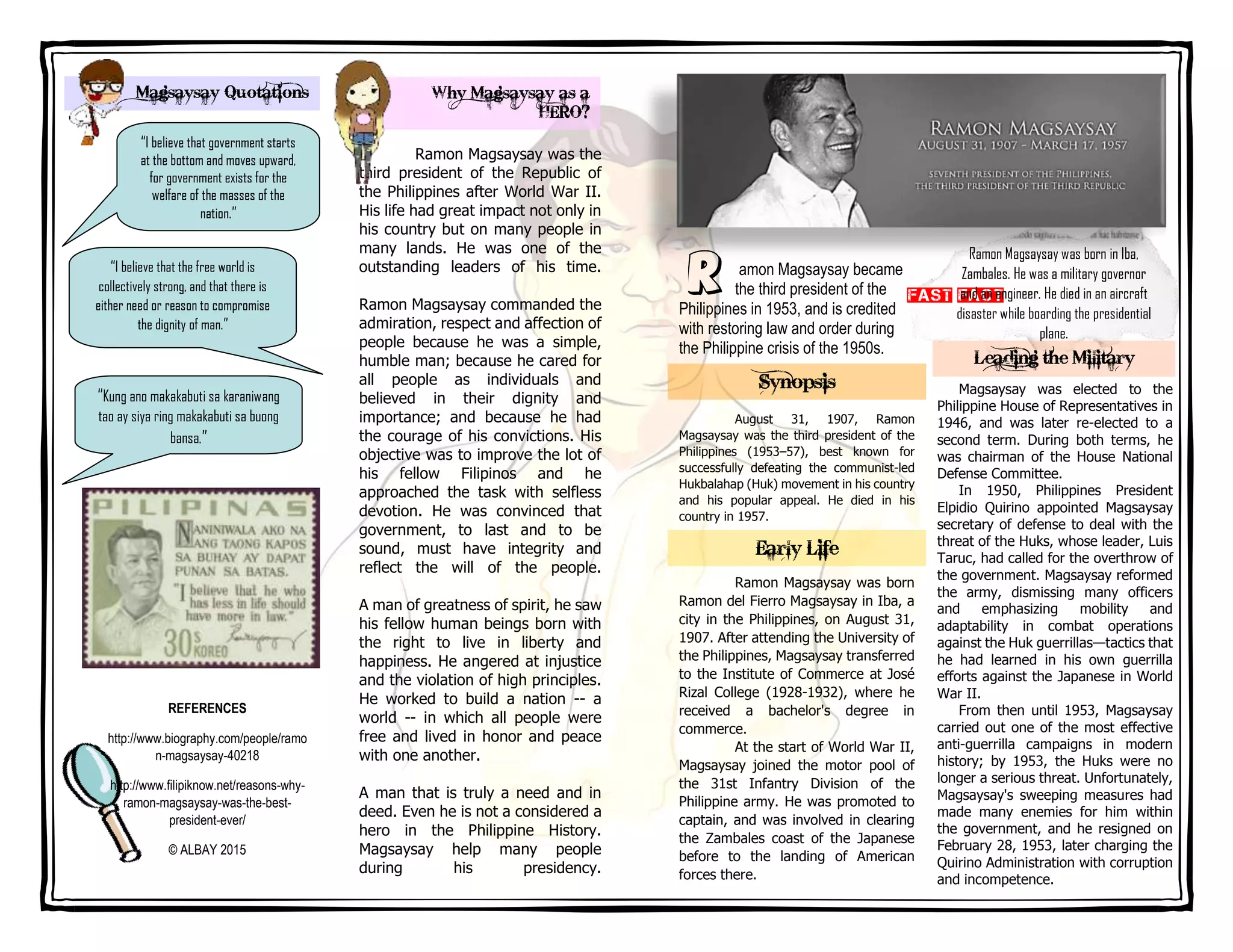
R FAST FACT
Ramon Magsaysay was born in Iba,
Zambales. He was a military governor
and an engineer. He died in an aircraft
disaster while boarding the presidential
plane.
amon Magsaysay became
the third president of the
Philippines in 1953, and is credited
with restoring law and order during
the Philippine crisis of the 1950s.
August 31, 1907, Ramon
Magsaysay was the third president of the
Philippines (1953–57), best known for
successfully defeating the communist-led
Hukbalahap (Huk) movement in his country
and his popular appeal. He died in his
country in 1957.
Ramon Magsaysay was born
Ramon del Fierro Magsaysay in Iba, a
city in the Philippines, on August 31,
1907. After attending the University of
the Philippines, Magsaysay transferred
to the Institute of Commerce at José
Rizal College (1928-1932), where he
received a bachelor's degree in
commerce.
At the start of World War II,
Magsaysay joined the motor pool of
the 31st Infantry Division of the
Philippine army. He was promoted to
captain, and was involved in clearing
the Zambales coast of the Japanese
before to the landing of American
forces there.
Synopsis
Early Life
Magsaysay was elected to the
Philippine House of Representatives in
1946, and was later re-elected to a
second term. During both terms, he
was chairman of the House National
Defense Committee.
In 1950, Philippines President
Elpidio Quirino appointed Magsaysay
secretary of defense to deal with the
threat of the Huks, whose leader, Luis
Taruc, had called for the overthrow of
the government. Magsaysay reformed
the army, dismissing many officers
and emphasizing mobility and
adaptability in combat operations
against the Huk guerrillas—tactics that
he had learned in his own guerrilla
efforts against the Japanese in World
War II.
From then until 1953, Magsaysay
carried out one of the most effective
anti-guerrilla campaigns in modern
history; by 1953, the Huks were no
longer a serious threat. Unfortunately,
Magsaysay's sweeping measures had
made many enemies for him within
the government, and he resigned on
February 28, 1953, later charging the
Quirino Administration with corruption
and incompetence.
Leading the Military
Reform
Magsaysay Quotations
“I believe that government starts
at the bottom and moves upward,
for government exists for the
welfare of the masses of the
nation.”
“I believe that the free world is
collectively strong, and that there is
either need or reason to compromise
the dignity of man.”
“Kung ano makakabuti sa karaniwang
tao ay siya ring makakabuti sa buong
bansa.”
REFERENCES
http://www.biography.com/people/ramo
n-magsaysay-40218
http://www.filipiknow.net/reasons-why-
ramon-magsaysay-was-the-best-
president-ever/
© ALBAY 2015
Ramon Magsaysay was the
third president of the Republic of
the Philippines after World War II.
His life had great impact not only in
his country but on many people in
many lands. He was one of the
outstanding leaders of his time.
Ramon Magsaysay commanded the
admiration, respect and affection of
people because he was a simple,
humble man; because he cared for
all people as individuals and
believed in their dignity and
importance; and because he had
the courage of his convictions. His
objective was to improve the lot of
his fellow Filipinos and he
approached the task with selfless
devotion. He was convinced that
government, to last and to be
sound, must have integrity and
reflect the will of the people.
A man of greatness of spirit, he saw
his fellow human beings born with
the right to live in liberty and
happiness. He angered at injustice
and the violation of high principles.
He worked to build a nation -- a
world -- in which all people were
free and lived in honor and peace
with one another.
A man that is truly a need and in
deed. Even he is not a considered a
hero in the Philippine History.
Magsaysay help many people
during his presidency.
The world is richer and better
because Ramon Magsaysay lived.
His spirit will continue to be an
Why Magsaysay as a
HERO?
Agricultural Tenancy Act in 1954
Source: Magsaysay: The People’s President
Although Magsaysay was a
liberal, the Nacionalista Party backed
him for the presidency against
Quirino in the 1953 elections, and
Magsaysay prevailed. He promised
reform in nearly every segment of
Filipino life, but he was often
thwarted by a congress that only
represented the interests of the
wealthy.
Magsaysay did manage to
enact agrarian reform, giving some
90,000 acres to 4,500 indigent
families for settlement/farming
purposes. He also set up a process to
hear and address citizen grievances,
and maintained a reputation for
incorruptibility throughout his
presidency, all of which went a long
way toward ensuring his popularity.
Sadly, Ramon Magsaysay's term
came to an abrupt end on March 17,
1957, when his presidential plane
crashed, killing Magsaysay and 24
other passengers. An estimated 5
million people attended Magsaysay's
burial on March 31, 1957, and
afterward, he was referred to in the
Philippines as the "Idol of the
Masses."
In his honor, the Ramon
Magsaysay Award, considered "Asia's
Nobel Prize," was established in
1957. In the spirit of Ramon
Magsaysay's
The Presidency
Let’s Continue. Administration Achievement
(1) His brilliant counterinsurgency
efforts were unprecedented.
Ramon
Magsaysay,
then the
Defense
Secretary
for
President
Elpidio
Quirino,
marking a
Huk target
with a
smoke
bomb from
a spotter
plane.
Photo
courtesy of
LIFE
Magazine.
(2) He gave land to the landless.
The usual sight in Malacañan Palace during
Ramon Magsaysay’s term. As noted by the
Philippines Free Press, the very first “at home”
of President Magsaysay in residence (a mere
two days after his inauguration) had
Malacañan Palace opening its doors to
citizens—and they came en masse. Source:
Presidential Museum and Library.
Ramon Magsaysay,
Defense Secretary of
the Quirino Cabinet, on
the cover of TIME
Magazine for
November 26, 1951,
featuring a quote
emphasizing his strict
adherence to the rule
of law: “I will send my
own father to jail if he
breaks the law.”
Source: Presidential
Museum and Library.
(3) He created a government of the
people, by the people, for the
people.
(4) He refused special treatment.
Ramon
Magsay
say, the
quintes
sential
mechan
ic.
Source:
Preside
ntial
Museu
m and
Library
(5)He banned nepotism and
corruption.
Best remembered for his humility and
compassion for the masses, President
Ramon Magsaysay was just 49 when
killed in a plane crash. On March 16,
1957, the president travelled from
Manila to Cebu aboard a newly
reconditioned twin-engine C-47.
Magsaysay named it Mt. Pinatubo, the
highest peak in Zambales where he hid
and fought during his guerilla years.
In Cebu, Magsaysay attended several
speaking engagements including the
one in University of Visayas where he
received an honorary doctorate. At
exactly 1:15 A.M. of the following day,
the plane left Cebu for Manila. It met its
tragic end fifteen minutes later when it
crashed on the side of Mt. Manunggal,
killing the president and 25 others while
leaving journalist Nestor Mata as the
sole survivor.
Several theories came up to explain
why and how Mt. Pinatubo met an
unexpected tragedy. Among these were
possible sabotage (direct or indirect), a
bomb on board, tipsy pilots, and
overloading. Initial investigations
discovered that technical lighting errors
were to blame while former Senator
Ramon Magsaysay Jr., son of the late
president, believes otherwise. Since
sabotage was already ruled out, it’s
possible that the several baskets of
mangoes, in addition to the passengers,
took its toll on the plane engine. Ramon
Magsaysay has long been gone but the
mystery of the plane crash remains
unanswered by the few evidences left.
The Backstory
Magsaysay
Plane Crash
Clueless Factor

Ramon Magsaysay.

  • 1.
    R FAST FACT RamonMagsaysay was born in Iba, Zambales. He was a military governor and an engineer. He died in an aircraft disaster while boarding the presidential plane. amon Magsaysay became the third president of the Philippines in 1953, and is credited with restoring law and order during the Philippine crisis of the 1950s. August 31, 1907, Ramon Magsaysay was the third president of the Philippines (1953–57), best known for successfully defeating the communist-led Hukbalahap (Huk) movement in his country and his popular appeal. He died in his country in 1957. Ramon Magsaysay was born Ramon del Fierro Magsaysay in Iba, a city in the Philippines, on August 31, 1907. After attending the University of the Philippines, Magsaysay transferred to the Institute of Commerce at José Rizal College (1928-1932), where he received a bachelor's degree in commerce. At the start of World War II, Magsaysay joined the motor pool of the 31st Infantry Division of the Philippine army. He was promoted to captain, and was involved in clearing the Zambales coast of the Japanese before to the landing of American forces there. Synopsis Early Life Magsaysay was elected to the Philippine House of Representatives in 1946, and was later re-elected to a second term. During both terms, he was chairman of the House National Defense Committee. In 1950, Philippines President Elpidio Quirino appointed Magsaysay secretary of defense to deal with the threat of the Huks, whose leader, Luis Taruc, had called for the overthrow of the government. Magsaysay reformed the army, dismissing many officers and emphasizing mobility and adaptability in combat operations against the Huk guerrillas—tactics that he had learned in his own guerrilla efforts against the Japanese in World War II. From then until 1953, Magsaysay carried out one of the most effective anti-guerrilla campaigns in modern history; by 1953, the Huks were no longer a serious threat. Unfortunately, Magsaysay's sweeping measures had made many enemies for him within the government, and he resigned on February 28, 1953, later charging the Quirino Administration with corruption and incompetence. Leading the Military Reform Magsaysay Quotations “I believe that government starts at the bottom and moves upward, for government exists for the welfare of the masses of the nation.” “I believe that the free world is collectively strong, and that there is either need or reason to compromise the dignity of man.” “Kung ano makakabuti sa karaniwang tao ay siya ring makakabuti sa buong bansa.” REFERENCES http://www.biography.com/people/ramo n-magsaysay-40218 http://www.filipiknow.net/reasons-why- ramon-magsaysay-was-the-best- president-ever/ © ALBAY 2015 Ramon Magsaysay was the third president of the Republic of the Philippines after World War II. His life had great impact not only in his country but on many people in many lands. He was one of the outstanding leaders of his time. Ramon Magsaysay commanded the admiration, respect and affection of people because he was a simple, humble man; because he cared for all people as individuals and believed in their dignity and importance; and because he had the courage of his convictions. His objective was to improve the lot of his fellow Filipinos and he approached the task with selfless devotion. He was convinced that government, to last and to be sound, must have integrity and reflect the will of the people. A man of greatness of spirit, he saw his fellow human beings born with the right to live in liberty and happiness. He angered at injustice and the violation of high principles. He worked to build a nation -- a world -- in which all people were free and lived in honor and peace with one another. A man that is truly a need and in deed. Even he is not a considered a hero in the Philippine History. Magsaysay help many people during his presidency. The world is richer and better because Ramon Magsaysay lived. His spirit will continue to be an Why Magsaysay as a HERO?
  • 2.
    Agricultural Tenancy Actin 1954 Source: Magsaysay: The People’s President Although Magsaysay was a liberal, the Nacionalista Party backed him for the presidency against Quirino in the 1953 elections, and Magsaysay prevailed. He promised reform in nearly every segment of Filipino life, but he was often thwarted by a congress that only represented the interests of the wealthy. Magsaysay did manage to enact agrarian reform, giving some 90,000 acres to 4,500 indigent families for settlement/farming purposes. He also set up a process to hear and address citizen grievances, and maintained a reputation for incorruptibility throughout his presidency, all of which went a long way toward ensuring his popularity. Sadly, Ramon Magsaysay's term came to an abrupt end on March 17, 1957, when his presidential plane crashed, killing Magsaysay and 24 other passengers. An estimated 5 million people attended Magsaysay's burial on March 31, 1957, and afterward, he was referred to in the Philippines as the "Idol of the Masses." In his honor, the Ramon Magsaysay Award, considered "Asia's Nobel Prize," was established in 1957. In the spirit of Ramon Magsaysay's The Presidency Let’s Continue. Administration Achievement (1) His brilliant counterinsurgency efforts were unprecedented. Ramon Magsaysay, then the Defense Secretary for President Elpidio Quirino, marking a Huk target with a smoke bomb from a spotter plane. Photo courtesy of LIFE Magazine. (2) He gave land to the landless. The usual sight in Malacañan Palace during Ramon Magsaysay’s term. As noted by the Philippines Free Press, the very first “at home” of President Magsaysay in residence (a mere two days after his inauguration) had Malacañan Palace opening its doors to citizens—and they came en masse. Source: Presidential Museum and Library. Ramon Magsaysay, Defense Secretary of the Quirino Cabinet, on the cover of TIME Magazine for November 26, 1951, featuring a quote emphasizing his strict adherence to the rule of law: “I will send my own father to jail if he breaks the law.” Source: Presidential Museum and Library. (3) He created a government of the people, by the people, for the people. (4) He refused special treatment. Ramon Magsay say, the quintes sential mechan ic. Source: Preside ntial Museu m and Library (5)He banned nepotism and corruption. Best remembered for his humility and compassion for the masses, President Ramon Magsaysay was just 49 when killed in a plane crash. On March 16, 1957, the president travelled from Manila to Cebu aboard a newly reconditioned twin-engine C-47. Magsaysay named it Mt. Pinatubo, the highest peak in Zambales where he hid and fought during his guerilla years. In Cebu, Magsaysay attended several speaking engagements including the one in University of Visayas where he received an honorary doctorate. At exactly 1:15 A.M. of the following day, the plane left Cebu for Manila. It met its tragic end fifteen minutes later when it crashed on the side of Mt. Manunggal, killing the president and 25 others while leaving journalist Nestor Mata as the sole survivor. Several theories came up to explain why and how Mt. Pinatubo met an unexpected tragedy. Among these were possible sabotage (direct or indirect), a bomb on board, tipsy pilots, and overloading. Initial investigations discovered that technical lighting errors were to blame while former Senator Ramon Magsaysay Jr., son of the late president, believes otherwise. Since sabotage was already ruled out, it’s possible that the several baskets of mangoes, in addition to the passengers, took its toll on the plane engine. Ramon Magsaysay has long been gone but the mystery of the plane crash remains unanswered by the few evidences left. The Backstory Magsaysay Plane Crash Clueless Factor