Instrumentation and ControlIn
Thermal Power Plant
Name : Malam raj D
En NO : 236230317010
Branch : instrumentation and control
Division : A1
Course Title: Applied Instrumentation
(Course Code: 4351701)
2.
Introduction
• A ThermalPower Plant converts the heat energy of coal into
electrical energy. Coal is burnt in a boiler which converts
water into steam. The expansion of steam in turbine
produces mechanical power which drives the alternator
coupled to the turbine.Thermal Power Plants contribute
maximum to the generation of Power for any country
• Thermal Power Plants constitute 75.43% of the total
installed captive and non-captive power generation in India
• In thermal generating stations coal, oil, natural gas etc. are
employed as primary sources of energy.
• Bharat HeavyElectricals Ltd. has been providing several
power plant automation solutions, based on the well proven
PROCONTROL P-13 DCS system. The applications range from
SG, TG controls and Station DCS for Industrial Co-generation
CPP to geographically distributed Unified Plant Automation
systems for Large Utilities upto 500 MW.
• The automation actively controls the plant during the three
main phases of operation.
• 1. Plant Startup.
2. Power generation in a stable or transient condition.
3. Plant Shutdown.
5.
Functions of ControlAnd Instrumentation
• The main work of C&I department is to observe, control and
manipulate electrical as well as non-electrical quantities like
temperature, pressure, vibrations.
• C&I department governs the whole functioning and operation
of power plant through the Central Control System (DDC-
MIS) “Distributed Digital Control Monitoring and Information
System”.
6.
• The operationand monitoring of the entire Power Plant is
implemented in functional Distributed environment
comprising the follows
• Binary Controls / Open Loop Control System (OLCS)
• Analog Controls / Closed Loop Control System (CLCS)
• Signal acquisition / Measurement System (MS)
• Operator Interface & Human Machine Interface systems
7.
• The OpenLoop Control System (OLCS)
• The Open Loop Control System (OLCS) / Binary Controls systems performs the
functions of sequential operation interlock and protection for various plant
equipments like Boiler and Turbine , valves , motor pump etc.,.
Are of 2 types-
1. Centralized Control System(C.C.S)
2. Distributed Control System(D.C.S)
• The Closed Loop Control System (CLCS)
• The Closed Loop Control System (CLCS) / Analog Controls Systems continuously
controls the valves, dampers, other mechanical devices and will include P, PI, PID
and other control algorithms depending upon the process and functional
requirements
8.
• Measurement Systems(MS)
• Measurement Systems (MS) All the signals that are coming into or
going out of the DCS systems for control, monitoring and
information purpose are caused by measurement systems.
• These are realized through input or output cards of the DCS systems
which will perform
• a) Analog Signal Controlling and processing
• b) Binary Signal Controlling and processing
9.
Operator Interface &Human Machine Interface systems
• This environment provides the following functions:
• Supervision of Plant Processes.
• Processing of Plant Information.
• Presentation of Plant Information.
• Analysis of Plant Events.
• Operator Dialogue.
• Long time storage of data for analysis of plant performance.
• Monitoring of plant performance by periodic calculations.
• Alarm management.
• Sequence of events recording.
10.
Centralized Control System
•In the early days of introduction of the computers for process
automation, a single big mainframe was used to control whole
plant.
• This single mainframe computer was alone made responsible
to carry out all the functions such as communicating with the
field instruments, performing calculations and control
operations.
• That means computer itself can perform the control
algorithm. This is known as Direct Digital Control [DDC].
11.
Distributed Control System
•MaxDNA-
• The intelligence of the system is distributed among
several modules, each working independently, with
its own inputs and outputs
• maxDNA is a network of applications where diverse
hardware and software solutions co-operate to allow
the plant to reach its greatest potential.
12.
• The followingfeatures are to be satisfied by
plant in order to implement maxDNA DCS
System.
• Open environment for optimizing the whole enterprise.
• Optimal operation environment, hardware up gradable to
the latest technology.
• Flexible, durable system that can be optimized for plant
operation.
• Minimize total cost of ownership.
• Powerful engineering functions.
13.
maxDNA Architecture
The hardwarecomponents of max system can be broadly divided into
following major components:-
Max Panels: The max Panels are steel cabinets of Dimensions
750x750x2415 (all dimensions in mm). It houses the Distributed
Processing Units, the Input/Output Cards and Terminal Boxes (TB) for
cable terminations coming from field. These TBs and Modules are
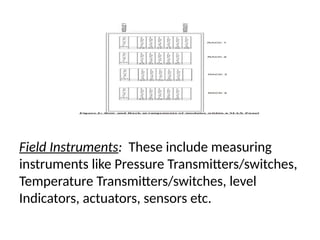
arranged in Max Panel in rack & row formation as shown in figure-2.
Typically a max panel can house upto 4 racks of modules with each rack
having at-most 8 modules
14.
Field Instruments: Theseinclude measuring
instruments like Pressure Transmitters/switches,
Temperature Transmitters/switches, level
Indicators, actuators, sensors etc.


![Centralized Control System
• In the early days of introduction of the computers for process
automation, a single big mainframe was used to control whole
plant.
• This single mainframe computer was alone made responsible
to carry out all the functions such as communicating with the
field instruments, performing calculations and control
operations.
• That means computer itself can perform the control
algorithm. This is known as Direct Digital Control [DDC].](https://image.slidesharecdn.com/rajapi4351701-251010093220-1d146e4d/85/RAj-API-4351701-pptx-10-320.jpg)